The Spinal Tap Workout (made up start up)

This is part of the made up start up series.  

Spinal Tap, the 1984 mocumentary follows a band of bumbling Brits. In one iconic scene, Christopher Guest (lead guitarist) describes his ‘special’ guitars to Rob Reiner (filmmaker). And their amps which “go to 11”. 

Befuddled, Reiner asks why not make eleven ten. Guest replies, because eleven is more than ten. 

It’s an iconic scene. 

Ten is special thanks to our fingers. Ten is easy thanks to repetition. 

Other number bases aren’t intuitive. We are used to ten. Binary counting looks like this: 0, 1, 10, 11, 100, 101, 110, 111, 1000 and so on. We aren’t used to binary but it’s great for computers. Zero and one are simply open and closed circuits electricity races through. This is why computers are amazing, lots of microscopic gates and speedy electrons charging through. 

Numbers are only tools and we should use the right tool for the job. This gets us to “three sets of ten”. 

Three sets of ten was (is?) the default workout. Three sets of ten curls, presses, pushes, pulls. Three sets of ten sit ups, pull ups, or get ups.  Why ten? Our fingers! 

Here’s the pitch: three sets of eleven

That’s silly. But hold on. There are many examples of what we call ‘Large N small p‘. It’s the Google search effect. Google holds a Large Number of auctions and earns a small percent of each ad buy. Making a few cents each transaction isn’t a great business unless it’s repeated a lot. Sales calls are “a numbers game”. Large N small p also accounts for unlikely events. If someone is ‘one in a million’ there’s eighty people like them just on planet earth.

Three sets of eleven uses the Large N small p effect to make workouts better. Participants only do one more repetition for 10% greater results.

Of the made up start up series this idea is not the best. How could you even sell this? But it’s in the non-obvious explorations that we find the better ones. 

The Sandler Rules (a short review)

It is helpful to think of The Sandler Rules: 49 Timeless Selling Principles and How to Apply Them like Parenting Teens with Love and Logic. Both books suggest shifting from helicopter parent or pushy salesperson to more of a consultant. For Sandler it’s principle 39. 

For Sandler, for sales, the customer’s progress is all that matters. It’s not how hard you worked. It’s not the feature. It’s not what you think. It’s not the last time this happened. 

It’s. Just. The. Customer’s. Progress. 

To find that the salesperson must be honest, a contradiction to the caricatures. “When interacting with prospects and clients, your objective is to uncover the truth, even if it’s not something you want to hear.” 

One obstacle, ironically, on the path from honesty leading to truth is knowledge. You can know too much. So, act like a dummy (Rule 17). Remember, selling is not about telling (Rule 14). 

Doctoring is a helpful analogy. Dermatologists don’t digress into the sciences  – they diagnose damage. The sales system differs from the medical one and strictly comparing the two makes the man on the moon mistake, but the philosophy is the same. 

Author David Mattson does a nice job of collecting the principles and assigning interesting ideas to each. My favorites: 

  • Rule 2: Don’t spill your candy in the lobby. Get information don’t give it.
  • Rule 4: Explain ‘no’ is okay. Aim to uncover the truth – even if it’s something you don’t want to hear.
  • Rule 13: No mind reading, don’t assume and clarify vague responses.
  • Rule 14: “‘Selling’ is not about “‘telling.’”
  • Rule 22: Defuse bombs right away – bring up the problem.
  • Rule 27: “You can’t sell anybody anything, they must discover they want it.”
  • Rule 37: “All Prospects Lie, All the Time… but why, and about what.”
  • Rule 38: The problem they bring you is never the real problem, “diagnosis is the salesperson’s responsibility”.
  • Rule 41: Whatever is happening is your responsibility
  • Rule 48: A life without risk is a life without growth

Sandler was suggested in Bob Moesta’s book Demand Side Sales. This book is an aligned sales system to the JTBD approach. Rules 37 & 38 (“all prospects lie, all the time” & diagnosis is the salesperson’s job) fit well with the curiosity inherent in JTBD.

The Sandler Rules: 49 Timeless Selling Principles and How to Apply Them is a fast read, best for the JTBD curious and those looking for some sales support. 

Here’s the review for Parenting Teens…

And the JTBD series

Start with No (book review)

In his 2016 book, Never Split the Difference Chris Voss suggests Jim Camp’s, 2011 book, Start with No

To Voss, ‘no’ is progress. Too often ‘yes’ is said for appeasing purposes and ‘maybe’ means we haven’t clarified what’s important. But ‘no’ is firm, it’s progress. 

Camp explores this idea deeper. He, like Voss, dislikes win-win negotiations. First, they lead to unnecessary compromises. In an effort to let both sides ‘get something’ negotiators compromise too much and on the wrong things. A 10% discount in exchange for a longer contract is good only if it’s important. Too often, Camp writes, people compromise on things which don’t matter. 

Second, win-win is considered fair. Who judges what’s fair? There’s no master evaluator. There are ethics though. Camp’s model is analogous to sports. Prepare, train, and play as hard as you can within the rules for the full period of time. Once the event is over, shake hands and respect your opponent. 

Third is the idea Voss runs with, a ‘no’ is progress, it’s “a decision that gives everyone something to talk about.” 

If ‘no’ is so important, why write a book? This coulda been a tweet. 

Well, no. There’re better ways to get to ’no’. And this book is really about something else entirely.

Our second house was a for sale by owner. A nice family with a nice home. We sniffed around each other like dogs with our initial questions and when asked about his timeline for building their next house the owner said, ‘I’m in no rush, I’ve got a house now’. 

That was good. He conveyed un-neediness. Being needy is Camp’s first warning. Do. Not. Need. A. Deal. Both Camp and Voss frame themselves against the classic negotiation book, 1981’s, Getting to Yes. Their books, they say, highlight what GtY gets wrong. Fair. But Getting to Yes presents the BATNA: best alternative to a negotiated agreement. That’s essential to un-neediness. 

The heart of un-needines, and of good negotiations is the secret message of the book. Start with No is really about our ego

Being needy is ego. Camp’s second rule is to act like Columbo. Disarm the adversary. In other words, put ego aside. Don’t try to be impressive, smart, or IN CHARGE. Don’t elucidate and don’t use words like elucidate. Camp warns about trying to be liked (chapters 2, 3), to be smart (6), or only talking about your side (4, 7, 8, 9). 

It’s hard to Start with No when you start with yourself.

The role of ego varies in size and scope. A successful negotiator finds the right balance of their own and their adversary’s point of view. This is the root of Camp’s system. It’s also the heart of copywriting and JTBD

Good negotiations are difficult and rare, Camp writes. That makes sense! To be a successful negotiator (according to Camp) we have to check our ego – a problem humans have been dealing with for hundreds of years. 

Camp tells a lot of ‘me’ stories. They’re about his big deal big deals, his awesome son, his business. It’s a little much (Voss’ stories are better). But hidden in those is a wonderful exploration of our ego and what we can do about it. 

Ego is tricky because like picking our nose, we don’t notice. It’s part of us. But when someone contrasts another way it makes us pause and consider that. For instance, “the most important behavioral goal and habit you can develop is your ability to ask questions” or “The self-image of the individual in the selling role traps him or her in a neediness mode and often leads to bad deals.” That frames our behavior and leads to questions like do I ask enough questions or am I needy because I want to feel smart, impressive, helpful, or whatever?

Camp’s book introduces his perspective, and that’s a good start to good negotiations.
Buffett on bulls and bitcoin

The framework of a legendary investor, a repeat restauranteur, and a movie producer all use.

At the 2022 Berkshire Hathaway annual meeting, Warren Buffett said he would pay twenty-five billion dollars for 1% of all the farmland in the United States – but wouldn’t pay twenty-five dollars for all the bitcoin. 

At the time one bitcoin traded for $38,300. 

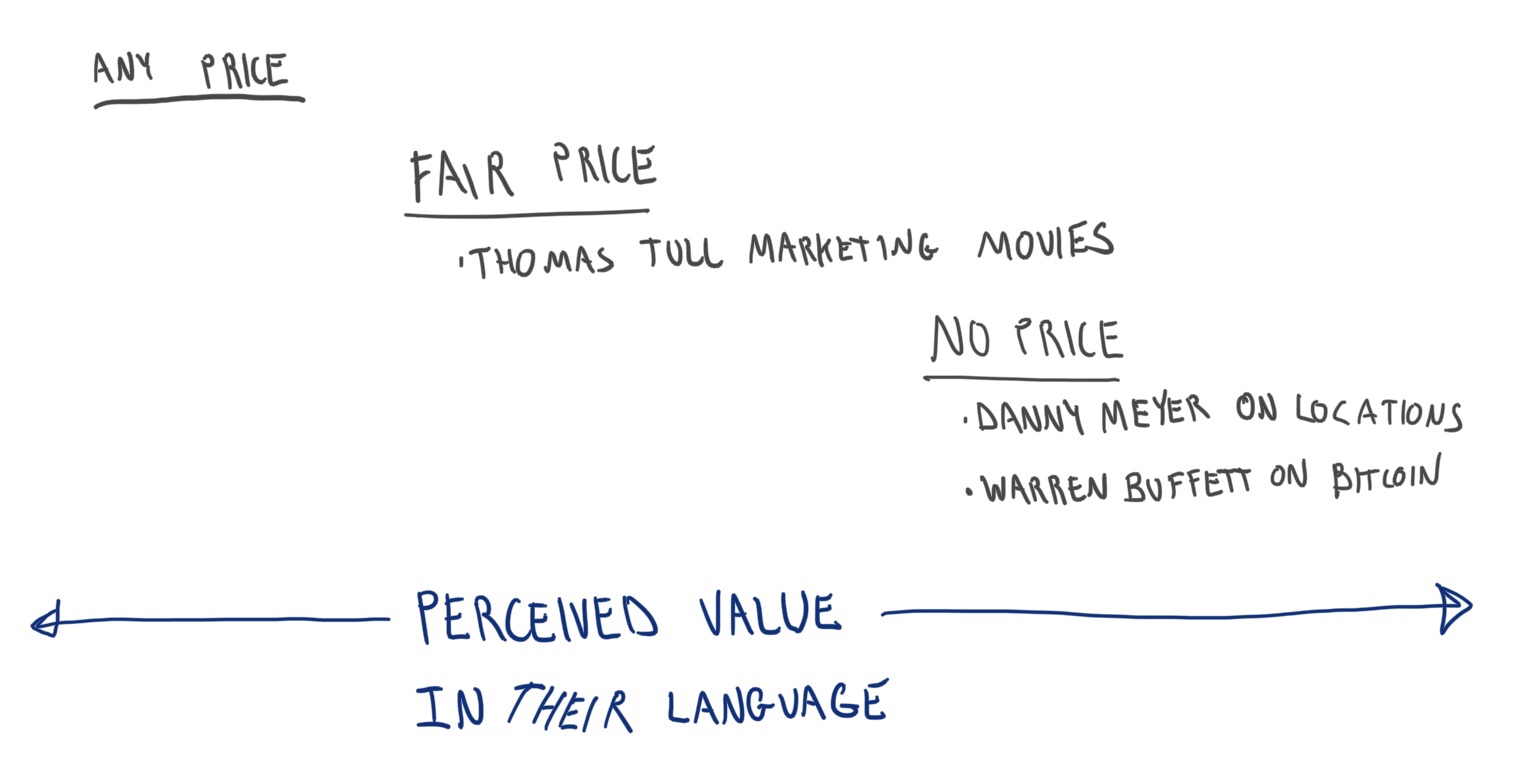
Buffett used the: ‘not even if it was free’ framework.  

Danny Meyer asks: Would I want this restaurant location if it were free? Thomas Tull’s context is movies. For him, it was: My grandmother is not going to see The Dark Knight Rises even if I gave her tickets and bought the popcorn. But, Tull questioned, movies like Batman are advertised in newspapers, read by lots of grandmothers. Another example is the Covid-19 vaccine. It doesn’t matter how well it works, how well it is marketed, or how well it is presented. Even if vaccines are easy, some people just won’t. 

The structure of ‘not even if it was free’ is: People pay for perceived value. 

Perceived value language can be found through JTBD. In his best interview to date, Bob Moesta demonstrates the JTBD of new windows. New windows, Moesta uncovers from homeowner Derek, come after kitchen remodels, but occur sooner if people spend more time at home. 

A window’s perceived value isn’t the number of panes, types of glass, or types of gas between the glass. The perceived value in windows is when something is ‘off’. 

Bob guided Derek to lay out the dominos: Covid led to work from home which led to everyone being at home which was loud and so he had to work from a distant part of the house that was only quiet when the door was shut which meant he needed a heater because the room got cold thanks to the windows.

The perceived value was making a house a home. 

Window installers can use these words at the right time to raise the customer’s perceived value. If you’re a window company, Bob concluded, maybe you should follow the kitchen remodelers. That comes first. Then the window value is clear. 

Buffett will probably never adjust his perceived value in Bitcoin and ditto for Danny Meyer and some locations. People do change their minds about vaccines, but only after their perceived value adjusts. 

Enhanced Savings Rates

This is from our HSA. It’s good copywriting. ‘5X’ is easy to understand. ‘You may be missing out’ is great too. 

The chart excels as well. It’s easy to understand and those Enhanced Rates do look bigger. They look bigger because of level one numeracy. 

We level one think all the time. It’s knee jerk and first blush. We see something and some combination of evolution and experience fit what we see with what we know. Big red ‘Sale’ signs are examples. We first compare the sale price with the previous price rather than the item’s intrinsic value. This makes sense as our first reaction is immediate, requires no additional effort, and is something we are used to doing because it mostly works just fine. 

The posts here, about average, focus on this idea too. Average is easy to compute and conveys certainty about an uncertain (often heterogeneous) world. Average is level one numeracy but we can do better. 

One way to get past this reactionary thinking is to change the what we know part of our lives. Books like The Data Detective (2021), How to Lie with Statistics (2010), Fooled by Randomness (2008), and Factfullness (2018) are wonderful. 

A fast fix comes from Sir David Spiegelhalter. Don’t look at relative comparisons, look at absolutes. Rather than the relative rate, look at the dollar difference.

That’s what I did. 

If someone saves the $2,000 in an ‘enhanced’ HSA account they have sixteen more dollars after twenty years. A lot of years for not a lot of money. For accounts of ten-thousand dollars, the difference is almost eight hundred dollars ($11,543 vs $10,745). Fine, a Series I Savings Bond accrued that same dollar value in six months. 

The don’t look at relative comparisons, look at absolutes is a good starting place – but there are further levels. 

First is to think about the costs. The enhanced HSA rates are an annuity, likely with some new terms. There’s the switching costs too. That’s a potential headache and unwanted contract in exchange for not much money. We will pass. 

Actual health rather than health savings is different. 

For people 25-34, their chance of dying from Covid-19 is about the same as pulling the ace of spades from a shuffled deck – twice in a row. 

For people 55-64, their chance of dying from Covid-19 is about the same as flipping heads eight times in a row. 

For people 75-84, their chance of dying from Covid-19 is about the same as pulling any heart from a random deck of cards – three times in a row. 

Those are low absolute risks but seriously consequential. 

The world is complicated and messy. Not only that, but it changes too. Numbers are helpful, but we have to ask the right questions to start. 

The Covid-19 odds are rough estimates. There are about forty million people in any ten year age group. The number of deaths in the 25-34 group is 11,451. I divided the deaths by size of the group to get the percent chance of death. Odds are multiplicative, three heads in a row are 12.5%, 0.5*0.5*05. Two ace of spaces are one in fifty-two times one in fifty two, or about 0.04%. 

Virus of the Mind (book review)

Post COVID-19 makes Richard Brodie’s 1996 book, Virus of the Mind more familiar. We’ve experienced a virus. In 2021 my daughters tested positive while my wife and I did not. In July 2022, only I tested positive. We have also seen a variety of symptoms. Individual accounts vary. Young people tend to do OK. Older people tend to do worse. The cause and effects of COVID-19 apply when thinking about a mind virus known as a meme.

Brodie defines a meme as ”a unit of information in a mind whose existence influences events such that more copies of itself get created in other minds.” Memes are (1) information, (2) influential, and (3) active replicators. 

Terrible twos is a meme. It is information about toddlers. It changes behavior and/or attitudes. It spreads thanks to alliteration, believability, and openness to new ideas from new parents. 

But terrible twos isn’t really true. Three is worse. Terrible twos persists because it is a meme. 

‘Meme’, which rhymes with ‘gene’ was coined by Richard Dawkins in his 1976 book, The Selfish Gene. Brodie’s book on memes is the sidecar to the Dawkins motorcycle of genes. 

For instance, how a meme spreads, much like how a gene spreads, depends on the environment. Humans evolved in certain atmospheric gasses and our genes did certain things. Genes weren’t programmed for bipedal mammals with large heads. We just ended up this way, a kludgy outcome. Things happen based on what works best at any given moment. 

Monopoly winners are kludgy. The best Monopoly spaces are orange. But players buy up the properties as they are available and cash is on hand. Winners – if your group makes it that far – won’t always have orange. They’ll have a rainbow. It’s one thing that works and hence replicates, after another.

That’s the thing to remember with genes and memes. There’s no destination, just replication.

Human genetic evolution kludged its way to three big triggers: danger, food, and sex. Ancestors with responses to DFS replicated better. We are the progeny of people who thought DFS were really important. Because DFS are wired into our genetic evolution they are also wired into our mimetic responses. Brodie writes, “Genetic evolution gave us the tendency to pay attention to certain memes.” 

It’s not only explicit danger, food, or sex. One sub response is competition. Because we are wired to compete, like in Status Games (Review here), genes and memes associated with competition do better. As a kid who delivered newspapers I always wondered why national and local news, business, and sports each had their own section. Why were those so important? It’s competition, a byproduct of danger (outrun the lion), food (get more berries), and sex (have a better mate). 

DFS and the sub-branches help memes spread but there are other paths as well. Conditioning like repetition is one. Tradition is another. Religion, writes Brodie, does this well. What’s universal about different faiths is their traditions. From weekly to annual, from small to large, most of the world’s largest religions have some aspect of regularity and that keeps the meme going. 

Religious memes (really, religion itself) demonstrates meme neutrality. We are all programmed by memes, there’s no avoiding that. We only choose which memes we are programmed with. Memes are (1) information, (2) influential, and (3) active replicators – and if we change what information we consume, what information influences us, and what information we spread we can change the memes in our world. Brodie writes, “Further compounding the problem is that you don’t immediately know whether the programming you get from a given mind virus is harmful or beneficial. Nobody ever joined a religious cult with the intention of getting brainwashed, moving to Guyana, and committing suicide.”

Thinking about memes was like thinking about what is water

Make up business model

Homeotelic responses are the most important type of action. Introduced here, someone who wanted to lose weight and save money would learn to cook for themselves. Cooking (homeotelic) satisfies both goals.

Harry’s and Dollar Shave Club used homeotelic approaches. Their first goal was cheaper razors and their second goal was easier razors. Online subscriptions achieved both goals.

Competitors like Gillette were forced into heterotelic responses. They couldn’t move towards easier because of their existing retail goals.

Makeup company Trinny London’s CMO Shira Feuer spoke with Rory Sutherland about how she manages the brand in a homeotelic way. Here are three ways.

  • Trinny London uses real people not models as their models. This is a good bit of differentiation. We’re like you the ads state.
  • The branding is like the models: nice but not fancy. The copy isn’t polished and the images aren’t photoshopped.
  • The company uses gifts, not discounts to extend value. Gifts are CAC Trojan horses.

If the Trinny London brand goal is nice and friendly, then not-models, simple copy, and free gifts all work toward that.

Feuer also worked at Burberry and tried to bring that aesthetic to the makeup world. But it was too polished. What works at Burberry does not work at Trinny London. Feuer also consulted with companies and remembers being told you should never pay full price for a Domino’s Pizza because the discounting is built into the pricing model. What works at Domino’s Pizza does not work at Trinny London.

The Domino’s Pizza turnaround was built around changing the culture, improving but not perfecting the pizza, allowing social media, and building their data prowess. That’s a great homeotelic plan – for DP.

Really, this is one of my favorite books.

Made up start up: Sandbags

A business succeeds by doing three things: creating something people want, getting it to them, and communicating the value. We call this: product, placement, promotion. 

Hey Siri, search ‘sandbag workout’

Workout sandbags are an interesting product because no one wants sandbags. The product is the sandbag but the JTBD is looking like this guy. Or at least more like this guy

Sandbags are also interesting because of their distribution opportunity. DTC opens opportunities blocked by traditional retail and neutralizes the TiVo problem. Channels like Amazon are okay, but shift the comparison metrics to price and stars. Companies that offer good-enough inexpensive options do well on Amazon – not a good tactic here. 

Lastly, the ‘people also ask’ sandbag section seeds great copywriting. These customer queries reveal wants. And customers want clarity. Searches are full of ‘program’ or ‘workout’ or ‘plan’. People are searching for what Bob Moesta writes are the ‘little hires’. Someone has bought a product, the ‘big hire’, but don’t quite know how to use it. That’s interesting too. 

People take action when their current situation stinks enough, a new solution looks good enough, there’s not too much ambiguity aversion, and their habits aren’t too strong. In his book Moesta puts it this way:

[Push of the malaise + Pull of the solution] > [Anxiety of ambiguity + Habit of the moment]

If LEFT > RIGHT then action occurs. 

Push: everyone wants to be in better shape. Like that guy? Who knows. 

Pull: sandbags are kinda weird, kinda bro. This may be an opportunity. 

Anxiety: people don’t know the ‘little hires’. Big opportunity. 

Habit: the workout (or not) of the moment. 

In Unacceptable, the book about the college admission scandal, parents hired help. The aiding advisor advertised high-school-test-prep ads at coffee shops and gyms near the schools. The customer wasn’t the student going to college, it was the parent paying for it. The consumer and ‘little hire’ were different from the customer and ‘big hire’. 

Successful products serve both groups. This makes the Unacceptable story tragically funny, some students didn’t know, what, or care what their parents did! 

This is spitballing. We’d also need to find: 

  • Where are the ready people? Maybe: in Google searches, Instagram fans, on Reddit forums, listening to personal development podcasts, and so on. What’s our version of the coffee shop?
  • What does ‘zombie revenue’ tell us about why people who buy it but don’t use it? 
  • What workout email helps customers make progress? 
  • Why are sandbags so bro? Is this an opportunity? 

Every business is a trade off. Doing one thing makes other things easier/harder. A team that plays offense fast has less time for their defense to recover. There’s a good way to sell sandbags. Is this it? Only the market knows. But it’s a good mental lift. 

Drucker’s disagreements

Decisions, writes Peter Drucker, are not made between right and wrong. They are choices between “almost right” and “probably wrong”. How then can someone choose?

“Decisions of the kind the executive has to make are not made well by acclamation. They are made well only if based on the clash of conflicting views, the dialogue between different points of view, the choice between different judgments. The first rule in decision-making is that one does not make a decision unless there is disagreement.”

Peter Drucker

In other words, argue well.

  • Both Presidents Eisenhower and Obama concealed their preferences to turn their Yes Men into Drucker’s Diagreeers.
  • Audrey Tang offered the expression rotate your position, using language to embody our action (and this connection works).
  • Tim Harford praised debate for setting boundaries and structure, letting the ideas duke it out while egos, relationships, and norms sat on the sidelines.
  • Sam Zell strives to be “business agnostic” and encourages his people to push back.
  • A good scrap, Wilbur Wright is quoted as saying, “brought out new ways of looking at things…helped round the corners.”

Disagreement can be upsetting. But the best organizations set up expectations to disagree. Drucker’s addition to the “argue well” collection is to draft the fine line between “almost right” and “probably wrong”. If things are that close then we must debate to find what’s right.

Urban’s words

Tim Urban words

This post is part of our new dictionary series. Words are information about how we can think and how we do think. These are from Tim Urban’s March 2022 appearance on The Psychology Podcast.

Low rung thinker. Think of a ladder. Climbers are high rung thinkers. They approach life like scientists, with curiosity and inquiry. They look around. Non-climbers are low rung thinkers. They approach life with dogmatic and group thinkyness. 

Our height is not static. We climb up and down the ladder. Changing the scope of your media is one way to affect the height. 

An inverse proxy for height is conviction. Depending on the topic, the more confident person the lower they likely are.

Grand Theft Auto Dating. Think of dating as a GTA level. In the game avatars run about stealing cars, shooting bystanders, and running from the police. There is a lot of exploration and not a lot of consequences. 

Dating can be like that. 

It’s not when we use innate norms. We evolved in small social groups where the cost of standing out was high. But we mostly don’t live that way anymore. Yet we act as if we do. 

Instead, says Urban, treat dating more like GTA (minus the carnage). Treat dating as having GTA rules rather than evolutionary ones. 

Identity rocks. Imagine identity as rocks in a backpack. We carry these rocks around with us and they can get heavy. They don’t allow us to change. 

Identities serve (at least!) two purposes. First, they give us membership to a group. As evolved creatures that used to matter a lot! Second, they embody what we want to be. ‘Caring’ is embodied in religion. ‘Freedom’ is embodied in politics. ‘Change’ is embodied in movements. Disembody the sensation from the identity. 

Idea lab. A real imaginary place where collaborators can throw out crazy ideas and freely disagree. It’s where “ideas are like science experiments.” 

Often this is in the culture of a place. One way to create this culture is by having two bosses clash. This shifts the incentive from appeasement to truth-seeking

But naming a room “the idea lab”. That frames it nicely. 

Loved Flash FM (YouTube). Also, the ideas around social groups and status games are in this post. Also, naming a room isn’t crazy. Some founders put a toy elephant in the corner of their meeting rooms so they never forgot about the elephant in the room.