Mental Accounting: Joy

When message board posters wondered about how much money Apple cofounder Steve Wozniak might have if he hadn’t sold his stock he told them.

But in his accounting:

“I gave all my Apple wealth away because wealth and power are not what I live for. I have a lot of fun and happiness. I funded a lot of important museums and arts groups in San Jose, the city of my birth, and they named a street after me for being good. I now speak publicly and have risen to the top. I have no idea how much I have but after speaking for 20 years it might be $10M plus a couple of homes. I never look for any type of tax dodge. I earn money from my labor and pay something like 55% combined tax on it. I am the happiest person ever. Life to me was never about accomplishment, but about Happiness, which is Smiles minus Frowns. I developed these philosophies when I was 18-20 years old and I never sold out.”

https://m.slashdot.org/story/445414

Four Thousand Weeks (book review)

Likely one of the best books I’ll read this year.

I have soft spots. For movies it’s one last job. For books it’s This is Water.

There’s this thing that everyone talks about but everyone talks about it wrongly. That’s a soft spot.

That’s Four Thousand Weeks: Time Management for Mortals. According to author Oliver Burkeman, we are doing time management all wrong. We are swimming through water without really knowing what it is.

And water is a good analogy because water, like time, isn’t something we can grasp. It’s something we have to accept. We can scoop water. We can vacuum water. We can pour water – but these are on water’s terms. To paraphrase high school science: water does what water does.

That is also how to think about time. We act like we manage time, “time management”, but only in the same way we manage water: creating spaces for it to be.

You should read this book!

It’s difficult to review for the same reasons productivity feels important. We check things off a list. We progressed. We got-things-done. But are these the right metrics or just the easy ones?

Productivity isn’t the goal. Accomplishment isn’t either. Living. L-I-V-I-N (a similar book) is the goal.

How to live is a messy question relative to How to be productive.


But here’s a tip. An honest-to-goodness fact. This is as close to a guarantee as you’ll ever get.

Spend time with people. Optimize community. Aim for togetherness. Move from ‘me’ to unity. Move from ego to love. Less get more done, and more to-get-her.

Be that way. That’s a productivity hack.

Living…for time

Metrics tag.

A huge goal of living well is living intentionally. Do the things I do do align with the things I want to do. Intentionality is why design is such large issue.

We can get lost in the abstraction. Such-and-such leads to end-result but we focus on such-and-such to the detriment of end-result. When my daughters were younger we tried to have family dinners as often as possible. I planned, prepped, and cooked the food. Sometimes they wanted something different, sometimes they wanted to help, sometimes life got in the way and dinner was canceled.

Sometimes this bugged the crap out of me. I put all this time, and effort, and blah blah blah. It was pure ego. And I’d lost sight of the end.

Kelly Starrett has a good podcast with Andrew Huberman talking about this (and many other things!). Kelly frames exercise as “earning credits”. The point isn’t the exercise, the point is to go and spend credits – being physically active with the people you love. Don’t do burpees to see how many burpees you can do in twenty minutes. Do them to have a more enjoyable hike with your kids.

From Huberman Lab: Dr. Kelly Starrett: How to Improve Your Mobility, Posture & Flexibility, Dec 9, 2024
https://podcasts.apple.com/us/podcast/dr-kelly-starrett-how-to-improve-your-mobility-posture/id1545953110?i=1000679727148&r=8703

Food Metrics

Is this right? It is important.

A helpful question to regularly ask is: What do these numbers really mean? I used to love looking through the Sunday Best Buy ad and comparing computer hardware. RAM, hard drive, monitor size – all catnip to a teenage boy in the 90s.

But what did those numbers actually mean?

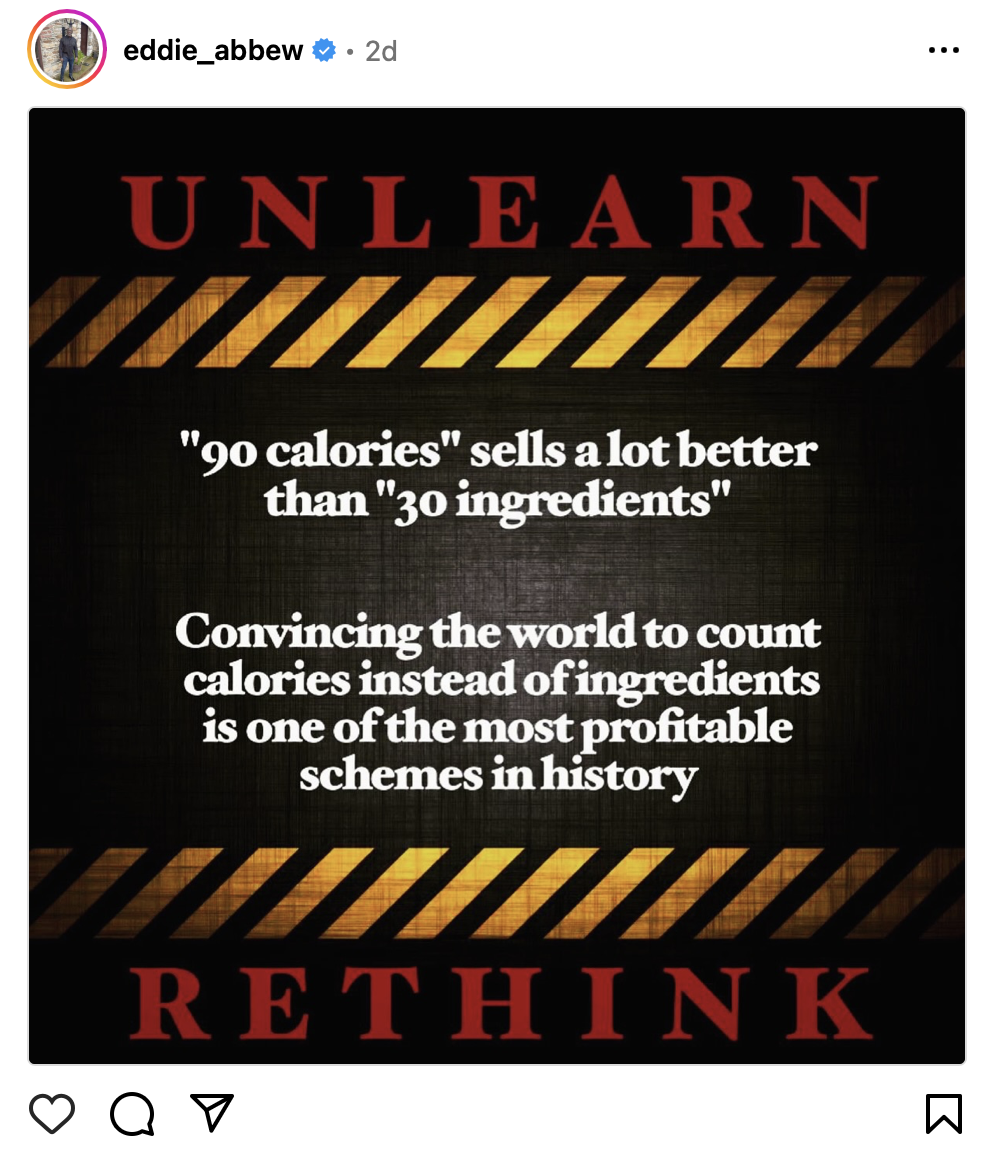
Jobs theory is about finding the meaning behind something. See “90 calories” and, click-whirr, must be healthy. That’s the meaning we associate. But is that the right connection?

Or is Eddie correct? Is number of ingredients a better signal?

Metrics, numbers, figures — whatever our attention catches is not accidental. Someone chose that, they framed the context around that scene. It’s up to us to ask, is this right?

How to make baseball fans

You don’t teach them the history of baseball, give them the baseball encyclopedia, quiz them about Abner Doubleday, and if they do well on the test, let them go to a game. What you do is get them enrolled in the journey of being a baseball fan because five minutes of it was fun, and they want it again. The next thing you know, they’re learning statistics because they want to. They’re learning facts because they want to, not because there’s going to be a test.

Seth Godin

How do you make someone anything?

There’s directional, measurable, logical. We will design this using our expertise. We are accountable.

But there’s also “it was fun and I want to do more”. That’s Alchemy.

But it’s not a choice between the two.

The rules of the system dictate the choice. Incentives. Norms. The business model.

Change the system to change the choice.

The 11th Commandment

You don’t go to church to learn the 11th commandment.

Posts written. Tasks completed. Books read.

It feels good. It looks good. It makes sense.

But it’s not always right.

New and more feels like progress.

New clients. More calls. New products. More sales.

But sometimes it’s not.

Sometimes we have what need, we just need to use it.

You don’t go to church to learn the 11th commandment.

Visualizing Tradeoffs

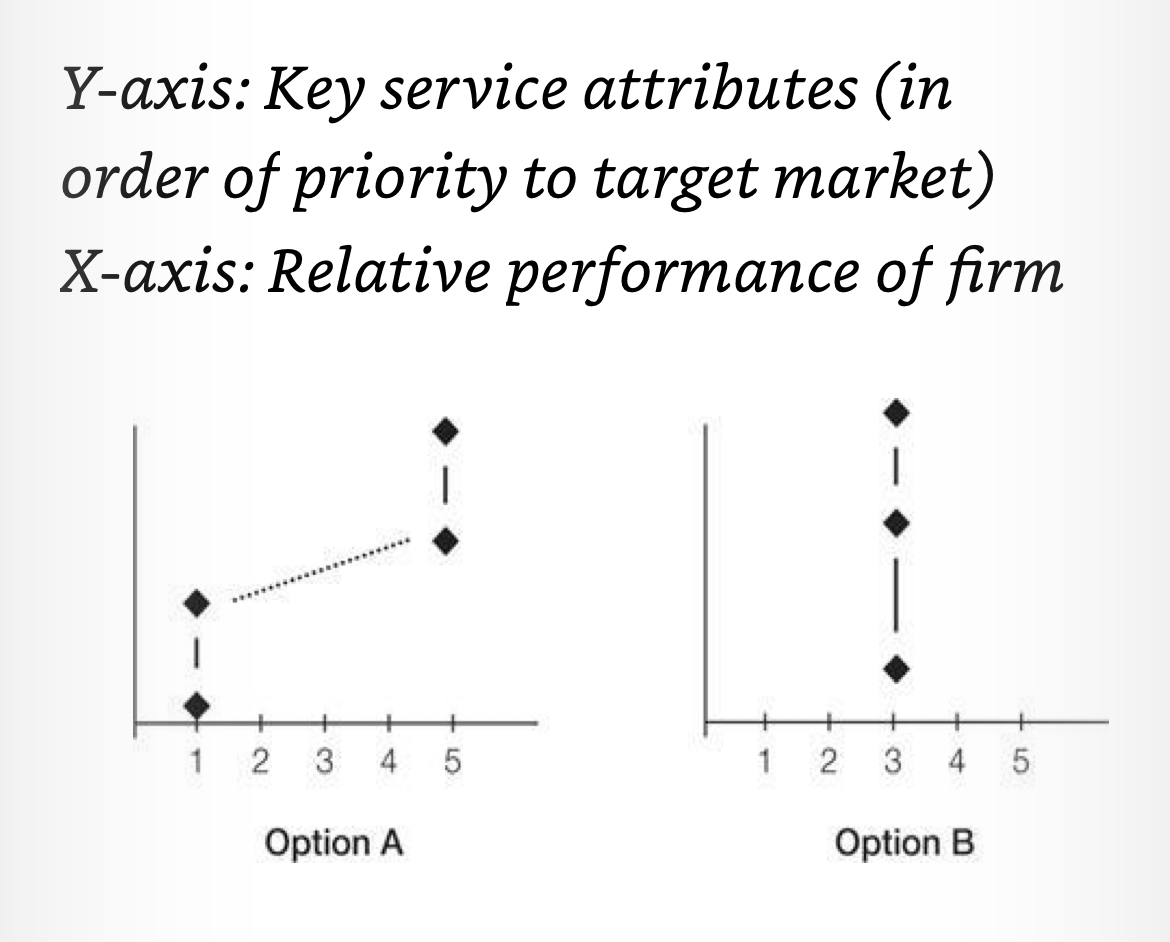
In Uncommon Service the authors note that customers want businesses to suck at something. It’s a Never Split the Different vibe. Or in terms of a karaoke bar: Play the hits!

A visualization from the book:

Restaurants have different attributes: food quality, pacing, pricing, ambiance, and so on. For a celebration, people are willing to trade price for service. This is the sort of “context” at the heart of JTBD.

“Our business,” listings read, “has 100 years of combined experience.” Well, that sounds like a lot. But is it two people with fifty years or ten people with ten? Then again, is fifty years of experience good? Do you want a doctor who went to medical school in the 70s?

There’s no answer, it’s all contextual.

But we do make trade-offs and must be honest about what they are and what that means.

Alice and Bob own soccer teams…

Alice runs her team conservatively and finishes with 17 wins, 17 draws, and 4 losses. 

Bob runs his team with more variance and finishes with 19 wins, 11, draws, and 8 losses. 

Which is better? 

Let’s reframe, like the ball bet. Is it better to exchange 2 wins for 6 draws and 4 fewer losses? 

Haralabos ‘Bob’ Voulgaris bought a soccer team because he knows these answers because he’s seen these questions. 

After Moneyball but before Morey-ball, Haralabos discovered and gambled on basketball inefficiencies. The best known now is the three-point shot. Voulgaris thinks that soccer is similar. Teams earn three points for a win, one for a draw, and zero for a loss. Rather than three or two points in basketball, it’s three or one points in soccer standings.

Soccer’s business model is like the music business model. Artists lose money recording an album, break even touring, and profit from the merchandise. This had to be Pixar’s business too. Division three soccer teams lose money, division two teams break even, and La Liga or Premier League teams “print money”. 

Soccer teams can move up (promotion) or move down (relegation). Bob’s team, CD Castellón is in the third division and they need about sixty-eight points for a chance at promotion. 

Both Alice (17/17/4) and Bob (19/11/8) earned sixty-eight points – but they don’t seem equal. This is Bob’s point – it’s worth risking more for wins than less for draws.

The big question is: What are the right metrics for this system? 

  • Hurricane wind speeds are probably the wrong metric. Though easy to measure they don’t convey the potential storm damage which comes from the rain, surge, and flooding. Moneyball and Morey-ball are both descriptions of systems where the important metrics shifted.
  • ‘Draws’ is a wolf in sheep’s clothing. It seems fine – splitting the difference between a win and a loss – but the unique point system shifts the weight. 
  • Risking more – Bob’s approach – focuses on what matters. It’s the points stupid.

Humans are loss averse but the soccer standing scoring rewards bucking this trend. Alice and Bob own soccer teams, let’s see what happens.

Zone Two cardio

When not listening to podcasts, I can often hold a conversation while running, and conversing is a proxy for Zone 2 cardio. It’s a Goldilocks exercise. Is this a better way to run?

Between Instagram stories, Andrew Huberman emails, and runner scuttlebutt, Zone 2 is in the zeitgeist. Without getting into physiology, can we figure out if it’s a fad or worth our focus?

Metrics. We count what’s easy. Miles and minutes are easier to count than training zone sessions. Hurricanes are graded by their wind speed but it’s the water volume that does the damage. Speed is easier to measure and report. Daily users were standard but it was people who used the product that gave Pinterest engineers a better signal. Easy to count, collect, and combine metrics are overrated.

+1 for Zone 2.

Incentives. ‘Why am I seeing this?’ is a good question. Who is selling me something? Vegetarianism is underrated because the people who sell it don’t have that much to gain. Status points, sure, but if something’s not being sold it’s more believable.

+1 for Zone 2.

Barbell approach. Sometimes average measures are worse. Exercise may be like that. Every workout at 145 beats per minute is not as good as some workouts at 170 bpm and others at 125bpm, though the average is the same. Zone 2 is easier than the 145 average which goes against the ‘more is better’ mindset.

+1 for Zone 2.

Swept up. It’s easier to get swept up in something. Housing bubbles. Crypto. Or just the feeling of a local sports team playing deep into the playoffs. The internet feed makes it even easier. Instagram knows my age, interests, and engagements. Oh, a forty-year-old running dude, the magic math concludes, here’s a bunch of running videos promoting zone two cardio. Is this an echo chamber?

-1 for Zone 2.

Conclusion: I’ll do more Zone 2 training. Happy New Year.

It’s not the fall…

It’s not the fall that gets you, it’s the impact at the end. 

The best metrics describe a state of the world. Hotness has three audiences. “Fahrenheit is basically asking humans how hot it feels. Celsius is basically asking water how hot it feels. Kelvin is basically asking atoms how hot it feels.” (Reddit

Another is the contrast between American and Canadian avalanches. In the states, a medium avalanche is “relative to the path”. In Canada a medium avalanche “could bury a car, destroy a small building, or break a small tree.” The southern system expects the audience to be familiar with the area

A third is calorie counts. Sure, bananas have calories but they can also be zero-point foods. Counting calories isn’t the point. Weight loss is the point, so what’s the best way to communicate information that leads to those actions? 

About hurricanes: “The Saffir-Simpson Hurricane Wind Scale we use to rate hurricanes is based on only wind and doesn’t take into account the chief hazards which can be storm surge and flooding rains. It’s wholly inadequate. We need to go away from rating one through five based on winds. Hurricane Harvey stalled for days over Texas and caused a hundred billion dollar plus disaster (Harvey made landfall as a category four storm, but most of the rainfall and damages was as a tropical storm).” – Dr. Jeff Master 

Hurricanes need to be rated more like Canadian avalanches. If measuring wind speed rather than rainfall wasn’t enough, there’s another problem: the hundred-year storm

Everywhere I’ve lived has a hundred-year storm. In Ohio (Southeast and Northwest) it was floods. In Florida it is hurricanes. Imagine a category five hurricane that hits Beach City once every hundred years. What chance is there for a storm of that level in the next thirty years? 

Master walks through this math. A one-percent chance each year is a ninety-nine percent non-chance. Multiply a ninety-nine percent non-chance thirty times and the hundred-year storm has a 26% chance of occurring in a thirty-year window. 

It’s not the hurricane winds that get you, it’s the flooding afterward. Yet we measure the winds.