Anchor Skills

Bob Hamman is the greatest bridge player ever. So what’s his advice for learning how to play bridge?

“Similarly in bridge if you have some baseline to work off you’re dealing with a lesser set of problems. That doesn’t mean you can’t start from scratch, you can. If have an anchor it helps. If you have a few anchors then solving is simplified.”

Think of a sudoku board, says Hamman. The minimum necessary numbers is 17. Typical ‘difficult’ boards will have twice that many. The more numbers the easier the board, but not all numbers are equally helpful. A board full of fives removes fives but leaves a lot of ambiguity.

For bridge, Hamman suggests, start with a game of trick taking (euchre, hearts) rather than a game of bidding. If someone gets tricks first it’s easier to teach bidding.

Ben Horowitz offers a corollary to this: it’s easier to teach an engineer how to be an executive than it is to each an executive to be an engineer.

Hamman was mentioned by Bill Chen (mentioned in Kris‘s newsletter). Chen plays chess and some bridge but he addresses the same idea. When someone tells Chen he’s really smart he says that he’s not really that smart, he just gets math-and math is the best baseline, at least for what Chen does.

There’s a lot of names for this idea: first principles, baselines, anchors, foundations. What’s helpful in this advice is the idea that some fundamental ideas are more helpful than others.

Hamman has played with Bill Gates and Warren Buffett. Two “regular guys with a bunch of bodyguards.

Hurdle Technologies for Consumer Goods

“The truth was, we sold health and safety first, environment second and as an add-on, these products worked as well as traditional products,” said Jeffery Hollender, co-founder of Seventh Generation on HIBT, “We believed that in order to set ourselves apart, especially to new moms – health and safety was critical as well as the environmental benefits.”

In food safety there’s an idea called ‘hurdle technology’. Rather than a single preventative measure for keeping food safe, there are a series of ‘hurdles’ that pathogens must clear to make it into the human body. Preservatives, temperatures (extreme high or low), and acidity are all hurdles that can and are used.

The same idea applies to consumer products, though we don’t quite have the language to think this way. Each consumer has a series of questions they want answered before they decide to buy a product, though we don’t quite have the language to articulate this.

Winning wines, for instance, showed that people want something that tastes good (average), something with an interesting label, and some guidance about how to, or what to serve with. Every time I walk past the 19 Crimes wines I smile, they get it.

Rx Bars demonstrate that same idea. Are there grains? No, okay, next hurdle. Is it tasty? Yes, okay, next hurdle.

Framing a problem this way helps a lot because as companies develop products they can narrow down the issues. Also notable, like Barefoot Wine and JTBD of wine, there was a new set of consumers (young moms) that Seventh Generation served.

Jazzercise? Job-ercise?

“I was teaching in the morning, which tends to be a time when a lot of stay-at-home moms take a class. They would come and take a couple of classes and then I’d never see them again. I wondered what in the world was going on. I went and talked to some of them and they said they like it but they said I was teaching it like they were going to be professional dancers. They didn’t want that, but they did want to look like professional dancers.

That is Judi Sheppard Missett on the How I Built This podcast.

There are a few ways to find the JTBD. One is to talk to current customers. Another is to talk to previous customers. Bob Moesta says to talk to both. What the previous customers told Judi was that they wanted to look great and have fun doing it.

The whole episode is good because it highlights a systemic need: non-weight lifting exercise. People wanted a thing, and as is often the case, couldn’t articulate it.

Everything in our life seems obvious now but there’s always a change around the corner. Phil Knight wrote in Shoe Dog that runners were considered weirdos. Nobody exercised. There was a need there, and Knight and Missett both filled it.

Moesta says that he likes to see things as sets. Jazzercise then might be the set between fitness-fun-novelty-and-groups. Whatever your customer’s set is, follow Judi’s steps and go ask them.

CAC Pack

Patrick O’Shaughnessy asked about clever customer acquisitions. The replies are pretty good.

In college, I played ultimate frisbee. Recruiting was kind of difficult. The traditional method was to buy card stock table tents and litter the dorm eateries. That seemed cluttered to me. I took our marketing money and subsidized t-shirts to $5 each. One guy on the team bought four. Did they work? Who knows. Was it better than table tents? For sure.

Customer Acquisition (Costs) strategies are not so easy to organize. Marketing? Samples? Scrolling through replies I settled on five. The whole stories are in podcast form: Overcast, iTunes.

The highlights:

  1. McDonald’s Kid Meals were created in Guatemala by a struggling franchise. The thinking was: kids eat less and different food. The Happy Meal was created in Chicago when an advertiser Bob Bernstein watched his son eat cereal for breakfast and read the box.
  2. AOL discs were everywhere because AOL had previously sent boxes to homes and saw a staggering conversion. At the time people had computers, but not software the getting people to try AOL was like a lot of other consumer products. Steve Case had worked at P&G and gotten shampoo distributed the same ways. (At one point AOL was half of worldwide CD manufacturing).
  3. “PS I love you, get your free e-mail at Hotmail.” was the original email signature. VC Tim Draper was an ’84 Harvard MBA and studied Tupperware. The I love you was dropped and the line worked.
  4. Netflix used coupons in DVD players in 2000-2002, a lollapalooza of technology, selection, and customer demand.
  5. When Rich Barton launched Expedia he asked Bill Gates for millions to buy TV ads and Gates said ‘Yes’. When Barton launched Zillow he asked Bill Gurley for millions to buy TV ads and Gurley said ‘No’. The difference was the business model. What might work instead? The Zestimate.

The theme across these is that a business disrupted an incumbent (or itself) by taking something that worked in one area and applied it to another. The cleverer the angle, the less the financial cost.

How jokes, and all things, work

Here’s Jerry Seinfeld telling Tim Ferriss about an idea he’s got. It’s still early. We don’t know yet if it’s a joke. Seinfeld said, “I don’t know what to do with that”

“When you’re on a cell phone call and the call drops, and then you reconnect with the person, they’ll go, “I don’t know what happened there.” As if anyone is expecting them to know anything about the incredibly complex technology of the cell phone, they offer this little, I don’t know if it’s an excuse or an apology. They go, “I don’t know what happened there.”

After Seinfeld has an idea he writes it down (there’s a lot of good writing and creative tips in this episode) and he works at it. Seinfeld explores the idea like my mother-in-law explores the home goods stores. Is this a good decoration? Does this match what else I have?

Seinfeld writes on yellow legal pads until a joke is pleasing to the ear. Then, it’s time to see how it works. And to remember, nothing is above the laugh.

At a comedy club the joke thrives, it dies, or it suffers enough damage to limp home and recover to emerge stronger and better prepared the next time. The comedy club is feedback.

“That’s the paradise of stand-up comedy. You don’t have to ask anyone anything. Stand-up comics receive a score on what they’re doing more often and more critically than any other human on Earth.”

Jerry Seinfeld

All things work like this. From idea to iteration to feedback in the market. Stand-up from Seinfeld is the cleanest version of this. Jerry’s method is the IKEA instruction of comedy, down to the simple paper it’s printed on. A comedian can have a joke in the morning, work it over over lunch, and deliver it after dinner.

All creations follow this process, but comedy is the gold standard because it’s clear and clean and quick. Write a newsletter (neé, blog) and the feedback is slow. Create a product and after development, marketing, and distribution you might know if people like it.

Poker’s appeal is principally the same. It’s cause-and-effect world. It’s easy to see. We like that. Comedy too.

Life is messy. But this helps. Keep in mind that the same process underlies everything creative: idea, iterate, feedback. The loop may be longer, but the process is the same.

Danny Meyer is an Alchemist (and you can be too)

“A question that stymied me for years and years, a question I got almost anywhere I went, it seemed like every organization asked, ‘How do you manage to hire so many awesome people?’.

“I said to look for fifty-one percenters, people who are emotionally wired to be happier themselves when they delivery happiness to you.”

Danny Meyer, ILTB

The central idea to Alchemy is to optimize important but overlooked things, with especially large returns from inexpensive yet important finds. How to find these things? Numbers provide a good clue.

When things are easy to measure, they are numerate. These numerate items are easy to discuss, to compare, to enter into spreadsheets then sum, average, and compare again.

Danny Meyer has succeeded (in part) because he competes in new areas. In the beginning of the podcast he tells O’Shaughnessy about competing on food and wine and ambiance and all that, but that’s what everyone does. It’s hard to have THE BEST food when everyone is trying to have that.

THE BEST food has convention. It has history. There are norms. There is price. Having THE BEST food in New York City is like being the best investor in New York. Good luck.

However, being the best at something slightly different is quite a bit easier. There’s a lot more area and a lot less competition if you do things off the beaten path.

Meyer found this in hospitality. Listening, we don’t get the impression that the tag wags the dog, but it’s got to be part of the reason Meyer is around, and talking on the Invest Like the Best Podcast.

Often Alchemy is using (free) psychology rather than (costly) structure. Better service rather than better linens.

One story Meyer tells in the book is about ‘the medicine cabinet’. One establishment was having the normal rumble of friction getting its legs under it and when patrons had a bad time, Meyer and staff offered a glass of dessert wine to soothe their pain.

Not only was the wine complementary, but it was special. At the time, dessert wines were novel so it was a special treat. The kicker was that they were the cheapest wines Meyer stocked.

Alchemy is like improving weaknesses, there is a lot of return for the initial effort, often much-more than optimizing factor f for the tenth time.

Danny Meyer is an alchemist. From the people he hires to the businesses he starts.

You are an alchemist. Find something that’s important but not measured, and deliver that.

Correlated Decisions

“We use quantitative methods to put together diversified portfolios that don’t blow up over time. We have technical guys who are very sophisticated, one guy was the MIT chess champion. We need these guys to balance our portfolios, but they’re not picking stocks. I pick those guys because they have no idea how to pick stocks and I don’t want to know what they think about picking stocks, that’s for our researchers.”

– Joel Greenblatt, Capital Allocators.

The JTBD of diversity within an organization is uncorrelated decisions. If we’re all thinking the same way, the expression goes, nobody is thinking.

Early in the episode with Ted Seides, Greenblatt cautioned that there’s always more correlation in a portfolio than someone expects. This is consistent with the idea that most financial issues are liquidity issues.

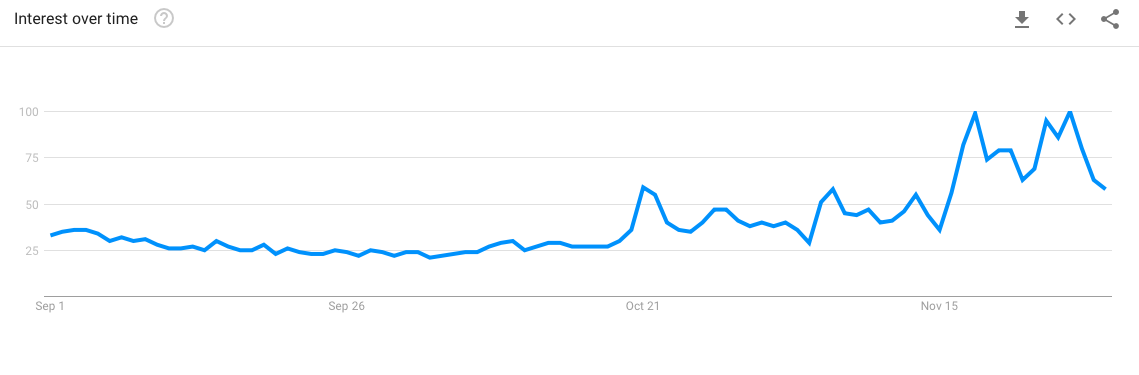
If there are 3 ways to spend your day then we should be wary about the feed, the search, and the trends. For instance, the September 1 – December 1 BTC search trends. When Coinbase emailed me “Why Bitcoin is in the News.” I thought, this might be a good time to sell.

Google Trends for “bitcoin”.

Trends, searches, and feeds aren’t bad, but they are correlated.

The best solution to uncorrelated decision making is to use a bit of decision making advice from Rory Sutherland. When we select one at a time, we choose the average item. When we choose multiple things at a time, we choose a variety.

Rather than consider a best option then, we can consider a basket of options. With finite resources it’s hard (impossible?) not to prioritize but it does lead to new ideas.

It’s neat to hear that Greenblatt’s operation is like a newsroom: editorial and news, research and technical. Division is balance. The worst outcomes aren’t when something goes against us but when everything does.

Second Order Parenting

“Perhaps the most important thing is supporting a kid’s sense of autonomy.” – William Stixrud

Peter Attia wants to be an Olympian. When he’s 100. When Attia first explained the idea, he worked backward. What should someone do now if they want to do something else later? If you want to be able to go to Disney World with your grandkids you better be able to walk eight miles now. Or some such thing.

Working backwards is a nice tool for solving problems. I want to get to n so first I need to get to n-1.

A similar approach is advocated in the book, The Self Driven Child. In that book William Stixrud and Neil Johnson ask parents to consider their future eighteen-year-old. Then, like Attia, work backwards and consider what a child needs to do at twelve so they are successful later.

Stixrud’s and Johnson’s ideas come down to four pieces of advice for parents:

  1. Offer help, not force 
  2. Offer advice, it’s their choice  
  3. Encourage children to make their own decisions
  4. Have kids solve their own problems, as much as possible 

It’s not so much about ice-cream for dinner, but it’s about setting some (wide, but safe) boundaries for children to operate within.

This has been hard because parenting is a bit of a wicked problem. There’s a lot of showy things a parent can do but might not necessarily be that helpful. Once a child is mentally and physically safe, what’s the next clear thing?

In the ERE book, Jacob Fisker shares a reverse fishbone diagram to show ‘net’ effects. The aim is to end up above the horizontal line. Eating a candy is a positive first order effect, it tastes good. But a negative second order effect (low nutrients, high sugar), and maybe even more (bad habits).

Early Retirement Extreme --- A philosophical and practical guide to  financial independence -- Contents

Easy decisions, hard life. Hard decisions, easy life.

There are many things with negative first order effects (difficult conversations, certain exercises, working late/early) but which have positive n+1 effects and so they are worth doing. Personal finance follows this diagram for example. Parenting according to Stixrud and Johnson follows it too. It might not feel easy and it might violate the actions=progress maxim, but it’s difficult non-actions that help kids the most.

One personal instance is schoolwork. We’ve been distance learning and I’ve played a large role from checking work to answering questions. And, sometimes just telling my daughters the answers. Like junk food it’s easy at first but it violates both the fishbone approach and the self-driven child advice.

How much to change, I don’t know. But this isn’t baking. Like over-price or over-rated or over-indexed, the direction for gains is clear: my kids have to learn to live their own lives and it’s my job to support them.

Market Mechanism 2

Photo by Tirachard Kumtanom on Pexels.com

This is in addition to the previous post on the market mechanism. Briefly, it’s the idea that competition erodes the value captured by the producer.

Barry Ritholtz asked Morgan Housel about what he wished he knew when he started. Housel responded, “One thing that sticks out is that good investing is not about being good at something but you have to find something that other people are bad at. The fact that you are good at modeling does not necessarily make a difference because a lot of people are good at that.”

This, said Fredrik DeBoer, is part of the myth of college. One way to avoid the squeeze of the market mechanism is to have a rare skill. In Housel’s words, to be good at something other people are bad at. People are compensated by what they know, proxied by a degree, then a graduate degree. More degrees more (proxied) competition.

Success is found, said Hamilton Helmer, in the durable. “If you do something better, the question is, ‘How can this be durable?’ There has to be something that prevents others from taking all of that away from you.” How can you avoid the market mechanism creating a commodity?

It probably will happen too. Rufus Peabody said about gambling: “I used to bet second halves in college and professional football. That used to drive my yearly earnings, it was an ATM machine basically. But the last three years I’ve basically broke even there and may not continue running the models because the inefficiencies that were there are no longer there.”

Profits attract competition, competition drives profits and prices down. The market mechanism is Santa for the consumer and saboteur to the producer.

There’s one way to avoid the market mechanism; attract less competition.

Movies, wine, investing, and sports all offer financial and psychic income. That’s a double dose of the market mechanism once someone sniffs out the potential rewards. A cooler choice might be digging pools.

Design Ease

James Clear joined Ted Seides to talk about habits:

“Or you see a plate of cookies on the table and that’s a visual cue for the cookies. The practical strategy is to make the cues for your good habits as obvious as possible. Rather than having cookies on the counter have fruit or nuts or something you want to eat.”

James Clear

Clear has a good framework which boils down to ease. Make the things you want to do easier (access, reward, feedback, etc.) and make the things you don’t want to do more difficult. We faced this one Christmas, relegating the cookies and promoting the fruit.

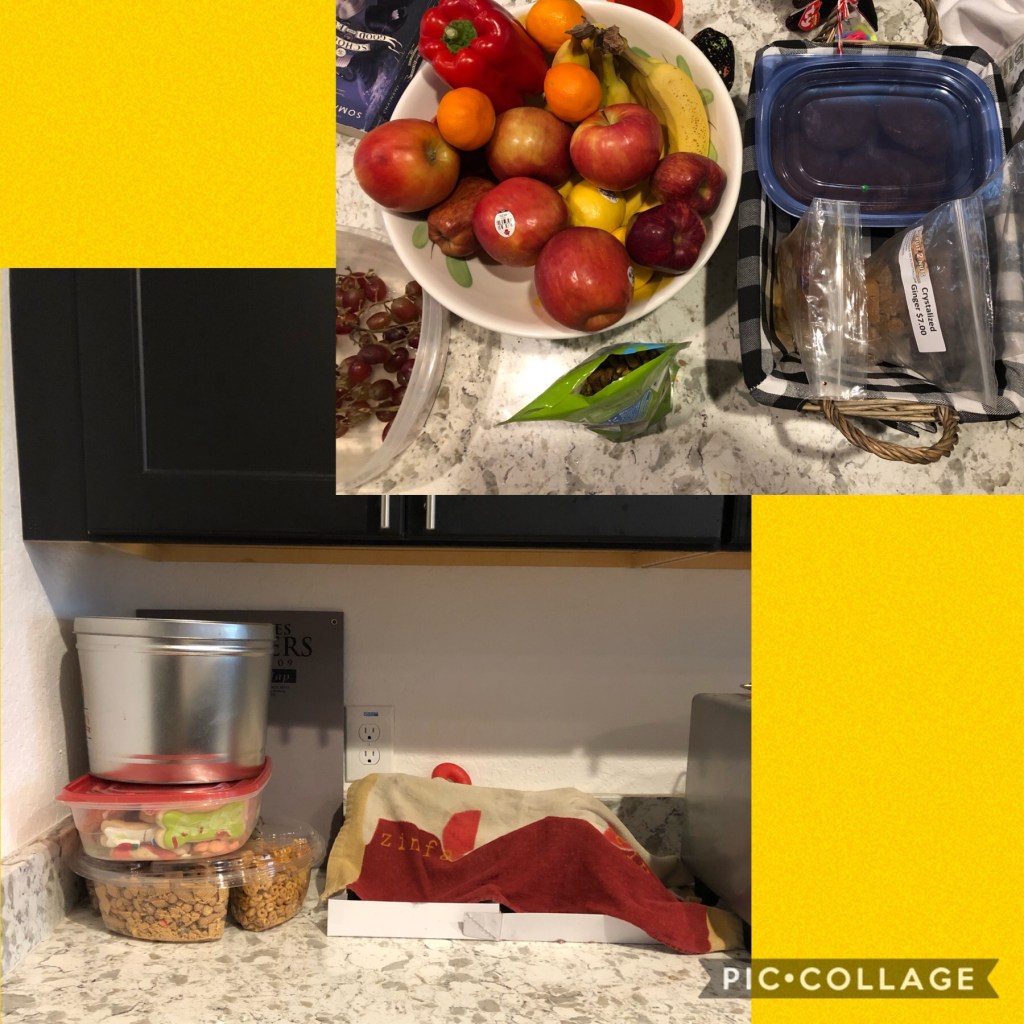
When the cookies (bottom left) were on the island we gorged on them. When they were moved five feet away to the corner, and replaced by fruit the gluttony stopped.

Recently we noted influential words and a potential addition is the word ‘design’. That’s a heavy word. It carries too much.

‘Design’ gives the impression that something was cultivated and refined. It gives the air of investment and taste. Design can be that, but there’s a quick and simple design rule that works almost all the time—and worked for our cookie and fruit switch at Christmas.

Go from zero to one.

Not in the Peter Thiel sense, but in the behavioral economics sense. If something is understood as free, we do more of it. Make us pay even a tiny bit though, and we do much much less.

Clear gives an example in the podcast. He told Ted that he’ll keep his phone in the other room, a mere 30 seconds away. That’s a big old nothing-burger of cost, yet it is when it comes to actually doing the thing. Try this. Put your phone one place and sit down with a book/computer/project in another.

Well done. You’re a designer.