If things were ideal, an investor’s early years would have low (or even negative) rates of return and their later years would have high ones. Would you rather double your net worth at fifteen or fifty-one?
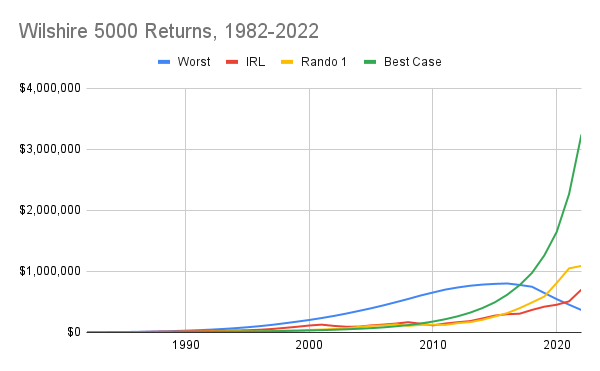
The most favorable market returns transform 30,000 into 3,200,000 after thirty years. Wild.
But the worst conditions cede only 300,000. Real-life, as often the case, is somewhere in the middle.
$1,000 invested into the Wilshire 5000 each year.
Each of these graphs is the actual returns of the Wilshire 5000 (16%, -5%, .01%, etc.) but arranged in different sequence. A random ordering (yellow) offers an extra 40% over real life. It’s a luck of the draw as they say.
But this isn’t a what if you invested in ___ at ___ post.
The point is to practice Maxims for Thinking Analytically. Extreme examples reframe how we understand and here we understand sequence matters.
Huge relative to what? Mills Snell smartly asks just that. “Like AirBnb, a two sided marketplace opens up monetization. Before someone puts their house on AirBnb they aren’t making any money. I think to the psychic it’s something similar. Their customer acquisition is people driving by and word of mouth. Maybe they’re willing to lose 75% of the revenue because they’re turning on so much potential revenue that they did have access to otherwise.”
Marketplaces are great businesses to own especially when they compete with non-consumption.
…
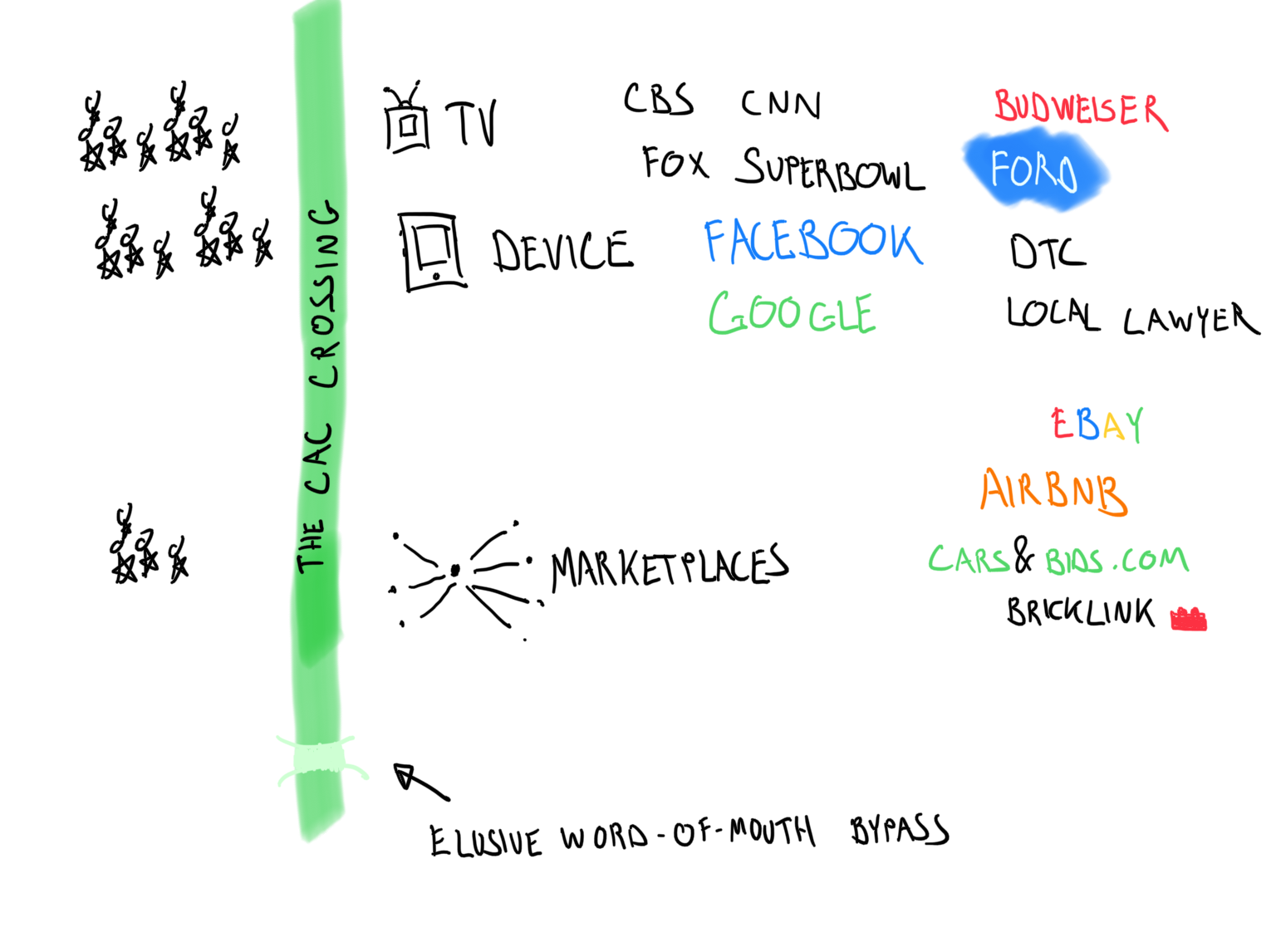
Every business approaches the CAC crossing. One way to pay the crossing tax is to advertise. Another is the marketplace take rate.
But there’s also the elusive word of mouth bypass, which like actual unicorns is quite rare.
And I probably ruined your parents’ life And your childhood too ‘Cause if I’m the music that y’all grew up on I’m responsible for you retarded fools I’m the super villain Dad and Mom was losin’ their marbles to You marvel that? Eddie Brock is you And I’m the suit, so call me—
Eminem, 2021, Venom
In complex systems you can’t do one thing. When he was chief economist of Uber, John List and his team ran an experiment to see how tips affected drivers. They rolled out the option to tip in four cities and collected the data. Tips, List wrote, work. When drivers earned more they drove more. But you can’t do just one thing. When tipping expanded to other markets other drivers drove more too. With the increase supply of drivers but the same demand, total earnings with tips were about the same as before. But the drivers ended up working more. It was more per ride but fewer rides.
As a teen I remember big concerns about what music teens listened to. In 1990 the parental advisory label started to appear on CDs. In 1997 Eminem release The Slim Shady LP. That music was for my car only, not the house. Eminem gets this. “I’m the super villain Dad and Mom was losin’ their marbles to”. It was NOT GOOD that we were listening to this.
Maybe?
List’s Uber experiment explains an externality. Do one thing and this other thing happens too. Eminem’s other thing is health. Venom is my favorite workout song and Eminem is the 13th most popular artist on Spotify with fifty-three million plays. A month! That’s 100k hours a day. If one-fourth of those hours are someone exercising, that’s 14,000 pounds lost each month.
…
Behavior change starts with easily understood stories. Tell someone a story they agree with, or understand, or can tell to others (which raises their status). Eminem’s explicit lyrics are something to warn against. But telling a positive story through some Fermi thinking sounds good too.
Catalog era. In 1888 the Sears catalog begins. In 1896 the United States begins rural free delivery. Companies can mail catalogs directly to their customers and customers could mail their orders. It’s an important step in the Reconstruction Era. In 1908 the Sears kit house appeared. By 1915 the Sears catalog peaked in size.
City era. By 1929 half of Sears’ orders are retail rather than catalog. Americans migrate to cities. Stores like Sears and Montgomery Ward get in front of them. Sears buys radio station WLS and locates stores in downtown areas. “Window shopping” begins.
Suburbs era. Americans move again. Following World War II, Americans seek space and the automobile allows it. At the time Walter Cronkite noted, “When [Eisenhower] approved and pushed through Congress this great interstate highway network that we now have, he changed the entire face of America.” Sam Walton opens his first store in 1945. The American mall begins in 1950, a decade later there are almost five thousand. By 1975 malls account for 33% of all retail sales.
Internet era. In 1994 K-mart reaches its peak store count and Amazon.com begins. Though digital, early websites are niches of catalogs or newspapers: classifieds, shoes, clothes, used goods, and so on.
…
How a business distributes to customers affects how a business succeeds. The four eras of modern retail demonstrate how the placement of goods and services changed over time.
A niche of the internet era, DTC, is a modern example of how the terms change. The DTC placement is, or used to be, quite cheap. Businesses warehoused goods away from expensive city centers or suburbs. Or dropshipped across the Pacific Ocean. They didn’t worry about fighting for shelf space when public and private and last-mile couriers were happy to work for them.
DTC brands also succeeded because they chose good products. Glasses, rings, clothes, razors, and makeup are all easy to ship, similar in scope, and don’t expire. They’re also products with favorable margins.
Lastly, the internet provided unique promotion opportunities. The internet allowed cheap websites and cheap – though growing expensive – advertising on social media sites. There were no gatekeepers and they told their story on podcasts and in videos.
What’s the next era? No one knows. What’s the question to ask? That’s easy. Where are my customers and how do I talk with them?
I tried, and failed, to get a photo of this issue.
For Christmas my youngest daughter got an iPhone. It was BOGO when you add a line, so I got a new iPhone too. For simplicity sake I ordered us Apple cases with the phones. And my case sucks. The silicon marigold iPhone 13 case is the worst I’ve ever owned.
But why?
Apple products are good. The computer I’m typing this on is an Apple product. If it’s read on a phone odds are one-in-three it’s an iPhone. Apple is one of the most valuable companies in the world – and has been for many years. What’s going on?
Well first, value is relative. If something is bad, it’s bad relative to what? My previous Smartish and Speck ($12 & $8 respectively) cases were more durable and provided prolonged protection on earlier inferior designed products. I think Apple cases are bad becausethey lack competition.
Apple, like Aldi, competes in a special way. Both are A+ companies and both compete outside the store. The goal is to get people inside, and if customers come in, they’ve got them. So Apple doesn’t convince me to buy the silicon marigold case rather than the leather case. No, Apple just wants me to buy Apple.
Aldi cereal is a visual example of this model, the boxes are bland (here in B&W) because they don’t have to grab the customer’s attention in the store. Contrast this with Walmart or Amazon where the competition is both inside and outside.
Smartish or Speck compete in the bedlam of Amazon. These cases have to throw sharp elbows in the arena of good, fast, and cheap. I found the Smartish case via a Wirecutter review, so it has to stand out as well. Ditto for Speck.
That said, I don’t know if the Apple case should even be good. Apple’s advantage is packaged hardware and software, not being best in class on accessories. Apple doesn’t sell a great phone case, instead the JTBD is ease and brand.
Product. Pricing power exists relative to production costs. A knowledge worker uses ‘information’ to create their service. If the price of the information increases and the worker cannot raise their prices they do not have pricing power.
A coffee roaster might have a different perspective. If coffee is coffee, then one Brazilian farmer raising prices doesn’t affect the roaster. They shop around. Or, they can stick with the roaster and pass the cost increase onto the consumer. Which gets to…
Promotion. Pricing power exists relative to perceived value. If customers buy ‘milk’, a business has low pricing power. But if customers buy ‘milk, from grass-fed low hormone happy cows’, that is different.
Customers don’t buy one thing. There’s always an intangible. Brands demonstrate this. A Rolex doesn’t just tell time. McDonald’s doesn’t just provide sustenance.
Placement. Pricing power exists relative to distribution and retail options. Think about location. Landlords have pricing power over restaurant tenants.
The internet (with shipping) removes the landlord – and their power. Website hosting, online shopping carts, and 3PL have minimal pricing power over their customers. So, online businesses can be quickly profitable. But not all internet services are created equal. Facebook has pricing power for Facebook communities, not so for email newsletters or websites.
One idea around here is that of the restricted action section, and how to unlock it. Broadly the goal is to limit any reduction in the range of choices. For example, the willingness to look stupid is a way to reduce the restricted actions section.
“Never stop listening while you do this (advocate your position). Don’t make it a crusade, make it a way you are expressing your opinion but trying to learn at the same time. I think especially in university environments you will be more effective that way. If you’re a top line university administrator, the pressures you’re under and the number of constituents you have to cater to is so extreme. Those are frustrated people. A lot of them may be on your side way more than you think but they can’t say so.”
Tyler Cowen
Whenever I find myself flummoxed by someone’s action it’s a sign I don’t understand the incentives. Sometimes the incentives are satisfying the stakeholders. I like Cowen’s approach here: be curious and find the incentives.
American Beauty, The Green Mile, The Matrix, The Sixth Sense, Being John Malkovich, Boys Don’t Cry, The Blair Witch Project, Fight Club, Toy Story 2, American Pie, and Star Wars Episode I.
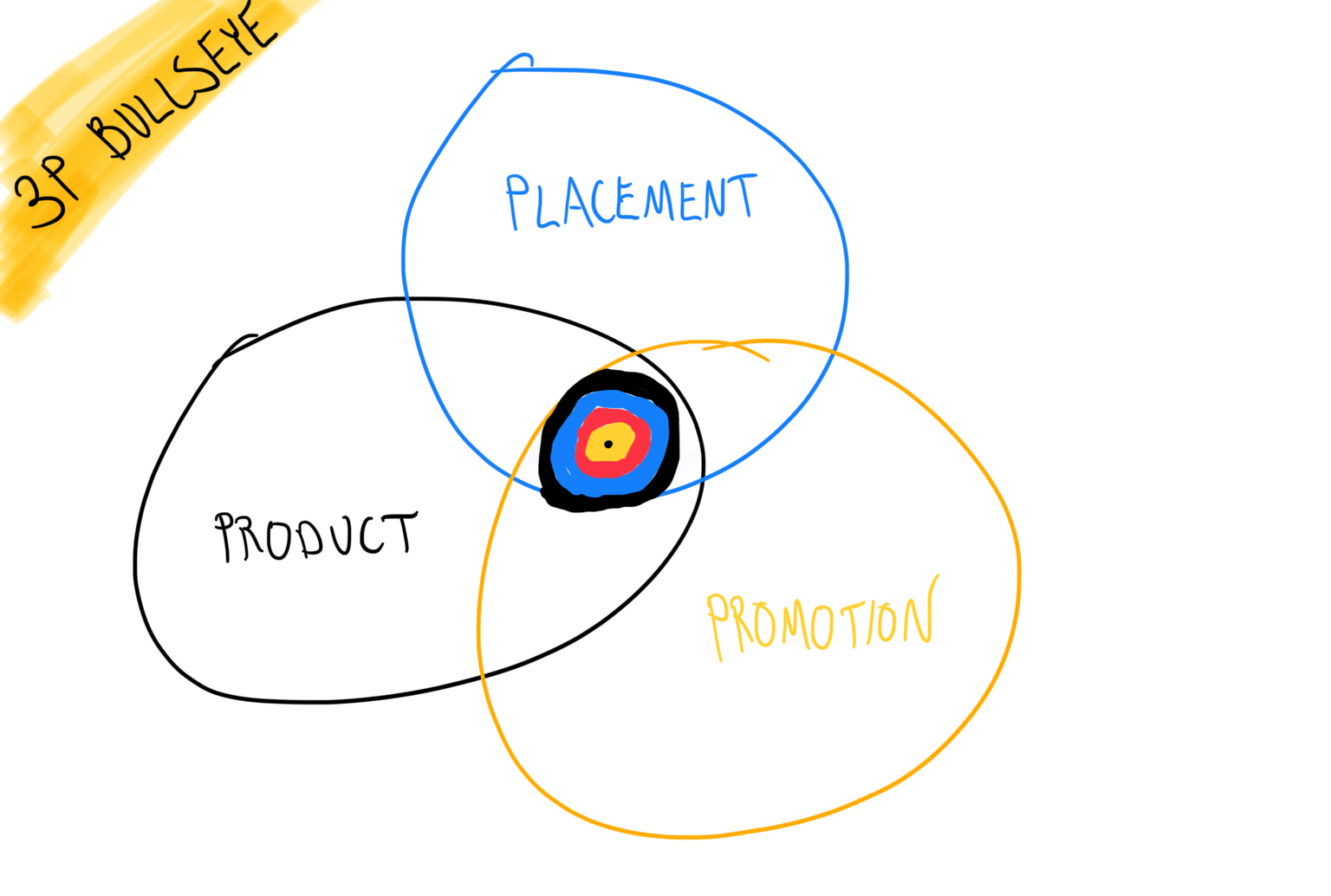
Was it talent? Maybe. Good economics? Perhaps. Instead, let’s look at this using the Placement, Promotion, and Product Bullseye. If a business ‘hits the bullseye’ it succeeds.
In 2000, Thomas Tull founded Legendary Entertainment. It was one of the first companies to combine private equity investments with Hollywood movie-making.
It was good timing. The late 90s saw the highest number of movie screens in America. In 2004, Blockbuster’s store count peaked. A year later DVD sales did too.
The placement for movies was primo. There had never been more screens on which to place movies. Make enough of something and some of them will be very good.
Tull also nailed the promotion for movies. Prior to Legendary, Hollywood used mass-market advertising – because it worked! Jaws pioneered and Star Wars exploded the model that with national advertising and distribution, movies could be huge.
But Tull saw national consumers as three segments. There were huge fans, who would pay regardless of promotion. There was also the free tickets and twenty bucks crowd. These people wouldn’t go for free tickets and twenty bucks. Then there was the middle group. It was them Tull wanted to reach with the advertising. Persuade the persuadable and he did just that
The final piece of the picture puzzle was a great product. Hire great directors – Nolan, Snyder, del Toro – and get out of their way. Legendary’s product was helped too by characters like Batman, stories like We Are Marshall, and laugh-fests like The Hangover.
The product was also profitable. Movie studios controlled the pricing and theaters earned their keep on soda, sweets, and treats. Ditto for DVD, a product with a high upfront cost but zero marginal cost .
…
Now flip it. Books are also media. Lee Child is a 3x NYT Best Seller and when Killing Floor was released in 1997 it had a limited audience, was hard to find, and was promoted in a review of books section of the newspaper. Not ideal.
Books became a better business model. They’re better placed: physical or digital. Promotion is more focused, specifically with the rise of podcasts. But Child still has ‘his biggest fan’ come up on the street to ask when his next book is out. It’s out now, he tells them, go buy it!. The product, for the right authors too, has never been better. But best sellers are not blockbusters.
…
Businesses ask: Where to direct resources? Through contrast, the bullseye model highlights the trade-offs.
Keep following along. 👇
…
Part one of Batman was looking at the movie industry from 1975-Marvel in the Batman BATNA post.
“We have scores about how much willpower some people have,” says Wendy Wood author of Good Habits Bad Habits, “and some people score really high on those scales. Those people are not denying themselves things, but instead they form habits that meet their goals. For example, my students study in the library or a place in their dorm and when they are there they put their phone away. There’s no distractions. They just work.”
There’s a lot in there!
Willpower might be a bad metric. Often we count, compute, and consider the things which are easy to count, compute and consider. But easy may not be the best way to judge a metric. Calories are easy to count, but how often does calorie counting lead to weight loss? So maybe ‘willpower’ – quantified or not – is the wrong thing to look at as well.
Instead Wood suggests habits which are helped by ease and ease is designed. Wood notes that her students go to a place that is designed for reduced distraction. They also take the advice of James Clear and put their phone just out of reach.
Design is part of writing Cal Newport told Tim Ferriss. We know this, Neil Gaiman’s writing cottage has been featured here, twice! What’s nice about it, Gaiman said, is that it’s just out of WiFi range. A separate place has been an ongoing study on Cal Newport’s blog.
Okay. We get it. But, here’s the twist. The design of “quiet space free from distraction” is only best for certain outcomes.
The starkest 2022 contrast is Twitter. Investing Twitter, for instance, is full of smart people trading ideas, giving commentary, and sharing thoughts. If the desired action is to be a better thinker in the markets the design must include Twitter. It just won’t work to sequester oneself just out of Wifi range. Even Charlie Munger joked about his kids thinking of him as a book with legs: but the book now is the timeline. Similar if the goal is public policy the design must include advocation. If the goal is sales the design must include talking to customers (and finding the JTBD).
The heart of design is intentionality. Here’s to all of us being a bit more intentional today.
Businesses have to do many things to succeed. But three areas encompass those many things: placement, promotion, and product.
Where is this sold? The placement includes distribution, retail (shelf space), shipping, etc.
How is it promoted? Also known as ‘marketing’ but includes how the customers understand the value.
What is sold? The ‘thing’. What are the trade-offs in the creation?
…
Consider toothpaste. It’s universal in retail, it’s promoted with national, regional, and local advertising, and it is designed to feel good.
Or, your local accountant. They have an office (Main St. USA), sponsor a little league team, have a weekly newspaper ad, and do a service many people don’t want to, or can’t, do.
Even, Google. It’s located in the world of bits rather than atoms, it spreads through word-of-mouth, and is the best search engine ever built.
Remove one area (placement, promotion, or product), and each business changes significantly. What if toothpaste loses shelf space to deodorant, if the local accountant stops advertising, or if Google search results become worse? These three areas are ‘gotta haves’.
We’ll look more at how Placement, Promotion, and Product influence how a business succeeds or fails.
Some parts of this diagram we’ve covered. If Product is the goal, then job to be done is the means. If Promotion is the goal, then Alchemy is the means. If Placement is the goal – well – this one we’ve looked at less, and it’s because of the internet which makes getting bits of data to anyone so simple it’s overlooked. We’ll fix that.


 The Waiter's Pad