No bad habits, no gold stars

We know nothing about venture capital!

“Correct, we have no bad habits. We were total outsiders. And, we weren’t kids that went to ivy league schools and worked at Goldman Sachs, so we weren’t accustomed to getting gold stars for painting in the lines. We were accustomed to doing things creatively outside the lines.” – David Fialkow, September 2021

People enter situations with a culture which can influence how they act. In society, and wearing a mask. In conversation, as debate structure. In politics, or anytime there is leadership.

People enter situations with incentives which can influence how they act. In music, ship platinum, receive gold. In football, three star recruits. In startups, what OKR? In horse racing, to race or to sell?

One of the tricky parts of life that covid revealed is the heterogeneity in life. Like, A LOT of variation. This same effect exists in the more mundane world of organizations. There’s no set of incentives or culture that always works. But there is a culture and there are incentives and each matter.


Have a nice day.

Show the way or in the way

One common mistake in our understanding of “how the world works” is to think that lack of action is due to a lack of information. If people just knew how important X was they would definitely do it.

One form is seen in the social media question: What would you add to the high school curriculum? Answers tend to hover around statistics instead of calculus, personal finance, or decision making.

Those are well intentioned suggestions, and on net, students would be better off if we could download a stats module in place of the first derivative. But information is not action.

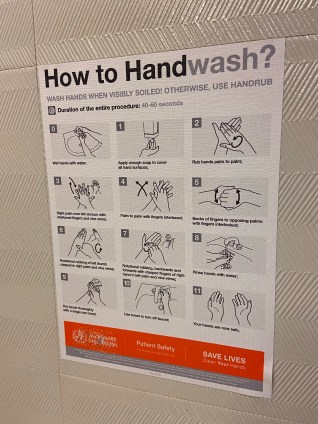
Orlando Marriott hand washing sign

Geez. We’ve looked at hand washing (twice!) and there’s probably a well designed study that notes signs like that, in bathrooms such as this, change a proxy for health in some-such-way.

But, there’s a better example. It’s a real life example. It’s been tested on thousands. It’s also in Orlando. Arrange hand sanitizers to be avoided. To hijack Ryan Holiday: the obstacle is the way. But after two days people watching in the theme parks it’s very clear, this works.

And the reason for signs showing the way and not sanitizer stations in the way is incentives.

Back to Twitter. Some schools offer personal finance. From Kris’s nephew.

“I have this assignment for school where I have to invest $1,000 into a company’s stock. And I know you’re a stocks person so I was wondering if you know a good company i should invest in. Because the winner gets a prize of who makes the most money.”

Just give every twelfth grader $200. But there’s no action in that. There’s no standards or benchmarks or assessments about net learning in the second quarter of the school year. So in a way, Kris’s nephew is getting exactly what the system incentivized.

This is the system. In education it’s hard to measure “financial literacy”. In public health it’s hard to measure “healthy place”. In these systems optics are rewarded. Theme parks are in the optics business too, but for them results like: Person Gets Sick at World Famous Theme Park matter more. It’s important to know the rules if we want to play the game.


In finance there’s paper returns and there’s “moolah in the coola”, that’s another analogy. Paper returns are optics. Money in the pocket is an outcome.

The day the *hobbies* died. Bye, bye thanks-to-America-Online…. (To the tune of American Pie)

One way to notice change is to notice the words people use to talk about changes. The online shopping of the 90s became just shopping. The online banking of the 00s became just banking. The online dating of the 10s became just dating. The online communities of the 20s, well you see where it’s going.

“The Internet has just killed hobbies. They’re dead. They’re gone. The concept doesn’t exist. The concept of ‘having a hobby’ died at the exact same time as the concept of ‘going online’. This was a phrase you heard constantly from 1994 to 2005. You get home and you ‘go online’. The big company was AOL, America ‘online’. Around the mid-2000s people stopped ‘going online’. Why? Because we were online all the time. The idea of not being online is now the weird thing.” – Marc Andreessen, CSPI podcast, August 2021

I remember this! You got home from school and you signed into instant messenger and entered the Yahoo euchre room. Good times good times.

Having a modifier doesn’t mean something will become the new thing, but it does mean it’s different and may be worth our attention. A few others: autonomous driving, crypto currency, digital wallet, online learning, distance education, internet friend, gig economy.

This time is different happens with technology changes and the descriptions offer a cutting edge hint.

Being (even more) Bayesian

Bayesianism has become my favorite math-idea-that-doesn’t-involve-math. It’s three simple steps. Step 1: have an idea about a thing. Step 2: observe the thing. Step 3: have a new idea based on the observation. (repeat)

There are two tricks to make this work for you. The first is how much to update. Being Bayesian means changing your mind in proportion to the change. Try the expression, “I’m slightly more sympathetic to X,” for example. Saying this acknowledges the new information and massages the ego.

The second trick is where to start (Step one), and we have to start somewhere.

“By not taking advantage of the accumulated knowledge that we have as a scientific community, we are artificially leveling the playing field. We are giving theories with no basis in scientific fact too great of a chance to prove themselves through the data.” – Aubry Clayton, The Conversation, August 2021

Clayton’s context is Covid19, but he touches on a larger point too. How much coordination and decentralized command a system allows.

A decentralized command iterates quickly. From the front lines of fast food to fashion to fights. If an organization wants to move fast, the decentralized command structure works better than coordination.

But while individual agents may be fast, the whole may be slow. Why? No coordination. The scientists in a medical research lab will do more experiments with no oversight or collaboration but they may not make more progress.

Coordination and decentralized command apply to both knowledge and people. Having accurate base rates and priors means coordinating our existing knowledge with the accumulated.


Bayesians even frame things beautifully. It’s not “changing your mind” bur rather it is “updating your beliefs”.

Base rate and mean reversion structure

One decision making suggestion is to start with the base rate, to find a set of comparable circumstances and ask, ‘what typically happens?’

In investing it is to find the price of, say Amazon, and ask how often a company of those characteristics grew at an expected percentage. Rather than start with the idea that Amazon is a great company that does a bunch of things well and so on – we can ask, for companies like this how many have grown at 15% a year? Zero.

Another example is (large, but maybe all) construction. The “base rate” is not good, fast, and cheap but overpromised, over-budget, and underwhelming. You cannot compare this to that people protest. Boloney says Bent Flyvbjerg, the cost overruns and benefit shortfalls are so consistent they are comical.

So starting with the base rate can help. What else?

On Wharton Moneyball the hosts discussed the 2020 Olympics and noted that the United States (men especially) have underperformed compared to years past. Is it culture? Training? Commitment?

“Is the U.S. doing badly or are other countries proportionally better?” – Shane Jensen, Wharton Moneyball, August 2021

Yes, says cohost Cade Massey, “Give Shane credit for the most parsimonious explanation we suggest for most any situation, try regression to the mean on for size and see if that can explain it.”

The idea behind regression to the mean is that performance varies up and down. There are many causal explanations for why this happens, think about talking heads for sports or stocks, but sometimes the mechanism is just old fashioned randomness.

But, ugh, we do no like this. Give me a reason man. So we assign reasons, which may be more comfortable than they are accurate.

We can make easier decisions. Easy decisions are designed. What designing a decision does is it shifts the information people use. Simple starter explanations like, the base rate or mean reversion, both create a decision making structure that will often help people get pointed in the right direction first. Start in the ballpark or base rates and then move towards your unique situation. Start with mean reversion as the mechanism and the adjust for other factors.


Mean reversion, said Cliff Aeneas (Bloomberg) is basically value investing, “they’re almost synonymous.”
Forever communicating well

One way to think about good communication is to think about information theory. Or copy machines. Each copy of a copy loses information.

We usually use words as the idea delivery vehicle. Works work, but maybe not as well as we sometimes hope. We can do better.

One way to communicate better is to prioritize trust over understanding. The world is as you say, I don’t have to understand because I trust you. That communication tool works best in time restricted situations.

Another way to communicate well is to consider what ‘language’ the listener understands:

“If you look at (Boris) Johnson’s speeches during the Brexit campaign, they are almost all carefully framed entirely in AngloSaxon words because he knew damn well who he was talking to. That’s always been the key in English or American politics. The idea that someone can speak to the ordinary people not as some quasi foreign elite, but as one of us, is deeply potent to the English and their American cousins.” – James Hawes, The Spectator’s The Book Club podcast, November 2020

But ‘one of us’ isn’t just the words we use. Visuals, emotions, and figurative languages matter too. Sport analytics, for instance, works better visually.

A third aspect is the culture around communicating well. For instance, part-of-the-reason the English language changed was the culture of London. Stable relationships offer little wiggle room for new expressions. But, “In an area like London, where there is a less tight-knit society and consequently lower societal pressures, it opens up language (and other cultural factors) to extensive change.”

To communicate well in that London meant expressing oneself in new ways. I wonder if they would have pronounced it gif or jif?


Modern English is only five-hundred years old and that change in London is why elementary students have to learn about homophones like meet and meat.

The itty-bitty-shitty-committee

The itty-bitty-shitty-committee is that voice in your head. It’s the chatter.

“The chatter is the zooming in really narrowly on a problem and getting stuck and spinning over and over in ways that are dysfunctional and destructive. We want to get rid of the chatter that gets in the way of your job, your relationships. and your physical health.” – @Ethan_Kross on Armchair Expert

I’ve been in that loop, in that cartoon whirlpool. I’m the bumbling sea captain. I see it. I try to avoid it. I can’t get out of my own way. Which is kind of wild, being the captain of this ship of one. Kross suggests reframing during rough seas.

It’s not a free bag, it’s a bag that’s been paid for. It’s not a free coffee, it’s a free coffee that’s been paid for. I used to advise college students that anytime they saw the word FREE on campus they could interpret that as “Your tuition pre-paid this for you.”

Time is also a good way to reframe a situation. Do I remember a situation like this from three years ago? No. Then I probably won’t remember this one three years from now. This kind of framing was especially good when my daughters were young. My wife used this too only her mantra was: this too shall pass.

Kross’s specific suggestions echoes Jenna Fischer‘s career advice. Fischer said she looks at herself as the CEO and the product. The boss Fischer said that headshots had to be done by a professional. The talent Fischer had to tell her photographer friend.

“Distance self-talking involves coaching yourself through a problem using your own name like you’re talking to someone else. We are much better at advising other people than ourselves…when we use a name to talk to ourself it changes the perspective, it’s a psychological jujitsu move.” – Kross

That’s incredible reframing. And it works!

If we remember. Usually when someone cuts us off on the road they’re an idiot. When we do it it’s because we’re late. Maybe that’s part of it. We see things differently when the information changes and a simple switch in internal dialogue can create big switches outside in our actions.


Dax Shepard and Kross talk about the IBSC around 31:20. The distant self-talk reframing is known as Solomon’s paradox.

This time is different: 70s airlines

This time is different is an attempt to understand when this time is different rather than when it’s not. Our working model is that TTID when the system changes.

In the high jump, things were different because the landing area went from wood chips to soft foam, allowing athletes to land on their back.

In startups like Uber, things were different because the technology costs like AWS and GPS fell. Similarly is Ben Thompson’s question: what happens when marginal costs are zero?

A systemic change was the case of airline deregulation in the 1970s:

“Something else happens and you can see it in the airline route maps. Look at one in 1978 and you don’t see that many red lines but in 2017 it’s an explosion of red all over the country and there will be these spots where they’re very dark: Atlanta, Chicago, Minneapolis. These are hub airports. Hub and spoke activity really takes off after this (airline deregulation) legislation.” – Bruce Carlson, My History can Bear up Your Politics, August 2021

Prior to deregulation, the average flight was 55% full and a ticket from New York to Los Angeles cost $1482 in inflation adjusted dollars compared to $268 in 2021. Carlson points out too that a number of companies like Pan Am went out of business after the deregulation.

Pan Am

Those idyllic phots are temping. Those were the days. But that’s like someone fifty years from now looking at Instagram and thinking that was life. Hey, everyone was beautiful and always on vacation.

These posts are an attempt to categorize when TTID. So far it’s when a fundamental aspect changes how a business creates value and captures value.


In 2019 one billion people flew in the United States. One in six 2019 flyers were on a Southwest flight. One in twenty went through Atlanta.

“Going for the no”

Mike Maples Jr. worked for a software company that enabled telecom companies to offer broadband service. Mike’s job was sales.For many telcos it wasn’t even a buy or build? question because they were in the hardware business: driving tucks, laying cable, and climbing telephone poles.

But not every company was a potential client. “I started” each pitch, Maples said, “by saying, ‘This many not be a good use of your time.'”

“I would start to make body language like I was going to leave because my goal was to have them reach out, pull me back, and go, ‘No, I’m screwed I’ve got to have three million subscribers in the next eighteen months, my CEO just committed to that on their last Wall Street call.” – Mike Maples Jr., Founder’s Field Guide August 2021

It wasn’t just customers Maples wanted, but the right customers. In high-cadence systems, the wrong customers slow a business’s innovation cycle. “They’re going to ask me for requirements that don’t matter for building a different future” Maples said, “because they’re conventional thinkers who live in the present.”

Traditionally we think of CAC as customers per dollar spent, but customers are heterogeneous, that’s a two-dollar word we learned during Covid. Maples is a venture capitalist so he wants to invest in things that are small now but will be huge later. In the current circumstances that means technology. So Maples restricted his customers because the product he sold (or, wanted to sell in the future) was very specific.

The opposite case can work too: expanding a customer base by offering a more generic product. This is the American Picker case. People browsed the antiques but bought the t-shirts.

A business model is not static. It’s more like a philosophy combined with a Bayesian formula. It has to change with the conditions, but that starts with an awareness of one’s system.


Systems and CAC are two of my favorite ideas. Read them all in a daily email drip on Gumroad. Find it on Amazon too.

They’re not waiting on a phone call from Paris

One strength of L’Oreal is a focus on cosmetics. Rather than a breadth of products like their competitor Unilever, L’Oreal has a tighter focus. That’s not all they do well according to Aoris Stephen Arnold:

“Another part is how they have organized internally, the company works very hard to have a decentralized model. The people running the Lancome brand in Australia or the people running the Redken brand in Brazil own it and are in control of it. They’re trying to get the benefits of their size and scale but have the flexibility, agility, and entrepreneurial feel of a small company and it is hardwired into their DNA, it is how they have operated for a long time. It has benefitted them as markets change, as they have in the last year, because they aren’t waiting for a phone call from Paris to tell people what to do.” – Aoris Stephen Arnold, Australian Investors Podcast, July 2021

Decentralized command is the idea that problems should be solved by the person closest to them. Sometimes Penn Jillette and his partner Teller are hired for private events. These events are good, but Jillette writes, his agent will warn the group ahead of time. “They’ll get a better show if they let us make all those decisions (what jokes, what volunteers, etc.), which is true and they usually understand that. But if they insist, we give them what they ask for, and they’re happy with that, too…but we know we weren’t as good as we could have been if they had just let us do our jobs.”

Hire people, advised James Mattis, who can “unleash their initiative”.

The decentralized command is not a complicated idea but to see it in an organization as far-ranging as L’Oreal can inspire other organizations. It’s worked on Seinfeld and The Simpsons. It worked for Alice Waters at farm-to-table Chez Panisse and for every-meal-is-the-same-at-McDs founder Ray Kroc. Spotify’s discover weekly came from a decentralized command. So did the iPad keyboard.

The decentralized command approach isn’t a panacea, but for organizations pointed in the right direction it can sure make them better.


A couple other L’Oreal figures. The company accounts for 12% of the beauty market globally, and turns up in 50% of the beauty queries on YouTube. L’Oreal also spends 60% of its advertising dollars online.