Thorpe’s Two Questions

Ed Thorpe is in graduate school and has a professor who is ‘mailing it in’. In class Thorpe stands up to the instructor, demeans him, and is threatened with expulsion. Needing to stay in school, if only to avoid the Vietnam War draft, Thorpe crafts a careful apology:

“I explained that I’d come to realize his teaching methods were unique and that students, though they may not always appreciate it rarely encounter a professor of his caliber. What I said was true, but allowed more than one interpretation.”

It was an early lesson that was almost quite costly. In the future, Thorpe started to ask two questions: “None of this would have happened if I’d have asked myself beforehand, if you do this, what do you want to happen? And, if you do this, what do you think will happen?

Book: A Man for All Markets

Your *cost structure* is my opportunity

“Your margin is my opportunity.”

Jeff Bezos

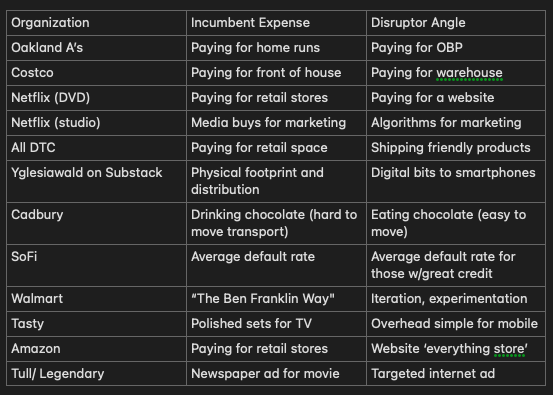
Businesses evolve to be better for the consumer. That is, to better fit the JTBD. In many cases that’s by making the same thing easier, cheaper, better, etc. Sometimes though, the job changes and the new job can be done in a easier, cheaper, better, etc. way.

Cheaper means a structural change. We made X like this, now we can make it like that and now X costs 7% less. Sometimes a business will disrupt itself and find a better way to make something. Amazon did this. When they started work on digital products, the books, music, and video business brought in seventy-five cents of every dollar.

But the job of books, music, and video was about to change. Convenience rose in importance.

Sometimes a business will make things cheaper by finding a substitute that allows for a comparable or better product. Sometimes a business will find that consumers aren’t that into X and would rather have Y, which is cheaper anyway.

Here’s a list:

The Walmart example kinda fits least but it’s also the least technical focused. It’s on anyway because it fits the spirit. To innovate – as incumbent or disruptor – requires a mindset of experimentation and a clarity of the JTBD.

Not just OK OKRs

Sarah Tavel told Share Parrish:

“At Pinterest our growth team decided their OKR was monthly active users, a lowest common denominator thing. But if you choose the wrong metric you end up optimizing for the wrong thing, you’ll build the wrong features. Startups are incredibly resource constrained and you waste a lot when you focus on the wrong things. When the team realized this and changed the OKR to Weekly-Active-Pinners the entire roadmapped changed and we were able to serve the users much more successfully.” – @SarahTavel The Knowledge Project.

Tavel’s quote could be about 2000s baseball as well. The early days of baseball Moneyball were an era of what Tavel calls vanity metrics. At one point in the Michael Lewis bestseller, protagonist Billy Beane yells: We aren’t selling jeans! His point was that classic metrics like hits, home runs, or even body-type weren’t the optimizations he was looking for.

The problem that Tavel’s and Beane’s teams faced was a data collection problem. These metrics were mostly right and easy to collect.

“I have an allergy for vanity metrics. I can see a vanity metric a mile away. It comes down to intellectual rigor and being honest with yourself: what are you measuring and is it the right long term thing?” Sarah Tavel

Really wrong metrics push behavior in absurd directions. For instance, records used to earn certifications (Platinum, Gold, etc.) based on shipments not sales. Sgt. Pepper’s Lonely Hearts Club Band soundtrack (1978) was a Platinum album but was a sales bust. That’s what happens with an OKR based on shipments, not sales.

To their credit, the RIAA changed the rules for certifications in 1979. That’s what Beane did too. Tavel too. It’s a good reminder to ask: am I using this information because it is helpful or easy?


Moneyball might be the best way to win in sports but sports is a story and stories need narrative. I loved the Tim Duncan Spurs but the media didn’t. It’s why there’s only one honest sport.

Weekly active pinners? Hold my beer.

Cruising mood

One of Tyler Cowen’s suggestions for thinking better is to avoid mood affiliation. From 2011:

“It seems to me that people are first choosing a mood or attitude, and then finding the disparate views which match to that mood and, to themselves, justifying those views by the mood.”

This is clear in politics when people judge ideas on whichever party is blaming/praising on whichever media. Rather than the easy pickins of politics though, let’s journey a sunnier path: cruising.

Cruise ships are awesome. Many miss this thanks to mood affiliation. It’s not their people. It’s not their food (buffets!). I don’t want someone to dictate where to be and when is the comment I hear the most. Some non-zero number of people look at a cruise vacation and decide they don’t like it and then come up with reasons for why.

But cruises balance flexibility with stability. The only rules are the times the ship arrives and leaves. That’s it. In that window people can do nearly whatever they want. Cruises are like Crocs, they can be as laid back or “attack mode” as the vacationer likes.

Food on cruise ships is good. The buffet is good, especially the vegetarian curry options because that is home-cooking for the international staff. Ships also offer a number of (revenue growth) fine dining options. The best of these are magnificent. It won’t be extraordinarily but how many people prioritize this on vacation?

On board are a variety of options like rock walls, FlowRiders, theaters, slides, escape rooms, and kids clubs. Off the ship are many interesting tours, excursions, and experiences. Private drivers are especially adaptable, this is another Tyler Cowen suggestion.

Look at that form!
Flowing

Cruising is not for everyone, but maybe not for the stated reasons. And Cowen, probably couldn’t stand cruising.

Vegetarian Update 1

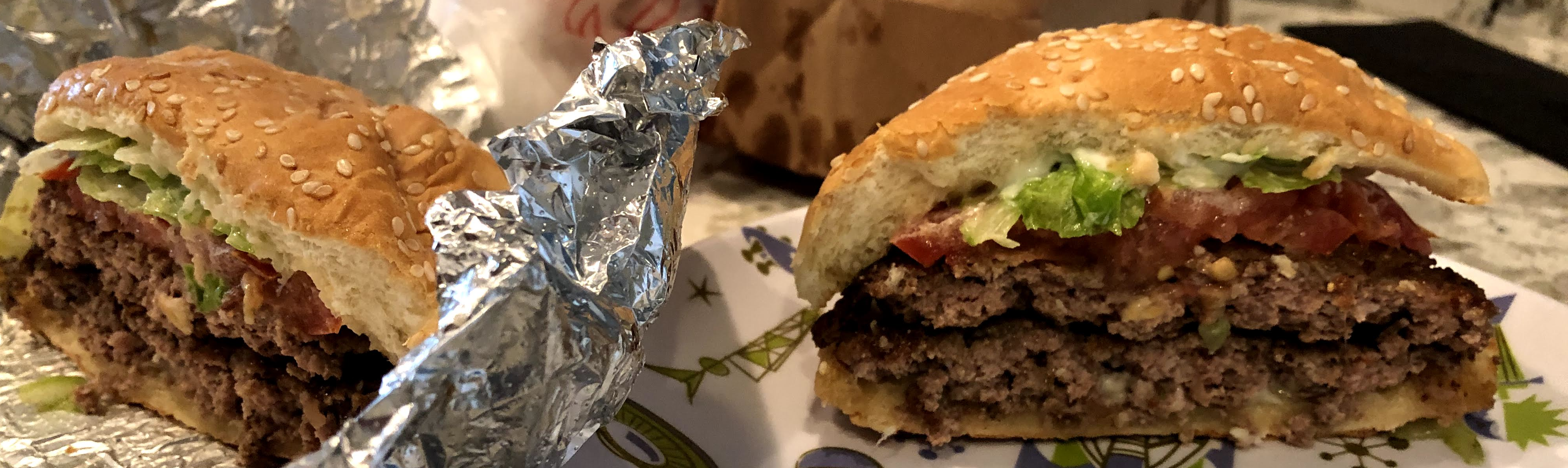
The Whopper and meatless Whopper. We did a blind taste test in May of 2020, 80% preferred the real thing, 60% napped afterwards.

Recapping, it seemed like there was potential that a vegetarian diet was healthy.  Without knowing where to start, my plan was to keep it simple, stupid. 

Simple substitutes work really well because we like easy decisions. If a dish called for rice, I used cauliflower. Spaghetti squash (roasted) became a friend. We also made a  big salad each week that served as a side or meal itself. More friction equals less change. The mindset here was “more veggies” rather than “zero meat”.

Simple recipes. One issue with internet recipes is that they can be fancy for fancy sake. Even internet bloggers use the heuristic: more work, more value. However, new recipes, techniques, and ingredients aren’t easy. To switch to eating more veggies I broke this connection with three ingredients: olive oil, salt, pepper. 

Defaults. A friend’s friend does no meal until dinner. That kinda makes sense.  Nearly all my meals are at home. This means leftovers. This is good. I love leftovers. However if there weren’t leftovers I ate peanut butter and jelly. If it worked for Steve Jobs’ outfits it can work for lunch. 

Meat substitutes. Meh. This stuff is kinda expensive and doesn’t really taste great. It might. But it doesn’t. At the moment I’d much rather have the real thing once a month than the substitute once a week. However we love beans and eggs which moved from the bench to the starting lineup in our dietary team. See also : Fix weaknesses first.

Carbs eh? Since starting in September 2020 I’ve eaten a lot more carbs, not pre-Whole-30/paleo phase carbs, but certainly more. It feels fine. My unscientific guess is that the loss of meat calories isn’t overwhelmed by the increase of carb calories. 

Bottom line:

  • The change has been easier (and more delicious) than expected because it wasn’t “whole hog”. In this case, it’s been easier to moderate rather than abstain. 
  • Defaults work. 
  • Simplicity works. 
  • We get used to change quite quickly. 

Donation Alchemy

One fertile area for creativity (and anything new is creativity says John Cleese) is in the area between zero and some. It’s in these places where something moves from free to costing that behaviors change. Oh, and it doesn’t have to be an actual cost. Mental accounting works too.

There’s a concept in charitable giving called overhead aversion.

“We know that donations tend to decrease when overheads increase. That makes sense. People want to feel confident they are having a tangible impact. Interestingly, this only applies when donors have to pay for the overhead themselves. In one study when donors are informed that an initial major donor has covered the overhead, donors are more likely to take an overhead free donation option than opt for a 1:1 matching scheme — even though the matching scheme will yield more for the charity.” – Maddie Croucher

This felt right. My reaction was, well if they muck up the overhead at least I know my money was well spent. This isn’t logical, but I’m not sure it is wrong. At my daughter’s school they collect canned food for a local food pantry. There’s a celebration for the class with the largest mound outside its classroom door.

Now, it would ‘do more’ to donate cash, rather than send food of unknown cost, calories, and willingness to eat, and again I’m not sure it’s wrong. It feels good to know my money was well spent and that the food we bought won’t go to waste.

This school’s canned food drive might be partially driven by the foot-in-the-door effect:

“I always thought that asking small, an ask you can’t refuse from the godfather, works best. If you’re giving three dollars a month it’s much easier to up that to eight or ten than it is to go from naught to fifteen.” – Rory Sutherland

It’s not like I have to find cash or write a check and put it in an envelope. The kidney beans and mac ‘n cheese are within arms reach. Not only that, my kids collect it.

Charitable donation best practices are new to me but I’d wager that what works is ease. Make things financially, intellectually, or socially easy and people will do more. If the overhead is covered that removes the question: will my money go to to those who need it? A small ask might mean that people find doing easier than considering whether or not to. Charities, schools, or businesses can all remove the hurdles for their customers.


One other idea with-regards-to the classroom donations is the social lesson. The food is tangible and the kids collect it. There’s also probably some social signaling pressure among parents to ‘show up’. So net-net is a canned food drive ‘better’?

Earned or eligible?

“We were trying to motivate vets to take advantage of an education employment benefit that they were entitled to after returning to the United States after their time serving in the military overseas. The office of Veterans Affairs had very little budget and could only send one email to veterans to market this program…We changed just one word in the email. Instead of telling vets they were eligible for the program, we reminded them that they had earned it through their years of service.” – Maya Shankar, Inside the Nudge Unit

Another way: a vaccination dose has been reserved for you.

Behavioral scientists call this the endowment effect, all things being equal we value the thing we have more than the alternative.

Cade Massey observed (2018) this in the NFL. One year a team would refuse to trade down, noting the value of a high draft pick, but the next year refuse to trade up, noting the value of multiple lower picks. All things equal is never quite true so the question is how unequal is this case?

The first step to any problem is admission and articulation. We had a derelict iMac on our kitchen desk for a long time. A few times a year the kids played Roblox and sometimes it streamed music. One day I logged in to the Apple trade-in program and discovered it was worth $240. Click, fill, submit the form and three days later a box showed up. Pack, seal, ship. Ten days on I had an Apple gift card. There’s no way I would spend $240 on an old iMac and so trading it in was an easy exchange.

If that was the whole story.

You see, this was the second time I did this. Almost two years early I did the same thing. Click, fill, submit. The box came, I procrastinated and the return, recycle, and reward never came. Why not? The transaction costs.

The endowment effect is a helpful human habit because it shields the owner from transaction costs. Exchanges have middle-men, asymmetric information, ambiguity, and egos. But words like ‘reserved’ and ‘earned’ reduce some of that mental accounting.


Another way to think about this is to ask is this a compromise or a coin flip??

Ohio’s Vaccine Lotto

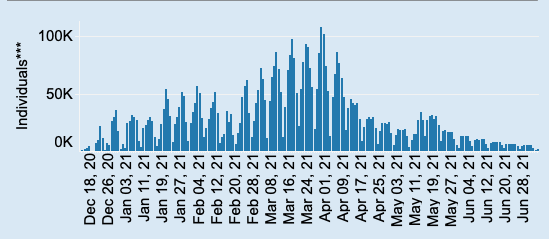
On May 12, 2021 Governor Mike DeWine of Ohio announced a one million dollar vaccination lottery. Teens were eligible for a college scholarship. Two days after the announcement Ohio doubled its vaccinations-per-day figure to thirty-three thousand people. Success!

Maybe. “States with lottery programs,” noted the Boston Globe “are not doing any better compared to states without such initiatives.”

And.

But, there are at least two reasons Ohio’s strategy was a good one. The first is the testing of new approaches. One of the beautiful things about the United States of America is the differences in states. When states do different things academics call this “heterogeneity” and “natural experiments”. While not perfect, these opportunities and observations lead to novel lessons. Part-of-the-reason there won’t be another 2020 are these learnings.

The second reason Ohio’s vaccine lottery was a good idea is an idea from Maxims for Analytical Thinking, a Michael Mauboussin recommendation:

MfAT is a book of thinking tools by Dan Levy who focuses on the ideas, information, and influence of Richard Zeckhauser. Maxim 1 is When you are having trouble getting your thinking straight, go to an extreme case. Using this lens, was the Ohio Lotto a good idea?

Imagine it this way. What if there were a Hypo-Ohio, where thanks to the industriousness, intelligence, and ingenuity of the individuals, a vaccine holiday was declared on February first. Employers gave employees the day off. Starbucks and Subway donated their stores for stick sites. Netflix was free for Ohio ISPs. Everyone that was willing and able to get a vaccine got vaccinated.
Ohio Vax

If that happened, like poker chips slid across a table, the May blip and March wave would be compressed into an early February explosion. This would have been awesome. We know from the vaccine friendship paradox that all social networks have a super-spreader. At the extreme, pulling the demand forward would be a good thing.

But what was the effect size? Here I’m over my skis. But that’s actually okay. The techniques I learned in my Ohio high school still work: remove the bad answers first. Like the 15y or 30y mortgage question, I’m looking for choosing from only the good options. At the extreme, pulling demand forward is a fantastic idea. How much effect, I don’t know, but I’m glad they tried.


Bias Warning: I thought the Ohio Lotto was a good idea from the start.
Venn Thinking

I didn’t feel great. I knew why. I’d been eating like crap. It wasn’t the less meat. It was the summer junk food.

In Florida, under the guise of ‘hurricane preparedness’, we buy junk food. It lasts forever. It’s delicious. It never makes it to Peak Hurricane Day, September tenth.

So I cleaned up my diet, kept up the exercise, and got a good night’s sleep. After a day I felt great.

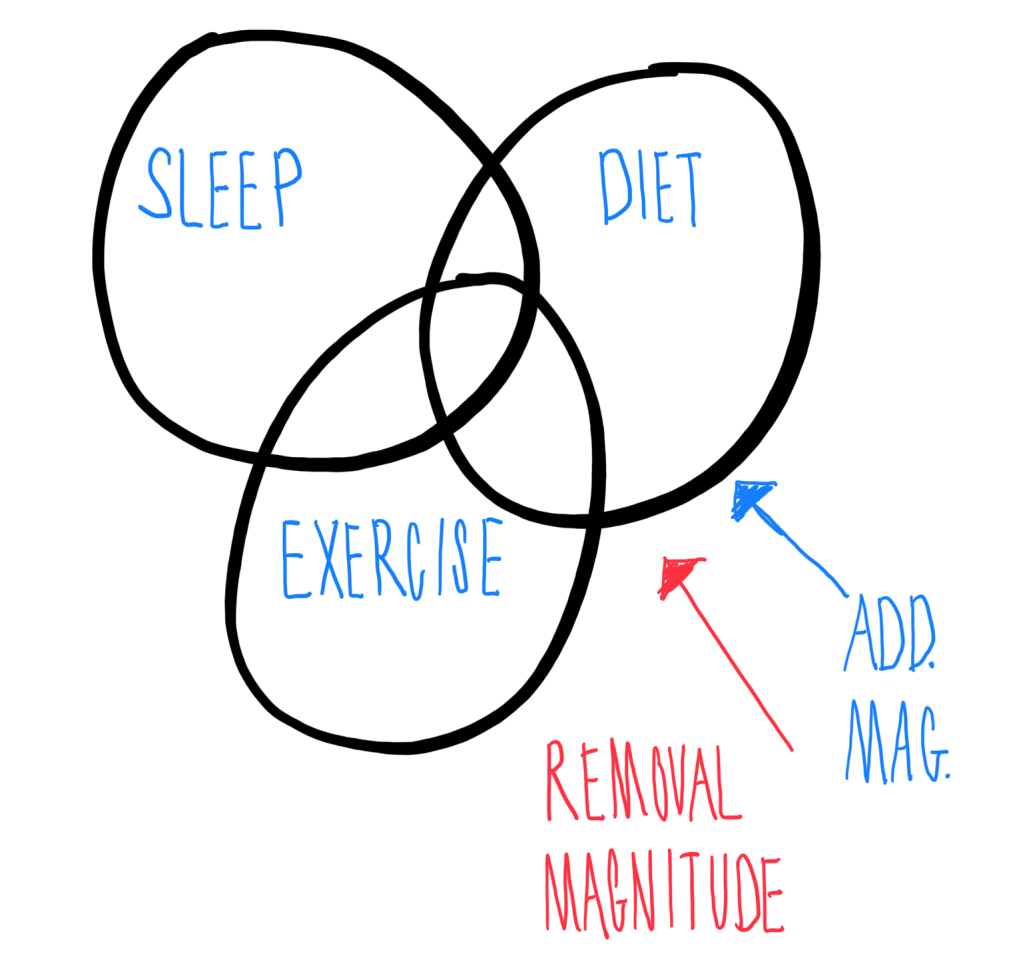
But this got me thinking. How many ideas are like this? How many Things in life are the culmination of a few different inputs? Marriage is some combination of money, resentment/enjoyment, love. Business is some combination of stakeholders, value delivery/value capture, and innovation.

Maybe each way to feel good, be married, or run a business is different, but each one probably has three or so legs to the stool with a sweet spot in the middle.

My other observation was the power of via negative. This is the idea that we can gain from not-doing rather than doing. Avoiding the wrong foods is more powerful than consuming the best ones. But removal is a brute force weapon. It does a lot of work but it only works to a point.

In the book Moneyball, Michael Lewis wrote that during the filtering phase of baseball draftees, Billy Beane would scarlet-letter-style mark players. If someone had a bad attitude or a run-in or some other glaring issue then they were a straight ‘No’. After removing those players, Beane et al. had to get to work on saying yes.

Venn Thinking is a visual metaphor: combine 80/20 thinking with via negativa. Ask, what are the key factors that drive an outcome (be careful of optics vs outcomes), then consider the brute force work of removal before optimizing on addition.

Alpha erosion and hot dogs?

Wharton Moneyball is a great podcast. The intersection of sports and business doesn’t do justice to the topics covered. Two events Moneyball does not overlook are the Kentucky Derby and Nathan’s Hot Dog Eating Contest.

During the July 2021 episode, co-host Shane Jensen asked if
it’s Joey Chestnut’s technique or some god-given gift that allows him to eat a record seventy-five hot dogs in ten minutes. Eating expert and co-host Eric Bradlow explained :

“They all do the same thing. Eat multiple hot dogs followed by buns dipped in water. Eat multiple hot dogs followed by buns dipped in water. Everybody, since Kobayashi started this strategy in the mid-2000s, uses this strategy.” – @EBradlow, Wharton Moneyball Podcast

Kobayashi’s creativity (and success) invited competitors. Alpha erosion is the idea that valuable advantages degrade with imitation. What was once scarce and valuable, is now abundant and worth less. Daryl Morey said that in the early days of basketball moneyball it was easier to draft players. By 2017 Morey noted how many other team’s draft boards looked a lot like the one in Houston.

But knowing alpha erosion exists and seeing it occur is not fait accompli. There are at least two paths: innovation and restriction.

Innovation occurs when an organization can deliver better products each year as judged by their consumers. Find the JTBD. The capacity for this is dictated by an organization’s culture. Does an organization allow for exploration, does it allow for an Innovator’s Solution. 

Restriction occurs when an organization can gain an advantage by acting in a way the competition cannot. Part-of-the-reason Dollar Shave Club and other DTC companies succeeded was because the distribution advantage of legacy companies was also a weakness. Gillette could not compete (as judged by the consumer) without upsetting the retail partners.

Restriction for an individual is to remove ego, which often opens new paths for competition success. Movie Producer Jason Blum demonstrated the success of the low-budget horror film and hasn’t suffered much alpha erosion. Part-of-the-reason, said Blum, is that people in show business like the rewards of the show part more than the business part. There are huge advantages for a person if they can look stupid.

Shoveling as many hot dogs into your mouth may not seems like a good idea. It’s probably not. But the lessons we get from it sure are tasty.