NBA’s broadcast innovation dilemma

Disruption theory (2:00 minute YouTube HBR explainer) describes how leading companies serve their customers through product improvements rather than invention.

Keurig’s innovation was capsule coffee and sustains their company with ideas like Brew ID which “recommends recipes with easy step-by-step instructions.”

It’s an innovation dilemma because sustaining innovations makes the money printers go brrr, like at ESPN.

These sustaining innovations fail when the customer Jobs-to-be-done changes.

“We started doing it for free,” Nate Duncan said on Wharton Moneyball in December 2022 about his NBA Strategy Stream show, “with the idea of eventually doing something like this back in the 2016/2017 season. We did it pretty much unpaid – our Patreon subscribers would throw us a few bucks but they weren’t obligated to – and we just built up a lot of reps doing it in the bad old days.”

Think about that. Duncan and his partner Danny Leroux worked “pretty much unpaid” to broadcast NBA games.

But they found an audience. They found an adapting JTBD.

Disruption theory also describes how leading companies can create both sustaining and disruptive innovations. One aspect is a separate P/L. But that takes financial, temporal, and status capital. Within any organization, what executive is going to suggest an unprofitable bet to create something people might want? No way.

But that’s disruption theory.
Build or Buy and a Better Approach

‘Build or buy’ choices are everywhere; from ordering take-out to business acquisitions. Bob Iger started to ‘buy’ when he noticed that the most popular parade characters weren’t from Disney but from Pixar. 

The first-level question may be ‘build or buy?’ but each has an important second-level angle. 

Build – what do we hope to learn from this experience? In Acquisitions Anonymous #148, Jesse Pujji talks about a supplement brand. 

Successful DTC brands have a successful product, distribution, and marketing system. 

Most of the product innovation, Pujji explains, is gone. Supplements are an established part of many production facilities. You could start one in thirty days. That part of the learning advantage is gone. 

So too is the distribution thanks to Amazon, Shopify, and 3PL

Common products delivered in the same way make it a game of good messages to profitable niches. That’s something a person learns by doing. The only built solution is social ads – which have become expensive. So rather than buy a supplement brand, Pujji suggests, to build one because you can’t buy the knowledge. 

Buy – what are the opportunity costs? Humans are generally bad at considering what else? Ask people about not buying a Ford and they say they’ll buy a Honda. It’s part of our mental accounting. 

Hack this system by making the choices explicit. Think like The Price is Right. It’s a choice of this or that. Did Disney debate their options? To be a fly on those walls….

Bob Iger had to buy Pixar, Marvel, and Star Wars because Disney could not build those things. Though many brilliant people could work on that project, Disney faced the innovator’s dilemma. Creation is rowdy, rambunctious, and most important to Disney – unprofitable. 

We’ve the tendency to think this or that and if this is good then that is bad. Life’s far more complicated. The opposite of a good idea may be another good idea. So ask why, ask about the second level aspects, and what else might happen here. 

Business Creation Context

I was walking around in my backyard, bored and a bit stifled Patrick O’Shaughnessy recalled during the summer of 2020, then I got a phone call. Soon after that, I started two new businesses.

This is what JTBD calls context, the state of who, what, when, where, and how. What sort of condition are people in when they make a decision?

In the 1980s, Oscar Mayer noticed falling bologna sales. To rekindle that meat market they created ready-to-eat lunches for adults modeled after the TV dinner. Customers didn’t want that bologna either.

But, when they redesigned the package for kids and called it a Lunchable, busy parents loved it. That context is hurried parents who need to get something their kids will eat, enjoy eating, and provide some nutrition.

The best way to follow Jobs theory is to subscribe to the Circuit Breaker podcast.

If you like that, subscribe to the Circuit Breaker substack. There, we recount, refresh, and revisit the ideas from each episode. So far we’ve covered…

  1. Empathetic Perspective
  2. Shopping vs Restocking
  3. Impulse Purchases
  4. Demand Side Sales
  5. Benchmarking; supply and demand

Context is a precise word but only in the context of Jobs. It’s who, what, when, where, and how.

Reset your thinking, and subscribe.

Why is this so cheap?

Our simple business model is a product, distribution, and marketing. 

  • Sex toys (product) sell better thanks to Amazon’s anonymity (distribution). 
  • RX BARS (product) sold better with a packaging redesign (marketing).
  • Catalogs, department stores, big box, and online (distribution) seeded DTC (products). 

Why is this so cheap?

One thing low-cost airlines got right, says Rory Sutherland, is they “magnify the things you didn’t get like a meal, pre-allocated seating, free checked luggage, and so on. And they had to do that to explain where the savings were taking place. Otherwise, you assumed it was worse trained pilots.” 

Yes! “People don’t just believe, here’s the price but you can get it for this,” agrees Marcia Kilgore, “you have to tell them how and you have to tell them why.”

According to Kilgore, beauty product is no longer differentiated. Everyone sells the same thing – and anyone can sell it. This is a problem for people like Kilgore. 

Hers is the ‘explain where‘ approach – we cut out the middleman. But with so many new entrants (thanks to easy products) it’s hard to communicate that message. 

“Instagram and Facebook have become the new landlords. We’re trying to get away from having to ‘pay retail’ and now you have to pay that same cut to Instagram.”

If the product is constant among beauty brands and the distribution channels are limited to retail and DTC what kind of levers exist in marketing? 

1/ Change the CAC/LTV. If Instagram is the new rent, then only acquire customers once. Kilgore’s company Beauty Pie uses a membership model like Amazon Prime. Founder Jeff Bezos said, “Our goal with Amazon Prime, make no mistake, is to make sure that if you are not a Prime member, you are being irresponsible.”

2/ More organic & less paid marketing. Instagram ads may be bid up but Instagram posts are still free. Beauty products have inherent characteristics that make how-to and before-and-after content successful. 

3/ Offer extras. The Beauty Pie boxes are nicely designed but not expensive. The message is “just as good but nothing extra”. The brand has good communication. They’re using alchemy.  

Should you build *magic*?

When talking about Jobs To Be Done, Bob Moesta notes that there are two ways to innovate. Supply-side innovation is internally driven. Organizations know their capabilities, limitations, and business model and build from that position. This type of innovation is more efficient, has limited scope (and costs!), and uses the language of the organization.

Alternatively, demand-side innovation is externally driven. Jobs theory is demand side as is the Mom Test and IDEO’s invention through iteration. This type of innovation includes prototypes and feedback, lots of questions, and uses the language of the customers and consumers. 

“Any sufficiently advanced technology,” Arthur C. Clarke wrote in 1962, “is indistinguishable from magic”. 

That quote highlights this aspect. Technology users want it to feel like magic. Builders use advanced technologies.

Face ID is magic. 

“What Apple did with Face ID was take a really hard computer science problem, and using a lot of complicated technology, create something with a simple name. I intuitively know what Face ID is just from the name. It’s also intuitive to use. I looked at it and was in. There’s an opportunity to do something like that (for crypto). Multiparty computation is not the right marketing term for what the average person might use.”

Brian Armstrong to Ben Horowitz. 

Uber is magic. 

“At first glance Uber might just look like a simple app—after all, the premise was always to hit a button and get a ride. But underneath its deceptively basic user interface was a complex, global operation required to sustain the business. The app sat on a vast worldwide network of smaller networks, each one representing cities and countries. Each of these networks had to be started, scaled, and defended against competitors, at all hours of the day.”

Andrew Chen, The Cold Start Problem.

The wrong lesson here is to think customers want magic. It’s situational! Shopping and buying are different

There is no best way to innovate, only trade offs. But Clarke gives us a nice framing for technology.

ESPN’s innovation dilemma

One pant leg on is a local maximum. One problem is solved but the larger set is not.

Clayton Christensen’s series on disruption and innovation is about local maximums.

Money machine go brrr is a strong incentive to keep printing. Maximizing a profitable business makes sense, which is the dilemma! Organizations find themselves looking good in one pant leg.

The solution to local maximums is exploration. But this is costly – money, status (uh oh), time, reputation. Plus the stakeholder’s opinions.

The solution, Clayton Christensen writes, is separation. Different groups with different strategies, finances, and when possible physical locations.

Solutions via exploration are important because customer and consumer preferences – their JTBD – change.

“We are all under the Disney umbrella,” Brian Burke said, “ESPN.com is a huge enterprise with an army of people and is a revenue generator in so many ways. It’s difficult to change course. FiveThirtyEight is agile, nimble, and experimental so (publishing there) was a great opportunity”.

ESPN.com go brrr.

Which is the dilemma, and Disney/ESPN uses FiveThirtyEight as the exploration solution. Who knows if Burke’s writing approach is better, but the publishing strategy is a solution to the innovator’s dilemma.

“The next ESPN.com” will be different. Whatever is next will have a different business model than the current Great Firms (Christensen’s subtitle). Whatever is next will have a different maximum. It will be a short vertical video or the degradation of the sport monoculture or something we can’t predict today.

Or even an analytic forward analysis from Brian Burke.

What do these numbers really mean?

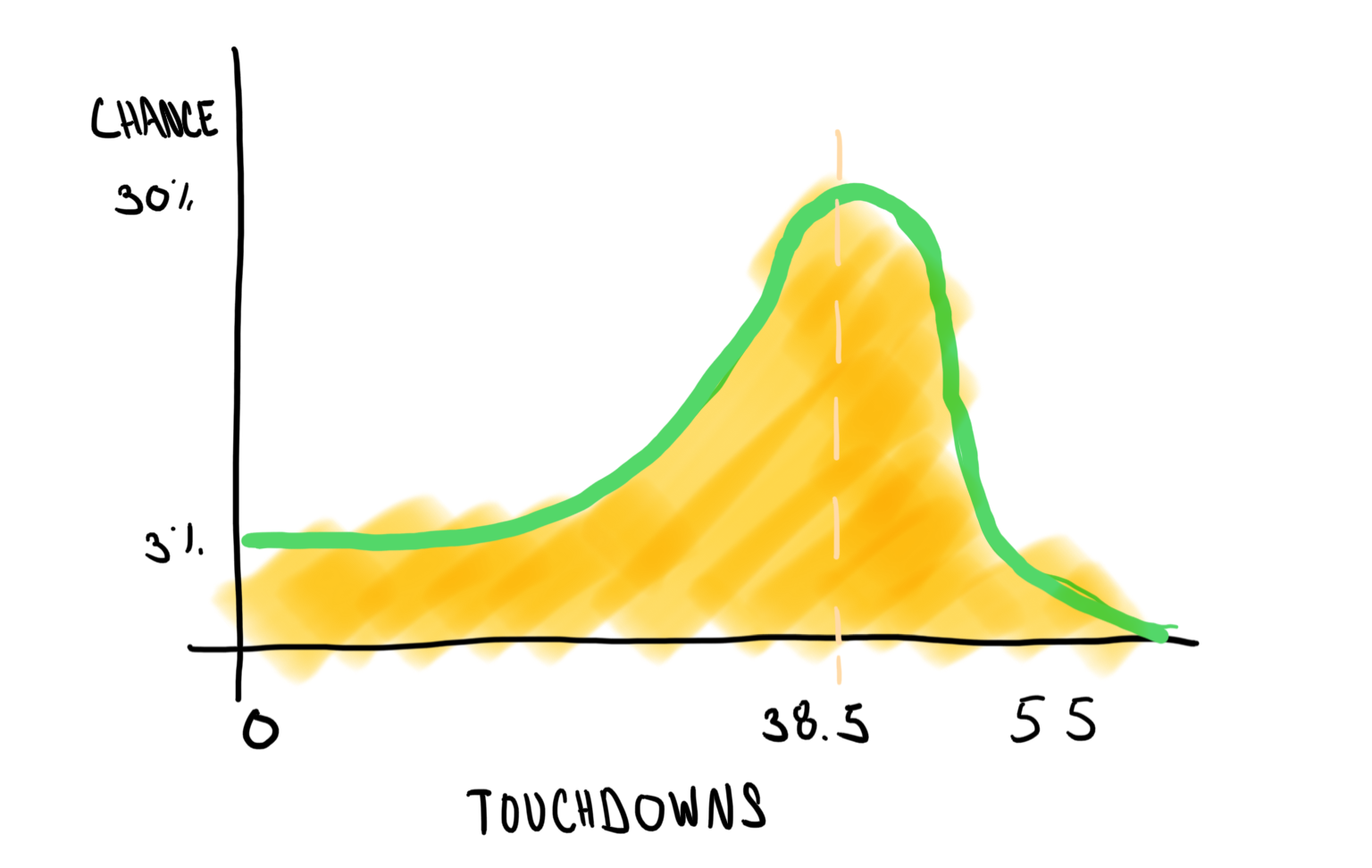
“Cold hard facts” like 32 degrees, 26 touchdowns, and 8 billion dollars trip us up. But what can be so confusing about simple numbers?

Numbers anchor our thinking. The run-up of mortgage interest rates drew the headlines rather than the typical monthly payment. Humans are relative thinkers and initial numbers frame our thinking.

There are also contextual clues to each number we see. Forty degrees can be cold or warm depending on the humidity, sunlight, wind, precipitation as well as our exertion. Ideal marathon conditions are for the runners, not the spectators.

Lastly, numbers represent distributions of outcomes. We’ve seen this with Aaron Rodgers’ touchdown tails:

And two other January 2022 news stories. The University of Georgia football team was favored to win the national championship game by fourteen points. They won by fifty-eight.

Rather than a large error, we can think of the fourteen-point betting line as a fulcrum. That was the point that balanced bets between the most common forecast: a close TCU victory or a Georgia blowout.

Another is the estimation that Chat GPT is worth twenty-nine billion dollars. It’s not, said Ben Thompson. There’s a one-sixth chance it’s worth two hundred billion.

🔢

Numbers carry more meaning than we typically assign. Life’s numbers are presented by accountants – and we need to think like auditors.

Other posts in the numeracy series include handshake puzzles and birthday bets, the problem with hurricane categories, and white water whitewash.

There are many good books about these ideas like Tim Harford’s Data Detective and the new Covid by the Numbers by David Spiegelhalter who wants us as auditors to ask, why am I seeing this number?

Kinko’s JTBD

When asked if he worried about Xerox vertically integrating, Kinko’s founder Pual Orfalea said ‘HAAHAHAHAH. No.’

It’s obvious with distance, hindsight, and present best practices that’s exactly what Xerox should have done. Move down the market, get closer to the customers, and let their purchase decisions drive product innovation. But Paul Orfalea just laughed.

And he’s right.

Xerox couldn’t have acquired Kinko’s because Xerox and Kinkos are two different businesses.

“We aren’t in the copy business. We are in the emotions business. We help people get jobs, make sales brochures, and celebrate the major moments of their lives.” – Paul Orfalea, founder of Kinko’s

People don’t want quarter-inch holes, the expression goes, they want to hang their damn vacation photos.

Orfalea figured that out and designed his organization around the idea. He empowered counterworkers to solve problems immediately. When customers came in worked up and stressed out about an errored order, the last they thing want to hear is ‘let me talk to my manager and see what we can do.’ No! An immediate refund and rushed redo was the solution, and it’s what Kinko’s did.

“Our customers didn’t particularly care how the work got done either,” Paul writes in Copy This,” But they cared passionately about obtaining relief, symbolized by the finished product.

Job to be done is a great theory for product development but it only works holistically. The Panera job is food and place. If either is ‘a mess’ then neither works. The things have to fit together as homeotelic systems. Actions A and B work toward the same goal.

Kudos to Kinko’s and Xerox for using the Rich Barton “Scrabble Letter” naming system. Orfalea credits the name of Kinko’s to his kinky hair and his mom noting that people don’t forget hard consonants, as our first is GooGoo Gaga.

Circuit Breaker Substack

“There are so many people working so hard and achieving so little.”

Andy Grove

Bob Moesta has one of the most impactful perspectives on achieving more, and on his podcast with Greg Engel discusses how to make better products, better services, and more successes.

Their Circuit Breaker podcast covers:

  • how and why to unpack jargon: our loyal customers will buy this innovative healthy snack
  • that your product is the mustard on the sandwich in the customer’s lives
  • big hires and little hires

And more.

The Circuit Breaker Podcast Substack is my tribute to the show. Subscribe for a certain job. But first…

The LEGO company is one of the most successful organizations ever. Spanning nearly one hundred years, war, factory fires (three!), expansions and depressions, currency conversions, and Nintendo et. al. the toy company has survived and thrived.

Throughout LEGO’s history, there’s always been a manager who thought: the toy is great and people will find out. Let them come.

Throughout LEGO’s history, there’s also been a manager who knows: we have to sell this thing. We go to them.

People were busy, people are busy, and people will always be busy.

That’s the job of the email: subscribe because you are busy and you want a reminder about last week’s episode, further details, and more JTBD goodies.

Alice and Bob own soccer teams…

Alice runs her team conservatively and finishes with 17 wins, 17 draws, and 4 losses. 

Bob runs his team with more variance and finishes with 19 wins, 11, draws, and 8 losses. 

Which is better? 

Let’s reframe, like the ball bet. Is it better to exchange 2 wins for 6 draws and 4 fewer losses? 

Haralabos ‘Bob’ Voulgaris bought a soccer team because he knows these answers because he’s seen these questions. 

After Moneyball but before Morey-ball, Haralabos discovered and gambled on basketball inefficiencies. The best known now is the three-point shot. Voulgaris thinks that soccer is similar. Teams earn three points for a win, one for a draw, and zero for a loss. Rather than three or two points in basketball, it’s three or one points in soccer standings.

Soccer’s business model is like the music business model. Artists lose money recording an album, break even touring, and profit from the merchandise. This had to be Pixar’s business too. Division three soccer teams lose money, division two teams break even, and La Liga or Premier League teams “print money”. 

Soccer teams can move up (promotion) or move down (relegation). Bob’s team, CD Castellón is in the third division and they need about sixty-eight points for a chance at promotion. 

Both Alice (17/17/4) and Bob (19/11/8) earned sixty-eight points – but they don’t seem equal. This is Bob’s point – it’s worth risking more for wins than less for draws.

The big question is: What are the right metrics for this system? 

  • Hurricane wind speeds are probably the wrong metric. Though easy to measure they don’t convey the potential storm damage which comes from the rain, surge, and flooding. Moneyball and Morey-ball are both descriptions of systems where the important metrics shifted.
  • ‘Draws’ is a wolf in sheep’s clothing. It seems fine – splitting the difference between a win and a loss – but the unique point system shifts the weight. 
  • Risking more – Bob’s approach – focuses on what matters. It’s the points stupid.

Humans are loss averse but the soccer standing scoring rewards bucking this trend. Alice and Bob own soccer teams, let’s see what happens.