What is Mike’s Notes?

Rather than write more short e-books, longer printed books, or bulging blog posts I started a (paid) monthly newsletter. It’s $20 for six months.

My goal is to create something to be read offline. It comes in PDF, EPUB, and MOBI attachments on the last Friday of the month. The most value will come from reading it without an internet connect and on the weekend. Why?

Habits.

With each iPhone software update, I mutter under my breath that Apple engineers need a sign that reads if it ain’t broke don’t fix it. A few days later I forget I had any problem because I’ve been retrained for tapping, swiping, and refreshing. I’m just a monkey that pushes a button for a reward.

The way I read is also trained by the internet. The context of LOOK MA, I’M CONNECTED TO THE INTERNET has one set of habits. In RSS readers I swipe. In Twitter I scroll. In browser tabs I close.

The internet is awesome for many things but horrible for learning. It’s trained me to expect random rewards and come back for more.

Mostly.

Shane Parrish has a great email newsletter that comes out Sunday mornings. Tren Griffin‘s comes out Friday. Patrick O’Shaughnessy‘s podcast comes out Wednesdays. The regularity keeps me consuming their content.

That’s why Mike’s Notes will be delivered on the last Friday of each month in printable and e-reader form.

Is Mike’s Notes for me? Probably not. People who should not buy this include:

  • Those reading more than two books a month.
  • Those listening to podcasts and taking notes.
  • Those watching YouTube lectures.

Most of all this isn’t for people on the fence. If this doesn’t immediately sound like a great idea, or you don’t think the excerpt below is great, do not buy this.

This is only for people who want to learn and believe – after reading this blog – that I can be one of their teachers.

The section below is part of the March 2017 edition.

The Yin and Yang of Negotiations

In Never Split the Difference, Chris Voss suggests that tit-for-tat and split the difference negotiations are the easy way out. He opens the book with a critique of the Harvard Negotiations Project and the book Getting to Yes. It’s okay, Voss writes, but you need to know more.

I’ll admit my bias. Getting to Yes is a book I regularly refer to. It’s one of those books – much like spiritual texts like the Bible, Meditations, or the Tao de Ching – where you don’t need to read it cover to cover. Instead, the most value comes from dipping and sipping.

Voss is a former FBI hostage negotiator who took the ideas from GTY and evolved them. Never Split isn’t a replacement for GTY, it’s a supplement. The two books are like yin and yang. One was built by academics in ivory towers, the other by a hostage negotiator in Central America.

The two books have a lot in common and combining them we get a whole that’s greater than the sum of their parts. Let’s look at what to do before and during negotiations.

Before negotiations

There are three questions you must answer before the negotiations.

  • What are the facts of the situation?
  • What are the perceptions of the situation?
  • What are some options out of the situation?

Another way to put is to follow Charlie Munger’s “two-track” analysis.

“First, what are the factors that really govern the interests involved, rationally considered? And second, what are the subconscious influences where the brain at a subconscious level is automatically doing these things – which by and large are useful, but which often malfunction.”

What kind of facts are there? Try to accumulate as many facts as possible that support your side of the negotiations. In GTY this is so you can “insist on objective criteria.” For a house sale some of those facts will be; comparable homes in size, school district, or amenities (master bath, pool). A seller might also stress the newer appliances while a buyer might note the older roof. Voss writes that you “fall to your highest level of preparation.”

The second facet is the perceptions each party may have about the negotiation. My brother recently closed on a home purchase and part of their final offer to the sellers was a letter about their growing family and a picture of his one-year-old son. That appealed to the buyer’s perception about who might own their home. Other things like “entertaining guests” or “safety” may be perceptions a house buyer holds as important.

Finally, you should prepare your list of options for a negotiation. Time, for example, gives you a lot of optionality. Voss often dealt with kidnappers and realized they lacked the option of time because they dropped their ransom demands as the weekend got closer. Why? They wanted fun money. After he learned this Voss decreased negotiation payouts only towards the end of the week when the kidnappers were more antsy to get paid.

Be creative when you answer these pre-negotiation questions. Voss compares a negotiation to playing cards. You don’t know what the other person is holding, so you need to come up with a wide collection of options. It won’t be all-encompassing, but coming up with ideas beforehand can prepare you for the negotiations when those cards are finally played.

During negotiations.

Listen

Voss spends most of the first part of his book explaining how to listen – and for good reason. Listening is hard. Eric Maddox had a difficult listening job. He was the interrogator in Tikrit Iraq in 2003. Special Forces operators would bring prisoners to Maddox and he had to put aside his feelings (“These men just shot at me”) and focus on the facts. Maddox wrote, “I didn’t care how bad a prisoner was, or was supposed to be…It was important to look at both sides as objectively as I could.”

“Your goal at the outset,” writes Voss, “is to extract and observe as much information as possible.”

How do you become empathetic and collect information?

Voss’s tactics They say You say
Be a mirror. “This is a family heirloom and it’s hard to part with.” “You must have a deep connection with it.”
Repeat their last 3 words. “My grandmother passed this down to me.” “She passed it down to you?”
Label their pain. “I just don’t know if I can give this up.” “It sounds to me like there’s an emotional connection to this item.”


Remember that during this discovery phase, the aim is understanding, not agreement. The more you can get the other side to talk, the better. In GTY the authors warn against a negotiation concession where a psychological one will do. Sometimes people just want to be heard. There’s a two-minute YouTube video with fourteen million views that show this.

When Danny Meyer opened Union Square Cafe he had a lot of kinks to work out. That meant he had to negotiate with a lot of customers. Your table is not ready, we lost your reservation, we’re out of fish and so on. Meyer wrote in his book, “For most people it’s far more important to feel heard than to be agreed with.” He added that as the service provider you always get to write the last chapter.  At his restaurant, this meant a free glass of dessert wine to people who had something unplanned occur. This wine was cheap for Meyer to provide but valuable to his restaurant guests. It’s a tactic Voss et al. would applaud.

Positions are not concerns

As you listen develop a picture of the person’s concerns which manifest as requests. When I bought the house I live in now I learned one of the concerns from the seller was moving closer to town. I would never have guessed this and it’s an example of something I didn’t and wouldn’t know about. At the time I didn’t think much of this but in hindsight I see that this was a concern mostly for the wife. Her husband worked a lot and so the burden of errands, time in the car, and taking kids (they have four boys) to activities weighed more on her than him. Her position was to sell the house, but her concern was to spend less time in the car.

Dollars are often front and center in negotiations but because it’s a convenient language for concerns. Credit cards that offer rewards in hotel or airline points are other versions of convenient metrics. Remember that everyone has concerns beyond the dollar.

Landlord $ …and stable, mature tenant who pays the rent on time. They also want minimal vacancy and limited expenses for maintenance.
Employer $ …and institutional memory and minimal switching costs associated with hiring new employees.
Salesman $ …and fast transactions, referrals.
Chris Voss $ …and publicity. Voss agreed with the Memphis Bar Association to a reduced rate in return for a magazine cover article.
Warren Buffett $ …and quality businesses. Buffett went from looking for “cigar butts” to chasing “moats.”

Never Split and GTY both emphasize control and security as two fundamental human concerns.

Another concern to keep in mind is that of the third party. In a home purchase there is the seller and buyer but also the buyer’s bank who will require a home appraisal to validate the loan amount.

Ken Grossman found out the hard way about negotiations with third parties when he tried to buy out his partner Paul Camusi. The two had gotten funding from friends and family. In that group was Camusi’s extended family. After years of negotiation and mediation, Grossman got a good enough agreement and bought out Paul and his family. Even though negotiations like this can take a long time,

Voss writes that if you hear someone described as “crazy” you should take that as a signal to look for clues.

Early on he didn’t pay his employees as much as other places but he wrote, “they loved what we were doing and it was a fun place to work.”  He identified their concerns as enjoying life. Part of that was how much you got paid and part of it was how much you liked your job.  By 2009 Grossman had build a larger and more successful company and created on-site daycare, medical care, and classrooms. Grossman understands his employees concerns.

He didn’t understand this for his buyout of Camusi. You see, he didn’t have to buyout only Paul but also Paul’s mother and others who had given the company loans in the early years. Few people are actually crazy, what’s more likely is that you don’t understand their concerns.


As always, thanks for reading, Mike.
Sean Iddings

Supported by Greenhaven Road Capital, finding value off the beaten path.

Sean Iddings was on the Five good questions podcast hosted by Jake Taylor. What I like about 5GQ is the conciseness and structure. While long conversations can be delightful, there’s also something to a crisp thirty-minute interview. Taylor does that. So does Aaron Watson.

In this conversation, Iddings and Taylor talk about intelligent fanatics. Iddings paraphrases Charlie Munger and says these are people that “do things ordinary mortals can’t.” It’s the John Patterson and Sam Waltons of the world. “Intelligent fanatics see things others can’t see,” says Iddings. That is, intelligent fanatics have these moments:

thatsinterestin

Jim O’Shaughnessy had his moment as a kid when he walked past a group of (adult) family members who were discussing stock purchases based on the personality of the managers rather his numbers.

Eric Maddox had his moment when he interrogated prisoners and found out that they told him things that didn’t jive with another story he’d heard.

Investors, interrogators, and intelligent fanatics all pay attention for that’s interesting moments and tug at them like a loose thread on a sweater.

Iddings is an investor and he’d prefer to find intelligent fanatics early but knows that’s not easy. To help he uses a spectrum approach. “I like to think of intelligent fanatics as a spectrum,” says Iddings. Spectrums are relative (rather than absolute) scoring systems. Michael Mauboussin articulated the luck <-> skill spectrum. Andy Weissman thinks of his VC deal flow on an active <-> reactive spectrum. Greg Ip wrote about the spectrum of ecologists <-> engineers.

A spectrum works nicely because you can identify something as here and want it to be there. 

Iddings finds intelligent fanatics through pattern recognition (a superpower). He compares it to playing the guitar, study and copy the masters. Jeff Annello compared it to chess. “I think an efficient decision maker is like a chess player that has studied a lot of games, and can very quickly call to mind other moves that have been made and what the best moves are.” Warren Buffett’s inspiration, Ted Williams, played baseball. Each investor has their own metaphor for pattern recognition.

Taylor wonders if the phase of intelligent fanatics has passed. Maybe they had an economic tailwind? We’ve seen that successes like Coca-Cola, Sierra Nevada (Ken Grossman), and McDonald’s (Ray Kroc) all grew in part because of favorable economic ecosystems. Even Steve Jobs got a boost from illegal digital music downloads.

Those tailwinds may be gone, but Iddings is a student of history. He knows that history doesn’t repeat, but it may rhyme. “It’s going to be in a different way but it’s still going to be replicable,” he says.

Thanks for reading,
Mike

Jeff Annello

Supported by Greenhaven Road Capital, finding value off the beaten path.

Jeff Annello is the coconspirator at Farnam Street and through some internet wandering I found two of his interviews that had some nice ideas. One with Halelly Azulay at The Talent Grow Show and the other with Chris Macintosh at The Big Question.

What appealed to me in these two interviews was Annello’s sense of work. He seems like a “lunchbox” worker. Show up each day, do good work, and your rewards will compound. If that was all I got from his interviews, that mindset would have been enough. But there were more notes than just that. Ready?

1/ Tools of the trade. In both interviews, Annello uses the analogy of a tool for mental models and said, “a mental model is a tool that helps you understand some particular aspect of how the world works.” Analogies like tools for mental models are good because they help articulate ideas. For example, one of Charlie Munger‘s oft quoted pieces of advice is to destroy your bad ideas. At the 2017 DJCO meeting Munger said he’s been busy doing this:

“I’m very busy destroying bad ideas because I keep having them. It’s hard for me to just single out one from such a multitude. I actually like it when I destroy a bad idea because it’s my duty to destroy it.”

Now mix in Annello’s tool analogy and we can visualize throwing out old tools and replacing them with new ones. Anyone who’s switched from corded drills to cordless ones or replaced a dull saw blade appreciates the new tool. So it goes for our mental models.

Annello, like a craftsman, enjoys the tools. “What’s constantly exciting to me is getting lifelong tools in the toolbox.” You see this in computer programmers who like to code and in woodworkers who have more planes that you’d ever thought possible. If you enjoy using things you’ll use them more.

Great jobs (like working at Farnam Street!) – writes Cal Newport – are rare and valuable and require rare and valuable skills. If you can match your temperament, work ethic, and luck in life towards tools used in those jobs you’ll get them.

Of course using a tool doesn’t mean using it properly. Annello suggests getting reps. “I think an efficient decision maker is like a chess player that has studied a lot of games, and can very quickly call to mind other moves that have been made and what the best moves are.” Annello knows that pattern recognition is a superpower because it saves you time.

Bill Belichick won a Super Bowl because he and Ernie Adams taught it to Malcolm Butler. Warren Buffett idolized Ted Williams because of William’s pattern recognition at home plate.  This superpower is built, just as Annello says, through repetitions. Which works for almost everything says Arnold Schwarzenegger:

A book interlude.

Annello said suggested It’s Your Ship for leaders. Sapiens was “an amazing book.” The Power Broker was “a fabulous book.” Poor Charlie’s Almanac is “the best summation of what causes us to make the errors we make.” Explaining Social Behavior was “an amazing book.” The Honest Truth About Dishonesty was good too.

2/ Biases and decision making. In both interviews, Annello was asked about common mistakes and he says one is “first conclusion bias.” Munger likes to say, Annello explains, “I never let myself hold an opinion unless I know the other side of the opinion better than that person does.” Avoid this bias with a “step back and ask, is that actually the best decision?”

My first conclusion bias was to think, “Yes, this a good idea.” But wait a minute. In agreeing with Annello aren’t I doing just that? Letting my first reaction rule the day? Rather, let’s take the scientific approach (“Good science bombards ideas from all possible angles,” Annello says) and test this.

Annello points out in the interview that for physical things, there’s isn’t really a bias. Ducking, catching, swinging, hoping or dodging are all skills honed over thousands of years of evolution. We’ve got a good track record for decisions of that sort. What trips us up are complex systems we aren’t well adapted for.

One way to improve our decision making in these areas is to spend time planning for the important parts. The Mercury, Gemini, and Apollo missions ran as many simulations and calculations as possible ahead of time. Flight director Gene Kranz said that they aimed to have most everything figured out. “During a mission countdown or even a flight test, so many things would be happening so fast that you did not have any time for second thoughts or arguments. You wanted the debate behind you.” The capsule speeds went from 5miles/min to 5miles/second and first reactions had to be correct. They sharpened them through preparation.

In other instances, we can slow down. Here’s what Danny Kahneman told Michael Mauboussin:

Better decision making comes from good preparation beforehand and awareness when to slow down so we can avoid the first conclusion bias.

3/ Disruption. Companies lose market share because something happened they didn’t expect. “The core thing you’re asking yourself,” says Annello, “is, does the world really work this way or not?” Is the way you’re doing business a way that will continue to work?

It’s difficult to answer this from within the system. “There’s this problem of being inside a system and not being abe to see it,” says Annello. What you need to do is “solicit advice from people who don’t belong to your worldview.”

When Reed Hastings excluded the DVD executives from the strategic meeting of the company it was an exemplary exception.

“One of the most painful moments along the journey was the DVD was all the revenue, all the profit. We were hybridizing it with streaming and getting more attention but the discussion was still around DVDS. We realized that we had to kick out the DVD executives of the main management meeting. That was hard because we loved them, but they weren’t adding value in terms of the streaming discussion. We compared ourselves and asked, ‘Compared to a streaming pure play, what would we do?’”

Companies must change, even though it’s hard. “It’s very difficult for a business who has dominated one sort of business model to adapt their model to the new world and dominate in another way,” says Annello. Yet, they must.

4/ Reading. 

“Like everything in life, reading has opportunity cost. The time you spend reading articles online is time you’re not spending reading something deeper and long lived, like a book.”

Reading, like any other verb, occurs when our habits (internal default) or structure (external default) allow for it. Part of [passing the marshmallow test](https://thewaiterspad.com/2017/03/06/steven-pressfield/) is having If/Then plans to circumvent temptations. If  I sit down, Then I’ll have a book rather than my phone. Even small obstacles – constructed or removed – can get us to do more of one thing and not another. Annello wants you to read more, so do I.

Thank you for reading,
Mike

Denis McDonough

Supported by Greenhaven Road Capital, finding value off the beaten path.

Ezra Klein asked, “how do you actually run a White House?” As chief of staff for President Obama, Denis McDonough knows. From the interview were four questions about leadership.

  1. What do you want in a leader?
  2. What does a leader need to know?
  3. What incentives matter?
  4. What about planning?

Ready?

1/ A good leader, says McDonough is three things.

  1. “I think you want a president to be well read and constantly updating on that.”
  2. “Disciplined.”
  3. “Open to arguments. You don’t want an ideologue in there. You want someone willing to learn new things.”

Obama, McDonough said, did these things. Karl Rove said similar things about George W. Bush. Both presidents were frequent readers. Obama, McDonough said, was “someone that’s constantly reading what’s coming to him but also going out and finding other stuff.”

Good leaders create a culture to argue well inMichael Mauboussin explains it this way, “A final dimension of learning is creating an environment where everyone in the organization feels they can voice their thoughts and opinions without the risk of being rebuffed, ignored, or humiliated.” In business, we see this in Jeff Bezos. In sports, we see it in Sam Hinkie and  Bill Belichick.

Good leaders also create a culture of learning. McDonough said he was inspired by Duke coach Mike Krzyzewski to put a sign on his desk that read “What and where am I learning today?” The idea came from hearing Krzyzewski talk about coaching the Olympic team. The main reason to coach that team, Krzyzewski said, was to learn more about the game of basketball.

2/  A good leader knows the other side. McDonough said:

“What the American public should expect is that he’s spending the kind of time to prepare for his decisions on issues commensurate with the impact it will have on the American people’s lives. If you run into a citizen on the street who is impacted by a decision you made, do you feel that you could argue to that person that ‘I know this impact on you has been significant but I spent a long time really thinking about it and considering the alternatives. I know it has impacted you in a negative way but the national interests have been advanced in the following way.’ Rather than saying, ‘My gut told me this was the best thing to do.'”

Good leaders have deep understandings of their own house, but also the neighbors, and the entire street. Grant Oliphant does this in his non-profit work. Ken Grossman used it to build a brewery. Wesley Gray used it on the battlefield. A deep understanding requires knowing your side, the other side, and the overall conditions.

3/ A good leader understands Incentives. McDonough said he was talking to a colleague who gets a lot of people that come to him for advice. These – mostly young – people want help deciding whether to remain public servants or go to the private sector. McDonough’s friend asks if they want to work for an office with a flag, or if they want to build the next Yelp.

Adventure may be an incentive. Tom Jermoluk, who worked with Jim Clark in the 1990’s said, “Jim was building the coolest stuff. You wanted to be around just to see what was going to happen next.”

Access and community can be incentives. Matthew Crawford wrote:

“The fringe benefit of a discount on parts, and the use of a lift after hours for his own car, is a big part of the compensation. Having the next crop of kids coming in and seeking his advice is no doubt another part; he rises in stature. Showing up at, say, the local dirt track oval on a Saturday night, with his shop’s posse in matching T-shirts, is another pleasure.”

Just simple job enjoyment can be an incentive. Grossman’s brewery ran on fumes during the early years and the employee compensation was middling. People stayed on, wrote Grossman, because they liked working there.

4/ A good leader plans – and then adapts. Plans don’t survive impact, but planning helps says McDonough, because “you trust each other and can make a (new) plan when the shit hits the fan.”

Andy Grove wrote to “plan the way a fire department plans: It cannot anticipate where the next fire will be, so it has to shape an energetic and efficient team that is capable of responding to the unanticipated as well as to any ordinary event.”

Thanks for reading,

Mike

Jim O’Shaughnessy

Supported by Greenhaven Road Capital, finding value off the beaten path.

Jim O’Shaughnessy joined his Patrick O’Shaughnessy on the Invest Like the Best podcast to share some life lessons. Serendipitously I listened to Sean Iddings on Five Good Questions and he mentions the book Thirty Lessons for Living. Jim would make a good addition to the book. What I liked most was Jim’s attitude. “Everyday I woke up and said, boy I’m lucky to be alive today because I’m going to go in there and figure out more.”

pablo (12).png

Jim’s learning started early. He remembers being a kid at the family library and hearing the adults discuss investment choices. The debate centered on personalities. That’s interesting, thought Jim, what about the numbers? He snuck off and did some research and found that the best returns were from companies with low P/E ratios, not dynamic leaders.

Often the genesis for better ways is someone seeing the old way and thinking, that’s not how I’d do it.  Eric Maddox questioned interrogation techniques. Ray Kroc questioned why a sleepy town had a great burger place. Daryl Morey questioned a Sports Illustrated cover.

But because a new idea is better, doesn’t make it easy. Just because Jim unearthed something that worked didn’t mean he could do it. Behavior is simple but not easy. 

“Investing is like dieting. There are a million diet books on the market today. Most of them have simple, easy to execute plans and it is remarkable difficult to get anyone to use that simple system. It’s all emotion.”  – Jim

“A lot more than people think is pure discipline.” – Patrick

“I couldn’t agree with you more.” Jim

To hijack a quote Jim would appreciate: “The name of the thing is not the thing. The stated returns are not your returns.

Trouble begins when you deviate from a good plan, says Jim. “The four horseman of the investment apocalypse are fear, greed, hope, and ignorance.” The first three are all about emotions.

Once Jim figured out what to do (use the numbers) and how to do it (with discipline) he started to build out his company. He gave four pieces of business advice.

  1. Hire adults for decentralized command. “You tell me the way to do it and that’s how we’re going to do it.”
  2. Be consistent in your actions. Jim says he has a low standard deviation.
  3. About meetings. “Meetings, for the most part, are a waste of everyone’s time
  4. Reputation. “Our business is based almost entirely on trust.”

Through all this, Jim had an attitude of discovery and the work didn’t feel like work. Phil Jackson opened his book this way:

“When you do things from your soul, you feel a river moving in you, a joy.” Rumi

And with this attitude, you’re motivated to practice and do many repetitions. Jim says that if you want to learn about art, “you want to look at tons of art.”

Here’s how Arnold Schwarzenegger put it:

Here are the books Jim O’Shaughnessy suggested:

  • The Tao De Ching. “I’ve been reading and reading this book since I was in my early twenties and every time I open the book I find yet another interpretation I hadn’t thought of.”
  • Adventures of a Bystander. “You look at this and say, ‘this has to be a work of fiction.'”
  • Surely You’re Joking Mr. Feynman. “This guy really had it all.”
  • Zen and the Art of Motorcycle Maintenance. “A great book.”
  • Cloud Atlas. “A tour de force.”
  • The Misbehavior of Markets. “The chapter on the destruction of the efficient market theory is worth the entire book.”
  • When Breath Becomes Air. “I’m not a crier but at the end of the book I did have tears in my eyes.”
  • For better communication, O’Shaughnessy suggested On Writing Well and How to Win Friends and Influence People.

Jim O’Shaughnessy also spoke about luck and in this last quote we circle around to where we started.

“Luck is the hand you’re dealt, talent and achievement is how you play that hand.”

Thanks for reading.


Gary Taubes

Supported by Greenhaven Road Capital, finding value off the beaten path.

Gary Taubes joined Russ Roberts on EconTalk to discuss his new book The Case Against Sugar.

This episode is another example of Roberts’s excellent podcast work. I don’t finish every episode, but do start each one. The subjects are interesting and the questioning and conversation is engaging. If you read this blog, you’ll like that podcast.

Two mini ideas before the notes.

I was shooting hoops with my daughter on an otherwise nice spring day, except for the wind. For each shot, I had to aim slightly left of the target if I wanted the ball to go it. I think biases, backgrounds, and beliefs are like the wind. We all have these unseen forces that push our conclusions one way or the other. If we want to be most accurate we need to aim a little left.

After half an hour we came inside and I thought, “that was fun.” Shooting hoops with your kids has an asymmetric return. Taubes makes the case that eating sugar is also asymmetrical. If you stop eating licorice sticks that’s a small payment for the potential upside if Taubes is right.

Onto our notes.

1/ Who comes up with new ideas? “You could argue that the times when paradigms shift, they are often driven by people outside the field with a different perspective and who aren’t trapped by the belief system of the field.”

Michael Mauboussin wrote in More Than You Know that one attribute of successful active investment managers is “geographic location.” Those people have one foot in the old (their domain) and one in the new (their location). There are other examples of this.

  • George Lucas worked in Hollywood (old) but moved to San Francisco (new) to get out of the, as Taubes says, “belief system.”
  • Warren Buffett worked for Ben Graham in New York (old) but moved to Omaha (new).
  • Paul Farmer studied medicine and medical anthropology at Harvard (old) but practiced, almost completely, in Haiti (new).
  • Sam Hinkie read investor letters (old) and applied that to running an NBA team (new).

Danny Meyer asks himself the question, “Whoever wrote the rule?” when he’s considering a new venture. In asking that Meyer gets out of the old belief system.

2/ “Nature does not divide itself neatly into textbooks.” – Neil deGrasse Tyson

Taubes said:

“Last fall I was doing a BBC interview by Skype on a program where the host was a very charming geneticist from Cambridge or Oxford and he studied the genetics of obesity. I said to him, ‘Do you know what regulates the flow of fat into and out of fat cells?’ He said, ‘We don’t know that.’ I responded, ‘No you don’t know that because you are a geneticist and don’t read endocrinology textbooks, but this was worked out in the 1960’s.”

Recently I finished The Well-Education Mind (basically Tools of Titans for classical education) and was struck by how connected education can be. In the book, Susan Wise Bauer lays out a schedule of education where everything is tied, knotted, and strung together like glistening spider web. Facts don’t bob alone by themselves but instead are connected. I knew this but I don’t learn like this.

3/ Experimentation. Toward the end, Roberts talks about schools, and tells Taubes:

“Your honesty about the data reminds me of when I passionately suggest we should try an alternative to the public school system…when I say that people say, ‘what’s the evidence that your system will be better?’ I say, ‘that’s really hard to accumulate.’…all I see is that we’ve had three generations of inner city kids that haven’t gotten an education.”

Experimentation, said Brent Beshore is the secret to business success (if there is any secret at all). Ken Grossman spent his first year of work at Sierra Nevada experimenting with new recipes and systems. Take time to experiment on new things, but then, writes Andy Grove, GO!

“The time for listening to the Cassandras is over. The time for experimentation is also over. The time to issue marching orders – exquisitely clear marching orders – to the organization is here.”

Thanks for reading.

ps To circle back to where we started, what’s the wind for Russ Roberts? He’s a great interviewer but he has a lens he sees the world through too. So do I. So do you. Also, podcasts have an asymmetric return (all learning does). I like how Ramit Sethi put it:

Screen Shot 2017-04-01 at 7.39.25 AM.png


Exponent #108

Supported by Greenhaven Road Capital, finding value off the beaten path.

If you know of someone doing better commentary on technology and business than Tren Griffin at 25iq.com or Ben Thompson and James Allworth at Exponent.fm please let me know.

Each post or podcast is like the idealized college course; informational, educational, entertaining, timely, and taught by someone who’s walked the walk. Jocko Willink addressed this specifically on Twitter:

There has never been a better time to want to learn things. Wow.

Exponent episode #108 from Thompson and Allworth was about artificial intelligence in technology and they go into the issues much better than I could. Our goal is to back out and look at some of the bigger ideas.

Ready?

1/ Technology. The episode is about the growing pains between no artificial intelligence and ARTIFICIAL INTELLIGENCE. Much like Tyler Cowen wrote about the industrial revolution, the end may be nice but getting there may be messy. Some areas will see this shift before others.

“Any space that has any sort of routine work and generates data is very susceptible to this,” says Thompson. “Data is what allows the learning to take place. It’s the application of these learning algorithms to data that allows this sort of intelligence.” We’re early in this shift Thompson says, right now it’s “basically statistics gone wild.”

Allworth is more precise with a prediction:

“There’s this fascinating NPR article and it’s a map of the most common job in every state over time. There are lots and lots of secretaries in the 70’s and 80’s. Fast forward to 2014 and the most common job in every state is truck driver. They’re everywhere. Look at this big push, all this money, that’s chasing autonomous vehicles. All those jobs are at risk. It’s the same thing you just described, it’s routine and there’s lots of data.”

We can look at another technology that contributed to drastic changes, The Box. But first, checkers.

One of the first games my kids learned was checkers. Their favorite part is the double (or triple) jump. This is when instead of capturing one piece, a player captures multiple pieces by consecutively jumping the opponent. Kids love this. One day, my seven-year-old daughter double jumped and landed in my back row. Not only did she get the thrill of the double jump, but she got a king as well.

When we play, I sprinkle in these opportunities but don’t point them out. The conditions exist but my daughters have to find them first. Business success seems to be like this. A founder is in a game of checkers and if they can see a few moves ahead they can wisely position their business. This is what happened with the shipping container. Once that move was made, a flurry of events followed that changed the game.

Here’s what Ian Cassel wrote about the man who created the container. “Malcom McLean is known, or actually unknown, for having reinvented the modern world of global trade…His impact on transportation is right up there with Henry Ford and yet his story remains relatively unknown.”

McLean invented the shipping container and the ships that moved them around the world. With this change, entire industries vanished. From 1967-1976 New York City lost one-third of its manufacturing jobs. Another victim was the garment industry. “With an ample supply of cheap labor and a well-established distribution network, New York was prepared to meet the demand,” at the turn of the 20th century. But shipping containers changed the rules for labor and distribution. Of course, with shipping containers, dockworkers also saw their jobs go away. It was contraction through attrition.  What used to be a good job that employed generations of men in the same family became unavailable.

One change – from bulk and crate shipping to containers – but many effects.

Technology is like a river. It allows for an ecosystem to grow around it. New York City was a great place for making clothes because there was labor (many people, minimal cost) and a good port. The technology of the shipping container changed this is in a big way.  It rerouted the river, and when one ecosystem died out another grew up.

2/ Inverting problems. Thompson (helpfully) directs the conversation to the boots on the ground situation. We may be in a simulation, but debating this doesn’t address a lot of actual problems. Thompson says:

“It’s the big picture versus the little picture thinking. Being worried about general intelligence is being worried about the big picture, the extinction of the human race….but for now there are lots of under the surface, smaller picture worries. By smaller picture I mean, very big large massive problems. We can talk about the other problem too, but there’s a lot of talk that needs to be done about this problem.”

“That framing of top down, bottom up is exactly right,” Allworth says, “I hadn’t thought about it like that until just then it’s such a fantastic articulation.”

Inverting is thinking forward and backward about problems and can be a helpful tool for solving sticky situations. When Allworth reframes a situation as being bottom up, he’s flipping the point of view.

When Ken Grossman ran a bike shop he had no college education and barely got through high school. It could have been helpful to take night classes on running a small business (the top down approach) or he could run his own business and learn on the go (bottom up). Grossman did the latter, and it worked out well because he saw another bike shop go out of business and learned what not to do.

“If you want to understand something, take it to the extremes or examine its opposites.” John Boyd

There are valid points of view from both the boots on the ground and from thirty thousand feet and we can use both perspectives to answer questions.

3/ Soap for bad language.

“What are they going to do when no one wants their CAT scan read by a human when the machine does it better – did I just get on a soapbox?” – Allworth

Even in a podcast – a technology river itself – we still allude to old ideas. According to Wikipedia:

Throughout the 19th Century and into the 20th, prior to the invention of corrugated fiberboard, manufacturers used wooden crates for the shipment of wholesale merchandise to retail establishments. Discarded containers of every size, well-constructed and sturdy, were readily available in most towns. These “soapboxes” made free and easily portable temporary platforms for street corner speakers attempting to be seen and heard at improvised “outdoor meetings,” to which passersby would gather to hear often provocative speeches on religious or political themes.

If “tweetstorm” every replaces this I’ll be tempted to become Captain Fantastic myself.

4/ Winner take all. Thompson said:

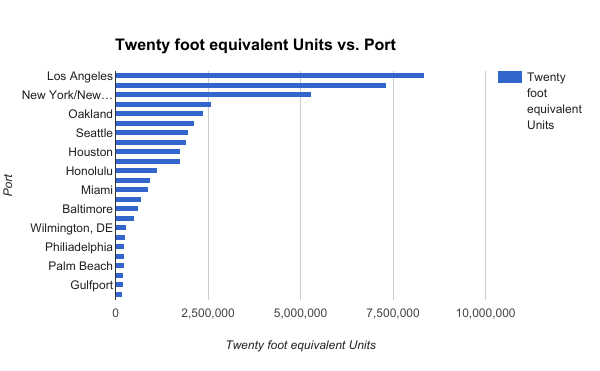
“The problem is that, the best writer in the world can be read by everyone, the best artist can be viewed by everyone, the best music can be heard by everyone. There’s no, ‘all the different courts of Europe will be patrons of the arts’. There’s going to be the best. The best dominate in a world of zero cost distribution. The story of technology broadly and practically of anything digital is the dominance of the up front fixed cost winner.”

This was the case for the shipping container. Ports, ships, and companies are all a winner-take-all situation.

image (5).png

Writers then too will be a winner-take-all. Gulp.

But people like this blog. Why do people read this and not Thompson? Thompson is right that in a world of “zero cost distribution” the best dominate, but best is subjective. My favorite podcasts aren’t yours. Businesses that define themselves as best in class/niche can survive. A local newspaper that does great work can survive in the internet age.


And “best” is flexible. Right now Facebook is the best social network, but I spend more time on Twitter. Someday it will be something new. Twenty years ago, writes Michael Lewis, in The New New Thing it was Microsoft this and Microsoft that. The Seattle titan was going to eat Yahoo, reshape the healthcare industry, and barrel into anywhere else they wanted. Only they didn’t.

Winners take all but only in categories and for the moment.

5/ Regulatory moats. Thompson said:

“Any regulatory repeal that benefits large corporations is the wrong sort of regulatory repeal…(about Verizon/AOL deal, “sorry I got on your soapbox”)…the sort of regulation that is so problematic is the regulation that restricts new kinds of businesses because that’s the opportunity cost. What you will so often find is that the folks opposing the repeal of that sort of regulation are the companies that are already in place….they love regulation because it locks them in.”

In Cowen’s 2017 book, The Complacent Class he writes about this as a contributor to the stasis. “In other words, it is harder for new firms to get up and running, but successful firms stick around for longer; both are signs of stasis.” Thompson warns against regulatory tailwinds (or moats).


Thanks for reading, Mike

Eric Maddox

Supported by Greenhaven Road Capital, finding value off the beaten path.

Eric Maddox was the interrogator who laid the bricks in the road that led to Sadaam Hussein. His story as told in Mission: Black List #1 and in a podcast interview with Patrick O’Shaughnessy was both fascinating and instructive. The book is moviesque and I wished it were forty pages longer. What was day-to-day living like in Iraq? How did they get food for their refrigerator? How did they get the house they lived in? What was their day like?

I want something one part MTV Cribs, one part Lifehacker’s How I Work, and one part Undercover Boss.

For now, all you get is me. Ready?

Maddox ended up in Iraq not because he spoke the language, but because he had just enough relevant skills. As someone only partially qualified, he was sent to an area that needed someone with only partial qualifications, Tikrit.

As we’ve seen with Bethany McLean, Kara Swisher, and Danny Meyer the backwater can be a great place to start. “It’s fascinating that being off the beaten path is such a key advantage,” said O’Shaughnessy. For comedian Pete Holmes it was the college he went to.

For Maddox, that advantage included a decentralized command structure. “There was no superior standing over my shoulder, watching my every move,” Maddox writes. That allowed him time to think and learn, to talk and listen, to plan and practice.

Maddox arrived in Tikrit and pretty green. He had some formal education (negotiation training) but doubted its efficacy. The system taught “wouldn’t work on me,” Maddox said, “I wouldn’t break.” Maddox has to adapt his education and figure out a better way to interrogate prisoners. Asked six months later – after the capture of Sadaam – what his system was, Maddox writes, “I let detainees information guide me from the beginning.” He talked to everyone; friends, family, street thugs, nobodies, suspects and more without an assumption about what they could tell. Maddox doesn’t automatically trust anyone, but he listens to them.

In his book, Never Split the Difference, Chris Voss compares it to playing cards. You don’t know what the other person is holding but it could be something you’d like to have or know. Voss writes that you should plan for things that could happen (known unknowns) but be open to unexpected information (unknown unknowns).  This is what happened to Maddox.  “The prisoners were giving me ideas I couldn’t even think of on my own,” he said.

In the beginner’s mind there are many possibilities, in the expert’s mind there are few.

After he talked to many people, Maddox believed that coalition forces were following the wrong leads. The old regime had expired. There was a new organization Sadaam was leading.  “I could create a link diagram based on what I was being told by prisoners, not what others had already assumed.” Maddox had to find the Chesterton Fence that was military strategy in Tikrit. He approached the fence, and before tearing it down, asked if it was still relevant. It was not, so he cut it like a Gordian Knot.

That didn’t mean Maddox knew what the new system was, just that there was a new system. He continued to interrogate prisoners and had a that’s interesting moment. All of  Sadaam’s old bodyguards were out of the loop – except one, Mohammed Ibrahim. Maddox writes that this was “very peculiar.”

How do you negotiate with a suspected terrorist? How do you get information from someone who was just shooting at you? Maddox had to rebuild a process on the fly. Here’s what that included:

  • Be objective.  “I didn’t care how bad a prisoner was, or was supposed to be,” Maddox writes. “It was important to look at both sides as objectively as I could.” The Harvard Negotiation Project calls this adopting the third stance.
  • Build empathy to figure out incentives. Maddox found out that prisoners want two things; freedom and safety for their family. When Chris Voss negotiated with younger kidnappers he figured out they wanted party money for the weekend.
  • Maintain relationships. Before a raid, Maddox hung out with his sources, “just as a way to keep the connection between us active.” This was part of the problem with Sam Hinkie’s process.
  • Build career capital. Maddox was only partially persuasive when it came time to convince his superiors where and when to act. It was only as he built up career capital that people began to support his ideas. Trish Higgins said “You earn your right to take risks.

Listening well – where this all starts – is like being a Driver’s Ed instructor. You have to pay attention to the situation from the other person’s point of view.

Maddox loved his job. He writes that Thanksgiving wasn’t lonely because it gave him a chance to reflect on the “engrossing work.” He had entered the positive feedback loop of skill and passion:

PassionSkill (1)

Mohnish Pabrai said to find something you’d like to do more than going to the movies. Manoj Bhargava said to find something you like to do more than following sports. Ken Grossman put it this way:

“I knew all too well how tough my business was to run, and unless they [Grossman’s kids] were as passionate about it as I was, it would not have ben a fun or successful livelihood.”


Thanks for reading.

If you made it this far you might like something else I’m writing. It’s a monthly newsletter that ties in connections just like this blog. It’s for people who want to keep learning but lack the time or “footstool” to get started. It comes as a monthly email attachment and its meant to print out and read “nonline.” You can see a sample here, or sign up here.


Melanie Whelan

Supported by Greenhaven Road Capital, finding value off the beaten path.

Melanie Whelan is the CEO of Soulcycle and she spoke wth Tony Robbins about the company she leads.

First, a theory. Fitness is a fashion. In the same way pleats, patterns, and pants come and go as popular, so do forms of fitness. Soulcycle – et al. – is the current thing, but how long will they last? Not long ago people criticized cycling because there was too much body weight support. Was that valid? Does it matter?

Threads will be tweaked, dyed, and spun in new ways but it’s still just a material stitched together. Exercise is much the same, movements sold in new ways. We won’t predict the future of Soulcycle, only that trends come and go. But, there’s still much to learn. Branding is a moat, and if Whelan builds a strong one at Soulcycle then like the Nike or Coca-Cola, the company will persist.

Here are 4 questions that businesses must ask and that Soulcycle has answered.

  1. Is there a market?
  2. What is your MIT?
  3. Do you hire right?
  4. Do you have WOMM?

Ready?

1/ Do people need what you’re selling? Soulcycle began because founders “Julie and Elizabeth had moved to New York from Colorado and Los Angeles where fitness was part of their lifestyle – they’d go to spinning or yoga or hiking and they couldn’t find anything in New York.” Scratching your own itch is a great way to solve a problem, but it doesn’t solve the Iron Law of the Market.

Tony Hsieh wrote that after his startup he wanted to run a new business, but not one selling “seven fingered gloves.” They might be the best gloves every made, Hsieh wrote, but if there’s no one to buy them then they aren’t really worth anything.

The Instagram founders thought there might be a market as phone cameras got better and social media grew.

In The New New Thing Michael Lewis chased Jim Clark around Silicon Valley through the 1990’s. Of two of Clark’s grander ambitions, one died and one survived all because of the market. Netscape was a smashing success while ITV failed. Even though the later was a larger investment in time, money, and talent, there was no market for an internet connected television.

2/  What is your Most Important Things? The MIT is the foundation of your business. Soulcycle, says Whelan, is “a hospitality company first.” Much like what Danny Meyer aims for in restaurants, Whelan tries for fitness. At Soulcycle this means “a yes in every interaction.” If you don’t get into class today, you’re placed at the top of a waitlist for tomorrow. If you want one bike but it’s taken, you get it next. Meyer suggests that any business owners can “write the last chapter for their guests.”

To get people that act with a hospitality first mindset, you need to find the 51% solution (another Meyer term). This means getting people who solve problems, take initiative, and act rather than react. “We believe you hire for attitude and aptitude and not experience,” said Whelan, “We will teach you everything you need to know…we want someone who naturally looks at the glass as half full.” This is also the reason there are no Soulcycle franchises. “We don’t franchise because we’re in the experience business,” says Whelan.

Details are easy to teach, attitude is not.

When Ray Kroc opened his first McDonald’s he hired a hardware salesman with no food service experience. He was “fastidious with great endurance” wrote Kroc.

3/ Do you hire right?  Whelan said that there is a format for each class, but instructors are “free to lead it however you’re inspired. What’s meaningful in Seattle is different from what’s meaningful in Coral Gables.”

Good organizations have a decentralized command. Hire the best people you can, then get out of their way.

During the Apollo 11 moon landing, there was a lot of pressure. The Mission Control Flight Director Chris Kraft told Gerry Griffin “Young man, we don’t have to go to the moon today. It’s your call.” That was important, wrote Gene Kranz, “The impact of Kraft immediately removed all political pressure from the decision. Griffin knew all he had to do was make the right technical call.”

Pete Carroll does this too:

“When I help guys in our organization I’ll give them guidelines. ‘When we’re in a situation, it’s okay to do this, if it doesn’t work out I’m fine with that.’ I try to instill in them a risk-taking mentality when then need it…If I’m not making the call, they’re making the call for me and I’m going to try to bolster their confidence to go for it…If you called it on my team, I’m the one that ultimately takes responsibility for it. So go for it.”

Fellow coach Phil Jackson wrote that the most effective approach to coaching “is to delegate authority as much as possible and to nurture everyone else’s leadership skills as well.” At the coaching level he implemented this too, “each coach had a high level of autonomy, but when we talked to the players we spoke as one.”

Leaders lead, they don’t micromanage.

4/ Is your marketing good? The best marketing is word of mouth marketing. It’s how Whelan ended up in her first Soulcycle class. “I have this rule in my life where if I hear about something three times from three different people I have to go and try it.” So she went, saw the culture, and liked it.

Jason Calacanis said that if you haven’t hit WOM you haven’t made a great product. Reed Hastings said the Canadian Netflix streaming experience was “a rocket ship” because of WOM. Jeremy Liew looks for WOM for his VC investments.

WOM is how lots of people get started and Whelan admits that it’s part of the reason classes are predominately men. She says this is “an opportunity we’re trying to solve.”

It’s this last line – “an opportunity we’re trying to solve” – that might sum up a business. Have a growth mindset and be willing to wrestle with a problem each day, knowing it won’t go away but will be back at your door tomorrow.

There’s this great scene in Billion Dollar Ball, at an early season practice for a woman’s rowing club where each athlete must test themselves against the machine. Each person rows for as long as she can and her results are recorded. It’s a game you can’t win. One senior notes, “the machine always wins.” That’s true at Soulcycle too. No one ever beats the bike, but that’s not the point. The point is to get back on the bike again tomorrow. It’s to be back at your business the next day.

Thank you for reading, Mike. I’ve got a new thing, it’s a (paid) monthly newsletter for people who like these blog posts. You can see a sample here.

Ken Grossman

Supported by Greenhaven Road Capital, finding value off the beaten path.

Ken Grossman tells the story of founding The Sierra Nevada Brewing Company in his book Beyond the Pale.

Sierra Nevada - Pale Ale (15809951871)

There must be something about breweries. There are notes here from Jim Koch (Sam Adams) and Dick Yuengling too. My guess is that brewing beer satisfies the soul. A link between work and outcome could be another Incentive.

One more thing to chew on before we get started. In March of 2017, Yuval Noah Harari started a podcast tour to talk about his books; Sapiens and Homo Deus. I haven’t read the latter, but the former was good. It was built on the idea that sapiens succeeded because sapiens used stories. This blog uses stories too, but do you?

The TLDR version of Grossman’s story is this. Thanks to some early positive male influences, Grossman was able to channel a nonconformist streak into productive skills such as wood and metal working, electronic, bicycle, and auto repair and eventually homebrewing. Lacking funds, Grossman built out his brewing capabilities one jury-rigged piece of equipment at a time. As such, Sierra Nevada expanded slower than possible but never overshot demand. Two other major factors were good timing (luck) and Grossman’s dogged work ethic.

Grossman was lucky in many ways. Danny Meyer wrote that luck is when naivete goes unpunished and that was true for Grossman. As I read the book I thought he would have gotten along well with Yvon Chouinard. Both liked to be outside, figure out their own solutions (for Grossman this involved some illegal activities), and not to listen to authority.

This inclination could have had disastrous outcomes. The list of anti-social outcomes is much larger than pro-social ones for someone with this attitude. Luckily Grossman ended up as an entrepreneur. You can rebel against the world in only so many ways.

Grossman was lucky to be nudged in this direction thanks to some kind neighbors and teachers. He didn’t see much of his dad after he divorced Grossman’s mom so it fell to other men to fill the role of father figure.

One was Big John across the street. “Another one of Big John’s traits that rubbed off on me was a thirst for knowledge…Anything was fair game.” Grossman started to read widely and learn. Another positive influence was shop class, which Grossman calls an “adult-sanctioned” hobby.

These figures were important because there’s a see-it-to-believe-it quality in a lot of people’s success. For Michael Lombardi, it was seeing a name. For Reed Hastings, it was seeing streaming on YouTube. For Judd Apatow, it was seeing Steve Martin washing his car. Here’s how Malcolm Gladwell put it:

As for the rest of school? “School sucked – I couldn’t stand the confinement, rules, and authority.” It’s not that Grossman was lazy, “I have always had the need to keep busy, not just physically but also mentally.” It’s that school really does stink. Someone once told me that they build prisons and schools the same way. When I pick my kids up from school it’s unnerving how true this is.

Grossman graduates high school but has no plans. His hobbies are hiking, photography, electronics, cars, and home-brewing. Grossman tries college but drops out. Instead, he gets his XMBA running a satellite bike shop. Grossman writes that his location was profitable, well stocked, and had a loyal customer base. The main shop did not. It was through seeing what to do but also what not to do that Grossman learned about what it takes to run a business.

After the bike shop goes out of business Grossman opens The Homebrew Shop. It’s a place homebrewers can go for supplies and support. There’s limited demand. Grossman is married and has a child. The Homebrew Shop doesn’t earn enough money so he gets a weekend job at another bike shop. Four years later he founds Sierra Nevada.

To set the backdrop let’s pull a quote from Jim Koch. In the 1970’s and 80’s American beer was like making love in a canoe – fucking close to water. It was the nadir of American breweries. Many small companies were going out of business because they were trying to be like the big breweries. They sold mostly the same product but due to economies of scale couldn’t compete on price. Grossman, along with fellow Californian Fritz Maytag (Anchor Steam), wanted to be different and make a new kind of beer. The trend for beer was “not to offend anybody’s taste sensibilities,” Grossman writes.

“Our lives became consumed with bringing our dreams to fruition,” Grossman writes, “Everything we did was with that goal in mind.” He tried to get a small business loan but he had no credit. This turned out to be a blessing in disguise as the prime rate soon climbs to 21%.

Short on cash Grossman scours bankruptcy auctions of old dairy equipment. It’s good enough, but not designed for a brewery. Grossman returns to school to classes like welding, agriculture, and refrigeration. This also gets him access to equipment so he can make modifications on his second-hand equipment. The first year of Sierra Nevada Brewing was all construction and equipment acquisition.

Grossman (eventually) got everything working and brewed a consistent batch. He sold it around Chico only, lacking the volume for distribution. During the 1980’s the industry started to grow and looking back Grossman realized that the breweries that failed made two mistakes.

  1. Inconsistent quality.
  2. Borrowing money.

Rather than keeping a low overhead, breweries borrowed too much. Not Grossman. “Our plan was to save every penny we could to generate enough cash flow to survive our first year.” Sierra Nevada didn’t grow as fast as they could have, they often had to limit shipments to their distributors, but they survived. Soon they got some buzz from San Francisco magazines and being served at Chez Panisse.

Grossman’s hours didn’t decrease. “(I) felt torn about not being able to spend more time with my family,” wrote Grossman. “Running a brewery was as difficult as running any other kind of business – hard work, long hours, low funds, and tough decisions.” To be good at anything requires some commitment – say 10k hours – and that precludes other things.

Here’s what that growth looked like:

  • 1985 4k barrels.
  • 1986 7k barrels.
  • 1989 20K barrels. (Breaks ground on a second brewery)
  • 1992 60K barrels.

How did Grossman do this? One step at a time. “If I looked at the obstacles we faced all at once, I would have thrown in the towel.” One example that could have inspired Elon Musk was a clandestine utility modification. Frustrated with a water line that kept breaking, Grossman writes, “I solved that problem when I rented a trencher and ran 500 feet of new pipe to the meter early one morning without telling anyone.”

Once they hit 60,000 barrels a year, Grossman hired a sale rep. rep, for the entire country. They didn’t need more because the best marketing is a good product. Scott Galloway calls this the “first rule of marketing.”  The beer sold itself.

Grossman didn’t do it on is own. The people who worked at Sierra Nevada “loved what we were doing, and it was a fun place to work.” As the company became more successful Grossman built The Oasis, an onsite medical facility with massage and lactation rooms. He also built Little Foots childcare on site. I told you he would have gotten along great with Yvon Chouinard.

He also needs to credit his family. Running a brewery is “all encompassing” and his family “has suffered from a lack of attention.” But the glove fit for Grossman. He felt for brewing like Bill Gates felt for computers or Mohnish Pabrai felt for investing. Grosman doesn’t know if this will apply to his kids. “I knew all too well how tough my business was to run, and unless they were as passionate about it as I was, it would not have been a fun or successful livelihood.” Most of Grossman’s successful brewing friends are “highly engaged and somewhat consumed by their companies.”

The great careers are infinite games. “This is a journey; there is no definite end point, and we will continue to strive to great great products.” Ray Kroc wrote that business isn’t like a painting you put finishing touches on and hang on the wall.

Thanks for reading.

In the first draft, I wrote ‘jury-rigged’ as ‘jerry-rigged.’ Not sure if I was correct I searched out the word origins. I had hoped that it would be Jerry after an industrious tinkerer, possibly in memory after a Darwin Award. Alas, it’s nautical. A jury-mast was a temporary one.

I’ve got a new thing, it’s called Mike’s Notes.