Ben & Jerry’s: The Inside Scoop (book review)

Ben & Jerry’s: The Inside Scoop is an underrated business book. Traveling through the 1980s and 90’s it chronicles the growing pains of America’s favorite ice cream pints. 

It’s a business book with two parts. 

The fun stuff

Two hippies create, grow, and scale a super premium ice cream brand from a converted gas station in Vermont! That’s fun. 

On Black Monday 1987 the duo showed up on Wall Street with “That’s Life, vanilla ice cream with pieces of stale apple pie (the stale pieces held up better in the ice cream), and Economic Crunch, which was actually some leftover Nutcracker Suite from the previous winter, renamed for the occasion.”

Ben and Jerry drove around in a Cowmobile promoting the brand. On their one-year anniversary, they hosted a block party, with Ben and Jerry organizing, acting as characters, and offering free ice cream of course.  

The grind

“Amateurs talk about strategy,” said Omar Bradley, professionals talk about logistics.” 

Ben & Jerry’s wasn’t the only super-premium ice cream. Häagen Daz was the market leader and a bunch of me-toos. Starting in Vermont, a state with no Baskin Robbins franchise was probably a blessing. 

But the distribution was still a grind, sometimes literally as their beat-up delivery truck broke down delivering the pints. Once they contracted out to distributors it was a game of sharp elbows for shelf space, full of kickbacks, relationships, and lawsuits. 

Even the Beatles had a logistics machine! 

Oh, and the people. 

Every business is built on the foundation of its people. In a podcast with Brent Beshore, Anu Hariharan said she looks to invest in good teams with product-market fit. This is despite her technical and financial backgrounds. To paraphrase: It’s the people, stupid. 

But that’s also the hardest part of a business. 

While Ben & Jerry’s product line, market share, and revenue grew, the team’s expertise did not. They hired slowly. Not because of a great vetting process but because they were overwhelmed. They fired slowly too, a terrible combination. 

Oh, and the finances!

We won’t recount the story here, but in Shoe Dog, Phil Knight writes about taking all of his profits back to the bank to say, see, these things sell, now please give me another, larger loan.  That happened in Vermont too. Inventory. People. Facilities. Raw materials. New facilities. At least they could drown their sorrows in a fresh pint. 

Be your own boss with your best friend(s), but work like hell.

Sounds right.
Freezer doors

There’s something mentally stabilizing, even encouraging, to know what’s going to happen.

Not precisely. Not like a crystal ball. Just generally, like a heads up.

At a parent meeting, my daughter’s volleyball coach said, the season is long and the work is hard, at some point your kid will want to quit, don’t let them.

That was good. It prepared the parents.

We don’t always get this information

Sometimes we get the “Instagram” life. That’s unhelpful.

In 1987, Ben & Jerry’s had their best summer ever: a year-over-year sales increase of 60% to 32 million dollars.

Financially things were good.

Functionally things were a mess.

At their brand-new plant, the freezer doors didn’t have “tolerance”. The sliding doors were only just large enough for a forklift to perfectly pass through. Sometimes it didn’t. The result was that after enough banging on the freezer frame, the staff left the doors open and relied on the plastic strips to insulate the ice cream as best it could.

“The term freezer door,” wrote CEO Fred Lager, “became a metaphor within the company for anything that wasn’t working and was being ignored despite a painfully obvious need for attention.”

Human resources, processes, and candy chutes were all freezer doors.

They had to address these growing pains.

At an all-hands meeting after the busy summer season wound down, Ben Cohen gathered everyone and gave a state of the company. To address the freezer doors he asked everyone to form groups and create a list.

There were a lot of complaints, but Ben took them all in stride. “It’s only an indictment of management if you think that a well-managed organization doesn’t have problems,” Fred recalled Ben’s comments, “This was just telling us what we had to work on and letting the employees know that we knew about it.”

It was a heads-up.

These wrap-ups that lead to heads-ups are post-mortem reviews. At the Rewired Group, they are a mandatory part of the process. But they don’t just successfully happen.

Our egos can get in the way. Post-mortems are NOT to assign blame. Howard Marks called this book, “a very interesting book on self-justification” – aka somebody f’d up and it wasn’t me.

What works better is a culture of extreme ownership. This starts at the top. Ben Cohen wasn’t a perfect leader. No one is. In Lager’s book, he comes off as demanding and not fully aligned with the rest of the ice cream crew. But what he does do is avoid the ego trappings of the top position.

“Eighty-five percent of all problems,” wrote Deming, “are system problems not people problems.”

Be wary of the ego. Address the system. Fix the freezer door.

The Lego Story (book review)

The LEGO Group was founded in 1932 by Ole Kirk Kristiansen and the story is told in The Lego Story by Jens Andersen.

The takeaway, like all successes, is to work hard and get lucky. Rather than a review, let’s tour history through industry.

1919, Denmark’s economy slows. “Farmers in Billund and other districts benefited from Denmark’s neutrality during the First World War, by selling grain and meat to the warring nations and earning some extra hard cash by producing peat.” When farmers have money they can pay carpenters like Ole Kristiansen. And if farmers don’t, they can’t.

1925, a fire in Ole’s woodshop. This will be a recurring theme.

1929, the depression. “For a while, the future looked promisingly bright, but shock waves from the Wall Street Crash in October 1929 that wiped out billions of dollars in wealth quickly spread to Europe. Germany and England, Denmark’s biggest trading partners, were badly affected, and the price of grain, butter, and pork crashed.”

1932, anything that sells. Though woodworking had been his trade, it was the 1931 Yo-Yo craze that inspired Ole to make toys. “By the 1930s, yo-yo-ing had become a nationwide fad,” writes Chat GPT, “with tournaments and competitions being held across the country.” Ole’s brothers and sisters want to know why a good carpenter would waste his time, “I think you’re much too good for that, Christiansen—why don’t you find something more useful to do!”

1933. “We worked like dogs, my wife, my children, and I, and gradually things began to pick up. Many days we were working from morning till midnight, and I bought a cart with rubber wheels so the neighbors wouldn’t be disturbed when I took the packages to the station late at night.”

1940, Germany invades Denmark. Though occupied (and part of the resistance group, running grenades to saboteurs in LEGO boxes) it was a good time for LEGO. Parents were “keen to protect their children from hardship,” and during the five years of occupation, LEGO’s revenue grew.

1942, another fire in the woodshop.

1946, plastics? Ole buys a plastic molding machine. Through the early 1950s executives at LEGO will say no no no, plastic toys will never take off.

1947, Ole sees his first plastic brick from an English toy manufacturer. This is the seed for LEGO but will prove a thorn in their intellectual property side for decades to come.

1951, the top-selling LEGO toy is the (plastic molded) Marshal Plan-delivered Ferguson tractor.

1955, LEGO bricks roll out to toy stores.

1956, LEGO bricks roll out to Germany. Andersen writes, “Selling toys in Germany would be like selling sand in the Sahara.” LEGO advertises in one city, Hamburg, creating a two-minute film to play before features. Word spreads.

1958, good news, LEGO invents the tube on the underside of the LEGO brick. Ole Kirk passes away and his son Godtfred takes over.

1962, the Scale Model Line. Godtfred grows up playing LEGO, so do other people. What if we make LEGO for professional adults? The Scale Model line is for engineers to design with LEGOs. Even the everyman could create his own house. The project fails but leads to the 1/3 size pieces ubiquitous in today’s sets.

1968 LEGOLAND Denmark opens. It’s a hit.

1976 oil crisis. “A significant part of LEGO’s challenges in the 1970s could be ascribed to two separate oil crises, a stagnating global economy, Denmark’s falling birth rate, and a declining toy market abroad.”

1978 minifig enters. Lego, Kjeld Kristiansen notes, has three phases: blocks, wheels, and mini-figures.

1989 LEGO pirates. But Gameboy too.

If there’s one consistent lesson through each decade of LEGO it’s the importance of sales. Every few years someone comes along and says the toys are good enough and every few years someone else reminds them but we have to sell these things. It’s just hard work.

Russian Reading List

There’s a financial advisor axiom that the best plan is the one you’ll stick with. For trainers, it is exercises done through a full range of motion. The best endocrinologists find an achievable plan, not an ideal one. There should be one for education too. With that in mind, here’s a list of Russian resources optimized for consumption rather than comprehensiveness.

We’ve done this before with books about China and related, history books that are business books.

The Rest is History (podcast). Some podcasts are better than books because the host(s) add context. Dan Carlin is great at this. Tom and Dominic do too, and their series on Vladimir Putin is excellent.

Red Notice. A finance thriller? Yep. Bill Browder spent decades opening, running, and closing a fund in Russia during the switch from communism to oligarchy.

Muppets in Moscow A 2022 book, h/t Marginal Revolution about Sesame Street in Russia.

Exporting Raymond. We love Phil Rosenthal’s Netflix travel/food show Somebody Feed Phil. This is the story of taking the show Everybody Loves Raymond to Russia.

Koylma Tales via Agustin Lebron called it “a collection of stories of people who lived in the Gulag, possibly the most revealing book on human nature I’ve ever read.” Takes place through the 1930s and 40s.

Sandworm: A New Era of Cyberwar and the Hunt for the Kremlin’s Most Dangerous Hackers. Forgot this source. “The true story of the most devastating cyberattack in history,” notes Amazon, “and the desperate hunt to identify and track the elite Russian agents behind it.” 2,000 reviews averaging 4.7.

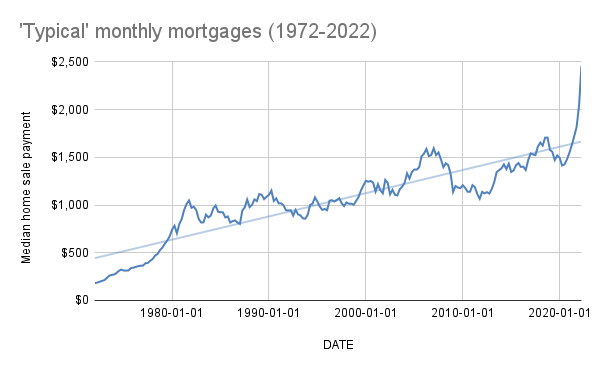
‘Typical’ monthly mortgages (1971-2022)

This is the ‘typical’ house payment for the last fifty years. ‘Typical’ being the median sale price and average thirty year rate.

If my parents had bought when I was born they paid $982. But if they bought when my brother was born, it would be almost two-hundred dollars less each month. A huge difference for a young family.

The sweet spot for modern buyers was October 2011 when payments flirted with $1,000. 

The Covid-19 drop and surge can be seen toward the right. It wasn’t until August of 2021 that payments crossed the trend line into wild heights. 

What difference does it make for someone now? Since the end of 2020, the ‘typical’ payment increased seven-hundred dollars a month. 

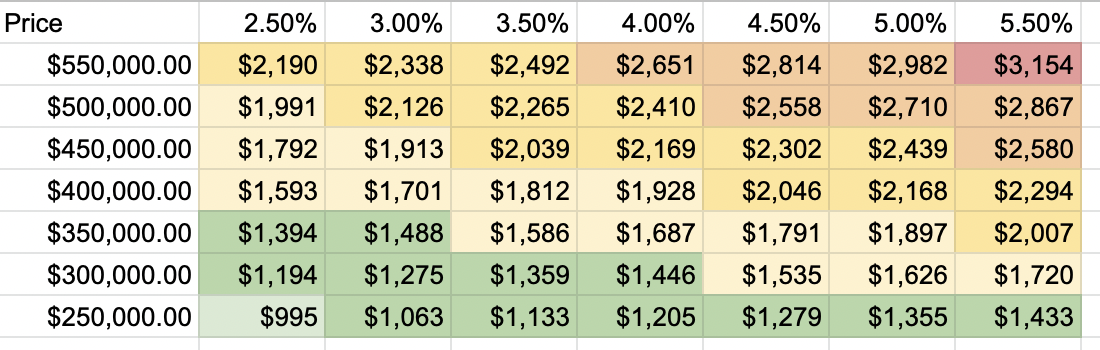
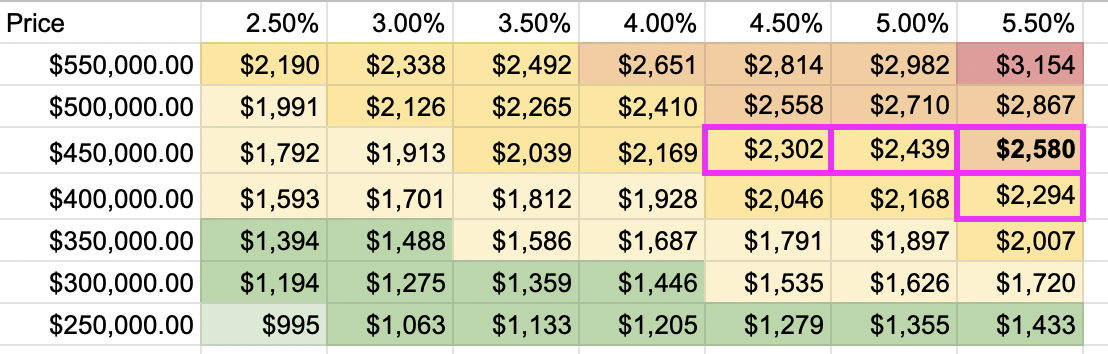
Interest rates are a headline metric, but are not the most important thing for buyers. The fall 2022 ‘typical’ monthly payment is: $2,580. A $50,000 decline on the purchase price is equivalent to 1% lower interest payments. Not only that, home prices have a .9 correlation with monthly payments whereas interest rates have a -.55 score.

Housing is easy news to consume. The bad is about rising prices and rates. The good is about remodels, flips, and luxury. The truth is somewhere in the middle, here it’s in color.

How “off track” are housing prices? The red line is the 2016- March 2020 trend line relative to the graph of median listing prices. Currently prices are a 33% premium to what the historical growth suggests.

United States figures only.

Start with No (book review)

In his 2016 book, Never Split the Difference Chris Voss suggests Jim Camp’s, 2011 book, Start with No

To Voss, ‘no’ is progress. Too often ‘yes’ is said for appeasing purposes and ‘maybe’ means we haven’t clarified what’s important. But ‘no’ is firm, it’s progress. 

Camp explores this idea deeper. He, like Voss, dislikes win-win negotiations. First, they lead to unnecessary compromises. In an effort to let both sides ‘get something’ negotiators compromise too much and on the wrong things. A 10% discount in exchange for a longer contract is good only if it’s important. Too often, Camp writes, people compromise on things which don’t matter. 

Second, win-win is considered fair. Who judges what’s fair? There’s no master evaluator. There are ethics though. Camp’s model is analogous to sports. Prepare, train, and play as hard as you can within the rules for the full period of time. Once the event is over, shake hands and respect your opponent. 

Third is the idea Voss runs with, a ‘no’ is progress, it’s “a decision that gives everyone something to talk about.” 

If ‘no’ is so important, why write a book? This coulda been a tweet. 

Well, no. There’re better ways to get to ’no’. And this book is really about something else entirely.

Our second house was a for sale by owner. A nice family with a nice home. We sniffed around each other like dogs with our initial questions and when asked about his timeline for building their next house the owner said, ‘I’m in no rush, I’ve got a house now’. 

That was good. He conveyed un-neediness. Being needy is Camp’s first warning. Do. Not. Need. A. Deal. Both Camp and Voss frame themselves against the classic negotiation book, 1981’s, Getting to Yes. Their books, they say, highlight what GtY gets wrong. Fair. But Getting to Yes presents the BATNA: best alternative to a negotiated agreement. That’s essential to un-neediness. 

The heart of un-needines, and of good negotiations is the secret message of the book. Start with No is really about our ego

Being needy is ego. Camp’s second rule is to act like Columbo. Disarm the adversary. In other words, put ego aside. Don’t try to be impressive, smart, or IN CHARGE. Don’t elucidate and don’t use words like elucidate. Camp warns about trying to be liked (chapters 2, 3), to be smart (6), or only talking about your side (4, 7, 8, 9). 

It’s hard to Start with No when you start with yourself.

The role of ego varies in size and scope. A successful negotiator finds the right balance of their own and their adversary’s point of view. This is the root of Camp’s system. It’s also the heart of copywriting and JTBD

Good negotiations are difficult and rare, Camp writes. That makes sense! To be a successful negotiator (according to Camp) we have to check our ego – a problem humans have been dealing with for hundreds of years. 

Camp tells a lot of ‘me’ stories. They’re about his big deal big deals, his awesome son, his business. It’s a little much (Voss’ stories are better). But hidden in those is a wonderful exploration of our ego and what we can do about it. 

Ego is tricky because like picking our nose, we don’t notice. It’s part of us. But when someone contrasts another way it makes us pause and consider that. For instance, “the most important behavioral goal and habit you can develop is your ability to ask questions” or “The self-image of the individual in the selling role traps him or her in a neediness mode and often leads to bad deals.” That frames our behavior and leads to questions like do I ask enough questions or am I needy because I want to feel smart, impressive, helpful, or whatever?

Camp’s book introduces his perspective, and that’s a good start to good negotiations.

The Last Lecture sign

On September 18, 2007 Randy Pausch entered a Carnegie Mellon University lecture hall and gave his ‘last lecture’. Pausch’s lecture was one of a series hosted by the university where varying academics spoke about “what mattered.”

What made Pausch’s lecture so moving was that weeks before he learned his pancreatic cancer had gotten worse. Pausch passed away ten months later.

Pausch’s story is beautiful and someone can join the twenty-million views on YouTube. But we want to think about something different, Pausch’s book, The Last Lecture.

“It’s not the bestseller that interests me,” said John Thompson, “it’s the world that makes bestsellers possible.”

There’s a lot of good stories every year, why was TLL a New York Times bestseller for 112 weeks and not some other book? Part of the reason is the business model.

“How do you value this book? You have fifteen pages of an outline by an author who has never written a book before, how much are you going to pay for it? It went for 6.7 million dollars. I thought that was crazy, who would pay 6.7 million for a book by an author who had never written a book and may not even live long enough to write it.” – John Thompson, Oxford Bookes University, November 2010

Thinking like an anthropologist, Thompson’s first order of businesses was to figure out the business landscape. Every industry has competitors and collaborators. There are explicit and implicit incentives.

A few landscape changes took place through the 1980s. Small independent bookstores yielded to chains. Scale meant changes in bargaining power. In that decade literary agents grew in stature, slightly empowering writers. Publishers meanwhile consolidated in number and power.

By the late 90s and early 00s the book selling economics was like venture capital or film: around 30% of books, estimated Thompson, generated the bulk of the revenue. Along with the need to grow, the incentive was to find Big Books like Dan Brown’s The Da Vinci Code (2003).

Finding a “Dan Brown” was a dream, quite literally. Instead, publishers looked for new authors with good ideas. Lacking that they tried something we are more familiar with in 2021: platform.

Walk into a 2010 bookstore said John Thompson, and each of those books at the front table were paying $1 in rent to be there. Books had to sell quickly or they were returned to the publisher. Without a “Dan Brown” the next best route was someone with a platform and so in 2004 Paris Hilton became a NYT bestseller.

Randy Pausch had never written a book, but Randy Pausch had been written about. Two days after the lecture, Jeffrey Zaslow featured Pausch’s pronunciations in the WSJ. Following that Oprah and ABC got in touch. After that Hyperion publishing.

This era feels like a shift in celebrity, as least through the lens of book sales. While Pausch’s talk wasn’t the most popular it was on the growing site YouTube. In 2005 Ronaldinho’s Touch of Gold was the video people shared. In 2006 it was Evolution of Dance. EOD became the most viewed YouTube video with ten million views. It had the most viewed crown, lost it, got it back, loses it (this time to Avril Lavigne), gets it back and loses it for the last time to ‘Charlie Bit My Finger’.

Evolution of Dance was number one for about as many days as Baby (Bieber) and Despacito (Fonsi) and half as long as Gangnam Style (Psy). It was the first viral video.

I remembered TLL as a dual feel good story. Both the message and that the message shined through. It does, but TLL succeeded because of the business model. Publishers wanted hits and lacking a “Dan Brown” looked for people with a platform.

Pausch’s story is beautiful and as a teacher I hope he would appreciate this post. In Internet time 2007 feels like a long time, but the things we did then we do now and we did before. There’s lots of change in actions but much less in reasons. Looking back at this moment is a nice (dual) reminder about how we live.


A couple other tent pole moments: 2010 – Old Spice, the man your man could smell like. 2012 “Hi I’m Mike founder of Dollar Shave Club dot com…” and 2012s Gangnam Style is first video with one-billion views.