Moneyball 3/7/18

Supported by Greenhaven Road Capital, finding value off the beaten path.

The March 7th, 2018 Wharton Moneyball podcast was full of interviews Casey Massey conducted with 2018 SSAC attendees. This is the sports analytics conference we drew from for the Competitive Advantage & Sloan 2018 posts.

Mina Kimes articulated that data is not a panacea. Thanks to a background in business journalism, “I look to data to find answers to basic questions and if I don’t I almost find it more interesting that if I did find the answer.” I forget this sometimes…

Data and curiosity, in James Carse’s terms, combine to form an infinite tool.

Kimes and Massey also agree that situations matter. “Perhaps one of the biggest lessons from the NFL season is how much situation affects quarterbacking, which has always been true unless you’re Aaron Rodgers or Tom Brady. To me it’s like 90% team scheme,” Kimes said. Yes, Massey agreed, context and situation matter so much “and it’s still underappreciated” added Massey.

From two-hour marathons to New England Patriots scouts situations affect outcomes.

I’ve started the Leonardo Davinci book by Isaacson and Leonardo is a product of circumstances. Here’s Isaacson early in the book.

Screen Shot 2018-03-19 at 5.44.58 AM.png

Ben Alamar pointed out the importance of communication. This is the next nut to crack in sports analytics.

“Even in this day of data availability and analytics sophistication, you still need to render it as simply as possible. And it’s still possible to come up with simple analyses that are insightful.”

Michael Lewis said that while he was researching Moneyball (the book) “Billy Beane told me, ‘we never talk to them about it (Moneyball), it just confuses them.'”

In the same interview Daryl Morey said, “It’s not what you know. It’s what you can impart on coaches so they’ll believe in it and they will then give it to their team. You have to have people skills. It’s not like you can come in and put something on someone’s desk and he’s going to believe in it.” How do you do this? Start by finding data that supports what the coaches already know.

Dean Oliver told Massey much the same thing, “If you can’t communicate it you won’t get a seat at the table.”

Data digging is never done and data discoveries are never obvious.


This is the clip Massey mentions, and it shows how the Warriors are trying to crack the communication challenge.  “Without a coach like Steve,” Lacob said, “it would be incredibly difficult to get these messages out.”

Kirk Lacob from the Golden State Warriors told Massey about their decentralized command structure. “I always thought our secret sauce was that we have great people and turn them loose and let them do what they’re best at.”

What makes Lacob’s boss, Bob Myers good at his job? “Those guys have something in common, they know what they don’t know. They’re very self-aware. They’re very trusting of other people. When they know there’s something they aren’t good at they’re happy to look to other people for those answers.”

This kind of structure requires humility and self-knowledge at the top and Lacob said they have this thanks to “sophisticated ownership.” This is an idea that Charles Koch emphasized too.

Sandy Weil spoke about alpha erosion. “Basketball might have the slimmest margins. In hockey we have draft models and how many teams have draft models as good as ours? Probably only a handful…In basketball, it’s probably three-quarters of the league.”

As both Jeff Luhnow and Daryl Morey have noted, once you do something that works others will copy it. Weil adds that most of basketball’s low-hanging fruit is picked.

Chad Millman has broken smart. I was struck by the number of interviewees who started a WordPress blog, YouTube channel, Twitter account, or email list. A lot of the people talking about analytics implementation and decision making started talking about analytics and decision making to no-one in particular online. Breaking Smart is:

“This is breaking smart: an economic actor using early mastery of emerging technological leverage — in this case, a young individual using software leverage — to wield disproportionate influence on the emerging future.”

“How and why you should choose the Promethean option, despite its disorienting uncertainties and challenges, is the overarching theme of Season 1. It is a choice we call breaking smart, and it is available to almost everybody in the developed world, and a rapidly growing number of people in the newly-connected developing world.”

Jeff Ma (who has his own delightful podcast) told Massey why he wanted to start a podcast. Being on TV “wasn’t the best form for us.” Ma and Rufus Peabody needed time to explain things and focus on the process. It’s only in a podcast that you can articulate what Tetlock calls “the wrong side of maybe.”

Invisibilia started up their fourth season and led with an episode about changing norms (which can change behavior). We can all view the world as cut and dry or nuanced and funky. The medium dictates the norm for that message. Even though Ma is saying the same thing on his podcast that he said on ESPN, the message is different.

Brian Burke, the creator of the 4th down bot, spoke about career capital. “The Eagles weren’t the only winners that day,” after the Super Bowl, Burke explained. Why? Because Doug Peterson went for it on fourth down, and this normalized it. The adage to fail conventionally is easiest to see in sports.

Rory Sutherland noted that without career capital, people purposely make negative choices because they signal positive characteristics “There are lots of cases where you need to signal something, by making a decision – and it may be the rationality of the decision – actually prevents you from making a better decision.”

On August 16, 2017, Moneyball podcast, the Wharton hosts said that stability and patience can balance the scales when leadership lacks career capital. Massey said, “My sense is that the single scarcest commodity in professional sports is patience…everyone is looking for an edge and the biggest edge is patience.”


Thanks for reading.

theSkimm

TechCrunch Disrupt NY 2016 - Day 1

Photo from TechCrunch Disrupt NY 2016

Supported by Greenhaven Road Capital, finding value off the beaten path.

theSkimm is not an email newsletter. It’s a brand built around helping female millennials. The distinction matters. For a company that has a growing employee family, potential acquirers (and fidgety VC investors), and ambitious founders, there needs to be more than just a newsletter.

But a newsletter was a great place to start. The early days of theSkimm were nothing like failed startups and theSkimm is one of the better entrepreneurial cases someone could study.

Let’s do just that.

In summary, Danielle Weisberg and Carly Zakin have succeeded because they noticed poor product-market fit and made a small bet to build something using their existing skills and being curious along the way. Once their brand snowball got rolling they focused on strengthening it and are now expanding to other areas.

You can read the pdf here or save the HTML for later. There’s also the podcast versions; iTunes, Overcast, or Soundcloud.

https://soundcloud.com/mikesnotes/skimm-lessons

Curious? 

Perception

Supported by Greenhaven Road Capital, finding value off the beaten path.

 Conspiracy by Ryan Holiday was good and the one that Holiday alone could write. Like a good song, Holiday establishes a pattern for you to tap your feet to; historical example and explanation followed by current events between Gawker, Thiel and Hulk Hogan with plenty of callbacks to earlier ideas as you go along.

If each chapter is like a song, then Machiavelli is on the drums. It’s his book – not the The Prince, but Discourses on Livy – that Machiavelli advices conspirators and that Holiday uses to set the tone.

Conspiracy plays the lead guitar and does vocals. Some parts are strained but Holiday makes it work and tells the story well.

Why was it a conspiracy? Who were the conspirators? What was conspired?

Each question is addressed but there are no final solutions.

This post will focus on the bassists, Perception. How do you see others, how do others see you, how do you see yourself? That’s the story that I expected from Holiday. Maybe he didn’t write it because he’s been down that road. Trust Me I’m Lying is his book about stories, perception, and marketing. Holiday’s books on stoicism – his recommendation of Meditations changed my life – are about managing your perception of the world. It’s about learning to see the obstacle as the way.

As Conspiracy sings the words, Perception fills in the gaps. For Gawker, they saw the world as one to comment on. Your sexual orientation was part of the world. Your book draft was part of the world. Your opinion, and their dismissal of it, was part of the world.

Gawker thought others saw them as benevolent. They were the kid in high school who was an outsider, like you, but at least they were able to crack smart at the cool kids. When they outed Theil, Gawker snickered. When they defied a judge’s orders they did so while rolling their eyes. Gawker succeeded because people wanted to see the world through Gawker’s eyes.

Gawker failed because the world changed what it wanted to see. At one point in the book Holiday notes the importance of AWARENESS. Thiel is aware, overly so. Terry Bollea (Hulk Hogan) has the word tattooed on his arm. The Gawker legal and editorial teams are not. They fail to change as the world does.

Holiday uses historical context to support his point. I’d wager that there’s more American presidents not named than named, but it’s close. In this kind of writing I just have to trust that Holiday understands the facts, explains them as best he can, and doesn’t miss something. This is the crux of any writing, how does the author learn then explain enough to tell the story?

I enjoy Holiday’s (email) booklist. I know he has learned a lot. But after I read the book I wondered, is that the lesson from Lincoln? Was that a small or larger part of Churchill and Roosevelt’s relationship? Did Holiday cherry pick from his readings read or did he separte the wheat from the chaff?

In reading A Man Called Intrepid, I’ve come to see the importance of managing perception  – as best one can – during the build up to the First World War. Churchill inspires the British. He persuades the Americans. He resists, but doesn’t antagonize, the Germans.

Roosevelt convinces Churchill he’ll come to his aid. He arm-locks Joseph Kennedy. He ‘Gets out the vote’ and then sends the voters off to war. Facts through one set of lenses we see one thing, through another set we see something else. From the book:

“We shall be worse off if we get too far ahead of public opinion,” Churchill wrote. He understood how people perceived him.

Germany with hindsight, is the universal bad guy. “President Roosevelt’s support for Churchill’s rebels must have begun almost unthinkingly. Hitler was set upon a monstrous course that seemed sure to bring disaster. Yet many in the United States, struggling with the Depression and disenchanted with the quarrels of Europe, saw only the economic success of Nazi Germany and not its evil roots.”

Churchill and Roosevelt weren’t the only ones swaying hearts and minds. Author William Stevenson points out the “fifth column,” sympathizers within a city loyal to the insurgents. “Hitler was sure that the Nazis could conquer America by propaganda.”

Rory Sutherland likes to point out that this is the beauty of marketing. Marketing, he says, is like magic – it creates value from nothing. Why is a Tiffany’s box different?

Sometimes it’s said that he best investors are contrarians. Theil has written about this, and so have we in this post Zero to One. “Be different” might not be the best definition.

The best investors are the most perceptive. They’re they ones who perceive the current situation the most accurately. It’s what Gawker failed to do when they underestimated the lawsuit. It’s what Thiel did correctly, when he brought it. And the roles were switched after the trial, when Nick Denton was the most accurate of how the world was.

Holiday’s book isn’t the best book I’ve read this year, but it’s a good one. It’s like a flag blowing in the wind. We can see how things are now but that’s not to say things won’t change. We will end this post where Holiday’s book begins.

IMG_94716BDED083-1.jpeg

Charles Koch

Screen Shot 2018-02-26 at 11.15.39 AM.png

Supported by Greenhaven Road Capital, finding value off the beaten path.

When Charles Koch spoke was on the Freakonomics podcast we took notes. Those are here. To recap.

  1. Leaders must create the conditions to argue well.
  2. A healthy mix of centralized and decentralized command works well.
  3. Systems are one orientation, goals are another.

This time we’ll look at Koch’s November 2017 conversation with Marc Andreessen. The big idea in this podcast episode was experimentation.

Most of the entrepreneurs, investors, and adventurers we profile have experimented. Tariq Farid experimented with knives on fruit. Patrick Collison experimented with different payment sequences. Even David Ogilvy, the advertising icon and generator of brilliant ideas advocated experimentation. “Innovations,” Ogilvy wrote, “provided you test them, can work wonders.”

Let’s see what Koch has to add.

Koch studied engineering at MIT. Why engineering? “I found out at an early age that I was good at one field; math and logic.” Koch experimented to Know Thyself.

After college, he took a job as a consultant, trying different sectors and different roles. “I learned that innovations come from mixing ideas in new ways.” Koch came to believe more and more in “the republic of science” and “an authority of the community.”  New ideas come from challenging old assumptions.

Sure, said Andreessen “Every engineer knows you need to have an open debate.” And, Koch added that it goes beyond just engineering. “What was really fascinating to me was that the principles of social progress were almost identical to the principles of scientific process. That got me really going.”

After his consulting stint, Koch returned to run the family company. The early days were filled with experiments. It was, “a lot of trial and error, mainly errors.” Though these trials and errors Koch decided to focus on two things.

He wanted his company to be counterparty of choice. “We do that by focusing on how we use capabilities to create value for these constituents.” In other words, he wants to deliver value to his stakeholders. Like Scott Norton, Koch is striving for the business version of Charlie Munger’s advice on marriage, “Be worthy of a worthy mate.”

Koch  also wanted his company to be in “continual transformation.” That means, “each one of us has to be lifelong learners, that is, constantly, searching for new and better ways to create value.”

These principles helped Koch Industries grow into related industries. First, they expanded their refining operations. Then grew their other businesses. Soon they expanded their capabilities into consumer products, wood pulping, glass, and software.

They’ve done this, Koch explained because they hire first for values and then for talent. “These principles are who we are as a company. We hire first on values and then on talent, and by talent, I don’t mean credentials.” What does he mean by talent? Potential. If you hire stupid people, Koch joked, make sure they’re lazy too. That way they won’t do too much damage.

Incentives for these people matter. “We try to do the best job overcoming they agency problem.” Well, said Andreessen, “The Silicon Valley way to defeat the agency problem is stock options.”  You want to get people who think like owners. Charlie Munger values this ownership mindset too, giving this advice:

“A lot of people running the business think like careerists. And believe me, you gotta think like a careerist to a certain extent if you’re in a career. But it also helps to look at the business strategy problems as though you are an owner. And so my advice to you is, you don’t wanna be…never get to be a careerist so much that you don’t see it from the owner’s point of view.”

Koch tries to “Understand what an individual employee has contributed to increasing the long-term value of the company….what did you do to help our culture, what innovations do you bring? It’s a combination of objective measures and subjective measures.”

“You don’t need to be precise but you do need to be directionally correct.” Does that mean an employee can make more than her boss? Yes! “Does it make sense that Lebron James makes more money than his coach?”

But how does a manager marry incentives for results and a culture of experiments?

“If you never have a failure you’ll never try anything new.”

“When you come up with a theory you want to try to falsify it as fast as you can.”

“Get the people together and point out the flaws and challenge an idea.”

“Every time we go through this kind of discussion and debate we come up with a better answer than I had myself.”

“When someone points out a flaw you should thank them.”

“All we care is, are you contributing in terms of culture and for the current and long-term value creation.”

It’s a cultural thing, and you have it or you don’t. Sometimes Koch will give talks and he warns the audience about this kind of management, “It’s not a cookbook. The leadership has to live by the underlying principles.”

The interview ends with some reading suggestions. Before Koch’s suggestions, a few people have told me Sons of Witchita is good. Koch suggested:


Thanks for reading, Mike.

Basketball February 2018

Supported by Greenhaven Road Capital, finding value off the beaten path.

We’ve had two posts that highlighted ideas from the SSAC. The first was general ideas about running organizations, the second was about pushing competitive advantages. Today’s notes will be from a Ringer Basketball podcast where Bill Simmons, Haralabos Voulgaris, and Jason Concepcion talked about SSAC and the NBA. Ready?

Specialization. Agreeing with Steve Nash and Daryl More, Simmons said that specialization is becoming a bug, not a feature. “I’ve always been an if you have one elite skill there’s a place for you in the NBA guy and now I’m wavering on that.”

Instead of thinking about actors, think about actions. The NBA, like any system, evolves over time. The pace and space era that exists today coincides with the smartphone era. Each paradigm has new rules, new winners (and losers) and new ways to play the game. The phone now does many jobs; it takes photos, sends emails, and allows payments. The modern NBA player now does many jobs too; shooting, defending and understanding the game.

Competitive advantages. In Sam Hinkie’s words, “when I worked at Bane Capital, everyone talked about the two or three (key) levers, and to pull like hell on those.” Teams succeed when they maximize their advantages.

“Why would you want your center Marc Gasol to be marginalized at the three-point line?” Haralabos Voulgaris

“That’s why Kevin Love, the way the Cavs used him, seems like one of the great wastes of anyone this decade. You have this guy who is unbelievable around the rim, great instincts around rebounding, and you have him twenty-five feet from the basket.” Bill Simmons

“I remember when Alvin Gentry become the (New Orleans) head coach, and he said ‘one of the first things we need to do is have Anthony Davis learn how to shoot threes.’ It’s like, no, it’s kind of silly.” Haralabos Voulgaris

Ben Thompson writes over and over again why Apple can’t become like Amazon or Google. They have different strengths. In our podcast on Moats and Allocators, we noted that good capital allocators know to double down on their strengths.

Anson Dorrance is the winningest soccer coach and he said, “My job is to find out a way to let her know she’s unique, acerbate her unique qualities and hide her weaknesses.”

Analytics

“(Some) is still gimmicky stuff. I don’t think teams are judging players by them…It’s fine. It’s interesting. But I don’t take it seriously.” Bill Simmons

However.

“The problem with the eye test is it’s not always on. The computer is watching everything. It’s watching every minute of every play. It keeps track of *something*. You miss a lot.” Haralabos Voulgaris

Later Simmons proves the point. “The worst case is Doc Rivers. Who for three years only signed guys who had played a good game against him.” Rivers suffered from the availability bias. There’s also recency bias, survival bias, and confirmation bias, which Shane Battier called, “the mortal enemy” of everyone at SSAC.

Human beings make mistakes and computer models aren’t perfect.

“What you want,” said Jason Concepcion “is for the eye test and the numbers to align on some sort of rule. When the two are in conflict is when you should dig in further.” Mike Zarren agrees:

“This is when things might be most valuable. If you’re watching something and it disagrees with some other process you have that told you something about what you’re watching, one of them is probably wrong. So you gotta go look into the black box and ask questions or ask, is the way you’re watching not capturing something.”

In his book Average is Over, Tyler Cowen suggests we use freestyle chess as the model for human and computer interactions. The advantage to this is that machines will find things (play moves) humans would never consider and there’s less domain expertise required. The most important things wrote Cowen, is to understand the limits of humans and the limits of models.

Conditions matter.

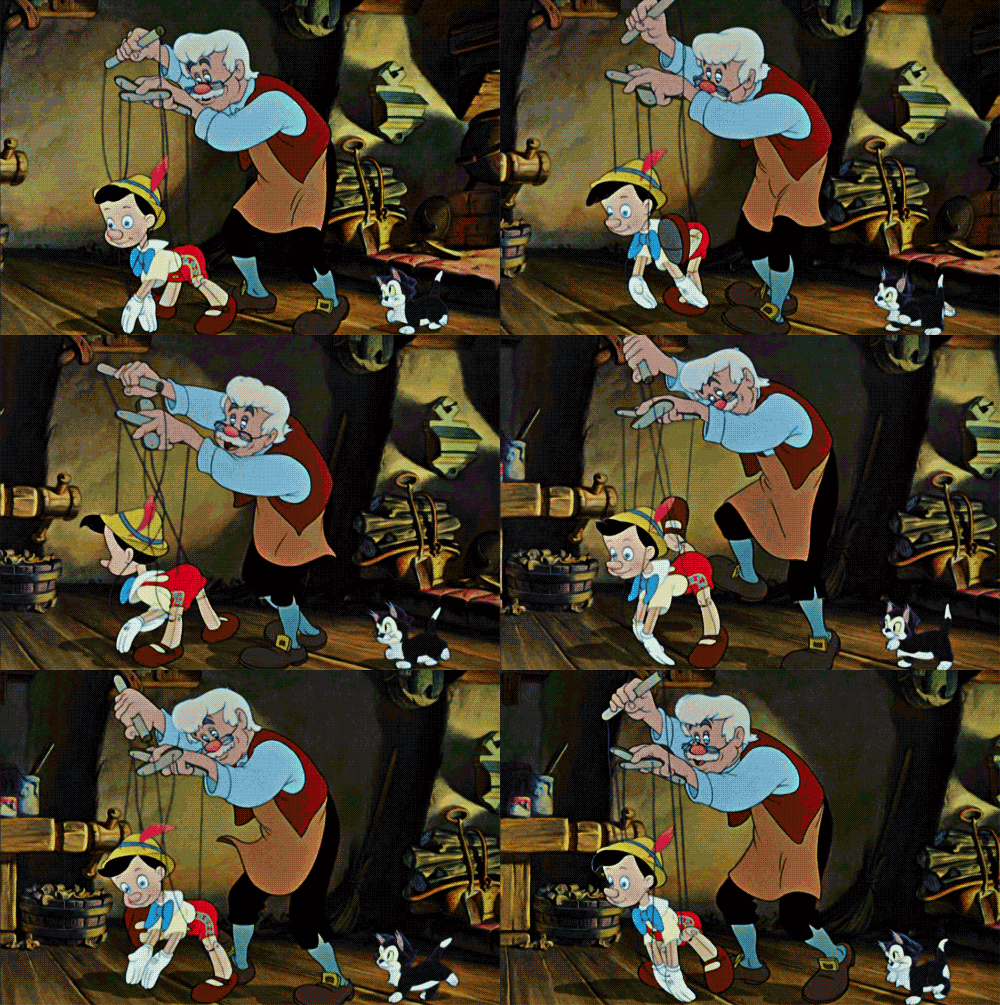
“Brad Stevens is the Geppetto coach, pulling all the little strings and making everyone look good, look better than they are.” Haralabos Voulgaris

“How about all the guys that left Boston. It’s a long list of people that miss Brad Stevens.” Bill Simmons


Conditions matter. Brad Stevens in Boston in 2018 is like Milton Hershey in Pennsylvania in 1900.

“Young Milton Hershey could not have chosen a better time and place to put what he had learned from Joe Royer into a business of his own…In 1870 America had begun an immigration boom that would last fifty years and triple both the country’s population and the number of potential customers for products like Hershey’s caramels…People were looking for consistent quality at a low price.”

Good organizations understand this. One New England Patriots scout said that if he graded a player highly, but that player was a bust on another team he wasn’t admonished. “Because that player in the Patriots’ system might have been successful.”

Managing stakeholders. About Sam Hinkie.

“The problem was, he alienated the media, which is what you don’t want to do. It was kind of smart because, as a gambler, if you know something you don’t want to tell everyone what you know. So, he was really quiet about what his theories were. But, having that type of job is such a … smarmy, handshake, wink-wink kind of business. You need to have relationships and do all these other things. You can’t just be the guy in the back with a bunch of spreadsheets.” Haralabos Voulgaris

Let’s end with the question we started with, what job are you hiring for? Why are people supporting your business? Daryl Morey said that managers can understand the fans when they listen to the owner. It’s only those two groups, the fans, and the owners, that have a long-term stake in the team.

Astros GM Jeff Luhnow said baseball has a build in advantage. “I think fans are never patient but in baseball, the typical fan is aware of your farm system…and there’s a certain amount of patience baked-in.”  Fans want to be entertained, to feel like teams are doing their best, to see progress. Those are the jobs a sports team, or any business is hired to solve. And it’s up to the management to communicate that.


Thanks for reading.


Ideas — Sloan 2018

Supported by Greenhaven Road Capital, finding value off the beaten path.

pablo (39).png

These notes will be an overview of some ideas from the 2018 Sloan Sports Analytics Conference.

Intellectual honesty.

“We took pride in building a culture where we loved each other enough to tell each other what we needed to hear. If you can do that and hold each other accountable to something, you’re going to progress in the right direction.” – David Griffin

Good organizations Argue Well. Good organizations prize intellectual integrity. Good organizations focus on truth and dampen ego.

That means being curious and asking questions. When asked about the next advance in basketball, Daryl Morey said:

“If we knew we’d be halfway down it. If we could properly forecast three things it would be a huge advance; what will they do when they get a lot of money, do they have the self-awareness to understand there’s a gap between them and, say, Chris Paul, and what are their habits to improve that gap?”

Morey believes that the best players are like the best organizations. Each improves by fixing their faults.

A pendulum swings toward de-specialization.

“When I came in the league you needed a power forward who was at least 6’9″, 250lbs, who can get his butt down by the basket and beat someone up. Nowadays he can’t cover anyone and with the rules, he’s really not making any money in the post.” – Steve Nash

“I think it’s the single skill guys (who are falling out of the league). You used to be able to be an absolute rebounder or defender but not do much else and make it in the league. The evolution of the league has made you too easy to guard or have a hole on the defensive side of the ball. That’s a good thing, you want more skill on the floor.”  – Daryl Morey

One framework for understanding this is to ask Clayton Christensen’s question, what job are you hiring for? “Understanding the job is the critical unit of analysis,” Christensen explained. Each NBA team needs to score points. Sometimes you can hire that out to a few individuals, sometimes many. The old model was, we need someone who looks like this so they can do that. The new model is, we need someone who does that.

This takes a nuanced approach. Morey said that Shane Battier “was a quality shooter in the role he had.” But don’t expect him to be like Steve Nash, who attempted more difficult shots. This level of understanding brings us to the next point; analytics.

Data is a tool.

“When the analytics wave came it swung the pendulum so far it went over a lot of people’s heads initially…now I think it’s found its way back into a happy medium. I don’t look at analytics as the only tool to measure a player but I do think it’s a helpful tool to measure a player…Test scores are your skill, GPA is your will.” – Jalen Rose

David Griffin, former General Manager of the Cleveland Cavaliers said:

“This is when things might be most valuable. If you’re watching something and it disagrees with some other process you have (e.g. analytics), that told you something about what you’re watching, one of them is probably wrong. So you gotta go look into the black box and ask questions or ask, is the way you’re watching not capturing something?”

But even if you figure something out it doesn’t necessarily lead to wins. Battier, Morey said, “Is still the only player we ever had who could take all the information and put it on the floor directly. Most of the time it’s the coaching staff coming up with the scheme and indirectly into the game plan.”

The same is true in the NFL. John Urschel said that his teammates with the Baltimore Ravens were overwhelmed by the information. John and other coaches would help players and tell them ‘this is what’s important, these are the five or ten takeaways.’ Tedy Bruschi added, “and five or ten is sometimes too much.”

Organizations need to get buy-in from their stakeholders; players, fans, staff, and ownership. That includes explaining the unintuitive, like analytics. Jeff Luhnow talked about this in the preseason before the Astros won the World Series. Good organizations also need to know what extrapolates and what doesn’t.

“The per thirty-six-minute stuff is the low-hanging fruit of finding undervalued players. Patient zero of the modern era was Paul Milsap, whose per thirty-six numbers carried over.” – Zach Lowe

Unlike Scotty Williams, said Michael Lombardi. “Scotty Williams looks great when he plays twenty-eight minutes for the Bulls, but when he plays thirty-eight minutes he sucks.”

Even though the SSAC is twelve-years-old, there’s still a lot of work to do.

No bad days.

“One of the great things about sports is that you get to go out there and compete. Championships are the pinnacle but there’s also the joy, having the joy of playing at a high level, you might not win a championship but you might have a hell of a run in the playoffs.” – Chris Bosh

“We have a saying, ‘There is no bad day in the NBA’ and that’s the way it felt every single day. I thought I had fooled people for twenty years and my biggest fear was that one day they would find out that I really can’t play and I don’t belong here.” – Shane Battier

Use track records.

“A good place to start is what’s worked over time…when I worked at Bane Capital everyone talked about the two or three levers and to pull like hell on those. In Philadelphia that was a lot of what we were trying to do, how do you save your resources so that someday if two players want to team up and join a guy you’ve got in-house, you’ve got enough resources to do it? How do you have enough young players and picks to make a blockbuster trade?” – Sam Hinkie

“Everyone was like, he (Mike D’Antoni) can’t coach. Everyone on our staff and our owner Leslie Alexander studied it and we thought ‘he has a way that works and he did not have teams that fit that’.” – Daryl Morey

The opinionated nature (and lack of skin in the game) makes tawking heads on television insufferable. This Dan Rasmussen quote about sums it up:

“In some ways, it’s like someone tells you they can run an Olympic level spring. You’d say, ‘well that’s interesting, what was your last time?’ They’d say, ‘well I don’t keep track of time but I guarantee I can run it.'”


Thanks for reading.

Competitive Advantage — Sloan 2018

Supported by Greenhaven Road Capital, finding value off the beaten path.

Among the many educational and interesting talks at the Sloan Sports Analytics Conference 2018 was a theme; competitive advantage. When we took a deep dive into Pat Dorsey’s work on Moats and Allocators, we saw competitive advantage as increasing prices. But that’s not the first principle. I missed it. Competitive advantages are positive feedback loops.

Moats and Allocators succeed because a business generates cash that can be turned back into the business to generate more cash. Josh Wolfe called competitive advantage the most important thing in business. “What can you do or what can you assert you can do, that will scare competitors and nobody else can do? From that flows good unit economics.”

This isn’t only true for businesses. Individuals have a competitive advantage when they work like crazy, often that means things they enjoy. This doesn’t mean to follow your passion. Replace that trope with this advice from Charlie Munger, “The more you know about some topic, the more passionate you will get.”

When Bill Simmons spoke with Daryl Morey the two talked about getting started in a business. Simmons said:

“The thing that’s great about Bill James is that when people always ask ‘How do I break into this business?’ it’s always, just work harder than everybody else. Throw yourself into whatever you’re doing. Bill James is the best example of *I have an idea, I’m going all the way with it.* He’s like a lunatic with it.”

In any system, each participant has a niche they’re best suited for. The giraffe can’t be king of the jungle but it can be the best tall herbivore. Similarly, sports teams can succeed but will succeed best when they dominate their niche.

Sometimes those niches are constrained; Miami is a different city than Philadelphia. Sometimes those niches are flexible; What’s the organizational ethos?

From the Sloan talks, there were two we’ll focus on; on the court and off the court.

On the court.

“The dynamics of how you play is based on the skillset of your best players. Daryl’s best players are James Harden and Chris Paul who are terrific in isolation.” – Jalen Rose

Gregg Popovich said that he’s not in love with how the game of basketball is currently played – but said that he plays this way because it’s how you win. Similarly, the Rockets will get a competitive advantage if they play a style that meshes with their best player.

When Steve Nash was in Phoenix, Mike D’Antoni – current Rockets coach and Morey collaborator – was his coach. Nash said, “A lot of what happened in Phoenix was pretty organic. I always like to push the ball, it gave me joy.” Like the Rockets, the team played to their strengths. “Mike’s brilliance,” Nash explained, “was seeing this was going in the direction of being difficult to cover, and we would wear people out.” D’Antoni “refined it continually and gave us some principles.”

This is hard to do, in basketball or venture capital. Marc Andreessen said:

“Naturally as we go through life we accrue beliefs about how the world works, beliefs about causes and effects and beliefs about patterns that we’ve seen. I try as hard as I can to be as ruthless as possible in shedding the old beliefs and leaving them behind. They are so rarely predictive of something new.”

Shane Battier was on the front lines (frontcourt?) for this change. When he came into the league every practice started with a session on how to double-team the post. That defense was fine, but Battier’s Grizzlies often lost to Nash’s Suns.

Later when Battier was with the Rockets, the seven-seconds-or-less Suns were so confusing that Rocket’s coach Jeff Van Gundy had defenses that were nearly impossible to play. Battier’s defense shifted yet again when he started to get more information from Daryl Morey. Battier said that guarding someone like Kobe Bryant was like playing blackjack, the odds were against you but you could try to get into situations with better odds.

Battier’s NBA experiences in Memphis, Houston, and Miami distinguish the different understandings of on-court competitive advantage. Some coaches played their style. Other coaches adapted. Some organizations drafted traditional power forwards. Other organizations hired for the job.

Competitive advantage means maximizing player upside and minimizing coaches ego.

Off the court.

“What are you trying to beat the league at? Are you trying to be the best player development team (medical staff, mental performance, etc.)? Your market determines the different levers you can pull. We feel like we are a free agent designation.” – Lawrence Frank, Los Angeles Clippers

Steve Pagliuca from the Celtics said, “Continuity is critical.” Why? “It gives people flexibility. They don’t have to make short-term moves because they’re worried about being fired tomorrow.”

Pagliuca’s continuity shifted decision makers from a careerist-pov to an owner-pov. This is something Charlie Munger would be proud of:

“A lot of people running the business think like careerists. And believe me, you gotta think like a careerist to a certain extent if you’re in a career. But it also helps to look at the business strategy problems as though you are an owner. And so my advice to you is, you don’t wanna be…never get to be a careerist so much that you don’t see it from the owner’s point of view.”

Obvious, you may say, but not so fast. As Rory Sutherland noted

“There are lots of cases where you need to signal something, by making a decision – and it may be the rationality of the decision – actually prevents you from making a better decision…If I pretend everything is logical, it may not be a really good decision but if things go wrong no one can blame me, is an extraordinary form of corporate insurance.”

This is the no one got fired for buying IBM problem. Signaling, writes Robert Hanson, probably plays a larger role in our lives that we may care to admit. How attuned players are to this kind of decision-making theory we don’t know, but if they don’t see the process they’re certainly aware of the outcomes.

Another reason the Celtics attract players, “Brad Stevens,” said David Griffin “is why Kyrie wanted to be there.”

Sam Hinkie said, “Kevin Durant is only going to a situation with stunning colleagues.” This is something, he added, David Griffin didn’t have in Cleveland for a while.

Morey explained – in his podcast with Simmons – that some things are more important than others. Most important of all are the players on the team. The next tier is the city, organization, owner, and coach. Then it’s lifestyle stuff.

The best organizations will figure out where they can succeed, and then – in Sam Hinkie’s words – figure out the two or three key levers and pull like crazy.


Thanks for reading.


Moats and Allocators

https://soundcloud.com/mikesnotes/moats-and-allocators

Supported by Greenhaven Road Capital, finding value off the beaten path.

After writing the post about Pat Dorsey I started to read, listen, and watch more of Dorey’s talks, presentations, and interviews. It led me to a more complete picture of Moats and Allocators. This audio post will cover:

Why alpha erosion occurs and the hard work to prevent it. In Dorsey’s words, capitalism works.

Building moats. Why can Tiffany & Co, Tide, and Whitman’s chocolate all charge more? We’ll also look at New Coke, Apple in middle age, and a Twitter poll.

Allocating capital. The best capital allocators are – probably – Intelligent Fanatics  and Outsiders. Oh, and these two; Charlie Munger, early Warren Buffett, 2012 Warren Buffett, Bill Gates and Warren Buffett.

We’ll end the episode with the same question Patrick O’Shaughnessy asked Dorsey, what would you do with HQ Trivia? My guesses; become a social consensus brand (best chance), raise switching costs (infinitesimal chance), establish network effects (meh, maybe), or become a shared experience (wildcard).

Warning: This podcast includes a musical number that may be stuck in your head for the rest of the day.

Ted Sarandos

Supported by Greenhaven Road Capital, finding value off the beaten path.

Ted Sarandos is the Chief Content Officer at Netflix, who started his journey in a Phoenix video store and went on to greenlight six billion dollars worth of content. Most of this post will draw from Sarandos’s November 2017 conversation with Marc Andreessen, who said;

“What Netflix has done, and at this scale, is an extraordinary accomplishment. I also think that Netflix beyond that has catalyzed the most dramatic period of revolution and change in the television and video industry since the arrival of color TV and maybe before that.”

Sarandos explained that he had a non-traditional start and his trajectory is thanks to serendipity. He planned to become a journalist, but “I was a really lousy writer.” Instead, he worked part-time at a video rental place. The owner read in a magazine that video rental and yogurt shops were the future, and he hated yogurt.

Whatever we call it; serendipity, luck, fortune – conditions matter. I’d wager that Sarandos would have had career success no matter what. But to become the Netflix CCO, he needed a writer to compose an article, a guy who hated yogurt to read it, and for that guy to land in Sarandos’s part of Phoneix.

That guy would eventually ask Sarandos to “take things over for a little while.”

“I took him up on it. I didn’t finish school and for me, it was this crazy MBA and film school mashup that I got paid for, and that kind of got me to where I am today. That was my entrance to the edges of the entertainment business.”

We call this education-via-action the XMBA and it turns up often. Just in the food world, we have stories of David Chang, Alice Waters, Ken Grossman, and Rich Snyder all learning by doing.

That’s what Sarandos did too. The early days of Netflix were Costco trips to buy movies. At the time, Sarandos said, everyone had a scale on their desk to determine postage.

“Netflix was hardly like being in the entertainment business. I worked out of my house. We bought movies at Costco.”

Soon Netflix moved from DVD to streaming. It was once Sarandos and Reed Hastings saw YouTube, “that’s when we knew Netflix was going to work.” These see-it-to-believe-it moments are powerful. Tony Hsieh said that he was dubious about ordering shoes without trying them on until someone showed him that people were already doing it, via magazines.

Netflix used this same sort of reasoning – it worked there why not here – for Marvel content. Those characters have succeeded in comic books and in movies, why not in a television show?

And the same reasoning for binge watching. Sarandos told The Guardian: “We saw that people would return those discs for TV series very quickly, given they had three hours of programming on them – more quickly than they would a movie. They wanted the next hit.”

Netflix’s streaming success comes – in part – from understanding early on about Wholesale Transfer Pricing. Tren Griffin has wonderful posts (one, two) on Netflix CEO Reed Hastings.

It’s why you shouldn’t expect sports on Netflix anytime soon. “The reason I don’t get tempted by major league sports,” Sarandos explained, “is that the pricing power all belongs to the leagues.”

Sarandos said that Netflix succeeds making original content because they understand the quantitative and qualitative aspects.

“The fundamental difference between Silicon Valley and Hollywood is quant and qual. The whole efficiency driven thing is very Silicon Valley and the whole quality thing is Hollywood. Rarely do those things meet. I think part of the reason Netflix has been successful is that we’ve always kept a presence in Hollywood and we’ve always kept a presence in Silicon Valley.”

Another thing that helps is the ability to argue well.

“It’s all credit to Reed. Reed created a culture where you’re free to ask questions, you’re free to push back – but support the outcome. Everyone has a strong voice at the table but once the decision is made everyone supports the outcome. “

Good arguments are hard but worthwhile. Marc Andreessen has said:

“It’s the responsibility of everybody else in the room to stress test the thinking. If necessary we’ll create a red team. We’ll formally create the countervailing force and designated some set of people to counter argue the other side…Whenever he (Ben Horowitz) brings in a deal, I’ll trash the shit out of it.”

These red teams work, but try to finding someone with a real belief is better said Josh Wolfe. “Some firms implement a devil’s advocate or red corner person to actively do that, it’s much better when it comes naturally.”

Sarandos sees about eight pitches a day, but sometimes it can be up to twenty. “There’s no shortage of ideas but there is a shortage of people who can execute on a big vision…You have to buy into the creator’s ability to bring a vision to the screen.”

That’s about the same investment rate for Andreessen’s firm, a16z, but how do you know which ones to pick? Andreessen said it’s the errors of omission that hurt the worst:

“We always worry about two kinds of mistakes, false negatives and false positives. False positive is, we say yes to something and it fails. False negative is we say no to something and it succeeds. In our business, those are the ones that torture the shit out of you.”

Well, explained, Sarandos, “Almost all the ones we pick and succeed change a lot and almost all the ones we don’t pick and succeed also tend to change a lot.” This is why picking the person is so important. Sarandos and his team saw a small movie the Duffer brothers had made. “Mostly what it said was that on almost no resources they pulled together this really rich, satisfying movie experience, which gave us confidence that they could do it on the small screen too.”

In the year before, Hastings explained it the Stranger Things choice to Andreessen (~37:00).


Once Netflix finds a person they mostly let them be.  “We’re way better off, taking someone’s creative vision and putting it through the service than us trying to go in and retool it….At the end of the day if the creator says, ‘That’s my show.’ we put it up.”

At Netflix, they have hunches about what works but don’t know for sure. Sarandos told The Guardian about House of Cards:

“It was generated by algorithm. I didn’t use data to make the show, but I used data to determine the potential audience to a level of accuracy very few people can do…We’ve been collecting data for a long time. It showed how many Netflix members love The West Wing and the original House of Cards. It also showed who loved David Fincher’s films and Kevin Spacey’s.”

Yeah But! – Andreesseen notes – it’s one thing to let one of the best directors in the world – David Fincher – do whatever he wants, what about television shows number two and beyond? Sarandos instills ownership. He explained the Fincher arrangement like this:

“You can give me twenty-six hours of home movies but you have to put your name on it.”

This same sense of ownership, wrote Ashley Vance, is how Elon Musk motivates his engineers. Ownership is how Intelligent Fanatics run their businesses too.


Thanks for reading, Mike.


Pat Dorsey

Supported by Greenhaven Road Capital, finding value off the beaten path.

Screen Shot 2018-02-22 at 6.28.29 AM.png
From a 2017 presentation at the 14th Annual Value Investor Conference in Omaha, Nebraska

Pat Dorsey joined Patrick O’Shaughnessy to talk (part1, part 2] about good business. There were two themes. First about operations; what operators should know about running a business. Then about observations; what investors should look for in a business. Ready?

Operations. “The most finite asset is not capital,” explained Dorsey, “it’s time.” How can you suppress FOMO? “(Something) could be an interesting idea but maybe it’s an interesting idea but it’s not one you have any competence at looking at.”

Don’t try to be a round peg squirming into a square hole. Dorsey said, “The first thing is; know who you want to be when you grow up.” It helps to know thyself.

Dorsey’s strategy is to focus on the areas with the most reward. “On the sell side you’re paid to say ‘Yes’, on the buy side you’re paid to say ‘No’.” Derek Sivers puts it another way, wait for the ‘Hell Yes!’

“We have three baskets; in, out, and too tough… we have to have a special insight, or we’ll put it in the ‘too tough’ basket,” explained Charlie Munger. Dorsey added that your ‘IN’ basket should be things that fit you. Like the right cut of bathing suit, adopt things that work for you.

“The path to superior results is to accept only the best ideas,” wrote Seymour Schulich.

Suppressing FOMO and staying focused help Dorsey avoid situations “when people create a product to meet demand.”

Yet, investors have to Be Different. “Don’t just do things other people do.” Instead,  have a “willingness to do stuff that looks optically stupid.” If someone says that’s the dumbest thing ever take it as a sign you’re headed in the right direction.

“Firms that are willing to change things that don’t work and that never say ‘because we’ve always done it this way’ is a hallmark of good firms.”

Good processes are run by good people. That means people with open minds and who don’t weaponize information. It’s people with intellectual integrity and humility. It’s people who Argue Well. When asked how to prepare for a stock picking competition, Dorsey said, “Get one member of your pair to take the other side.”

Dorsey succeeds because he has good processes and good people that operate within a circle of competence. He told Patrick, “take care of your customer and ignore Wall Street…at the end of the day, the guy who pays your bills is the guy who matters, and that’s the customers.”

Observations. Dorsey relies on three forms of analysis; financial calculations, destination visitations, and moat inspections.

Financial calculations won’t give the full picture but they can give a peek into a business. Calculations like CAC and customer LTV tell you something, but like any number, require interpretation. They are “very blunt tools.”

Dorsey explained that an LTV:CAC ratio of 1 means something and 5 means something else – but more isn’t always better. Changes in strategy, like when Adobe switched to subscriptions, can change the ratio and changing ratios should change strategy.

Destination visitation is another observation technique Dorsey uses.

“You can’t understand a business unless you sit in the customer’s shoes and the best way to sit in their shoes is to go talk to them.”

“In the case of Chegg, we did an online survey of eight-hundred students across the country.”

“You gotta get off your rear end and work the phone. The insights we get from talking to people deep in the industry are phenomenal.”

Visits are helpful because visits are valuable. In his 2017 presentation at the Value Investor’s Conference, Dorsey said: “quantitative data is often priced efficiently.” While:

“Qualitative insights come from sending out thirty emails and getting one back. It comes from getting out to trade shows and talking to people. That’s how you add value.”

Being there is a powerful information gathering tool. But it’s also a harder one than a database formula. Milton Hershey apprenticed as a caramel maker. Yvon Chouinard was a climbing-gear-user before a climbing-gear-manufacturer. John Elkann worked in half a dozen departments at Fiat before becoming the head of all of them.

When Warren Buffett says that he’s a better investor because he’s a businessman and vice versa this is what he means. There’s a depth in understanding the numbers behind a balance statement line item. Dorsey calls it a “granular understanding.” Visits are not a magic bullet but nothing is.

Dorsey said that he went to India to see if it was “diligence-able.” The verdict, kind of. After a week he learned that consumer taste was not something they would understand, “that’s out of our wheelhouse, but there are plenty of good Indian export businesses that compete on a global scale.”  But there’s no rush, “It could be five years or never when we buy something in India.”

Mohnish Pabrai gave advice on how to study and avoid sunk cost tendencies. Like say, flying halfway around the world to find investments.

https://soundcloud.com/mikesnotes/mohnish-pabrai-on-sunk-costs-via-a-2016-talk-at-uc-irvine

Moat inspections are the final technique. Remember, not everything is a network effect and not every brand is a moat. “Economic moats are not evenly distributed across the market.” Brands can be a moat but “If a brand doesn’t translate into pricing power it’s not worth what the company spends to maintain it.” Rory Sutherland guessed that people buy brands as a kind of insurance.

At the Value Investor’s Conference, Dorsey noted the question to ask about (signaling) brands.

“Positional and legitimacy brands have a big big difference from low-search-cost brands. If I decide I can get a razor from Dollar Shave Club a lot cheaper than Gillette and it does the same job I get full value from that product without anyone of you having to change your mind.”

Meanwhile, a Rolex and Mickey Mouse watch both tell the same time but it would require social consensus to affect those brand values.

Businesses with high switching costs can have pricing power (read:moats) too but some businesses ahem Bloomberg ahem are more like rent collectors. The better moats, Dorsey explained, are like plumbing. They’re essential services but not primary costs.

However, companies like Boeing and Airbus are fungible. On the consumer side, it’s easier for established brands to get upset. “This was not possible fifteen years ago….moreover, I can use Facebook and Google to target very effectively.”

Dorsey also falls in the less-pain-in-the-ass camp. About Amazon, he said, “Everything comes back to making the customer’s life easier because if the customer’s life is easier they’ll use it more.”

Josh Wolfe told Patrick, “We always point our turret and say a very sophisticated two-word question to figure out where the next thing is; what sucks?”
In his book, Alex Moazed wrote “You can think of transaction costs broadly as pain-in-the-ass costs. All platforms reduce these costs in some way.”

If you can find what Moazed calls a platform company you want something that “will grow itself” says Dorsey. How do you find them? Dorsey said, start with a universe of 5,000 then throw out whatever you aren’t interested in, like commodities, chemicals or life insurance. From there think about who has tailwinds and write up a first pass memo. These, Dorsey explained, are not should we invest but could we invest.

If you want more of Pat Dorsey, his site collects interviews and presentaitons.


Thanks for reading.