Alex Blumberg 3

Supported by Greenhaven Road Capital, finding value off the beaten path.

Alex Blumberg was on James Altucher’s show to talk about being a leader at Gimlet and making good podcasts. Here are the notes.

1/ Be naive. “You don’t even know how hard the thing you’re thinking about doing is.”

Not knowing how hard something will be is important to starting something hard.

2/ Play infinite games. About difficult times Blumberg said, “The trick is recognizing this is a sucky feeling, there’s nothing you can do about it but try to fix it.”

Gimlet was founded in 2014 and they still don’t have all the kinks worked out – and they never will be. Blumberg has begun the business game where the finish line always moves. Brent Beshore calls it a “daily knife fight.” It’s Groundhog Day.

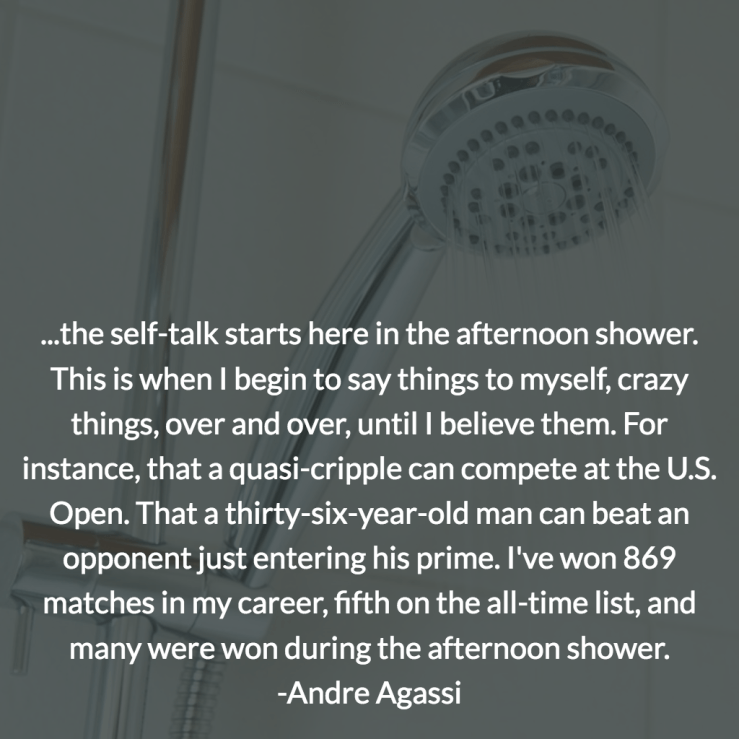
You’d better love the game. For a long time Andre Agassi didn’t. He had to answer the essential question, why am I playing this game? before he enjoyed it. Phil Jackson coached players to “Forget the ring, what matters most…is the courage to grow.” Scott Adams uses the systems and goals framework to describe this.

The best games have no finish lines.

3/ The lightbulb moment. About starting a podcast company. “It seems obvious that this is something that needs to happen. It felt very clear from where I was sitting. The idea didn’t feel risky. It felt like I was in a unique position to see it and that I just needed to act.”

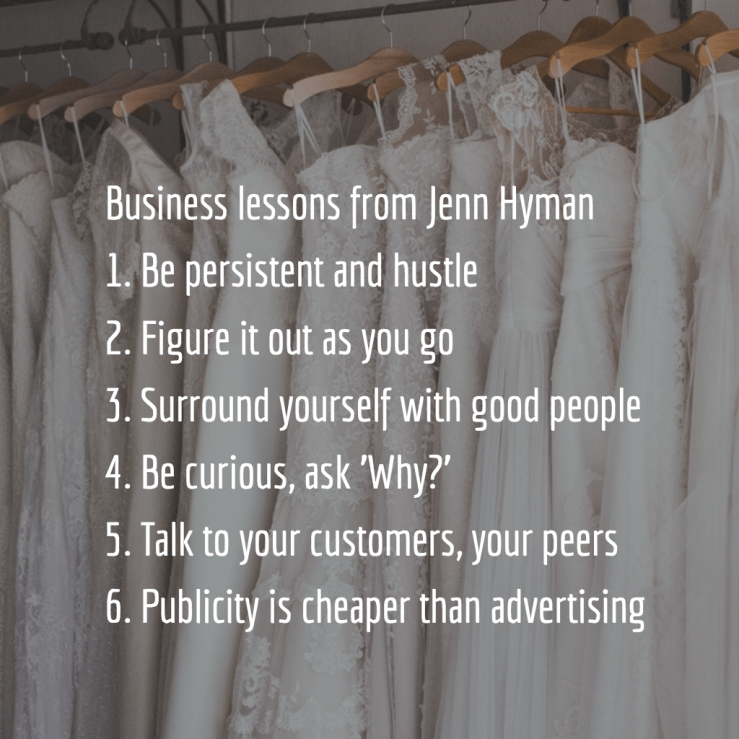
People in the weeds find spots for future flowers. Jenn Hyman said that Rent the Runway:

“was a lightbulb moment for me because I realized I was having a conversation with my sister about the experience of wearing an amazing dress. Of walking into a party feeling self-confident, feeling beautiful.”

Joe Peta hurt his back and looked at baseball statistics to have his lightbulb moment. Thomas Russo advised to “listen for things that surprise you.” Patrick Collison had his moment when he wondered why it was so easy to sell things on App stores but not the internet.

4/ Be different. “Our theory about what kind of podcast we want to launch is, if we’re going to try to compete in a space where we know people are already listening, we want to come with an approach where we can differentiate ourselves…there are other areas like sports shows and we haven’t figured out a way to crack into sports yet.”

To Be Different is important.

5/ Decentralized command. Blumberg can’t make every decision. “I don’t have the right information to make every decision so you have to set up a process for who’s making a decision and how they are making it.”

The invested people have the relevant information. During Hurricane Matthew, Waffle House didn’t order a shut-down. Why?

“We’re a 24-hour restaurant, so oddly enough shutting down is a big deal for us,” Waffle House’s Vice President of Culture Pat Warner tells FoxNews.com. “When it comes to making the final decision, we let our operations team on the ground, like individual restaurant managers, make the final decision based on local conditions. But our job [as corporate officials] is to give them all the support they need to stay open.”

Jocko Willink would point out the dichotomy in that. Leaders must understand the micro and macro views. Charles Koch said:

“The way we look at it is that certain things need to be centralized…But there are other things where the people at the plant have better knowledge…we’re very centralized on some things and decentralized on others. It’s not perfect. It’s a constant balance and rebalance and reworking and trial and error.”

6/ Certain skills. “It’s really rare to find people with the right mix of temperament, skill set, and desire.”

The two-jar model is a way to think about outcomes as being skill or luck based. We can control both our domain skills and our collegial skills.

On his podcast, Bill Simmons talked about Colin Kaepernick, Tim Tebow, and Michael Vick. Each has different domain skills like strength, speed, and reading defenses. Each also has collegial skills like interviewing, commenting, and interests. Vick’s domain skills overwhelmed his non-domain ones and he had a longer career than Kaepernick and Tebow.

Blumberg wants people who aren’t assholes and can host podcasts.

7/ Shut up and listen. Good leadership means meetings where everybody was heard. “I’ve taken that to heart and try with every meeting that I’m in to get everybody to talk at least once. It’s a simple thing that people want to be heard.”

In Negotiation, conversations, or meetings people want to be heard.


Thanks for reading, I’m mikedariano. Want more podcast notes? Subscribe here: http://eepurl.com/cYiwTP.
Andre Agassi

Supported by Greenhaven Road Capital, finding value off the beaten path.

Open by Andre Agassi was unexpectedly good. The pace, tone, and voice were all unique. Here are a few notes.

This book circles and Agassi’s life spiral around the essential question; why am I doing this? For Agassi, it took a long time to figure out.

Agassi didn’t start playing tennis, his father started for him. The early stories of overbearing are thick. A product of his circumstances, his tennis improved but his love for the game didn’t. But what else does someone with a ninth grade education do? He played but knew tennis didn’t answer the essential question.

He dated (and married) Brooke Shields. This is not the answer. He took drugs (and maniacally cleaned). This is not the answer. He considered retirement.  “I tell myself that retiring won’t solve my problem.”

Then his coach’s daughter ends up in the hospital. Agassi buys an inner tube for her head. It’s a small, spontaneous act but it gives him a peek. “This is why we are here. To fight through the pain and, when possible, to relieve the pain of others.” The idea is planted. Agassi forms a charity. He starts a school. “I go to Key Biscayne. I want to win, I’m crazy to win. It’s not like me to want a win this badly…and I realize precisely why…I’m playing to raise money and visibility for my school.”

This is Agassi’s answer to the essential question.

“I”m only slowly becoming aware of the full story myself. I play and keep playing because I choose to play. Even if it’s not your ideal life, you can always choose it. No matter what your life is, choosing it changes everything.”

We all need to answer our own essential question. Once we do the path becomes clear, the direction set.

pablo (20).png

There are two parts of tennis in the same game. The first is forehands and backhands and everything we see. That’s the 10,000 hours game. The second is the indirect game. We don’t see it, but it’s just as important.

“My father says that when he boxed, he always wanted to take a guy’s best punch…When you know that you just took the other guy’s best punch, and you’re still standing, and the other guys knows it, you will rip the heart right out of him.”

“I see fear creep into Pete’s face. We’re tied, two sets apiece, and doubt, unmistakable doubt, is trailing him like the long afternoon shadows on the Wimbledon grass.”

“When you think it’s your day, it usually is.”

“I see the pilot light in Hewitt’s eyes go out.”

There are two games of tennis, the one we see and the one we don’t.

Through tennis, Agassi lived other things too.

Loss aversion. “A win doesn’t feel as good as a loss feels bad, and the good feeling doesn’t last as long as the bad. Not even close.”

Frequency and magnitude. “Reporters ask how it feels to win twenty-six matches in a row, to win all summer long, only to run into the giant net that is Pete. I think: How do you think it feels? I say: Next summer I’m going to lose a little bit. I’m 26-1, and I’d give up all those wins for this one.”  Fifty one dollar bills equal one fifty dollar bill. One tennis tournament does not equal another.

Debt. “In the fifth set, however, he’s spent, whereas I’m just beginning to draw on funds long deposited in the Bank of Gil.” Agassi’s serendipitous meeting with Gil Reyes transformed his career. One way was building up his “bank of fitness.” Code debts, relationships debts, volatility debts all come due.

Media commentary. “Overnight the slogan (Image is Everything) becomes synonymous with me. Sportswriters liken this slogan to my inner nature, my essential being. They say it’s my philosophy, my religion, and they predict it’s going to be my epitaph.” Outsiders have one point of view, sometimes it’s the wrong one.

Hedonic adaptation. After winning some prize money, “item one on our agenda is what model of cool but cheap car we’re going to buy. The main thing is to buy a car with a tailpipe that doesn’t blow black clouds. Pulling up to Sizzler in a car that doesn’t smoke – now that that would be the height of luxury.” Everyone has a normal day but none are the same.

Be the house. After Gil, Brad Gilbert, author of Winning Ugly is the next most influential person in Andre’s life. After one of their first practices, Brad said, “Sometimes the best shot is a holding shot, an OK shot, a shot that gives the other guy a chance to miss.” Andre wants to hit winners, Brad wants him to hit not-losers. Winning is all about shifting the odds in your favor.

Hanlon’s razor. While playing in a cold match in Argentina Agassi catches an opponent’s serve. Was he disrespecting him? “I always wanted to do that,” Agassi says at the press conference afterward. In the book he writes, “The truth is, I was just cold and not thinking. I was being stupid, not cocky.”


Thanks for reading. Want more notes? Sign up here: http://eepurl.com/cYiwTP.

Jenn Hyman

Supported by Greenhaven Road Capital, finding value off the beaten path.

Jenn Hyman is the co-founder and CEO of Rent the Runway. She spoke with Guy Raz on How I Built This about her journey creating the company.

pablo (19).pngHyman pollinated the flower that became Rent the Runway while she worked at Starwood hotels. “I had this thesis that we had entered the experience economy.” Later she was home for Thanksgiving, in her sister Becky’s apartment and:

“Becky had just gone to a store and bought a dress that was a higher cost than her rent and as her responsible older sister I remarked that she should probably wear one of the dresses in her closet again rather than go into credit card debt.”

Lightbulb

lightbulb

Hyman answered the question, What jobs are your customers hiring you to do? Women ‘hired’ dresses to do something. Hyman explained, “I was having a conversation with my sister about the experience of wearing an amazing dress. Of walking into a party feeling self-confident, feeling beautiful.”  Feeling great is the job of a dress.

Now we’ve got a company.

Well, now we have an idea. Companies are much harder.

Hyman was at Harvard and met her co-founder, Jennifer Fleiss. Thanks to a lucky break emailing Diane von Furstenberg (nothing ventured nothing gained) they went to prove their idea.

Future founders should study this. Hyman explained:

“We did real life research. We went to Bloomingdales and bought one hundred dresses – all in our own sizes. So if this experiment didn’t work out we’d have an awesome new wardrobe. We spent a lot of our savings on this. We hosted a pop up at Harvard undergrad. We invited a bunch of different groups. The idea behind this was to see: Will women rent dresses? What will they rent? How much will they pay? What brands do they want? And most importantly, if they do rent, what happens to these dresses after they get rented?”

They talked to Jim Gold at Nieman Marcus who said:

“This is a really good idea women have been renting the runway from my stores for decades. It’s called buying something, keeping the tags on, and then returning it to the store.”

Hyman and Fleiss answered two questions:

  1. Will young professionals do this? Yes
  2. Are people already doing something like this? Yes.

8830100398_eca5a61590_o (1)

Talking to customers is crucial. Great companies have the shut up and take my money moment. Dead companies have no idea what their customers want. Scott Fearon traded on this. Kip McDaniels knows and writes for them. Jason Calacanis said that Airbnb was for serial killers – unless, there were a few crazy first customers. And there were. Andy Rachleff pivoted Wealthfront’s direction after talking to customers.

Before Tony Hsieh invested in Zappos, he didn’t believe shoes would sell. Who would buy something they wear without trying it on? Hsieh wondered. Well, it turned out that catalog shoe sales were the fastest growing part of the market. People were already doing it.

Okay, Hyman and Fleiss have their idea and they talked to customers. It’s time to launch this thing. Now all they needed was 1.75 million dollars of venture investing to build out the inventory. “We needed some selection. You weren’t going to come and start renting if there were only five units of inventory on the site.”

Got the inventory, then what? Pictures.

Pictures? “We figured out right before the website is set to launch we have no photos.” Hyman assumed there was a centralized photo database of all the pictures. Nope. Hyman was naive, and all founders are. Jessie Itzler said if you have to believe you can do something without knowing why you can’t.

The site launched. The women hustle. They built up an email list. Someone on the list had a @NYTimes address. They sent an email. It’s a technology reporter. Noting the fact that women are never covered in the technology section, Hyman and Fleiss get featured in the business section. Their traffic booms. Annual revenue goals are met in a month.

This is great. Right?

As some challenges pass new ones emerge. They need more money. Venture capitalists don’t understand the model. This wasn’t for their wife or admin or daughter. This service was for people they didn’t even think about. This is the Uber story. This is the Airbnb story. This is the Pinterest story.  This is the story Hyman is trying to tell. If you shade your view – accidentally or not – you miss seeing things.

Who is going to share a dress, share their car, share their home? A lot of people thought Hyman, and she was right.


Thanks for reading, I’m mikedariano. Want to see what I read? Sign up here: http://eepurl.com/cYiwTP.

Be Different

Supported by Greenhaven Road Capital, finding value off the beaten path.

Rather than a notes post, this one will be a summary page about one idea; being different.

This repeats in different interviews because people want to start something new. The want comes from a dissatisfaction. Where succeed by being different and right. Howard Marks 4 puts it this way:

marksmatrix.jpg

This is simple but not easy. You have to do things that others think stupid, said Pat Dorsey. These are non-obvious things, said Jason Calacanis. These are ideas that people are opposed to. Leigh Drogen [said]:

“Union Square Ventures finds that when they go into a partner meeting with an idea they want to see a barbell of, ‘I think that’s an awesome idea’ and ‘you’re freaking crazy, why would we ever do that?’ Their worst investments are the ones where everybody thinks, ‘yeah that makes total sense.'”

What kind of person. A hard one. Rishi Ganti suggested people become more like Indiana Jones. Scott Fearon wrote that loners, cynics, and skeptics do better. Marc Cohodes said about short-selling “if you’re not a tough motherfucker you shouldn’t do this.”

Where to look. Somewhere you know well. Before Alton Brown created a hit cooking show he made television for ten years and went to culinary school. Danny Meyer followed a similar path, focusing on a certain type of NYC eateries. Andy Rachleff said, “to be non-consensus and right you have to have tremendous knowledge of your domain.”

You want El Dorado, without conquistadors or tourists. Rishi Ganti pointed out that the pricing mechanism – and you only need two bidders – create markets. You want to be the only eBay bidder.

These things can have unconventional pricing. Moneyball was all about finding mispricings because of incorrect labeling. It’s something Joe Peta found too when he bet on baseball. Crypto, for example, is a different pricing.

What to build. If you find an opportunity then build with care. This is paramount. Andy Rachleff calls it product market fit and says it “trumps everything else.” Scott Galloway said that product comes before marketing six days a week and twice on Sunday. In Zero to One, Peter Thiel wrote that early on everyone is a builder or seller.

Good builders talk to their customers. Do not confuse friends, family, or spreadsheets for customers. This means physical proximity. Melanie Whelan goes to spin classes. Scott Norton threw a ketchup party. Matt Wallaert went into a classroom to talk to teacher and students.

Alpha erosion. If the new thing works congratulations, you have what investors call alpha. Don’t get comfortable. Alpha will be eroded unless it is protected by a moat, these are powerful and rare.

It’s why Daryl Morey said that their draft board isn’t so different anymore. Competing teams noticed that Morey’s team tended to draft well and copied, tinkered, and remixed it. Ed Thrope said: “any edge in the market is limited, small, temporary, and quickly captured by the smartest or best-informed investors.”

Career risk. Only certain companies allow for this kind of “being different.” You don’t get fired for buying Blackstone, said Ganti. Wesley Gray said that getting crushed in the short-term with good long-term strategies is “the biggest issue with arbitrage.” In Michael Lewi’s other book Flashboys he wrote:

“It wasn’t all that hard for the people who ran Goldman Sachs to see the source of the problem, or to see why no one inside the system cared to point it out. “There’s no upside in it—that’s why no one ever steps out on it,” said (Matt) Levine. “And everyone’s got career risk. And no one is thinking that far ahead. They are looking at the next paycheck.””

Simple and valuable, but not easy.


Thanks for reading.

The Yin and Yang of Negotiations

Supported by Greenhaven Road Capital, finding value off the beaten path.

This is a repost from elsewhere but it needs to be its own post.

260px-yin_yang-svg

In Never Split the Difference, Chris Voss suggests that tit-for-tat and split the difference negotiations are the easy way out. He opens the book with a critique of the Harvard Negotiations Project and the book Getting to Yes. It’s okay, Voss writes, but you need to know more.

I’ll admit my bias. Getting to Yes is a book I regularly refer to. It’s one of those books – much like spiritual texts like the Bible, Meditations, or the Tao de Ching – where you don’t need to read it cover to cover. Instead, the most value comes from dipping and sipping.

Voss is a former FBI hostage negotiator who took the ideas from GTY and evolved them. Never Split isn’t a replacement for GTY, it’s a supplement. The two books are like Yin and Yang. One was built by academics in ivory towers, the other by a hostage negotiator in Central America.

The two books have a lot in common and combining them we get a whole that’s greater than the sum of their parts. Let’s look at what to do before and during negotiations.

Before negotiations

There are three questions you must answer before the negotiations.

  • What are the facts of the situation?
  • What are the perceptions of the situation?
  • What are some options out of the situation?

Another way to put is to follow Charlie Munger’s “two-track” analysis.

“First, what are the factors that really govern the interests involved, rationally considered? And second, what are the subconscious influences where the brain at a subconscious level is automatically doing these things – which by and large are useful, but which often malfunction.”

What kind of facts are there? Try to accumulate as many facts as possible that support your side of the negotiations. In GTY this is so you can “insist on objective criteria.” For a house some of those facts will be; comparable homes in size, school district, or amenities (master bath, pool). A seller might also stress the newer appliances while a buyer might note the older roof. Voss writes that you “fall to your highest level of preparation.”

The second facet is the perceptions each party may have about the negotiation. My brother recently closed on a home purchase and part of their final offer to the sellers was a letter about their growing family and a picture of his one-year-old son. That appealed to the buyer’s perception about who might own their home. Other things like “entertaining guests” or “safety” may be perceptions a house buyer holds as important.

Finally, you should prepare your list of options for a negotiation. Time, for example, gives you a lot of optionality. Voss often dealt with kidnappers and realized they lacked the option of time because they dropped their ransom demands as the weekend got closer. Why? They wanted fun money. After he learned this Voss decreased negotiation payouts only towards the end of the week when the kidnappers were more antsy to get paid.

Be creative when you answer these pre-negotiation questions. Voss compares a negotiation to playing cards. You don’t know what the other person is holding, so you need to come up with a range of options. It won’t be all-encompassing, but coming up with ideas beforehand can prepare you for the negotiations when those cards are finally played.

During negotiations.

Listen

Voss spends most of the first part of his book explaining how to listen – and for good reason. Listening is hard. Eric Maddox had a difficult listening job. He was the interrogator in Tikrit Iraq in 2003. Special Forces operators would bring prisoners to Maddox and he had to put aside his feelings (“These men just shot at me”) and focus on the facts. Maddox wrote, “I didn’t care how bad a prisoner was, or was supposed to be…It was important to look at both sides as objectively as I could.”

“Your goal at the outset,” writes Voss, “is to extract and observe as much information as possible.”

How do you become empathetic and collect information?

Voss’s tactics They say You say
Be a mirror. “This is a family heirloom and it’s hard to part with.” “You must have a deep connection with it.”
Repeat their last 3 words. “My grandmother passed this down to me.” “She passed it down to you?”
Label their pain. “I just don’t know if I can give this up.” “It sounds to me like there’s an emotional connection to this item.”


Remember that during this discovery phase, the aim is understanding, not agreement. The more you can get the other side to talk, the better. In GTY the authors warn against a negotiation concession where a psychological one will do. Sometimes people just want to be heard. There’s a two-minute YouTube video with fourteen million views that show this.

When Danny Meyer opened Union Square Cafe he had a lot of kinks to work out. That meant he had to negotiate with a lot of customers. Your table is not ready, we lost your reservation, we’re out of fish and so on. Meyer wrote in his book, “For most people, it’s far more important to feel heard than to be agreed with.” He added that as the service provider you always get to write the last chapter.  At his restaurant, this meant a free glass of dessert wine to people who had something unplanned occur. This wine was cheap for Meyer to provide but valuable to his restaurant guests.

Positions are not concerns

As you listen develop a picture of the person’s concerns which manifest as requests. When I bought the house I live in now I learned one of the concerns from the seller was moving closer to town. I would never have guessed this and it’s an example of something I didn’t and wouldn’t know about. The position was to sell the house, but the concern was to spend less time in the car.

Dollars are often front and center in negotiations but because it’s a convenient language for concerns but everyone has concerns beyond the dollar.

Landlord $ …and stable, mature tenant who pays the rent on time. They also want minimal vacancy and limited expenses for maintenance.
Employer $ …and institutional memory and minimal switching costs associated with hiring new employees.
Salesman $ …and fast transactions, referrals.
Chris Voss $ …and publicity. Voss agreed with the Memphis Bar Association to a reduced rate in return for a magazine cover article.
Warren Buffett $ …and quality businesses. Buffett went from looking for “cigar butts” to chasing “moats.”

Never Split and GTY both emphasize control and security as two fundamental human concerns.

Another concern to keep in mind is that of the third party. In a home purchase, there is the seller and buyer but also the buyer’s bank who will require a home appraisal to validate the loan amount.

Ken Grossman found out the hard way about negotiations with third parties when he tried to buy out his partner Paul Camusi. The two had gotten funding from friends and family. In that group was Camusi’s extended family. After years of negotiation and mediation, Grossman got a good enough agreement and bought out Paul and his family. Even though negotiations like this can take a long time,

Voss writes that if you hear someone described as “crazy” you should take that as a signal to look for clues.

Early on Grossman didn’t pay his employees as much as other places but he wrote, “they loved what we were doing and it was a fun place to work.”  He identified their concerns as enjoying life. Part of that was how much you got paid and part of it was how much you liked your job.  By 2009 Grossman built a larger and more successful company and created on-site daycare, medical care, and classrooms. Grossman understands his employee’s concerns.

He didn’t understand this for his buyout of Camusi. You see, he didn’t have to buyout only Paul but also Paul’s mother and others who had given the company loans in the early years. Few people are actually crazy, what’s more likely is that you don’t understand their concerns.


Thanks for reading. If you liked this post, you’ll like my emails too. Sign up here: http://eepurl.com/cYiwTP.

Matt Wallaert

Supported by Greenhaven Road Capital, finding value off the beaten path.

pablo (18).png

Matt Wallaert joined Barry Ritholtz to talk about designing good behaviors. I liked it.

Behavior matters, said Wallaert, and it’s something fixable. Take lines for example. They’re too long. But what does that mean? “It’s not that people are in line are too long but that it feels too long.”

Feelings. Interpretations. Expectations. It’s the gray area of our gray matter we call psychology. Behavior designs are a tool. One we could use more often. Rory Sutherland said, “It’s always more acceptable to spend money on infrastructure than to spend money on psychology.”

Sutherland proposes that it feels like cheating to use psychology. Is that what behavior design is, a Konami code?

I don’t think so.

Looser than the laws of physics, our biases affect us too. We value things we own more than identical ones we don’t. We like a deal, we love a steal. We emphasize size, sometimes too much. Wallaert wants us to account for these things like a pilot accounts for a crosswind. Sometimes the force will be a gust, sometimes persistent, and sometimes absent.

1/ See it to believe it. Part of the reason for issues around women’s employment is the see-it-be-it problem. “If I never see a female scientist as a little girl,” Wallaert asked, “how will I ever have the opportunity to think, oh I might be that?”

This was the case for Felicia Day. “I’d always wanted to write. But in order to try something in life, you probably have to be exposed to someone who makes you think, Whoa. I want to be cool like them!”

Anastasia Alt said similar things:  “It was very possible to be successful as a trader where the environment was one where people didn’t necessarily look or think like me,” but, ” it meant a lot to me to normalize the presence of women in these roles.”

Comedians – like Judd Apatow and Joe Rogan – make this point time and again. Oh, I didn’t know that was possible until I saw [insert name here].

2/ Talk to your customers. When Wallaert was at Microsoft they wanted to understand why Bing searches in schools were lower than expected. Their first idea was, as many adults do, to bemoan the younger generation.

“The marketing department decided that kids aren’t curious enough and planned to run a campaign around encouraging curiosity in kids. I said, let’s go look and we go into a classroom and see kids are plenty curious enough. One of the tenets of behavioral science is to go look at how people are behaving.”

Not talking to customers was a common misstep among failed startups. Scott Fearon wrote “I was mixing up what I liked with what my customers wanted,” and this personal lesson became an investing premise. Patrick Collison reached out to his customers and realized his initial idea was actually much better than he realized.

3/ Empower flight attendants.

“I had tweeted at Alaska and Virgin to put in their employee app a way that makes it much easier to give someone free food or miles on the spot when something bad happens. United today said ‘we’re going to do that.'”

Good organizations have one of two structures.

  • The Boss spends some of her time out of the office talking to the people who use their product. This is why Melanie Whelan spins. It’s why Intelligent Fanatics travel. It’s why Andy Grove wrote, “We need to expose ourselves to our customers.”

Or.

  • The Boss empowers employees, as Wallaert suggested. Jocko Willink did this in the military. Warren Buffett said to “hire well, manage little.”  Ray Kroc wrote, “It has always been my belief that authority should be placed at the lowest possible level. I wanted the man closest to the stores to be able to make decisions without seeking directives from headquarters.”

4/ Work worth doing.

Pasted Image 0.jpeg

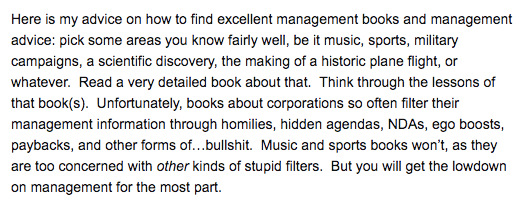
Much of this portion of the interview reminded me of the book Shop Class as Soulcraft. One quote from a good book:

“When you do the math problems at the back of a chapter in an algebra textbook, you are problem solving. If the chapter is entitled “Systems of two equations with two unknowns,” you know exactly which methods to use. In such a constrained situation, the pertinent context in which to view the problem has already been determined, so there is no effort of interpretation required. But in the real world, problems don’t present themselves in this predigested way; usually there is too much information, and it is difficult to know what is pertinent and what isn’t. Knowing what kind of problem you have on hand means knowing what features of the situation can be ignored. Even the boundaries of what counts as “the situation” can be ambiguous; making discriminations of pertinence cannot be achieved by the application of rules, and requires the kind of judgment that comes with experience. The value and job security of the mechanic lie in the fact that he has this firsthand, personal knowledge.”

5/ Argue well. Toward the end Wallaert says he loves Oregon because, “you can vehemently disagree about something and still come to dinner on Friday night.” Not to overstate things, but that’s genius. Really. Erik Weiner’s wonderful book Geography of Genius has few conclusions (among many great stories) but one is that great ideas are forged. Athens had symposia, Florence had workshops, Edinburgh had ‘flying’, Calcutta had the adda.

Good ideas swan from arguments. Adopted by Jeff Bezos and Charles Koch who said:

“A critical part of our management philosophy is building a challenge culture. We find this is one of the biggest problems in aquisitions we make, in many of them if you challenge your boss it hurts your career. Here if you don’t challenge your boss …(because you see a problem in what’s being done)…if you don’t challenge you’re not really doing your job.”


Thanks for reading, I’m mikedariano.

Scott Galloway 2

Supported by Greenhaven Road Capital, finding value off the beaten path.

Scott Galloway was on the FT Alphachat podcast and talked Amazon, CPG, Amazon, Apple, Whole Foods (Amazon).

Galloway has this advice for companies:

pablo (17).png

1/ Nail the boring stuff. “It’s the boring stuff that’s creating shareholder value.”  Things like capital allocation and supply chain management matter more and more. Don’t think boring stuff matters? We do, and so does Royce Yudkoff and Brent Beshore.

2/ Open stores. Well done these are excellent investments. “Stores are where you go consummate the relationship,” said Galloway. Apple’s path may be one to follow, told wonderfully in The One Device by Brian Merchant.

3/ Staff those stores with great people. “Customers no longer go to stores for the product, they go for people.” Good organizations create decentralized systems that empower employees to solve customer problems. Pete Carroll said this applies to football, Phil Knight wrote this about Nike, and Ben Rich wrote it about Skunk Works.  Good companies will also train their staff to listen – which is sometimes all you need to do in a negotiation.

4/ If you have a media brand make sure that at least half your revenue comes from subscriptions. Less than that said Galloway, and you’re in trouble. Tren Griffin explained how this might work for the streaming audio services:

“How can the SSP music streamers become more like Sirius XM? First and foremost, they must start working to improve each of the unit economics variables and become more like Sirius. These variables discussed below are all important, but nothing is more important for the SSP music streamers than improving gross margin (#2). Without a gross margin fix, nothing else matters.”

5/ Have a great product. “People come to me and I tell them, ‘build a better mousetrap and the brand will take care of itself.'” People used to wrap things up in “shiny paper” but now it takes a great product. Ryan Holiday has said this is his best marketing advice too. In the Griffin post he wrote, “The best way to retain customers is always to have a fantastic product.” It’s what the Instagram team did.


6/ Be an excellent tracker. Galloway said:

“We’ve voted with our pocketbooks and said that as long as there is a coupon at the end of it or the offer is more relevant–violate my privacy…You confide more in Google than your priest or any friend.”

7/ Watch out for Amazon. “I’ve never seen a company execute so well.” In addition the cheap capital, Galloway thinks Alexa is “a game-changer.” The question CPG companies need to answer is; ‘In what ways are we better than Amazon?’

In his interview about Harry’s, Andy Katz-Mayfield talked about this. He’s away that Harry’s has to be different from Amazon and Dollar Shave Club. Easier said than done.

Warren Buffett said at the 2016 Berkshire Hathaway meeting, “We don’t look at something like that (Amazon.com) and try to beat them at their own game. They’re better than we are at that, and we aren’t going to try to out Bezos Bezos.”

Charlie Munger said about this in general, “Figure where you have an edge—and stay there…If you play games where other people have the aptitudes and you don’t, you are going to lose. And that is as close to certain as any prediction that you can make. You have to figure out where you have got an edge. And you have got to play within your own circle of competence.”


Thanks for reading. Get a Saturday morning email with my favorite podcast from the week by signing up here http://eepurl.com/cYiwTP. Perfect for dog walks and Sunday drives.

Jessie Itzler

Supported by Greenhaven Road Capital, finding value off the beaten path.

Entrepreneurs are great to study because they’ve done the thing rather than talk about the thing. Sure it’s an N of 1  but there are still things to be learned. Tyler Cowen put it this way:

Screen Shot 2017-08-17 at 8.46.56 AM

Can we extend this to business advice? For the most part. Though everyone liked Shoe Dog. Can we do this for Itzler? Let’s find out.

Itzler’s interview on The Investor’s Podcast focused on Marquis Jet. Itzler had no experience with planes but he took a ride in a private jet and said it was like a Wizard of Oz moment when everything turns from black and white to color.

These see-it-to-believe-it moments are the seeds of growth. Judd Apatow and Joe Rogan saw comedians. Alton Brown went to Tuscany. Ezra Klein read a blog. Richard Thaler read Value Theory.

thatsinterestin

But interestingness needs gumption to lead to action. Don’t worry that you don’t know it all, that’ll help. “Not knowing what you don’t know,” said Itzler, “is a gift.”

If you knew how hard this was going to be, you wouldn’t do it.

Okay, notice things and just start. After that, you have to hire for your weaknesses. Itzler knew zilch about aviation so he hired people who did. At this point you’ll start to hear doubts, that’s okay too. Good ideas are different ideas and different ideas are the big ones.

Itzler said, “when my wife started Spanx if she would have asked her parents or her close friends about footless pantyhose they would have been like, ‘if it’s such a good idea, Sara, why haven’t the big guys done it yet?’ and that might have scared her off.”

Leigh Drogen said “Union Square Ventures finds that when they go into a partner meeting with an idea they want to see a barbell of, ‘I think that’s an awesome idea’ and ‘you’re freaking crazy, why would we ever do that?’ Their worst investments are the ones where everybody thinks, ‘yeah that makes total sense.'”

Jason Calacanis said about VC investments “If it’s clear that it’s going to work you should not invest.”

Andy Rachleff said about the Howard Marks Matrix (below), “I also believe this framework can be applied to entrepreneurship….To be non-consensus and right you have to have tremendous knowledge of your domain…When we started the idea of people trusting their money to be managed exclusively by software was a radical idea.”

andy

If you have an interesting idea then it’s time to get the business growing. For Modern Monopolies this is the chicken and egg problem. It’s when founders do things that don’t scale. Itzler did this too, filling every plane seat with people. “We out-cared everybody and that created word-of-mouth.” That and good PR which “is so inexpensive compared to advertising.”

As the company grew Itzler focused on getting the product right. He followed Scott Galloway’s advice: “People come to me and I tell them, ‘build a better mousetrap and the brand will take care of itself.'”

Itzler also suggests taking time to think and said “I’m sure Bill Gates takes time to think.” Well not only that, but he spends a whole week doing it.

I learned from that video that part of the goal of Think Week (for Gates) is to let good ideas percolate up.

“We’ve institutionalized it as a grassroots process. This is a way that somebody just a year or two into the company – and has ideas that may or may not relate to the group they’re in – can write something up.”

Good organizations have decision makers interact with customers. Think Week Papers may be a channel where the front line staff can communicate what they see with the C-suite. Talking with his customers helped Itzler sell to Berkshire, that’s good business.


Thanks for reading, I’m mikedariano.

See everything I’m learning here: http://eepurl.com/cYiwTP.

NFL Summer 2017 ‘Tawk’

Supported by Greenhaven Road Capital, finding value off the beaten path.

https://soundcloud.com/the-bill-simmons-podcast/summer-hot-air-nfl-story-lines-with-mike-lombardi-tate-frazier-and-joe-house-ep-246

Bill Simmons, Mike Lombardi, Joe House and Tate Fraiser covered NFL storylines in a podcast. Not much is happening, so, there’s not much to talk about. Unless you talk about the things other people have talked about. Let’s dig into the notes.

1/ Base rates.

“Charlie Casserly was proclaiming he (Andrew Luck) was the next John Elway, they both went to Stanford but he’s not the next John Elway.” – Lombardi

“I don’t think you can compare anyone’s stats from this decade to last decade. No one gets hit anymore. The interceptions are way down. Even bad quarterbacks have good stats. I grew up with Steve Grogan and he would have years where he threw nine touchdowns and seventeen interceptions.” – Simmons

“Playing in a dome is a huge advantage.” – Lombardi

Base rates are a great place to begin any decision-making process. Michael Lewis wrote that base rates are “what you would predict if you had no information at all.” But base rates must be accurate. Is Stanford University relevant for quarterback talent? Does it matter when and where players play?

Dan Carlin reframed base rates within a historical context. Sam Hinkie used them to (try to) build a basketball team.

2/ Odell Odell Odell. Beckham has been a summer storyline too. Most receivers, Simmons said, have a bit a diva in them and the guys wonder if Beckham is worth the resources to have on your team. Simmons would take him, “The guy’s fucking scary…he does have greatness in him.” “He puts the ball in the end zone, he makes plays,” added Lombardi who compared Beckham to Jarvis Landry:

“He (Beckham) has 288 catches in his career. Landry has 288 catches in his career. Both came out of LSU three years ago. Beckham has 14 yards per catch. Landry has 10. Landry is a solid player. Beckham gives you that dimension where if he’s open on the three line you hit him.”

Similar statistics but one is a much better player.

What made Moneyball successful is that output was cheap if you knew what to buy. Fancy figures like home runs and batting average were expensive while OPS was cheap. Billy Beane bought output cheap.

If we ranked players by OPS (rather than BA) we might have seen something that looked like this:

#29 .8200 OPS $15 million/ year
#30 .8000 OPS $2.5 million/year

The difference between player #29 and #30 for OBP was small while the cost was high. Does that hold for NFL wide receivers? I’m guessing no. During a Wharton Moneyball podcast, they mentioned that NFL analytics can improve but how much change will it bring to looking at this position? Again, probably not much. As coaches have said, you can’t teach height or speed. (Or hands)

3/ This is water?  We all exist within some system and see the world through the lens of that system. Fish live in water. Tigers have Umwelt (and so do you).

One system is your generation and “Beckham is symbolic of understanding millennials,” Simmons said.  “This is the hardest thing for my generation,” continued Lombardi, “if you’re evaluating talent. You can’t judge players through your eyes. You have to understand what Millennials do…If you’re going to cast a guy aside because you don’t relate to him from your generation, you’re going to make a lot of mistakes.”

Mistakes beyond sports. Business mistakes like hiring the wrong CEO just because they did well at Google. Investing mistakes like thinking someone is brilliant when really it was a bull market.

Warren Buffett wrote: “The rise and fall of the tide is hardly something for the duck to quack about.” Flip that around and the selfie culture doesn’t mean anything more than a sign of the tides.

4/ How to win a football game.

How do I win games? Let me count the ways.
I win games by skills, agility, and might.
My playbook is sharp, my depth just right.

Lombardi said about Seattle “It’s the complete opposite of New England. New England’s players say nothing, Seattle’s players are outspoken and they both work.”

Success comes from having a system and doing it as best you can. Cherry picking ideas, adopting best practices, and talking with other coaches are all good things but they can’t be the thing.

Charley Ellis and David Salem have both shared what they think David Swensen has done right at Yale and both have warned about mistakes they think people make. In his podcast with Patrick O’Shaughnessy, Leigh Drogen warned against any sort of bolting on.

You can’t copy and paste.

Rather, choose to be different. Create a decentralized spirit. Build culture. Do those things and you’ll win games. It’s worked for New England (see: Bill Belichick) and Seattle (see: Pete Carroll).


Thanks for reading. Don’t miss any posts, get links and see what else I listened to here http://eepurl.com/cYiwTP.

Frank Lloyd Wright

Supported by Greenhaven Road Capital, finding value off the beaten path.

IMG_0890.JPG
Kentuck Knob. Southwest Pennsylvania. 2017

We amended a family vacation to include stops at Kentuck Knob and Fallingwater (yes, that one) to see these Frank Lloyd Wright houses. In preparation I read about Wright and noticed four patterns we’ve seen before.

1/ Luck. Wright was born in 1867 to a doting mother and overly ambitious father. His dad moved the family around as he tried this and that and his mom treated Wright like a prince during those years.

Ed Thorpe wrote, “Chance can be thought of as the cards you are dealt in life, choice is how you play them.”

This was true for Wright. His mother couldn’t control the moves (the cards) but she played them well, getting Wright music lessons, drawing supplies, and blocks as a child. When he was in high school Wright’s father left the family and Frank dropped out to help pay the family’s bills. His mother’s family hired Wright to do basic drawing work. In 1871 the great Chicago fire destroyed a swath of the city and fifteen years later Wright was one of the many builders that immigrated to rebuild and expand the city.

While Wright’s childhood wasn’t in the big woods of Wisconsin, he had both misfortunes and fortunate breaks.

2/ Learn by doing. Wright wasn’t opposed to dropping out. He didn’t like school. Rather, he had spent so much time learning by doing.  At one job Wright couldn’t do anything but trace prepared drawings. That was fine because it gave him time to learn and ask questions.

As his skill grew he left one firm for another until he started his own. Job hops gave Wright experience doing this and that. It showed him how people thought. Tyler Cowen suggested to Russ Roberts that the advantage to centrality is not connecting with everyone but with someone who might. Cowen said that being in DC means he doesn’t need to visit think tanks but only talk to people who do.

Know and do, do and know.

Yvon Chouinard wrote  “I didn’t know anything about clothing. I learn everything by taking a step forward and see how that feels. If it feels good I take another step, if it feels bad I take a step back…I learn by just doing.”

Wright, Aziz Ansari, and Ty Warner all learned by doing.

3/ 10K hours. Wright was committed to his work and not much else.  Charlie Munger never coached youth soccer. Gene Kranz of ‘failure is not an option’ fame wrote, “Behind every great man is a woman – and behind her is the plumber, the electrician, the Maytag repairman, and one or more sick kids. And the car needs to go into the shop.” John Boyd had the greatest gulf between professional accomplishments and personal failings.

Malcolm Gladwell told Stephen Dubner this was his point in Outliers:

The work required for elite success is intense and leaves little room for much else.

4/ Be different. The reason Wright stands out in time is because he was different. He even invented a word, Usonian, to describe a style. That’s Tyson Zone different. Wright wrote about his approach, “No house should ever be on a hill or on anything. It should be of the hill.”

Critics baptized him as ‘Frank Lloyd Wrong.’ Artists refused to have their work shown at the Guggenheim. Being different means headwinds.

But America needed a style of architecture and Wright wanted to give them one. It reminded me of Alton Brown show Good Eats. When someone asks, what the hell is that? it means you might be headed in the right direction.

Leigh Drogen said:

“Union Square Ventures finds that when they go into a partner meeting with an idea they want to see a barbell of, ‘I think that’s an awesome idea’ and ‘you’re freaking crazy, why would we ever do that?’ Their worst investments are the ones where everybody thinks, ‘yeah that makes total sense.’


Thanks for reading. Get the weekly snapshot via email here: http://eepurl.com/cYiwTP.