Patrick Collison

Supported by Greenhaven Road Capital, finding value off the beaten path.

Patrick Collison (Stripe, Atlas) talked to Jason Calacanis at the TWIST Launch 2017 event. Collison, says Tyler Cowen, is one of the smartest people he knows. Much like the Bill Gurley interview at Launch 2017, this could have been twice as long. We’ll take what we can get, here are the notes.

Collison’s interview reminded me of the – (EPISODE OF THE YEAR) – podcast between Patrick O’Shaughnessy and Body Varty. Varty is a tracker and says, “there’s an impossibility to it, and yet, if we go and try there’s also a chance.” Tracking is about listening, searching, and being relentless. It’s a great metaphor for anything and pairs nicely with the story Collison tells.

Pre-foothold. Before founding Stripe, Collison (along with his brother John) built apps for the App store. It was a good business and showed them sometimes.

“We (John and I) had been talking about this idea (payments) for awhile. We had sold apps in the app store and it had been incredibly easy…we were kind of reflecting on how easy it was to sell apps on the app store and it was so monstrously difficult to do other transactions on the broader internet.”

Like Ken Fisher, Collison noticed that in one area (the app store) something worked whereas in another (the broader internet) it did not. Collison started looking around and noticed that other people were having this same problem. His friends were creating a lot of workarounds to use the legacy payment companies. Obviously, he could do better.

3te95w

Regular readers will know that nothing is obvious or fast. Even though the existing system was a quagmire it wasn’t that obvious that it could be fixed or that Collison was the one to do it. “It was almost two years of us writing code by ourselves,” he says, “We’ve been working on this for quite a while, laying the foundation.”

Collison recalls that around this same time the Facebook team had multiple irons in the fire. “It was not obvious that Facebook was the thing to be working on,” he says. The Stripe prototype too “wasn’t obviously a great idea…we didn’t know if we should raise money for Stripe or not.”

As Calacanis questions, there’s an origin story expectation but it never comes. Collison even mentions hindsight bias and explains the emotional roller coaster he was on. “Maybe a month after starting work on it (Stripe) we’re like, ‘This could take over the world.’ But of course the next morning it was like, ‘This is the worst idea in history.’”

As the idea grew Collison moved to the Bay area because that’s where his potential customers were. He avoided the #1 mistake of failed startups and found that the payments pond “was actually a much larger ocean.”

For the most part, the journey to this point is consistent for successful and for unsuccessful startups.  “Two years is a long time when you’re in it, working away, with so many of these roadblocks and headwinds and people telling us that it couldn’t work or shouldn’t work or it’s a bad idea…it could be that it’s a bad idea, or not.” Collison explains that the early days – maybe even the early years – are similar for companies that live and ones that die. This is among the reasons Bill Gurley recommended a book like The Startup.

Post-foothold. Collison points out that Stripe isn’t established yet, but they do have a foothold. Stripe’s goal “is to increase the GDP of the internet,” says Collison.

While “the internet does not care about the national borders of the atoms they’re sitting on top of,” some founders can start internet businesses easier than others. Collison says they looked through the Stripe data and saw “so many people that were going through such lengths to surmount these stupid barriers.” The story was playing itself out again. Originally Collison saw companies struggling to accept payments. Now it was companies trying to incorporate in the state of Deleware, have a United States bank account, and get basic tax and legal structures implemented. Stripe created a product called Atlas to do these things.

As Collison told this story and explained the journey he used words like “hypothesis” and “experiment.” I think that wording matters. Brent Beshore said the secret to business is trying things and do more of the things that work and less of the things that don’t.

One of those experiments is staying private. Collison says that Stripe is going to “hold off as long as possible” from going public. Why? Ken Fisher guessed that because there is ample private capital and too much public pressure. Collison mentions the latter saying that Amazon is the best example of long-term thinking and they had an uphill battle to keep that mindset.


Thanks for reading,
Mike

PS This was another “shorter” post. If you liked the brevity and fewer links, let me know.

Michael Lombardi 2

Supported by Greenhaven Road Capital, finding value off the beaten path.

In episode 102 of The Ringer’s NFL Show, Mike Lombardi spoke with Tate Fraizer about his experience preparing to draft NFL players. Besides the revelations about Al Davis’s eating habits, Lombardi pointed out ideas we can use in other domains too. Here’s how to draft NFL players (or make any decision better).

https://soundcloud.com/ringernflshow/gm-street-tales-from-the-draft-war-room-with-mike-lombardi-ep-102

Step 1: Collect the right data. Lombardi said that during his time with the Oakland Raiders, owner Al Davis wanted the fastest players. That became their most important data point.

“We’re watching Texas Tech. offensive tape, watching Wes Welker make every catch and we drafted Carlos Francis in the fourth round because he was the fastest guy at the combine…We picked Taylor Johnson in the second round which was a guy that could really run but we passed Jason Whitten to pick Taylor Johnson because Jason Whitten didn’t have a fast enough forty time.”

Forty-yard dash times are available data but they may not be the most helpful. Daryl Morey saw this as General Manager of the Houston Rockets when he asked if points and rebounds don’t tell the whole story.

Another mistake coaches made was overvaluing someone with a great recent performance. “Take the one year player and look back don’t look forward, thinking he’s going to build off that,” Lombardi said he learned to not expect one-year wonders to continue that success in the NFL. Phillip Tetlock writes that superforecasters don’t overreact to new information.

Step 2: Prepare your wish list. Like a kid at Christmas, football teams don’t get everything they want. It’s good to have the list though, says Lombardi.

“In ’86 Bill Walsh sends me to the blackboard to write down three names…I write them on the blackboard and he says, ‘When we pick we’ll pick one of these three guys.’ [all three players get picked by other teams] and we look at each other and we’re like, ‘Holy crap we got nobody to pick.’”

Lombardi’s team traded down to get some more time to talk through who to pick but it shows they weren’t prepared.

Preparation is one of the keys to How to Negotiate Well. It’s also a key part of Bill Belichick‘s success. Sam Hinkie said that this is an iterative process. His office would redraft players to see how well their systems worked and refined it over time.

When making the list it’s tempting to slide into easy comparisons, don’t. “He (Al Davis) wanted to make Tyler Brayton an outside linebacker because Al Davis thought he was Ted Hendricks…every player at the Raiders had a Hall of Fame name attached to them.” Morey eliminated this problem when he disallowed same race comparisons.

Another thing to do is remain objective while making your list. “Bill (Belichick) doesn’t get married to a player and will trade down knowing they’re all going to be about the same,” said Lombardi. This objectiveness can be hard but remember says Peter Lynch, you can’t treat investments like they’re your grandchildren.

Step 3: Prepare the room. Once you’ve gathered the data and created your list it’s time to get the room ready for the actual NFL draft. Lombardi said that Al Davis’s draft room was like a press conference while Bill Belichick’s is a small affair.

Part of what Belichick does well in those small rooms is to argue well. Writer Michael Holley spent years with Belichick’s Patriots teams and noted, “Belichick has no problem listening to any counter argument – provided that it can be supported with some type of evidence.” In fact, said Scott Pioli, arguing well is a necessity of working with Belichick. “It’s so important that part of the evaluation of you is going to be whether or not you have an opinion.”

Lombardi said that Belichick “decides who to pick, who not to pick but he takes information in.


Thanks for reading. If you liked this post you’ll like the Bill Belichick series. You can also subscribe to Mike’s Notes: https://gumroad.com/l/mikesnotes.


The AirbnUber Strategy

Supported by Greenhaven Road Capital, finding value off the beaten path.

Inspiration: The Upstarts by Brad Stone

For hopeful entrepreneurs, a roadmap can be a godsend. Adam Carolla puts it this way:

Learning from others is a great way to skip mistakes or at the very least, prepare for them. Let’s see what Brian Chesky did at Airbnb and Travis Kalanick did at Uber. Ready?

1/ Be bright yourself. Chesky attended the Rhode Island School of Design. Kalanick earned a perfect score on the math portion of the SAT. We’ll get to the luck and other factors in a moment but we should at least acknowledge that both men had certain capabilities.

2/ Get/be someone who writes code. Chesky teamed up with someone else and Kalanick adopted the Uber project after it had already been started. For all their abilities in point one, we immediately see that they didn’t write the “Hello World!” code. That’s not to say they couldn’t, only that even successful founders need help from other people. This also is apparent in the advice to ‘hire people smarter than you’ or ‘hire for your weaknesses.’

Screen Shot 2017-03-02 at 8.13.15 AM.png

3/ Build something. Your first thing won’t be THE thing, but you can’t iterate ex nihilo. Uber went from UberCab to UberX, a monumental shift in the short history of the company. Airbnb’s early site was built on a simple WordPress theme. What each group of founders did was just start. Then you can…

4/ Talk to customers and make changes. The famous story that comes from this period was when Paul Graham told Chesky he needed to get to New York and help the owners take better pictures of their apartments. Do things that don’t scale. Uber too would do this, handing out phones to drivers to test the app. Gentlemen and women in Silicon Valley call this a ‘pivot.’  Marc Andreessen (naturally) put it more colorfully; “When I was a founder, we didn’t have the word pivot. We didn’t have a fancy word for it. We just called it a fuck up.”

5/ Be lawful but not angelic. Neither Chesky or Kalanick toed the line. Chesky pursued a mission he felt was superior to the laws. Kalanick just thought he was right. That’s the point of entrepreneurship. It’s the idea that you can do better. Yvon Chouinard said to study the juvenile delinquent if you want to understand the entrepreneur.

6/ Practice your apologies. At some point, your company will make a big mistake. Follow the advice of Scott Galloway and do these three things. Acknowledge that it happened, take full ownership for the situation, and over correct. Lawyers and public relations experts can help with the words but their fingerprints shouldn’t show.

7/ How to disrupt lives. A change means someone loses and someone gains. Founders who want to #disrupteverything create this transaction. Taxi drivers expected a closed ecosystem with valuable assets (medallions) and limited competition. Drivers of the black cabs of London studied “The Knowledge” to earn their license and chance for a middle-class income. Disruption changes both sides of the ledger, suppliers and consumers.

8/ Elbow grease. Even though both companies eventually found replicable systems for entering new markets at first it was a lot of legwork and elbow grease. There were trips to lawmakers, ‘workcations’ (Uber), and long hours. Technology appears to be a silver bullet solution but as Ben Horowitz notes, most problems require a lead bullet approach.

9/ Once you have a bearing, accelerate to escape velocity. When I did a triathlon, the swim portion was in a large circle. Every so often I paused to reorient myself before swimming again. Startups should do this too. When asked for advice Chesky tells founders to stay off the radar as long as possible but then grow as fast as they can.

Caveat emptor: During the early days of Stripe Patrick Collison wasn’t sure he should be working on Stripe. The early days of Facebook was the same story. The roadmaps for successful and unsuccessful startups are indistinguishable in the beginning. That means you can do all these things and not be a Silicon Valley unicorn. There’s one more thing you need; luck.

Laird Hamilton said, “We’re all equal before a wave.” Stone’s books cover is a wave. Founders can do everything right but they have to get lucky too.

Thanks for reading. If you liked this post you can read more good stuff like it at Mike’s Notes, a monthly paid newsletter.

Josh Brown

Supported by Greenhaven Road Capital, finding value off the beaten path.

Josh Brown was on the Bespoke podcast to talk about his job, his tweets, and whether New York City is selling high or selling cheap. Host George Pearkes also got the answer to a question I’ve wondered about – why does Josh Brown spend so much time on Twitter and talking on CNBC?

Ready?

1/ Watch out for the okay name.  Brown is introduced as an author, blogger at The Reformed Broker and “a regular contributor on CNBC.” That helps to set the tone but we should beware of the okay name.  The authority of being on television or from Harvard (like Royce Yudkoff) is only one part of whether someone is trustworthy or not. Brown (like Yudkoff) has a larger body of work so we’ll move on with the notes but remember that So-And-So from Such-and-Such isn’t a good enough reason to trust someone.

2/ Create structures. I’m a big fan of creating structures. In the last April edition of Mike’s Notes, I wrote about arranging our two sets of default actions. We call our internal defaults habits and our external defaults structures. Time and again we see that even small structures can have large behavioral effects.

Brown takes this same approach for his clients. “We want to set things up in advance so we can make as few decisions as possible in the future.” It’s a measure twice (thrice), cut once attitude.

Rituals are an example of structure. There’s a great book about them. Steven Pressfield credits them with his success:

“There are so few people that process self discipline….coming up I had one friend that got up at the crack of dawn and he was a role model for me. I basically tried to become him. I copied so much of the way I live right now from this one particular friend. Role models are tremendiously important.”

If these things work so well for writers, why not for financial planners? That’s what Brown is trying to do.

3/ Compare to something else. This part was excellent.

“Can you imagine going to a real estate investors, someone who bought an apartment building and is renting out the apartments. Can you imagine going to that guy and saying, ‘Let me see your returns. Okay, you would have done better in an office properties REIT or the Vanguard REIT ETF. You’re screwing up.’”

The guy is just like, ‘what are you talking about? I’m investing in real estate, leave me alone.’ Nobody would ever do that but we do it with the stock market.”

The point Brown and Pearkes make here is that it’s not hypocritical when you reframe a trading account as a hobby rather than an investment. Brown says that his firm will set up fun money accounts for clients.

Reframing investment accounts as hobbies is a powerful tool to consider the same situation differently.  Andy Grove reframed his job when he asked, ‘what would a new another leadership team do?’.  Another way to reframe something is to think of a challenge as a game. Ray Dalio uses words like “puzzle.” Chris Dixon said it’s a “maze.” Astronaut Chris Hadfield said, “A mistake is like a loose thread you should tug on hard, to see if the whole fabric unravels.”

4/ What job are you hiring for?  When Brown and Barry Ritholtz teamed up to form Ritholtz Wealth Management they had to be “more than a transactional window.” So they did what every other advisor did; surveys.

Risk tolerance surveys are to the financial world as pain tolerance questions are to the medical one. In her book, Run, Don’t Walk, Walter Reed physical therapist Adele Levine writes that when she had surgery the doctors asked her how much pain she was in. Compared to what? Levine thought. Every day I see double, triple, quadruple amputees from the Middle East wars. Compared to them, I’m a two. 

That same framing is what Brown saw with his clients. “You can ask a client what’s their risk tolerance and if the market is down that day they’ll say, ‘I don’t like a lot of risks,’and if it’s up that day, ‘oh, I can handle a lot of risks.’”

Brown et al. had to find the real problems, not the superficial survey responses.

He needed to figure out what people really want. To use Clayton Christensen’s phrase (of Harvard Business School while we’re on the topic of Okay Names), what job are you hiring for? Christensen uses this question to look at how companies get disrupted and that’s what happened in investment management. People didn’t want risk surveys, they wanted to know ‘Am I going to be okay?’

Screen Shot 2017-04-28 at 10.01.14 AM.png

The job people hired for was for someone to convince them they would be okay.  Brown said they had to reorient around that rather than “our own brilliance.”

Part of that job is communication. “In my opinion, we have five of the top twenty-five financial blogs,” says Brown. They want to know there’s a plan and that it’s built on facts.

When Reed Hastings talks about Netflix’s competition he only mentions Amazon and HBO within a larger set of competitors. The competition, says Hastings, is everything. It’s sleep, exercise, Facebook, and Josh Brown’s Twitter feed. His point is that people hire many services to fill their leisure time. To put it another way, everything that’s not sleeping or work is Netflix’s competition.

If you serve customers, what job are they hiring you for?

5/ Deep work and twitterWhy is Josh Brown on Twitter so much? Because someone else is minding the store. Brown explains that there is a (growing) team at RWM that does excellent work. It’s “an amazing squad.” Brown’s posts, tweets, and tv appearances are all “in service to running the firm.”

As Tren Griffin wrote in The Rise of the Freemium Business Model “The cost of educating the potential customer about the benefits of the product can be dramatically lower once a potential customer has used the product in the free setting.” That’s just one part of a great article and explains what Brown does.

It’s hard to imagine someone doesn’t know about RWM and what the company does and how they do it. Those “five of the top twenty” blogs are one part education, one part marketing.

But I’d still wager that long, uninterrupted blocks of work happen. I read those blogs, they’re good.

If RWM is like a restaurant, Brown is the maitre d’. He greets you, knows the menu, and helps you choose a wine. But there’s a lot of cooks in the kitchen that make food so good you’ll tell your friends about it.

Thanks for reading,
Mike

The link to Mike’s Notes is what Griffin calls “premium freemium.” If you’d like to show support, that’s the place


Brian Scudamore

Supported by Greenhaven Road Capital, finding value off the beaten path.

Brian Scudamore told the founding story of 1-800-GOT-JUNK on the How I Built This podcast. It started when Scudamore needed cash for college and saw another junk hauling business. He bought his first truck, called the competition to figure out pricing, read the classifieds and started. Soon he could afford two trucks, then three. Very soon the business was teaching more than school and Scudamore dropped out.

He parked his trucks at busy intersections and kept track of what areas led to more leads. In addition to these mobile billboards his got free press from the local papers when, on his girlfriend’s suggestion, he called and said that his business might be worthy of a story. The paper sent a writer and photographer. The latter said, ‘you guys are going to be busy tomorrow,’” and they were. Up to this point, the business was grown on cash flow, though other challenges soon rose up.

The biggest was a series of hiring mistakes that led Scudamore to clean house, going from 11 employees to 1 – himself. He had to park the extra trucks and field all the calls, but this rip-the-band-aid-off approach needed to be taken. How did Scudamore know he had made a mistake? “I was avoiding spending time with my employees and I had the wrong people…nine of my eleven staff were the wrong people.”

With success, Scudamore enrolled in a young entrepreneur organization and at a meeting, he found himself envious of his peers who worked in ‘cooler’ businesses (read: NOT BORING). “I found myself feeling sad because I was comparing myself to others and I didn’t feel good enough.” So Scudamore went off to dream up a list of BHAG’s for his company. This has continued today with the “Can You Imagine” wall at headquarters.

Scudamore’s goals centered on expansion to all the North American markets larger than the one he started in (Vancouver). He didn’t know how to franchise, so he just called people who had done it. This “just call somebody” attitude came up in other interviews he gave.

First, he expanded to Toronto but when it came time to come to America he needed to rebrand from “Rubbish Boys” to something better. The Got Milk campaign was popular at the time as well as the 1800-FLOWERS ads. Scudamore combined the two and thanks to some elbow grease – rather than money – he obtained the 1-800-GOT-JUNK number.

With the expansion were growing pains. Scudamore and his first CEO were “type-A” personalities. This energy was crucial during the cold-calling, door-to-door early days but with expansion and the franchise process, the company needed someone with a calmer hand at the tiller. He eventually found that person and the business has been great since then.

Two books Scudamore suggested were The E-Myth Revisited (“The E-myth Revisited is all about a philosophy of people don’t fail, systems do…you can’t overcomplicate things. I think systems need to be simple.”) and The 22 Immutable Laws of Marketing.


Thanks for reading,
Mike

Hey, one more thing. If you liked this shorter style of post with fewer links and explicit connections let me know on Twitter or via the contact page.

If this had been a longer style post there would have been connections to; the importance of low overhead, branding, culture, hustle, and runway.

Update

giphy (4).gif

Royce Yudkoff and Rick Ruback

Supported by Greenhaven Road Capital, finding value off the beaten path.

On Invest Like the Best Patrick O’Shaughnessy talked to Royce Yudkoff and Rick Ruback about the course they teach at HBS (and their book) that gives students the tools to find, buy, and run small businesses.

These businesses (750k-2M EBITA) are plentiful because there is an imbalance between the people running them now and those willing or able to run them in the future. Unlike Brian Scudamore’s companies, Uber, or HackerOne – there isn’t a marketplace to match buyers and sellers. Instead, the forty or so searchers a year that come out of places like HBS browse in a bare-bones manner.

People interested in investing in this situation would do best to connect with one of the dozen or so colleges that have programs like this, talk to a small business broker, or connect with one of the five hedge funds that make these types of investments.

Students who go through HBS (or the other schools) will typically bootstrap the search themselves. This takes about twelve months. At HBS they teach students to look for businesses with these characteristics:

  1. Recurring customers bases who have high switching costs. “Ideally over 90% but certainly over 80.”
  2. Low cyclicality. While the seller probably doesn’t have debt the buyer will. Cyclicality/seasonality can make debt service painful, or even fatal.
  3. Low customer concentration.
  4. Good free cash flow characteristics. “Almost all of EBITA is available for debt service, acquisitions, or distributions to equity.”
  5. Business that can be transferred away from selling owner with a big step-up for performance. Founders usually excel at working in the business and buyers should find instances where they can grow things by working on the business.

There are also a few negative screens:

  1. Technology companies.
  2. Stroke of pen risk. Someone can just change the reimbursement rates for medical expenses and — poof.
  3. Hobby businesses. Avoid, “I’ve always wanted to do X” situations.

The ideal small business will be “enduringly profitable business” in a boring domain with minimal go-to-zero risk.

Of course, no company will satisfy all the parts of this checklist. “In the real world you need to compromise, you just don’t get everything…as a searcher, you need to decide what’s good enough for you.”

Once a buyer/student finds a business, they typically finance half by borrowing from a commercial bank, a quarter from the seller, and a quarter from their investors. Each group will be paid back, then earn 7-10% returns, and appropriate levels of common stock. The limited investor base and permanency of them can allow for long-term orientations and decision making.

This sort of debt structure makes the “go-to-zero” risk of these businesses low. Or, in internet form:

Businesses sell for 3-5X EBITA. Even though the seller borrowed money, they probably didn’t overpay.

These businesses can be great for the buyer and their investors and it’s not likely Wall Street will start to sniff around for these returns. The amount of work in just the board meetings and calls to LPs for a one million dollar investment isn’t worth it. Also, these businesses are hard to find. A lot of times the people that live in towns with the business seller don’t even know what kind of cash is generated.


Thanks for reading,
Mike

PS. This is another experiment at short, more direct, less linky posts. Did you like what you read or do you like this:

Once a buyer/student finds a business, they typically finance half by borrowing from a commercial bank, a quarter from the seller, and a quarter from their investors. This allows plenty of skin-in-the-game for everyone involved. Harry Snyder created a profit sharing system at In-N-Out. Investors like Ian Cassel look for large ownership stakes. SITG makes people have a larger stake in the outcomes, but sometimes people don’t want this.  “At one meeting (soccer coach) Anson Dorrance proposed a resolution that every administrator who appoints a coach should be fired when that coach is fired. Nobody seconded the motion.” 

Along with SITG, investors need to keep a long-term mindset for decision making. Patrick Collison said that he’s kept Stripe private so long because this is a hard hat to wear in the winds of the public markets. Long-term thinking, wrote Sam Hinkie has other benefits, “to take the long view has an unintuitive advantage built in – fewer competitors.” But this isn’t easy. In the Steven Pressfield post we saw how to switch from short-term to long-term thinking. 

Bill Gurley 2

Supported by Greenhaven Road Capital, finding value off the beaten path.

Bill Gurley was on This Week in Startups (LAUNCH Festival 2017 edition) and it was a fast half hour or so. Let’s not waste time here either, here are the notes.

1/ How many investments does Gurley make in a year? “As a partnership, we average about two (investments) a year.”

That’s not a lot. Gurley, it appears, is on the same path as Brent Beshore, look at many companies but be choosy with the ones you invest in. Looking at the list there are names you know (Tinder, Snap, WeWork) but also unfamiliar ones. Those other, mostly B2B focused enterprises, are intentional. Gurley said, “there’s a ‘hits’ dynamic to consumer startups. Even if you are a very successful repeat entrepreneur, you may head out to do the next one and fall flat on your face.”Consumer startups and enterprise startups have different arrangements of the two-jar model.

Consumer and enterprise startups have different arrangements of the two-jar model. B2B entrepreneurs, says Gurley, have more stable and predictable results. This is because the skill jar scores factor more into the results than the luck scores. For consumer startups, the situation is reversed.

2/ Obvious opportunities. HackerOne is a bug bounty program and “it’s an enormously obvious idea yet it’s not easy for every company in the world to prop this up because you have to know whether it’s okay to pay a hacker in Estonia or not.” HackerOne creates a marketplace for hackers and companies (another B2B).

At the same festival, Patrick Collison of Stripe said this was something that inspired him to create Atlas. “In the Stripe data, we saw that there were so many people that were going to such lengths to surmount these stupid barriers.”

Sam Shank said he founded Hotel Tonight for this reason too. You want to save people time or money, Shank said, ideally both.

Many entrepreneurs start when they scratch their own itch but others see a rough road they could smooth. Gurley, Benchmark, and HackerOne all thought the one-off, bug bounty system could be improved.

3/ Snapchat, the sexting app. “When we first stumbled upon the opportunity years ago there was a lot of noise that suggested the company was about sexting.”

Teenagers. Ugh.

In their defense, teenagers rarely get the benefit of the doubt. This can be for good reason, but not always. When bicycles were created and popularized, people thought they were bad for teens. So too for cars, phones, AIM, and, now, Snapchat. But not so fast. Adults doubting teens is like a fairway crosswind and wise players will consider that before their approach.

Gurley did just this. He talked to teens. They told him that Facebook was to them like LinkedIn was to adults. Gurley said that weaknesses are strengths and strengths are weaknesses. The things Facebook did well were not the things Snapchat did well.

There’s too much noise and not enough signal when you don’t talk to customers. It’s one-way startups fail. “The normal mind,” said Nick Murray, “takes out of the noise what it wanted to hear all along.”

4/ Books!

Competitive Strategy is “the most efficient short-form MBA you can get.”

Crossing the Chasm, “especially if you’re doing any enterprise work.”

Innovators Dilemma “is fantastic and is really the core essence why startups have an advantage.”

Startup. “It’s remarkably detailed. We spend so much time analyzing success that sometimes it’s just good to read how hard it can be.”

Shoe Dog. “It shows how much grit matters.” (We’ve looked at Grit too).

5/ Grit and moats. Gurley is an investor in Uber and Uber has been in the news for all the wrong reasons. Calacanis asks if too much grit can be a problem.

The taxi industry has a great moat, regulation. Along with network effects (supply & demand) and IP, it provides pricing power. Taxi companies could raise prices and not overly affect demand. Licenses are another regulatory moat.

Screen Shot 2017-04-17 at 8.45.56 AM

In Exponent.fm #108 Ben Thompson said:

“What you will so often find is that the folks opposing the repeal of that sort of regulation are the companies that are already in place….they love regulation because it locks them in.”

Gurley said, “The most regulated industries become the least capitalistic…regulation protects the incumbent.”

Entrepreneurs, said Yvon Chouinard are like juvenile delinquents, and delinquents break things.

To attack this moat, the thinking goes, requires a more cavalier attitude. But as you do it you get to tell your story. Uber should have told a better story.

Storytelling, Gurley said, “is essential for any founder.” Storytelling is built on top of relationships. It was part-of-the-reason Sam Hinkie failed in Philadelphia. It was part-of-the-reason Eric Maddox succeeded in Iraq. People who use empathy to build relationships tell their story better and good stories make people more forgiving when you break things.


Thanks for reading.

If you liked this post, I have a monthly paid newsletter that covers ideas like this and more. It’s $20 for six months. See it here: https://gumroad.com/l/mikesnotes

Ken Fisher 2

Supported by Greenhaven Road Capital, finding value off the beaten path.

Ken Fisher joined Barry Ritholtz (again) on the Masters in Business podcast and it was as good as their first interview. Here are the notes from Ken Fisher‘s first appearance:

  1. Writing, like any skill, takes practice.
  2. Writing is a way to organize thoughts.
  3. The only three questions that count.
  4. How Fisher picks stocks.
  5. Fisher’s favorite books.

Round two had new topics. Ready?

1/ Venn thinking/talent stacking. One way to succeed is to be great at a few things, the other is to be good at many. Charlie Munger is the latter. So is Scott Adams. Fisher says that companies can be like this too and calls it “multiple compound yields.”

“IBM never had the best computer but if you took all the pieces of what they did, they compounded to the best totality for the customer.”

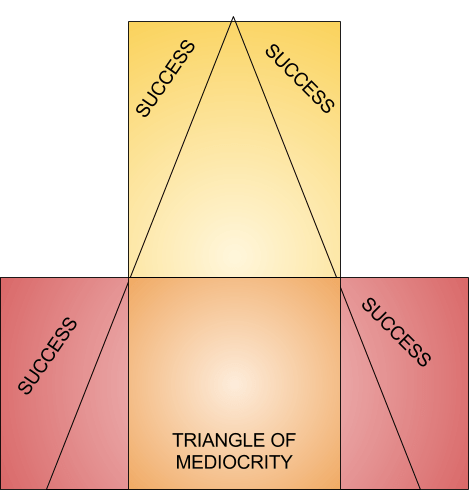
TRIANGLEofmediocrity (1).png

There are two ways to escape from the triangle of mediocrity. The red path is to have many skills but none best in class. This is the Munger & Adams path. The other, yellow, is to have a few well-defined skills. Professional athletes, accountants, and pilots follow the yellow model. Fisher suggests that companies can be identified this way too. If IBM is pretty good at many things that make them a great company.

2/ Rapid fire.

  • “People invest based on the way they feel, and the way they feel is almost always backward looking.”
  • Annuities are a complicated contract “that’s almost never understood by the consumer.”
  • The fiduciary rule is “a stupid rule with great intent.”

3/ Options. Ritholtz asks why private companies are staying private for longer and Fisher says it’s because they have options. There are alternative sources of capital and the public sphere of regulation costs and public pressures aren’t that appealing.

Remaining private may not be the end goal, but having the option to wait is valuable.

Arnold Schwarzenegger credits his movie success to his real estate investments. Schwarzenegger says that thanks to rental income from a four unit building he owned he could be choosy in for his roles. When he came off the body building tour, Schwarzenegger was mostly offered roles as a cop or prisoner or, and this is true, a body builder. He didn’t want to take these roles and he didn’t have to.

4/ Contrarian experiments. To outperform others in certain domains you must be different and you must be right. Sam Hinkie wrote about the challenges of this in a zero sum environment but it’s difficult in fields like investing too. Fisher says that because he was the youngest of the brothers:

“I had to figure out different things I wanted or how to get them a different way…I’ve been prepared to operate by trial and error, you can do a huge amount of small things on a small scale, test them and see if they work, and if they work do them on a bigger scale and if they don’t work move on to the next one.”

Being a contrarian experimenter has helped and it makes sense why:

  • Keep doing what you’re doing and you’ll keep getting what you’re getting.
  • If I knew what would work I would just do it.

Fisher says he found ideas for things to try in other domains. “What I try to do a lot in my career is to do things that people were doing in other realms that they weren’t doing in this.”

These things will look weird, that’s a good sign that you’re different. They may also look weird for a long time. That’s okay.

5/ A punch to the gut. “Most people haven’t been hit in the gut enough times (like a boxer) to know how they react when they get hit in the gut.”

Jim Chanos said, “I went through [the stock market crash in October] 1987 and I went through the Drexel insolvency in 1990, and I know what the fear of not getting paid is.” There’s something to having been through a difficult experience before. Whether its physical (hiking a mountain), relational (your first major fight with your spouse), or in business (losing a major client). Once you’ve done it and realize you’ll get through it, it allows for a different approach to the problem.

Fisher saw this in John Templeton and said “his spirituality led him to a form of internal calmness that’s rare. He would make investment decisions other people wouldn’t make because he was so at peace with himself.”

6/ See it to believe it. Fisher had a group of early mentors; his father, grandfather, and a “substitute grandfather.” Mentors influence and allow for see it then believe it to happen.

Reed Hastings had this happen to him, twice. His first instance was just getting in the room.

“The lucky break of my life was that I got to serve coffee in a teaching lab for computers. If I hadn’t gotten that first job serving coffee and been so exposed to very this alternative style computer architecture it would never have occurred to me. That changed my life.”

The second moment was when he saw YouTube in 2005. It wasn’t great video quality but it opened Hastings’s thinking to what could be possible.

Ken Grossman saw this too. He was on his way to being a trouble maker except for the men on his street who acted like fathers.

The people in our lives are like the sun. They’re there and if we don’t act to change the situation (get in the shade, put on sunscreen, have good mentors) there will be some effect (tanning, burning). Whether UV rays or ideas, exposures affect us all.

7/ Walking. Fisher says that he likes to walk and spends “as much time as I can in the woods.” History is full of walkers and there’s science behind it. This is what Stephen Johnson wrote:

“The history of innovation is replete with stories of good ideas that occurred to people while they were out on a stroll…How this works is easy to understand. When you exercise, you increase blood flow across the tissues of your body. Blood flow improves because exercise stimulates the blood vessels to create a powerful, flow-regulating molecule called nitric oxide. As the flow improves, the body makes new blood vessels, which penetrate deeper and deeper into the tissues of the body. This allows more access to the bloodstream’s goods and services, which include food distribution and waste disposal. The more you exercise, the more tissues you can feed and the more toxic waste you can remove. This happens all over the body. That’s why exercise improves the performance of most human functions.”


Thanks for reading.

What is Mike’s Notes?

Rather than write more short e-books, longer printed books, or bulging blog posts I started a (paid) monthly newsletter. It’s $20 for six months.

My goal is to create something to be read offline. It comes in PDF, EPUB, and MOBI attachments on the last Friday of the month. The most value will come from reading it without an internet connect and on the weekend. Why?

Habits.

With each iPhone software update, I mutter under my breath that Apple engineers need a sign that reads if it ain’t broke don’t fix it. A few days later I forget I had any problem because I’ve been retrained for tapping, swiping, and refreshing. I’m just a monkey that pushes a button for a reward.

The way I read is also trained by the internet. The context of LOOK MA, I’M CONNECTED TO THE INTERNET has one set of habits. In RSS readers I swipe. In Twitter I scroll. In browser tabs I close.

The internet is awesome for many things but horrible for learning. It’s trained me to expect random rewards and come back for more.

Mostly.

Shane Parrish has a great email newsletter that comes out Sunday mornings. Tren Griffin‘s comes out Friday. Patrick O’Shaughnessy‘s podcast comes out Wednesdays. The regularity keeps me consuming their content.

That’s why Mike’s Notes will be delivered on the last Friday of each month in printable and e-reader form.

Is Mike’s Notes for me? Probably not. People who should not buy this include:

  • Those reading more than two books a month.
  • Those listening to podcasts and taking notes.
  • Those watching YouTube lectures.

Most of all this isn’t for people on the fence. If this doesn’t immediately sound like a great idea, or you don’t think the excerpt below is great, do not buy this.

This is only for people who want to learn and believe – after reading this blog – that I can be one of their teachers.

The section below is part of the March 2017 edition.

The Yin and Yang of Negotiations

In Never Split the Difference, Chris Voss suggests that tit-for-tat and split the difference negotiations are the easy way out. He opens the book with a critique of the Harvard Negotiations Project and the book Getting to Yes. It’s okay, Voss writes, but you need to know more.

I’ll admit my bias. Getting to Yes is a book I regularly refer to. It’s one of those books – much like spiritual texts like the Bible, Meditations, or the Tao de Ching – where you don’t need to read it cover to cover. Instead, the most value comes from dipping and sipping.

Voss is a former FBI hostage negotiator who took the ideas from GTY and evolved them. Never Split isn’t a replacement for GTY, it’s a supplement. The two books are like yin and yang. One was built by academics in ivory towers, the other by a hostage negotiator in Central America.

The two books have a lot in common and combining them we get a whole that’s greater than the sum of their parts. Let’s look at what to do before and during negotiations.

Before negotiations

There are three questions you must answer before the negotiations.

  • What are the facts of the situation?
  • What are the perceptions of the situation?
  • What are some options out of the situation?

Another way to put is to follow Charlie Munger’s “two-track” analysis.

“First, what are the factors that really govern the interests involved, rationally considered? And second, what are the subconscious influences where the brain at a subconscious level is automatically doing these things – which by and large are useful, but which often malfunction.”

What kind of facts are there? Try to accumulate as many facts as possible that support your side of the negotiations. In GTY this is so you can “insist on objective criteria.” For a house sale some of those facts will be; comparable homes in size, school district, or amenities (master bath, pool). A seller might also stress the newer appliances while a buyer might note the older roof. Voss writes that you “fall to your highest level of preparation.”

The second facet is the perceptions each party may have about the negotiation. My brother recently closed on a home purchase and part of their final offer to the sellers was a letter about their growing family and a picture of his one-year-old son. That appealed to the buyer’s perception about who might own their home. Other things like “entertaining guests” or “safety” may be perceptions a house buyer holds as important.

Finally, you should prepare your list of options for a negotiation. Time, for example, gives you a lot of optionality. Voss often dealt with kidnappers and realized they lacked the option of time because they dropped their ransom demands as the weekend got closer. Why? They wanted fun money. After he learned this Voss decreased negotiation payouts only towards the end of the week when the kidnappers were more antsy to get paid.

Be creative when you answer these pre-negotiation questions. Voss compares a negotiation to playing cards. You don’t know what the other person is holding, so you need to come up with a wide collection of options. It won’t be all-encompassing, but coming up with ideas beforehand can prepare you for the negotiations when those cards are finally played.

During negotiations.

Listen

Voss spends most of the first part of his book explaining how to listen – and for good reason. Listening is hard. Eric Maddox had a difficult listening job. He was the interrogator in Tikrit Iraq in 2003. Special Forces operators would bring prisoners to Maddox and he had to put aside his feelings (“These men just shot at me”) and focus on the facts. Maddox wrote, “I didn’t care how bad a prisoner was, or was supposed to be…It was important to look at both sides as objectively as I could.”

“Your goal at the outset,” writes Voss, “is to extract and observe as much information as possible.”

How do you become empathetic and collect information?

Voss’s tactics They say You say
Be a mirror. “This is a family heirloom and it’s hard to part with.” “You must have a deep connection with it.”
Repeat their last 3 words. “My grandmother passed this down to me.” “She passed it down to you?”
Label their pain. “I just don’t know if I can give this up.” “It sounds to me like there’s an emotional connection to this item.”


Remember that during this discovery phase, the aim is understanding, not agreement. The more you can get the other side to talk, the better. In GTY the authors warn against a negotiation concession where a psychological one will do. Sometimes people just want to be heard. There’s a two-minute YouTube video with fourteen million views that show this.

When Danny Meyer opened Union Square Cafe he had a lot of kinks to work out. That meant he had to negotiate with a lot of customers. Your table is not ready, we lost your reservation, we’re out of fish and so on. Meyer wrote in his book, “For most people it’s far more important to feel heard than to be agreed with.” He added that as the service provider you always get to write the last chapter.  At his restaurant, this meant a free glass of dessert wine to people who had something unplanned occur. This wine was cheap for Meyer to provide but valuable to his restaurant guests. It’s a tactic Voss et al. would applaud.

Positions are not concerns

As you listen develop a picture of the person’s concerns which manifest as requests. When I bought the house I live in now I learned one of the concerns from the seller was moving closer to town. I would never have guessed this and it’s an example of something I didn’t and wouldn’t know about. At the time I didn’t think much of this but in hindsight I see that this was a concern mostly for the wife. Her husband worked a lot and so the burden of errands, time in the car, and taking kids (they have four boys) to activities weighed more on her than him. Her position was to sell the house, but her concern was to spend less time in the car.

Dollars are often front and center in negotiations but because it’s a convenient language for concerns. Credit cards that offer rewards in hotel or airline points are other versions of convenient metrics. Remember that everyone has concerns beyond the dollar.

Landlord $ …and stable, mature tenant who pays the rent on time. They also want minimal vacancy and limited expenses for maintenance.
Employer $ …and institutional memory and minimal switching costs associated with hiring new employees.
Salesman $ …and fast transactions, referrals.
Chris Voss $ …and publicity. Voss agreed with the Memphis Bar Association to a reduced rate in return for a magazine cover article.
Warren Buffett $ …and quality businesses. Buffett went from looking for “cigar butts” to chasing “moats.”

Never Split and GTY both emphasize control and security as two fundamental human concerns.

Another concern to keep in mind is that of the third party. In a home purchase there is the seller and buyer but also the buyer’s bank who will require a home appraisal to validate the loan amount.

Ken Grossman found out the hard way about negotiations with third parties when he tried to buy out his partner Paul Camusi. The two had gotten funding from friends and family. In that group was Camusi’s extended family. After years of negotiation and mediation, Grossman got a good enough agreement and bought out Paul and his family. Even though negotiations like this can take a long time,

Voss writes that if you hear someone described as “crazy” you should take that as a signal to look for clues.

Early on he didn’t pay his employees as much as other places but he wrote, “they loved what we were doing and it was a fun place to work.”  He identified their concerns as enjoying life. Part of that was how much you got paid and part of it was how much you liked your job.  By 2009 Grossman had build a larger and more successful company and created on-site daycare, medical care, and classrooms. Grossman understands his employees concerns.

He didn’t understand this for his buyout of Camusi. You see, he didn’t have to buyout only Paul but also Paul’s mother and others who had given the company loans in the early years. Few people are actually crazy, what’s more likely is that you don’t understand their concerns.


As always, thanks for reading, Mike.
Sean Iddings

Supported by Greenhaven Road Capital, finding value off the beaten path.

Sean Iddings was on the Five good questions podcast hosted by Jake Taylor. What I like about 5GQ is the conciseness and structure. While long conversations can be delightful, there’s also something to a crisp thirty-minute interview. Taylor does that. So does Aaron Watson.

In this conversation, Iddings and Taylor talk about intelligent fanatics. Iddings paraphrases Charlie Munger and says these are people that “do things ordinary mortals can’t.” It’s the John Patterson and Sam Waltons of the world. “Intelligent fanatics see things others can’t see,” says Iddings. That is, intelligent fanatics have these moments:

thatsinterestin

Jim O’Shaughnessy had his moment as a kid when he walked past a group of (adult) family members who were discussing stock purchases based on the personality of the managers rather his numbers.

Eric Maddox had his moment when he interrogated prisoners and found out that they told him things that didn’t jive with another story he’d heard.

Investors, interrogators, and intelligent fanatics all pay attention for that’s interesting moments and tug at them like a loose thread on a sweater.

Iddings is an investor and he’d prefer to find intelligent fanatics early but knows that’s not easy. To help he uses a spectrum approach. “I like to think of intelligent fanatics as a spectrum,” says Iddings. Spectrums are relative (rather than absolute) scoring systems. Michael Mauboussin articulated the luck <-> skill spectrum. Andy Weissman thinks of his VC deal flow on an active <-> reactive spectrum. Greg Ip wrote about the spectrum of ecologists <-> engineers.

A spectrum works nicely because you can identify something as here and want it to be there. 

Iddings finds intelligent fanatics through pattern recognition (a superpower). He compares it to playing the guitar, study and copy the masters. Jeff Annello compared it to chess. “I think an efficient decision maker is like a chess player that has studied a lot of games, and can very quickly call to mind other moves that have been made and what the best moves are.” Warren Buffett’s inspiration, Ted Williams, played baseball. Each investor has their own metaphor for pattern recognition.

Taylor wonders if the phase of intelligent fanatics has passed. Maybe they had an economic tailwind? We’ve seen that successes like Coca-Cola, Sierra Nevada (Ken Grossman), and McDonald’s (Ray Kroc) all grew in part because of favorable economic ecosystems. Even Steve Jobs got a boost from illegal digital music downloads.

Those tailwinds may be gone, but Iddings is a student of history. He knows that history doesn’t repeat, but it may rhyme. “It’s going to be in a different way but it’s still going to be replicable,” he says.

Thanks for reading,
Mike