Haralabos Voulgaris

Supported by Greenhaven Road Capital, finding value off the beaten path.

Haralabos Voulgaris (‘Haralabob’) joined Bill Simmons for a Round 1 Playoffs basketball podcast. What stood out was Haralabob’s detachment. I recently finished a re-read of Charlie Munger; The Complete Investor and one big takeaway from that book was how rational Munger is. Good decision makers are rational decision makers and it’s a trait Haralabob has in spades. Without further gambling cliches, let’s get into the notes.

https://soundcloud.com/the-bill-simmons-podcast/round-1-playoffs-with-haralabos-voulgaris-ep-205


1/ Availability heuristic. Heuristics have long been awesome parts of being homo sapiens but they sometimes misfire.

Heuristics can be positive (I’ve heard that book mentioned a lot, I’ll check it out), neutral, (I didn’t realize that many people had this kind of car), or negative ( I think XYC is a good investment because I’ve heard a lot about them). Good decision making means figuring out how ‘true’ information that easily comes to mind is.

In their podcast, Haralabob tells Simmons that he voted for Kawhi Lenord for MVP in part,  “I think people discount his defense. I think people discount how efficient he is on offense. He’s the only player that has to defend the other team’s best option.”

He’s saying that Leonard does things that are important but are hard to see. That is, these things aren’t available.

2/ Situations matter. “I think Paul George has a lot more upside (over Jimmy Butler) if he’s in the right situation.” Haralabob and Simmons compare these players because they were both playing and potentially traded. Haralabob points out something that Simmons has mentioned many times over that situations matter. For example, how would Tom Brady have turned out without Bill Belichick?

We saw in the AirbnUber Strategy post the importance of a situation. Neither company was first to market but both ended up winning (for the moment) because of a number of factors.

Another example is the Marshmallow Test Context. Self-control and delayed gratification wrote Walter Mischel is domain dependent.  The rewards and temptations of one situation can cause an otherwise restrained person to be anything but.

3/ “Don’t be a model whore.”  This is an idea I’ve seen more lately and Haralabob explains it nicely.

“In our model one of the things we had was that if a rookie projected above Lebron (James) the model was messed up. Tyreke Evans’s rookie year was quite good and compared favorably to Lebron and I remember looking at that and thinking ‘there’s something wrong with that.’”

Models are crucial first steps of an evaluation. We see this with people who buy businesses like Trish and James Higgins, Brent Beshore, or Royce Yudkoff. All of them use models to filter but then they also roll their sleeves up. Haralabob said, “You can’t just be a model whore, you have to watch the games.”

Good decision makers use models as first filters but then don their deerstalker.

4/ Basement bloggers. One great thing about the internet are the ‘basement bloggers.’ Whatever niche you want to dive into, it’s probably out there. For Haralabob there’s “the super quiet part of the internet, the people who go to Sloan every year and write a blog who are doing stuff that is super advanced,” who are really interesting.

The opportunity to learn has never been greater.

5/ Corner threes? That’s interesting.

“I remember reading Phil Jackson saying something like, ‘we don’t take those corner threes because they lead to fast breaks,’ and I was like – oh, that might make sense. So I watched every corner three that was taken in the NBA and charted whether it led to a fast break or didn’t it. Actually, it was the case that corner threes led to less fast breaks than other shots from the three point line.”

thatsinterestin

Danny Moses told Patrick O’Shaughnessy that a “healthy skepticism” is helpful. That’s what Haralabob had. When something doesn’t jive with our view of the world it’s a good opportunity to go digging. Patrick Collison said that this is how Stripe started. He saw that app store payments were easy but internet payments were not.


Thanks for reading,
Mike


Finances and Fitness

Supported by Greenhaven Road Capital, finding value off the beaten path.

The reverse chronological podcast feed is fertile ground for serendipity. Hearing interviews with Ben Carlson on Planet Microcap and Ryan Flaherty on The Tim Ferriss Podcast consecutively helped coalesce ideas about better decision making.

1/ KISS (keep it simple, stupid). “People assume they have to make it complex to succeed,” said Carlson, “to change strategies with every macro environment.” Rather the best financial plan is a simple one that you’ll stick with.

Flaherty said that when elite athletes come to him there are only a few key exercises that they need to focus on. Among them in the hex squat. The performance of this activity is the best predictor for the speed of an athlete.

One mental misstep is to assume complicated solutions are better. This isn’t always the case.

The first dog I owned, a labradoodle, was having running issues. She could run alongside me just fine but would limp around the next day. The vet suggested surgery in his office or laser surgery in Columbus Ohio. The three thousand dollar surgery seemed like a complicated solution, so instead of running we spent the summer swimming and the problem went away thanks to simple rehabilitation.

2/ Learn the basics. “For people trying to understand how the market works, for how business works, you can do a lot worse than dabbling in stock picking when you’re first starting out,” said Carlson. The goal isn’t to jump in and start accumulating ten baggers, but see how the game is played. Good decision makers build up a deep understanding.

Good decision makers/investors don’t start buying Apple puts. That’s like the couch potato joining a CrossFit gym to bang out overhead squats. Flaherty says he’s amazed at the number of people who start doing exercises without really knowing how to do them. If you want to learn how to do the Olympics lifts, Ryan says, find someone to teach you how to do them.

In investing or fitness, don’t expect to go from novice to professional. It takes time to get good at something and you’re better off starting with the basics.

3/ How committed are you?  The largest constraint for health and wealth is time. Flaherty says that even professional athletes come to him with limited time. Everyone has a full slate of commitments and they can only do so much.

Carlson says much the same about investing. “(Individuals) either don’t have enough time or they don’t have the skill set to approach the market.” If you aren’t willing to put in the time to figure things out then active (microcap) investing probably isn’t for you. Fortunately, there are many other options such as index funds.

Steve Pressfield has written about the differences between professional and amateurs. The crux is that professionals show up every day, rain or shine, whether they’re in the mood or not. It helps if you at least somewhat enjoy the activity. Some runners and writers, for example, share the attitude, I don’t like running/writing, but I like having run/written.

4/ Compounding. At the end of the interview, Flaherty said that he often gives the book The Slight Edge to people as a gift. The idea in that book is that if you do a lot of little things in your work those will compound to large advantages later on.

This is a natural link to investing. When Carlson is asked about how investors can tune out the noise (Example: My Friend is Beating Me) he says that two things tend to work. You can absolve yourself of any news and take the Rip Van Winkle approach. This only works because of compounding. This ‘8th wonder of the world’ is what allows us to delay gratification.

5/ Fix your weaknesses. A problem that amateur and professional athletes both have is weak supporting muscles. It’s fine to build up the major groups says Flaherty, but it’s not fine to neglect the supporting muscles. Though they play a smaller role, they could still be the weakest link a chain that breaks.

For the investor, the weaknesses move from tendons, ligaments, and small muscle groups into their head. Wise investors explains Carlson, need emotional discipline. An ability to stick with the plan, be humble, and avoid negative herding tendencies. Having a financial advisor – like Carlson – is a firebreak for rash decision making. Another is the checklist.

It’s hard to fix physical or mental weaknesses yourself and that’s why external sources; coaches, checklists, training partners, mentors, books, etc. help so much.

6/ Permanent loss. “True risk,” says Ben, “is that which is irreversible.” Investors are fine until they lock in an outcome. He summarizes Bernstein, saying, volatility is a while deep risks come from permanent decisions.

Professional athletes are like money managers in that one big mistake can ruin their careers. This is why we see people going to coaches like Flaherty to get better, stronger, and healthier. Work on the little things when things are good so that you can draw on them when things are not.


Thanks for reading,
Mike

Want to support the blog? Do that here —> Mike’s Notes.


Troy Carter

Supported by Greenhaven Road Capital, finding value off the beaten path.

Troy Carter joined Guy Raz on the How I Built This podcast to tell his story.

Carter is a high school dropout. Instead of learning from teachers he chose Jazzy Jeff and the Fresh Prince (Will Smith). “They were the only guys from Philadelphia, they were from our neighborhood, they were successful, they were like gods in Philly and they were the way out. Meeting them was plan A, B, and C.” Soon after meeting the duo Carter realized, “I wanted to be less Fresh Prince and more James (Lassiter) and he became my teacher.” It was the manager, not the performer, who Carter wanted to emulate.

Finding mentors is crucial for success. These people, either directly in our lives or in books, have a huge influence in our lives. For Ken Grossman it was the men on his block growing up. For Brian Chesky it was reading a book about Walt Disney. For Judd Apatow it was seeing Steve Martin.

With this choice, Carter moved to L.A. to work for Lassiter and it was great.  “I was having the time of my life.” But he wasn’t getting a lot of work done. “I was taking a lot of shortcuts…I thought I was much bigger than I was.” Carter lacked the rare and valuable skills required for his rare and valuable job.

It’s amazing that he advanced so quickly without experience. Tom Brokaw started building his skills as a teenage disk jockey. Casey Neistat made homemade videos. Bill Belichick grew up in the game of football and has such a deep understanding that coaches say he will spend twenty minutes talking about a single play.

Great jobs require great skills and Carter didn’t have them (yet). He was fired and returned to Philadelphia.

Thanks to some connections via friends and family, Carter gets back in the game by managing Eve. He soon found out that you’re never really ready.

“I had absolutely no clue what I was doing…initially the job was protecting my friend and everything else was learning as I was going along. I remember our first tour was the Cash Money/Ruff Ryders tours. I got on the bus and there was this old bus driver and he said ‘you got the float?’ and I said I’d be right back. So I got off the bus and called one of my buddies who had done touring for a long time and asked ‘what’s float?’ and he said it’s the money you give the bus driver for gas, tolls, and food.”

In his book about Amazon, Brad Stone writes:

“By the first weeks of 1996, revenues were growing 30 to 40 percent a  month, a frenzied rate that undermined attempts at planning and required such a dizzying pace that employees later found gaps in their memory when they tried to recall this formative time. No one had any idea how to deal with that kind of growth, so they all made it up as they went along.”

As Carter cut his teeth he developed his “West Philly Spidey Sense,” a negotiation skill. “Being able to read rooms and read people is very very important and also knowing what’s important for that person on the other side of the table and what’s important for the client. A lot of times it’s not conflicting.”

Through practice, Carter came to the same conclusion as the Harvard Negotiation Project, the book Getting to Yes, and our ideas in How to Negotiate Well.  Carter also learned about how Eve could expand from music to other areas like television, movies, and clothing. Mimicry is a good way to start and Carter copied the Fresh Prince playbook just like Jason Calacanis mimicked Tim O’Reilly.

Carter’s success brought him an acquisition offer and he sold his management company for two million dollars. It sounded great on the surface – Carter had money and a way to scale his business – but it ultimately didn’t work.

“I was dreading getting up and going into the office. I would go in and pull the shades down because I didn’t want to work with people there.” As Mohnish Pabrai and Brian Scudamore noted, if you aren’t excited to go to work something is wrong.

Carter also found out that “Two million dollars isn’t actually two million dollars. You buy a house, pay taxes, a couple of new cars and I invested in the new business.” He didn’t have a low overhead mindset.

Not liking his job he took the money and invested in a new business, taking Eve with him. One year later Eve walked in to explain she’s leaving him for another agent. ‘How bad was this’ asks Guy Raz and Carter says that it was bad, but, “You can’t fall off the floor.”

After this reset, Carter gets introduced to another young, up and coming female artist. She had just been dropped by another label. Her one year experiment to break into the music business was over and her father wanted her to go back to college. Carter says “she was an incredibly hard worker.” That person was Lady Gaga.

Carter and Gaga were an overnight success together… – – wait, wait, wait. You know there’s no such thing as an overnight success.

Raz asks if Carter knew Gaga would be huge. “The real answer is, you don’t know. You think and you hope but you don’t know.” It would take a lot of work and so that’s what they started doing, work. Gaga was a great songwriter and many people wanted her songs – just not her singing them.

Around this time Facebook and MySpace were becoming larger “and we started using those platforms and we were lucky because they were global.” Their shoestring budget was used for tours and costumes thanks to this low-cost distribution blessing.

In tinkering with how to distribute music, Carter started to talk with those technology companies and led to a few investments.

Screen Shot 2017-05-02 at 9.12.49 AM.png


Thanks for reading,
Mike


Jocko Willink


Supported by Greenhaven Road Capital, finding value off the beaten path.

In episode #073 of his podcast, Jocko Willink answered questions from the internet. It was another two hours chock full of good advice.

What I like so much about Jocko’s podcast is that he uses the lens of war to see the human condition. This isn’t that unlike Charlie Munger speaking about the Psychology of Human Misjudgment or Daryl Morey explaining how to assemble an NBA basketball team. Each has to account for how psychological principles and a range of outcomes affects their decision making. Good processes – I think – are domain independent.

Ready?

1/ How not to overreact. The first questioner asks if Jocko has to think about not overreacting. He says;

“I would say at this point it’s fairly ingrained, I don’t overreact to stuff anymore.”

“In order to move in that direction picture what a situation looks like from the outside, what do I look like?”

Avoiding overreaction to a situation takes practice. Jocko has years of ‘reps’ with soldiers, businessmen, and even his own children. Doing something over and over is a great way to build a skill.

Jim O’Shaughnessy and Jeff Annello also spoke to the value of repetitions.

Controlling your actions also requires detachment. In the podcast, Jocko and Echo Charles compare it to watching tape like sports teams do. You need to be able to see things from another point of view. In his book about Charlie Munger, Tren Griffin comes back to the idea of detachment again and again. Munger has succeeded because he’s able to detach from the crowd and his biases.

In a podcast with Tim Ferriss, Willink said they used simulated firefights. “What we did was put them under extraordinary pressure where to fail to detach and step up and away from the problem would result in failure.”

The Harvard Negotiation Project calls detachment “the third stance.” Imagine what another person would see if they were watching a situation. Jocko and Echo also compare it to being above a maze. From there you can see how all the parts interact. Detachment is a key part of accurate empathy.

This idea is simple but not easy.

Jocko said that the situation of the United passenger being dragged off the plane was an example of a failure to detach. If you want to help in a situation like this, says Jocko, do so in a way that helps the people involved remove themselves from the storm of distortion. Get them to detach.

2/ Dichotomies.

  • New leaders need to balance humility (I don’t know everything) with preparation (but I’ll learn as much as I can).
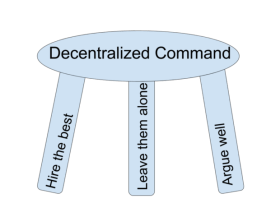
  • To implement a decentralized command, allow subordinates to lead a project but within an area where you won’t lose strategic ground or have them lose face.
  • Work can be fun and serious at the same time but leaders should set boundaries. Jocko told his soldiers ‘no jokes on the radio and no jokes in the slides’. Those areas were set aside to be serious.

Finding balance is hard. If you’re unsure how to balance two opposite things, identify where an asymmetrical payoff exists. Jocko explained, “You tell a good joke, it gets you 2 credits. You tell a joke that’s bad it’s negative 39.” If the risk/reward ratio is too high move toward the other end.

3/ Grit. Around here we like Grit and so does Jocko. Patrick O’Shaughnessy wrote:

“I learned through experience this year that growth and discomfort go hand-in-hand. When faced with almost any choice, I took the harder option whenever I could.”

In the field of education teachers are taught that students learn best when the information is in their “zone of proximal development.” A fancy term for ‘sweet spot.’ Jocko also believes in the Goldilocks; not-too-easy but not-too-hard approach. He said, “The attitude of ‘we’re crushing it’ is probably an indicator that you’re not doing the best job.” In that case, things are too easy.

Of course, you don’t want things to seem impossible. In a children’s book I read to my kids the author made the distinction between things that are hard and things that take a long time. Leaders can create a Goldilocks zone but individuals can create one for themselves. This is what Jocko has done:

“Of course I come up short. What do I do when those things happen? I keep going…Worn down isn’t beaten and frustration isn’t going to kill me. When I do come up short that’s okay because I just learned one more thing that’s going to get me over the top.”

4/ Ego. Someone asks Wilink how to manage people that try to outperform you. You’ve got a good problem on your hands, says Jocko, “The more people you can bring on your team that out perform you the better you’re going to do.” If you aren’t willing to hiring people that do better work than you then the problem is “100% ego. ”

Successful operators hire people smarter than them.

Thanks for reading,
Mike

A full version of this post is available to subscribers of Mike’s Notes.

Steven Galbraith

Supported by Greenhaven Road Capital, finding value off the beaten path.

Ted Seides has a podcast now. Podcasting truly is an embarrassment of riches. This reminds me of when I first discovered the pizza buffet as a teenager. I get my choice of all this?!?! 

Ready?

1/ Moneyball the shit out of this. When Moneyball was published I worked for a minor league baseball team. I read it and thought, that was a good book but it won’t work in any other sport. Sabermetrics was built on the fact that baseball has a lot of good data. Well, (again) I was wrong. Galbraith bought a soccer team, the Derby County Rams, and applied the Moneyball approach.

For starters, the actual purchase was Moneyball-esque. The team had been relegated to a lower league, the seller panicked, and Galbraith’s group swooped in. As the new owners, their goal was to return to the higher league because the sponsorships and earnings there were much higher than the lower ones. That meant figuring out what actually mattered. Galbraith (et al.) found that two things were really important:

  1. Time of possession.
  2. Shots on goal.

To increase those values it was better to pay more for the 8th, 9th, and 10th players rather for a superstar. Mix in the right culture (no easy feat) and coach (ditto) and you have a chance.  “If you get the process right and you take enough shots on goal you should ultimately get the prize.” Galbraith says there’s a relationship between investing and sports and this is why. In areas with a healthy dose of luck, it’s better to focus on the process.

Post-college Galbraith saw this in his own career. “In finance and investing there are a lot of uncontrollable things and the only thing I could control was my work ethic.” He understood the two-jar model and did things that would increase the skill scores like; a Chase training program and working overseas.

3te95w

It may be tempting to, follow the header, and ‘Moneyball the shit out of this’ but as we say, not so fast. When Michael Mauboussin spoke with Daniel Kahneman about big data they both noted that losses loom larger than gains. In Moneyballing terms, this means that people may lose job responsibility to an algorithm. Those losses “loom large” and managers need to be aware of this.

2/ Gambling in college. “College sports were really inefficiently priced. We used to bet on Utah State against Montana and with a little bit of homework you could get an edge.”

Galbraith’s college experience taught him to find less crowded ponds. This is what Ken Fisher says he tries to do for investments. Charley Ellis said “The secret to great success in business is to choose competition that’s not very good. The same thing works in sports, it works in lots of different things.” When Danny Meyer expanded his restaurant empire he did this too. The best NYC Indian restaurant had a low Zagat score and so that’s what he opened next.

Here’s how Nate Silver put it in The Signal and The Noise:

“However, when a field is highly competitive, it is only through this painstaking effort around the margin that you can make any money. There is a “water level” established by the competition and your profit will be like the tip of an iceberg: a small sliver of competitive advantage floating just above the surface, but concealing a vast bulwark of effort that went in to support it. I’ve tried to avoid these sorts of areas. Instead, I’ve been fortunate enough to take advantage of fields where the water level was set pretty low, and getting the basics right counted for a lot. Baseball, in the pre-Moneyball era, used to be one of these. Billy Beane got an awful lot of mileage by recognizing a few simple things, like the fact that on-base percentage is a better measure of a player’s offensive performance than his batting average.”

3/ Be different. “If you have the mean view you’re going to have a mean outcome. You can’t be provocative for provocative’s sake, but you do need to think outside the zeitgeist to where things could evolve to.”

This was my favorite quote because the advice to “be different” is common but it comes with the caveat Galbraith mentions.

4/ Argue well. “The better managers did want to hear the negative scenario. As a portfolio manager, I didn’t want my analysts coming in telling me nothing but the good news.” Good organizations allow for healthy arguments.

Beyond Google and the United States Senate, arguing well is part of what Ray Dalio and Bridgewater so successful.

5/ Be there. Galbraith (and others) own the Narragansett Beer company in Rhode Island. Beyond the enjoyment of owning a brewery, it’s been educational too. Galbraith says that owning this business has taught him lessons he wouldn’t have otherwise learned that have influenced his investment choices.

Galbraith has also seen this on a board with a business owner that asks different, diverse questions. There’s something to walking the walk that gives an experience others can’t, don’t, or won’t get. As Buffett said, “I am a better investor because I am a businessman, and a better businessman because I am an investor.”

6/ Writing as thinking.
“When I became a serious investor I found that having to actually put my thoughts to paper was an unbelievably powerful way of marshaling what the hell I was thinking.”

“It clarifies where true north is.”

“Writing is refined thinking,” wrote Stephen King.  Bob Seawright put it this way:

“When I tried to organize my thoughts and put pen to paper, it forced my thinking to be more rigorous and it exposed gaps in my thinking and errors in judgement more readily.”

7/ Deep work. Galbraith’s covered a lot of ground in the investment world, working with many different people. He found that the most successful traders tend to be insular. “I think that is something that’s key to successful investing.” Look at Buffett in the HBO documentary he says.

Another way to frame it is to say that these people are doing deep work. Cal Newport defines deep work as “professional activities performed in a state of distraction free concentration that push your cognitive capabilities to their limit. These efforts create new value, improve your skill, and are hard to replicate.”

Deep work is to careers as weekly miles are to runners. If you allow too many others things; work, social media, junk food, to get into your life then you won’t put in the hours for the miles (or deep work).

Thanks for reading,
Mike

We’ve hit on soccer before on the blog. Anson Dorrance is the winningest college coach ever. There were bigger concepts behind Bill Simmons and Malcolm Gladwell’s discussion on soccer. If you liked this post you’ll like this paid newsletter. I write it too.

Patrick Collison

Supported by Greenhaven Road Capital, finding value off the beaten path.

Patrick Collison (Stripe, Atlas) talked to Jason Calacanis at the TWIST Launch 2017 event. Collison, says Tyler Cowen, is one of the smartest people he knows. Much like the Bill Gurley interview at Launch 2017, this could have been twice as long. We’ll take what we can get, here are the notes.

Collison’s interview reminded me of the – (EPISODE OF THE YEAR) – podcast between Patrick O’Shaughnessy and Body Varty. Varty is a tracker and says, “there’s an impossibility to it, and yet, if we go and try there’s also a chance.” Tracking is about listening, searching, and being relentless. It’s a great metaphor for anything and pairs nicely with the story Collison tells.

Pre-foothold. Before founding Stripe, Collison (along with his brother John) built apps for the App store. It was a good business and showed them sometimes.

“We (John and I) had been talking about this idea (payments) for awhile. We had sold apps in the app store and it had been incredibly easy…we were kind of reflecting on how easy it was to sell apps on the app store and it was so monstrously difficult to do other transactions on the broader internet.”

Like Ken Fisher, Collison noticed that in one area (the app store) something worked whereas in another (the broader internet) it did not. Collison started looking around and noticed that other people were having this same problem. His friends were creating a lot of workarounds to use the legacy payment companies. Obviously, he could do better.

3te95w

Regular readers will know that nothing is obvious or fast. Even though the existing system was a quagmire it wasn’t that obvious that it could be fixed or that Collison was the one to do it. “It was almost two years of us writing code by ourselves,” he says, “We’ve been working on this for quite a while, laying the foundation.”

Collison recalls that around this same time the Facebook team had multiple irons in the fire. “It was not obvious that Facebook was the thing to be working on,” he says. The Stripe prototype too “wasn’t obviously a great idea…we didn’t know if we should raise money for Stripe or not.”

As Calacanis questions, there’s an origin story expectation but it never comes. Collison even mentions hindsight bias and explains the emotional roller coaster he was on. “Maybe a month after starting work on it (Stripe) we’re like, ‘This could take over the world.’ But of course the next morning it was like, ‘This is the worst idea in history.’”

As the idea grew Collison moved to the Bay area because that’s where his potential customers were. He avoided the #1 mistake of failed startups and found that the payments pond “was actually a much larger ocean.”

For the most part, the journey to this point is consistent for successful and for unsuccessful startups.  “Two years is a long time when you’re in it, working away, with so many of these roadblocks and headwinds and people telling us that it couldn’t work or shouldn’t work or it’s a bad idea…it could be that it’s a bad idea, or not.” Collison explains that the early days – maybe even the early years – are similar for companies that live and ones that die. This is among the reasons Bill Gurley recommended a book like The Startup.

Post-foothold. Collison points out that Stripe isn’t established yet, but they do have a foothold. Stripe’s goal “is to increase the GDP of the internet,” says Collison.

While “the internet does not care about the national borders of the atoms they’re sitting on top of,” some founders can start internet businesses easier than others. Collison says they looked through the Stripe data and saw “so many people that were going through such lengths to surmount these stupid barriers.” The story was playing itself out again. Originally Collison saw companies struggling to accept payments. Now it was companies trying to incorporate in the state of Deleware, have a United States bank account, and get basic tax and legal structures implemented. Stripe created a product called Atlas to do these things.

As Collison told this story and explained the journey he used words like “hypothesis” and “experiment.” I think that wording matters. Brent Beshore said the secret to business is trying things and do more of the things that work and less of the things that don’t.

One of those experiments is staying private. Collison says that Stripe is going to “hold off as long as possible” from going public. Why? Ken Fisher guessed that because there is ample private capital and too much public pressure. Collison mentions the latter saying that Amazon is the best example of long-term thinking and they had an uphill battle to keep that mindset.


Thanks for reading,
Mike

PS This was another “shorter” post. If you liked the brevity and fewer links, let me know.

Michael Lombardi 2

Supported by Greenhaven Road Capital, finding value off the beaten path.

In episode 102 of The Ringer’s NFL Show, Mike Lombardi spoke with Tate Fraizer about his experience preparing to draft NFL players. Besides the revelations about Al Davis’s eating habits, Lombardi pointed out ideas we can use in other domains too. Here’s how to draft NFL players (or make any decision better).

https://soundcloud.com/ringernflshow/gm-street-tales-from-the-draft-war-room-with-mike-lombardi-ep-102

Step 1: Collect the right data. Lombardi said that during his time with the Oakland Raiders, owner Al Davis wanted the fastest players. That became their most important data point.

“We’re watching Texas Tech. offensive tape, watching Wes Welker make every catch and we drafted Carlos Francis in the fourth round because he was the fastest guy at the combine…We picked Taylor Johnson in the second round which was a guy that could really run but we passed Jason Whitten to pick Taylor Johnson because Jason Whitten didn’t have a fast enough forty time.”

Forty-yard dash times are available data but they may not be the most helpful. Daryl Morey saw this as General Manager of the Houston Rockets when he asked if points and rebounds don’t tell the whole story.

Another mistake coaches made was overvaluing someone with a great recent performance. “Take the one year player and look back don’t look forward, thinking he’s going to build off that,” Lombardi said he learned to not expect one-year wonders to continue that success in the NFL. Phillip Tetlock writes that superforecasters don’t overreact to new information.

Step 2: Prepare your wish list. Like a kid at Christmas, football teams don’t get everything they want. It’s good to have the list though, says Lombardi.

“In ’86 Bill Walsh sends me to the blackboard to write down three names…I write them on the blackboard and he says, ‘When we pick we’ll pick one of these three guys.’ [all three players get picked by other teams] and we look at each other and we’re like, ‘Holy crap we got nobody to pick.’”

Lombardi’s team traded down to get some more time to talk through who to pick but it shows they weren’t prepared.

Preparation is one of the keys to How to Negotiate Well. It’s also a key part of Bill Belichick‘s success. Sam Hinkie said that this is an iterative process. His office would redraft players to see how well their systems worked and refined it over time.

When making the list it’s tempting to slide into easy comparisons, don’t. “He (Al Davis) wanted to make Tyler Brayton an outside linebacker because Al Davis thought he was Ted Hendricks…every player at the Raiders had a Hall of Fame name attached to them.” Morey eliminated this problem when he disallowed same race comparisons.

Another thing to do is remain objective while making your list. “Bill (Belichick) doesn’t get married to a player and will trade down knowing they’re all going to be about the same,” said Lombardi. This objectiveness can be hard but remember says Peter Lynch, you can’t treat investments like they’re your grandchildren.

Step 3: Prepare the room. Once you’ve gathered the data and created your list it’s time to get the room ready for the actual NFL draft. Lombardi said that Al Davis’s draft room was like a press conference while Bill Belichick’s is a small affair.

Part of what Belichick does well in those small rooms is to argue well. Writer Michael Holley spent years with Belichick’s Patriots teams and noted, “Belichick has no problem listening to any counter argument – provided that it can be supported with some type of evidence.” In fact, said Scott Pioli, arguing well is a necessity of working with Belichick. “It’s so important that part of the evaluation of you is going to be whether or not you have an opinion.”

Lombardi said that Belichick “decides who to pick, who not to pick but he takes information in.


Thanks for reading. If you liked this post you’ll like the Bill Belichick series. You can also subscribe to Mike’s Notes: https://gumroad.com/l/mikesnotes.


The AirbnUber Strategy

Supported by Greenhaven Road Capital, finding value off the beaten path.

Inspiration: The Upstarts by Brad Stone

For hopeful entrepreneurs, a roadmap can be a godsend. Adam Carolla puts it this way:

Learning from others is a great way to skip mistakes or at the very least, prepare for them. Let’s see what Brian Chesky did at Airbnb and Travis Kalanick did at Uber. Ready?

1/ Be bright yourself. Chesky attended the Rhode Island School of Design. Kalanick earned a perfect score on the math portion of the SAT. We’ll get to the luck and other factors in a moment but we should at least acknowledge that both men had certain capabilities.

2/ Get/be someone who writes code. Chesky teamed up with someone else and Kalanick adopted the Uber project after it had already been started. For all their abilities in point one, we immediately see that they didn’t write the “Hello World!” code. That’s not to say they couldn’t, only that even successful founders need help from other people. This also is apparent in the advice to ‘hire people smarter than you’ or ‘hire for your weaknesses.’

Screen Shot 2017-03-02 at 8.13.15 AM.png

3/ Build something. Your first thing won’t be THE thing, but you can’t iterate ex nihilo. Uber went from UberCab to UberX, a monumental shift in the short history of the company. Airbnb’s early site was built on a simple WordPress theme. What each group of founders did was just start. Then you can…

4/ Talk to customers and make changes. The famous story that comes from this period was when Paul Graham told Chesky he needed to get to New York and help the owners take better pictures of their apartments. Do things that don’t scale. Uber too would do this, handing out phones to drivers to test the app. Gentlemen and women in Silicon Valley call this a ‘pivot.’  Marc Andreessen (naturally) put it more colorfully; “When I was a founder, we didn’t have the word pivot. We didn’t have a fancy word for it. We just called it a fuck up.”

5/ Be lawful but not angelic. Neither Chesky or Kalanick toed the line. Chesky pursued a mission he felt was superior to the laws. Kalanick just thought he was right. That’s the point of entrepreneurship. It’s the idea that you can do better. Yvon Chouinard said to study the juvenile delinquent if you want to understand the entrepreneur.

6/ Practice your apologies. At some point, your company will make a big mistake. Follow the advice of Scott Galloway and do these three things. Acknowledge that it happened, take full ownership for the situation, and over correct. Lawyers and public relations experts can help with the words but their fingerprints shouldn’t show.

7/ How to disrupt lives. A change means someone loses and someone gains. Founders who want to #disrupteverything create this transaction. Taxi drivers expected a closed ecosystem with valuable assets (medallions) and limited competition. Drivers of the black cabs of London studied “The Knowledge” to earn their license and chance for a middle-class income. Disruption changes both sides of the ledger, suppliers and consumers.

8/ Elbow grease. Even though both companies eventually found replicable systems for entering new markets at first it was a lot of legwork and elbow grease. There were trips to lawmakers, ‘workcations’ (Uber), and long hours. Technology appears to be a silver bullet solution but as Ben Horowitz notes, most problems require a lead bullet approach.

9/ Once you have a bearing, accelerate to escape velocity. When I did a triathlon, the swim portion was in a large circle. Every so often I paused to reorient myself before swimming again. Startups should do this too. When asked for advice Chesky tells founders to stay off the radar as long as possible but then grow as fast as they can.

Caveat emptor: During the early days of Stripe Patrick Collison wasn’t sure he should be working on Stripe. The early days of Facebook was the same story. The roadmaps for successful and unsuccessful startups are indistinguishable in the beginning. That means you can do all these things and not be a Silicon Valley unicorn. There’s one more thing you need; luck.

Laird Hamilton said, “We’re all equal before a wave.” Stone’s books cover is a wave. Founders can do everything right but they have to get lucky too.

Thanks for reading. If you liked this post you can read more good stuff like it at Mike’s Notes, a monthly paid newsletter.

Josh Brown

Supported by Greenhaven Road Capital, finding value off the beaten path.

Josh Brown was on the Bespoke podcast to talk about his job, his tweets, and whether New York City is selling high or selling cheap. Host George Pearkes also got the answer to a question I’ve wondered about – why does Josh Brown spend so much time on Twitter and talking on CNBC?

Ready?

1/ Watch out for the okay name.  Brown is introduced as an author, blogger at The Reformed Broker and “a regular contributor on CNBC.” That helps to set the tone but we should beware of the okay name.  The authority of being on television or from Harvard (like Royce Yudkoff) is only one part of whether someone is trustworthy or not. Brown (like Yudkoff) has a larger body of work so we’ll move on with the notes but remember that So-And-So from Such-and-Such isn’t a good enough reason to trust someone.

2/ Create structures. I’m a big fan of creating structures. In the last April edition of Mike’s Notes, I wrote about arranging our two sets of default actions. We call our internal defaults habits and our external defaults structures. Time and again we see that even small structures can have large behavioral effects.

Brown takes this same approach for his clients. “We want to set things up in advance so we can make as few decisions as possible in the future.” It’s a measure twice (thrice), cut once attitude.

Rituals are an example of structure. There’s a great book about them. Steven Pressfield credits them with his success:

“There are so few people that process self discipline….coming up I had one friend that got up at the crack of dawn and he was a role model for me. I basically tried to become him. I copied so much of the way I live right now from this one particular friend. Role models are tremendiously important.”

If these things work so well for writers, why not for financial planners? That’s what Brown is trying to do.

3/ Compare to something else. This part was excellent.

“Can you imagine going to a real estate investors, someone who bought an apartment building and is renting out the apartments. Can you imagine going to that guy and saying, ‘Let me see your returns. Okay, you would have done better in an office properties REIT or the Vanguard REIT ETF. You’re screwing up.’”

The guy is just like, ‘what are you talking about? I’m investing in real estate, leave me alone.’ Nobody would ever do that but we do it with the stock market.”

The point Brown and Pearkes make here is that it’s not hypocritical when you reframe a trading account as a hobby rather than an investment. Brown says that his firm will set up fun money accounts for clients.

Reframing investment accounts as hobbies is a powerful tool to consider the same situation differently.  Andy Grove reframed his job when he asked, ‘what would a new another leadership team do?’.  Another way to reframe something is to think of a challenge as a game. Ray Dalio uses words like “puzzle.” Chris Dixon said it’s a “maze.” Astronaut Chris Hadfield said, “A mistake is like a loose thread you should tug on hard, to see if the whole fabric unravels.”

4/ What job are you hiring for?  When Brown and Barry Ritholtz teamed up to form Ritholtz Wealth Management they had to be “more than a transactional window.” So they did what every other advisor did; surveys.

Risk tolerance surveys are to the financial world as pain tolerance questions are to the medical one. In her book, Run, Don’t Walk, Walter Reed physical therapist Adele Levine writes that when she had surgery the doctors asked her how much pain she was in. Compared to what? Levine thought. Every day I see double, triple, quadruple amputees from the Middle East wars. Compared to them, I’m a two. 

That same framing is what Brown saw with his clients. “You can ask a client what’s their risk tolerance and if the market is down that day they’ll say, ‘I don’t like a lot of risks,’and if it’s up that day, ‘oh, I can handle a lot of risks.’”

Brown et al. had to find the real problems, not the superficial survey responses.

He needed to figure out what people really want. To use Clayton Christensen’s phrase (of Harvard Business School while we’re on the topic of Okay Names), what job are you hiring for? Christensen uses this question to look at how companies get disrupted and that’s what happened in investment management. People didn’t want risk surveys, they wanted to know ‘Am I going to be okay?’

Screen Shot 2017-04-28 at 10.01.14 AM.png

The job people hired for was for someone to convince them they would be okay.  Brown said they had to reorient around that rather than “our own brilliance.”

Part of that job is communication. “In my opinion, we have five of the top twenty-five financial blogs,” says Brown. They want to know there’s a plan and that it’s built on facts.

When Reed Hastings talks about Netflix’s competition he only mentions Amazon and HBO within a larger set of competitors. The competition, says Hastings, is everything. It’s sleep, exercise, Facebook, and Josh Brown’s Twitter feed. His point is that people hire many services to fill their leisure time. To put it another way, everything that’s not sleeping or work is Netflix’s competition.

If you serve customers, what job are they hiring you for?

5/ Deep work and twitterWhy is Josh Brown on Twitter so much? Because someone else is minding the store. Brown explains that there is a (growing) team at RWM that does excellent work. It’s “an amazing squad.” Brown’s posts, tweets, and tv appearances are all “in service to running the firm.”

As Tren Griffin wrote in The Rise of the Freemium Business Model “The cost of educating the potential customer about the benefits of the product can be dramatically lower once a potential customer has used the product in the free setting.” That’s just one part of a great article and explains what Brown does.

It’s hard to imagine someone doesn’t know about RWM and what the company does and how they do it. Those “five of the top twenty” blogs are one part education, one part marketing.

But I’d still wager that long, uninterrupted blocks of work happen. I read those blogs, they’re good.

If RWM is like a restaurant, Brown is the maitre d’. He greets you, knows the menu, and helps you choose a wine. But there’s a lot of cooks in the kitchen that make food so good you’ll tell your friends about it.

Thanks for reading,
Mike

The link to Mike’s Notes is what Griffin calls “premium freemium.” If you’d like to show support, that’s the place


Brian Scudamore

Supported by Greenhaven Road Capital, finding value off the beaten path.

Brian Scudamore told the founding story of 1-800-GOT-JUNK on the How I Built This podcast. It started when Scudamore needed cash for college and saw another junk hauling business. He bought his first truck, called the competition to figure out pricing, read the classifieds and started. Soon he could afford two trucks, then three. Very soon the business was teaching more than school and Scudamore dropped out.

He parked his trucks at busy intersections and kept track of what areas led to more leads. In addition to these mobile billboards his got free press from the local papers when, on his girlfriend’s suggestion, he called and said that his business might be worthy of a story. The paper sent a writer and photographer. The latter said, ‘you guys are going to be busy tomorrow,’” and they were. Up to this point, the business was grown on cash flow, though other challenges soon rose up.

The biggest was a series of hiring mistakes that led Scudamore to clean house, going from 11 employees to 1 – himself. He had to park the extra trucks and field all the calls, but this rip-the-band-aid-off approach needed to be taken. How did Scudamore know he had made a mistake? “I was avoiding spending time with my employees and I had the wrong people…nine of my eleven staff were the wrong people.”

With success, Scudamore enrolled in a young entrepreneur organization and at a meeting, he found himself envious of his peers who worked in ‘cooler’ businesses (read: NOT BORING). “I found myself feeling sad because I was comparing myself to others and I didn’t feel good enough.” So Scudamore went off to dream up a list of BHAG’s for his company. This has continued today with the “Can You Imagine” wall at headquarters.

Scudamore’s goals centered on expansion to all the North American markets larger than the one he started in (Vancouver). He didn’t know how to franchise, so he just called people who had done it. This “just call somebody” attitude came up in other interviews he gave.

First, he expanded to Toronto but when it came time to come to America he needed to rebrand from “Rubbish Boys” to something better. The Got Milk campaign was popular at the time as well as the 1800-FLOWERS ads. Scudamore combined the two and thanks to some elbow grease – rather than money – he obtained the 1-800-GOT-JUNK number.

With the expansion were growing pains. Scudamore and his first CEO were “type-A” personalities. This energy was crucial during the cold-calling, door-to-door early days but with expansion and the franchise process, the company needed someone with a calmer hand at the tiller. He eventually found that person and the business has been great since then.

Two books Scudamore suggested were The E-Myth Revisited (“The E-myth Revisited is all about a philosophy of people don’t fail, systems do…you can’t overcomplicate things. I think systems need to be simple.”) and The 22 Immutable Laws of Marketing.


Thanks for reading,
Mike

Hey, one more thing. If you liked this shorter style of post with fewer links and explicit connections let me know on Twitter or via the contact page.

If this had been a longer style post there would have been connections to; the importance of low overhead, branding, culture, hustle, and runway.

Update

giphy (4).gif