Top Gun Twitter targets

That makes no sense!!! is a signal for misunderstanding. We may not need to understand. The logic may not be local to us. But people don’t do dumb things.

Tyler Cowen questions Twitter’s ad targeting, “can’t they send me a targeted ad for Indian classical music at least once? An economics book? That would be easy given who I follow. But they can’t even do that. It’s Top Gun. I know Top Gun is out and my eyes roll.” 

This is a known problem. Thomas Tull founded Legendary Entertainment in 2000 based (partially) on this idea. The fans of Batman will know when Batman comes out (2005, 2008, 2012). People reading the newspaper will not know, but people who read the newspaper also may not care. Tull said he could give his mother two tickets and money for popcorn, drinks, and a snack and she still wouldn’t go see Batman. 

Tull thought: How to persuade the middle group? Don’t waste money advertising to the huge fans or the never-buyers

The Top Gun:Maverick trailer came out July 2019! Everyone between thirty-five and fifty knew about the movie. Yet Top Gun is on Twitter. That makes no sense?

Option 1: Momentum. Paramount Pictures has an annual budget for social media and each gets their share. TG was on Twitter because it’s just something they do. 

Option 2: Social proof. PP has the annual budget to advertise on social media to build social proof. According to Robert Cialdini, social proof and authority are both tools to reduce uncertainty. Maybe lots of people heard about TG but were unsure if they should go. Seeing it on the timeline makes the film appear popular, more people go, the film appears popular, more people go, and so on. 

Option 3: Twitter ads are just bad. Cowen is right. 

Option 4: Twitter ads are secretly great. Cowen did go see Top Gun. The mechanism is something other than social proof (#2)

Option 5: Twitter ads aren’t targeted, they’re brand building. Maybe a better analogy for Twitter is the NFL, a place for national brands to reinforce their messages. My last three promoted tweets were for Google, Extra gum, and the AP news. 

Option 6: Something else. 

A viral YouTube ad from 2013 was It’s Not About The Nail. Put another way this thing isn’t really about the thing at all. A lot of life has deeper parts to it. 

Last week one of our regular players brought Gatorade to the pickleball courts. She had too much and was getting rid of it. The superficial reading is that she wants to get rid of it. Why? It doesn’t spoil. Just drink it over the next few years. But really it was about sharing. 

Status Games (review) make no sense superficially. But peel back the layers of evolution and we see that status is a proxy for power. Rather than physical conflict to create a hierarchy, certain species use status. Physical conflict reduces the individual and collective. Groups which adopted a non-physical mechanism performed better than ones who did not. 

Sometimes superficial is just superficial. Twitter might just have bad targeting and Yeah that makes no sense is a fine answer. But sometimes it’s not! And that’s where the fun stuff hides. 

Thinking paths and more

An athlete shoots 70%. If they shoot twice, what are the chances they make at least one? 🤔 

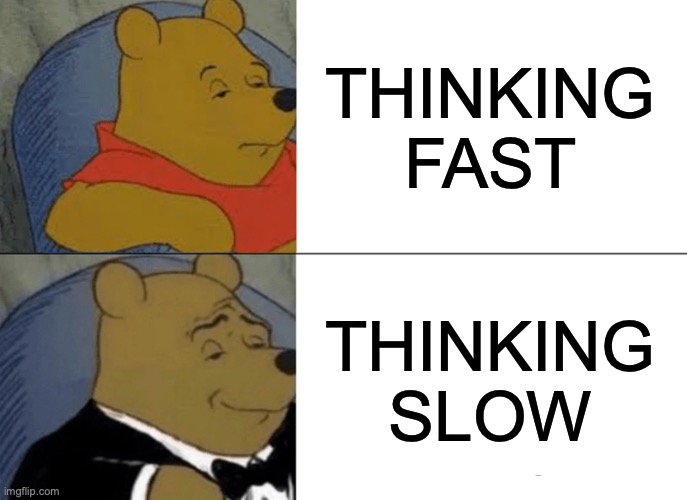
Before answering, consider thinking. Daniel Kahneman has an entire book about Thinking, Fast and Slow. Fast thought is immediate. Slow is deliberate. Often ‘thinking fast’ about thinking fast and slow is that slow is better.

That’s not the case. Lots of fast thought works well. 

One problem with Kahneman’s book – which he admits, Kahneman is a scientist and when the evidence changes his understanding does too – is the social science replication crisis. Some studies don’t repeat. Or repeat quirkily. For example: Linda is 31 years old, single, outspoken, and very bright. She majored in philosophy. As a student, she was deeply concerned with issues of discrimination and social justice, and also participated in anti-nuclear demonstrations.

Which is more probable? (1) Linda is a bank teller. (2) Linda is a bank teller and is active in the feminist movement. 

There’s a lot in there. But our fast reaction goes something like: If this information is here it must be important. Answer number two. That’s how we think. 

But take the same Linda is 31 years old… prompt and ask this question: There are 100 persons who fit Linda’s description. How many of them are: (1) Bank tellers? __ of 100 (2) Bank tellers and active in the feminist movement? __ of 100. 

Phrased that way the conjunction fallacy goes away. 

Thoughts are path dependent. Reframing changes the path.

An athlete misses 30% of the time. If they shoot twice, what are the chances they miss both? 🤔 Well they miss thirty percent of the time. To miss both it would be 30%*30%, which equals 9%. So to the original question, this athlete will make at least one more than ninety percent of the time.

If riddles are a good proxy, there are two tools: intuition and presentation. Intuition is internal. How many mental models do we have? How numerate are we? What’s our (ongoing) education? Presentation is external. What are the norms? What’s the phrasing? All framing is relative so what is this relative to?

Let’s leave with one more. Historically category five hurricanes hit Beach City once every hundred years. What chance is there for a storm of that level in the next thirty years? 

Other examples for our intuition: Birthday Bet, Simpson’s Paradox.

Also, this thinking and these riddles are courtesy of Michael Steiner’s podcast appearances. Sign up for Listen Notes and search him out. I enjoy [The Pathless Path](https://lnns.co/lGC0UYZr47A) & The Derivative.

White water white wash

We like things we are good at and we are good at things we intentionally practice.

We practice better numeracy through examples like A+ BS HSA rates. The point there was that organizations choose favorable framing in absolute or relative numbers.

Numbers are just characters in a story.

LoTR has Frodo. Stranger Things has Eleven. Batman has Batman. Tim Harford’s advice for better numeracy is to ask who is telling me this story and why are these the characters?

A clever example comes from the August 2022 episode of Acquisitions Anonymous where the hosts discuss a Vancouver white water rafting company. Business pitches use numbers to tell a story about why a business is worth a lot of money. Like a job interview or a date, it’s a polished version. 

This particular pitch used a blended SDE (seller’s discretionary earnings) multiple. Rather than value the business on elevated 2021 numbers, the seller’s broker included 2019 & 2018. That is a wolf in sheep’s clothing and co-host Bill D’Alessandro pulled away the mask. 

Yeah, Bill begins, blended earnings are often good but the 2021 Covid-19 bump is so large it pushes the weighted average higher than any other year. Pre-Covid-19 the SDE was around three-hundred-thousand-dollars but the weighted average is over five-hundred. 

Averages, weighted or otherwise, work best with distributions like number of autos owned, Wordle guesses, or years of school. 

Averages, weighted or otherwise, work terribly with distributions like financial wealth, number of testicles (an average of one), and movie revenue. 

Stories work best with coherent characters. Number stories work best with coherent calculations. We are experienced with stories about people. We stop books, leave theaters, or stream something else if we don’t like the way things fit together.

We’ve so much less experience with numbers. 

But now we have a little more. Thanks Bill.

2022 definitions

These are an ongoing series.

Psychological literacy: An understanding of ones unconscious and automatic processes. (via Dolly Chugh)

Heterogeneous: a data set where the mean is misleading. More here, here, and here.

Zoom towns: An enjoyable place to live enabled by remote work. (via Conor Sen)

Hopium: the drug of hope, as in, “you’re high on hopium.”

Inflation: the balance of supply and behavior.

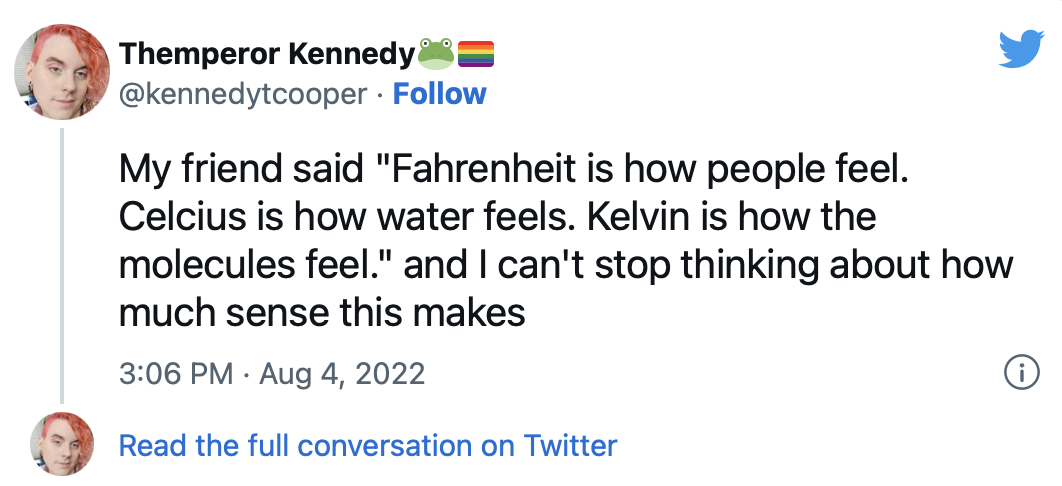
Temperature: (An idea we love to talk about here, here – and this tweet is a great addition.

Breakthrough: (An update) In the early 2000s, Daniel Yergin said, the question around American energy was, “would imports rise to sixty or eighty percent?” Well, that didn’t happen.

“This guy, George P. Mitchell, in Texas was convinced you could get gas out of shale rock. He had a commercial reason, to supply a substantial party of Chicago’s natural gas and his fields were running down. It took sixteen years to get halfway there and another five years to get a complete breakthrough in 2003. People never saw it coming. No one saw the scale of it, how fast the U.S. went from the biggest importer of oil in the world to the biggest producer of oil in the world – a net exporter which was inconceivable.”

Fixing weaknesses (NFL)

Ethics aside, there are no bad businesses – only the wrong business model. Successful organizations have the right people interacting in the right way given the conditions. Outcomes are a mix of who and how with a sprinkling (or deluge) of randomness. 

One ‘condition’ is the relationships with customers. Amazon sellers interact through Amazon, and whatever information the everything store deems important is what the who needs to figure out how to do. As a result those stores compete on price and stars. 

Another ‘condition’ is fickle investors. Money managers prefer clients who aren’t depositing and withdrawing money constantly. So they write letters, go on podcasts, and pitch what they do in an effort to get the right clients. Organizations with a low CAC have figured out the current how

A ‘how’ we’ve advocated is to always fix your weaknesses. Eric Eager explains an NFL example. 

“The Chiefs just got done with negotiations with Orlando Brown, who wanted to be the highest paid left tackle in football. The Chiefs balked, and it’s a great decision. If you pay for a guy to go from an 85% win rate to a 95% win rate, that doesn’t matter nearly as much as taking your weakest guy from an 80% win rate to 87%.”

For NFL offensive lines the conditions are such to fix your weaknesses. 

A lot of times we look at the who and the how. It’s the nouns and verbs that are most salient. ‘Hire a new salesperson to make more calls.’ Instead should we start with the system conditions?

Systems are clearer during change. The four eras of consumerism: rural homes and mail, city center stores, suburban expansion, and internet DTC saw changes in the distribution and communication conditions and the dominant businesses changed. System analysis, relative to who and how, is likely underrated. 

Average measurements are overrated because they are easy to compute, give a number which implies certainty, and convey ideas about as well as a bunny ears black and white television.

Fixing weaknesses is a good default option. But so is asking about the system. It’s a non-obvious and valuable way to figure out how the who can do their best work. And maybe that means fixing weaknesses.

Robot vacuum innovation using JTBD

Robot vacuum innovation using JTBD

Too fast? Slow down. Too hot? Cool down. Too little? Add more. Too long to wait? Make it shorter. Maybe.

Waits are complainable for a couple of reasons. Fairness, if someone enters a line later but finishes sooner. Ambiguity, if the wait duration is unknown. Comfort, if there’s somewhere to sit, charge a phone, or entertain us, waits can be wonderful.

Not all problems have “symmetrical solutions”. Changing something else might change the main thing. Even better, sometimes something else is easier.

For instance, we bought a Roomba. It is loud. Rather, it is Loud AF.

Too loud? Make it quieter. Maybe. But loudness has layers like, how much noise I can hear. One change is quieter. Though that tradeoff makes it more expensive.

Another approach is to hear it less. The Roomba does just that! The vacuum has a scheduling feature and integrates with smart homes. Want a quieter Roomba? Run it when no one is home.

Asymmetry is at the heart of Alchemy. Rory Sutherland wants people to see that problems are asymmetrical and then use psychology (in this case, technology) to solve the problem in a new way.

The idea of symmetry is from Bob Moesta in episode 7 of the Circuit Breaker podcast. The idea of tradeoffs is from episode 2. One of the Roomba’s competitors is non-consumption, episode 13.

‘Typical’ monthly mortgages (1971-2022)

This is the ‘typical’ house payment for the last fifty years. ‘Typical’ being the median sale price and average thirty year rate.

If my parents had bought when I was born they paid $982. But if they bought when my brother was born, it would be almost two-hundred dollars less each month. A huge difference for a young family.

The sweet spot for modern buyers was October 2011 when payments flirted with $1,000. 

The Covid-19 drop and surge can be seen toward the right. It wasn’t until August of 2021 that payments crossed the trend line into wild heights. 

What difference does it make for someone now? Since the end of 2020, the ‘typical’ payment increased seven-hundred dollars a month. 

Interest rates are a headline metric, but are not the most important thing for buyers. The fall 2022 ‘typical’ monthly payment is: $2,580. A $50,000 decline on the purchase price is equivalent to 1% lower interest payments. Not only that, home prices have a .9 correlation with monthly payments whereas interest rates have a -.55 score.

Housing is easy news to consume. The bad is about rising prices and rates. The good is about remodels, flips, and luxury. The truth is somewhere in the middle, here it’s in color.

How “off track” are housing prices? The red line is the 2016- March 2020 trend line relative to the graph of median listing prices. Currently prices are a 33% premium to what the historical growth suggests.

United States figures only.

Sweet words

Successful copywriting uses the customer’s language. Find out what, how, when, and why the customer thinks – and the words they use.

One accent of customer language is certainty. We dislike not knowing. Not knowing feels risky. It’s why this bag of sugar is so sweet: 30 calories per serving. Diets are trends. Eat this or that? Now or later? Are health bars actually healthy? Is sugar bad for me? It’s too much! But this simple bag of sugar puts it in the customer language: calories, and not that many. 

Road construction is another example, only inverted. Fines doubled when workers present. I don’t know how much, but I certainly don’t want it to be doubled! In this case, the natural dislike of the unknown is magnified and aids in the messaging to slow down. 

This hook helped Jaws (1975) set the mold for summer blockbusters. It was a difficult movie to make, in part due to “that sonofabitchin’ bastard rig” (the shark) which kept breaking down. The footage was such a mess that during editing Steven Spielberg used barren shots of the water along with John Williams’ score. That was great because rather than seeing the shark, audiences imagined the shark, a worse fate. 

Organizations can remove or introduce anxiety in their customer communications. How much depends. On what? On what the customer thinks. 

We talked about Jaws’ role in the evolution of the movie business model in this post, Batman BATNA. Contact too:

1 math trick for better predictions

Warning, this is “I watched one YouTube video” level of expertise. Also, some graphs have truncated y-axis.

Predictions are fun. Will a dice roll four or greater? Will it rain tomorrow? Will this company be worth more money tomorrow, next month, next year? An event does or doesn’t happen. We get to predict an outcome.

If an NFL team wins six of their first seven games how many games will they win in total? Well 6/7 is ~85%, and there are seventeen games therefore they’ll win ~14.5 games. But in 2021 there was a team that won six of their first seven games and one math trick could predict it.

Pierre-Simon Laplace gives us the “rule of succession”. That sounds complicated but it’s simple: For any number of outcomes add one to the observed cases and two to the total cases.

Here are four coin flips: heads, heads, tails, heads. The observed rate for heads is 0.75 (3/4). The ‘Laplace’ rate for heads is 0.66 (4/6). Laplace’s addition shifts predictions away from ‘never’ and ‘always’. This is the secret. ‘Never’ and ‘always’ are rare for sequential events.

Here is what the Laplace rate looks like compared to the observed rate for eighteen coin flips.

Here is what the Laplace rate looks like compared to the observed rate for the “six of the first seven” football team, the 2021 Tampa Bay Buccaneers.

Laplace starts at .500. Tampa wins six of their first seven games (.857) but Laplace only increases to .777. Their final winning percentage was .764.

Then there’s the 2021 Detroit Lions, a team that lost their first eight games.

The Laplace rate doesn’t know anything. It doesn’t know coins are 50/50. It doesn’t know about Tom Brady. It doesn’t know the Lions are bad. It’s just a formula that slowly adjusts to extreme events.

Laplace (b. 1749- d. 1827) didn’t have the NFL, so he made predictions about something else, the sunrise. The observed rate is 1.00. The Laplace rate, after 10,000 observed sunrises, is 0.99990002. So you’re saying there’s a chance?

No. That’s a simple wrinkle. Laplace called the sunrise a special “phenomena” which “nothing at present moment can arrest the course of.”

Coin flips, dice rolls, and drawn playing cards are random and have an expected rate.

Sunrises are special phenomena and Laplace’s rate is less helpful.

Football outcomes are a mix. They’re like the sunrise, in that teams have inherent principles. They’re like coin flips in that predictions are difficult, a sign of randomness.

Math helps: relative vs absolute saving rates, people live longer the longer they live, what the mean age means, the vaccine friendship paradox, how many ants long is Central Park?, or how many rolls of toilet paper do the residents of Columbus Ohio use in a week?

Math can be simple. Technique (add one to the numerator, add two to the denominator) and a bit of explanation (extreme events are rare without explanatory phenomena) is all we need.

Simpson’s Paradox

Alice farms carrots and corn. She plants 10 carrots (harvests 90%) and 100 ears of corn (harvests 75%).

Bob farms carrots and corn. He plants 1,000 carrots (harvests 85%) and 100 ears of corn (harvests 70%).

Though Bob harvests a lower percent of carrots and corn, than Alice, his total harvest is higher. This is Simpson’s Paradox.

AliceBob
Carrots9/10 = 90%850/1000 = 85%
Corn75/100 = 75%70/100 = 70%
Total84/110 = 76%920/1100 =84%

Wikipedia has examples of Simpson’s Paradox: UC Berkeley gender bias and batting averages, but it’s farming that grows my insight. Picture Alice with her backyard garden. She has a two acre lot. There’s a house, a shed, and maybe a pond. For her 110 seeds of carrots and corn Alice probably has some raised beds. Now picture Bob’s homestead with a thousand carrot seeds.

Another example.

There are two girls in the same high school, Kim and Abby. They take English 101, but with different teachers. Kim does well, earning 88/100 on the homework portion and 80/100 on the exam portion of the class, and Kim’s final grade is 84%.

Abby’s teacher assigns a lot(!) more homework. She earns 860/1000 on the homework portion and 75/100 on the exams, and Abby’s final grade is 85%. Kim did better on each section, but Abby’s final grade was higher.

Okay. Put a pin in that paradox and consider this:

Linda is 31 years old, single, outspoken, and very bright. She majored in philosophy. As a student, she was deeply concerned with issues of discrimination and social justice, and also participated in anti-nuclear demonstrations.

Which is more probable: Linda is a bank teller [or] Linda is a bank teller and active in the feminist movement?

Okay. Last one.

There are 100 persons who fit the description above (that is, Linda’s). How many of them are:

  • Bank tellers? [___] of 100
  • Bank tellers and active in the feminist movement? [___] of 100.

What we’ve done is reframe problems. We’ve changed the story around the numbers and our understanding.

Simpson’s paradox is easier to understand thinking geometrically in terms of farm space or using familiar examples like school. Linda, via the conjunction fallacy, is easier to understand in percentages rather than absolutes. Rory Sutherland suggests solving life’s problems like sudoku puzzles. Look at it from one direction but if that doesn’t work try another. Use your current experience to find a future answer.