Like what is this place optimized for, places are designed to increase or reduce action frictions. Grocery stores for the end consumer are designed for comfort – stores for middlemenare designed for speed.
The end consumer grocery store has wide aisle to avoid the butt brush effect, produce in the front (colors have a relaxing effect), and pasta near the sauce because customers look for complimentary items. Fish and coffee are separate because of the smells. Stuff for kids is on lower stuff. The blueprint for a traditional grocery store is called a planogram.
For a dark grocery store the layout is different. The aisles are smaller. The seltzer is separated. Spaghetti and linguini are parted too. Salt and pepper also. In dark stores the design goal is speed which means reducing confusion. Also, shot glasses, bags, foil, garbage bags, batteries, and foil pans are next to each other because those items are ordered for parties.
The central point of JTBD is that innovators over index on what they can build and under index on progress the customers wants. Too often innovators ‘scratch their own itch.’
This doesn’t mean verbatim bequeaths . Do that, said Ford CEO Jim Farley, and you get The Homer.
No, successful JTBD innovation uses the customer’s language.
A business that offers same day responses resonates more with customers than one that has “agents standing by”. How a customer describes their issue outlines the progress a customer wants to make.
An example of customer language comes from GEICO’s advertising start. GEICO executives told their marketers that, on average, phone calls took eight minutes and customers saved about 18%. Good numbers.
But when the marketing staff listened to the customer language they found the numbers were too good. “Research pointed out,” said Ted Ward on NPR, “that ten minutes wasn’t long enough to talk about something like car insurance but fifteen minutes was, and twenty minutes was considered way too long.” Eighteen percent was too good too, hence the 15 minutes to save 15% or more.
Customer words are the breadcrumbs along the JTBD path. Innovators settle into metrics which may not be helpful but are familiar, easy to collect, and seem important. But those metrics aren’t how the customer sees the world. For instance:
Best Buy Geek Squad formerly shared the average wait time. That led to disappointed customers. They switched to 90th percentile waits and customers became a lot happier.
Netflix used to offer star ratings (3.2, 4.1, etc.). That didn’t resonate like sub-genres like my favorite, ‘one last job then I’m out’.
Temperature can be Celsius or Fahrenheit but each has different fidelity. Laymen like Fahrenheit whereas scientists subscribe to Celsius.
Canada gets avalanche descriptions. Americans describe a class three avalanche as medium ‘relative to the path’, whereas in Canada a class three ‘could bury a car, destroy a small building, or break trees.’
This same effect exists at Disney. Touring Plans creator Len Testa noted that if his app says a time that’s too far from the Disney estimate people won’t believe it.
Each of these is an example of Lutz’s subtitle: it’s not what you say it’s what people hear. When people heard 8 minutes they knew it wasn’t enough time to get a legitimate car insurance quote.
Prices are set by the amount supplied and the amount demanded. When supply is mostly fixed, like top home-run-hitters, prices rise. This is the market mechanism.
One way to shimmy around this feature is to find things nearly as valuable, but less demand. This is Moneyball. It’s also investors who “fish in smaller ponds”. It’s also art. Collectors pine for Picasso but many fewer for real estate. Discretionary income +housing budget is a lot of money. Find a different attribute to compete on can be good advice.
Sometimes. We can overcorrect. Kristen Berman noted that one experiment which shifted the incentives from monthly to daily saw sales reps “focus on selling large numbers of cheaper items rather than more expensive items that have higher margins. A focus on short term returns can undermine pursuits of higher impact goals.” It was a case where 100 monthly sales did not equate to 4 daily sales.
This is Goodhart’s Law, when a measure becomes a target it ceases to be a good measure. A textbook example is higher education ranking hackings. Some schools counted “a postcard expressing interest” as an applicant. More applicants meant more rejections and a selectivity shine that was only a veneer.
But wait. Goodhart’s Law is a human quirk and quirks can be hacked. Airbnb grew because like eBay or Amazon, stars replaced brands. But while a four star hotel is mostly the same four star homes were not. So the company added subcategories.“We picked the subcategories based on what guests want,” said Jiaona Zhang, “but we also picked subcategories based on what we wanted our hosts to do.”
Airbnb used Goodhart’s Law to direct their host’s attention. Once a category was counted hosts worked toward it.
Measures are a tool. They can be like Moneyball and show cheap things. They can be like Goodhart observed and show unintended consequences, but also tweaked for tidy Airbnb hosts. Measures only seem static but really reveal a lot.
Demand-Side Sales 101 opens with a foreword from Jason Fried, from his time selling shoes:
“I noticed that when people browsed shoes on a wall, they’d pick a few up and bounce them around in their hand to get a sense of the heft and feel. Shoes go on your feet, but people picked the shoe with their hands. If it didn’t feel good in the hand, it never made it to their foot.”
Authors Bob Moesta and Greg Engle of the Rewired Group wrote this book to explain how sales fits under the JTBD umbrella. Rather than selling, Moesta (whose voice I read this in) wants sales staff to be more like a concierge.
Sales isn’t about bringing the product to the person.
Sales is about helping the person make progress.
Investors get this. An investor is only able to maneuver to the extent their limited partners allow. An educational endowment may not invest in companies whose business is distasteful to their staff, students, alumni, etc. Other investors can take advantage of this restricted action section. In the words of Seth Klarman: I want partners who cash checks when I write them and write checks when I ask for them.
Consumer good businesses get this too. It makes no sense to ‘sell to’ people who don’t want the product. Moesta wants to take this spirit and distill it: move past selling to helping.
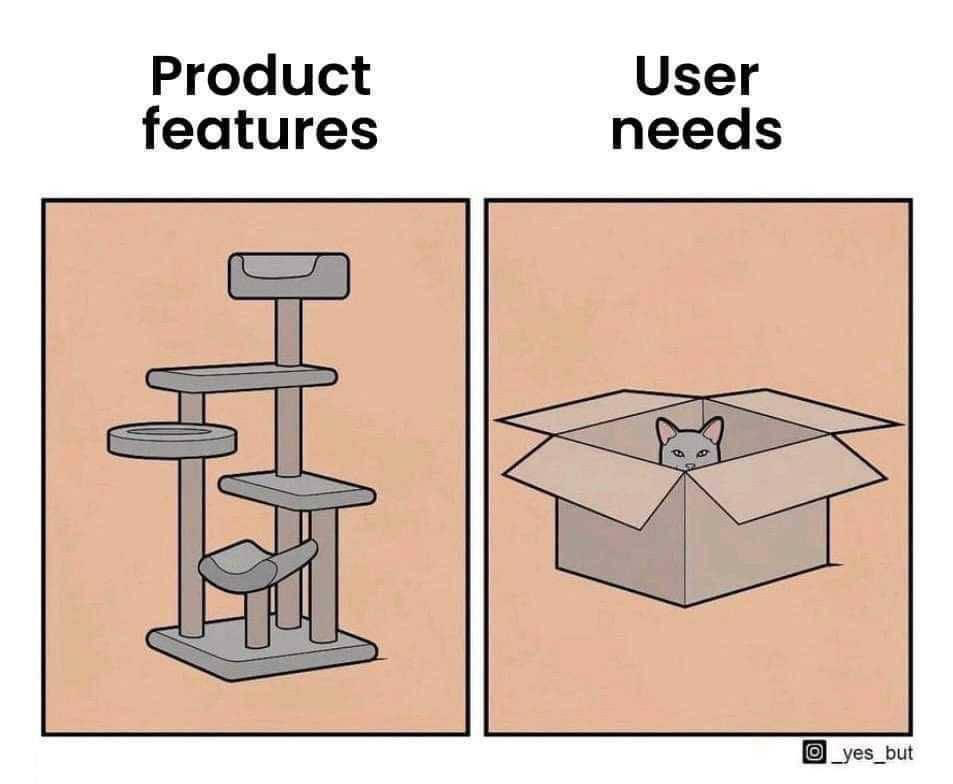
Products that help have to start with what the customer actually needs. This is demand side (rather than supply side) innovation. Supply side tends to be features a business can create. Demand side tends to be the progress a user needs.
This orientation may lead to novel solutions. Channeling Theodore Levitt, Moesta writes:
““I need a drill, because I want a hole.” “I need a hole, because I want a plug.” “I need a plug, because I want a lamp.” “Why do you want a lamp?” “Because it’s hard to see, and I want to read better.” Now, we are beginning to understand the customer. They don’t need a drill at all; they need a Kindle.”
Think of your product, Moesta and Engle explain in their Circuit Breaker podcast, as the mustard on a sandwich. That’s how important whatever it is you do. The iPhone is the greatest product created, but it too is just the mustard. The elemental arrangement (a book about that) of sand and plastic is great – but only because it allows progress like emailing, photo taking, and reading Bob’s book.
There are four forces that affect change: Push of current situation, Pull of the new solution, Anxiety of the new solution, Habit of the current situation.
Moesta is dyslexic and sees these four aspects as an equation. Customers act when [Push of old + Pull of new] > [Habit + Anxiety]. A lot of copywriting works this way. ‘New’ and ‘Best’ are aspects of pull while money-back-guarantee is an aspect of anxiety.
Diet can be seen this way. The way we look at the scale is the push of the current and the pull of the new is the vogue diet of the moment. Anxiety is fear of failure and the ambiguity aversion of the unknown. Habit is what mindlessly eat.
Oh, and a wedding is coming up.
Understanding the four forces isn’t quite enough to make sales. Customers travel through time, and six stages:
First thought. In a competitive market it helps when there is no name for a thing because names mean competition. Meanwhile a business has to create the question that leads to progress. “Questions are places in your mind where answers fit. If you haven’t asked the question, the answer has nowhere to go. It hits your mind and bounces right off.”
Passive looking. Buyers consider actions. Push and Pull don’t yet outweigh Habit and Anxiety.
Active looking. Something happens. I’ve had it.
Deciding. What do people really value? Everything has trade-offs. Successful organizations sync their strengths with the customers’ wants.
Onboarding. A sale occurs.
Using. How well something performs (relative to their(!!!!) expectations). This is 100% subjective. It’s not what you can build, it’s what they want to do.
The 2011 Betty White Snickers commercial is how Mars used demand side sales to sell more Snickers.
“When Snickers reframed their product from competing with Milky Way—supply-side selling—to solving the customer’s struggling moment—demand-side selling—they created pull for their product by helping people make progress.”
Milky Way is a treat and competes with glasses of wine and Oreo. Snickers is a snack and competes with Red Bull or Clif Bar.
“But great salespeople don’t sell; they help. They listen, understand what you want to achieve, and help you achieve it. A better title would be “concierge.””
Recap: Mood affiliation is when an attitude unduly influence our perception, for example cruise ships. Bayesian thinking is updating our beliefs relative to the information.
“The marshmallow study,” Andrew Huberman told Shane Parrish, “was when they gave kids the option to have one now or two if they wait. It’s fun to watch the videos where the kids sit there and use all sorts of distractions and strategies (to keep from eating the marshmallows).”
It’s enjoyable to like the marshmallow study.
We must discount it.
Being Bayesian means updating on new information and liking is information.
Selling is information too. I believe in meditation, vegetarianism, and exercise because they are hard to sell. If someone said: Sit a room and focus on your breathing and you’ll feel better, I would believe them because one of their incentives is NOT financial. Kinda. Health as a product: vitamins, beds, bells, rings, bands and so on, fails this test. Regulating my sleeping temperature (which Huberman helpfully explains) may be helpful, but the bar of persuasion is higher. That’s being Bayesian.
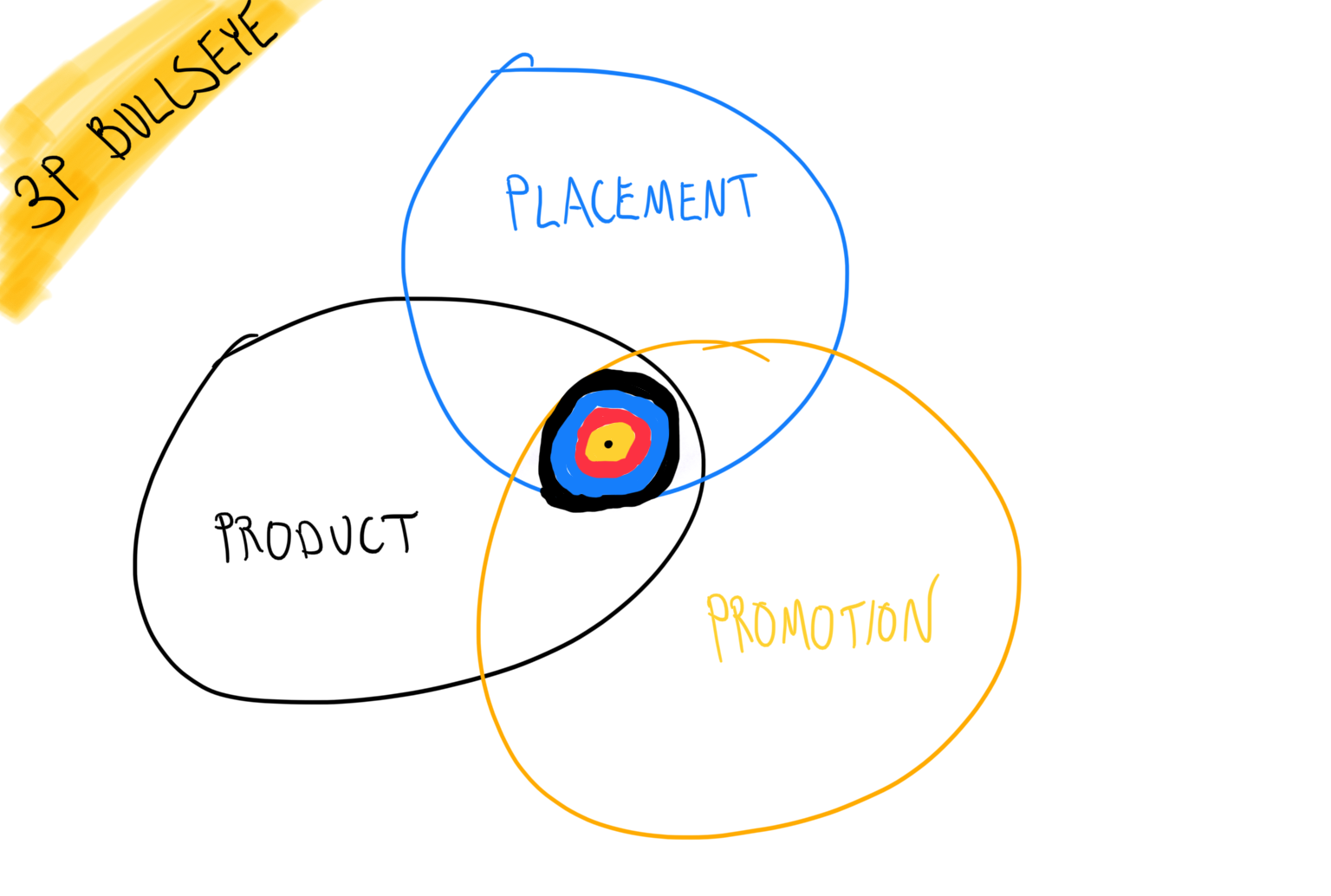
Amateurs talk strategy, General Omar Bradley said, professionals talk logistics. The placementof a product affects the business model. Each method has strengths and weaknesses and trade-offs to make.
There are a few aspects of placement:
The TiVo problem is one aspect of placement. Can innovators gain distribution faster than distributors can gain innovation? White Claw did it. Five Hour Energy did it. TiVo did not. Amazon is hard to compete with because of their placement advantage.
In Nomadland, Jessica Bruder writes about the nomads that move from sugar beet harvest to national park service to – at the end of the year – Amazon warehouses. These ‘workampers’ are “fascinated” by “America’s appetite for sex toys” Bruder writes.
Thanks anonymity! Sure, a warehouse picker at Amazon knows Ken Jacobs in Tulsa orders this, but Amazon is so large and Jacobs’s mail is opaque that products with ‘social restricted action‘ have never sold better.
The second is the first Chick-fil-A Manhattan location.
When you think about a restaurant in Manhattan, location ties you down to specific systems that you have put in place. If you have a location with three stories you have to figure out how to split a kitchen in half. Or, how do you refrigerate trash? People don’t usually think abut that. When do you see trash? At night.
For us the biggie was upstream ordering: How do you take a line of people that stretches from 6th Avenue to 5th Avenue and get them through in a fast way? You don’t do it the same way as a suburban location.
Steve Nedvidek, Manage This – The Project Management Podcast, July 2017
Make something sell something is not business. How and where a product gets to the customers matters too. Both sex toy retailers on Amazon and Chick-fil-A in Manhattan had to choose among trade offs when their distribution model changed.
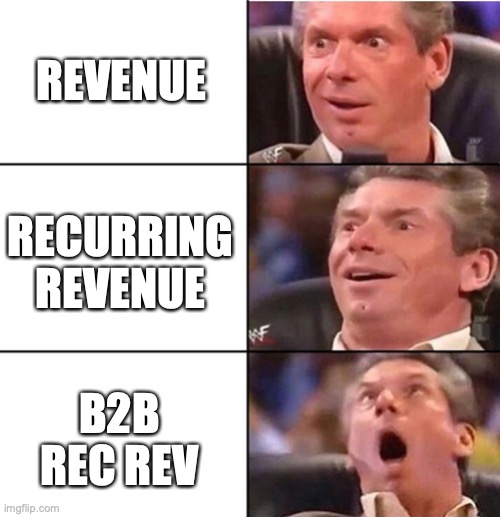
Software companies have a great business model: spend a lot making something once, but each sale costs almost nothing. Google took a bunch of effort to create but takes much less now. Movies are like this too. Businesses with low marginal costs and high sales are very profitable.
That structure applies to decisions too.
Rather than make a decision each time, we can design decisions. Atomic Habits, James Clear’s best-selling book explains this (and embodies it, books are low marginal cost too!). Decisions with low marginal costs and accumulated effects are very beneficial.
Google’s advertising is golden because many people use the service many times. But payoffs also come from one person facing the same design many times or from many people facing the same design once. Framing tradeoffs is one design decision:
Tradeoffs work because they shift the important information. This ad is great because it forces us to think about what we don’t get and is important relative to the first. Part of the reason we want a new phone is to take and share awesome pictures.
…
Imagine we go back to March of 2020, Morgan Housel told Derek Thompson. The Federal Reserve Chairman, the White House, and the Treasury Head go on television with this warning: We are about to enter the second Great Depression, it is that bad, if not worse. We can prevent that. However, in 2022 there is going to be 10% inflation as a consequence of avoiding thirty percent unemployment.
That would have worked.
We know there are tradeoffs, we just don’t try to think of them. But highlighting the exchange shifts how we think, and maybe how we act.
I do not like these words and frames, I do not like the discount games, I do not like the way this stands, I do not like this ad’s brand.
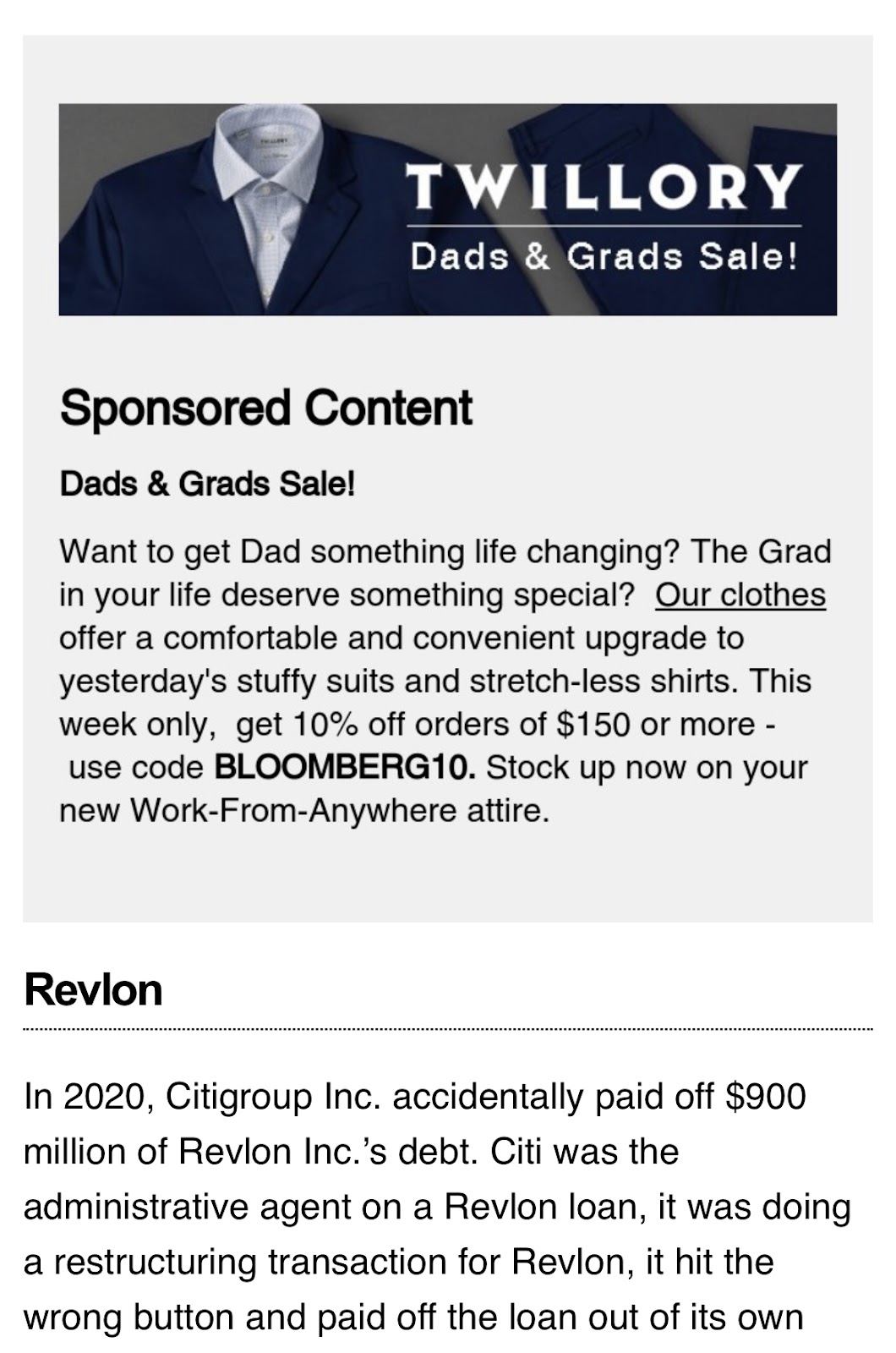
Apologies to Dr. Seuss, but this dad and grads ad from Twillory in the Money Stuff newsletter is just sad.
(I’ll stop now)
The problem with a ‘Dads & Grads Sale!’ is that people don’t really want to save money on these gifts. Father’s Day and graduation are special. There’s nothing people get for their dads that reflects their role. A coffee machine or picture frame or dress shirt doesn’t say ‘Thanks, I love you’ for all the conversations, miles, and smiles of our lives. But we try.
Except deals. Dads and grads shopping is a ‘you get what you pay for situation’. Reframe it. If Mother’s Day flowers were half off would you still do it? It’s different, right?
Unless they’re a deal finder (Hi Uncle Frank!) there’s no utility in the discount. Discounts do push action – but there’s already a deadline, Father’s Day!
The wasted space on ‘discount’ should focus on value. The Twillory reviews have good wording for this: breathable, my old suits don’t cut it anymore, my new favorite work shirt, most comfortable shirt I’ve ever owned, great for road trips, stretch and comfortable, these products now dominate my wardrobe.
That language is what the ad should say.
Follow the link and there’s a two for X sale. That’s good. It could have been the messaging: buy for you and dad. That’s a way to rewrite the ad. Another:
October 27, 2021: @Twillory amazing customer service. Performance pants I ordered were too short. Within a day, and before receiving my return, you shipped out the new size. No company of any size has ever done that. Always told I need to wait. Trust your customers like Twillory!!!
Just copy a tweet. This uses the language of the customer and reduces hesitation about a new brand with a new fabric. Or:
Sponsored Content: Father’s Day is June 19. Dads and Grads need help looking good. Don’t buy whatever polo and pants – buy something nice. Whether for the graduate’s first job, internship, or six weeks backpacking Europe or for dad’s round of golf, Sunday service, or dinner with mom – buy something nice. Order by June 24th for free shipping on orders of two shirts or more.
The angle here is that the customer is not the consumer. Also, the discount shouldn’t be for the merchandise directly. Free shipping or socks or gifts work better because they retain the product’s value.
All of the parts of the ad are true, but they could be better (copy)written. Second consider the ‘job’ of the gift giving (don’t be cheap, buy something nice) and of the gift (wear this in these circumstances). Happy early Father’s Day to all the dads out there.
This could be wrong. Their strategy may suggest this copy. But it feels inferior and stiff unlike their shirts.
If I listened to my customers, Henry Ford lamented, they’d have asked for a faster horse. Let’s peel back this meme.
Superficially, Ford noted, customers do not know what they want. It takes visionary God-given insight to make things for people. Maybe.
What’s happening is that customers share a suggested solution. Ask the right questions to find the problem.
Prior to streaming in 2007, Netflix mailed DVDs. The business worked better than Blockbuster because movies came right to the customer, who returned them whenever they pleased. Life was good.
Mostly. People told Netflix they wanted new releases faster. That was the suggested solution. Instead, Netflix asked questions. If some customers got their newly released movies right away and others did not, would customer churn differ between the two groups?
And it did!
But not by much. At least not by enough to justify the extra cost of 2004’s The Machinist.*
But people wanted more new movies. Right?
Here Netflix got into the problem part of Ford’s words. Customers ask for one thing but what do they really want?
What the Netflix customers really wanted was any movie faster. To address this JTBD Netflix did two things.
First, they built more shipping centers so more movies were geographically closer to more people. During this expansion, Netflix went from ~20 centers to ~100.
Second, they changed the website so ‘local’ movies were presented on the homepage. A customer might log in to see Shrek 2 rather than The Incredibles.
Customers said they wanted newer movies, but what they wanted was faster movies.
*That’s another Netflix find. We tend to like Adam Sandler movies more than Drama/Thriller
In college, our ultimate frisbee marketing wasn’t table tents like everyone else, but t-shirts. It seemed superior to subsidize the extra shirts, Mike C. bought four, than pay for paper adverts. It was an accidental Influence via social proof. Robert Cialdini writes, “there are three main optimizing conditions (for social proof): when we are unsure of what is best to do; when the evidence of what is best to do comes from numerous others; and when that evidence comes from people like us.”
So maybe the shirts were the better advertising route. But that’s hindsight. At the time the thinking was: why not use the money to get something that advertises the club but also which we can wear. It allowed our marketing budget to stretch into our uniform budget too.
…
Though cleaning Airbnb rentals, residential homes, and apartment turnovers seem the same, the unit economics are not. The rentals required extra work like stacking pillows and sorting silverware and the homes required return visits to address distress and missteps. Plus, the rentals and residences were “times are good” businesses. George wanted something that would cover when times were not good too. That left apartment turnovers.
Then George did two other things. First, George brought all the rental turnover services in house, “one throat to choke.” When a tenant leaves, property managers need to make one call. George’s crew cleans the carpet, patches the walls, and fixes what is broken. Bundling these services is a better solution to the JTBD.
The second thing George did was to hire a quality control manager. This person follows the main crew, addresses small misses, and coaches the crew on the larger items. This, Acquiring Minds host Will Smith, sounds expensive. Yes, George replies, if you look at it only as a cost. But it’s not just a cost in the sense of apartment preparation.
You see, George explains, this is my marketing. It’s through word-of-moth referrals that people find George. The quality control is part marketing. And if that wasn’t enough, the quality control changes George’s LTV-CAC calculation.



 The Waiter's Pad