If this blog has a core, at the moment, it’s about decision making. One way to change decision making is to change the initial conditions. One way to do that is to dial ease up or down.
Losing weight is about introducing new habits and breaking old habits. WW, formerly Weight Watchers, uses ease a lot. Make the good things relatively easy and make the less good things relatively difficult. For example, part of what makes keeping a food journal a successful dietary change is that it introduces a friction, writing down the food forces our focus: do I really want to eat this? There’s no noting bananas though.
“To introduce new habits you want to pick foods you can eat on autopilot. If you’re with WW there are zero point foods that you don’t need to pay attention to. Bananas are pretty healthy and you’re probably not going to overeat bananas.” – Julie O’Brien, The Science of Change, November 2021
The episode is full of behavioral hacks, for instance having slack in the system for an occasional treat (or lapse). Another is the idea of rules of thumb. WW has points, intermittent fasting has times, Whole30 has no carbs. Each also restricts booze.
As a teen I worked retail with a woman who did the points system. She ate popcorn all the time. I didn’t get it. Popcorn has calories. But it worked for her.
As a teen I thought the world was more black and white. Now I get there’s more shades of grey. Now I appreciate the aspects of designing ease.
–
Here’s a few more posts about the different ways ease works.
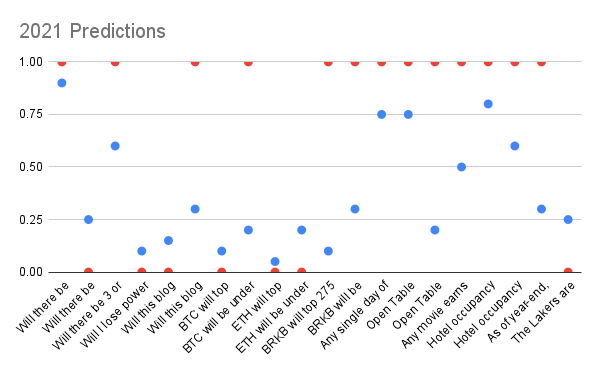
Here are the 2021 predictions graded. My average Brier Score was 0.227 whereas a coin tosser Brier is 0.25. A perfectly accurate forecaster scores 0 and perfectly inaccurate forecaster is 1. The big misses will be in bold.
My guesses are blue, outcomes are red. The closer the blue is to the red the more accurate I was. This chart makes the predictions looks okay.
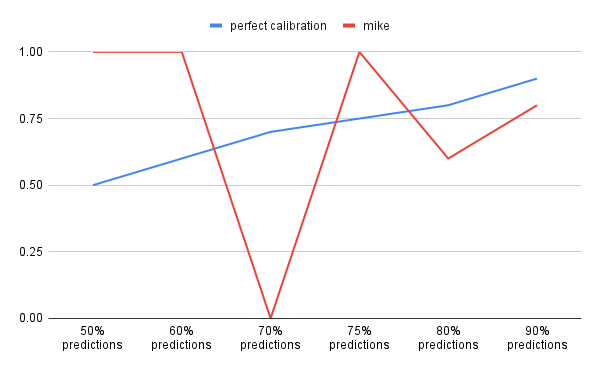
But when I bucket them it gets worse.
That looks terrible. Let’s see how.
Hurricanes. NOAA “An average season has 12 named storms, six hurricanes, and three major hurricanes.” Will there be more than 12 named storms? Yes, 90%. Will there be more than 30 named storms (the 2020 record)? Yes, 25% Will there be 3 or more major hurricanes (top winds of 111+mph)? Yes, 60% Will I lose power at my home in Central Florida for more than 3 days? Yes, 10%.
Overall there were 21 named storms and four of which were major and we didn’t lose power at all this summer. Mostly these were safe but relevant predictions. Hurricanes are one of those things I’d like to appreciate correctly. Like an alligator on the river bank, I want to know enough to take a good photo but also to keep my fingers.
Blog.
Will this blog have more than 41,000 views in 2021 (41k is the 2020 number)? Yes, 15% Will this blog have more than 800 posts by year end? Yes, 30%
The blog had 29,000 views and 908 blog posts and a whopping 335,000 lifetime views (!!). What’s surprising was my inability to predict myself. As things go, I got into a great writing streak in the summer and fall of 2021 and the posts reflected that.
Finance
BTC will top 75,000 at any point in the year? Yes, 10% BTC will be under 30,000 at any point in the year (started 2020 at this point)? Yes, 20% ETH will top 5,000 at any point in the year? Yes 5% ETH will be under 130 at any point in the year (started 2020 at this point)? Yes, 20% BRKB will top 275 at any point in the year? Yes 10% BRKB will be under 234 at any point in the year (started 2020 at this point)? Yes, 30%
First, in hindsight this was cheating. ‘At any point in the year‘ is a case of something is always happening. To get better at predicting I need to ask better questions. The biggest paired misses of the year were my guesses about Berkshire Hathaway stock ($BRKB). I thought there was a 10% chance of the stock being under 234 and 30% being over 275 (and that’s with the generous ‘at any point’ language).
I’m not quite sure what to think of this one. Robinhood and retail? The stock didn’t move more than 20-40 points in 2018 or 2019 and as a ‘value’ stock I expected tighter growth. Though mostly correct on crypto, with hindsight the range of outcomes is much wider.
Economic Recovery These will be graded per Bill McBride’s numbers on Calculate Risk. Any single day of the last week of the year will top 2M travelers (2019 was 2.0-2.5M)? Yes, 75% Open Table reservations will be down less than 10% YOY? Yes, 75% Open Table reservations will be positive YOY? Yes, 20% Any movie earns more than 250M on opening weekend during the year (highest grossing movies)? Yes, 5% Hotel occupancy tops 60% (graph)? Yes 80% Hotel occupancy tops 70%? Yes, 60%
Mostly got these correct and directionally too. Predicted 75, 75, 80, and 60% for events that all happened. Missed reservations being positive but grading it I can’t remember what this meant. Also missed on movie opening as Spider Man No Way Home earned 270M, partly from my two daughters and me.
Sports
As of year-end, Tom Brady averages +270 ypg? Yes, 30% The Lakers are NBA champions? Yes, 25%
Tom Brady continues to amaze averaging 313 yards per game. And our Aaron Rodgers saga comes to an end, with Rodgers just falling short by 1.5 touchdowns. This one is another head scratcher. Rodgers had two games with no touchdowns and missed a game due to Covid. Is this the variance that Plus EV noted or was it just luck?
One famous account in the Talmud (Shabbat 31a) tells about a gentile who wanted to convert to Judaism. This happened not infrequently, and this individual stated that he would accept Judaism only if a rabbi would teach him the entire Torah while he, the prospective convert, stood on one foot. First he went to Shammai, who, insulted by this ridiculous request, threw him out of the house. The man did not give up and went to Hillel. This gentle sage accepted the challenge, and said:
"What is hateful to you, do not do to your neighbor. That is the whole Torah; the rest is the explanation of this—go and study it!"
The perspective of Shammai reminds me of the stereo sales agent who talks in terms of features: 5.1 sound, number of speakers, bass output, whatever. Hillel meanwhile is the person who understands the job to be done – just make it sounds good.
‘Is diet a form of counter signaling among wealth people?’ wonders Rory Sutherland. “If so it won’t really scale. It will be profitable. It will be large enough, there are enough wealthy people. But if it doesn’t scale beyond the highly educated and well paid then obviously the environmental benefits won’t be so great.”
Though I agree with Rory (a lot) here he’s surprisingly wrong.
Blockbuster Video and Southwest Airlines had the same business model, though they aren’t the only ones to operate this way. For Blockbuster the problem wasn’t everyone having Netflix but some people having it. If they lost 5% of their customers, sometimes their most profitable ones, in any given area that changed the unit economics. The same fixed costs spread over fewer customers meant the non-fixed costs had to change too. The same with Southwest. In the early days of the airline, founder Herb Kelleher told employees they only made money on the last two passengers.
These marginal customers are the reason Rory is wrong here. Much like the first pounds lost on a diet being the most impactful, the first ‘meat consumers’ lost will also have an outsized gain (or is it loss?). But that’s not all! Because the environment is a complex adaptive system, the effects are almost certainly non-linear.
Most of the podcast between Sutherland and Live Kindly’s Jodi Monelle is about delivering value through meaning. Value through meaning is kosher, it’s vegan, it’s carbon free too! Value, Rory says, is ‘Beyond Meat’. It’s like meat, but better. It’s beyond meat. That’s good value.
Alchemy is about taking existing or marginal resources and deploying them for non-linear effect. Sometimes small changes go boom.
One way to see this is in the expression 20,000×1 != 1×20,000. Rory Sutherland introduced this idea through travel. A new rail line, Sutherland said, that saves many people a few minutes is worth less than a change that saves a few people many minutes.
Another example Rory gave was airline lounges. A sole traveler visiting a lounge many times a year gets a small benefit whereas that traveler with their family twice a year gets a huge benefit. In each case the same number of scones are consumed, but the effect to the consumer is different.
A real life example is the Credit Karma Save program.
“One of the things we noticed was that there’s strong deposit behavior around paydays and we wondered if there was a way to do nudging around paydays. So we created a savings boost program where just by depositing a dollar that month you’re eligible to win twenty thousand dollars that month.” – Kyle Thibaut, The Science of Change, October 2021
That’s not all. Credit Karma also offers Instant Karma, a cash reimbursement program for their debit card users. Every transaction is a chance to win that amount back.
I’d wager that the Credit Karma accounting for “customer reward” or “interest paid” or such, is similar in scope to the competition – but having a few large chunks rather than many small ones is a golden idea.
–
It’s always nice to validate an idea with an “out of sample test”. Does this work elsewhere? Marc Andreessen riffed on the idea that there are only bonds and call options.
…
March 28, 2022 update. Previously this idea was in the Landslide post which covered: sun and skin damage, landslide prevention, and Marc Andreessen on the culture of work.
Language is a marker. It’s a symbol of our basic Bayesianism – the more we use some words the more important the ideas behind them are. Here’s our collection of interestingish words, so far. Here are some 2021 additions.
…
“Uncached questions.” When an interviewer asks an interviewee a question which may require longer thought for a more thorough answer. Per Wikipedia, a computer cache is a component that stores data so that future requests for that data can be served faster.
“Dog in the race.” As in, I don’t have a dog in this race. Growing up it was dog in this fight. I suspect it will evolve further to dog in this pageant.
“Double click on that idea.” Even though the days of roller ball mice are in the past, this comment still pops up like an advertisement for Windows in 1995.
“FOBO“, fear of a better option. As in, I have FOBO and don’t want to decide now.
“Makes perfect sense”. This one is a caution flag. Some say it makes perfect sense that the hybrid immunity (Covid plus vaccines) is greater than vaccines or having had covid. I don’t remember this coming up ex-ante. Instances of MPS need to be more predictive than descriptive.
“Breakthrough”, something years in the making which gains distribution. As in, the Covid mRNA vaccine was a breakthrough.
There’s a few ways to be paid for work. One is monetary. Another is pleasure. A third is knowledge through experience. Framing work this way means someone always ‘gets paid’.
A friend posted on the neighborhood Facebook group that he cleaned his dryer vent and it was full of stuff *after only three years*. ‘Oof, I thought, and ordered a cleaning kit on Amazon. But do I need it?
About one in twenty-five homes has a fire each year. Half of all fires are cooking related and another sixth are from heating equipment. About one in ten are electrical related and 3% of those are due to dryer related fires. So all told, about 0.012 percent of homes in the United States have a dryer related fire each year. That’s an already low base rate, mix in a newer home and the satisfaction I get from cleaning the lint trap and our odds are pretty dang low.
Though unlikely, this was still a good exercise. For one, cooking fires are more common than I thought. One in fifty homes? Each year? The damage may be small, these are fires reported and responded to, but it’s high enough to be a bit more careful in the kitchen. Second, I’ll be paid in experience, one of the best teachers a guy can ask for.
In the early 2010s I listened to Dave Ramsey nearly every day. The Nashville based personal finance (personal accountability) radio host is still on the air, holding court. There’s a few things that make Ramsey popular.
First, he’s great on the radio. The content fits the medium, and Ramsey’s basic explanations, stories, and approaches combined with the delivery works.
Second, he gives good advice rather than perfect advice. There’s a difference between precision and accuracy, usually between the world of a model and the real world. It’s why Ramsey suggests beginning with the debt snowball:
“Start by listing all of your debts except for your mortgage. Put them in order by balance from smallest to largest—regardless of interest rate. Pay minimum payments on everything but the little one. Attack that one with a vengeance. Once it’s gone, take that payment and put it toward the second-smallest debt, making minimum payments on the rest.” – Dave Ramsey (link)
A great behavioral angle. We like feelings of progress and by focusing on the smallest balance we get that, especially given the financial conditions we may be in.
A third thing Ramsey does well is filling an answer gap. One time a woman called into his show and asked a question. He answered. She protested that her friends and family wouldn’t understand. He suggested telling them her financial advisor advised it. I don’t have a financial advisor she said. “I’m your financial advisor!!”, Ramsey retorted.
In another instance he told someone it didn’t matter how much their income was, the purchase wasn’t “in the budget”. Could they afford it? Yep. But framing it against the contrived ‘budget’ change the conversation. (I’ve used this one, it works.)
Both “I’m your financial advisor” and “it’s not in the budget” fill in an answer gap. Having ready answers can change our fast thinking. It works for drinking too much, a diet, or any kind of behavior we’re trying to stick with.
The ready answers can be pretty arbitrary too. If you offered “meatless Monday” would anyone actually comment? I’d wager not. So it’s not the validity of an explanation but merely the existence of one.
–
Some people don’t like Ramsey’s advice but I’m reminded of the Tyler Cowen expression: opposed to what? If not this then what?
It’s important to highlight base rates in the wild as a way to keep them top-of-mind. What’s available is what we think about. Nowhere is this better than sports. We tend to overreact rather than “short the narrative” and base rates are a useful thinking tool to practice.
Talking about the last week of the NFL season and potential playoff situations, otherwise sane Shane Jensen offers up, “I think it’s less likely the Colts lose to the Jaguars than that other game ends in a tie.” Okay, what’s the base rate? Since 2017 there have been 5 games that ended in a tie, and 7 games where a big underdog won.
What’s probably happening is recency bias. The Jaguars lost by forty points to the Patriots, fired their coach mid-season, and maybe aren’t the best run organization. All of those things can be true as well as still being more likely to win than a tie game.
Part of the Wharton Moneyball podcast is to be entertaining. That’s fine. But part of it is to be analytical, and for that this was a miss.
This episode dropped among a list of NFT episodes, but first the quote.
“In education there is a lot of incentive to fail with the pack rather than to take a risk away from the pack. For example, folks would teach the Prussian Lecture method. We all knew it was bad, we all did it together, and education failed but no one stood out. There were brave people who built flipped classrooms, but a lot of students didn’t like it and they would get bad teaching evaluations and sometimes lose tenure. If in football you play by the book, which isn’t really the book, it’s what everybody has historically done, and you fail then you are failing the same game the way everybody else fails. In a way you are failing in a more honorable space than somebody who does something differently and takes that chance.” – Eric Eager, The Science of Change, November 2021
Failing conventionally is an idea we’ve looked at before. But there are two additional points.
1. Conventions (‘the book’) change.
2. It’s the relative difference to these moving conventions that matter.
In football, for instance, going for it on fourth down is being normalized. If in next year’s season the convention is go for it on fourth and one in the opponent’s territory then the conventions have changed and coaches who go for in in their own territory will have less relative difference from the conventions.
What does any of this have to do with NFTs? NFTs are weird. They’re basically agreements. We all live under a collection of agreements: constitutions, laws, proposals, deals, partnerships, user agreements, contracts and so on. Some of these agreements are more explicit than others. The laws of physics notes Neil Degrasse Tyson are true whether you believe them or not. Contracts more solid agreements depending on the enforcement system. Relationships are toward the softer end of agreements and NFTs are digital agreements.
Like Eager’s flipped classroom and fourth down comments NFTs are novel conventions. And we should expect more weirdness.
Conventions used to be dictated by the physical space. We acted mostly like the people around us acted. Now, we hang out on the internet. The conventions are still dictated by the people around us but now it’s in the digital space. And as we are in the digital space more we will come up with new agreements there.
Digital art is an early development for these digital agreements because it’s easy. An NFT is basically a link to a file with an agreement attached. The file is stored in this server which is how website work, AND it is owned by so-and-so.
Our lives are full of agreements and conventions. If the things we do are online more the agreements and conventions in our lives will change. NFTs may be one such example.
–
Art NFT are a bit overhyped because the price is wrong. The floor on one ape was $200,000 but really the price was 50ETH. But there’s no way whoever buys this ape will pay for it when 200K=50ETH. Rather, part of the NFT craze is that a bunch of people have ETH at prices well below the fall 2021 levels.
 The Waiter's Pad
