Jerry Neumann uses Rob Fitzpatrick’s book, The Mom Test in his Spring 2019 class. Spring from there, we’ll work our way through a number of talks and interviews Fitzpatrick has given about his 2013 book.
“It’s an incredible time to be a learner, I remember when I was young and it was very good, but I always felt like ‘I gotta get into this more, I want to understand it better.’ Today, the videos and courses that are online with the very best professors is phenomenal.”
…
I was excited to learn from Fitzpatrick because one of the lessons of failed startups is poor feedback. Founders would scratch their own itch or eat their own dog food to no avail. Scott Norton did not and said, about their first tasting session for a new line of ketchup, “We knew if we had one and invited all our friends they would be ‘this is amazing.'”
Fitzpatrick said, “The reason I call it the mom test is because you ask questions where even your mom couldn’t lie to you.”
Fitzpatrick’s idea boils down to asking before building. Once we have A THING and present it to A PERSON all of our social NORMS kick in. Fitzpatrick said about his mistakes, “I was essentially asking for compliments and opinions rather than getting real data, real evidence, and real commitments to purchase.”
Instead, he preaches an iterative approach with limited stakeholders. This, he said, is why college students are entrepreneurship cockroaches, “They can keep trying dumb stuff until something works.” College students don’t have mortgages or families or reputations to maintain. They have few stakeholders.
Stakeholders mean commitments which reduce time and opportunity for solving problems. Sam Altman advises founders they get one other big thing – family, hobby, sport – besides their startup.
Fitzpatrick gives permission to stay small. “The temptation to look big makes you more fragile.” And reminds founders that smaller means agile, “big companies can’t innovate because their mistakes would be too expensive.”
This is the entrepreneur’s advantage.
Think about buying from an entrepreneur, it’s usually a terrible choice on some dimensions like size, permanence, and resources. But, “The reason they buy from a startup is that you’re doing something to make their life better in a way that no one else is.”
Much like IDEO, Fitzpatrick suggests starting with the customer’s actions. Look at what they do, not what they say.
Ask them about their life, not your product.
Ask them about the past, not the future.
Ask them and then listen, don’t talk.
This is all very cheap, it only takes time and not even full time. Consider making meetings and taking lunches, after work, or on the weekends. “Nothing is expensive until growth.” And don’t aim for growth until after people love it.
Then scale might come, and along with it a whole new set of responsibilities like lawyers, investors, and a team. Those are all further stakeholders. Don’t forget A rounds lead to B rounds and on down the line, “Being committed to fundraising brings a lot of extra admin tasks.”
That’s the scaled startup path and Fitzpatrick said that was all he knew early on because it’s all the media covered. But there are smaller startups too “No one writes about this in the press because it’s not a dramatic story.”
Bootstrappers pull money through time. “The main idea criteria is that someone will pay you money quickly, that’s it.” One way to do this is like how Peter Rahal did it with RXBAR.
Direct to consumer has very generous payment terms, immediate.
Being small also lets founders talk to their customers. Fitzpatrick said, “If you do a survey it gives you data you can put in a pie chart but you lose the depth of it.”
Quantitative data works for large organizations because of dapper decision desires, everyone wants to look logical. “It’s difficult to justify making decisions on that (conversational) data because it’s not statistically significant and it doesn’t feel rigorous but I’d much rather make a decision on a small amount of truthful data than a big amount of superficial data.”
Grant McCracken articulated the same problem.
“When a senior manager says, ‘Fine, that’s what you think, where are the numbers?’ And the best we can do is say, ‘Just trust us.’ It’s like, yeah right, ‘I’m not trusting my career, my children’s opportunity to go to college on your impression. Where’s the data?’ By data they don’t mean, I did an ethnography in someone’s kitchen. They mean, please could I have some numbers.”
This is why Paul Sonkin and Paul Johnson wrote the book Pitch the Perfect Investment, to help analysts understand the local logical of their managers.
Within organizations, there’s the decision but also how the decision appears.
And as groups grow, more people move away from the customer. They lose what McCracken calls “kitchen table data” or what Tricia Wang calls ‘dumpling stand data’. Larger organizations need to create ways for everyone to have a customer touchpoint. Kayak had a service phone everyone answered. RXBAR did too. Fitzpatrick said that some companies have their engineers ask one or two follow on questions about use when they are working on bug tickets and others have Friday parties users are invited to.
The goal is to reduce biases. The Mom Test is about reducing our bias toward kindness. “It’s not enough to talk to them,” said Fitzpatrick, “you have to talk to them properly.” How so? “If you can meet them in a cafe rather than an office you’re immediately going to get more honest feedback.”
Scott Belsky spoke with Debbie Millman about his career at Adobe, in VC, and writing The Messy Middle.
More than work. Belsky said he learned a lot from his grandfather, “things I wanted to emulate but not emulate as well.” For instance, “I think he struggled after the loss (sale) of that (his) company.”
Work keeps at bay three great evils; boredom, vice, and need concluded Voltaire. Michael Ovitz paid his dad’s employer to keep his dad employed. This was part of the warning Brynjolfsson and McAfee issued in their talks too. There’s more to work than work.
School. “Traditional schooling first failed us when it taught us to stay between the lines.” Schools reward ‘the one right answer. That’s fine for some things but less great for others. We’ve looked at how IDEO embraces a different model. We’ve also seen examples like Jerry Murrell, Peter Rahal, and Martine Rothblatt who demonstrate that entrepreneurial excellence doesn’t always fit in at school.
School, like other tools, is great for some things and less great for others. Our mistakes arrive thinking school is always the answer, like the hammer sees every problem as a nail.
Ignorant enough. “None of us knew what we were doing, but we shared a tremendous amount of initiative that overcompensated for our lack of experience.”
Enthusiasm, naivete, and optimism are essential for entrepreneurs. Sam Walton wrote, that it was a blessing to “be so green and ignorant” when he started in retail.
Communicate well. “To me, design was almost like a cheat to get something done better.” “The (CIA) team I was asked to speak with was the team that merchandises information to people in the field. They had so much information that they wanted people to pay attention to but if they don’t use design practices no one is going to look at it.”
Belsky faced the same problem baseball teams and basketball teams face. How do you communicate data to practioners? Daryl Morey and Jeff Luhnow have some ideas too.
Aha moments “This (how disorganized the creative world was) was the frustration that inspired Behance.” Glitches in the matrix are moments to pause and ask how something could be better. Keith Rabois said, “Anomalies are giving you hints for things you don’t understand; they’re an opportunity to find a paradigm shift.”
Follow your curiosity, wrote Brian Grazer. Scratch your own itch, but also ask customers if they face those moments too.
Does the glove fit? “The exit scenario (for Behance) never came up. We loved what we were doing.” Millman added, “If you really love what you’re doing it’s just part of your overall life.”
Jobs aren’t perfect but they can be fulfilling. Josh Wolfe said, “On Sundays when my peers were watching American football I would be reading and learning something.” Belsky said, “The competitive advantage is doing work no one wants to do.”
That’s worked for James Higgins, “When you go down market there is a premium associated with rolling up your sleeves, and getting in the weeds and making things happen. That process is something we really enjoy.”
**Be different enough now, be right enough later. “Entrepreneurship is about identifying edges that will someday become the center and building and leading teams over the long haul to turn such a vision into reality despite the odds.”
Josh Wolfe said he hopes people agree with him, only later. Paul Johnson and Paul Sonkin say that good investment pitches include why the market will come around to an undervalued idea.
Meetings. “A mock-up is worth a thousand meetings.”
Media BS. “It’s easy to tie a bow around the Behance story and I found it interesting that it was anything but.” The media business isn’t always about telling the truth. Andre Agassi for example, was given the glasses and the line at the end of a photo shoot and it became his motif. It wasn’t planned. It wasn’t him. But it took the narrative.
Argue well. One of the most important part of an organization is good discussion. James Mattis said that if you don’t bring up your shortcomings internally, the enemy will point them out for you. We’ll leave with four more quotes from Scott.
“Is it permissible for people to talk to you and raising their hand and saying ‘I disagree.’”
“We were proud of the fact that we could go in a room, duke it out, and it was a very healthy process because we were exposing each other’s blind spots.”
“I’ve always kept an elephant list, the third rail things nobody wants to talk about and I try to interject one or two elephants whenever we’re together.”
“This is a key part of kind of eliminating the organizational debt that accrues in any organization. Organizational debt is the accumulation of decisions leaders should have made but didn’t.”
Paul Johnson and Paul Sonkin are the authors of Pitch the Perfect Investment, a book they say is written for recent graduates, MBAs, and portfolio managers. They wanted to write the book, in part because, “It’s been our experience that once you’re a couple of years out of school and in the business you know everything.”
They are wrong about who this book is for.
This book could be for any organization. “We tried to create something with staying power,” said Sonkin. Many businesses search for alpha, “a variant perspective” as their differentiator.
Let’s see how.
…
All organizations need good communication. “Not getting an idea adopted into the portfolio is the equivalent of having no good ideas.” Scott Belsky opined the value of design to Debbie Millman and this obstacle exists in sports too.
The solution tends to be ease. Warren Buffett writes with ease, “I’m addressing partners. There’re 600,000 of them, but in my mind I usually have my two sisters.” Buffett is a great stock picker but he’s also avoided redemption stampedes.
Buffett doesn’t pontificate, he humanizes because the type of language matters. Michael Lewis wrote in Moneyball, “He (Paul DePodesta) doesn’t explain anything because Billy doesn’t want him to. Billy was forever telling Paul that when you try to explain probability theory to baseball guys, you just end up confusing them.”
What works in sports is visual and back and forth. Daryl Morey said it’s a “give and take,” in a relationship “where both of us (Morey and James Harden) can give feedback to each other that sometimes isn’t easy. Like, I’m not seeing what you’re seeing, let’s talk about it.”
In an investment shop, said Johnson, the managers need to give good feedback and the analysts need to ask more questions. Managers need to say (only) ‘No’ less and analysts need to ask ‘Why’ more. “They’re talking essentially two different languages which is why Paul and I tend to think of this as couple’s counseling.”
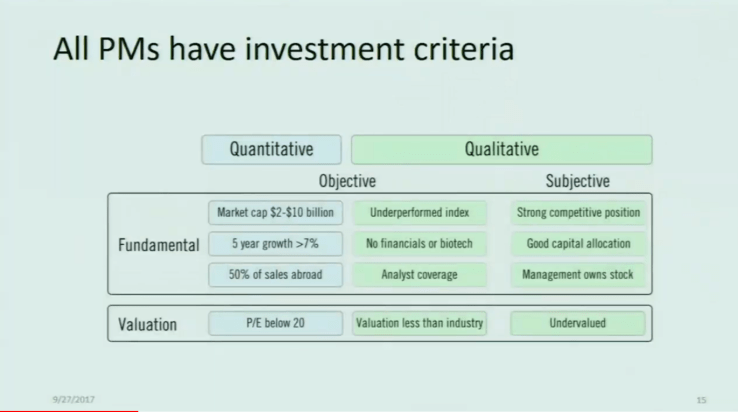
Their YouTube talk is full of good slides like this one and the 2X2 shows where communications can fall through the cracks.
Quantitative fundamentals are the easiest thing to get right because they are the most concrete whereas qualitative subjective valuations are much more nebulous. How much insider ownership matters? How large must a moat be?
Managers must be clear about their unstated subjective criteria if they want a decentralized command structure. The DC works for TV, AI, and Pizza. It works because the people closest to the situation know the most about it.
For analysts, it means figuring out four things; how much can I make, how much can I lose, why haven’t others grabbed this, when will others get it? These four questions are like the Five Whys, only for ‘Why is this a good investment?’
Analysts misstep because they misunderstand their mission. “Analysts say they get paid to analyze, no, they get paid to come up with ideas that go into the portfolio.”
Analysts should strive for the indirect approach. Paul Wagner, Tom Cruise’s agent, put it this way in Powerhouse:
I said, “I think it should be Tom Cruise,” and everybody went, “Whaaaaaaaaat?” Except Mike. He looked at me and said, “You do, do you? Hmm . . . interesting.” Then Dustin wanted to meet with Tom, so I said to Tom, “I have this crazy idea.” Others will probably say Tom was their idea and it probably “was,” because the art of agenting is to let clients have the great idea.
Johnson said, “I’ve met a lot of analysts that say, ‘I got very frustrated because before long it became his idea not my idea.’ That’s good. That’s what you want. You want them on the team and they’re not gonna buy unless it becomes their idea.”
Great organizations are Tolstoyian – alike. They have leaders that communicate well, they encourage debate, they have a diversity of thought, they have high expectations, they have extreme ownership, and they talk their customers and feel the winds of the real world.
Johnson’s and Sonkin’s book has those things and more specifics for investment managers and analysts. Sonkin’s YouTube channel has more interesting content and they teased (joked?) about a podcast coming soon.
Our first post on Marc Cohodes was based on his conversation with George Pearkes on Bespokecast. Today we’ll look at a sit-down interview with Grant Williams for Real Vision.
What’s great about short sellers like Cohodes (and Jim Chanos ) is their willingness to offer a different opinion. “I always say that free speech is free so long as it’s bullish,” said Cohodes in 2017. Internal, but cordial, dissent, argument, and conflict are good for organizations as steel sharpens steel.
…
“It all started in high school, I was never a good student. I was taking a tenth-grade economics class where we invested in stocks and I sort of got the bug then.” I wasn’t a great student, is a common refrain but we shouldn’s assume school is good or bad.
School is school. That said, lots of entrepreneurs like Peter Rahal don’t fit in school. Katrina Lake rearranged her schedule so school fit around her business. Tiffany Zhong said, “I don’t think everyone should drop out. There’s a lot more to that. What will you be doing instead and who will you be doing it with?”
For highly motivated, focused, and intelligent people the opportunity cost of school is too high. For most everyone else it’s not.
Cohode’s first investment was in coin drop arcade machines. For research, he visited arcades, talked the owners, and found that business was slowing. “I realized at the time that this isn’t for everyone and I’m genetically mutated to have the short selling gene.”
Getting as close to the customer as possible is where the best data is. “My rule of thumb is this, Chanos made so much sense when he was unwinding this Baldwin United business that it was a fraud. It made so much sense and I overlaid it against the long story which was so convoluted and made so little sense.”
But that Baldwin United trade went against the people and associates Cohodes worked for. “I didn’t mind taking shit (for selling Baldwin United) from the powers that be at the bank.” Organization work better with top-down support. Organization work better pushing down support, not directives. Organizations work better that way, but Marc’s independence made it indifferent.
Cohodes warns that “thesis creep is fatal” and as the facts, people, or situations change the investors must consider changing too.
Marc tries to find situations where the creep is less likely to creep. He’s uninterested in Tesla which is “one of these tastes great, less filling names. Elon says it tastes great, shorts says it’s less filling.” Tesla has too much sizzle around the steak that the company could run on fumes until it’s a great business.
Shorting is like lifeguard training, said Cohodes; reach, throw, row, go. You want to carefully try to save another person and only take risks when there’s no other option. “There are some guys who are interested in wresting a jaguar out of a tree. I’m interested in when a guy shoots the Jaguar out of a tree I’ll go in and cut him up. I don’t tackle anything that has momentum, something that’s un-analyzable, something that’s too hot. Like the FAANG stocks. I could care less.”
And, “I kind of view myself as a huge fish that’s sitting in the water near a waterfall. I’m just sort of meandering, not letting the current push me one way or the other. I’m watching all the food sources come down the waterfall. I’m thinking, ‘Do I want shrimp today? Do I want plankton today? Do I want a minnow today?'”
And, “I try to get into situations where I have a jump. Where I can out analyze, out think, or out hustle.”
Around the 49:00 mark there’s a nice conversation about Cohodes’s experiences in 2008 with Goldman Sachs and his investments. It’s a good reminder that we all operate in a system and all systems have rules that seem permanent but that can change in a moment.
To find the right shrimp, to find a jaguar that’s been wrestled to the ground, to find situations he can out hustle others, Cohodes has to know his shit. He does. “What people don’t realize is that I’m an investor. In life, you can be an investor or a trader. I’m an investor whose specialty is on the short side. When I short a company I know it better than the guy running it.”
When investigating Badger Daylight, “I started calling various North American operators and asked what their market was growing by and they said 2-3%. I asked how some can think it’s going to grow at 30-40% and the operators say those people are full of shit and they’re lying.”
Then he puts stuff on Twitter and “I get all sorts of feedback” from former customers, suppliers, competitors, regulators. Andrew McAfee and Erik Brynjolfsson noted this change in their book Machine, Platform, Crowd where the masses can come to better solutions than the masters.
Cohodes gets maligned because he’s direct with bad news when we want to hear good. We could all be more like Rick Federico, who called Cohodes and said if you’re going to short P.F. Chang’s at least call me first and I’ll address your issues. It’s like Michael Ovitz wrote, “When you tell someone the truth, all they can do is get upset – they can’t call you an idiot.”
On Leadership. “The coaching part isn’t easy but I’ve had a lot of experience with that. It’s the overseeing of all the departments…the things that support our team…it all has to be tied together…that’s not in the football manual.”
On Staffs. “The fewer people you have to manage the easier it is to get everyone on the same page.”
Belichick also said that too little work leads to distractions and complaining. He runs a decentralized command organization where the people best suited to solve a problem are the ones closest to the problem. He holds meetings to ensure everyone knows the direction and finish line.
On Meetings. “My philosophy is if we need to meet we meet…But once you get the information covered get everybody out of the meeting and let them go do it.”
There’s limited micromanagement, everyone has something to do. Brent Beshore said much the same thing, “Really just finding people where we all share in the vision of where we wanna go, and then giving people the autonomy to get there.”
On Culture. “A big part is the selection process. If you select people that aren’t going to be able to adjust to the culture you’re going to be swimming upstream.”
Culture is what people do when you don’t tell them what to do. Good organizations self-select employees, investors, or any stakeholder who want to be there. If a person is the average of the five people they spend the most time with, then organizations are the average of the five people who make the most decisions.
On Goals. “We’ve very short-term, what do we need to do today?…Each day is independent…Until we reach the daily goal there’s no point in trying to go to a place we’re not ready to go to.”
On Commitment. “And at some point, you’re going to have to make a decision between what you want to do and what the team needs you to do and we all expect that we’ll put the team first.”
One of the early CAAA agents (see also: Michael Ovitz) was told his interview was one question if he had a date with a girl he was head over heals for, would he come into work if asked. He said yes and was hired.
On Work. “What’s the point of working hard if you don’t have the right instruction and right methods?”
Throughout the interview, Belichick returns to the idea of small continuous improvements. “Correct the mistake, learn from it, move on.”
On LT ⚡️. “As a coach, you couldn’t see (the opponents strategy) but as an athlete, you could.”
Lawrence Taylor would come off the field and tell the coaches what a team was running. ‘Are you sure?’ They’d ask. ‘Yeah,’ he’d explain, ‘This guy was gonna double team me except the play went to that side’ and so on. LT also said he knew who was blocking him on each play because it was the guy that looked the most afraid.
On Adapting. “You have to have a system that’s flexible enough to handle the various problems you’ll have to handle so that when they come up there’s not a panic on your team.”
On Wharton Moneyball, Chris Collingsworth guessed that part of the reason the Patriots underperform early in the regular season is they’re working on different strategies with players in different roles.
On Timing. “Making the cut at the right time is more important than being fast.”
Every business succeeds because they get the timing right by solving a customer’s need or launching in a bull market.
On Succeeding. “What worked for them worked for them.”
Neil Gaiman advised writers that you are your competitive advantage, no one can tell a story like you can. Everyone has unique experiences that generate unique solutions.
On Preparation. At a certain point in the season, “It’s time to start putting stuff in the drawer. If it doesn’t affect the winning and losing of this game let’s put it in a drawer and deal with it after the season.”
Thanks for reading. Want more Belichick? ⭐️⭐️⭐️⭐️⭐️
In a Real Vision interview, Marc Cohodes said he was now friends with Rick Federico of P.F. Chang who called him and said, ‘Whatever your issues, at least reach out to me first.’ Cohodes was impressed by this, by a leader who welcomes good arguments.
Who’s this Federico guy? I wondered. Thanks to the serendipity of search I found his talk with Patrick Doyle, former CEO of Domino’s Pizza and it was fantastic.
Doyle oversaw a revitalization of Domino’s Pizza, with stock market returns that rival any FAANG save Netflix.
Domino’s Pizza is a great story, starting in Michigan in the 1960s and pioneering home delivery. Before we get into the notes on Doyle we should note the half-century build up for food delivery. Christopher Payne, COO of DoorDash, called the switch to convenience from experience is “the biggest shift in commerce.”
The economic of everything is changing. Both ride sharing and meal delivery have affected restaurants said, Dave Chang. What took so long is that food delivery was too early until it wasn’t. Brian McCullough said, “The lesson of the early internet is that sometimes just good enough technology is good enough.”
Before mobile lots of business like Instagram, Airbnb, and Uber weren’t businesses, they were ideas. Timing matters.
But that cuts both ways. Domino’s Pizza had to change too. Doyle said in 2011:
“Are you willing to view the dislocation we had in our economy as an opportunity to drive change and innovation in your business, or do you take a very conservative view and say, ‘Times are tough so we’re going to ride this out until things go back to how they were.’ The people who are taking that approach are going to fail.”
After lackluster years of 2006 and 2007, Patrick Doyle and the Domino’s Pizza team needed to transform. Unlike school, there’s more than one way to solve a problem. Domino’s Pizza might have succeeded in any number of ways. What they actually did was these four things.
It wasn’t that Domino’s Pizza was bad so much as badly perceived. “All the research told us that our pizza was as good as our national competitors. The bad news was that once you put our brand on that pizza consumers thought less of it.”
Domino’s had negative brand equity. People liked it less if they knew who made it. In third-party research, they also found out that “We were tied for taste with those fine purveyors of fine dining over at Charles E. Cheese.” As any sane parent knows, nothing good comes from Chuck E. Cheese.
Good feedback is hard to get and fatal if you don’t. Two stellar sellers are Jenn Hyman and Peter Rahal who each hounded their customers in test after test asking is this best?
Knowing about the pizza problem was only half the battle. Domino’s had to come up with a solution but they had the to a hammer everything looks like a nail problem.
Doyle’s predecessor, Dave Brandon “inherited perfect silos.” The company needed new ideas. They needed what Greg Lindsay spoke about, “Google started a beekeeping club so that engineers who are interested in beekeeping might meet each other and actually have discussions about unrelated subjects.”
Domino’s Pizza started promoting from within, transferring around, and changing the culture. “We’ve established a program bringing people in early in their careers, starting them in stores learning the basics of the business and then moving them around.”
Some solutions are intellectuizable – I think therefore I get.
Other problems you have to feel to understand. Robert Cialdini told Barry Ritholtz, “I realized that in a laboratory with college students I was missing the power of these (Influence) techniques.” Mike Lombardi wrote, “Blackboard coaching is a killer.”
Domino’s Pizza’s transfers, promotions, and scrambles led to better empathy, stronger teams, and a challenge culture. “We have a lot of really nice people who play well with each other, have a high level of trust, and challenge each other.” That challenge is important. James Mattis said to protect the mavericks in your service, the ones that upset people in the bureaucracy, “because if they are not nurtured in your service, the enemy will bring their contrary ideas to you.”
Good arguments, said Geoff Mulgan, are “one of the things which is essential to collective intelligence.” Warren Buffett likes Carol Loomis because she’ll tell him when he’s full of baloney.
But good arguments take time and respect, two things Domino’s cultivated as they grew from within. Doyle said, “If you trust the people you work with you can get twice as much work done.”
With the plan for new roles and experiences as well as employees that respect each other, Domino’s Pizza was ready for a decentralized command structure. “Decisions that come to me that have an 80-90% probability of being correct should not have gotten to me, that decision should have been made a long time ago.”
Alex Blumberg was in a similar situation to that of Doyle when he started Gimlet Media and immediately tried to arrange a workable structure. “I don’t have the right information to make every decision so you have to set up a process for who’s making a decision and how they are making it.”
Doyle said about a hypothetical one million dollar investment with a 50/50 chance of working out but a ten million dollar payoff, “We will do that all day long.” He wants the Domino’s employees to be empowered. He needed to provide top-down support. Here’s Kevin Arnovitz of ESPN on this idea:
Chris Douvos got this advice, “But David Salem said to me, ‘I want you to be unafraid of being wrong and alone because if you’re unafraid of being wrong and alone every now and then you’re going to be right and alone and that’s the box where fortune and glory reside.'”
When Domino’s decided to change the Pizza Doyle said, “The folks were told that you can change anything, everything is on the table. And two years they came back with the answer and the answer was that they changed everything.”
And he went with it. That’s what Netflix does too. Ted Sarandos said that they don’t use their data to make shows, they use their data to find directions and director but once something is done they put it on the platform as is.
Domino’s new pizza didn’t have to be great. Taste is not their point of differentiation, service was. The pie had to be good enough.
Quantifying ‘consumer preferences’ makes it seem real, tangible. It’s not. Humans are funky and full of contradictions interpersonally and intrapersonally. Quantifying leads to numbers and numbers lead to mathematics which interacts terribly with psychology.
The Wharton Moneyball often notes the non-transitive nature of sports. If Team A defeats Team B and Team B defeats Team C then Team A must be better than Team C. But based on the labyrinthian tie-breaker systems the different leagues have this can’t be true. Ditto for consumers.
Consumers ‘think fast’ and most decisions are binary, like pass/fail in college rather than graded.
Domino’s Pizza didn’t need to enter the top-quartile of pizzas so much as be more edible. Many cheeses, doughs, and sauces later they had a New and Improved Pizza.
But ‘New and Improved’, “…is wallpaper. People don’t pay any attention when brands say, ‘We’ve got this new product and it’s new and improved.'”
Okay?
“One of the lessons is that great communication uses tension.”
Domino’s Pizza needed breakthrough (attention) and persuasion (action). “We finally landed on honesty, to accept the criticism and play it right back to consumers.” And this, the most important thing in the Domino’s transition, “What we think about our pizza doesn’t matter. What our customers think about our pizza matters a lot.”
Doyle points out that Domino’s brand is like a Modern Monopoly, it is what the customers say it is. Brian McCullough said this about eBay, “They were the first company who succeeded with the business model of the platform, of whatever the users are doing.”
Domino’s Oh Yes We Did campaign was one of honesty, action, and tension. But the effects went beyond the marketing. “What it did culturally was probably more important than what it did for consumers. If you’re trying to create a culture where people are comfortable taking risks, the most powerful way is to do it publicly, to consumers, and that is who we are (publicly and privately) and that energized the organization.”
With a new pizza and a new plan Domino’s created this ad:
“We put this ad on the air and our sales were up double-digit the first week.” It was much bigger than Doyle and his team expected and it showed them something else. “People trust each other. They don’t trust big institutions.”
Two simple ideas:
1. People are becoming companies & companies are becoming more like people.
2. On social media people want to follow people – not companies.
Social media now leads the thinking at Domino’s marketing. But they still follow David Ogilvy‘s advice and talk to consumers.
When Domino’s expanded their menu to include artisan pizzas they noticed that it was a healthier offering. Could they sell that? Nope. “As we tested the different ways of marketing it, the taste as the primary focus was the most compelling.” People want pizza that’s easy to get, doesn’t cost too much and tastes good – whatever that means to them.
Part of ease means tech and Domino’s is looking more like a technology company. “Over half the people working in our headquarters work in technology.” Doyle also said, “We now base our decisions around customer behavior and we test everything.” That’s something Andrew Ng would be proud of, who noted that being a technology company means acting like a technology company.
Chris Dixon and Fred Wilson talked about the difficulty of finding the next killer app but with examples like Domino’s we get a glimpse of what it kinda-sorta looks like. It’s native and does things in a new way. Like ordering, “We will look back in ten years and say that thumbing things into a tiny screen is the most absurd interface.”
So Domino’s is invested in voice. So Domino’s has Hot Spots. So Domino’s will A/B test new ideas. They removed the internal silos and the company flourished by getting feedback, pushing ideas up, and embracing social.
When Kareem Abdul-Jabbar joined Tyler Cowen on Conversations with Tyler it was an odd pairing. Sure, Cowen’s interests are wide-ranging, but Kareem as one of the first guests? The only incongruous thing was my understanding.
Kareem Abdul-Jabbar has lived quite a life, growing up around Jazz greats in NYC, playing basketball during a golden age of college basketball and the early days of the modern NBA. He’s lived, reflected, and written about being an African American. He’s been awarded the Presidential Medal of Freedom, just like John Wooden, who was like a second father to him.
Skill and Luck. The two-jar model is handy for identifying outcomes that tend toward luck and outcomes that tend towards skill. Kareem was lucky to be tall was not born to play basketball and preferred baseball as a kid. As a ten-year-old, “I had a better chance sitting on the ball and hatching a unicorn than making the ball swish through the hoop.”
The next two years, “I spent much of fifth and sixth grade riding the bench.” By the seventh grade, “I was no longer an XXL benchwarmer.” Yet, as a freshman, “my style of play reflected my personality: politely passive.” Eventually, Kareem became the NBA’s leader in career points.
Not so fast, John Wooden might say if he were still alive. In the two-jar model, outcomes = skill + luck, and prioritizing outcomes means relying on luck. That’s a bad feedback system. Kareem explained, “Coach Wooden’s most important lesson was that we should never focus on the outcome but on the activity itself.”
“Through basketball, I found my superpower. My power wasn’t in being a great player, but in loving something enough to work hard at being better.” Kareem Abdul-Jabbar
Success wasn’t about winning, winning was a byproduct of success. Wooden said, “Just do everything possible to prepare. As long as you know you have done everything possible and you have given your best self on the court, that is your reward. The scoreboard is meaningless.”
And, “If you get yourself too engrossed in things over which you have no control, it’s going to adversely affect the things over which you have control.”
This is why, Kareem writes, that Wooden didn’t like sports movies, because the team that learned the lesson often would win. “His (Wooden’s) point was that the life lesson is the success. The traveling is the reward, not reaching the destination.”
Kareem arrived after UCLA because he wanted to be there. John Wooden prioritized aligned stakeholders.
It’s not only rowing in cadence but recruiting people who want to be on the boat. Wooden told Kareem, “I wanted young men who wanted to play for UCLA and not one that I had to talk into playing for UCLA. I always believed that the way to build a great team is to find the kind of people you want to work with and tell them the truth.”
UCLA was able to recruit people who wanted to be there. This is what Josh Brown does through blogging. It’s what Warren Buffett does through letters. And the form matches the recipient. Here’s how Cade Massey explained one version of this:
…
One theme through Kareem’s life was the racial changes and lack of changes in America. Through his involvement, he met people like Muhammed Ali who told him, “When you saw me in the boxing ring fighting, it wasn’t just so I could beat my opponent. My fighting had a purpose. I had to be successful in order to get people to listen to the things I had to say.”
Kareem heard plenty of racial taunts at basketball games. He told reporters, “Bitterness gets in your way, you get involved in revenge instead of trying to create a change. I used to be bitter, but now I just play hard to win.” And after one game, “I’d already delivered my presentation of racial equality earlier that evening when we crushed their team.”
If bull markets conceal bad investors maybe the opposite is also true; times of stress can reveal people of remarkable character. Kareem Abdul-Jabar is one of those people.
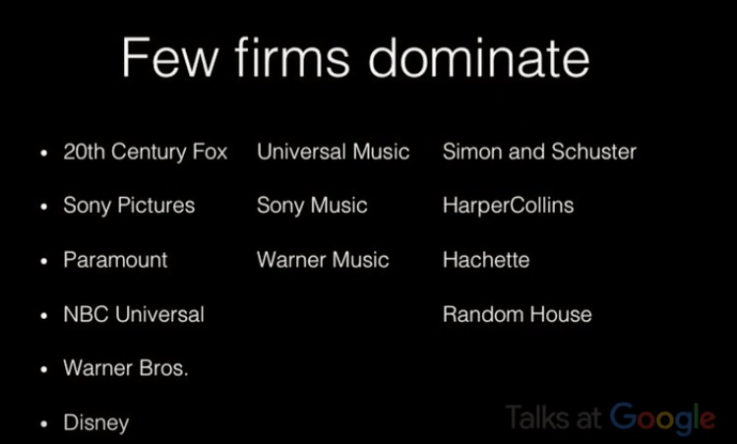
Smith and Telang wrote this book because of a “perfect storm” in the economic entertainment ecosystem. Traditionally a few firms dominated because the best business model for the last hundred years was a return to scale. The value was in finding/attracting talent, creating a market, and distributing the product.
This model worked. This model was logical. This model was successful.
Before 1995, the search for talent “was unscientific at best” and size helped to seek talent, sell it, and ship it. The Firms did this well and movies are one example. ‘Windowing’ is the process of a theatrical release followed by DVD sales followed by digital sales followed by subscription streaming followed by cable and broadcast rights.
Each stage of price discrimination maximizes revenue. People who value movies highly see them early, people who value movies less seem them later. Streaming, Sharing, Stealing is a book now because technology has evolved and the old windows are closing.
…
Blockbuster was founded in 1985 and The Little Mermaid began the ‘second golden age of animation’ in 1989. Shawn Fanning created Napster in 1999. Each of these was a locally logical decision at the time. It made sense to start Blockbuster, it made sense to make The Little Mermaid, it made sense to start Napster. Each is like a mile marker on the highway of entertainment history.
Smith and Telang note that the Netflix/HBO/Amazon/Spotify/etc. state of today was a sort of perfect storm. We should be wary of simple stories like Napster ruined everything, and be more like Sanjay Bakshi and approach things with a ‘part of the reason is this’ mentality. Smith and Telang propose three things.
First is broadband internet, “It became harder to delay a product in one channel versus another channel because people found it easier to infringe.” Gatekeepers Firms had to control distribution so they could control the windowing of theater to dvd to rental and so on.
Second is digitization. “Now you had technology change happening that eroded the role of a gatekeeper at these firms.” Casey Neistat is the vlogging example. E.L. James is the writing example. The digitiziation pendulum might have swung too far:
Our third change is the rise of platforms, because, “they didn’t have limited shelf space.” Frank Underwood kills a dog yet Netflix lives on because there’s always something else on.
At this point we should pause for a moment and recall something Andrew Ng said. Ng told the story about the early days of the internet and what it meant to be an internet business. It’s the difference between being a tourist and being a resident. “What defines an Internet company is whether or not you have an architect at your organization to leverage internet capabilities to do the things that the internet does really well.”
What things does an internet company do? Internet companies, Ng said, AB test, push decisions up (not down), and have short product cycles. We’ll see a Spotify example shortly.
Michael Smith is emphatic about this because it’s a perpetual point in his presentations. The genius for House of Cards was not knowing that Kevin Spacey, David Fincher, and Robin Wright were good at their jobs.
“The advantage Netflix got was from using its data was to do something that no traditional broadcast network could replicate. Netflix’s advantage didn’t come from knowing how many fans of Kevin Spacey were in the audience. Netflix’s advantage came from knowing exactly who they were as individuals and promote content to them directly based on their individual preferences.”
That’s what it means to be a digital entertainment company.
Netflix made nine trailers for House of Cards; some for Fincher fans, some for (former?) Kevin Spacey fans, some for fans of shows with strong female leads. None were for dog fans, dog fans won’t like House of Cards.
Smith recalled, “Michael Eisner said that if he had tried to include a similarly violent scene in an episode of broadcast television he’d be out in ten minutes.”
Why could Netflix show House of Cards but ABC could not? Unlimited shelf space. ABC has a shelf space of one. This point is made by Ben Thompson at Stratechery too, pointing out the Netflix advantage when they signed a deal with Starz. Primetime evidence exists too, as we see shows about doctors, law enforcement, families, and more doctors, more lawyers, and more families.
Netflix serves niches.
…
Music is both like movies and not like movies. Hal Varian noted that “music is something you want to hear over and over again. Movies you want to see on an occasional basis with one exception, kids movies.”
They’re also different in consumer preferences. For music, live is the premium experience. For film, premium means polished. No one pays to see Daniel Craig run across a stage but many love to attend Phish shows just to be surprised.
Knowing that music and movies are different and knowing that Gatekeeper Firms and technology companies are different we’ll look at Spotify’s “discover weekly (Twitter)”.
Former Spotify engineer Chris Johnson said, “Discover Weekly wasn’t handed down from the top. There are news articles about how this is the Apple Music killer and we’ve been planning it for months. No. This is purely an organic bottom-up feature that a small team of four engineers worked on.”
In his talk, Johnson explains the iteration and small steps and, in hindsight, the obviousness of it. Their ‘that’s interesting’ moment was when “We noticed users spending more time on editorial playlists than they were on their personalized discover playlists. What’s going on here?” Didn’t people leave the radio DJ for Spotify?
It was 2014 and Spotify created the first personalized playlist. “It turned out that a month later millions of users are still listening to their personalized Play it Forward playlist. We’re like, ‘Holy crap, what’s going on here?’ We did not expect that.”
That’s when Johnson and his team realized, “The same content as the Discover Page but…a playlist.” People wanted, expected, used playlists more than pages. They tested and tweaked. They released internal versions. They changed the cover art of the playlist.
Then Apple pushed the U2 album onto iPhones. Uh oh. That’s kinda what Spotify was doing, pushing playlists onto the app. Johnson included a survey to Google Docs asking for feedback. Only three people out of a thousand brought it up so they kept building. “Users know best. AB test everything.”
Another part-of-the-reason Discover Weekly works is that it’s human curated. Not one person editorially but a person sporadically. “All the models we’re building are built using human data, on what users are streaming or curating. We’re just mining through the human element.”
In another talk, Mathew Ogle said “Every song on Discover Weekly is there because at least one other person on Spotify added it to their playlist. It’s not there because a machine thought it sounded good.”
Using Ng’s definition, Spotify is definitely a digital music company. Like Netflix, they’ve made it easy to pay for and listen to music and have provided added value using data and AB testing to the users.
But Spotify has other problems – “For Spotify the royalty payments also crush its gross margins.” – that Netflix does not. Marc Andreessen asked Ted Sarandos about sports and Ted said, “It’s okay for us not to be doing everything…The reason I don’t get tempted by major league sports is that the pricing power all belongs to the leagues.”
…
Netflix and Spotify exist because consumer preferences changed. In How Music Got Free we see part of the story about how this happened. For example, CD’s were over-engineered. “Where the (CD) sales literature promised ‘Perfect Sound Forever,’ (Dieter) Seitzer saw a maximalist repository of irrelevant information, most of which was ignored by the human ear. He knew that most of the data from a compact disc could be discarded—the human auditory system was already doing it.”
And the industry dominated distribution. “Consolidation in the radio industry also helped, creating a homogenous nationwide listening environment that could propel an album to a Platinum status almost instantly on the basis of a single hit. Controlling the airwaves was critical—if Limp Bizkit could go forty times platinum, then literally anyone could.”
In 1996 the compact disc retailed for $17, cost $1 to manufacture, and had approximately 1.8 good songs. Music was ripe for Christensen’s disruption. It was true that CD’s were easier to buy, sounded better, and had more ways to listen. But the MP3 was better in certain ways and the shortfalls could be improved.
It was technological advances that led to 1,000 songs in your pocket.
It was analytical advances that led to Discover Weekly.
It feels like circa 2019 there’s more room to improve analytically than technologically. Netflix uses analytics for strategy but not scripts. Ted Sarandos, “We’re way better off taking someone’s creative vision and putting it through the service than us trying to go in and retool it. At the end of the day if the creator says, ‘That’s my show.’ we put it up.”
Smith quotes Frank Underwood in House of Cards, “Power is a lot like real estate. The closer you are to the source, the higher your property value.” Netflix is darn close to the data source.
This approach is appropriate because Netflix has unlimited shelf space. Smith notes that they can invest in properties with niche audiences like those for Woody Allen, Adam Sandler, and Arrested Development. Netflix wants to offer one thing you love at any given moment. ABC wants to offer something most like at one particular time. “Netflix didn’t face the same scarcity that traditional broadcast networks do. In a traditional broadcast network, you can only deliver one show at a time so that show has to appeal to as many viewers as possible. But a Netflix subscriber who was offended by Kevin Spacey’s actions could choose from thousands of other shows on Netflix.”
“Netflix doesn’t have to find more viewers to watch the individual programs. Netflix has to find more programs that appeal to individual viewers.”
The stakeholders matter too. “Netflix wasn’t pursuing an advertising-supported business model so it didn’t have to worry about offending advertisers by including a potentially controversial scene.”
This trio of broad band, digitization, and platforms is the media subset of what Michael Munger writes about in Tomorrow 3.0. In the book, Munger explains the three T’s of transaction costs that prevent economic exchange; triangulation, transfer, and trust.
In other words, I’ve got to find what I want, I’ve got to get what I want (and pay the person for it), and I’ve got to trust the other person. That’s what the digital behemoths have done. Netflix make it easier to find what we want – even though we didn’t know we wanted it – because they make nine different trailers for a tv show Netflix is able to get us what we want legally by offering an automatic payment system. Netflix creates trust that they’ll provide something because they have so much.
2008 Bit Torrent accounted for 31% of peak hour internet traffic.
Teaching this is fun, says Michael Smith. Students are digital natives and they get this.
“With higher education for example, we have nothing to worry about when it comes to technology changing our business and our power. The students do exactly what you all just did, they nod their heads then go ‘Wait a second!’.”
How so? “There’s a lot of parallels between what happened in the entertainment industry and what might happen in higher education.”
A transition from gatekeepers who succeeded thanks to the collection of talent, the creation of markets, and the distribution of content to digital companies with platforms and unlimited shelf space. Austen Allred has one theory of education. Our XMBA post is a looser approach.
…
Digitization changed some parts of the economy more than others. Information goods like newspapers, movies, and music all became non-rival as copies were cheap to make and share. Thanks also to network effects, ideas went viral and sharing was easy.
“Why 45 million ppl watched Bird Box on Netflix: holidays & ppl need entertainment, slow TV season before new episodes/shows come out in Jan, no good new movies released. So ppl basically had no other choice but to watch this I Am Legend/World War Z/Quiet Place reboot.”
Entertainment (and the economy) isn’t better or worse, only different. It’s like a hike where the terrain has changed but the direction towards good enough has not.
For Spotify, Mathew Ogle spoke in 2015 about music discovery (https://youtu.be/81OlAEnyTKE). Chris Johnson gave a talk in 2016 in Austin about Spotify’s Discovery Weekly history that was insightful (https://youtu.be/HWFYA6N9uA0).
Greg Lindsay’s talk, Innovation Doesn’t Happen at Your Desk is an attempt to get people to work together and better. I think he’d agree with Rory Sutherland in that many of the logical questions have been answered and we need to get a bit weird.
A more positive term for weird is serendipity.
Lindsay tells of a natural experiment where a building needed asbestos treatment. The teams there had their offices shuffled about, and when their (innovation) results were measured, “Randomness was the best strategy for increasing innovation for these teams.”
Put different people near each other, let them talk, and watch the good ideas flow.
Part of the explanation is The Allen Curve, an observation that people talk more to those nearby, even when digital tools allow us to talk to anyone anywhere. Dr. Thomas Allen said, “Broadband communication isn’t a substitute for face to face.” That is, people communicate with those they see.
Lindsay said, “All three major types of artificial sweeteners came from lab accidents where the researchers then picked up their lab bench and stuck their fingers in their mouths.”
Jenna Fischer agrees with action as a solution, “…you’re much more likely to be in the right place at the right time if you’re busy doing showcases, plays, and taking classes. Chances are you won’t be in the right place at the right time if you’re spending your days eating Lucky Charms your couch. Trust me, I tried.”
There are four “black boxes” for serendipity Lindsay said:
You
The office
The city
The network
YOU
Building on ideas from James Lollies and Joey Ito, Lindsay said, “You know the classical line, the true sound of scientific discovery is not Eureka but ‘that’s interesting’.” And “Do you have the latitude to chase something?” It takes an internal curiosity and external circumstances.
That’s interesting moments surround us. Peter Rahal wondered why a Crossfit sold t-shirts but not protein bars. Eric Maddox wondered why certain people were still hanging around an area. Brian Koppelman wondered why Americans celebrate entrepreneurs. Jim O’Shaughnessy wondered if personalities weren’t the perfect proxy for well-performing investments.
THE OFFICE
Cubicle offices are too much like tree farms, orderly and great for optimizing harvests. Another way to approach Lindsay’s idea is via Christensen’s disruption model; optimized offices are best for sustaining innovations while open offices (and mandates) are better for disruptive technology.
“Google started a beekeeping club so that engineers who are interested in beekeeping might meet each other and actually have discussions about unrelated subjects.”
Pervading the office furniture is the office culture, and perks are not culture. Ben Horowitz said that culture is what people do when you don’t tell them what to do. Does your boss encourage serendipity? Do you?
THE CITY
Lindsay cites Geoffrey West that cities get better as they get bigger.
He also (seems) to like the work of Jane Jacobs and mentioned a Sante Fe panel/study along with this; Being Nicely Messy. While YOU and THE OFFICE are bonsai-like cultivatable, the city is more emergent. “Cities are the greatest serendipity environments of all so Google and Facebook are trying to design these environments that are more walkable and allow all these sorts of spillover effects.”
THE NETWORK
Org charts often differ from communication networks. Albert-Laszlo Barabasi has done similar work to what Lindsay cites. Barabasi noted that the people best connected in a network are rarely the decision makers, it’s the safety management supervisor who has to visit each office and likes to talk.
For a long time, there were only small changes in human existence. Then James Watt was asked to fix a steam engine. Watt fixed, tinkered, thought, experimented, and (is credited) with the invention of the double acting piston. Then the industrial revolution took off. Watt’s invention is a GPT (general purpose technology). Christened to remove water from mines, it was implemented in many other places. Subsequent GPTs were railways, the internal combustion engine, and electricity.
Technology becomes a GPT and not just a T when it’s applied to adjacent domains. In the early days of electricity, factories kept their layouts but changed their fuel. Electricity became an OG GP with the conveyer belt.
From there we get the Model-T, which benefited from another GPT, the combustion engine. Then we got the internet. As Andrew Ng noted, malls with websites weren’t Amazon competitors. What makes an internet company said Ng, is acting like an internet company. One example is Spotify and the Discover Weekly Playlist. AI may be another GPT, because Brynjolfsson said, “The core AI breakthroughs have applications in just about every part of the economy.”
This doesn’t mean the end of work. “It’s too soon to worry about the end of work…it may be that someday we will be able to make machines that do the full spectrum of what humans can do but that’s not the challenge we face today.” Ng said to think of tasks, of “anything a typical person can do with less than a second of thinking we can probably now assume automate.” Ajay Agrawal said much the same, “AI doesn’t do workflows, it does tasks,” and “Think of the recent advances in AI as advances in prediction; better, faster, cheaper prediction.”
Brynjolfsson isn’t worried about jobs so much as returns from work. Median income is flat since 1999 and though the economy has grown, the top twenty percent (based on wealth) earned more than 100% of the gains. They are the Apple iPhone of the economy.
What’s allowed this? People do more with less. Facebook bought Instagram when there were fifteen employees. When photography was a chemistry problem, Kodak occupied the lord’s estate and 145,000 serfs kept the kingdom running. When photography became an arithmetic problem Kevin Systrom & Mike Krieger stormed the gates with a band of merry men. Though it wasn’t only men, it was Systrom’s wife, neé girlfriend, who contributed an essential idea.
Instagram’s success is emblematic of the digitization bull that’s gone through the economic china shop. Along with easy copies are zero marginal cost distribution and the rise of the individual. Steve Jobs got this wrong, noted Brynjolfsson’s co-author, Andrew McAfee. Jobs mistakenly wanted the app store to remain closed. But the iPhone’s ascent accelerated when it opened, creating what Alex Moazed calls a Modern Monopoly.
Though we do more with less, “it would take the average American only eleven hours of labor per week to produce as much as he or she produced in forty hours in 1950,” this doesn’t mean the end of jobs is nigh. The Second Machine Age is an optimistic book about work.
AI, like other technologies, can supplement humans. Thanks to algorithms we’ll stick with base rates rather than have overconfidence in our abilities. McAfee said, “The single biggest failure mode that I see when I talk to smart people is that smart people tend to have exaggerated version of a failure mode, to be too confident of their own judgment.”
Then there are the jobs that won’t be too affected. In a study of 964 O*Net occupations, most had 20-30 tasks and most of the tasks were things algorithms won’t or can’t do. “When you look at all the tasks of a particular occupation, some of them were suitable for machine learning but many others were not. There was no case where machine learning just ran the table and was able to do the whole set.”
We talk about truck drivers being automated but truck drivers do a lot. Finn Murphy wrote that he was not only a driver but a manager, counselor, and in one case, an honorary Native American. Hal Varian makes a similar point when he points out that only one job has been automated away, the elevator operator. But, the tasks from that job have shifted to other areas, receptionists, concierges, and hostesses all do more.
Education might help. “There’s an increasing need for interpersonal skills…It’s not that work is disappearing but that there’s a whole bunch of tasks that only humans can do and we need to shift our skillset into those and then labor income is likely to go up.”
In another talk Brynjolfsson explains, “Right now and for the next ten years training and education are probably at the top of my list and most economists…I don’t think our schools are doing a very good job teaching those, or worse yet, many of them are actually crushing them.”
Seth Godin wants schools to teach students how to lead and how to ask interesting questions. Bill Burnett at Stanford (https://youtu.be/34EuT2KH2Lw) said school cripples our creativity, “Something happens, mostly our educational system which promotes a massive fear of failure and a search for only one right idea.”
Rory Sutherland noted that the opposite of a good idea may be another good idea, which is contrary to the one-right-answer attitude in some schools. Pat Dorsey praised the liberal arts approach to education; “In a way equity investing combines a lot of different fields in that it is a set of ever-shifting problems to be solved. It’s not electrical engineering where there’s a right answer to everything. There is never a right answer to what the company is worth, or what is the competitive advantage to a business, or how much cash will they generate in five years.”
Which brings us to Erik Brynjolfsson and Andrew McAfee’s, Machine, Platform, Crowd. They wrote this one because “People who run companies kept approaching us in the hallways of places like Davos and kept on saying, ‘I believe your story, now what do I do?’ In some cases, I got the impression that there was desperation behind the questions,” explained McAfee.
Brynjolfsson and McAfee’s solution is in the title; collaborate with machines, harness platforms, and use the wisdom of crowds.
They wrote the book because “The narrative these days is that technology is killing jobs and it’s not too far from that narrative to ‘therefore technology is a bad thing’. We think that’s a really harmful road to go down.” Paul Daugherty agrees, “I’ve started using the term ‘collaborative intelligence’ rather than ‘artificial intelligence’. The problem with AI is it scares the public and it leads to the wrong discussions.”
Another stumbling point is making GPTs general. Malls with websites aren’t Amazon and record stores online aren’t Spotify. The issue is that “Tech progress rewrites the business playbook.” McAfee said, “I see a lot of companies underestimating the power of machines a lot of companies underestimating the power of platforms and a lot of companies not doing a great job of tapping into the crowd.”
Okay, so how can someone use these ideas?
For machines, we need to get away from HiPPO decisions (https://youtu.be/WyYaubtZuX8?t=391) and move to Geek decisions. This is sabermetrics in baseball like the Oakland A’s. This is running 10,000 experiments a day like at Google. This is who to market new shows to like at Netflix.
For platforms, the key is the interface. How can an organization create an easier way for customers to find X? How can an organization create easier ways for producers to create X? Successful platforms solve for Michael Munger’s three T’s; triangulation, transaction, and trust.
For crowds, the key is trusting weirdos. McAfee said that the core can be bested by the crowd. “I honestly just mean these hundreds of millions or very soon billions of complete stranger weirdos out there available on the internet that you can tap into where you can access their knowledge and their tenacity and their energy if you do it correctly.”
Yet again we’ll remind ourselves that technology is a tool like a shovel not a panacea like a silver bullet. It’s still up to the user not to hammer their thumb. Machines, crowds, and platforms are wonderful compliments for decision making. McAfee said, “The failure mode among really smart people is to trust themselves too much.”
No one knows how fast work will change. We’ll get glimpses of pieces first. The duo gives examples like a smart grid in a series of factories or an autonomous shipping route from Dallas to Los Angeles. While Brynjolfsson wants more training, McAfee wants changes to the entrepreneurship policy and physical infrastructure.
Neither seems to think work is going to go away in the next thirty years, and McAfee points out work is more than a job. “I’ve become a fanatic about work, about the value and importance of something like a job. The evidence is overwhelming that when work leaves a community bad things happen.”
Roger Lowenstein wrote about Warren Buffett, “(he) understood that most people, regardless of what they say, are looking for appreciation as much as they are for money.” Voltaire concluded, “Work keeps at bay three great evils: boredom, vice, and need.” Adam Smith suggested that man wants to be loved and be lovely. Andy Grove wrote this:
“I felt the frustration that comes when the things that worked for you in the past no longer do any good.”
“Businesspeople have emotions, and a lot of their emotions are tied up in the identity and well-being of their business.”
“In many instances, your personal identity is inseparable from your lifework.”
Change, especially when your personal identity is at stake, isn’t easy. Brynjolfsson and McAfee cite the work of Angus Deaton and Ann Case who coined ‘deaths from despair’. “I think about which of those social problems will be fixed by a magical check from the government showing up every month,” McAfee said, “and my answer is basically none.”
Jobs give more than money.
We don’t know how the future will be different only that it will be different. In that spirit we’ll take our final word from Andy Grove:
“You need to plan the way a fire department plans: It cannot anticipate where the next fire will be, so it has to shape an energetic and efficient team that is capable of responding to the unanticipated as well as to any ordinary event.”



 The Waiter's Pad