Susan Tynan

Supported by Greenhaven Road Capital, finding value off the beaten path.
pablo (35).png

If you were unaware, the How I Built This podcast hosted by Guy Raz is excellent. The episode with Susan Tynan could be a case study on understanding customers.

Before we jump into Tynan’s comments, here’s what other people have said about customer focus:

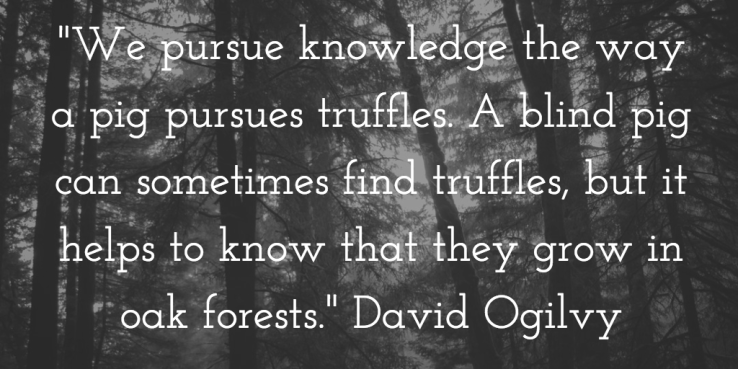
David Ogilvy’s early career experience selling Aga Cookers door-to-door led him to conclude, “Find out all you can about your prospects before you call on them; their general living conditions, wealth, profession, hobbies, friends, and so on. Every hour spent in this kind of research will help you and impress your prospect…Learn to recognize vegetarians on sight.”

Ali Hamed said that the best products are built with empathy at their core. “That empathy translates to features and functions that understand the seemly non-pragmatic nuances of a given industry.” The IDEO team calls these latent needs.

Jack Ma said this while building Alibaba, “We should not design our products for the investors, we should design our products for the customers. What do the customers need? What do the customers want?”

…

Susan Tynan explained the experiences which led to her adopting this view too. After earning her MBA, Tynan got a job at Living Social. Her focus there was on family and home deals. Calls, emails, posts, requests, and feedback were all bits of data about what customers did, or didn’t want. “I sold a lot of framing deals so I knew customers were looking for a deal in this category.”

But, Living Social’s cardiac existence and it wasn’t for her. She wanted “a business I could touch and feel.” This idea for frames was planted after a trip and was taking root.

“The idea originated eight or nine years ago. On annual hiking trips with my sister, I had bought national parks posters and I took them to a local frame store to be framed. It was a terrible experience. It was really intimidating and really expensive…I had these feeling when I picked them up, ‘how did that just happen to me?'”

As Hamed said, the best founders “understand the problem as the first party.” It’s how Soulcycle, Gimlet, and Harry’s started too.

Unlike failed startups, Tynan talked to others.

“I started talking to everybody about it. Imagine me at a cocktail party or a friend’s baseball game talking to people about it and I kept hearing the same stories about six-hundred dollars worth of framing and I couldn’t believe it.”

But why her? Tynan guessed:

“It required someone out of the industry to plot it from the consumer’s viewpoint.”

But centralized framing is expensive. Tynan needed to raise money. She met with one Ventrue Capitalist who told here, ‘I was just searching for this service last week.’ Tynan raised enough to invest in equipment, a facility, and people.

At first, sales were slow. “One or two degrees of separation.” Then “we started to send out frames to people in the press and the first couple of months we got big hits from Architectural Digest and In Style.”

They didn’t send random things, that’s not understanding your customer. They were customized. “We asked, what exactly what would this editor at this magazine like? What’s something about their life can we figure out?”

Even now that the company has grown, “I can’t help myself. I do always want to be skimming customer support tickets and things like that.”

…

Susan Tynan has succeeded – so far – thanks to hard work and (mostly) good luck. While frame assembly may be physically demanding, it’s her customer focus that too many businesses find difficult.

Clayton Christensen said that understanding the job the customer is hiring you to do is the critical unit of analysis.

Marcus Lemonis said his trick is to “turn my mind into a consumer and not a business owner. I think ‘Would I buy that? Would I pay for that?’ and I really work hard at it.”

Yvon Chouinard wrote “We knew what we wanted. I heard someone say that if you wait for the customer to tell you what to do you’re too late. We were our own customer. I think that was the secret to coming out with products.”


Thanks for reading.


Deep Books

Supported by Greenhaven Road Capital, finding value off the beaten path.

I saw this:

And thought, that’s interesting let’s see what people suggested. Hmm, let me write some of these down. Huh I wonder if there are any patterns here. Here are three observations from looking at the 152 replies to the tweet above.

…

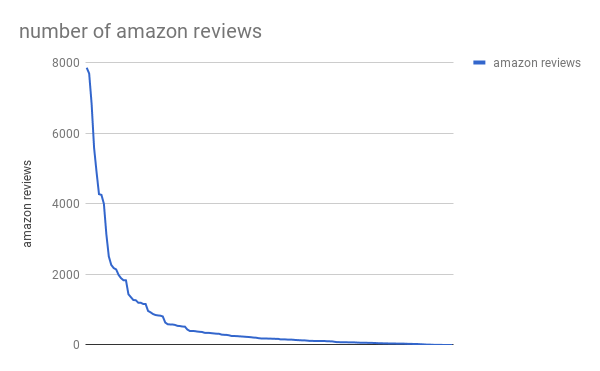
Book success follows a power law distribution.

chart (3).png
Number of Amazon reviews for the suggested books, n=152

In the Increasing Returns Economy post/podcast, we looked at Brian Arthur’s work and one of his major points was that managers need to recognize their economic ecosystem, optimization or innovation. Beach trips require different acts, steps, and plans than ski trips. Innovation, Arthur wrote, requires commando units to move fast and break things. Optimization requires hierarchy and efficiency.

Tren Griffin has written similar things about books, advising for only missionaries to write them. Much like DIY investing, unless there’s something extra in it for you, you’re likely better off spending your time on something else.

…

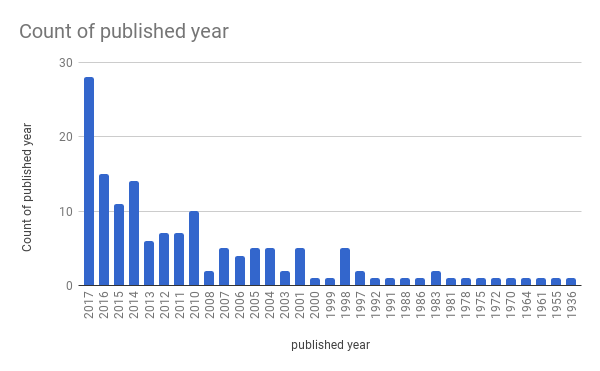
There was also a recency bias towards books.

chart (4).png

One-third of the suggestions were books published since 2016. It could be the case that the best “deep’ instead of ‘broad’ book(s) have been published in the last two years. But it could also be the recency bias. This mental shortcut is something Sam Hinkie, Marc Andreessen, Gina Martin Adams, Barry Ritholtz, and Micahel Mauboussin all caution against.

…

In compiling this data and drafting this post I got my own dose of the sunk cost tendency. First I listed the books, then I thought the number of reviews might indicate a good place to start, then I thought if I’ve done this much work let’s turn it into a post.

…

If you’re looking for something to read, here are some suggestions. These are all Amazon Affiliate links.

Most Amazon Reviews. How to Win Friends and Influence People, When Breath Becomes Air, Being Mortal, Devil in the White City, Zealot, and, The Untethered Soul.

Hidden Gems. These I calculated; years since publication/number of reviews. So something a few years old but with many reviews would rank higher here. The top ones not yet mentioned were, Dark Money, The Undoing Project, Shoe Dog Evicted, and Brain on Fire.

Oldest. Some deadlifters advocate for older books, preferring books that weather the test of time. Those oldies but goodies were Modern Man in Search of a Soul, Children of the Ashes, The Arms of Krupp, and The Structure of Scientific Revolutions.

You may have missed. These are books a few years old but with a healthy quantity of reviews. Class, Empire of Cotton, TheTao of Physics, The Beginning of Infinity, and Debt.

Patrick’s reviews.

Empire of Cotton. ⭐️⭐️⭐️⭐️⭐️
Ficciones ⭐️⭐️⭐️⭐️⭐️
The Luxury Strategy ⭐️⭐️⭐️⭐️
Dream Big ⭐️⭐️1/2

Happy reading, see the full list here.

David Ogilvy

Supported by Greenhaven Road Capital, finding value off the beaten path.

pablo (34).png

Much like our posts on Rory Sutherland, IDEO, and Bill Belichick, this is a deeper dive.

David Ogilvy succeeded as a Madison Avenue advertising executive for multiple reasons, including these three:

  • He was objective in his research. If the facts differ from your beliefs, change your beliefs rather than the facts.
  • He created advertising around big ideas. Images should aim to inspire intrigue, not win awards at Cannes.
  • He groomed a culture. Hire “gentlemen with brains” and give them the autonomy to do good work. Also, avoid bureaucratic bloat. “If you were a dairy farmer and kept cows, would you employ twice as many milkers as you have cows?”

You can read it here.

You can listen to it on Soundcloud, iTunes, or Overcast.

Grab Bag 4

Supported by Greenhaven Road Capital, finding value off the beaten path.

A request: If you listen to the podcast, please let me know if you liked this as one episode or would prefer many shorter ones.

https://soundcloud.com/mikesnotes/grab-bag-4

This audio post covers four things that caught my eye in podcasts.

Why is Nick Saban undefeated against his former assistant coaches? Rather than having their number, it’s more likely that those assistants take jobs at colleges whose football teams aren’t very good. Much like Apple executives leave the mothership to start companies that never rival Apple, coaches leave for schools that never rival Alabama.

What’s the reference class for the Philadelphia Eagles? When the Eagles were home underdogs in the playoffs, some commentators gave hope to their fans because the Eagles were undefeated when underdogs at home. However, this was a terrible reference class. As Michael Mauboussin has written, summarizing the work of Amos Tversky, good reference classes are “broad enough to be statistically significant but narrow enough to be useful in analyzing the decision that you face.”

There are no called strikes in investing. Warren Buffett’s advice, used accidentally, helped one football predictor rise to the top of his betting pool.

Visual Analytics. Data doesn’t magically change behavior.  Many sports teams have found that adoption by players increases when numbers are translated into the language of pictures. Good analytics; collecting data, finding patterns, communicating to players and coaches, and implementing strategies is part-of-the-reason the Las Vegas hockey team has succeeded so far.

Novel Analytics. Moneyball started the data rush and different industries have advanced at different rates. The largest data staff in the league has helped the Toronto Maple Leafs. As athletes approach “the right wall” of physical capabilities, new avenues of advantage will become more valuable.

Identity flexibility. Ideas become dangerous when anchored to your identity. Just as a ship needs to move when conditions change, so too should our ideas about how the world works.

Ali Hamed

Supported by Greenhaven Road Capital, finding value off the beaten path.

pablo (33).png

Ali Hamed’s podcast with Patrick O’Shaughnessy was a wonderful hour+ of stories, ideas, and adjacent possibles. Among other things, I thought Hamed’s explained the value of understanding customers and establishing advantages.

Customers, customers, customers.  Successful companies satisfy a customer’s need. This is true for authors like Andy Weir and restauranters like Alice Waters. It’s something that Hamed understands too:

“The hardest part of starting a technology company used to be building a product. Now the hardest part of building a company is acquiring your first customers.”

“I think the tech world has this problem where we go out and say ‘We think we’re really smart and the rest of the world is really dumb, and so why don’t we build apps to make their lives more like ours.’ What you end up doing is building products with judgment at their core. But when you find founders that are building products for themselves and their friends you find products with empathy at their core. That empathy translates to features and functions that understand the seemly non-pragmatic nuances of a given industry.”

Empathetic understanding is part of IDEO‘s Human Centric Design. It’s why IDEO CEO Tim Brown wrote:

“Walk into the offices of any of the world’s leading design consultancies, and the first question is likely to be ‘Where is everybody?’ Of course, many hours are spent in the model shop, in project rooms, and peering into computer monitors, but many more hours are spent out in the field with the people who will ultimately benefit from our work.”

Hours are spent with the customer, not in the design studio or, as Hamed said, tech world. It’s something  Jason Calacanis sees too. He told Meb Faber:

“I have to always get founders to stop thinking about the game ‘Startup Land’ and get them to play the game ‘Customers.’ My inbox is filled with ‘How do I get investors to do this?’ ‘How do I convince VC’s to do that?’ I’m like, ‘How do you convince customers to buy your product?’ Let’s answer that question.”

But what your customers want isn’t always clear. People would have told Henry Ford they wanted faster horses. IDEO encourages people to find latent needs. As Hamed noted, find someone who already is the customer. This was Yvon Chouinard‘s advice too:

“We knew what we wanted. I heard someone say that if you wait for the customer to tell you what to do you’re too late. We were our own customer. I think that was the secret to coming out with products.”

Hamed ended up here thanks to the base rate. He said, “‘What are the main reasons seed companies don’t get to a Series A?’ One of the main reasons is they never build their software and bring it to market…And the second reason is they don’t find customers.”

Founders of failed start-ups missed this.

…

Advantages. Hamed’s second pursuit is advantages. He said, “The minute I’m nervous to get on this podcast and talk about one of our investments means it’s not defensible enough and I never want to be the guy waiting for everybody else to find out about his secret.”

What kind of advantages does Hamed look for?

“Our goal is to add one or two asset classes a year and ask:
why does this exist,
do we understand why no one knows how to price it,
do we think that our teams’ DNA of being between technology and finance allows us to underwrite it differently than anyone else can?”

Hamed is also fortunate to have the right stakeholders that let him explore these kinds of moats. He explained, “We have an amazing LP base that allows us to be flexible and do these weird, niche, interesting things because they like we’re getting a really high return and no one knows how to do it.”

Stakeholders are like bobsled pushers. They help start your journey but at some point, they just need to hop in and keep their head down.

Seth Klarman said “The more flexibility you have, the better your ability to maneuver in complicated, volatile, and fairly competitive markets…the more weapons you have at your disposal.”

Michael Batnick wrote about the volatility of stocks like Amazon, Netflix, and Apple. Realized and idealized returns are two different things. Moats too are non-obvious.

In the episode, Hamed gave an example of scheduling and payment software. For example, a company like McDonald’s pays the software company and the software company pays the employees on whichever day they choose – for a small fee. Hamed said:

“I don’t know what to call it – payroll finance, I don’t know – there’s probably a word that will one day be a thing once it’s an established asset class but that’s the type of stuff we love…not by taking a ton of risk but by doing something no one’s done before.”

I don’t know what to call it. That’s a moat! It’s like what Scott Norton and O’Shaughnessy talked about, once there’s a manual for how to do something it’s not a new something. Hamed said, “We love looking at stuff and wondering, this is a new thing, how do you buy it?”

…

The best example was a Stanford Ph.D. who was a consultant for heavy equipment operators. She found out a better way to do warranties and built an app to do so. “That’s a person,” Hamed said, “who’s solving a problem that no one in Silicon Valley gives a rats ass about.”

She knows her customers and her advantages is an unsexy industry.


Thanks for reading.


Steve Vassallo

Supported by Greenhaven Road Capital, finding value off the beaten path.

pablo (30).png

Our mission here is a sort of mental find/replace function. We want to find existing ideas and replace them with new ones. Sometimes this works. Sometimes it doesn’t. Shane Parrish gave the best warning about this, saying that you can’t just give employees 20% time and be like Google. Rather, you have to understand the context for why 20% time works.

…

Steve Vassallo is a partner at Foundation Capital and he wrote a manifesto – The Way to Design – for designers who want to be founders. It’s a beautiful hour-long read. In it, Vassallo gets at some ideas we’ve seen elsewhere. Like a writer, let’s see if some of our existing words (ideas) would be better after the find/replace function.

…

Vassallo was a designer before being a founder or VC. He writes that design thinking is advantageous for two reasons; better arguments and as a disruption antidote. You want a design cofounder who can “project her weirdness onto the organization.” We call back-and-forths between multiple-points-of-view Arguing Well.

Argument is natural selection for ideas. Or, as Daniel Kahneman told Michael Lewis, “The idea that everyone is entitled to his/her opinion was a California thing – that’s not how we did things in Jerusalem.” Good organizations are good because they have the best ideas.

Another advantage of a design co-founder is as disruption antidote. Vassallo writes that consumer preferences have migrated from speed to cost to design. Or as Jan Chipchase wrote, wants are solved by technology but technologies are like hermit crab shells, they’ll be adopted, adorned, and abandoned.

Disruption theory and it’s solutions is focused on changing needs. Last year the buyer valued faster, now they value cheaper, next year they’ll value easier. Designers – possibly – can figure out these needs that underly the shell.

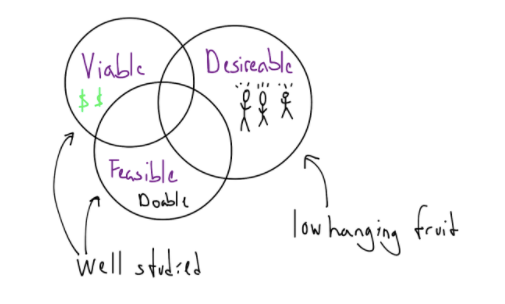
In picture form Morgan Housel explains it this way:

Screen Shot 2018-01-05 at 6.13.03 AM

Design thinking is rooted in the first layer; “Solve someone’s problem.” It may not lead to profit but it’s a better start. Too many failed startups didn’t start there.

…

Okay, but how? Good design is less about Apple products and more about being curious. Curiousity can have wonderful effects. It’s something the Kelley brothers and rest of designers at IDEO advocate. One designer said that when talking to someone about their needs they should feel like the most interesting person in the world.

Good design is a process, not a product. Vassallo writes “product-market fit is a liquid not a solid.” It’s something that changes through time rather than a crystalized destination. Design thinking is an adaptive mindset. Specifically:

Good designing aims for potential. Vassallo wrote, “It’s extremely powerful, especially in your earliest days as a company, to have someone who can convert your abstract ideas into something with existential heft.” I loved that expression, existential heft. Dream big, says Vasallo, and go make something.

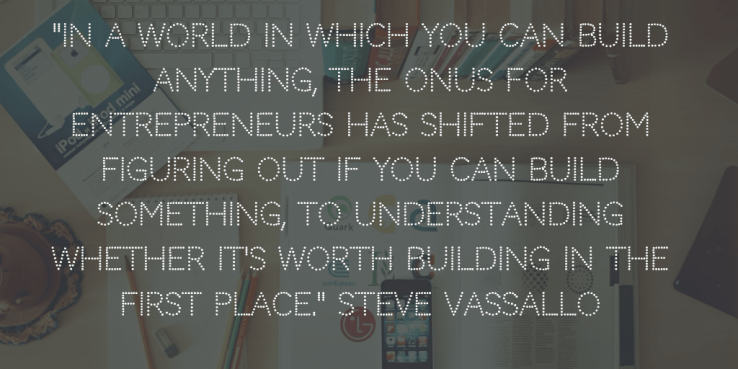
Good designing asks not ‘Can we?’ but ‘Should we?’. This, I’d guess, Vassallo picked up from his time at IDEO. Founder David Kelley said, “So much of the world is focused on problem-solving, we’re good at that and we should keep working at that but we really believe the designer’s task is to figure out what is a problem worth working on. What’s a non-obvious need?” Don’t build a better mousetrap because the need isn’t trapping mice.

Good designing approaches familiar problems in novel ways. Vassallo wants founders to solve problems not build apps. That means having the internal drive to change something annoying but to do the external work of talking to other people. This is do things that don’t scale story (8:55 mark) of Airbnb.

Good designing exploits leverage points. Vassallo has probably read The Systems Bible because he warns against entrepreneurs solving complex problems. These Wicked problems can have vicious feedback systems. Vassallo wants designers and founders to be like Rory Sutherland’s butterflies. Find small changes that can have huge effects.


Thanks for reading.

Michael Mauboussin

Supported by Greenhaven Road Capital, finding value off the beaten path.

pablo (32).png

This is our fourth(!!) post from a Michael Mauboussin podcast. There were these; Michael Mauboussin and Michael Mauboussin from conversations with Barry Ritholtz, and one – Michael Mauboussin – from The Knowledge Project podcast.

I think what appeals to me about Mauboussin’s interviews is his clarity of explanation. In his talk with Ted Seides he draws from The Santa Fe Institute, Complex Adaptive Systems, investing research, Brian Arthur, Steve Jay Gould, Malcolm Gladwell and Joseph Stiglitz. That’s a lot of big ideas to simplify.

The whole episode is worth a listen. These notes are only about decision making. Ready?

…

Making good decisions. One thing Mauboussin referenced over and over was the reference class. “When thinking about any kind of forecast it’s incredibly important to understand the reference class from which this problem comes and to weight your own views with the evidence you have from the reference class.”

For example, data about 2017/2018 treasury notes and volatility measures are atypical. You wouldn’t expect these conditions to persist.

And when talking about Amazon, Mauboussin said that the growth rates some people expect have never occurred in a reference class of 313 examples.

Base rates and reference classes are so important to Mauboussin because good decisions come from good odds. “To me, a lot of investing decisions boil down to probabilities and outcomes and trying to be on the right side of expected values.”

Knowing what typically happens is a good starting place. It’s what Sam Hinkie and Daryl Morey used to get their General Manager jobs. When interviewing with the owners each presented what typically happens before teams win.

Choosing a reference class is an art and science. In Think Twice, Mauboussin wrote;
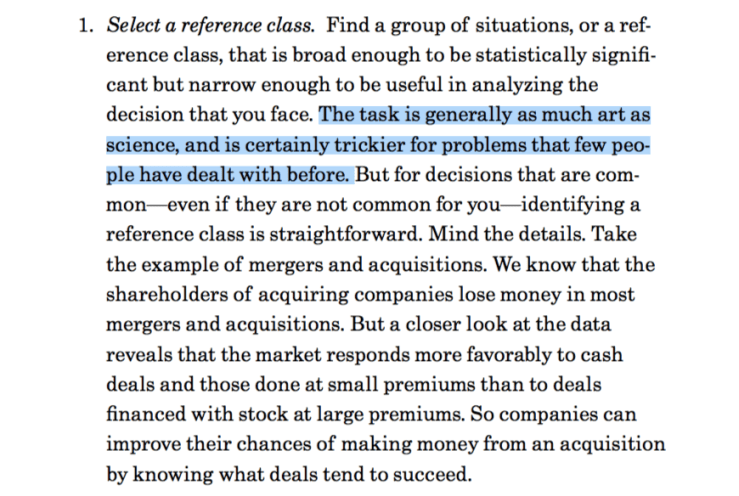
Screen Shot 2018-01-09 at 10.22.31 AM.png

Reference classes are like Goldilocks, not too big and not too small. This is something Michael Lombardi and Bill Simmons have addressed regarding the NFL:

“Charlie Casserly was proclaiming he (Andrew Luck) was the next John Elway, they both went to Stanford but he’s not the next John Elway.” – Lombardi

“I don’t think you can compare anyone’s stats from this decade to last decade. No one gets hit anymore. The interceptions are way down. Even bad quarterbacks have good stats. I grew up with Steve Grogan and he would have years where he threw nine touchdowns and seventeen interceptions.” – Simmons

“Playing in a dome is a huge advantage.” – Lombardi

How relevant are colleges, eras, and domes for football players? That’s what you’d need to figure out.

If you can find a good reference class, compute a base rate, and then tweak your understanding based on your inside knowledge you’ve made a good start for good decisions. Now, we have to deal with biases.

“Heck, if you’re in the investment business,” said Mauboussin about the confirmation bias, “and you’ve never fallen for this one you’re not doing your job. We all do it.”

Richard Thaler warned Barry Ritholtz, “If you have a certain lens that you look at things through, then you’re gonna see everything to be consistent with your point of view.”

One way to get around this is, using Thaler’s words, more lenses. Mauboussin said this, noting that quirky backgrounds are a good diversity to have. Venture Capitalist Steve Vassallo said the same thing when he wrote that there should be a designer on the founding team to “project her weirdness onto the organization.”

Another bias is hindsight bias. Mauboussin said, “writing things down is really helpful. Be aware and say, ‘ I know that we had pros and cons for manager X but now he’s underperformed so let’s revisit the pros or vice versa.”

This is something The GMs advocated among other bias busting ideas. Biases are like bacteria. Good procedures (hand washing) can help but not eliminate.

Okay, let’s see where we are on our good decision making checklist.

  • Find an accurate reference class.
  • Calculate the base rate.
  • Systemize how you’ll sterilize your biases.

Now we need to think about teams. A diversity of ideas is important because it allows you to Argue Well. Find, “people with different experiences and backgrounds and training and personalities that can surface different points of view.”

But you don’t want too many people. “Richard Hackman at Harvard studied teams across all different disciplines and found that the optimal size was four to six.”  That’s about the right number of people for two pizzas, a Jeff Bezos heuristic.

These quirky groups will – hopefully – find new and interesting ideas. That is, they’ll come across Chesterton fences and debate the merits.

Sports are a good example knocking down Chesterton Fences. Mauboussin said that Go and Chess players are awed by AI moves. Our mental blinders, said Stanford professor Bill Burnett, block innovative solutions to Wicked problems.

“Another,” said Mauboussin, “is shifting in baseball. Baseball’s been played for a hundred and twenty-five years and all of a sudden people say, ‘we tend to know where guys hit the ball, we’re just going to put defenders in those spots.’”

Seides added that Big Data Baseball was “one of my favorite books…It’s what happens after you understand Moneyball.”

Mauboussin liked it too, “The thing that blew me away from that book was pitch framing…and simply bringing in a catcher who was good at pitch framing could lead to a substantial delta in games won.”

But it takes career capital to shift in baseball and keep your job. Mauboussin explained:

“I do think there’s an element of career risk, and this spans not just sports but also investment management. Bill Belichick goes for it on fourth down and it doesn’t work out and people give him the benefit of the doubt. But if you’re a coach who has a .500 team, it may be the correct decision but if you lose that game people don’t think about the quality of your decision-making process, they do think about the outcome, that’s a real big problem.”

Without career capital, people are incentivized to fail conventionally. I like how Tren Griffin addressed this:

“Bucking the crowd’s viewpoint in practice in the real world is not easy since the investor is fighting social proof. Robert Cialdini: “social proof is most powerful for those who feel unfamiliar or unsure in a specific situation and who, consequently, must look outside of themselves for evidence of how best to behave there.” I discussed social proof in a recent blog post on Cialdini’s book Influence. In many cases, following the crowd (social proof) makes sense. Sticking with the warmth of the crowd is a natural instinct for most people. Many people would rather fail conventionally than succeed unconventionally. But doing the reverse is easier said that done for most people.”

Seides added that Scott Malpass and David Swensen can do things that other people can’t. We heard how Jeff Luhnow approached this problem as he built the Astros into a World Series Champion. Luhnow said “I spend a large part of my job managing those stakeholders. It all comes down to communication.”

We’ve speculated – along with Ben Falk – that part of the reason Sam Hinkie was fired was that of poor communication. As Josh Brown cautioned, “If you’re just telling a client, ‘Shut up I got this,’ you’re not going to be the client’s advisor for a long period of time.”

Successful managers – of money, people, or teams – who blaze their own path must communicate with their stakeholders.

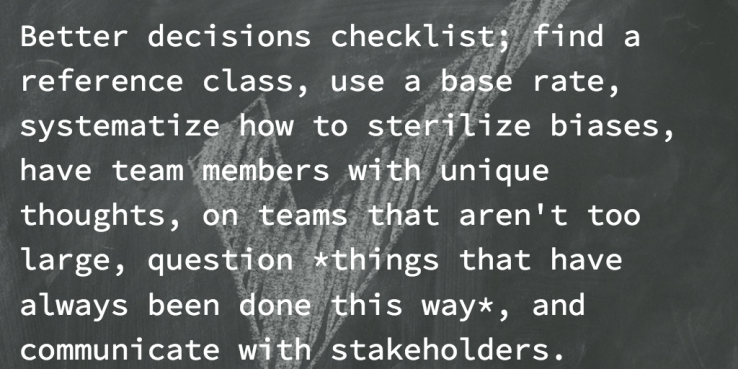
That’s about all it takes to make better decisions; find a reference class, use a base rate, systematize how to sterilize biases, have team members with unique thoughts, on teams that aren’t too large, question things that have always been done this way, and communicate with stakeholders.

Oh, and make sure you’re constantly learning. “Constant learning is such a big deal, In this industry, you can’t live without it… But recognize it’s not about shuffling papers, It’s about thinking.” This is something Guy Spier said too:

“What’s really important is that whatever you’re doing you’ve got to be thinking intelligently. When Todd Combs talked about his five hundred pages a day it stimulated a lot of people to go find five hundred pages a day to read but you gotta be intelligent about how you’re reading it.”

For Mauboussin, the ecosystem of constant learning is healthy when he’s healthy. That means eating, sleeping, and exercising. And “You can’t emphasize enough that hard work is really important. In the investment industry hard with isn’t necessarily spending sixteen hours at your desk, it is constantly thinking and reading and learning.”

What should you read? Here’s a start:

Steven Jay Gould’s Full House. Mauboussin’s The Success Equation. Brian Arthur papers. Books like Scorecasting, Scale, Adaptive Markets, or The End of Theory.


Thanks for reading this.
Guy Spier

Supported by Greenhaven Road Capital, finding value off the beaten path.

pablo (31).png

Guy Spier joined Preston Pysh on The Investor’s Podcast for an hour on Bitcoin. Just kidding, though there was a Bitcoin discussion there was a lot more.

When asked how to build patience Spier said,  “you can’t build patience and temperament in isolation, it has to be related to something.” Look at marriage for example. There’s a big difference between having a mantra of patience and having patience. Instead, Spier suggests small steps during hard times. I found this timely considering the hullabaloo around new year resolutions.

…

Write to think. “The more conscious we are of what we’re doing the better it is and writing is a great way to be more conscious of yourself. Even better would be to keep an investment diary.” This is something other investors have said too. Bob Seawright said, “When I tried to organize my thoughts and put pen to paper, it forced my thinking to be more rigorous and it exposed gaps in my thinking and errors in judgment more readily.” Non-investors can benefit too. Adam Grant said that only after a long summary does he “distill why I care about it.”

…

Design easy choices. “When you come into my office you can go left or you can go right. When you go left it takes you to where I am now, into my busy room where my computers are and if you go right you get to my library with no electronic devices and lots of books. My goal is to spend more time going right than going left.”

Besides the physical environment, Spier has cut back on his subscriptions. “At some point, you have to get away from reading about investing to reading for investing.”

Later in the interview, Spier adds, “What’s really important is that whatever you’re doing you’ve got to be thinking intelligently. When Todd Combs talked about his five hundred pages a day it stimulated a lot of people to go find five hundred pages a day to read but you gotta be intelligent about how you’re reading it.”

More Deep Work is the toughest part of many knowledge jobs. This bar is lowered through good design. This is what Aziz Ansari told Bill Simmons:

“I get so much done on airplanes, especially if there’s no wifi…What happens when I’m writing is I’ll hit a point where I don’t know where to go. In those moments I’ll check my email or New York Times, and then I’ll go back to it. But when I don’t have my phone or I don’t have the internet I’ll hit that moment and I’m forced to come up with an idea but that idea is gone when you take that break.”

…

Random fools and humility. “I gave a talk to the Swiss CFA society and one of the points I made was that while I really appreciate your respect for me, all you need to do is read Nassim Taleb’s book Fooled by Randomness. While I have a twenty-year track record, there’s no way you could prove to someone who knows how the numbers work whether I’m lucky or smart.”

Spier continued, “we cannot rule out that I’m just a coin flipper who has flipped a high number of heads for many reasons that have nothing to do with what we are talking about now.”

It’s hard to Know thyself, –  and maybe impossible – but the questions are worth asking if only to see how we go about finding the answers.

At the very least it gives us a glimpse of humility. Marc Andreessen carries Charlie Munger’s shovel trying to unearth our thinking mistakes.

“Naturally as we go through life we accrue beliefs about how the world works, beliefs about causes and effects and beliefs about patterns that we’ve seen. I try as hard as I can to be as ruthless as possible in shedding the old beliefs and leaving them behind. They are so rarely predictive of something new.”

Others like David Salem call this “intellectual honesty.”

…

Rapid fire.

For value investors, “I think it’s far harder to sell stocks well than to buy stocks well.”

“They’re as dangerous as an MBA with a spreadsheet.” Like Jerry Kaplan and Rory Sutherland, investors know there’s more data than a spreadsheet cell allows.

“I think for the vast majority of really good investments; it’s insanely cheap, nobody disputes it’s insanely cheap it’s just that there’s this terrible thing staring you in the face that you have to overcome or understand or reason with.”

Thanks for reading.

The Increasing Returns Economy

Supported by Greenhaven Road Capital, finding value off the beaten path.

When Michael Mauboussin brought up Brian Arthur’s work in his conversation with Ted Seides it woke my curiosity. In this podcast episode, we’ll cover Arthur’s 1996 Harvard Business Review Paper.

https://soundcloud.com/mikesnotes/the-2-s-of-business-revisitng-brian-arthur

In summary; there are two economies

  • The innovation economy which is defined by increasing returns, positive feedback, heavy on know-how and light on resources.
  • The optimization economy which is defined by bulk processing, genteelism, and heavy on resources and light on know-how.

Arthur wants managers to be aware of their economy. Innovative economies require commando units who can move fast and break things. Optimization economies require hierarchy and baby steps.

Instagram‘s success aligns with Arthur’s “properties that have become hallmarks of increasing returns.” They weren’t the first or best photo filter app but they did enter an unstable market with multiple potential outcomes and the ability to “lock in” the market.

Arthur notes that all companies are some blend of innovation and optimization. Apple’s App Store, iTunes, and iOS integrations are innovative while Apple’s hardware manufacturing is optimized. What matters most for the innovation parts of a business is adaptability, “when the games themselves are not even fully defined, you cannot optimize. What you can do is adapt.”

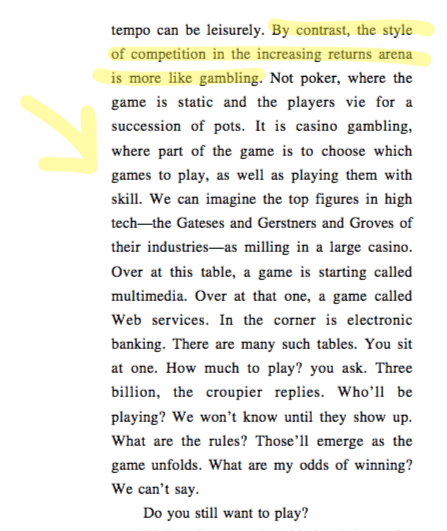
Arthur explains that here, in my favorite passage.

Screen Shot 2018-01-10 at 11.37.37 AM.png

The podcast includes examples from Nate Silver, Jeff Luhnow, Ed Thrope, and Jerry Kaplan.

IDEO and d School

Supported by Greenhaven Road Capital, finding value off the beaten path.


Untitled.png
Where is your idea? 


IDEO is the design studio responsible for among other things, the first Apple mouse. Founded by David Kelley, the company has grown to include his brother Tom and annexed part of the Stanford campus for a design (d) school. In addition, the IDEO U YouTube channel has some wonderful content.

…

In a tweet, the IDEO ethos is; Ask then build then ask more.

In a blog post, the IDEO ethos is; SEE BELOW

In an ebook, the IDEO ethos is: here. One experiment we’re running in 2018 is these things called ‘dots.’ These are ‘distillations of thoughts’ that take about thirty minutes to read or listen to.

…

IDEO focuses on “human-centric design.” This is also the backbone of the d-school and IDEO U instruction. Human-centric design is about finding problems then designing solutions. As founder David Kelley said;

“So much of the world is focused on problem-solving, we’re good at that and we should keep working at that but we really believe the designer’s task is to figure out what is a problem worth working on. What’s a non-obvious need?”

Non-obvious needs come from asking a lot of questions. But don’t expect people to tell you what they want. In more than one talk by more than one IDEO-er, someone referenced Henry Ford’s quote, “If I had asked people what they wanted, they would have said faster horses.”

And the Steve Jobs one, “It’s really hard to design products by focus groups. A lot of times, people don’t know what they want until you show it to them.”

I used to think that Jobs quote was a sign of his arrogance. Now I don’t. The IDEO team made me think about latent needs. Chief Executive Officer of IDEO, Tim Brown wrote that good design, “is helping people to articulate the latent needs they may not even know they have, and this is the challenge of design thinkers.” Put another way, good designers design from first principles.

These insights come from interviewing. Brown wrote:

“Walk into the offices of any of the world’s leading design consultancies, and the first question is likely to be ‘Where is everybody?’ Of course, many hours are spent in the model shop, in project rooms, and peering into computer monitors, but many more hours are spent out in the field with the people who will ultimately benefit from our work.”

For example, IDEO redesigned the school lunch experience. In interviewing students they found that they didn’t have enough time to socialize. In interviewing staff they found that the students weren’t eating healthy food. The solution was to serve the food family style, and with some clever choice architecture, bring out the fruits and vegetables first.

This school lunch solution wasn’t birthed in one great moment of Silicon Valley brilliance. Instead, it was a process of iteration. Brown wrote:

“The reason for the iterative, nonlinear nature of the journey is not that design thinkers are disorganized or undisciplined but that design thinking is fundamentally an exploratory process; done right, it will invariably make unexpected discoveries along the way, and it would be foolish not to find out where they lead.”

This is the build and ask process. Brown explains that early designs should be fast and to the point. For designing experiences the initial design can be post-it notes on a wall. The Kelley brothers said that you should “squint” at prototypes. Prototypes are like compasses, they give headings.

Good prototype builds come from good brainstorming questions. Stanford professor Bill Burnett warns against lazy brainstorming.

“The number one thing we see is that people grab the first idea, or the first couple ideas and run with them. Ninety-nine out of one-hundred times those first ideas are things that are available to you. They’re things you know how to do and so by definition, they’re not innovations.”

IDEO style human-centric design is for wicked problems. This isn’t solve-for-x. It’s why good brainstorming is collaborative and requires commitment. Burnett suggests using the comedian “yes and…” approach.

David Kelley says to brainstorm like ten-year-old girls rather than ten-year-old boys. Boys are competitive whereas girls are more cooperative. The latter comes up with more innovative solutions than the former.

…

Better questions help to better brainstorm and better brainstorms lead to better prototypes which lead to better questions. Good design according to IDEO is a cycle of ask and build.


Thanks for reading.

Again, the Kindle is here.