Copywriting Lulz

“So it’s decided,” goes the commercial, “we’ll park even deeper into parking spaces so people think they’re open.” 

“Surprise.” Lolz.

Good copywriting, a subset of jobs theory, speaks in the customer’s language. And this commercial was not written from a rider’s perspective. It’s a driver’s perspective. 

Insurance is an interesting sale because people hesitate to consider premiums, claims, and losses. We’re ambiguity averse and that’s the whole enchilada with insurance. 

It wasn’t until the birth of the AFLAC duck in 1999, that insurance companies found humor as a path to awareness. Okay, customers thought, it’s not that serious, I can make a phone call

But it still had to be kinda serious.

During a rebrand, GEICO found customers saved about 23% and it only took about eight minutes on the phone. However, when they tested that messaging, customers thought it was too good to be true. Instead, “fifteen minutes to save fifteen percent” was born. 

Someone must answer the question: Why is this so cheap? That’s the customer language

Insurances sales (all sales!) start with a simple unintimidating prompt. It can’t be too juvenile, even the mayhem man wears a suit. Costs (higher or lower) must be part of a story: Bundle with us and we pass the overhead savings on to you. 

Jurassic Park (book review)

Jurassic Park (1993) by Michael Crichton is a book about expectations. But first, we have to address the movie.

The movie was great. It was an amazing adaptation (and is connected to the Pixar story btw). But – it defines the characters. Hammond, Malcolm, Ellie, and Grant are the movie version in my version. Oh well.

Ok, back to expectations.

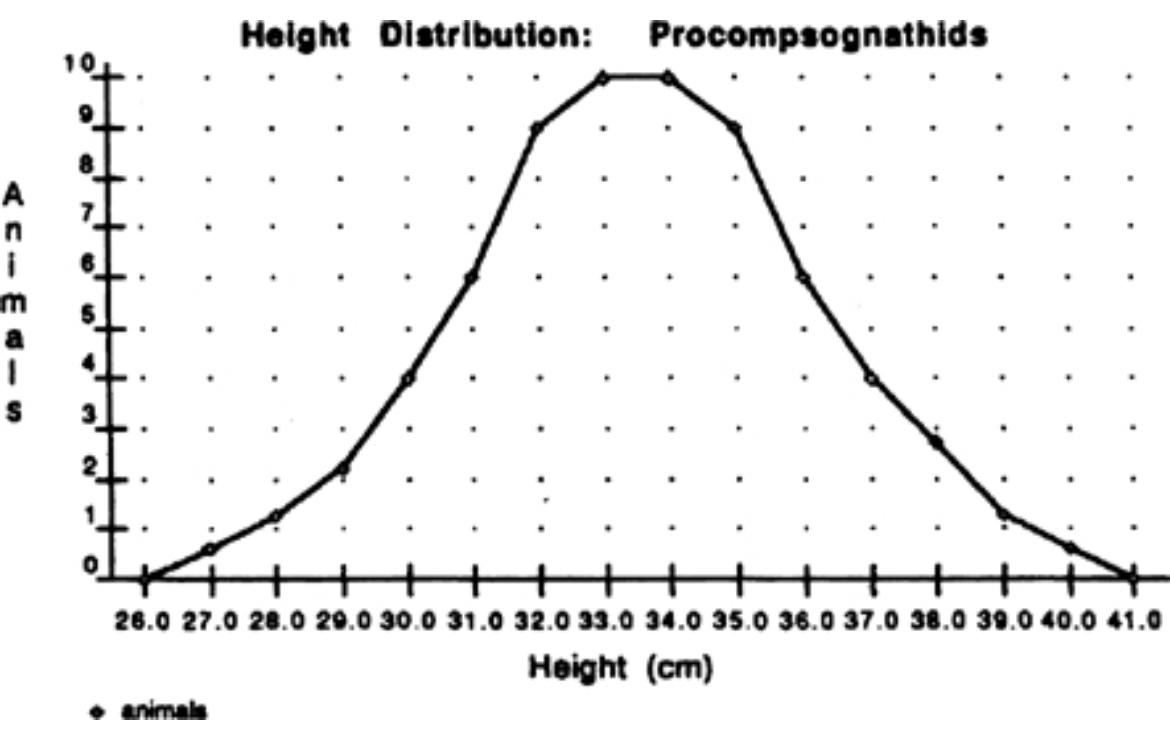
The Jurassic Park story turns when Malcolm tours the facilities and sees this:

See, Hammond says to Malcolm, everything here is normal!

But, Malcolm counters “that is a graph for a normal biological population. Which is precisely what Jurassic Park is not. Jurassic Park is not the real world.”

Normal distributions (and averages) are a specific tool. But they are the wrong tool for distinguishing between Snickers and Milky Way, student loan debt, or Aaron Rodgers touchdown passes. Or, tracking dinosaurs.

Jurassic Park is not the real world. It is a zoo. Cages. Fences. Pens. Controlled feeding. Controlled breeding (oops). Controlled everything.

Malcolm again, “Because the history of evolution is that life escapes all barriers. Life breaks free. Life expands to new territories. Painfully, perhaps even dangerously. But life finds a way.”

Life finds a way.

“Now you see the flaw in your procedures,” Malcolm said. “You only tracked the expected number of dinosaurs. You were worried about losing animals, and your procedures were designed to advise you instantly if you had less than the expected number. But that wasn’t the problem. The problem was, you had more than the expected number.”

Hammond expected to run a zoo.

Hammond expected a ‘normal number’

Hammond expected his problem to be ‘fewer’ not ‘more’.

Expectations are heavy, they are hard to throw off. I could only picture Jeff Goldblum as Dr. Ian Malcolm. Hammond could only picture Jurassic Park one way too.

This isn’t really a book about dinosaurs, they’re just a stand in. For what?

Also interesting that Waltrop’s Complexity came out around the same time. Something was bubbling in the early 90s. Something is bubbling now too.

Ben & Jerry’s: The Inside Scoop (book review)

Ben & Jerry’s: The Inside Scoop is an underrated business book. Traveling through the 1980s and 90’s it chronicles the growing pains of America’s favorite ice cream pints. 

It’s a business book with two parts. 

The fun stuff

Two hippies create, grow, and scale a super premium ice cream brand from a converted gas station in Vermont! That’s fun. 

On Black Monday 1987 the duo showed up on Wall Street with “That’s Life, vanilla ice cream with pieces of stale apple pie (the stale pieces held up better in the ice cream), and Economic Crunch, which was actually some leftover Nutcracker Suite from the previous winter, renamed for the occasion.”

Ben and Jerry drove around in a Cowmobile promoting the brand. On their one-year anniversary, they hosted a block party, with Ben and Jerry organizing, acting as characters, and offering free ice cream of course.  

The grind

“Amateurs talk about strategy,” said Omar Bradley, professionals talk about logistics.” 

Ben & Jerry’s wasn’t the only super-premium ice cream. Häagen Daz was the market leader and a bunch of me-toos. Starting in Vermont, a state with no Baskin Robbins franchise was probably a blessing. 

But the distribution was still a grind, sometimes literally as their beat-up delivery truck broke down delivering the pints. Once they contracted out to distributors it was a game of sharp elbows for shelf space, full of kickbacks, relationships, and lawsuits. 

Even the Beatles had a logistics machine! 

Oh, and the people. 

Every business is built on the foundation of its people. In a podcast with Brent Beshore, Anu Hariharan said she looks to invest in good teams with product-market fit. This is despite her technical and financial backgrounds. To paraphrase: It’s the people, stupid. 

But that’s also the hardest part of a business. 

While Ben & Jerry’s product line, market share, and revenue grew, the team’s expertise did not. They hired slowly. Not because of a great vetting process but because they were overwhelmed. They fired slowly too, a terrible combination. 

Oh, and the finances!

We won’t recount the story here, but in Shoe Dog, Phil Knight writes about taking all of his profits back to the bank to say, see, these things sell, now please give me another, larger loan.  That happened in Vermont too. Inventory. People. Facilities. Raw materials. New facilities. At least they could drown their sorrows in a fresh pint. 

Be your own boss with your best friend(s), but work like hell.

Sounds right.

The Starbucks of Authors

There’s no way this can be good, or so I thought. He’s the McDonald’s of authors. Cheap and everywhere. 

I was wrong, he’s more like Starbucks. 

James Patterson by James Patterson was fun! And reading should be fun. 

An “ego-biography” the book runs through Patterson’s life, from blue-collar Massachusetts to New York madmen to Palm Beach production. And the book runs. It’s fast. Short chapters. Strong stories. No wonder people love the guy. 

If there’s a summary of Patterson’s story it’s this quote from his grandmother, hungry dogs run faster. Peterson was hungry. 

He worked at McLean Hospital where “I had begun scribbling short stories…I couldn’t stop writing if I wanted to.” Catholic high school, Catholic college, a year or so at Vanderbilt, writing all the way. 

He moved to New York City. Patterson got a job at J Walter Thompson. The job was “hell” but “I’d write early in the morning, every morning. I’d lock my office door at lunchtime and write for half an hour. I’d write on the plane during every business trip. I’d write pages at four in the morning, and I’d write again until midnight. I refused to give up on myself.” 

He succeeded in New York City, rising through the ranks of J Walter Thompson. “Why? Because I chopped wood—I worked hard—and I could write. I could also write fast.” 

He wrote in New York City, finishing his first book. Then, he got “the best advice” from a fellow author, “Write another book. Start tonight”. So Patterson wrote. 

He sold in New York City. In 1993 he published the first Alex Cross novel. By 1996 he was just an author. 

And then he became ‘Starbucks’. 

At the same time I read James Patterson by James Patterson, Chat GPT became popular. The AI tool will reshape work. In Average is Over, Tyler Cowen writes about how the most successful chess teams are not computers or humans but humans using computers. Similarly, Chat GPT will not replace ‘knowledge workers’ but the best knowledge workers will use Chat GPT. 

That analogy makes sense.

Good organizations use leverage like people, money, and intellectual property to scale their operations. Technology companies are easy examples, but we’ve looked deeply at why Disney had to buy Pixar for the same reasons. 

That analogy makes sense. 

Except when it comes to writing. 

Patterson’s collaborations were icky, were too processed. But that’s the wrong analogy. 

Patterson writes an outline and has his collaborators fill it out. But don’t think “middle school notes”. Instead, think about a manager asking someone to start a new product. James starts the car, the collaborators run the race. 

It works because Patterson is mostly hands-off. Peter de Jonge wrote, “One of the best things about working with Jim, and this may be the key to why he is a publishing juggernaut, is that he is almost pathologically open-minded. If an idea adds stakes or drama or weight or in any helpful way propels the story forward, he’s game. As he told me once, you can tell any story you want, but it has to be a story.”

It reminded me of how Apple built the iPhone. Steve Jobs told the team what to do, they built it, reviewed it with Steve, got feedback, and built more. Jobs didn’t tell them how – well, sometimes he did and sometimes he was wrong – he just told them what. The same with Patterson. 

And this is great. Patterson’s book was fun. Reading should be fun. More Patterson books, more fun!

The Lego Story (book review)

The LEGO Group was founded in 1932 by Ole Kirk Kristiansen and the story is told in The Lego Story by Jens Andersen.

The takeaway, like all successes, is to work hard and get lucky. Rather than a review, let’s tour history through industry.

1919, Denmark’s economy slows. “Farmers in Billund and other districts benefited from Denmark’s neutrality during the First World War, by selling grain and meat to the warring nations and earning some extra hard cash by producing peat.” When farmers have money they can pay carpenters like Ole Kristiansen. And if farmers don’t, they can’t.

1925, a fire in Ole’s woodshop. This will be a recurring theme.

1929, the depression. “For a while, the future looked promisingly bright, but shock waves from the Wall Street Crash in October 1929 that wiped out billions of dollars in wealth quickly spread to Europe. Germany and England, Denmark’s biggest trading partners, were badly affected, and the price of grain, butter, and pork crashed.”

1932, anything that sells. Though woodworking had been his trade, it was the 1931 Yo-Yo craze that inspired Ole to make toys. “By the 1930s, yo-yo-ing had become a nationwide fad,” writes Chat GPT, “with tournaments and competitions being held across the country.” Ole’s brothers and sisters want to know why a good carpenter would waste his time, “I think you’re much too good for that, Christiansen—why don’t you find something more useful to do!”

1933. “We worked like dogs, my wife, my children, and I, and gradually things began to pick up. Many days we were working from morning till midnight, and I bought a cart with rubber wheels so the neighbors wouldn’t be disturbed when I took the packages to the station late at night.”

1940, Germany invades Denmark. Though occupied (and part of the resistance group, running grenades to saboteurs in LEGO boxes) it was a good time for LEGO. Parents were “keen to protect their children from hardship,” and during the five years of occupation, LEGO’s revenue grew.

1942, another fire in the woodshop.

1946, plastics? Ole buys a plastic molding machine. Through the early 1950s executives at LEGO will say no no no, plastic toys will never take off.

1947, Ole sees his first plastic brick from an English toy manufacturer. This is the seed for LEGO but will prove a thorn in their intellectual property side for decades to come.

1951, the top-selling LEGO toy is the (plastic molded) Marshal Plan-delivered Ferguson tractor.

1955, LEGO bricks roll out to toy stores.

1956, LEGO bricks roll out to Germany. Andersen writes, “Selling toys in Germany would be like selling sand in the Sahara.” LEGO advertises in one city, Hamburg, creating a two-minute film to play before features. Word spreads.

1958, good news, LEGO invents the tube on the underside of the LEGO brick. Ole Kirk passes away and his son Godtfred takes over.

1962, the Scale Model Line. Godtfred grows up playing LEGO, so do other people. What if we make LEGO for professional adults? The Scale Model line is for engineers to design with LEGOs. Even the everyman could create his own house. The project fails but leads to the 1/3 size pieces ubiquitous in today’s sets.

1968 LEGOLAND Denmark opens. It’s a hit.

1976 oil crisis. “A significant part of LEGO’s challenges in the 1970s could be ascribed to two separate oil crises, a stagnating global economy, Denmark’s falling birth rate, and a declining toy market abroad.”

1978 minifig enters. Lego, Kjeld Kristiansen notes, has three phases: blocks, wheels, and mini-figures.

1989 LEGO pirates. But Gameboy too.

If there’s one consistent lesson through each decade of LEGO it’s the importance of sales. Every few years someone comes along and says the toys are good enough and every few years someone else reminds them but we have to sell these things. It’s just hard work.
Crazy Russian incentives

Around 1992 Russia privatized state companies. The government gave each citizen one voucher they could bring to an exchange for a share of that day’s company. A simple plan – until humans get involved.

Not all Russians wanted to own shares. Local markets emerged. A small fish bought all the vouchers in one neighborhood, a medium fish bought all the neighborhoods in a town, a large fish bought all the towns in a region. Eventually sacks of vouchers made it to the national exchanges.

Though unintended, these mini-markets worked. Free economies FTW. So far so good.

Each exchange had a schedule. A modern Monday might be 1,000 shares of Apple at nine, 200 of IBM at ten, 500 of Ford at eleven and so on. If only one person showed up Monday at nine they would get all the shares for their vouchers. It was the market mechanism at work. It’s cheaper (more valuable) to not bid against someone in an auction. When one companies shares went up they shut down the airport the day before their voucher offering. Another company ignited a tire fire on train tracks leading in and out of town.

Insiders were insistent on owning their companies because the valuations were way off. By one estimate, the voucher privatization program valued the entire Russian economy at ten billion dollars, or one sixth the market cap of Walmart. If you could buy a legitimate twenty dollar Amazon gift card for one dollar would you? Rather, how many? This economic transition was called a katastroika. A combination of the catastrophe and perestroika – Gorbachev’s politics.

George H. W. Bush has his last year as president, Achy Breaky Heart finishes the year as the fifteenth most played song, and there’s money to be made in Russia.

“I went to someone in the investment management division,” Bill Browder writes in Red Notice, “expecting him to hug me since I was sharing the most joyous jaw dropping investment opportunity he would ever see. Instead he looked at me as if I was suggesting the firm should invest in Mars.”
Russian privatization was a huge opportunity. Everyone at Salomon Brothers missed it. Why? Incentives.

On Browder’s first day, his first manager explained the system: generate five times your salary or you’re done.

“Nobody at Salomon Brothers could divorce themselves from their own narrow mindset. Perhaps if I had been more subtle and clever I could have pierced their myopia, but I wasn’t, I had no political skills. I presented my idea for weeks and weeks hoping that through repetition I would get through to someone.”

Incentives and culture form what people do when they’re not told what to do.

At the London office the formula – which worked wonderfully – was fees through consulting.

Eventually Browder’s repetition got through and he got a call from Bobby Ludwig in New York. Two days after a phone call with Ludwig, Browder pitched the idea. An hour later Ludwig delivered twenty-five million dollars and marching orders. At the New York office the formula for Bobby Ludwig was to make money.

When Browder returned to London he had to switch departments but couldn’t find a desk. “Bill, why are you bothering me with this?” Ludwig asked when Browder appealed to him, “If they won’t give you a desk just work from home, I don’t care where you work. This is about investing in Russia, not desks.”


There’s this idea that to understand what’s going on in the world someone has to know the history or stay on top of things. But sometimes we can come back to first principles. We’re all humans with incentives. Also, the Red Notice audiobook performance is amazing.

Russian Markets

Competition’s effect is the “market mechanism”. This example is from 1996 Russia.

Bill Browder is looking at stock in a Russian oil and gas company. The country’s companies have just become public, and though MNPZ has slightly smaller reserves than British Petroleum, it’s trading for 100x less. Why?

I was convinced that there must be some other explanation for the deep discount and spent the next several days searching for it.

Did the preferred shares have different par values? No. Was the ownership restricted to workers? No. Could the higher dividends be arbitrarily changed or canceled by the company? No. Did they represent only some minuscule part of the share capital? No. There was no explanation. The only reason I could fathom for why they were so cheap was that no one had showed up to ask about them-until I had.

Amazingly, I found that this anomaly wasn’t restricted to MNPZ.

Nearly every company in Russia had preferred shares and most of them traded at a huge discount to the ordinary shares. These things were a potential gold mine.

If there’s a name, there’s a market mechanism. If the invisible is now visible, there’s a market mechanism. If something is weird, new, unknown, secret, there may not be.

Pricing power evaporates with the heat of the market mechanism. Sometimes though, in the far reaches, someone can, find a gold mine.

Russian Reading List

There’s a financial advisor axiom that the best plan is the one you’ll stick with. For trainers, it is exercises done through a full range of motion. The best endocrinologists find an achievable plan, not an ideal one. There should be one for education too. With that in mind, here’s a list of Russian resources optimized for consumption rather than comprehensiveness.

We’ve done this before with books about China and related, history books that are business books.

The Rest is History (podcast). Some podcasts are better than books because the host(s) add context. Dan Carlin is great at this. Tom and Dominic do too, and their series on Vladimir Putin is excellent.

Red Notice. A finance thriller? Yep. Bill Browder spent decades opening, running, and closing a fund in Russia during the switch from communism to oligarchy.

Muppets in Moscow A 2022 book, h/t Marginal Revolution about Sesame Street in Russia.

Exporting Raymond. We love Phil Rosenthal’s Netflix travel/food show Somebody Feed Phil. This is the story of taking the show Everybody Loves Raymond to Russia.

Koylma Tales via Agustin Lebron called it “a collection of stories of people who lived in the Gulag, possibly the most revealing book on human nature I’ve ever read.” Takes place through the 1930s and 40s.

Sandworm: A New Era of Cyberwar and the Hunt for the Kremlin’s Most Dangerous Hackers. Forgot this source. “The true story of the most devastating cyberattack in history,” notes Amazon, “and the desperate hunt to identify and track the elite Russian agents behind it.” 2,000 reviews averaging 4.7.

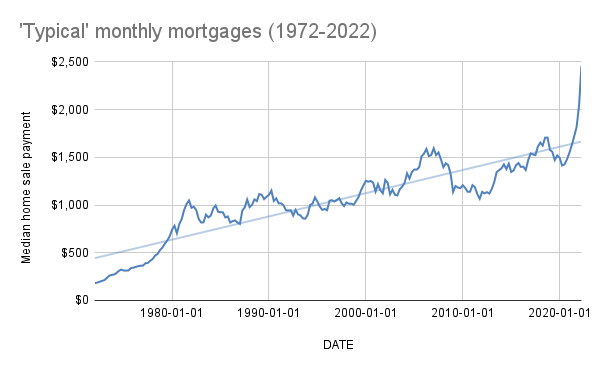
‘Typical’ monthly mortgages (1971-2022)

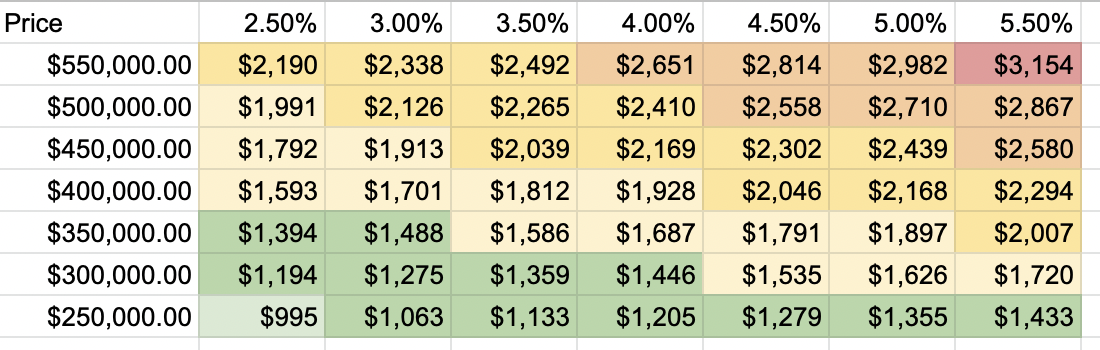
This is the ‘typical’ house payment for the last fifty years. ‘Typical’ being the median sale price and average thirty year rate.

If my parents had bought when I was born they paid $982. But if they bought when my brother was born, it would be almost two-hundred dollars less each month. A huge difference for a young family.

The sweet spot for modern buyers was October 2011 when payments flirted with $1,000. 

The Covid-19 drop and surge can be seen toward the right. It wasn’t until August of 2021 that payments crossed the trend line into wild heights. 

What difference does it make for someone now? Since the end of 2020, the ‘typical’ payment increased seven-hundred dollars a month. 

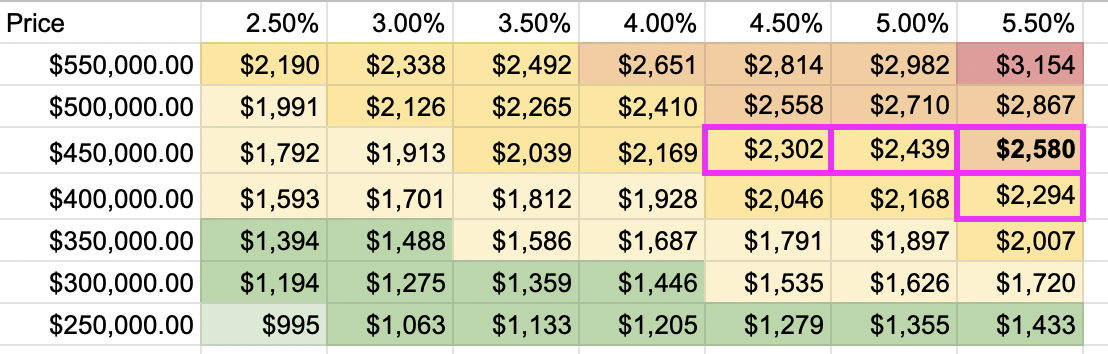
Interest rates are a headline metric, but are not the most important thing for buyers. The fall 2022 ‘typical’ monthly payment is: $2,580. A $50,000 decline on the purchase price is equivalent to 1% lower interest payments. Not only that, home prices have a .9 correlation with monthly payments whereas interest rates have a -.55 score.

Housing is easy news to consume. The bad is about rising prices and rates. The good is about remodels, flips, and luxury. The truth is somewhere in the middle, here it’s in color.

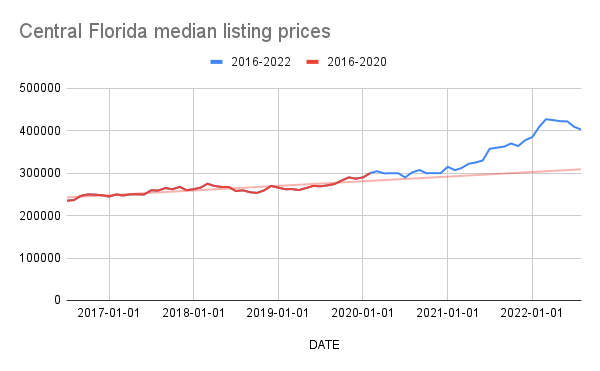
How “off track” are housing prices? The red line is the 2016- March 2020 trend line relative to the graph of median listing prices. Currently prices are a 33% premium to what the historical growth suggests.

United States figures only.

The positive externalities of Eminem

And I probably ruined your parents’ life
And your childhood too
‘Cause if I’m the music that y’all grew up on
I’m responsible for you retarded fools
I’m the super villain Dad and Mom was losin’ their marbles to
You marvel that? Eddie Brock is you
And I’m the suit, so call me—

Eminem, 2021, Venom

In complex systems you can’t do one thing. When he was chief economist of Uber, John List and his team ran an experiment to see how tips affected drivers. They rolled out the option to tip in four cities and collected the data. Tips, List wrote, work. When drivers earned more they drove more. But you can’t do just one thing. When tipping expanded to other markets other drivers drove more too. With the increase supply of drivers but the same demand, total earnings with tips were about the same as before. But the drivers ended up working more. It was more per ride but fewer rides.

As a teen I remember big concerns about what music teens listened to. In 1990 the parental advisory label started to appear on CDs. In 1997 Eminem release The Slim Shady LP. That music was for my car only, not the house. Eminem gets this. “I’m the super villain Dad and Mom was losin’ their marbles to”. It was NOT GOOD that we were listening to this.

Maybe?

List’s Uber experiment explains an externality. Do one thing and this other thing happens too. Eminem’s other thing is health. Venom is my favorite workout song and Eminem is the 13th most popular artist on Spotify with fifty-three million plays. A month! That’s 100k hours a day. If one-fourth of those hours are someone exercising, that’s 14,000 pounds lost each month.

Behavior change starts with easily understood stories. Tell someone a story they agree with, or understand, or can tell to others (which raises their status). Eminem’s explicit lyrics are something to warn against. But telling a positive story through some Fermi thinking sounds good too.