Would you buy a ski chalet? 

How much money do you need? Make sure it’s at least at least one million. Now, double your number (I will move the goal posts for you). If it’s not at least $20 million, raise your number to that.

Would you buy a ski chalet?

A form of this question regularly rises on a sub-Reddit. 

Business sellers (occasionally it’s sunny stock situations) come into a large amount of money and ask strangers on the internet: *How do I…*. What a time to be alive! Bags of money bring baggage. So, would you buy a ski chalet?

On Reddit answer is no.

And it’s not even close. 

Potential purchasers make three assumptions that posters point out. First, that they will always enjoy skiing and the attractions of a single place. This is unlikely. Retired wealthy Redditors reply that they want to travel more and wider, now that they have more time. That they might get injured while skiing, which takes the shine off. Or their children, who they now want to spend more time with, will lose interest or get injured.

Second, ski chalet’s are in mountains, and mountains are not the most accessible places. It’s probably a plane ride, a rental car, and maybe even connecting flights. The sweet spot, per the commenters, is two hours. Vacation places within two hours get used and enjoyed. It’s logarithmic.

Third, vacation homes away from home are inconvenient to manage. Imagine spending a large amount-though you can afford it and then paying someone the lowest price to keep an eye on it. This is not a recipe for success.

Ultimately, the advice breaks down to three points: do things you enjoy, with people you love, and not too much stress. This is the main point of the story.

And this advice supplies to people who are not in the market for a ski chalet. One of the maxims for thinking analytically, is to take things to an extreme case. If we had all the money we thought we ever needed, How should we spend it? This is an actual question being answered by people who answered correctly and incorrectly.

Do things you enjoy, with people you like, and not too much stress.

It’s not the price of the ski chalet that’s the problem, is that it doesn’t fit with this advice.
Reverse Financial Advice (MUSU)

Financial advice is tricky because it’s a bunch of priority influenced trade-offs. There are many ways to succeed financially, it’s just a question of how: What are the priorities and trade-offs?

Our previous personal finance MUSU was based on the Michael Douglas movie, The Game. In that thriller, Douglas is sent on an adrenaline adventure. We never know if what he lives through is real, or just the game.

That start up could imitate market crashes, pandemics, and stressful situation. Individual investors would never know if what they live through is real, or just the game.

Today is another personal finance idea.

A lot of advice starts with the idea of goals. What is your goal retirement age? What is your goal retirement income? What are your contribution goals for the kids’ education?

Share your goals, work backward in time, make assumptions, and then generate a plan.

But as humans, this is difficult to articulate. As we saw with opportunity, cost neglect, if it’s not an obvious choice in front of us, we don’t generate it. I want to retire at 65 and live on 80% of my current expenditures and pay for two college educations. Blah. Generic options like multiple-choice tests in school.

Thinking different – please read this book – is hard. So it’s logical to conclude that non-differentiated thinking means that it might not be what a person really wants.

The pitch: show us your portfolio, and we will tell you your goals.

For example, someone comes in with a limited portfolio in a bunch of individual stocks. The goals of this person is to rely on luck. Or, someone comes in with $X,000. This is the portfolio of someone who wants to work for twenty more years.

A lot of clients would come in and go oh hell no. That’s good! That reaction creates boundaries to what they truly do/don’t want out of their financial plan.

Additionally, this presentation could be presented using base rates: People with X at age Y work for Z more years – just like you will unless something changes.

This is a hard sell because finance is, like Rory Sutherland writes, a “name brand”. People buy financial advice for the same reason they buy name brand products, as downside protection. I don’t need it to be good, our subconscious reasons, I just need it to not be shit. Brands are undifferentiated on purpose!

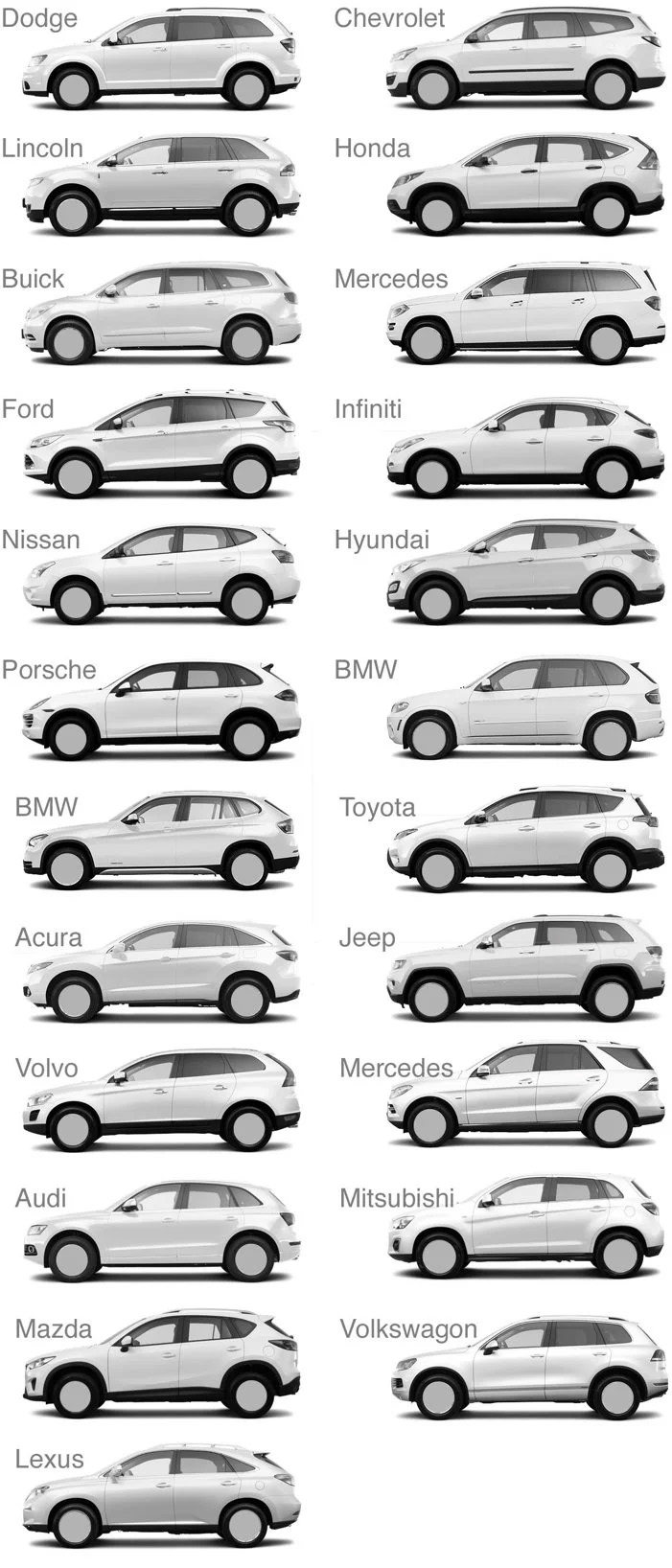
The “white suv meme” circulates on the internet and we laugh. But new leads to unexpected factory recalls, disappointed customers, and other monkey wrenches. New/Unproven is not what the customer wants, though it’s better on some dimension. That goes for cars as much as it goes for financial advice. Even if, a little game or a backwards approach might lead to some good ideas.

A 50% Tax Rate

Personal finance is tricky.

One aspect is that precise but not accurate plans feel right. Running a Monte Carlo portfolio analysis on a low-beta trend-following model to prove the robustness feels “more right” than buying Vanguard Target Date Funds. We feel agency, authority, and accuracy through action (even though it may be more wrong).

A second aspect is framing the choices rather than making the choices. Choosing from good options, 30 or 15 Year Mortgages?, takes less time and works just as fine. A list of pros and cons doesn’t make a lick of difference when it’s just bad options.

I forgot these things.

Talking to a friend about how to estimate income from CDs vs. other instruments (when rates were 5%), he advised assuming a 50% tax rate.

What?!?! I thought. With an effective income rate of around twenty-five, some capital gains, some sales tax, and miscellaneous fees that sounded way too high. It certainly wasn’t the assumption in my spreadsheet. Plus the friend lives in a high cost-of-living area.

His number will be “more wrong” but in some ways, it was “more right”.

I’ve grown to see the world as less good and bad and more a series of tradeoffs. There are Good and Bad, but much is a bunch of tradeoffs. Myopia isn’t good or bad. It’s a tradeoff between now and later.

Behavioral psychology unearthed different biases, but how the field did that is a tradeoff too. Knowing about different biases is helpful (opportunity cost neglect, base rates, etc.), but just because one is “discovered” doesn’t make it a big deal. We can’t consider every other available option, something will be neglected.

Every choice is a tradeoff, like personal finance plans. My 25%+, like Price is Right, will be closer to the true amount without going over. But my friend’s 50% has a greater confidence interval. We know something is always happening and assuming you get half your money rather than 3/4ths means a lot less somethings can happen to you.

There’s a book series called The Five Love Languages.

I like the books even though they may be completely wrong.

Author Gary Chapman proposes that each of us likes to be communicated to in some ways more than others. The love languages: acts of service, touch, quality time, gifts, and words of affirmation describe different ways our partners, teens, and children prefer communication.

Personal finance plans work the same way.

Some people prefer accurate plans while others prefer ones with a margin of safety. Some people can stomach volatility. Some people want to invest like their friends.

Preferences drive choices, choices illuminate trade-offs.

And I listened to my friend and changed my spreadsheet to 50%.

The Psychology of Money (book review)

The Psychology of Money by Morgan Housel is a book of twenty money lessons but really it’s about two things.

Thing 1: How the world works.

There is the world and there is how we think about the world. The more these ideas overlap the happier more calibrated the person. People follow stories (chapter 18), pessimisms sells (17), and tails drive everything (6) are all explanations about the world.

It’s through a combination of evolution, social pressure, and a history of this-worked-for-me that we drift. Sure, we think, Tom lost so money in crypto but he didn’t listen and get in when I told him the candlestick fed cycle jump was coming (luck, chapter 2). When something bad happens to us we’re unlucky. When something bad happens to them they’re idiots (1).

Things 2: How you work.

So it’s not just outside that we misunderstand. It’s inside too. We move the goalposts (3), confuse consumption (8), and aim for the rational rather than reasonable (11).

Asking what do I really want out of this big trip is not easy.

So we don’t.

Thankfully Housel is here to help. Think of time as freedom (7), just save (10), and don’t confuse consumption for wealth (9).

The Psychology of Money is a difficult book to review because it’s personal. It’s how you see the world and understand yourself. Oof.

While the chapters are short, don’t spend little time on them. Read them. Stop. Think. Reflect. Note. The book is a refreshing break from the digital cycle. You’ll read this and think: Oh yes, this is a breath of fresh air and one I needed.

That “start young” advice

“If you want to do better as an investor, the single most powerful thing you can do is increase your time horizon. Time is the most powerful force in investing. It makes little things grow big and big mistakes fade away.”

The Psychology of Money

Start investing young was the advice I got. At 22 I opened a Roth IRA.

But there was a nuance I failed to note. It’s not just about time horizons but also how to get there.

Young Mike opened a Roth knowing it should compound for a long time. But he didn’t think about how that might happen.

Save 3-6 months of living expenses was another piece of advice. This is an average lie. It’s not enough or too much. We should call them “repair funds” because emergencies are not covered.

Emergencies need a year or more.

In Nomadland, Jessica Bruder writes about “house-less” Americans. With RVs and campers, these ‘nomads’ travel the country for work. Do you know how busy Amazon gets at the holidays? It’s these people working there. Seasonal National Parks? That’s them too.

Generally, four events precede someone becoming nomadic: health, house, job, spouse. Mary Smith or her significant other lost their _____ and now she’s nomadic. Three months of savings for that? Get out.

But that’s tough. So much time horizon is eaten up by savings accumulation – which an individual may never need! In hindsight I see all of Young Mike’s mistakes. But he didn’t think they were mistakes at the time.

This balance is what makes Morgan’s book so good. It’s not black and white numbers. It’s messy. It’s color. It’s holistic, it’s an ecosystem. You never do just one thing.

I didn’t read The Psychology of Money when it came out because I’ve read a lot of Morgan’s memos, followed him online, and written about personal finance. But the book is good. It’s not about money as much as it’s about morals.

You don’t need to ___ because you are already ___.

“You have to be careful,” warns Clayton Christensen in How Will You Measure Your Life?

When things are going well with your friends and family. When your kids are doing well. When your spouse is happy. You have to be careful. 

“When it seems like everything at home is going well, you will be lulled into believing that you can put your investments in these relationships onto the back burner. That would be an enormous mistake.” 

I’m in good shape for forty-one. In December I ran a 1:37 half-marathon, impressing myself. 

But my neighbors say I don’t need to run because I’m already fit. 

The causality is backward. 

The Millionaire Next Door profiles people with large net worths and how they did it. They invested, worked smart and hard, and checked their expenses. They wore simple watches, drove older cars, and traveled simply. You don’t need to live so cheaply, their nosey neighbors might note, you’re already rich

Parts of How Will You Measure Your Life? are about the “dilemma” between short and long-term incentives. Measuring your life is a long-term game that needs long-term incentives. And “you don’t need to… because you are already…” is backward logic. 

You need to.

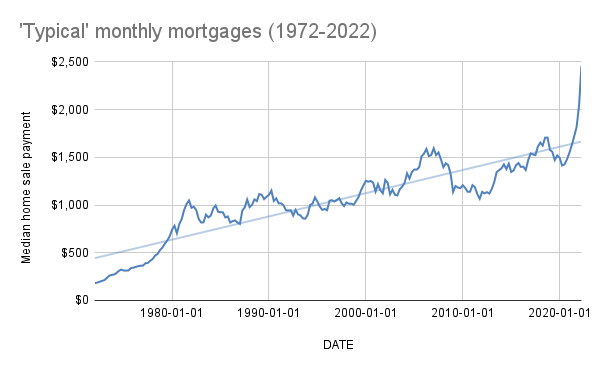
‘Typical’ monthly mortgages (1971-2022)

This is the ‘typical’ house payment for the last fifty years. ‘Typical’ being the median sale price and average thirty year rate.

If my parents had bought when I was born they paid $982. But if they bought when my brother was born, it would be almost two-hundred dollars less each month. A huge difference for a young family.

The sweet spot for modern buyers was October 2011 when payments flirted with $1,000. 

The Covid-19 drop and surge can be seen toward the right. It wasn’t until August of 2021 that payments crossed the trend line into wild heights. 

What difference does it make for someone now? Since the end of 2020, the ‘typical’ payment increased seven-hundred dollars a month. 

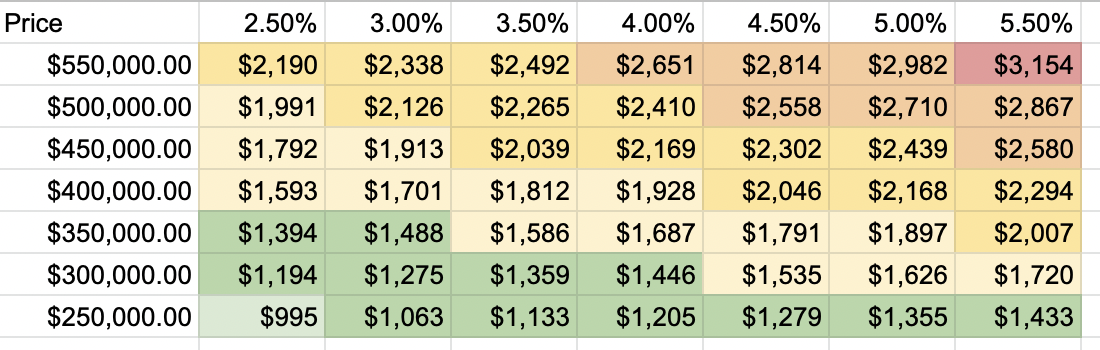
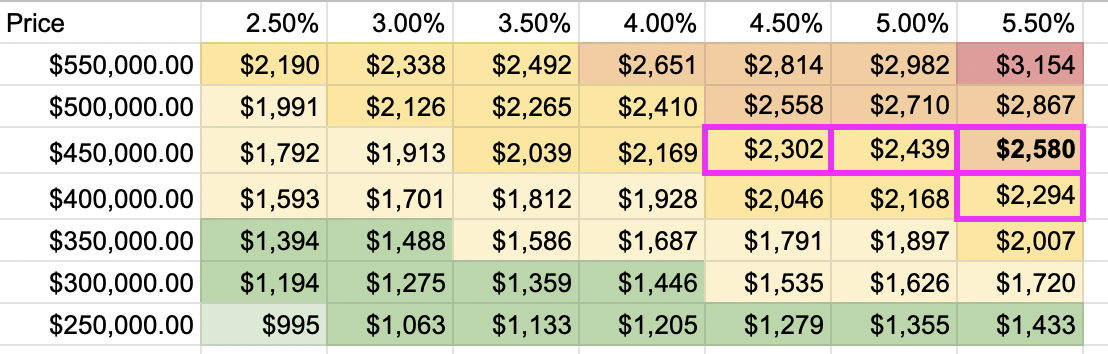
Interest rates are a headline metric, but are not the most important thing for buyers. The fall 2022 ‘typical’ monthly payment is: $2,580. A $50,000 decline on the purchase price is equivalent to 1% lower interest payments. Not only that, home prices have a .9 correlation with monthly payments whereas interest rates have a -.55 score.

Housing is easy news to consume. The bad is about rising prices and rates. The good is about remodels, flips, and luxury. The truth is somewhere in the middle, here it’s in color.

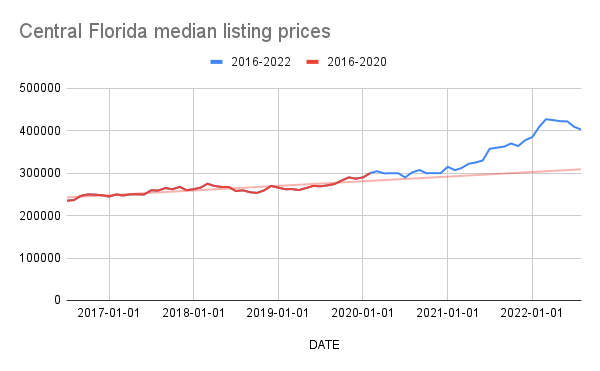
How “off track” are housing prices? The red line is the 2016- March 2020 trend line relative to the graph of median listing prices. Currently prices are a 33% premium to what the historical growth suggests.

United States figures only.

Enhanced Savings Rates

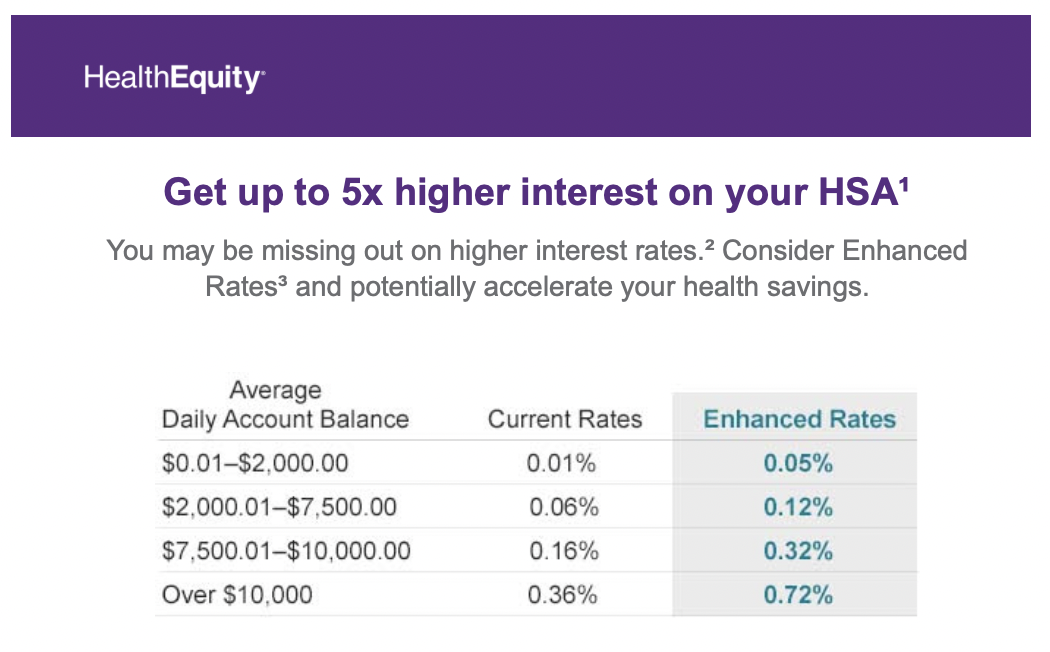
This is from our HSA. It’s good copywriting. ‘5X’ is easy to understand. ‘You may be missing out’ is great too. 

The chart excels as well. It’s easy to understand and those Enhanced Rates do look bigger. They look bigger because of level one numeracy. 

We level one think all the time. It’s knee jerk and first blush. We see something and some combination of evolution and experience fit what we see with what we know. Big red ‘Sale’ signs are examples. We first compare the sale price with the previous price rather than the item’s intrinsic value. This makes sense as our first reaction is immediate, requires no additional effort, and is something we are used to doing because it mostly works just fine. 

The posts here, about average, focus on this idea too. Average is easy to compute and conveys certainty about an uncertain (often heterogeneous) world. Average is level one numeracy but we can do better. 

One way to get past this reactionary thinking is to change the what we know part of our lives. Books like The Data Detective (2021), How to Lie with Statistics (2010), Fooled by Randomness (2008), and Factfullness (2018) are wonderful. 

A fast fix comes from Sir David Spiegelhalter. Don’t look at relative comparisons, look at absolutes. Rather than the relative rate, look at the dollar difference.

That’s what I did. 

If someone saves the $2,000 in an ‘enhanced’ HSA account they have sixteen more dollars after twenty years. A lot of years for not a lot of money. For accounts of ten-thousand dollars, the difference is almost eight hundred dollars ($11,543 vs $10,745). Fine, a Series I Savings Bond accrued that same dollar value in six months. 

The don’t look at relative comparisons, look at absolutes is a good starting place – but there are further levels. 

First is to think about the costs. The enhanced HSA rates are an annuity, likely with some new terms. There’s the switching costs too. That’s a potential headache and unwanted contract in exchange for not much money. We will pass. 

Actual health rather than health savings is different. 

For people 25-34, their chance of dying from Covid-19 is about the same as pulling the ace of spades from a shuffled deck – twice in a row. 

For people 55-64, their chance of dying from Covid-19 is about the same as flipping heads eight times in a row. 

For people 75-84, their chance of dying from Covid-19 is about the same as pulling any heart from a random deck of cards – three times in a row. 

Those are low absolute risks but seriously consequential. 

The world is complicated and messy. Not only that, but it changes too. Numbers are helpful, but we have to ask the right questions to start. 

The Covid-19 odds are rough estimates. There are about forty million people in any ten year age group. The number of deaths in the 25-34 group is 11,451. I divided the deaths by size of the group to get the percent chance of death. Odds are multiplicative, three heads in a row are 12.5%, 0.5*0.5*05. Two ace of spaces are one in fifty-two times one in fifty two, or about 0.04%. 

Post-it note math

It was October 2000 or thereabouts and Jacob Lund Fisker wanted to know if someone could live a sustainable and rich life.

“I did a little back of the envelope math. We physicist restrict ourselves to post it notes typically. I took the global GDP, divided it by the global population, and took our ecological footprint number and divided by it as well. If everyone did what I was setting out to do, the maximum each person could spend was six thousand dollars per person per year.” – Jacob Lund Fisker, Through Conversations, November 2021

He did it and Fisker retired early.

There’s a few things going on with FIRE. One is attention grabbing, everyone has a means to share their story and the atypical gets attention. Another is the financial conditions, it’s easier (though not easy) than ever to make a large amount of money, in a short amount of time, and invest in a mostly up market. The last and staying part of FIRE is the intentionality. It is impossible to FIRE without prioritizing one’s life.

Fisker’s philosophy is my favorite because he’s a system thinker. Early Retirement Extreme is a book that starts with systems and ends with personal finance. Saving half of one’s income is the act but you can’t do just one thing.

We’ve looked at spreadsheets for emergency funds, 401Ks, and how many touchdowns a quarterback will throw. Spreadsheets offer precision with numbers but don’t address our systems. Basic math is fine if the system is great but it doesn’t matter how great the math if the system is shit.


My two favorite books about systems are Fisker’s book Early Retirement Extreme and The Systems Bible.

20,000×1 != 1×20,000

Alchemy is about taking existing or marginal resources and deploying them for non-linear effect. Sometimes small changes go boom.

One way to see this is in the expression 20,000×1 != 1×20,000. Rory Sutherland introduced this idea through travel. A new rail line, Sutherland said, that saves many people a few minutes is worth less than a change that saves a few people many minutes.

Another example Rory gave was airline lounges. A sole traveler visiting a lounge many times a year gets a small benefit whereas that traveler with their family twice a year gets a huge benefit. In each case the same number of scones are consumed, but the effect to the consumer is different.

A real life example is the Credit Karma Save program.

“One of the things we noticed was that there’s strong deposit behavior around paydays and we wondered if there was a way to do nudging around paydays. So we created a savings boost program where just by depositing a dollar that month you’re eligible to win twenty thousand dollars that month.” – Kyle Thibaut, The Science of Change, October 2021

That’s not all. Credit Karma also offers Instant Karma, a cash reimbursement program for their debit card users. Every transaction is a chance to win that amount back.

I’d wager that the Credit Karma accounting for “customer reward” or “interest paid” or such, is similar in scope to the competition – but having a few large chunks rather than many small ones is a golden idea.


It’s always nice to validate an idea with an “out of sample test”. Does this work elsewhere? Marc Andreessen riffed on the idea that there are only bonds and call options.

March 28, 2022 update. Previously this idea was in the Landslide post which covered: sun and skin damage, landslide prevention, and Marc Andreessen on the culture of work.