Survivor Bias in WW2 Airplanes, NBA players, & Mutual Funds

graveyardlandscape.png

My project on Survivor Bias is an attempt to answer the question: “What can we learn from dead startups?

Looking at dead startups is  form of  thinking called inversion that Tren Griffin and Charlie Munger both use. Rather than asking:

– What do successful startups do?

We can ask:

– What did unsuccessful startups do?

Avoiding the latter can be just as helpful as pursuing the former.

Look at Blockbuster and Netflix, two companies that had a lot in common. In many ways Blockbuster was the better company. They had more offerings of each new release movie, and you could get the movie from them more quickly. Depending on how fast you turned around each DVD, the cost savings wasn’t huge. Netflix relied on the notoriously error prone United State Postal Service, Blockbuster on prime retail locations.

Why study Netflix but not Blockbuster? Because Netflix survived, but that dismisses everything Blockbuster did right – or wrong. Much of that information is now lost and we can’t learn from Blockbuster’s mistakes. Luckily the same can’t be said for technology startups.

Thanks to blogging – and especially Medium.com – the number of “my tech startup failed and here’s what happened” articles are plentiful. Even better is that they’re consistent. In combing through the reflections on 60+ defunct startups a few patterns emerged.

Those findings will come soon enough (you can follow the project at Medium). First we’ll explain what Survivorship Bias is with three characters: World War 2 airplanes, basketball players, and mutual funds.

WW2 airplanes.

In World War 2 the allied nations had a problem, they were losing too many aircraft. At the most dangerous times of the war the odds of coming back were a coin flip. 

The Navy decided that the best solution would be to add armor to the planes, but could only add so much, and didn’t know where to put it. They took this question (how much armor to add and where) to Abraham Wald, a mathematician working on the war effort. Wald applied his models to places where the plane hadn’t been shot.

This took everyone aback. Why armor where the planes hadn’t been hit?

Wald reasoned that if some planes were able to return after being shot in certain places, other planes had not been able to return after being shot in the inverse of those places. Wald found the survivorship bias in looking at only the planes that made it back.

Basketball players.

Earl “The Goat” Manigault is one of the most famous basketball players in New York City. Born in 1944, Kareem Abdul-Jabbar once called him “one of the best basketball players in New York City,” Manigault is a small blip on the radar of American basketball, and maybe not even that.

His story is still worth telling. Part of the value of inversion comes from looking at what not to do. For planes the inversion led to the conclusion that damage to certain areas was very bad. For basketball players we can follow the same reasoning.

Manigault failed to become a successful basketball player for two reasons; his game and his addiction.

Besides praising his game, Abdul-Jabbar also noted it had flaws. “Earl couldn’t shoot the ball from beyond eight feet. He could leap out of the gym, but he couldn’t shoot the ball beyond eight feet, and he wasn’t interested in passing it.” Outside shooting and passing are two key basketball skills and Early didn’t have either one.   

The second fatal flaw for Manigault was his additions. He was kicked out of high school for smoking marijuana. The same year Abdul-Jabbar entered the NBA, Manigault entered prison for possession of drugs.

We see in this story of two New York City basketball players that there are things to learn from both. Study Abdul-Jabbar’s path and you’ll see that he took dance lessons and worked hard. You’ll also see external forces, Abdul-Jabbar had the good fortune to be at UCLA and with the Los Angeles Lakers. Those things are good to know, but not that helpful for aspiring basketball players. 

Study Manigault and you’ll see equally instructive things. If you don’t have the core skills for your pursuit, whether that means passing in the NBA or coding a website, you won’t survive there. Ditto if you become addicted or lack a supportive structure around you. The most helpful advice might come from Manigault.

Mutual funds.

When I first looked at a mutual fund statement I wondered how people could be so stupid. “You just pick the one that’s had the higher returns,” I told my father. I was obviously a know it all who knew nothing.

Time passed and I noticed the fine print, past performance may not be indicative of future results. A few years after that I learned that survival bias is present in mutual funds as well.

Mutual funds are collections of investments where investors pool their money to buy securities, usually with a theme. An example might be when all the teachers in a state – through their pension – buy a “long term growth fund.” This fund, along with all other “long term growth funds,” will be lumped in the “long term growth fund category.”   

At the end of each year, one news source or another will report on how well “long term growth funds” did that year. The next year the same thing will happen and so on. Now here’s where our bias enters.

This reporting won’t include all the funds. Some of the funds will go out of business because of poor returns. Those poor performers will be omitted from the next year’s report because they won’t be around anymore. That is, the report will only include the survivors.

We see that CNN or whoever will fail to report about Growth Fund B, which due to poor performance has been closed. This boosts the returns at all levels and happens in a fractal manner with nearly all investments.

Why should founders care?

Founders need to be warned about specific causes of death and survivorship bias because other founders wish they had been. This is not my opinion. A consistent thread in the postmortems was the influence of Survivor Bias.

One founder wrote, “all that you can really glean by examining the crème de la crème is perhaps an understanding that putting in just enough hard work will (probably) generate just enough sheer luck for you to accomplish what you set out to do.”

Another wrote: “The startup press glorify hardship. They glorify the Airbnbs who sold breakfast cereal to survive, and then turned their idea into a multi-billion dollar business. You rarely hear the raw stories of startups that persevered but ultimately failed.”

A third: “For every entrepreneurial story where the success is attributed to the founders being steadfast through hard times, there are probably five failures that were due to founders being stubborn or scared about making a hard decision. This is a prime example of survivorship bias, where we attribute success to traits that survivors exhibit, even if there was no causation by those traits.”

That failed founders made time to share their experiences is a gift. How often does someone account for why their marriage fell apart or their attempt to flip houses ended?

We don’t hear those stories because stories of failure are difficult to tell. Except in the industry of technology. The mantra of failure is not seen as a scarlet letter as much as a badge of honor. It’s more like a “I ran a marathon and all I got was this lousy t-shirt.”

Thanks for reading, I’m @mikedariano on Twitter. If you want to follow along, the bestplace is at Medium; https://medium.com/survivorship-bias.

Gear doesn’t matter

This post is available in podcast form on Soundcloud and iTunes.

Money = Gear = Success?

False.

As noted in the Daymond John post, money is not a silver bullet. Life often presents us with black box problems and we need to create black box solutions. Gear, like money isn’t a silver bullet.

I didn’t always think this way.

A Personal Story.

For a long time I thought that gear mattered. I thought I needed the right tool. In college I bought a Palm Pilot to stay organized, it didn’t move the needle. In graduate school I bought a laptop for papers, it didn’t move the needle. In my early 30’s I bought a fancy pants camera for better pictures, it didn’t move the needle.

Only recently have I come to realize that the tools don’t really matter. It’s fun to think about new tools and I still check out links like “the best pocket notebooks” but I know these are marginal improvements (we’ll call this moving from  1 to 10 in the grid of success). It’s not my story that demonstrates this best, so let’s meet our characters.


Our Characters.

Casey Neistat; award winning filmmaker, vlogger,  “the guy who snowboarded through Times Square in 2016,” and founder of Beme.

B.J. Novak; actor and writer on The Office, author of The Book With no Pictures, and founder of List App.

– Gina Trapani; creator of Lifehacker, podcast host of This Week in Google, and founder of Todo.txt.


Our thesis.

The tools you need to create something, whether it’s apps, books, or  anything do not matter. What matters is the work that you need to do with those tools.

Casey Neistat creates a daily vlog where he talks about life, New York City, and making things. In the vlog Casey Neistat’s Guide to Filmmaking he addresses tools specifically.

“Gear doesn’t matter….If all it took to be good was the right equipment, the people who had the most money would always win. This is a movie called Pan, it premiered this weekend. Now if all it took to make good stuff was to have the right equipment, trust me, whoever made that movie with their $155M budget had way better cameras than you could ever afford…story is all that matters. Story is golden”

Neistat immediately disproves our equation, money = gear = success.

B.J. Novak also uses a simple where gear doesn’t matter. Novak’s system includes stickers and notebooks.

He tells Tim Ferriss that he buys Moleskine notebooks and “If I’m taking a walk or having a drink with a friend and some funny idea comes up, I write it down and I never judge ‘what would you do with this idea’ or ‘how would you end that joke.’”

After that he’ll sit down with a notebook and develop some ideas on the computer. For that he uses Microsoft word.

“I use Microsoft Word for same reason my dad used Wordstar, it’s just what I learned and got in the habit of, and I use final draft for screenplays because everyone does. I would like something that kind of combines the two, but it’s not worthy it to me to investigate and switch.”

Novak has notebooks anyone can buy and prefers one brand of software because that’s what he “got in the habit of.” Again, gear doesn’t matter.

Gina Trapani too has a system that’s not about the tools. At Product Hunt she was asked what language she would code in if she could only code in one language for the rest of her life.

“This is an interesting question. I’ve had a real affinity for the language I’ve cut my teeth on, it would be Java. I enjoy coding in the language I feel most proficient and comfortable in and I think Java would be the top one.”

She’s also shared the tools she uses, and it’s a pretty generic list of things. An IDE for code is more valuable than a plain text editor, but there’s a place for plain text – like her app Text.app. Trapani’s focus is to do good work, the gear doesn’t matter. 


It’s cutting edge production, not cutting edge products.

If you focus on the gear you’ll get caught on the product treadmill. Each new things is great until the next version comes out.

Each new iPhone is awesome, but it’s never a monumental leap. Neistat goes on to say that if you can’t afford a camera to just use your phone, it’s really good. Tools only move the needle from 0 to 1.

The matrix of tools and product.

Tool Work
You 1 to 10 10 to 99
Someone else 0 to 1 ––––––––

The only thing that’s not up to you is the tool that gets you started.  This doesn’t need to be perfect, just functional.  Neistat uses Final Cut Pro, Novak uses Microsoft Word, Trapani uses Eclipse. Each of these pieces of gear gets them started.

A developer friend was telling me that he writes plugins for the coding tools he uses. That’s the next phase, 1 to 10. It’s in the phase that you get comfortable using the tool. Novak explained that after he takes notes in the notebook he sit down and fleshes out the ideas. He’s learned how to use his tools.

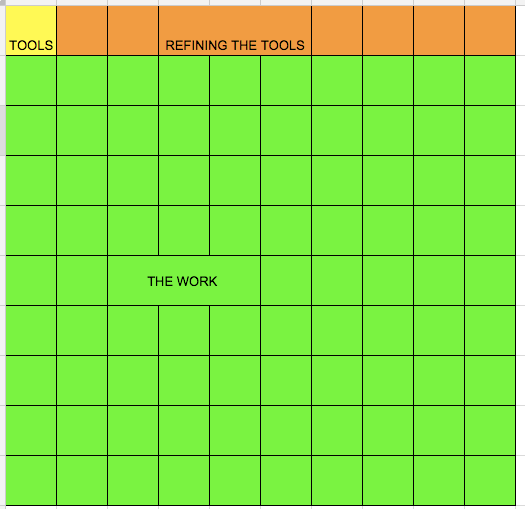
From there we move to doing the work. Making movies, writing books, creating podcasts. Whatever the work is, it’s constitutes the bulk of the grid of success:

Screen Shot 2016-02-09 at 10.53.26 AM

– The yellow box is the tool. That box holds the “27‑inch iMac with Retina 5K display” and the computer at the public library. It also includes fancy cameras, cellphone cameras, and film cameras. The tools you use make up 1% of the grid of success.

– The orange boxes are how you use the tools. You need to know how to use the iMac software, and how to use it well. If you’re a photographer it’s knowing what Instagram filter is better than another or the rule of thirds. If you’re a writer it means knowing how to spell words and spin a good story.

– The green boxes are the work you have to do with the tools. That’s writing the blog post, filming the movie, or cold calling clients. This is the bulk of what it takes to be successful.

Conclusion. You can think of the things you produce as a formula; tools  x work = output.

Some people tweak this equation by limiting the tools they use. Christopher Nolan doesn’t use email or a cellphone. Neil Gaiman writes with fountain pens in a cabin in the woods. Philip Roth, George R.R. Martin and Stephen King all have the basic gear, just like our characters above.

What really leads to success is doing the work, not the gear.

Thanks for reading, I’m @mikedariano on Twitter. Thanks to @Lepolt and @DukeCavinski for setting me straight on a few things. 

Justin Jackson’s podcast Mega Maker and John Saddington’s Tomo both inspired some of the thinking behind this post as well. If you liked this style of post you may like what they’re doing too.

Business Lessons from Daymond John

Daymond John (@TheSharkDaymond) joined James Altucher (@JAltucher) to talk about why it helps to be broke. We’ve seen the value of constraints before:

Kevin Kelly said that a lack of money can be a valuable constraint because it forces you to invent solutions.

Amanda Palmer said, “limitations can expand rather than shrink the creative flow.”

Austin Kleon said that that people overestimate what they can get done in large amounts of time. This is the corollary to the axiom, if you want something done, give it to the busiest person you know.

Maria Popova only got started reading the classics because it was all she had access to. Now it’s a central part of Brain Pickings.

David Levien wrote short, active chapters because he had a short train commute.

Seth Godin made a video game shorter and simplier because he had limited bandwidth, and it was better because of it.

Scott Galloway created his company L2 because there are constraints on what companies can do.

We’ll add Daymond John to the list, as his entire conversation with Altucher circles around his new book The Power of Broke: How Empty Pocket, A Tight Budget, and A Hunger for Success Can Become Your Greatest Competitive Advantage, a book of stories about the value of constraints. 

How? 

It’s easy to say that having less of something is good for you, but how? John explains how this can help your business.

1- Don’t start a company when you have a lot money. John tells Altucher that he noticed his company FUBU was dressing everyone in their music videos. Why don’t we create music, John asked. He set up a label, recorded an album, and was ready to make it big.

“We thought money was going to shorten our learning curve,” John says, “we decided to spent money on more advertising, glossier videos, and a big shiny office people would come up and see.”

It didn’t work because, John says, “we never went through the maze.”

They failed to create trust, a brand, and learn what made music popular from the producer’s point of view. Those answers are only in the minutiae of the day-to-day work when you build something. 

2- Think broadly in terms of assets, not narrowly about only money. This interview is a good example of thinking of assets rather than money. “Assets are what feeds you, liabilities are what eats you,” John explains. If a lack of money (as a constraint) is valuable, it’s because it forces people to rely on their other assets.

Who do you know that can help, John asks. Nicholas Megalis said this same thing about making online videos. There are people out there who have assets that you can use, said Megalis, use the internet to connect with them.

For John that meant teaming up with L.L. Cool J and getting him to wear FUBU clothing. These other assets are often priceless. John couldn’t have paid L.L. Cool J to wear his clothes and promote them in the same way as when he asked him to wear them. It created a different type of relationship, the only kind that would work. 

Tim Ferriss mentioned this vis a vis his podcast. He couldn’t buy the time of his podcast guests, but he could provide them exposure on his platform and people might be willing to come on for that.

3- You need to run the maze and do the initial work. John says that his first glimpse that this might work was Good Friday, 1989. His mom had just showed him how he could make the kind of hat he wanted and he took a garbage bag full of them to the mall. He sold $800 in an hour. “There’s nobody in my way…it just opened my eyes,” said John.

But, it had to be him. Later in the interview he tells Altucher that a sales team wouldn’t have worked. They wouldn’t have hustled like him. They wouldn’t have talked to customers like him. They didn’t have the same passion as John, and wouldn’t have gotten the same results. 

Fellow fashion entrepreneur Sophia Amoruso told this same story. If something didn’t sell she wouldn’t touch anything like it “with a ten foot poll.” She had to be the one to see that. 

Systems talk to us but we need to listen. John was there and he listened. Amoruso was there and she listened. When you are the only one there, you are the only one to listen.

4- A rising tide lifts all boats. FUBU was one of the boats and on the tide that was hip-hop. “You don’t have to be a big start,” John says, “just someone that people respect in the market.” If you get the timing right, you just need to be there and be early.

Howard Marks saw this shift as well. He says that he “was lucky to get in early” during the birth of the high yield bond fund. 

Chris Dixon said that he looks for a company founder to have one of three attributes, technical skill, domain expertise, or understanding of a culuraul movement. John knew the cultural movement we call hip-hop inside and out.

Dixon mentions the sharing economy (AirBnB and Uber) as another example of the rising tide effect.  Matt Barrie was a personal example for the freelancing trend. Sophia Amoruso an example of the clicks not bricks trend.

5- Don’t blow up. John says “all entrepreneurs that are successful take affordable next steps, they don’t mortgage the entire farm on the first bet they have.” (tweet this) The key is to survive until tomorrow. If you can do that each day you’ll succeed.

Josh Kopelman and Sarah Tavel both said that if someone were starting out in venture capital they should make little bets.

“Success boils down to serially avoiding catastrophic failure while routinely absorbing manageable damage.” – David McRaney

Besides not making any bets that are too big, how else can you avoid blowing up?

Brett Steenbarger suggested to not have your emotions and personal life wrapped up in your work.

Chris Sacca said to look at the downside, if I could instantly go to zero then it’s not worth doing.

Nick Murray warned that the easiest way to blow up was to chase big gains.

Thanks for reading, I’m @mikedariano on Twitter. If you like this post, you may also like my series about Survivorship Bias on Medium. It’s the antithesis of this site. Here I write about people who succeeded, there I write about people who didn’t.

If you liked this post you can also check out Ramit Sethi’s business advice or how to create an X-MBA.

5 Lessons about CEO pay from NPR

Jacob Goldstein and Stacey Vanek Smith at NPR’s Planet Money did a podcast about why CEO pay exploded in the 1990’s. It’s an interesting story in itself, like a beautiful painting or football play.

But it’s the backstory we want. We’re interested in how big ideas manifest as small examples.  Today we’ll dissect this twenty minute podcast and look for lessons to apply to our own lives and businesses. 

Ready?

1- Macro problems can influence micro actions.  Goldstein and Smith explain that in the early 1990’s the United States was going through a recession but CEO’s were still “getting rich while laying off their employees.” That doesn’t seem fair.

Campaigning for the White House, Bill Clinton promises – and delivers – legislation that creates a $1M limit for what companies can pay a CEO and deduct as an expense.

This is an example of “part of the reason thinking,” an idea taught by Sanjay Bakshi. Anytime we have what we think is the answer, we should understand that it’s only part of the answer (part of the reason).

Why did the federal government change accounting laws regarding CEO pay? Part of the reason is that the United States was in a recession. Why at this time? Part of the reason was the election cycle. Why choose $1M? Part of the reason is that it’s a nice round number. 

Wide sweeping changes like macroeconomic or culture, are always part of the reason something happened. We saw this with Chris Dixon who said that one of his investing perespectives is to ask if an entrepreneur is part of a larger trend like with AirBnB or Uber.

A never leads to B by itself, there’s always a bigger issue at hand that is at least part of the reason.

2- Nudges work best in certain situations. Summarizing the legislation, Smith says, “It was a nudge from the federal government to pay CEO’s less.” Companies didn’t have to pay a CEO less than $1M, but if they didn’t, their tax consequences would change.

Part of this change was to allow a CEO to get stock options. This solved two complicated problems with one solution – pay a CEO less and have their income tied to the success of the company. (Though if you read our How to Solve Black Box Problems post, you know where this is headed.)

The nudges failed, and here’s why.

Nudges work best when people don’t feel like they’re losing something. To put it another way, nudges work best at the start of something or a break in the action. Notice these three examples from Nudge:

– Drivers who have a default opt-in for organ donation when they apply for a license remain organ donors more often than not.

– Students who have healthy foods at the start of the lunch line will buy more healthy foods.

– Employees who have a default retirement plan save more than those who have to choose.

The common theme to each of these successful nudges is that it happens at the start of a situation where the person may not know exactly what to do. This was not the case with CEO pay.

CEOs were not new hires and knew what they had been making. They didn’t have either feature of a successful nudge. Added to this was the feeling of loss aversion.

3-Loss aversion is a powerful emotion. The best story about loss aversion comes from professor Richard Thaler (author of the aforementioned Nudge).

He writes in Misbehaving about the famous coffee mug experiment. Thaler handed out coffee mugs with the college logo to half his class. Thaler wondered how much the kids with the mugs would sell them for, and how much the kids without them would buy them for.

There was no reason (he randomly handed them out) that the kids who had the mugs would want them more. Thaler then created a market. Students who had mugs wrote down their selling price. Students without mugs wrote down their buying price.  Thaler acted as the intermediary to match sellers and buyers.

There were none. That’s right, in some trials of this experiment the lowest seller had a higher price that the highest buyer. The average coffee mug seller wanted $5.25 while the buyers offered only $2.25.

Just to recap: for a free gift, they just got, the students with coffee mugs wanted twice what the buyers offered. Thaler writes that Daniel Kahneman called this the “instant endowment effect.” As soon as you have something, you value it more.

The same human condition holds for a CEO as it does for a college student, you don’t want to lose what you have.

A large salary in exchange for a medium salary and potential stock gain is not something people tend to prefer. The research of the same Daniel Kahneman that Thaler mentions has shown that people would rather take a sure $100 over a 50/50 chance for $220 – but – they would take a 50/50 risk to not lose $80 rather than a sure loss of $50.

Toward the end of the podcast Smith and Goldstein talk about protests in Silicon Valley when the stock option was under threat of removal. WAIT A MINUTE? Didn’t I just explain that CEOs didn’t want stock options?

YES, and we see the endowment effect at play in both cases.

  • Executives in the 1990’s didn’t want to trade salary for stock options.
  • Technologists in the 2000’s didn’t want to trade stock options for salary.

The endowment effect and loss aversion are strong factors indeed.

4- Is it difficult or complicated? “We thought stock options were free,” said Barbara Franklin. Duh, who is this Barbara Franklin and why didn’t she realize this? Wait, Franklin is a HBS graduate and former secretary of commerce and serves on company boards.

My facetious hindsight bias aside, it’s worth noting the difference between difficult and complicated situations.

Franklin explained that because options didn’t cost anything to create – no money was deducted from an account – board members that decided executive compensation thought they were free. Boards thought they were dealing with difficult situations when in fact they were dealing with complicated ones. 

As the United States economy slumbered out of the recession and into a few booming years, those free options became valuable. Someone given options at Procter & Gamble would have seen them go from ~10 to ~60. Caterpillar ~8 to ~32. Cisco ~1 to ~80.

That wasn’t the only effect. Those free shares out would have also diluted What others held. Image you’re an employee who earns company stock as part of your retirement plan. Your company has a market cap of $2M, 500K shares, and a share value of $4. Time passes, 1992 turns into 1997 – you go to the movies and see Jurassic Park, Forrest Gump, and Clueless – and then check on the stock again. The value of the company has grown to $3M, with 600K shares,  and each share is worth $5. The company is worth 1.5X more, but your portfolio is only worth 1.25X more. Now you’re the clueless one.  

Even though there were lots of smart people who wanted to rein in CEO pay, they didn’t (and maybe they couldn’t) predict the consequences. The best they, and we, can do is think of the second order effects.

5- Second order effects in systems, the differences between your spouse and a cookie. Systems, we’ve seen, talk to us if we listen. Imagine the system of baking cookies.

You follow a recipe, but miss the step that says to thoroughly mix the baking powder. You proceed with the recipe, and the cookies will come out with a funky taste. “Ah, I forgot to mix the baking powder,” you’ll tell yourself. 

Now imagine that for Valentine’s Day you get your valentine a personalized, but not expensive gift. They on the other hand, get you something generic, but costly gift. “Should I have spent more?” you ask yourself. 

  • Cookies are simple, closed systems with easily definable parts and problems.
  • Relationships are complex, open systems with hard to define causes and consequences.

Second order effects are easy to identify in simple systems (cookie making, dominos, eating Taco Bell). They are hard to identify much less figure out in complex systems. 

To know where were stand can help us understand where we are. Ben Horowitz explains it this way:

“The problem with these books (about business) is that they attempt to provide a recipe for challenges that have no recipes. There’s no recipe for really complicated, dynamic situations.”

The more moving parts something has, the harder it is to figure out. Look at all the parts involved in CEO pay:

Macroeconomic forces and a presidential election forced the pay issue to come forth. The government delicately changed the accounting process to shift pay from salary to stock options. A stock market run (the S&P went from 330 in 1990 to 1500 in 2000) meant that those options diluted the shares of other people, and CEO’s still got paid.

The minor issue of CEO pay in the 1990’s has 5 lessons our decision making today:

  1. Nothing happens in a vacuum. Admit that part of reason is the environment.
  2. Nudges work best at the start when someone isn’t sure what to do.
  3. Loss aversion is very powerful.
  4. Identify what situations are difficult and what are complex. Doing so will influence your approach to problem solving.
  5. Second order effects to the type of problem you identify in #4 will vary widely. Proceed with caution.

Thanks for reading, I’m @mikedariano on Twitter.

P.S. If you liked this post, you may like the project I’m doing on Survivorship Bias. Check it out at Medium.

The X-MBA

notbooktab

This post is available in podcast form on iTunes, Soundcloud, and Overcast.

I could be wrong about everything you read. My theory that you can create your own MBA program and get results from it could be wrong.

The best case for why I’m wrong is demonstrated by James Allworth and Ben Thompson – both of whom have traditional MBAs – on the Exponent podcast. Their discussions about the technology industry is some of the smartest and most educational around. If that’s the kind of thinking a traditional MBA brings, then it’s well worth it.

This example though bolster my point in two ways.

1- I don’t think Allworth and Thomson are traditional. I think they are the exceptions. The normal MBA path is not that good, but the alternative is – the XMBA.

2- Their podcast is a manifestation of educational access. You could listen to them talk about business and read what they write to get a pretty good education.

The XMBA is the eXperiential Masters of Business Administration. It’s the idea that you can take the resources (time and money) required for a traditional MBA (or any graduate degree) and apply them to an XMBA. It’s been happening as a matter of necessity – as we’ll see – but you could do it out of choice as well.


When the experiential becomes the norm.

Michael Schur, the showrunner for Parks and Rec., spoke about a time on the show when Amy Poehler was pregnant. The cast and crew had to bank a few episodes for the next season because she would be unable for filming.

Schur and his team decided to have a mini six episode arc (the harvest festival) that worked so well it led to the more serialised style of the rest of the show. It was an experiment out of necessity that became the norm.

The same thing is happening for elementary and high school education. Top basketball players are being homeschooled. Silicon Valley types are “hacking homeschool.” Out of experiments in learning, a new form of education has arisen – and it  might be better.  

Similarly, our three characters each did an XMBA out of necessity. We can look at how each succeeded to if we can too.


Our characters.

Tim Ferriss, bestselling author, lifestyle entrepreneur du jour.

Sophia Amoruso, founder of Nasty Gal, author, podcaster, instagrammer.

Ezra Klein, blogger, journalist, and co-founder of Vox Media.

In these three stories we’ll see how each of our characters decided to pursue their own XMBA, but first, a 90’s movie clip to put us in the right frame of mind.


‘How do you like them apples’


Tim Ferriss’s XMBA

Ferriss actually wrote two nice blog posts – part 1 and part 2 – about his DIY MBA. I’d only heard snippets of the story via his podcast before reading these posts. They’re what you would expect from Ferriss. Briefly, Ferriss bookmarked $120K to invest in 6-12 companies and “learn as much as possible about start-up finance, deal structuring, rapid product design, initiating acquisition conversations, etc. as possible.” It was a success. He learned a lot and made some money on the side.

The part that doesn’t get enough attention in his writing was how much he wanted an MBA. It had an emotional pull on Ferriss. Each of our three characters were outsiders before they succeeded. They probably felt like outsiders do. Pursuing a degree is as much an emotional tug as an intellectual one. They wanted to belong.


Sophia Amoruso’s XMBA

Amoruso’s entrepreneurial path mirrors that of many others. Find an underserved group, provide them a superior product or service, scale, build a business, cash in. That’s it!

No, that’s not it. It’s not that easy, but it’s not that complicated either. Amoruso writes in#GIRLBOSS how she solved hard, but not impossible problems:

“I didn’t know anybody to turn to for business advice, and because of this, people ask me all the time how I figured it out. Well, I figured it out by doing what I think is one of the best strategies for learning anything anywhere: I Googled it.”

Yep, she googled it. Amoruso was looking for warehouse shelving and after a Google image search she found some. She was looking for a resource for selling on eBay and found the book, eBay for Dummies. Each time she faced an obstacle she searched for a path to the solution.

There were implicit learning moments too.  Amoruso writes about wanting to go to art school, but tuition was $50K. Instead she did her own art project, a photo series called Armed to Bless. That project taught her how to take photos, tell a story, and finish projects. All skills she would use later to build Nasty Gal.

The consistent thread for Amoruso’s XMBA was that at each obstacle she found a solution.


Ezra Klein’s XMBA

Klein’s path is also circuitous. Long before he was one of the “most powerful people in Washington” he was a poly-sci major at UCLA. Blogs had just become a thing and he started blogging. “It was ridiculous,” Klein said, to think that blogging could be a career, but that’s exactly what happened. Blogging grew, Klein blogged more and his work started to get recognized. Things were going well, but he still wasn’t a journalist. Klein considered going back to school. Tuition was only $50K a year.

Just like Ferriss and Amoruso, Klein pursued an XMBA. An opportunity opened up at the Washington Monthly, but it paid a pittance, and that was a blessing. It meant that more experienced colleagues couldn’t apply for it (it would be too steep a pay cut), but Klein could. He did and got the job. He approached that opportunity like it was his advanced degree.

That Washington Monthly experience helped Klein work his way to The Washington Post. He advises young journalists to do exactly this:

“Don’t go to journalism school. You’re better off just interning, or writing a blog, or reading think-tank papers. When I hire, I see j-school experience as neutral — it doesn’t separate one resume from another in the least. And a lot of journalism schools teach bad habits, and make you pay for the privilege of learning them. “


How to roll your own XMBA.

How do you do this?

1- Opportunity cost. This blog post takes about 7 minutes to read, the podcast about 15 minutes to listen to. Consuming this displaced something else. What was it? That thing is the cost to reading this.

A traditional MBA will replace something as well. Amoruso had a business to run, and if she went to graduate school that business would wither and die. Klein’s opportunity cost was that he was giving up a low paying writing job so he could take a lower paying, but more prestigious writing job. Ferriss too would have had to limit his book writing and TV show production if he went back to school. A traditional MBA can have a very high opportunity cost.

2- Financial cost. MBA programs are expensive, but can be worth it. Ben Thompson went to Northwestern University Kellogg School of Management which costs $130K in 2015. That’s a lot of money, but it might be worth it. Like Matt Damon’s character in Good Will Hunting, you can learn a lot from the public library for a few dollars in late fees, but you can also learn a lot at Northwestern. Somewhere between the two is a cost-benefit-analysis that you need to figure out.

3- Connections. Each of our characters networked as part of their XMBA. Klein needed to do so because he was taking the tangential approach to becoming a journalist. Ferriss says that he met with founders and became an advisor. Amoruso was great at finagling together people. Connections mattered when Nicholas Megalis made online videos, when Austin Kleon did book research, and when Jay Jay French formed Twisted Sister. Venkatesh Rao explains why connections matter in the new economy, and his framework can be nicely laid over the XMBA.

4- You have to be a strong self directed learner. If you fall into a Reddit thread and come out later and having learned less than Alice in Wonderland, you may not be a great candidate for the XMBA. Amoruso writes that she never felt like she was “missing out on anything by being so far removed from my life in the city. I was addicted to my business, and to watching it grow every day.”

5- Experience is more important than signaling. Part of a degree is the “signaling value” to others that you did a thing. Your own XMBA won’t have that. To split the difference you can create something that has some value. If you created a carwash ($3K to start) and ran that for two years rather than MBA night classes, you’ll have something to show.


In summary.

There’s a nice post written by Mark Suster that summarizes the choice nicely. Suster is writing about startups but you can substitute graduate school. Emphasis mine:

“My advice is often, “make sure that what you get out of working at this company is one or several of the following: a great network of talented excutives (sic) and VCs, more responsibility than your last job, specific industry or technical skills that will help you in what you do next, a chance to partner with companies that will increase your industry relationships, etc.””

That sounds like a good summary for us.

If you have ideas about an XMBA or did something similar, let me know. I’m @mikedariano on Twitter or you can text me, 559-464-5393.

Josh Kopelman

Josh Kopelman (@JoshK) joined Erik Torenberg (@ErikTorenberg) on the Product Hunt Podcast to talk about venture capital, startups and what Kopelman would do if he had to start over today.

Ready to learn from Josh Kopelman?

1- See it to believe it and really believe in it.

Kopelman said that he was “always fascinated with entrepreneurship,” in part because his grandfather was an entrepreneur. Kopelman is another case for see-it-to-believe-it, because sometimes we need that to know what is possible.

It happened to Penn Jillette when he went to clown college in Florida. There he found people like him, who wanted to sit around and talk about what make jokes funny.  “It was really important to me,” Jillette said.

Ezra Klein and B.J. Novak both said this was true for becoming writers. When Michael Lombardi saw Vince Lombardi he felt the same thing, even though the two had nothing in common besides their last name.

This is only the spark. For see-it-to-believe-it to take hold, you need to embrace whatever it is.

Kopelman calls the early days of startups a “magical time,” and that things need to be “organic.” He talks about startups like a parent talks about a baby (in hindsight). Kopelman cares greatly about entrepreneurship because he’s embraced it.

In his book The Hard Thing About Hard Things, Ben Horowitz wrote that “yoga isn’t culture.” Similarly, in Deep Work, Cal Newport wrote that giving kids iPads doesn’t make them tech savvy. Those are superficial responses to deep problems. Those are responses to things that aren’t embraced. If you dive deep into something like Kopelman did, you won’t have this problems.

Another superficial response, to just give money.


2- Give more than money.

Torenberg commented that the First Round service model was different, and asked how they came to that business model. Kopelman said that the founders asked, “(what if) instead of being a venture firm managing a portfolio, if you could be a venture firm building a community? It could be far more powerful.”

Kopelman said he saw this in 2007 when Mint.com won a TechCrunch conference. As 25K people flooded the service databases collapsed. Mint needed help, not money.

First Round started making calls. They found someone who worked at Facebook on databases, and someone else who had faced the same problem. They had social capital that could help with the problem faster than financial capital. They found positive network effects.

In the Michael Covel post we saw the power of network effects vis a vis birthdays. For example, did you know it only takes 23 people to have better than 50/50 odds that any two of those people share a birthday?

What Kopelman discovered was that rather than birthdays – which is a fun way to demonstrate network effects, but not useful –  the network connected skills. A founder may not know if she needs help with SQL or SEO, but the more people she can reach out to, the better connection she can find.

And there are a lot of First Round people:


3- Virality dust.

Kopelman says there’s no such thing as virality dust (or community dust, see #1), but that the potential needs to be baked in from the beginning. Ryan Holiday wrote about this is Growth Hacker Marketing, but Casey Neistat explains it in a matter of minutes.

According to Neistat you need a few things for virality:

– Zeitgeist: “make sure it’s of the now.”

– Timing: “if you’re too late no one cares, if you’re too early no one knows what you’re talking about.”

– Fresh: “if you’re doing something a million people have already done, chances are it’s not going to catch on.”

– Message: “is it something that everyone’s going to get?”

Next you have to make, “a totally kick ass video that people actually want to watch.” Even if you nail all these things, Neistat notes, “the video probably won’t be viral.”


4- “They’re there, we’re here.”

Kopelman explained that he lives in Philadelphia  for family reasons, but that he doesn’t need to live in silicon valley. “Great companies can be founded anywhere,” Kopelman said. “There’s a real benefit to not being in the valley echo chamber….to see how the rest of the world views technology is really compelling.”

Michael Mauboussin noted that investors share this advantage too if they are away from the cacophony of Wall Street. Chris Dixon talked about the value of being where things are quiet. Tadas Viskanta and Tyler Cowen both explained why this is harder now than ever before.

But – and you should have known this was coming – there are some times when you need to be there. Sarah Tavel said that for technology startups (financial, content, and advertising aside) you need to be in the valley. Our timeless example is that of Samuel Zemurray, the man who went from a wheelbarrow of bruised bananas to running the largest banana import company in the United States. While his competitors at United Fruit sat in Boston Zemurray was in New York, New Orleans, and Honduras, rallying his company by saying, “they’re there, we’re here.”

The way to figure this out is to ask, where do I need to be to do my most valuable work? Warren Buffett and Charlie Munger spend so much time reading, they don’t need to be anywhere in particular. Adam Davidson and Taylor Pearson write books, and can do that work from where they choose. Sophia Amoruso moved Nasty Gal back to L.A. because that’s where the sellers and models were.


5- The XMBA.

To succeed in venture capital is hard, Kopelman said. His advice? “Start off with smaller checks than you expect to write and view them as tuition.” This idea of tuition has popped up a number of places lately.

Tim Ferriss said he viewed his angel investing as tuition rather than paying for an MBA.

Sophia Amoruso wrote that “Nasty Gal has been my MBA.”

Ezra Klein viewed a writing fellowship as his version of graduate school.

In my own research about the survivorship bias (sign up for updates and the ebook when it’s finished) founders of failed companies note this. “I like to look at my experience as if I went through an affordable MBA. Stanford and Harvard both welcome you at about $100,000 per year, and I doubt I would have learned so much more there – even I if could afford it,” one founder wrote.*


6- How to evaluate entrepreneurs.

“A product is a DVR for decisions a founder has made.” – Josh Kopelman (click to tweet

Kopelman says that founders can often give good meetings, and his job is to figure out how to get beyond that. His job is to think at the second level and beyond.

We’ve seen the advantages of second level thinking in other interviews. Mellody Hobson gets to the second level by reframing questions. Ken Fisher gets to the second level by asking what other people think. Tyler Cowen gets to the second level by assuming somethings is true and walking through the consequences.

Kopelman gets to the second level by asking what decisions has an entrepreneur made and why.


7- About luck.

Kopelman gave one of the best quotes about luck: “We bust our ass to try to get lucky.”

That’s what it takes. It’s a long list of people who attribute some success to luck: Seth Godin, Mark Cuban, Jason Zweig, Morgan Housel, and Michael Mauboussin among many others. Each of them worked really hard and got lucky.

Thanks for reading, I’m @mikedariano on Twitter.

* A consistent point of my research has shown that part of the reasons startups fail is because they didn’t understand why they saw an opportunity, but others didn’t. Kopelman advises that if you don’t have an edge because you know the team involved or know the industry, then the reason there aren’t any other fishermen at that pond is because they already know there are no fish.


Sarah Tavel

Sarah Tavel (@SarahTavel) was on the Product Hunt Podcast with Erik Torenberg (@ErikTorenberg) to talk about products, Pinterest, and personalized venture capital. Tavel spoke widely and sharply about a host of start-up and series A investments and any entrepreneur would be better off listening.

Ready?


1- How Hobbits explain Pinterest’s success.

In the story Lord of the Rings, it falls to a hobbit, who wants to do nothing more than eat, garden, and eat some more, to destroy the most powerful ring of all. Hobbits weren’t as strong as man or sharp as elves. They didn’t have the gumption of dwarves or desires of orcs. They were different – and because they were different only a hobbit could destroy the ring.

VC’s would do well to be more like hobbits,Tavel was.

At Bessemer, she led the series A round in Pinterest (when there were 5 employees). How did you see something other people didn’t Torenberg asks.

“When there are a lot of the same people looking at companies,” Tavel said, “they come to the same conclusion.”

Or, “maybe it wasn’t hyped in the valley because the valley wasn’t the core user,” Tavel added.  

Or, it could have been her experience working with Diapers.com or because she was a woman, or any host of other reasons. The only definitive conclusion was that Tavel thought different.

thinkdifflogo

No one could have predicted the success of Pinterest – or any startup unicorn. The only thing a person can do is be prepared to spot one. Tavel did the work to be prepared.

Casey Neistat mentioned the same thing the day before his snowboarding through Time Square video exploded online (12M views). The day before he made it, Neistat said (5:10):

“They’re forecasting one of the worst storms ever to hit New York City, should that happen I want to be positioned to make an awesome New York City blizzard movie. If there’s enough snow to make the movie, there’s too much snow to do any prep. I’m primitively organizing all of those logistics now so if I wake up and there’s 10 inches of snow I’m ready to go.”

Chris Hadfield followed the I don’t know what will happen, but I’ll prepare like crazy path too.

So how do you prepare? You build career capital.


2- Career capital, it can start by selling ads on whiteboards.

This blog is like a broken record of praise toward Cal Newport’s idea of career capital, but it comes up so much the point has to be continually hammered home. Sophia Amoruso built it via eBay, photograpy, and vintage clothes. Brian Koppelman and David Levien built it via Rounders, Oceans 13, and their other movies (and cashed some in to make Bilions). B.J. Novak built it via The Harvard Lampoon, Raising Dad, and 18 months of stand-up.

Tavel created career capital too. Even though she “stupidly tried to negotiative my title” at Pinterest she was a utility player. If something needed done she did it. “Before I knew it,” Tavel said, “I became a product manager.”

This do anything that needs done attitude built up a toolbox of skills and got her promoted at Pinterest. Tavel explained that she got hired for jobs within the company only because she was in the company. If she had applied as an outsider they would have turned her away. Being there and showing people she could do the work was the most important thing.

Sophia Amoruso writes about this in her book #Girlboss:

“You want to know what four words I probably hate the most? “That’s not my job.” Nasty Gal is not a place where these four words fly. At the end of the day, we’re all here for one reason and one reason only—to make the company succeed—and there will undoubtedly be a day (perhaps every day) when you will have to roll up your sleeves and dive in where you’re needed. When a company is growing quickly, there will be times when there are holes—there is a job that needs to be done, and there is no one there to do it.”

That’s what Tavel did, and “before I knew it, I became a product manager,” she told Torenberg.

Tavel’s career capital looked like this; sales and cold calling skills (from being in college and selling advertisements), product manager skills (shepherding internal projects at Pinterest), and technology (“(I) learned whatever I needed to learn about technology even though it wasn’t part of any of my experiences”).

Okay, that sounds like a lot. It is, but there’s a silver lining, you don’t have to be great, just valuable.


3- You don’t need to be great, but you do need to be valuable.

Tavel is undoubtedly very skilled. She’s a Harvard graduate. Has a LinkedIn profile employers would salivate over.

But, she’s not world class in any one thing. BUT, her combination of good skills is world class. To succeed in business you want to be more like the decathlete than the sprinter. You want to be valuable because of your mix of skills.

This idea was first introduce to me in Scott Adams’s book, How to Fail at Almost Everything an Still Win Big:

“I’m a perfect example of the power of leveraging multiple mediocre skills. I’m a rich and famous cartoonist who doesn’t draw well. At social gatherings I’m usually not the funniest person in the room. My writing skills are good, not great. But what I have that most artists and cartoonists do not have is years of corporate business experience plus an MBA from Berkeley’s Haas School of Business.”

Tavel did good work at Pinterest, but one day Greylock Partners approached her asking if she wanted to get lunch. Lunch led to a job offer and she left Pinterest. The option only came though because of Tavel’s diversity of skills. She knew consumer product. She knew about investments. “I was one of the rare people,” Tavel said, “that checked all the boxes.” She was a world class business decathlete.


4- Have the right KPI.

One part of the interview that Tavel and Torenberg don’t spend enough time on – for me at least – was the idea of Key Performance Indicators. Tavel touches on it twice:

Once she gave advice to people who want to join a startup and advised that people want to look at the trend of the company and industry and user growth rates to see if they were really joining a rocket ship.

The other was with her investment philosophy. Tavel said she wants to do investments where she’s the first one a founder thinks to call. If that’s not the case, then she probably doesn’t need to invest because she’s not going to add value.

Both Chris Sacca (“I only get invovled in deals I can personally make an impact”) and Mark Cuban mentioned this first person to call mindset and share it on the Shark Tank television show.


5- Everyone needs a default ‘No’

A default no is a good tool for avoiding bad decisions. Mellody Hobson said their investment default choice is no. “Scouting’s not about finding players,” Michael Lombardi said, “scouting’s about elminating players.”

Charlie Munger said, “we have three baskets; in, out, and too tough… we have to have a special insight, or we’ll put it in the ‘too tough’ basket.” Billionaire Seymour schulich wrote, “the path to superior results is to accept only the best ideas.” You guessed it, Tavel had a default ‘No’ as well, hers was about work.

When she was at Pinterest, Tavel said she had a default ‘No’ when people asked if she wanted to leave. It wasn’t until she met with the people at Greylock that she changed her mind. She also advised people who are thinking about leaving their jobs to have a default ‘No’. “Don’t leave just because you think you should,” Tavel said. Rather, keep a no I won’t leave my job mindset until something good comes along.


6- Be there – wherever there is for you.

When asked where a start-up should be, Tavel said they should be in Silicon Valley. Or, if they were a financial tech company in New York. The key is to be where you need to be.

The story of Samuel Zemurray is told in the – wonderful – book, The Fish That Ate the Whale. The book describes Zemurray’s life going from a Russian immigrant with a single cart of bruised bananas to one day becoming the owner of the largest banana importer in the United States.

Throughout his career Zemurray was on the boats from New Orleans to Hondros. He supervised the work on  plantations. He dug ditches. He did the work. While his competitor – United Fruit – was in Boston making plans, Zemurray was on the ground doing things. “They’re there, we’re here,” was his rallying cry.

Thanks for reading, I’m @mikedariano on Twitter.

Danger in Safety

This post is available in podcast form on Soundcloud or iTunes

There’s a simple reason why things that appear safe are the most dangerous of all – because we don’t expect anything unsafe to happen. I remember playing basketball as a kid and getting into some big collisions with the ground, walls, and other players. Those impacts never hurt much because my body knew it was coming. I braced for it and was fine. My biggest collision as a kid, was with water.

I was at the local pool and trying to do a one-and-a-half from the low board. I needed to  bounce high off the board and rotate quickly through the front flip. “I can do this I thought.”

I didn’t. I did smacked my face and body so hard that I nearly blacked out. I remember blackness in my peripheral vision and thinking, “underwater is not a good place to be.”

I made it to the side of the pool and wondered how the water could hurt so much.

The difference between my contact playing basketball and the pool was all in my preparation for  impact. I knew to brace myself for the hardwood, but not the pool. For me, the pool was something that appeared safe but was dangerous.

streetclosed.jpg
An obvious warning.

Our stories.

We’ll have three stories in today’s post:

– Money market fund creators and investors.

– Mountain climbers.

– Art forgers and researchers.

Each of these stories have situations that appear safe but are inherently unsafe because they appear safe.

Money market investors.

Money market funds were created to be a liquid, low interest, safe place to invest. Typically earning more interest than a savings account, but less than mutual funds, money market funds grew in to $3.8 trillion by 2008.

The first of these was Reserve Primary Fund, which was well regarded and well run. It was as safe a place to put your money as any. Until 2006.  As Greg Ip explains in Foolproof:

“In 2006 Reserve began investing in commercial paper, which soon represented half the fund’s assets, making possible higher yields that acted as a magnet to investors.”

Prior to 2006, Reserve’s investments were more conservative. Dollar by dollar, they started to move away from this, though the $1 price never changed – and for money market funds it shouldn’t.

Then Lehman Brothers went bankrupt, and Reserve held their corporate paper. While Reserve may have been riskier, they weren’t idiots. “Lehman’s paper retained its top rating from Moody’s and Standard & Poor’s until the day of its bankruptcy,” Ip writes. Yet, they failed.

Cliff Asness warned about this very thing in his podcast with Tyler Cowen.

“That (money market portfolios that hold short-term bonds) is to me a very dangerous asset,” Asness said, “because it tells people there’s no risk when there’s actually is risk.”

He continued, “I think the thing people don’t appreciate is how dangerous things are that you think protect you, but only mostly protect you.”

Here we have our big idea, there is danger in the things that we think protect us. Reserve thought they were safe because Moody’s said Lehman was fine. Investors thought Reserve was safe because they were a money market fund. 


Mountain climbers.

Mountain climbing is dangerous but has become easier. This is not to take away from the 73-year-old woman who climbed Mt. Everest, but because it’s easier, we misconstrue things as safer. Difficulty and danger are independent variables on the side of a mountain.

Laurence Gonzales writes about this is his book Deep Survival:

“The standard route up (and down) Mount Hood is not technical. It’s more of a hike on a steep snow field. On a good day, you can walk it without crampons, snap some pictures on the summit, and be back at the Timberline Lodge ski resort for New Zealand fire-broiled spicy lamb loin chops.”

Well, that sounds quite nice, but it’s not. Knowing what to look for, we can spot it already. It’s easier but still dangerous. Gonzales writes, “it’s a dangerous illusion, because success depends on doing everything perfectly.”

In the same way that Reserve needed perfection to end the day at $1, climbers on the South Route need the same luck.

On May 30, 2002 they did not get it.

Four men – hooked together “like beads on a string” – began their tragic descent.

Their plan was for them to hook together at 35 foot intervals, and climb down together. If they kept the rope pulled tight between them, then no one would slip and gain momentum before another could arrest him. There was one flaw, if the top man fell. Which is what happened.

Gonzales writes about the fall, “Before Ward’s rope went taut against Read’s harness, Ward was going as much as 30 miles an hour, the equivalent of the speed you’d attain by jumping from an eight-story building.”

Ward – the top man – plucked Reed off the mountain like a grape off a vine. They both fell, gained momentum, and pulled the other two down as well.  The climbers thought they had created a system that would protect them. They needed a perfect descent to be safe. 


Art researchers and art forgers.

Art forgery is an art. In both the literal skills to paint or draw, but also the psychological. A successful art forger doesn’t paint the Mona Lisa, they draw it.

In a wonderful Hidden Brain episode, author of The Art of Forgery, Noah Charney explains how:

“The majority of successful art forgers in the 20th century …. use provenance, or the documented history of an object, as a trap to lure the researcher to authenticate the work.”

Charney explains that rather than forge the Mona Lisa, a forger would create sketches that Da Vinci may have done which could have led to the Mona Lisa. Rough drafts of the masterpieces.

The forger uses a form of psychological jujitsu to fell his opponent, the researcher.

For a while this worked brilliantly for forgers because of two factors acting on the researchers.

  1. Who would forge a sketch instead of the real deal?
  2. If I find something new, that would be great for me.

Art researchers thought the odds of #1 were too low to ever happen and felt the pull of #2 as quite strong.

Three different groups, all fooled by the same challenge – danger veiled in safety.

What went wrong?

There are there wide sweeping conclusions to our stories.

1- We underestimate risks in situations that appear safe.

Reserve invested in companies – after decades of not doing so – because it thought the risk of a Lehman default was low.

The mountain climbers hooked together because they thought the risk of them falling together was low.

The researchers validated more work because they thought the risk of forgery of sketches was low.

2- We reach for more.

Reserve Primary wanted greater returns, and reached for them.

The mountain climbers wanted to get down the mountain more quickly, and reached for a faster way.

The art researchers wanted to be the one who found a hidden treasure (“Let’s be honest, every art historian wants to be Indiana Jones and wants to find lost treasures.” Noah Charney).

3- Conditions change in small ways and we don’t notice.

Reserve didn’t know that Lehman held debts that were about to go bad.

The mountain climbers didn’t know that the snow was turning to slush.

The art researcher didn’t know how quickly and deeply a forger could figure out the history and backstory.


How do we avoid this type of failure?


Listen to your systems and know what it means.

–-

Thanks for reading, I’m @mikedariano on Twitter.

Sophia Amoruso (part II)

This is part two of my notes from Sophia Amoruso’s conversation with Tim Ferriss. If you missed part one, you can find it here. There we answered:

– Why start small?

– Why have to have some skills and more importantly why to develop them?

– How to learn quickly?

– What is the most important thing?

These notes will pick up where we left off.

Ready?


5- Be different. Why was Nasty Gal named Nasty Gal? Because Windblown Lilies of the Valley was already taken. Or something like that.

Amoruso writes that there were other vintage clothing sellers on eBay, but they had names, “so bohemian it hurt.” “So the contrarian in me grabbed the keyboard and named my shop-to-be Nasty Gal Vintage.”

It’s entirely possible that Amoruso would have ended up like all the other vintage clothing stores if she wasn’t different – but she was, and her difference helped.

It wasn’t just a difference in name, but in attitude and quality. Amoruso writes in #Girlboss:

“The bin to my right had all of the vintage items that had just sold and needed to be shipped out. I’d grab an item and inspect it to make sure it was in good shape. I’d zip zippers, button buttons, and hook hooks, then fold it and slide it into a clear plastic bag that I sealed with a sticker. I’d print out a receipt and a Photoshop-hacked note reading “Thanks for shopping at Nasty Gal Vintage! We hope you love your new stuff as much as we do!”— even though “we” was just me. Then I’d put it in a box and slap a shipping label on. Only I didn’t slap anything— I took a lot of pride in how carefully I affixed those labels.”

A different name. A different attention to detail. A different brand too. Nasty Gal meant something. She recalls getting emails from fans who said that they looked at her pictures before going out at night as a way to get style ideas. Amoruso wasn’t just selling clothes.

She succeeded in the way that Peter Thiel suggests: “All happy companies are different: each on earns a monopoly by solving a unique problem. All failed companies are the same: they failed to escape competition.”

Nasty Gal escaped the competition.

Note, you don’t need a lot to be different. Dan Ariely and James Altucher talked about the Significant Objects Project where people gave rich histories to objects on eBay and saw the scales skyrocket. Sometimes you can be different in one important one.

This is what Amoruso did. She was different because her brand told a story that people were eager for.

You have to be different. If you really want to succeed, you can’t be the 100th pizza place in town. Morgan Housel spoke about being different in investing. Judah Friedlander spoke about being different in comedy. Michael Mauboussin spoke about being different in business.


6- Push boundaries and grey areas until you get pushed out. Nasty Gal succeed despite breaking the rules of eBay. Before explaining what they did, let’s set the stage with a matrix of rule following:


Laws & Rules Follow spirit Break spirit
Follow letter No trouble Maybe trouble (could get off on technicality)
Break letter Maybe trouble (could get off on public support) Trouble

We move in and out of these boxes all the time. Follow the speed limit? No trouble box. Keep up with traffic? Maybe trouble box. This box – “I was just keeping up with traffic officer” – is where Amoruso operated on eBay. She writes:

“For example, it was against eBay policy to link to an outside website, social media or otherwise, from your listings. However, it was common practice among sellers to link to their MySpace pages— almost everyone did.”

For vintage clothings sellers on eBay, the letter and spirit of the law were two different lines. You could cross one but not both. Amoruso nudged the line, then the line moved.

That’s the thing with the spirit of the law, it can move on you. It’s one thing to keep up with traffic on I-95 on Labor Day weekend. It’s another to speed through a school zone. You can also get outed by others. This is what happened to Amoruso, someone in the vintage clothing community reported her to eBay, and she was gone.

This entire experience reminded me of bananas, specifically Philip Zemurray the Banana King. In the wonderful book, The Fish That Ate the Whale we see all the grey box things Zemurray did. One example of this type of thinking was when one of his competitors lobbied the government for bridge regulations that would keep Zemurray from getting his bananas from one side of a river to another. Zemurray circumvented the letter of the law (don’t build a bridge) by building building two (very) long barges.


7- Keep a low overhead. When you’re buying used clothing to sell on your eBay store it’s easy to keep overhead low. When you’re running a business with employees that’s one of the fastest growing in fashion it isn’t – but that’s exactly what Amoruso did.

Step by step, she slowly scaled up. First she lived in a pool house with no kitchen. “There was shit on top of shit,” Amoruso writes, “boxes balanced on top of a toaster oven on top of a mini-fridge like a game of household-object Jenga.”

From there she went to a 1,000 square foot loft, away from everything. The best parts were that the space was bigger and had the inherent advantage of being away away from her friends in the city. Amoruso doesn’t come out and say it, but it seems like the lack of distraction helped her work her butt off. Each upgrade in space was just big enough.

Finally Nasty Gal had made it and everyone got Herman Aeron chairs. This was it. They had arrived.  

WAIT WAIT WAIT. That’s not what happened.

“There was no way that I was going to have interns rolling around on these things!” Amoruso writes. “It sent the wrong message to the company to preach frugality while balling out on twelve grand worth of chairs. You can’t act like you’ve arrived when you’re only just receiving the invitation. We couldn’t return the Aeron chairs, but after we were settled in our new LA offices, our poor office manager, Francis, spent six months selling them . . . on Craigslist.”

The low overhead (Amoruso calls it frugality) mindset can be very helpful. Ezra Klein got a writing fellowship because he didn’t have bills to pay. Jerry Seinfeld, Jay Leno, and Sarah Silverman – as they said in Sick in The Head – each kept their expenses low so they could do the work they wanted.

Low overhead is a form of optionality.


8- Know thyself. Amoruso isn’t the CEO of Nasty Gal anymore. “The things I think I’m good at,” she says, “aren’t the skills a CEO needs.” But it wasn’t always this way.

Early on this mean that if she knew she didn’t know something, Amoruso had to learn it. Hence why she bought the book eBay for Dummies. She also recognized that while her modeling and photography skills were good – they weren’t great. She knew this and hired/bartered for people with those skills.

Michael Lombardi calls this “management of self” the most importance management there is. To know what we don’t know and to act wisely on that. How do we start to figure out this sort of thing? Experimentation.

Naval Ravikant, Scott Adams, and Gretchen Rubin all advocate for self experimentation with habits, foods, and even routes to work.

Amoruso has figured out her limits and abilities thanks to living and breathing (experimentation with what works and didn’t) Nasty Gal for the past decade (2006-2016).


9- Life’s natural state is hard. Now that Amoruso is not the CEO, she’s not off on a beach. “It doesn’t get easier,” she tells Ferriss, “it’s the same but with different stuff.” In essence, there’s no finish line.

You don’t feel content to be done if you’re doing things. There’s no permanent finish line.

Marcus Aurelius wrote: “People who love what they do wear themselves down doing it, they even forget to wash or eat.”

That’s where Amoruso is, she’s worn down because she loves what she’s doing. It seems right to end with this Casey Neistat video:

Thanks for reading, I’m @mikedariano on Twitter. If you want more from me, you can get updates on my Survivor’s Bias project here.

Sophia Amoruso (part I)

Sophia Amoruso (@NastyGal) joined Tim Ferriss (@TFerriss) to talk business. Amoruso is the founder of Nasty Gal, author of #Girlboss, and host of the #girlboss radio podcast.

In the same way that we looked at Amy Schumer’s advice as a hero’s journey, Brian Koppelman and David Levien’s advice as creating a great television show, and Ramit Sethi’s advice as starting a business, we’ll follow a similar path for Amoruso.

How do you run a great business?


1- Start small. “eBay was not my way into the fashion industry,” Amoruso says, “that was not my intention.” She was just bored., Her job, checking ID’s at an art school, left her a lot of free time, and she started hanging out on eBay and Myspace. She started small.

When James Manos was writing on the Sopranos (College) he said that it wasn’t their intention to make something great, just to do good work. Everything great starts small.

Austin Kleon noted that it’s hard. You compare your work to the people you admire and your work stinks. That happens to everyone.

glassdesk.jpg

Amoruso had to start small. In listening to her interview and reading her book it sounds like she was/is barely holding on. Start small and you get a chance to strengthen your grip, to get stronger and hold on longer. 

Seth Rogen and Evan Goldberg started small when they wrote Superbad but wanted to be in Hollywood. Michael Lombardi started small when he worked at Hofstra but wanted to be in the NFL.  Chris Hadfield started small when he flew a glider before he flew in space. Ryan Holiday and Maria Popova both emailed friends before their lists grew to thousands.


2- Have some basic competencies you can build into career capital. In both her interview with Ferriss and in her book, Amoruso briefly explains:

“I had the photography experience. I had cute friends to model. I wore exclusively vintage and knew the ropes. And I was an expert scavenger.”

But she was really good at those things. Plus, Amoruso had skills as copywriter and was willing to learn – she bought the book, eBay for dummies.  She also had enough know-how to style a model. She had basic competencies that she built into career capital.

The good news to this template is that no one starts out as great at anything. The bad(ish) news is that you need to work really hard to be better than other people.

Ken Fisher is a best stelling author, but he wasn’t always that way.

Barry Ritholtz compliments Fisher’s work and says, “you’ve obviously inherited your dad’s writing skills.”

“Not true,” replies Fisher, “because if I had inherited them they would have come to me very naturally, but I worked hard to learn how to write.”

B.J. Novak‘s career show this too. Novak’s parents were both writers, which gave him some exposure to writing, but no inherited skill.

Instead Novak had to succeed in high school and get into Harvard. There, he had to apply 3 times to write for the Lampoon. Then he had to create his own show (“The BJ Show”) and come up with a variety capstone for it. Naturally he needed a headliner and so he had to call around and reach out to Bob Saget.

Only a few dozen steps later and he ends up working on The Office. Novak created careerp capital. Amoruso created career capital. We need to create career capital.

Amoruso built her capital as she built her business. She got better at taking photographs and trading (negotiating) headshots for hours of modeling. She was attuned to keywords, buzzwords, and tags. Her business and her personal skills (career capital) grew hand in hand.

Note that this isn’t an infinite reservoir. Amoruso couldn’t be good at everything – and we’ll see how she understood that in #8.


3- Learn quickly what works. Amoruso says she would put items up on Sunday nights (the best time) and see what sold. Then she would look for more of that. For the things that didn’t sell, she writes, “I wouldn’t touch anything like it with a ten-foot pole ever again.”

I’m researching failed startups via the repository of stories at autopsy.io and this failure to learn is a consistent feature for failed companies.

One founder wrote that rather than focus on growth they should have aimed for repurchase rates of a certain amount by a certain date. If that didn’t happen then they would know they had a big problem.

Another founder notes that they took a lot of time to build a physical prototype without figuring out what the customer really wanted. “In retrospect, this was a mistake. Instead, we should have released something far more lightweight, and as quickly as possible.”

Amoruso avoided this mistake because she “listened to the audience.” B.J. Novak told Ferriss, “there’s no one smarter than the audience.” When Novak worked on The Office he would test jokes with friends, colleagues, and in front of audiences.

Ezra Klein started Vox because he listened to his audience. Ryan Holiday writes that the best authors listen to their audience before they publish a book.

It’s devilishly hard to predict what people will want but paramount to learn. So how do we do this? We need to look at what people do, not what people say.

Economists define the difference as stated and revealed preferences.

  • Stated preferences are what we say we want; get fit, save more, write everyday.
  • Revealed preferences are what we actually do; go/not go to the gym, spend/save our paychecks, write/watch tv everyday.

Customers and audiences function the same way. A theme at autopsy.io is the number of founders who thought they had shut up and take my money clients but they didn’t.

One founder articulated it this way, “We kept hearing, I’d like to get it for my son/nephew/cousin,” instead of, “That’s super awesome, I want it now!!11!””

8830100398_eca5a61590_o (1)

To learn quickly you’ll need to see what people do, not what they say. Amoruso saw the dresses people bought, an actual manifestation of the meme.


4- Focus on THE MOST IMPORTANT THING. Two things mattered above all for an eBay fashion store, says Amoruso; silhouette thumbnails and item descriptions. As she leveled up her basic skills (#2) to core competencies she noticed that some things mattered more than others. Amoruso wrote:

“Silhouette was always the most important element in my photos. It was critical on eBay, because that was what stood out when potential customers were zooming through thumbnails, giving less than a microsecond’s thought to each item.”

The other MOST IMPORTANT THING is that you have a good product. “If you have something great,” Amoruso says, “people will talk about it.”

But another MOST IMPORTANT THING will be to own your own domain. Paul Graham wrote, “If you have a US startup called X and you don’t have x.com, you should probably change your name.” Amoruso says she had to buy NastyGal.com from a porn site for 8K$.

Here’s the deal with THE MOST IMPORTANT THING, it’s kinda hard to figure out, and impossible to prescribe. As time ticks and situations swirl, everything changes.

What do you do? We’ll finish with the advice from Penn Jillette: “the most important thing is everything.” Whatever it is that you’re working on, make sure it gets the attention, love, and effort it needs to be great.

If you wanted to plant a garden, you wouldn’t put seeds in the crack of a sidewalk. If you wanted to start a business you wouldn’t neglect customer emails (or whatever needs done).

Do great work and you’ll have people pounding down your door, yelling, “shut up and take my money.”

That’s all for part 1, part 2 about gray areas, low overhead, and the most important thing to know is coming soon…

Thanks for reading, I’m @mikedariano on Twitter.

The research I’m doing on Autopsy.io is about the survivor bias. The final output be 100% free, but you need to sign up via email to get it. Emails will be twice a month max, and at the end I’ll email you the final outcome.