First principles: story

Imagine a young Ben Folds. He’s walking to piano lessons. He loves the piano but not this particular teacher. It’s snowing. And windy.

There’s a bicycle track through the snow. It’s all Folds sees. It’s snowing and windy.

He sees the track and imagines what happened. The track changes direction, the story changes too. Folds writes:

“I want to laugh at how old-fashioned and easily entertained I must sound to a kid today, who has a lot more seductive electronic shit competing for their attention. But a story is a story, in any era. And the best ones, I’ve always thought, develop from mysteries you want to solve.”

There’s a dichotomy between deep work (Newport) and Against Waldenponding (Rao). We balance on this tightrope each day. Some days more on one end, other days at the other, and some we troop between the two.

Newport wants people to learn first principles, to study things which change slowly. Rao wants people to fit first principles into the world in interesting ways, to prototype, to gather rough consensus and run code. 

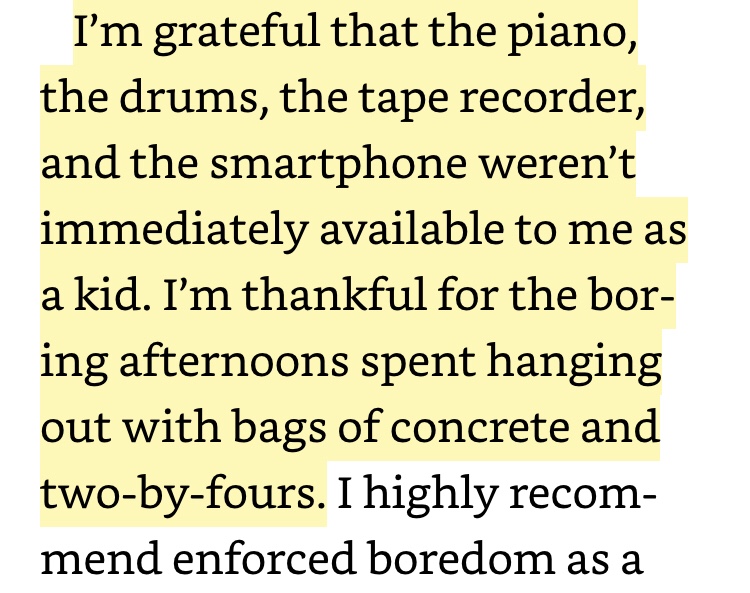
Stories are a first principle idea to consider. We run on stories and one way to get better at telling them is through boredom. Folds again:

Related: The 3 Ways to Spend Your Day.

The 3 Ways to Spend your Day

There are three ways to spend your day working in the knowledge economy.

The first day is to spend it trending. Follow the popular topics on Twitter, Reddit, and YouTube. This is good for serendipitous moments of discovery, awareness of the world, and to ‘keep-up’ with what the external algorithms suggest.

The second way to spend your day is to spend it in the feed. Cultivated email, RSS, and perennial podcasts. An infovore knows what they like and has is delivered. Often it will be confirmatory information from familiar sources, that’s okay if you’re honest about it.

The final way to spend your day is in search. There’s something to be curious about and you intend to do just that. Google offers the broadest service but new entries like Listen Notes and Twitter search modifiers have started to index novel parts of the internet.

There’s no ‘best practice’ for the 3 Ways to Work, rather the work of the day dictates the way.

Much of what we call knowledge work focuses on decision making and much of this is a cycle between the exploration of the new and application of the familiar. It’s a balance between finding new things and digging into curio-seams.

Tyler Cowen is an example. His feeds at Marginal Revolution and Twitter offer the day-to-day goings-on, but searches on Listen Notes, YouTube, and the blog allow someone to figure out ideas like mood affiliation (my notes here), which is one way we make mistakes.

For example: Are plastic bags more harmful than paper? Are bag-bans beneficial? What’s the metric? We’ve already noted another Cowen-ism about solving for the equilibrium, but without search, we’d have missed the idea about mood affiliation. Cowen told Russ Roberts:

“Plastic is often more environmentally friendly than having a paper bag because it takes less energy to make and dispose of. Plastic is better for the world and can even be better than those reusable cloth bags unless you use them two-hundred times and up but that’s hard to do and that’s the break-even point. The environmental virtues of plastic compared to a lot of other alternatives is underrated.”

The question of bag bans for me was pure mood. Us good, them bad. I didn’t consider transport costs (paper is much heavier) and production costs (efficiency figures). Instead, I took the easy route of WYSIATI: what you see is all there is, and all I see in my laundry cupboard is plastic bags.

Drizzle as marketing

img_6031

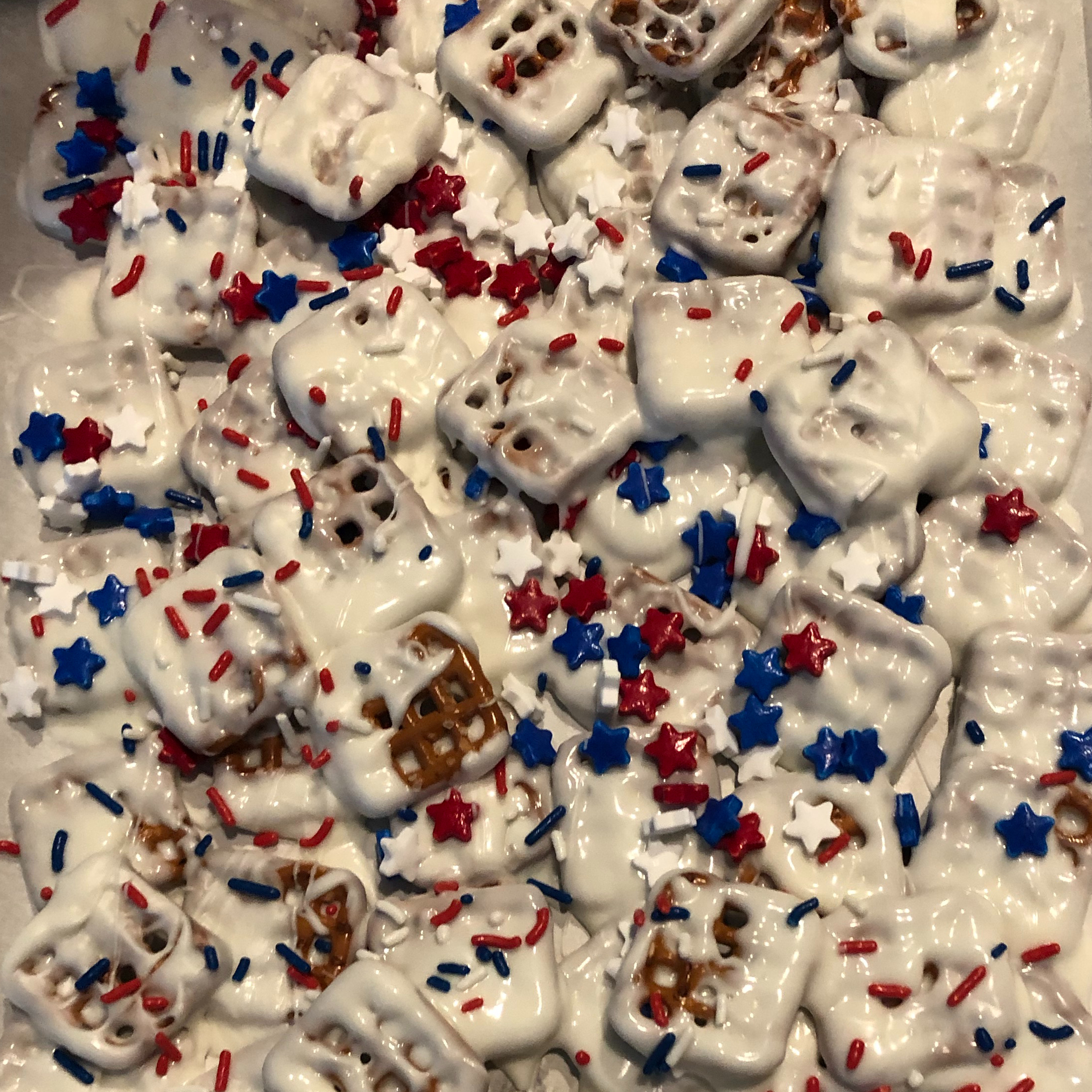
We made this for the Fourth of July. There were delicious. They were also tedious. 

We microwaved a block of white chocolate and used kabob sticks to carefully dip each pretzel into the creamy confection. It required careful speed. Go too quickly and the ratio of chocolate to pretzels was off. Go too slowly and the chocolate vat stiffened but the ratio was better. 

The next time we’ll drizzle the pretzels. The next time we’ll lay them flat and drizzle spoonfuls of white chocolate and red-white-and-blue sprinkles. It would have tasted just as good, looked just as nice, and it would have been drizzled. Think about something that’s been ‘drizzled’ compared to dipped or dunked or plunged. Each of those words carries a different meaning. Each of those words has a tiny bit of Alchemy. 

Businesses succeed by delivering value to customers as well as keeping some value for themselves. Reframing by renaming is an easy way to do just that. 

These ideas are everywhere. Sometimes, like the case of our patriotic pretzels, it can be more work to provide less value. The next time I’ll be delivering some Drizzled Delights rather than chocolate covered pretzels with sprinkles.  

The Vaccine Friendship Paradox

One non-intuitive concept, at least in scale, is the network. Like average numbers, it takes some work to construct the correct conclusions. Graph, chart, and count the way that people interact, decide, and connect and there will be patterns. It’s network effects which fuel companies like Instagram and create the increasing returns economy.

Networks, as Nicholas Christakis notes, are agnostic. They spread whatever they are seeded with, whether real viruses like Ebola or WOW viruses like corrupted blood. The question then is; How and what to seed a network with?

Eric Bradlow wondered about Covid vaccines on Wharton Moneyball:

“We study diffusion of products all the time. In theory, you want to observe the social graph. In marketing the question is: Who do you give the free product to? This is standard network analysis and with that data you could do a smarter initial seeding (of a vaccine).”

Is there more bang for the buck if one person gets the vaccine rather than another?

Yes, though it’s not intuitive.

As the Friendship Paradox video shows, we aren’t all connected to the same number of friends. Some people have more, some have fewer friends and to wisely allocate a scare resource (like with marathon slots) it takes some small adjustments.

Christakis has spent a lot of time mapping networks and noted that across cultures, space, and time most human networks look the same. Some people are more connected than others. A few have hundred of connections and hundreds have a few.

It’s important for Christakis because like Bradlow, he works with a diffusion problem. Rather than marketing products though, it’s about sharing vaccines and vitamins. The thinking for both goes like this, if you can share something that works with the right person then they will share the benefits of that with the rest of their network.

But how do you pick the right person? Christakis shared this tip: “Go into a village and pick people at random. Have them suggest their friends and vaccinate their friends rather than the originals.”

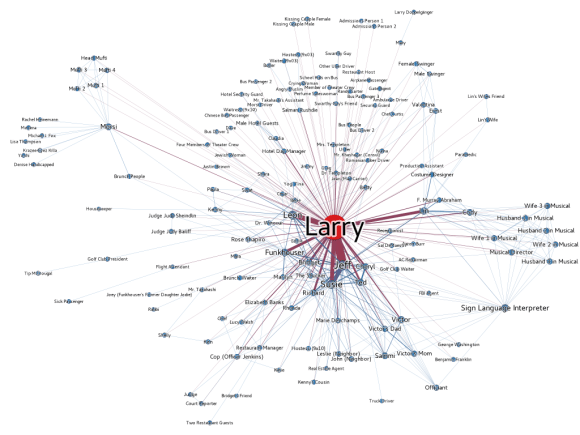
Most networks are like the Curb Your Enthusiasm network (via Funkhauser).

curb_your_enthusiasm_-_season_9_-_network_graph

Randomly enter that network and you could get anyone but then ask for that person’s friend and more often than not you’ll get Larry. He’s the hub. He’s the super spreader. He’s who to vaccinate or market to.

It’s a neat bit of math. Rather than random choice, ask one question to improve the odds of an idea, movement, or effect catching on.

While there’s nothing on networks, my latests pay-what-you-want is on Tyler Cowen’s ideas about decision making. One idea is ‘meta-rationality’ or knowing when you don’t know AND knowing where or who to go to to find out. 

What you pay: Deals in the NBA

Shane Jensen to Seth Partnow, “you make the decision to be agnostic to contract in your analysis, but as you think about building a team, contracts are something you need to take into account.” Partnow notes:

“If you’re doing an asset value ranking then age and contract come into the decision making process. There’s some players at the very high end you pay whatever: LeBron, Kawhi, Giannis. You pay them whatever because they still outperform that based on the max contract structure. It’s almost literally impossible to overpay those players.

Partnow

The other group that tends to outperform their contract is rookies, again based on contract structures.

This was in the same podcast where the Wharton hosts discussed Tom Brady, who is making more things go right, and appears to be defying the Howard Marks word of warning: “Buying good things can’t be the secret to success in investing. It has to be the price you pay. It’s not what you buy, it’s what you pay. There’s no asset so good it can’t become overpriced.”

The Netflix and Pool Co. Contrast

Marc Andreessen once noted that it’s important to learn the right lessons from our experiences. As the expression goes, you never step in the same river twice.

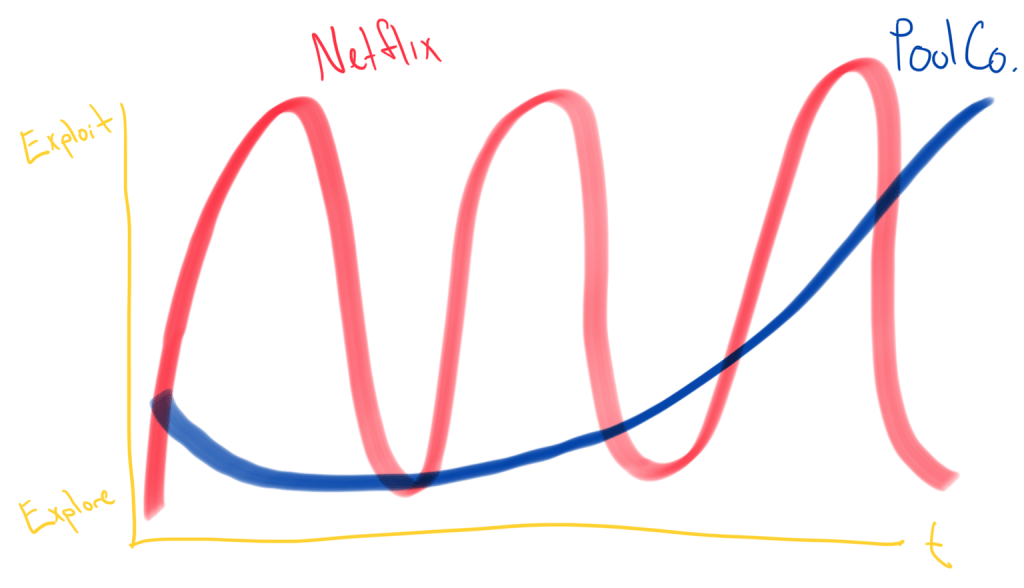
One lesson from Reed Hastings’ No Rules Rules book about Netflix is the idea of cadence. To survive in their system, Netflix must tack from explore to exploit at a faster pace than the local pool construction company.

In the book Hastings writes that the Netflix expense policy (‘Act in the best interest of Netflix’) probably costs 10% more than a more strict policy but that it allows the employees to make faster decisions in an industry where the cadence has to be quick.

Co-Author Erin Meyer points out up front that Netflix has succeeded at four inflection points: DVD by mail to streaming, streaming licensed content to original, licensings original content from external studios to internal, from USA only to global.

That’s a lot of change in a short amount of time.

Pool Co. by contrast will probably stay in the exploit region for a longtime, in the right geographic region forever.

The filter from Hastings is this: the internal cadence should reflect the system’s cadence.

What are the incentives behind this prediction?

Predicting like Tyler Cowen, Enrico Fermi, and Nate Silver.

One way to think more like an economist is to think about incentives.

In our piece about Tyler Cowen, the setting is finding food in a strange place. The incentives question is, what to ask a concierge or driver considering their incentives are often avoid blowback rather than emphasize excellence.

The incentives of predictions are boiling in the last week before the US presidential election. Though math is always clear cut (2+2), the selection isn’t (why do 2+2 explain this?). Some polls, Nate Silver noted (on ModelTalk) offer extreme predictions as a form of marketing. Their incentive is attention, not precision.

In his update of The Signal and the Noise, Silver writes that it’s hard to change ones mind once allies, alliances, and reputation are created.

One way to avoid this pitfall is to make guesses to and with others who have a similar incentive structure. In the book, The Last Man Who Knew Everything, David Schwartz writes about Enrico Fermi. It’s December 1938 and Fermi has just fled Italy via Stockholm for his collection of the prize. It seems a good choice as the Italian media and Mussolini-mob wonder why Fermi shakes hands to receive his prize rather than give the fascist salute.

Settling into his professorship at Columbia (New York, but soon headed to Chicago) Fermi joins the “Society of Prophets”, or that’s at least what his wife calls it.

The Society meets monthly, and each member predicts ten yes/no events. A tally and total are kept. When the family moves to Chicago in 1942 Fermi successfully predicted 97% of the events.

“He did this, she (Laura) writes, using the most conservative algorithm imaginable: the next month would look almost exactly like the previous month. He did, however, miss one prediction—the surprise German invasion of the Soviet Union. The game was ideal for someone of Fermi’s temperament, invariably conservative and skeptical of any predictions of quick or revolutionary change.”

Fermi had strong priors. Fermi made boring predictions. Fermi was right. For Fermi and his colleagues the incentives were academic accuracy. For pollsters it’s media recognition.

The book is a bit thick, but inspiring is that while Fermi won the Physics Nobel Prize in 1938, his explanation for the discovery was wrong.

“Online” Banking, “Traditional” Celebrity

In one of the business classes I took in college (2000-2005) a professor used online bill pay as a way to demonstrate up-selling. A bank charged clients for the privilege to pay bills online, up to so many a month of course. That feature looks to become commonplace around 2011.

Related is brands and “traditional” celebrity endorsement, a topic between Connie Chan and Tiffany Zhong (more on Zhong here).

First, something is a thing; a celebrity. Or it’s a verb; dating or bill paying. Then, with a new way to do it, its explanation is modified

  • traditional celebrity rather than influencer
  • online bill pay rather than mail the check bill pay
  • online dating rather than dating
  • e-learning rather than school
  • social media rather than media
  • iPhonography

This post will be a marker along the way then, when we noticed the world shift slightly, from one of many paths to another. That celebrity must be modified.

“If you use Tinder, you do not do online dating, you just do dating. If you get in an Uber, you’re not doing digital car sharing, you’re just getting somewhere.” “People now behave in a way where the internet is background to everything they do.”

Tom Goodwin, 2018 YouTube

Feel free to add others in the comments.

Jobs with Rules

Education has been top of mind lately around our house (thanks Covid). We’ve considered college admissions, advantages of online learning, and whether reading is different than listening to a book (spoiler: both are good).

There’s some big picture ideas too: curriculums, college, and careers. My daughters (12, 10) aren’t near that yet, but it’s hard not to think about as we see careers adapt to remote work. My wife can work online, somewhat. Teachers can teach online, somewhat. Aside from some manual labor, for the last decade all my income has been earned online.

In Shop Class as Soulcraft Mathew Crawford notes that you can’t hammer a nail over the internet. Or, are things rule based or not? Rules mean code, code means computers and as Feynman explains, computers are fast at following rules.

TikTok’s design is simple rules. On, off. Yes, no. Open, closed. Watched, not. Shared, not.

Circa 2013 self-driving trucks were the topic du jour. However, driving a truck isn’t that binary, it’s not that rules based.

Our truck driver, Finny Murphy writes more about the problems solving involved. Keep the truck between the lines. Pick up this cargo, take it there. Then go here. Unload, schedule workers, back down this long driveway. Get stuck. Negotiate with owner to use his chainsaw, trim a limb. Murphy’s job would have been better with more computer help as he’d spend less time ‘bob-catting’ (driving without a trailer) if there were a network that listed jobs.

Contrast truck driver with financial planner, the latter has years of college. They’re licensed. They’re a charter holder or a master of business. Even more likely is that they have a podcast. The financial planner helps people with money, a very important thing. They wear suits! They have offices!

Which is more rule based?

One sign to spot rule based conditions is when we stop calling something the ‘internet something’. Internet banking, internet dating, and ‘I read it online’ are all things of the past. It’s just banking, dating, and reading now. Did you know, that internet bill pay used to be an add-on, banks *charged* for that service.

Which is more like TikTok, financial planning or truck driving? Finances is already rule based with target date and index funds.

Okay, so what direction should education head?

In Average is Over, Tyler Cowen writes that three things are scarce: quality land and natural resources, intellectual property or good ideas that should be produced, and quality labor with unique skills. I’ll read ‘good ideas’, ‘quality labor’, and ‘unique skills’ as antonyms for ‘rules based’.

Note: About 7% of truck drivers have bachelor degrees compared to 35% of the population. Both figures lower than I’d guessed. Also, rules can be especially helpful when they make you ‘color blind‘ to unhelpful information.
Cuban Missile Crisis (58 years)

It’s about halfway through the Cuban Missile Crisis anniversary and if you want to dip in, Dan Carlin did a great podcast about the event.  I enjoy listening this time of year to ‘feel it’. Media transports us through time and space but to listen on anniversaries or read in places adds a something.

Three ideas:

1/ It’s no wonder game theory thinking came from this era. John von Neumann worked on the Manhattan project and later advocated for mutually assured destruction. My prior is more Oppenheimer less Neumann, but as Carlin reminds us, life is complicated:

“What if the US had gone the full force Robert Oppenheimer ban-this-stuff route? What would the Soviets and Joseph Stalin had done? To a man they (the Russian advisors) say it would have been seen as weakness and Stalin would push forward with his weapons program.”

Like the prisoner dilemma, if one player will choose with certainty it reduces the opportunities for the other.

2/ As we covered, Eisenhower liked to argue well. That can be difficult for leaders to model. One technique according to Marc Andreessen, is for those in charge to challenge each other.

Eisenhower gives the Atoms for Peace speech but before playing a clip Carlin confesses, “nothing can be trusted from this era, nothing. The presidents, from Truman to Eisenhower all have two faces to them and I don’t know which one is real.”

Or, it’s hard to have ‘Yes’ men if no one knows what you’re thinking.

3/ That Atoms for Peace speech only comes about because of career capital. Eisenhower succeeds Truman, born in 1884, the year the steam turbine was invented. Carlin suggests we imagine Truman as a grandfather calling his grandchildren asking how to turn the damn devices off.

Eisenhower is elected, gives the speech and coins military industrial complex eight years later. Carlin adds, “I can’t imagine our leaders today giving a speech like (Atoms for Peace). In 1953 he laid the whole situation out.”

If you’ve a long solo fall drive, fall walk, or evening outside take a listen. There’s many more parallel ideas like between humanitarian intervention (related: With the Old Breed) and herd immunity. It’s also a prompt for thinking about hot and cold communication (it took half a day for Kennedy’s letters to make it to Krushchev as well as alternative histories.