Lowenstein’s Warren Buffett

Supported by Greenhaven Road Capital, finding value off the beaten path.

Roger Lowenstein’s Buffett: The Making of an America Capitalist was a good tour of WB’s investing career through the late 1990’s. The many Buffett Books, (20 pages on Amazon!), CNBC Archive, and Berkshire Letters are enough material for someone to become a Buffet expert. This post is my novice preferences.

All unattributed quotes are from Lowenstein.

Ready?


The volume of materials demonstrates Buffett’s emphasis on communicating with your stakeholders.

“But one purpose of his letters was to attract and knit together a shareholder group who would behave like his partners—in other words, who would stick with him.”

“He took pains to explain his approach in advance, and in concrete terms—precisely because he knew that a misunderstanding could sunder the union.”

Investors require patient capital but restless capital can walk away. Chris Douvos noted about long-term investing, that “The Venn Diagram of the people who can do it and have the courage to do it is actually pretty small.”  Writing letters was Buffett’s way of bucking up his stakeholders.

Flip-flopping is pejorative while updating beliefs is praised. Buffett is and was an updater.

“In Buffett’s view, (Disney’s) most valuable feature was its library of old cartoons and films, such as Snow White and Bambi. A Ben Graham would not have been interested in such an imprecise asset. However, Buffett estimated that, on a proportional basis, the library alone was worth the price of a share.”

“He was bolder than Graham: more willing to load up on a stock or to ride a winner. And, of course, his results had been better.”

“The ‘main qualification is a bargain price,’ he wrote; but he also would pay ‘considerable attention’ to qualitative factors.”

Munger may have planted the seeds for the switch from quantities to quality but Warren prepared the soil.

Maker Schedule, Manager Schedule. Paul Graham blasted manager schedules because, “A single meeting can blow a whole afternoon, by breaking it into two pieces each too small to do anything hard in.” Buffett’s calendar was a makers calendar.

“His day was a veritable stream of unstructured hours and cherry colas. He would sit at the redwood horseshoe desk and read for hours, joined to the world by a telephone (which he answered himself) and three private lines: to Salomon Brothers, Smith Barney, and Goldman Sachs.”

Berkshire Hathaway is the buyer of choice – in part – because of their Decentralized Command. Lowenstein explained that Buffett, “picked the chorus line but didn’t attempt to dance.”

DC works because the people on the ground know the details better than the people up in the offices. Andy Grove valued the wind of the real world. But front lines expertise is also an ignorance. Buffett’s managers send their profits to Omaha because Warren is a better capital allocator. Much like Charles Koch, Buffett got a detailed report from the front lines but made his decisions from a command post.

Coca-Cola.  In 1988 Roberto Goizueta noticed someone was buying Coca-Cola stock. Don Keough wondered if it was his fellow Omaha native, after a phone call he found out it was.

Part of the reason Buffett bought was that while Americans were drinking 74X as much Coke as Indians, even though India had 3X as many people.

Investing heroically. Buffett’s success – in part – is due to investing in good companies during bad times. One example was GEICO, and Lowenstein recounts Buffett’s diligence:

“Then he went to see insurance experts—the B, C, and D of the day. Every one told him that GEICO’s stock was overpriced. Buffett’s reading of the facts was just the opposite, but he found them daunting. They were experts; he was in B-school. Every stockpicker worth his salt eventually comes to such a crossroads. It is extremely difficult to commit one’s capital in the face of ridicule—and this is why Graham was invaluable. He liked to say, ‘You are neither right nor wrong because the crowd disagrees with you.'”

With Graham’s support and Buffett’s diligence, we have an example of  Howard Marks‘s matrix. Chris Douvos said that David Salem encouraged him to ‘invest heroically.’ Lowenstein wrote:

“Buffett’s portfolio was decidedly unconventional. With his big bets on American Express, Berkshire Hathaway, and two or three others, the lion’s share of the pool was in just five stocks.”

The real competitive advantage Warren Buffett enjoyed was being Warren Buffett. In the book, his research is almost trancelike. As Mohnish Pabrai asks students who ask him about becoming investors, “Are you wired for it?” Pabrai notes:

“The first question investor need to ask themselves is ‘Does the glove fit?’… after you read an annual report you have to ask yourself, ‘you know, I spent two hours reading that, would I have preferred doing that or watching a Star Wars movie?’…you have to ask what type of activities give you the greatest satisfaction.”

Warren’s satisfaction comes from reading the reports.


Thanks for reading.

David Heinemeier Hansson

Supported by Greenhaven Road Capital, finding value off the beaten path.

Yes, we wrote that Katrina Lake had a good point about MBA programs, BUT I couldn’t help myself when this David Heinemeier Hansson (DHH) video titled “Unlearn your MBA” from 2010 came up on YouTube. This is our second post on DHH, the first is here.

Why should someone unlearn their MBA? For starters, it teaches you the wrong thing. In business school, you’re writing for professors. In the real world, you’re writing for customers. There’s a big difference.

DHH and his co-author Jason Fried are big on sharing their ideas via writing on their blogs and in their books. Josh Wolfe made the point that part of what makes a great founder is being a great communicator.

If that weren’t enough encouragement, writing well is a form of thinking well. Maria Popova put it best, “writing is thinking in public.”

Another problem with MBA program is the planning emphasis. Yes, DHH admits, planning is helpful for McDonald’s when they want to plan how many cheeseburgers they’ll sell in Q2 2020. But small businesses don’t need quite as much. MBA programs offer one thing, and rather than unlearn it we should reconsider it.

Hanson has choice words for venture capital too. “It’s a time bomb…the most harmful thing you can do to your business.” Why is that? Money becomes a crutch. Instead of relying on money, strengthen your creativity. Constraints are an asset. “Sometimes restrictions get the mind going,” wrote David Lynch, “sometimes you come up with very creative, inexpensive ideas.”

Instead, Hanson says; build a product with a price that generates actual profits. When Marc Andreessen’s number one piece of advice is to charge more I wonder if it means the same thing. You need the market to respond to what you’re doing.

For Hanson, the sooner the market speaks, the better.

Productivity advice. “Being a workaholic neither guarantees success or is a requirement for it.” Sure, Hanson says, there’s no such thing as an overnight success, but success comes from better choices, not more time.

Hanson lives in California and has co-workers around the world. “You can’t over collaborate seven time zones away,” he tells the class. He shared another smarter not harder choice with Lifehacker, saying his best time-saving shortcut was:

“Saying no. I’m always astonished by the tangled web of obligations most people manage to weave for themselves. I say no to almost everything. Then I can commit myself fully to the few things that I do truly choose to do.”

And about email.

“Most people’s inbox are overflowing because they waver, so they defer, which just makes the anxiety ever greater. Just make the call, which in my case is mostly “no,” then move on.”

Casey Neistat and Ryan Holiday teamed up to give similar advice in April 2018:

Hanson also believes in being there. Basecamp is a flat-ish organization because they don’t want to “disconnect the deciders and the doers.” One feature of Dead Companie’s Walking was absentee managers.

That Hanson spoke at all is surprising. As he says at the end, he’s afraid of alpha erosion.

“The companies that I look to that are doing well rarely get any PR at all. Most companies that are run like us are smart, they duck, they don’t talk about how much money they make. They don’t want to attract any attention.”

Eddy Elfenbein reminds us, “Always be aware that these advantages are not permanent.” And success attracts interest.


Thanks for reading.

Tren Griffin

Supported by Greenhaven Road Capital, finding value off the beaten path.

Tren Griffin was delightful in his podcast with Patrick O’Shaughnessy. What makes these two such a treat is the enthusiasm. This post will be a snapshot whereas Tren’s blog is an ongoing story.

Businesses succeed when they create something of value and capture part of that value. “Just because you have a product people want to buy,” said Griffin, “doesn’t mean you’ll have any margin.”

David Chang noted this too, “One of the things I wish the public knew is that just because you’re a busy restaurant doesn’t mean you’re making money.”

You know you have value, Griffin said when, “Everyone in the company is thinking, ‘My god, how are we going to satisfy all these orders?’ You’re not sitting around in the conference room, thinking, ‘Maybe we should add a feature.'”

Word of mouth is the gasoline on the bonfire of value. “You can’t scale a business very well if you have inorganic approaches to acquiring customers. If you have to buy radio ads it’s a hard slog.” And that word-of-mouth needs to feed into a large enough market. “It’s hard to scale a business for horse blankets.”

But As a company grows they need to watch out for the Wholesale Transfer Pricing trap.

Griffin takes inspiration from Fisher, “Fisher basically says, if you’re negotiating for something and you only have one choice you’re screwed.” The Movie Pass model, he said,  “is fundamentally dependent on the price of the retail tickets and they only have one supplier.” Netflix avoided this trap with original content and it’s reflected in Ted Sarandos‘s disinterest in sports. “The reason I don’t get tempted by major league sports,” Ted said, “is that the pricing power all belongs to the leagues.” Griffin points businesses to Andy Rachleff’s advice.

The organizations that capture value best have moats. They can be network effects (Modern Monopolies), economies of scale, intellectual property, or brand. “But brand doesn’t mean as much anymore, word-of-mouth means more. To the millennial generation and younger, they’re hooked on getting some product that Yeezy’s.” Brand could be considered a capital light business. During Rory Week we looked at his ideas, specifically around trains. It takes millions of dollars to upgrade to faster trains, Sutherland said, but much less to upgrade to more enjoyable ones.

Griffin notes that there’s a difference between building moats and buying them. Bill Gates built one. Warren Buffett buys some. To build one, Griffin said, takes an artist. “Jim Senegal and Howard Schwartz are artists. They have a gestalt sense of where the value is and what customers want.”

Moats, wrote and spoke, Pat Dorsey have high switching costs and we used his ideas for this podcast:

https://soundcloud.com/mikesnotes/moats-and-allocators

While platform businesses dominate today, there’s more than one way to build a business.”Sometimes you have to sell a box to sell software. You sell this thing which allows you to sell this service and the margins are in the service and the stickiness is in the thing.”

GoPro, Giffin said, never invested enough in the software angle. “Software is eating the world but hardware allows for distribution.” Software businesses are great. “I’m in the software business,” Griffin said, “and I see the gross margins in other businesses and I think, ‘MyGodd. How do they survive? They’ve got no money for anything.'”

Griffin’s notes, quotes, and ideas come from lots of reading. His deep interest started in 1999, “People were getting rich in ways I couldn’t imagine…I just didn’t know what to do…I read The Alchemy of Finance and I said, ‘I gotta read more books’… I read Hagstrom’s books and thought, ‘Who is this Munger guy?'”

He collected quotes. He wrote up notes. He built out his set of mental models. “Looking at mental models,” Griffin said, “is a mental model.”

How should you go about this? Let the index at the end be the beginning of the next. “If you chase someone like Munger down and read the books they recommend, then you find other strands and it’s like the root system of a redwood tree.”

More specifically, it’s Munger’s Worldly Wisdom and Psychology of Human Misjudgment talks that set Griffin’s hair on fire. Learning, thinking, and reading has also led Griffin to adopt Munger’s maxim, a year in which you don’t change your mind about something is a wasted year.

For instance, “The older I get the more I realize there are more pools of alpha than I thought.”

Griffin’s Barksdaleisms post is full of great quotes and we’ll cherry-pick one from the podcast.

“The infantry is always ahead of headquarters.” Jim Barksdale

This, said Griffin, was “classic Jim.” “Great operators get out of their chair and find out, they go and meet with the infantry…There’s nothing like a whole day in a call center to give you a good sense of what the customers are thinking about your product.”

This was something Kayak founder Paul English followed to the letter. English installed a red phone in the middle of his office. Tracy Kidder wrote that he also:

“He had wanted everyone at Kayak—and especially the programmers—to imagine themselves in the place of that customer looking for the right flight to Cleveland. Paul had devised a scheme he called “Empath,” which had obliged every coder in Concord to answer some angry emails from customers.”

Griffin said, “You and I need to go out on sales calls. We need to sit with customers…
Bill Gates said, ‘Unhappy customers are our greatest sense of learning.'” Andy Grove said that you can’t make decisions without feeling the winds of the real world.

Going out into the real world – Chasing the Scream – teaches you that gangs are antifragile

In Shop Class as Soulcraft, Matthew Crawford puts it this way:

“This history provides a nice illustration of a point made by Aristotle: Lack of experience diminishes our power of taking a comprehensive view of the admitted facts. Hence those who dwell in intimate association with nature and its phenomena are more able to lay down principles such as to admit of a wide and coherent development; while those whom devotion to abstract discussions has rendered unobservant of facts are too ready to dogmatize on the basis of a few observations.”

This is our fourth post highlighting Griffin; Tren and Munger, Tren on a16z, and Tren and his book. Thanks for reading.

Jim Chanos

pablo (50).png

Supported by Greenhaven Road Capital, finding value off the beaten path.

Rapid fire notes from Jim Chanos conversation with Barry Ritholtz on Masters in Business.

Chanos’s firm, Kynikos, is named after the Cynics of Ancient Greece. “They basically were searching for the ultimate truth.” Here is one, unique, Diogenes primer.

Decentralized Command. Early in Chanos’s career, he worked for Gilford Securities, a job with “the latitude to do whatever I wanted to do.” Later in the episode, Chanos said that one mentor was Bob Holmes:

“Bob Holmes was not only a mentor but he stood behind me in the darkest days of Baldwin. The stock had doubled. The New York partner was screaming for my head on a plate. I was all of twenty-five years old. But he stood behind me. He’d seen the work. He’d seen the documents. He’d said, ‘Kid, you’re right.'”

Lowenstein describes Warren Buffett’s approach to decentralized command as “he picked the chorus line but didn’t attempt to dance.” Kirk Lacob of the Golden State Warriors put it this way; “I always thought our secret sauce was that we have great people and turn them loose and let them do what they’re best at.”

Of course, decentralized command only works with the right incentives. It’s the Upton Sinclair warning; don’t expect someone to understand something his job demands he not. Chanos said his first short report “wasn’t received very well as you can imagine, particularly because the big brokerage firms who recommended the stock were also making a fortune selling their annuities.”

Tesla, Chanos said; “is one of the bellwethers of this market. It is a hopes and dreams stock. Investors have pinned their hopes and dreams on this stock and on this CEO, who has done a very good job promoting that vision. The problem is that it is an automobile company.”

It sounds like his criticism of Musk is selling too much sizzle and not enough steak. Great leaders, said Josh Wolfe, “…need a marriage of both. You need a storyteller and you need an operator.”

The secret to great investing is having an edge.

“Julian Roberts had said it best, ‘What is your edge?’ When having a bear and a bull discuss a stock at his shop he would constantly say, ‘What do you know that the market doesn’t?’ What is in your process that gives you an edge, trading-wise or research-wise? What makes you see things differently? Where you see the reality rather than the perception of reality?”

Edges are tricky, performance figures are easy. But as Chris Douvos noted, performance is often a lagging indicator. It sounds like Chanos agrees, “What most people do is look at performance and that alone will not do it for you because you’re always going to chase that which is behind.”

Around 23:30 Ritholtz and Chanos discuss China. Here’s Josh Brown’s request for readings about the country. Beyond the books and the podcast, there’s this 99PI episode about duplitecture in China and also the ghost cities.

China’s problem, said Chanos, is borrowing. “Any time you use debt to fuel grow you’re pulling forward consumption.”

Early in his career, Chanos learned the value of arguing well. Another mentor was Julian Robertson, and “his approach galvanized me. He’d call me up and say, ‘I see you’re short XYZ Corp. Some guys in my shop like that. Why don’t you come over for lunch.’ It was always like going into the lion’s den.”

Reporters like to know the other side too. Ritholtz asked if that’s why Chanos had a pleasant relationship with the media. “Reporters generally like talking to short sellers because they’re going to get the opposing point of view on a situation.”

A recent addition to this point is what Bryan Caplan calls the Ideological Turing Test.

https://soundcloud.com/mikesnotes/clip-bryan-caplans-ideological-turing-test

Books “I read a lot of history,” Chanos said.

“One of my favorite historians is William Manchester. Everyone remembers his MacArthur biography (American Caesar) and his unfinished Churchill Trilogy, but the book that’s a game changer is A World Lit Only by Fire. It’s the story of middle ages and reformation, written through this prism of great people like Magellan and Gutenberg.”

Also.

“In my history of fraud class, we love The Match King by Frank Partnoy…a wonderful story of the greatest fraudster of the 1920’s.”

Thanks for reading.

Daryl Morey

Supported by Greenhaven Road Capital, finding value off the beaten path.

In honor of the Houston Rockets ascent, here are my twelve favorite Daryl Morey quotes. As Morey noted at the 2017 Sloan Conference, we need to continue our education, because, “We’re here because human beings are really really bad at making decisions.”

1/ “The problem, if you’re a journalist, is that you have to take an angle that’s interesting to your audience.”

News as noise is true when two groups have different metrics. Analytics are a difficult story whereas tropes are not.

2/ “I was really into baseball because I was a math nerd and you couldn’t get football stats, baseball was the only game in town.” Interests are your competitive advantage. As Buffett says, he and Munger aren’t going to try to out Bezos Bezos.

3/ “One of the tough meetings early on was meeting with coach O’Brien and saying, ‘Yes, you are number one in field goal percentage but you also are giving up the most open threes in the league.'”

Ease of measurement does not convey importance. “Someone created the box score, Morey says, and he should be shot.”

4/ “I was having this conversation with Frank Vogel. If you knew threes were good on offense you had to know they were bad on defense but that whole marriage hadn’t happened yet.” Invert, always invert.

5/ “Our poor CEO, all the press hits of negativity for our owner Leslie Alexander hiring me. He’s just dealing with the radio guys calling me deep blue, calling the owner crazy.”

Credit to Alexander for choosing to try something unconventional rather than conventional.

6/ “Yeah, teams have caught up (with Houston’s draft model). We feel like we’re farther ahead but the edge is much smaller. The difference between better model and slightly better model is way different than better model and no model. That edge has really eroded and we’ve adapted.”

Alpha erodes.

7/ “The baseball analytics guys were coming in and telling everyone they’re wrong and everything is wrong, so that was a tough sell. By the time basketball started looking at analytics a lot of our analysis was making coaches feel better. Guys like Shane Battier averaged eight points and five rebounds but coaches loved them. A lot of the advanced analytics stuff said that guys like Shane were worth a lot more than you think. When you have a message that’s like hey you’re right, here are a few areas you could improve versus, hey, you’ve been wrong your whole life you idiot the integration was a little easier.”

8/ “I want more bad owners… you’ve seen the poker analogy. If you’re the one shark among minnows you clean up but if you add just one more shark all the profits are divided by two.” It’s the parodox of skill.

9/ “I don’t think it’s really a factor (Morey’s lack of basketball experience). I mean, you don’t have to be a farmer to run Hormel.” Hardwood version of Green lumber.

10/ “Mike (D’Antoni) is a very good communicator and I’m reacting to him. He just says, ‘Hey, this is what I’m planning to do,’ and the answer, almost universally, is ‘sounds great.'”

As Morey’s contemporary Kirk Lacob said, “I always thought our secret sauce was that we have great people and turn them loose and let them do what they’re best at.”

11/ “A good strong locker room creates option value for certain guys you can add.”

Culture, said Ben Horowitz, is what people do when they aren’t told what to do. Peter Theil wrote, “No company has a culture, every company is a culture.”

12/ “When there’s a deal that’s fair for everyone, just do it.” Chris Douvos was encouraged to be a Partner, to be fair, and never have to go into the bottom drawer to pull out the documents that said who got what.


Thanks for reading.

Cade Massey

pablo (49).png

Supported by Greenhaven Road Capital, finding value off the beaten path.

At last Cade Massey was the interviewee rather than the interviewer. The podcast he co-hosts, Wharton Moneyball, is a lively discussion of sports analytics and a show we’ve covered before. These notes and quotes are from Massey’s appearance on Bet the Process.

In addition to being a Wharton professor, Massey consults with teams, mostly in the NFL. His initial research was a 2005 paper, Overconfidence vs. Market Efficiency in the National Football League authored with Richard Thaler. Massey now consults with teams because, “They want fresh eyes looking at things but they also want a bridge to what’s going on in other industries, what are best practices, what’s going on in other sports, what’s happening in the academic world.”

Teams want out of sample tests. Teams are looking for Ray Dalio‘s investment rule; “that it has to be timeless and universal.”

The smarter football teams have read The Success Equation. In that book, Michael Mauboussin writes about a continuum of luck and skill. Some actions, like chess, are more skill based. Some actions, like football, have more luck based. The luck and skill balance should influence decision making one way or another.

Sand enters our decision-making gears when we think we know something we don’t. Massey said, “Teams are too sure they know who is going to be good.”

“Teams put too much value in the top picks of the draft. Every year it feels like those guys aren’t just can’t miss but probable Hall of Famers…Every two years they’re talking about someone being a generational player.”

Teams violate Charlie Munger‘s iron rule of life, “that only 20% of the people can be in the top fifth.”

Instead, teams should pit historical data against player evaluations. But this is tricky. “Usually when people say they are ninety percent confident they are right fifty percent of the time.”

Take the Cleveland Browns. With two of the top four picks, Cleveland selected a quarterback and cornerback. Cleveland’s staff had a high degree of certainty about those picks. But consider a hypothetical trade, the sixth pick for the sixteenth and a few later ones.

“Teams don’t think enough in bundles. It’s not the sixteenth pick versus the sixth pick. It’s the sixteenth pick and a few other picks versus the sixth alone. You’re choosing one vivid, supposedly Hall of Fame player, versus three solid other players. It’s hard to keep that in mind, mostly they’re thinking about one vivid guy versus some vague possibilities.”

Layered on this decision-making quagmire is the vividness tendency. We like simple and obvious things. Ambiguity is like a puzzle piece that doesn’t immediately fit and as such we toss it out.

Instead, the Browns could have traded back.

“I’ve worked with an organization who had a philosophy of always picking up a future pick…it’s the surest return of the draft.”

Of course, trading back carries some risk.

“What you see (trading back) is that some teams are more comfortable doing those things. They’re going to take a little bit of risk and in exchange for their risk they’re going to get a little premium…if you can do that philosophically the numbers are in your favor.”

Risk is fine, so long as you’re compensated. Chris Douvos recalled David Swensen telling him, “Risk is not itself a dirty word. There are two kinds of risk, there are risks you can mitigate and there are risks that you can’t. The ones you can mitigate you want to spend all your time mitigating and diversifying them and the risks you can’t mitigate you want to make sure you get compensated adequately for.”

Trading back has the highest expected value on average but that doesn’t mean it always works.

“You have to have that philosophy and know that sometimes it’s not going to work out.”

Leaders must shoulder the shit umbrella.


Screen Shot 2018-05-01 at 10.48.36 AM.png

Being on the wrong side of maybe requires top-down support for what’s happening on the field. Coaches like Bill Belichick get the benefit of the doubt whereas other coaches do not. Scout Jason Licht told this story about working for Belichick and the Patriots:

“If I said a guy was a first-round pick, the Colts picked him, and he turned out to be a bust, they (Belichick and Pioli) wouldn’t have looked down on me. They wouldn’t have said I was a bad grader. Because that player in the Patriots system might have been successful.”

Massey explained, “That is what separates the best teams from the teams that aren’t run that way and that’s the root of all these issues. You need owners who will stand in the fray and handle the flack and keep a long-term perspective.”

Belichick was focused on the process not, the outcome. If the process is the steak, managers must also sell the sizzle. This was part of Sam Hinkie‘s problem – ironically so. Massey recalled:

“I remember Sam Hinkie talking about how he conveys information to the organization. Back when he was working for Daryl Morey as assistant GM of the Rockets, Sam would give information to his head coach one way, to Daryl in a different way, to the players in a third way altogether. You’re going to be dramatically more effective as an analyst if you can communicate in different ways tailored to the audience.”

The piece Hinkie lacked was how to communicate with the media and fans. Jeff Luhnow was interviewed by Massey for the Wharton show and he noted all the different people a general manager is accountable to.

“I think it’s important in our position we spend the requisite amount of time managing the stakeholders; the fans, the media, the influencers in the organization, the ownership – all of those stakeholders. I spend a large part of my job managing those stakeholders. It all comes down to communication.”

Money managers face this too. Joel Greenblatt told Barry Ritholtz, “My investors were great but maybe they wouldn’t be so kind when that (a 20% loss) happened, and it did seem to happen every two or three years.”

Besides overconfidence and under communication teams also have to align incentives. “The fundamental issue is that the general manager has a shorter term focus than the owner,” which is, “A classical principal-agent problem with a difference in time preferences.”

When Bet the Process cohost, Jeff Ma suggests a ten-year performance bonus, even if the manager or coach isn’t with the team, Massey calls it “A great idea.” Anson Dorrance had this idea too. He suggested that any board member who votes for a coach should lose their board seat if the coach gets fired. The board members kindly passed on this idea. Nassim Taleb, we will note, was not involved.

At the SSAC in 2017, Massey hosted the “Moneymind: Overcoming Cognitive Bias” panel. There, Farhan Zaidi explained his regret minimization technique. When his scouts were worried about being proven wrong on a trade, Zaidi said: “‘What if instead of making this trade we took him out back and shot him?’ and everyone said to make the trade.”

Massey said regret bias is “a major issue in decision making, and probably even stronger in sports where it’s public.” Billy Beane opined to Michael Lewis that baseball managers faced second-guessing from anyone who had played.


Thanks for reading. We’ve only hit the big decision-making points in these notes. In the podcast, Massey, Ma, and Rufus Peabody add nuance to the conditions.


Joel Greenblatt

pablo (46).png

Supported by Greenhaven Road Capital, finding value off the beaten path.

Joel Greenblatt joined Barry Ritholtz for a strong seventy or so minutes. Even though I’ve read (but need to re-read) You Can Be A Stock Market Genius I still enjoyed this episode. On to the annotations!

A new Point of View. Greenblatt had an hmm, that’s interesting moment in college.

“Junior year I read an article about Ben Graham’s stock picking formula and ‘net-net’ seemed very simple to me. I was at Wharton at the time and we were learning about efficient market theory and none of it resonated with me.”

“What they were telling us at Wharton was, don’t try to figure things out, stock prices are efficient.”

“It was a good age, I was twenty-one at the time.”

Time and again we this advice; pay attention to the world and if you see something that doesn’t fit your worldview note it.

How do you get seven million dollars from Michael Milken? Luck.

“The simple story is that I had a friend at Wharton who was one of the people in Michael Milken’s group and I had been working at a hedge fund but had always wanted to go out on my own, felt I was ready, and mentioned it to my friend, and said if I could raise X dollars I would go out on my own and he called the next day and Mike said fine.”

And then how do you return 50% a year for ten years? That’s (partially) luck too.

“One, we stayed small (“One of the ways to get those kinds of returns is not to run a lot of money. After five years in the business we returned half our outside capital.”).”

“Two, we were concentrated (“And the other way is to be concentrated. Six to eight ideas were usually eighty-plus percent of our portfolio.”).”

“Three, we got lucky. You have to have some luck to get those returns.”

I agree with Michael Mauboussin‘s comments about luck; “There is no way to improve your luck because anything you can do to improve a result can reasonably be considered a skill.” But also with Scott Adams:

“I find it helpful to see the world as a slot machine that doesn’t ask you to put money in. All it asks is your time, focus, and energy to pull the handle over and over. A normal slot machine that requires money will bankrupt any player in the long run. But the machine that has rare yet certain payoffs, and asks for no money up front, is a guaranteed winner if you have what it takes to keep yanking until you get lucky.”

The manageable variables for a lucky outcome are persistence and time.

Capital Allocation. In Greenblatt’s The Little Book that Beats the Market, he introduces the Just Broccoli store. What I misunderstood when reading this book were the second order effects. I thought 8% >2% returns. While true, the real value comes from reinvestment.

“All things being equal it’s better to own the business that can reinvest its money at fifty percent returns than two-and-a-half percent returns.”

After the Moats and Allocator’s podcast, I now understand that better.

https://soundcloud.com/mikesnotes/moats-and-allocators

Jellybeans and noise. Greenblatt started his Google Talk pointing out that Warren Buffett advocates for indexing, “But Warren Buffett doesn’t index and I don’t either, how come?”

“People are still emotional,” Greenblatt demonstrated to a ninth-grade class with a jar of jelly beans. First, he had each student privately count, guess, multiply, and estimate any way they saw fit to figure out how many jelly beans were in the jar. They wrote their estimate on an index card.

Then, he opened up a dialogue in the room and each student shared their guess OR changed it based on what they heard. The index card average was much closer than the open floor guesses. Do your own work, be disciplined, Greenblatt told the class.  “99.9% of what you read in the news each day is noise.”

Stakeholders. We call them stakeholders rather than shareholders to include anyone who is part of your life. Greenblatt returned investor’s money, in part, because he wanted fewer people to call him. A concentrated position, “like clockwork lost twenty percent of my net worth in two or three days.”

“My investors were great but maybe they wouldn’t be so kind when that happened and it did seem to happen every two or three years.” Today’s Gotham Capital Index Plus is a different arrangement, with different stakeholders, different rules, and different incentives.

Books!

“There’s a book called The Invisible Heart which explains basic economics…it’s a very short book that most people should read.”

“For investing, if you’re a sport’s fan Moneyball was one of the great ones…undervalued players are very similar to undervalued stocks.”

“I just read a book called The Power of Moments which I really enjoyed…it really comes down to doing new things.”

“I’m also having a lot of fun with Never Split the Difference.”

“Everyone who’s interested in investing needs to read The Intelligent Investor, especially chapters eight and twenty.”

“Buffet wrote a bunch of letters that were compiled by Lawrence Cunningham into topics and I always assign that in my class because I think it’s a great book (The Warren Buffett Shareholder: Stories from inside the Berkshire Hathaway Annual Meeting).”


Thanks for reading.


Chris Douvos

Supported by Greenhaven Road Capital, finding value off the beaten path.

Chris Douvos spoke with Patrick O’Shaughnessy, Ted Seides, and gave a pair of presentations at Stanford (2016 & 2017) that we will use for these notes on venture capital investing.

Douvos’s investing career began with some choice teachers; David Swensen at Yale, experience at Princeton, David Salem at TIFF. Douvos learned to be a BLT investor – beyond the long-term. Swensen told him:

“Investing is about optimizing discomfort. If you’re feeling too comfortable you’re not taking enough risk. Risk is not itself a dirty word. There are two kinds of risk, there are risks you can mitigate and there are risks that you can’t. The ones you can mitigate you want to spend all your time mitigating and diversifying them and the risks you can’t mitigate you want to make sure you get compensated adequately for.”

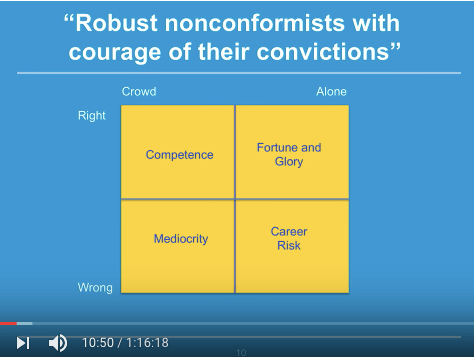
From David Salem he learned to invest heroically, as a robust nonconformist with courage in his convictions. Douvos presents it this way:
Screen Shot 2018-05-01 at 10.44.46 AM.png

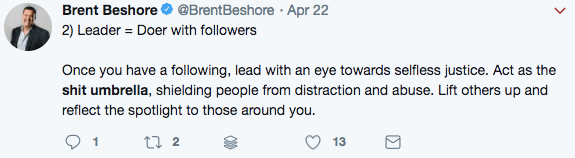
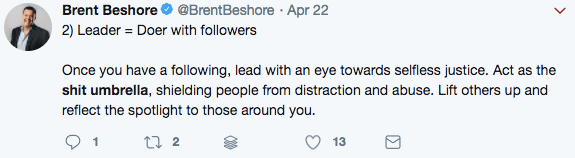
Howard Marks has a similar matrix that inspired Andy Rachleff to start Wealthfront. David Salem explained to O’Shaughnessy in their podcast that to be right and alone you need degrees of freedom. Or as Brent Beshore puts it, you need a shit umbrella above your head.
Screen Shot 2018-05-01 at 10.48.36 AM.png

Besides support from the top, Douvos warned Patrick that investors shouldn’t choose venture if they have the wrong timeline. “The biggest drive of venture success is a willingness to have a long horizon.”

High tolerance for risk, illiquidity, and a distant horizon, Douvos said, “is a rare trio.” Yale is the canonical example. “But Yale has a comfort envelop dynamic. They have an accommodative committee that will stick with them through thick and thin. They have a time horizon that is much longer than most folks.” This was a point Salem made too; someone can’t imitate the Yale strategy without imitating the Yale people and processes too.

But imitating Yale is comforting. Those folks are doing it. Being different takes career risk. Jeremy Grantham told Douvos, “Over ninety percent of decisions as an asset manager first take into account the career risk associated with those decisions.”

No one gets fired for IBM and not-buying IBM takes career capital. Michael Mauboussin explained it this way:

“I do think there’s an element of career risk, and this spans not just sports but also investment management. Bill Belichick goes for it on fourth down and it doesn’t work out and people give him the benefit of the doubt. But if you’re a coach who has a .500 team, it may be the correct decision but if you lose that game people don’t think about the quality of your decision-making process, they do think about the outcome, that’s a real big problem.”

Rory Sutherland said that this comes from our willingness to signal competence.

“If I pretend everything is logical, it may not be a really good decision but if things go wrong no one can blame me. This is an extraordinary form of corporate insurance.”

“The Venn Diagram of the people who can do and have the courage to do it is,” said Douvos, “that interaction is actually pretty small.”

The Venture Captial Model. According to Douvos, there’s no great model. As he says in a presentation at Stanford; “you don’t have winners repeating.” But, he tells O’Shaughnessy, it’s not as extreme as monkey’s throwing darts. That said, factors may not be the best approach. “If you found four factors, I’m not sure they would correlate with success, but they would certainly correlate with volatility.”

His best guess for a venture capital model with quantifiable inputs would be; concentration, scientific processes, early-ness, and size discipline. Like he says, it’s not easy.

One thing he wouldn’t include is performance. “I actually think track record is a lagging indicator, not a leading indicator.” Part of the reason is the time it takes for venture investments. The average investment, Douvos explains, lasts longer than the average marriage. Also, size isn’t a perfect indicator. “Someone once told me, it’s harder than you ever dreamed it would be to raise fund one, but far easier than you ever thought it would be to raise fund two.” O’Shaughnessy adds, “I call this assets vs alpha.”

Venture capital hasn’t always been so difficult and messy. Douvos admits in talks that he does a kind of “voodoo.” But it wasn’t always voodoo. No, this problem began with David Swensen.

“After Swensen placed all his chess pieces on the board he wrote a book and when I pitched non-profits I would sit down and say, ‘Now a reading from the book of David.'” That book, Pioneering Portfolio Management, became an investment tome. Swensen wrote for so much of an allocation in venture capital and groups invested so much in venture capital.

Money flowed west and the landscape bloomed. “All these things led to a flowering of entrepreneurship.” But opportunity withered. Douvos is electrified in his chats and likes to quote Buffett; Opportunity = Value – Perception, though he’s not sure Buffett ever said such a thing.

“A thousand flowers are blooming and the vast majority of those will die off but the few that survive with thrive and be transformative.”

And that’s the stage venture capital is today. The innovators were followed by the imitators who are followed by the idiots – and “sometimes I feel like we’re in the idiot phase.” Things are feverish. “I think a lot of people in this zip code think about sexiness as a proxy for an opportunity but it’s the exact opposite.”

Douvos recalled his time as a “Henry McCance barnacle.” Following McCance around he recalled, “He told me, ‘When an asset class works well, capital is expensive and time is cheap. What we saw in the bubble was that capital got cheap and time got expensive.'”

Today, Douvos repackages a Gatsby line for the Valley.

“The tempo of the city had changed sharply. The uncertainties of 1920 were drowned in a steady golden roar and many of our friends had grown wealthy. But the restlessness of Palo Alto in the 2000’s approaches hysteria. The parties were bigger. The shows were broader. The buildings were taller. The morals were looser.”

Perception isn’t value. Indexing isn’t value either. “If you were to index venture you would waste your time.” Venture capital returns are like average income when Bill Gates is in your sample. “Skewness can drive sadness,” said Douvos when he presented that the mean return for a vintage of funds was 45% higher than the median return.

This doesn’t mean good ideas, good companies, and good people aren’t out there. They are. The world is getting better. But investors have to work harder to find them.

Douvos is perplexed when he reads articles about another app. Come hang out at his portfolio companies “and you’ll see smart, domain focused people doing amazing world-changing stuff.”

Douvos looks on college campuses. “If I could make a pairs trade I would go long Berkeley and short Stanford.” That’s nothing against Stanford, where Douvos has given presentations, but more for Berkely. It’s a Moneyball approach, find value where others aren’t looking.

Douvos models himself after Herodotus. After an early visit to California he reflected, “I thought I needed to be in the land of the start-up-ians.” Walt Wittman’s Song of the Redwood Trees also inspired Douvos. “Populous cities—the latest inventions—the steamers on the rivers—the railroads—with many a thrifty farm, with machinery,”

pablo (48).png

West, young man, go west.

He knew from his days at TIFF and Princeton that running up and down Sand Hill Road, “You just get his warmed over conventional wisdom and sometimes a healthy dose of politics on the side…Historians prize primary sources and the primary sources were the entrepreneurs.” So he moved west and starting showing up at companies with a case of beer on a Friday afternoon. “People are thrilled to talk about what they’re up to.”

“I asked Mike Maples, ‘How is your success so repeatable?’ and he said, ‘I’m looking to meet with ten people a week that are really smart that no one else is meeting with.”

“I set a rule for myself to be like Herodotus. For every hour I sit with a VC I’m going to sit with an entrepreneur.”

“Creativity doesn’t come from within the community of consensus.”

Though different in words, the spirit is the same as How Brian Koppelman made Billions. If you have genuine interest people will talk.

But not necessarily believe. Douvos told a group of students, “(To do this job) you have to be a professional skeptic, everyone is a fantastic salesman. You can sit there all day and get pitches from people and every opportunity is as exciting as the last.” He wears many hats; investigative journalist, counselor, teacher.

Douvos raises money then gives it away, then (hopefully) gets more back. The model works, for now.

Patrick O’Shaughnessy asks if he’s worried about Initial Coin Offerings but Douvos isn’t perturbed. “You created a more effective vehicle in a sense – but you still need help. So much has to go right in building a company that you want more people in your squad than you ever dreamed possible.” He points to a 2014 blog post that Josh Kopelman titled Domino Rally Business Models. In that post, Kopelman notes that you need a lot of things to go right for a business to succeed. Douvos said, “taking a company from 10M to 100M in revenue is an amazing challenge…It’s like riding a tiger whose fur is on fire running through an oil field.”

Help comes as doing something, making connections, offering insight. “One of my views is that active management will look like catalytic management.”

Douvos, again and again, lays out what he looks for. He’s teaching not obstructing, he wants to educate not confusticate. His process?

1/ The people. Do they have an edge somewhere? They must be “people who are reflective, opinionated, and have humility.”

“Every great partnership is a well-rounded whole of jagged pieces that fit together nicely.”

2/ The strategy. “Is there a resonance between the strategy and the people?” It’s like Christensen’s Disruption Theory, only instead of the firm, it’s applied to the individual.

“It’s amazing how often I meet middle managers from Proctor and Gamble who all of a sudden want to run a micro-cap buyout firm. They say they can bring operational experience but, no, you had a staff of thirty people for all these years in Cincinnati. What do you know about being in the weeds and deploying all these other plays in the playbook?”

3/ The portfolio. “These are fragile.” How does someone diversify the risk when “Bob the VP of sales sleeps with Jane the wife of Bill the VP of engineering.”?

Then we get into PE math “I tell entrepreneurs, once you take venture capital the venture capitalist’s business model is your business model.” Douvos wrote:

“Here’s where it gets dicey for the masses, though (and I’ll make some gross simplifying assumptions): if you’re an LP and investing in an run-of-the-mill $500 million fund hoping to get a 3x net return, that fund has to generate $1.75 billion in returns ($1.25B in profit less 20% carry equals two turns of profit). Of course, that’s just the capital that accrues to the firm’s ownership stake. Since a lot of firms end up owning only 10-15% of their companies at exit, you’ve typically got to gross the $1.75 billion up by a factor of between 6.67 and 10. That suggests that those firms need to create between $12 and $17 billion of market cap just to get a 3x fund-level net return to their LPs. Caliente!”

4/ The performance. It takes seven years and by the time you see results, it’s like looking through a telescope at life in the past. “The challenge is that performance is easy to measure,” but it may not be the right metric.

“People focus on a few metrics because they are easy to extrapolate but if you’re doing this job well it’s crazy time intensive.” It’s getting a beer with people, it’s walking tours, it’s visiting.  It’s “building the mosaic and that takes time. It’s why people take shortcuts and that’s why you default to brand.”

So what makes Douvos work?

When asked about his day, Douvos explained his average week; meeting with a manager about their portfolio with mental notes about cross-references to check, meeting with investors, a Palo Alto walking tour and history of the electronics industry, meeting with entrepreneur, “hopefully I’ll have a neuron fire from a conversation from a few days earlier.”

After that, he’ll drive to a robotics or AI lab and talk with the teams there.

Douvos got to this point by standing out. He visited campuses before others. He started blogging before others. He wore a red t-shirt before others, actually, the t-shirt is a good story. He realized, “ I can educate people.” When you’re the first voice, you get to choose the conversation.

“Venture Capital,” Douvos said, “has more units of ego per dollar of return than any other asset class.” But Douvos tries to build partnerships and community. He tries to manifest what Mr. McCance at Greylock told him. “If we ever have to go into the bottom drawer to pull out our documents we lost. We should have a partnership with a capital ‘P’ where we do right by you and you do right by us.”


Thanks for reading.

Andy Rachleff

pablo (45).png

Supported by Greenhaven Road Capital, finding value off the beaten path.

Andy Rachleff joined Jason Calacanis for a nice seventy-five minutes of startup, investment, and strategy talk. Much like his conversation with Aaron Watson, Rachleff reminds us to revisit Howard Marks. Here are my notes.

Luck Rachleff started venture investing in 1996, “Right when Netscape and the Mosaic browser came out.” Sometimes, he said, “Better to be lucky than good.”

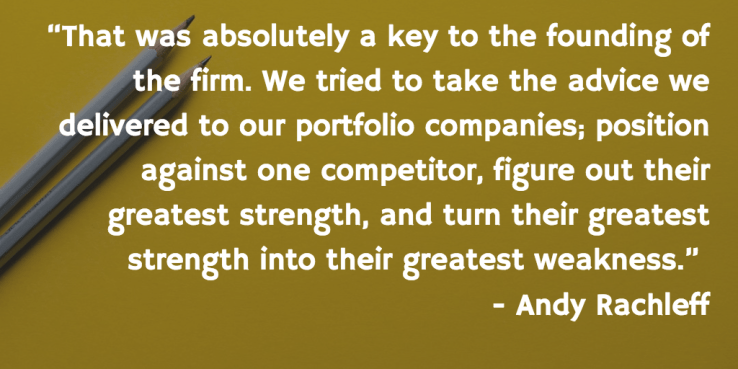
Starting Benchmark. The company’s start came from envisioning someone else’s end. Throughout the interview, Rachleff’s advice for founders is, figure out your competitor’s greatest strength and make it their greatest weakness. In venture capital, John Doerr was Kleiner Perkin’s strength. “We figured the best way to beat an individual was with a team.” And so Benchmark’s structure was created. And it worked well.  “We thought an equal partnership would attract talent like no other firm…On and on we keep attracting great people who are better than the founders were.”

What’s the name of this magical arrangement? “We call it communist capitalism.”

What job are your customers hiring you for? When the conversation switches to Wealthfront, Rachleff explains, “millennial pay us not to talk to them.” How do they do that?  “What might surprise people is the thing that most attracts people to our service is we do everything in software.”

Calacanis is surprised when he hears travel agents are still around, but if we ask what job are your customers hiring for? we can see why. Baby boomers and large groups use travel agents because of an informational disparity the internet can’t bridge. Millenials have the mindset of, I’ve got an app and I’ll figure it out.

But Wealthfront isn’t a casino. Their job is to provide the best service they can.  Crytpo is “a great interest to our target demographic, but we are a boring service that’s focused on investment strategies that have been academically proven over time.”

“Everything we do,” Rachleff said, “is rules-based and unfortunately crypto doesn’t qualify for that.”

Some rules originated with cash flows.

“My investment idol is a guy named Howard Marks who runs a hedge fund called Oak Tree, and Howard likes to say, in order for something to be an investment it has to have a cash flow because the only way you can evaluate something is by evaluating its cash flow. If there isn’t a cash flow it’s speculation.”

But that doesn’t mean you shouldn’t invest in crypto. “If you think about buying Bitcoin as entertainment you’re going to be fine,” Rachleff said. Calacanis said he gets similar questions about angel investing since he wrote his book. Others have said this about DIY investing. If you’re going to put in the time to master something then go for it but don’t invest so much you blow up.

Zero Marginal Cost & Economies of Scale. That Wealthfront even exists is interesting. Besides learning from Marks, Rachleff mentions Bridgewater and other pioneering financial firms that innovated something which is now deliverable to the masses. This was a theme to Albert Wenger’s podcast with Patrick O’Shaughnessy too. Wenger’s big idea is that everything has become (or will become) computable and distributable thanks to zero marginal cost.

Besides distribution, the beauty of software Rachleff says, “it keeps getting better.” For example, Wealthfront combines your ‘house’ savings account with data from Redfin and Zillow to give an estimate about buying a home, the number one withdrawal reason of millennials.

The software also lets Wealthfront install bias frictions.

“There’s a lot of research that suggests human nature is such that we want to sell when the market goes down and buy when the market goes up, which the exact opposite of what you should do. The problem is, it doesn’t feel right. it doesn’t feel right to sell when you’re winning and it doesn’t feel right to buy when you’re losing.”

Calacanis put it better; “Anyone who has played blackjack and was up ten grand will tell you, leaving the table is heartbreaking.”

Nudging. “You don’t pick the risk level, because most people don’t know how to. We tell you what we think it should be and you can adjust it if you want.”

For a long time, I viewed nudging as a panacea without realizing that nothing is a panacea. Everything has tradeoffs. Nudging too.

Lessons from Reed Hastings. “There’s no one I think more about as I run Wealthfront than the lessons I learned from Reed Hastings.”

What makes him good?

“He keeps it really simple.”

How so?

“He takes asymmetric risks.”

Is that a better form of risk?

Yeah, and it comes from pattern recognition.

Venture Capital Pattern Recognizers. “I don’t think the vast majority of people should invest in startups,” Rachleff explains as he tells Jason that the top two-percent of firms generate ninety-five percent of the realized gains. What makes that top group so good?

Success. “You have to know which leaps of faith to take.” You have to know which asymmetrical risks are worth it. “The thing that separates the premier firms from the other firms is they’ve had a lot of success and they’ve learned from that success which leaps of faith to take – which you wouldn’t know unless you’ve had those successes.”


Thanks for reading.

Albert Wenger

Supported by Greenhaven Road Capital, finding value off the beaten path.

After Albert Wenger was on Patrick’s O’Shaughnessy’s Invest Like The Best Podcast I thought, this guy sounds fascinating, I gotta see what else he’s said. Hours – really days – later with viewed YouTube videos, exhausted podcasts, and creased pages from his book, World After Capital here are three things I learned from Wenger.

1/ The steps to thesis-driven investing. These including understanding the thesis deeply (i.e. network effects don’t overlay old businesses) and changing your thesis as others come in.

“To me, the idea of having a thesis is a little like the idea behind science.”

2/ Crypto-currency and techno-economic revolutions with a specific focus on the work of Carlotta Perez.

“My view is that when the dust settles there will be a dozen or so protocols that matter and to get to the ones that matter we’re going to have to try thousands if not tens of thousands.”

“The zero-knowledge position is that your best prediction for how long something will be around is how long it has been around. That predictor is very very powerful.”

3/ The World After Capital, why we need to sell the sizzle with the steak.

“We have failed to provide a good forward-looking narrative.”


Thanks for listening, and of course, the book’s pages were only metaphorically creased.