What the mean age means.

The Math of Life and Death is a good addition to the when are we ever going to use this collection of popular science books. With numeracy being so important in life, a regular diet of these ideas keeps someone mentally fit. Consider the story of student loans as one example.

Often the mathematical manuscripts show mean and median differing in network systems like in the case of income or the social graph. Or, how much Bill Gates skews average wealth but not legs.

Kip Yates reminds us of other instances.

“However, ecological fallacies can be more subtle than this. Perhaps it would surprise you to know that despite having a mean life expectancy of just 78.8 years, the majority of British males will live longer than the overall population life expectancy of eighty-one years. At first this statement seems contradictory, but it is due to a discrepancy in the statistics we use to summarize the data. The small, but significant, number of people who die young brings down the mean age of death (the typically quoted life expectancy in which everyone’s age at death is added together and then divided by the total number of people). Surprisingly, these early deaths take the mean well below the median (the age that falls exactly in the middle: as many people die before this age as after). The median age of death for UK males is eighty-two, meaning that half of them will be at least this age when they die.”

Kip Yates

Numeracy is becoming more important because we are generating more data. Luckily, we don’t have to become mathematicians but we do have to see if ideas pass the sniff test. We have to think about how survivor explains sampling, and consider gambling parlays. We have to be mathematically minded.

Poker’s Appeal?

Photo by Javon Swaby on Pexels.com

“I’ve grown accustomed to this type of (probabilistic) thinking because my background consists of experience in two disciplines; sports and poker, in which you’ll see pretty much everything at least once. Play enough poker hands and you’ll make your share of royal flushes. Play a few more and you’ll see your opponent has made a royal flush when you have a full house.”

Nate Silver, The Signal and the Noise, 2020 update, audiobook.

Maybe the reason poker is popular isn’t so much the gambling as the way of thinking. We’ve looked at lot of poker players here, at least relative to their overall occurrence.

From James Holzhauer we get the idea of forward and backward thinking. How might his Jeopardy run been thwarted? What if the questions were harder? Or, much easier?

From Jeopardy James we also get to think about what Mauboussin calls the success equation. If outcomes are a product of skill and luck, what are the skill components to Jeopardy? There’s knowledge, yes, but there’s also buzzer ability. Here noobs are severely disadvantaged, and Jeopardy has evolved the training time challengers now get.

From Annie Duke we see the market mechanism at play. Why does Duke no longer play poker? It’s harder! Make something glamorous and financially rewarding and people flock to it, which raises the skill and increases the role of luck. It’s the reason behind why pool companies manage differently from Netflix.

From Maria Konnikova we think about small bets, or +EV. It’s not that all every decision must be correct but that decisions on the whole are.

Maybe the reason we like poker so much isn’t the glamorousness or the risk taking but the approach. Maybe the reason we like poker is because it articulates an innate sensation.

Probabilistic can be a worldview. It’s not the default, but it is helpful. Maybe poker is like sushi or pickleball, something about the approach appeals to us.

Gaming Work or Working Games?

“We have every reason to believe,” said Jane McGonigal, “the future of work will be more like Fortnite than the kinds of office jobs that we have today.”

2020 results

I would wager that future response balances will have a COVID-19 influence to them. School for example, seems to be tilting more digital as both administration wants to appear technological, tools become cheaper to implement students, and external forces require it.

Translating JTBD

“At Twitter we had all the sales people in a different building and so we organized a margarita and taco event in the sales building. Of course all the engineers wanted margaritas and tacos so they had to go and spend time with the sales people and ask them around their roles.”

Kris Cordle

Cordle goes on to tell Shane Parrish that once a sense of community forms it’s easier for the sales people to go to the engineers, “rather than filling out a form that goes to the engineer who goes, ‘what is this person talking about?’.”

Jobs-to-be-done is like an elegant meal—but in the kitchen the cooks are hot and the chef is scratching her head wondering what will make it into tomorrow’s soup.

JTBD-ing is messy because we don’t have the language for it. The axiom to don’t ask the customer what he wants exists not because the customer doesn’t know but because the customer doesn’t know how to express it.

Here’s a question transcription of a sample interview Moesta conducted:

Look at the ground Moesta covers! For a mattress! Look at the language. “You moved?” “Who suggested sand bags?”

JTBD is elegant because of the hard work behind it and the hard work is the translation. Often this comes down to: what does the person need to feel.

Now we can circle back to Cordle and see how, like a game of telephone, the message ‘needs to feel this’ gets garbled going from one person to another. What makes the message clearer is good communication which exists in a good culture.

Margaritas and tacos seems unnecessary to the bottom-line but becomes axiomatic once we trace the process back. Like looking at the flurry of activity in a kitchen can give a sense how such a polished meal emerges.

For more, check out Moesta’s (2020) Demand Side Sales 101.

Japanese, in L.A., with a Brit

“I went to a Japanese restaurant in Los Angeles, like the number seven restaurant in Los Angeles, and I couldn’t believe that this was the place. It was in a strip mall somewhere, but it was utterly fantastic. The presentation on the exterior was atrocious, and sometimes I think that is done deliberately. In a sense, there is a category of restaurants where it’s all about food. Like, with a name like Smuckers it has to be good. We couldn’t be this crowded with such terrible frontage.”

That’s Rory Sutherland on episode 201 of Risky Conversations. Tyler Cowen, more here, uses the same idea and beyond, “When I heard that name I thought, this place must be great. When Americans want to eat Ethiopian food, what kind of name are they looking for? The Red Sea? Queen of Sheba? Fine. But when it’s EYO Sports bar you know it’s really for Ethiopians.”

The biggest returns in life come from new information or new analysis. Though it’s helpful to keep in mind that not everyone wants the same returns or if they do, on the same timeline. Dining isn’t only about the food, there are many jobs to be done with a meal out. However, if one of your jobs is different (in scope or time), you can often hire for a great price.

For food, follow the lead of Rory and Tyler, and find good food at places with bad names.

Inverting Punting Questions

Typical analytic situation have three potentials for improvement (or, competition).

  1. Better data, think motion tracking in football or hockey.
  2. Better models, think the shift from batting average to on-base-percentage.
  3. Better people, think the 1980’s shift when Edward Thorpe began competing with other Ph.D.

However, the largest potential gain in analytics (at least sports, circa 2020) is the implementation. It’s no use coming up with a good idea if you can’t get it into the portfolio.

Richard Sherman and Chris Collinsworth offer a stopgap solution. Talking about the Pittsburgh Steelers decision to punt on fourth and one from the forty-six, “If you’re the Cleveland Browns you’re definitely relieved,” said Sherman, “shoot you only needed a yard, you can fall for a yard on most defenses.”

This idea has been around a long time in sports, Bill Simmons has spoken about it often on his podcast; what does my opponent fear the most? I’ll do that.

Some NFL teams have solved the implementation obstruction with a direct line from the analytics department to the coach. Teams slower to adopt and adapt can take the idea of inversion and just ask one of their coaches. It would be great to see a head coach ask his defensive coordinator if the offense should stay on the field, or indeed if they should punt.

Note, I listened to Thorpe’s A Man for All Markets and while long, it was good particularly because it was read by him!

Influential Words

Could: a verb used for clicks as in, this <insert news> could have these economics effects on your portfolio.

More: a pronoun used to show relative position, though the original may not be stated, as in, Laura got more for her money at Herr’s.

Deal: a noun used to show relative rather than absolute spending. As in, I got a great deal on my new SUV.

Largest increase or fastest growing: an adverb/verb combination demonstrating increase in a small group. As in, pickleball is America’s fastest growing sport. Antonym: Large N, small p.

The theme here is relativity. People are relative thinkers; see corporate greed or cheating college. Words matter because they frame our approach. Listen closely. Consider the focus. Do the words hint at who was at fault? If this were a movie why is this the script? Need to change how people understand something, or apply some extreme ownership?

Part of the reasons pickleball IS so fast growing is my participation. Thanks too to Tim for a conversation long ago that planted this seed.

Framing as a Fire or as a Fight

One way to change an experience, and all experience is subjective, is to change the framing of it. Our food takes longer because we make it fresh. Via a16z:

“There has been some interesting work in the linguistics community asking if we should be using war as a metaphor for the virus. There’s a lot of discussion about ‘front line workers’, which is a war metaphor, but unlike people in the military, they didn’t volunteer for this degree of risk.”

Gretchen McCulloch

McCulloch goes on to consider how things would be different if the pandemic were described as a fire or natural disaster. What if outbreaks were flareups, people sheltered temporarily, and we extinguished the threat?

Some added stress of this pandemic is from our ambiguity aversion: we don’t like the feeling of not knowing.

So we use metaphors. Fights are: Us vs them, victory is this mark, loss is this, collateral damage is undesired but expected.

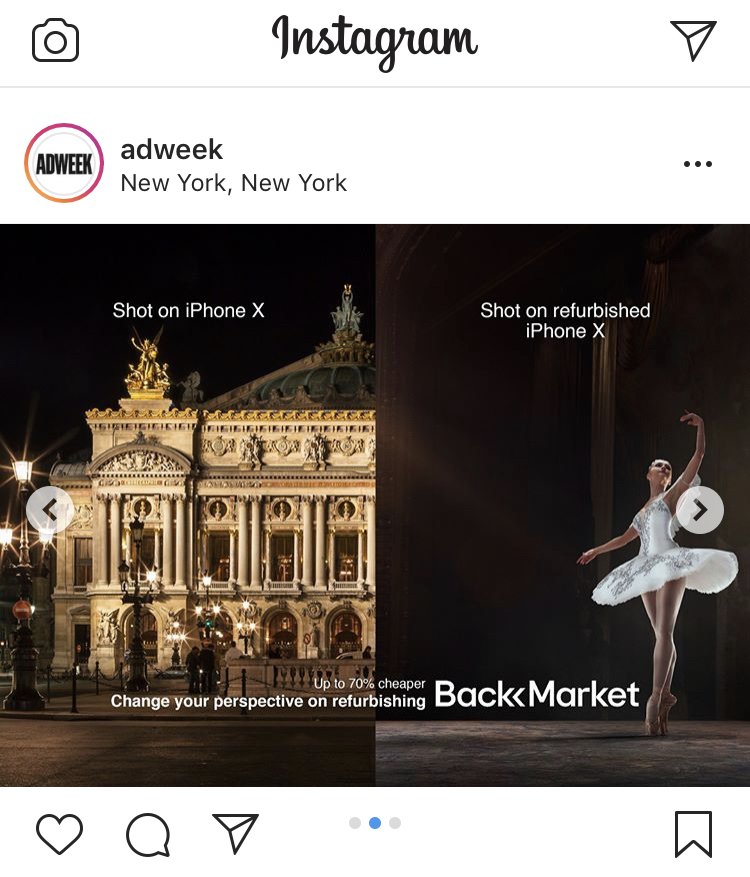
This post isn’t to say that Fire or Fight is better for the pandemic, but to think about using framing in interesting ways. Here’s one we’ve featured before:

This ad frames opportunity cost. It says, you’ve got 1,200 dollars. Do you want a new iPhone or a nearly-new iPhone and tickets to the ballet?

Framing works not because people can’t do the thinking by themselves, but that they don’t because thinking about all this is hard. We’ve evolved to process information where available equals important. That’s often good enough, so we stop thinking.

This is all good news. It’s why Alchemy is possible. Using the right words changes the focus which changes the understanding which changes the actions.

Would the pandemic be different if we viewed it more as a natural disaster? Maybe. Would our understanding, focus, and concept be different? Certainly.

Is “wet bias” a bad thing?

“Bias” tends to have negative connotations. It’s the “wrong” answer.

The problem here is a translation issue. It’s going from the world of One Answers (mathematics) to the world of Many Answers (life).

Weather is a fascinating demonstration. Nate Silver writes in the 2020 edition of The Signal and the Noise, “The further you get from the government’s original data and the more consumer facing the forecast, the worse this bias becomes.”

Relatedly:

(John Gruber) “I staunchly believe that Fahrenheit is the better scale for weather because it’s based on the human condition. Who gives a crap about what the boiling point of water is, it’s the most ridiculous thing I’ve ever heard in my life.”

(Ben Thompson) “The other thing is that Celsius is not precise enough. In the car it adjusts it by point-five because a single degree of celsius is too much for the car. Fahrenheit is more finely grained in a positive way.”

This is why we have a wet bias. We design weather for people.

Silver again, “It’s deliberate and it has to do with economic incentives. People notice one kind of mistake, the failure to predict rain, more than another kind, false alarms. If it rains when it’s not supposed to they curse the weatherman for ruining their picnic. Whereas an unexpectedly sunny day is taken as a serendipitous bonus.”

One change in my thinking over the yeas has been to reframe ‘bias’ as ‘tendency’ and then consider what’s happening. Humans are only illogical in the game of optimization, which matters in the world of calculations rather than considerations.

Wet bias may be inaccurate but that doesn’t make it wrong.

Da Moon

Via Reddit.

“My parents are everything to me. They’ve worked their asses off to raise me and my two little siblings, starting with nothing as immigrants. They’re in the restaurant business and the pandemic forced them to burn through a large chunk of their savings, and they stress out over finances every single day. My dad always told me one day he’ll retire once the house is paid off, and that day is finally here.”

The OP dollar cost averaged their way to six Bitcoin for an estimated $240,000. “Thank you bitcoin community for all the memes and bullshit TA threads. I’ve reached my moon.”

We denominate freedom in money (the number) and sometimes get caught in this metric. But personal financial success seems to be mostly choosing from the good options, having good luck, and remembering da moon. Inverted: it’s not getting caught up with the Jones family.

With the 2020/2021 run it’s been a treat to see the Reddit stories about paying down debts, hitting marks, and people cashing out.

There’s certainly luck, but for OP there’s also brains and heart.

OP: Original Poster