Jim Chanos

Jim Chanos and Stephen Roach at Asia Society New York

Jim Chanos was interviewed on the Financial Times podcast. I’d not heard of Chanos and  am glad I listened. For background I found Tren Griffin’s post and Barry Ritholtz’s interview helpful. Also, thanks to  Patrick O’Shaughnessy  who suggested this podcast.

Here’s what I learned from Jim Chanos.

1/ Know the pot and the payout.

Summaries of short sellers typically concludes with a warning that shorted positions are asymmetrical. Gains are limited by the shorted prices, but losses are uncapped.

In theory.

In reality, Chanos says he’s “seen far more stocks go to zero than infinity.”

Charlie Munger uses the same thinking, explaining:

“Any damn fool can see that a horse carrying a light weight with a wonderful win rate and a good post position etc., etc. is way more likely to win than a horse with a terrible record and extra weight and so on and so on. But if you look at the odds, the bad horse pays 100 to 1, whereas the good horse pays 3 to 2. Then it’s not clear which is statistically the best bet using the mathematics of Fermat and Pascal.”

Cliff Asness explains to Tyler Cowen that this isn’t easy to understand:

“I want to ask one of my two older kids (age 12)… ‘Does this (merger arbitrage) sound like a good idea to you?’…There’s about a 98 percent chance they say, ‘No. That sounds like a terrible idea to me, you can lose a lot, you can make a little. Who wants to do that?’ I’d be the proudest pop on Earth if either one of them kind of paused and said, ‘how often do both of those two things happen, Dad?’ Because, that’s the proper question.”

As Sam Hinkie also noted, San Francisco is a great place to live – and an expensive one. The pot for SF was high (no pun), but so was the buy in.

2/ Have the numerate filter at the ready. Chanos is at a meeting about China when he stops a young analyst for confusing square meters and square feet.

No, says the analysis, “I double checked. It’s 5.6 billion square metres.”

Whoa, Chanos thought, “that’s a five foot by five foot office cubicle for every man, woman and child in China.”

To be numerate you just need to be good enough with numbers. To know that 1 square meter is 10 square feet. To know the population of China. To know how to divide one large number by another.

Charlie Munger said that if you don’t get this basic algebra down, “you go through a long life like a one legged man in an asskicking contest.”

Tyler Cowen noted that numbers are not always answers. “Statistics are often telling you what the questions are, not the answers.”

You just have to know enough math, and be ready and able to use it.

3/ Know your history. Wow, does Chanos’s knowledge of history show. He references the 1980’s housing bubble, the Japanese housing bubble, Tyco, Worldcom, and many others. He calls this “pattern recognition.”

This value in pattern recognition is why people like David Chang say, “I can learn more from a history book or autobiography about someone that make a ton of mistakes,” as compared to a book on management.

There’s good reason. Nassim Taleb writes in his review for The Hour Between Dog and Wolf “Great book. I ignored the connection to financial markets while reading it. But I learned that when under stress, one should seek the familiar. Bravo!”

The more history we know, the wider our “pattern recognition.”

4/ Have red flags. “I’m always wary of accountants who become CEOs too. That’s always a bad sign for me,” Chanos said.

Another red flag, people who call meetings to say everything is fine. “I remember that my head of stock loan went to a meeting that Bear Stearns had with its prime broker clients to put them at ease. My partner came back and he was of course less at ease based on that meeting.”

I’ve collected my favorite red flags but missing in that link is the one Chamath Palihapitiya told Kara Swisher. He said that when an early believer bails, it’s a red flag. I found the same thing in my book about start-ups that failed. If a seed round investor didn’t lead the A round, no one else would join in.

5/ Skin in the game. “When it comes to finance, you have this bizarre idea that ‘we just can’t hold individuals responsible for their actions, we have to look at the corporation.’”

The flaw in the criminal justice system, says Chanos, is no skin in the game. This leads to moral hazard and we should know better. Mellody Hobson said her company looks to invest in “leaders who are aligned with the shareholder. If we see CEO’s that don’t own any stock that’s just not good. If we see CEO’s that pay themselves too much, that’s not good.”

When Tim Ferriss played poker with his own money, he played different. Jason Zweig suggested skin in the game as necessary to better predictions and decision making. Nassim Taleb has written A LOT about it.

Decisions change with skin in the game, and Chanos believes for the better.

6/ Ultimate backstop. “Who watches the watchmen?” is the tagline for the Watchmen comic, but is relevant here is well. In finance the question is, ‘who insurers the insurers?’

If Chanos didn’t know, he stayed away, “We thought about it (shorting the US housing crisis). And my fear was: I was worried that we wouldn’t get paid.”

In his book Foolproof Greg Ip addresses this problem of insurance. Who is the insurer of last resort Ip asks? Hurricanes in Florida meant the state got involved. In California the disaster was differed by the state stepped up. Flood insurance is offered through the United States Government.

For large enough disasters – financial, natural, or otherwise – everyone steps up to insure everyone else. When Chanos wasn’t sure who  would “step up,” he stepped away.

Thanks for reading, I’m @mikedariano on Twitter. If you liked these podcast notes, you’ll love my notes on Sam Hinkie’s resignation letter.

Bad Good Old Days & Good Bad Old Days

We touch on a few biases on this blog.

Bob Seawright actively busted his hindsight bias (I knew it all along).

Nate Silver almost teed off on the Texas Sharpshooter fallacy (drawing the bullseye after you shoot).

The survivor bias midwifed my book, 28 Lessons from Start-ups that Failed (dead men tell no tales).

Another biases needed it’s own page, the Rosy Retrospection bias, our tendency to shade the past in a more favorable light.

This isn’t always bad. In my podcast with Aaron Watson, I pointed out that bias awareness is more important that rejection. Sometimes our currents of bias are helpful. Our energy then, should focus on ensuring  they move us in the direction we want to go.

We can bust Rosy Retrospection with objective observations of the past.

In One Summer, Bill Bryson writes that the 1920’s roared in a variety of ways:

“Citizens were imprisoned for criticizing the Red Cross at their own dinner tables… a clergyman in Vermont was given a fifteen year jail term for handing out half a dozen pacifist leaflets. In Indiana, a jury took just two minutes to acquit a man who had shot an immigrant for speaking ill of America…a filmmaker was imprisoned for showing the British in a bad light in a movie about the American War of Independence…a black youth who fell asleep on a raft on Lake Michigan and drifted onto a white beach was stoned to death by a white crowd.”

The worst deflation in American history occurred in 1920, GNP fell 5%. The 1920’s weren’t always golden.

More modern examples abound. Charlie Munger said:

“I personally think that the world is better for having Wal-Mart. I mean you can idealize small town life. But I’ve spent a fair amount of time in small towns. And let me tell you you shouldn’t get too idealistic about all those businesses he destroyed.”

Wal-Mart didn’t displace just Mayberry, but trimmed away a lot of fat as well.

Even times we consider idyllic now, were bemoaned in favor of a more distant past. David McCullough writes about bicycles in 1900:

“Voices were raised in protest. Bicycles were proclaimed morally hazardous. Until now children and youth were unable to stray very far from home on foot. Now, one magazine warned, fifteen minutes could put them miles away. Because of bicycles, it was said, young people were not spending the time they should with books, and more seriously that suburban and country tours on bicycles were “not infrequently accompanied by seductions.”

Now parents would love to have their kids get outside and ride their bike.

We don’t even need to go that far. “The 1990s have a good image,” wrote Peter Thiel is Zero to One “but many of those years were not as cheerful as our nostalgia holds.”

The old days were good and bad. If you start thinking they were always one, be careful.

Charles Lindbergh

This blog began with podcast notes, but I’ve been on a real history kick (Wright brothers, Napoleon Bonaparte ) and we’ll continue with Charles Lindbergh. But, first Philip Tetlock will temper our thinking. This from the endnotes of Superforecasting:

“Don’t confuse your judgments of foresight with those of character. It should not matter whether you see the forecaster as an adulterer or an affable television host or a skilled speechwriter or a Wall Street insider or a Prussian imperialist or an Ivy League sexist.”

Tetlock wants us to compartmentalize people and evaluate their actions appropriately. Consider professional sports. Teachers cheer on players who flunked their class. Pastors will root for players who visit strip clubs. MADD moms will clap the same player they later scold. This is okay.

We can use Charlie Munger’s “cancer surgery formula” and apply it to people. About his investment in GEICO, Munger said:

“figure out if there’s anything sound left that can live on its own if they cut away everything else….All they (management) had to do was to cut out all the folly and go back to the perfectly wonderful business that was lying there.”

Lindbergh was both daring and unsavory, and here are a few things I learned about him from Bill Bryon’s – wonderful (!!) book – One Summer, America 1927.

1/ A transatlantic flight would have happened with or without Lindbergh. We noted this in episode #02 of the podcast, when we thought about alternative histories. Besides Lindbergh there were better funded and staffed teams on both sides of the Atlantic.

What Lindbergh had going for him was the right set of skills (see #2). Scott Adams introduces this as a Venn diagram of skills, and it’s what Lindbergh had. Sometimes to succeed you just need the right mix. For Adams that was average drawing and humor with a Haas MBA. Lindbergh too had a potpourri of skills. He earned them through an XMBA.

2/ Lindbergh got his XMBA. The eXperiential Masters of Business Administration values the experience over the administration. It’s about the sum of skills you get in one area versus another. It’s the opportunity cost to do, learn, build one thing and not another.

Opportunity cost

In 1920 Lindbergh entered college, in 1922 he exited. He wanted to be a pilot. The conditions of flight, Bryson writes, were not great. “Flying was poorly paid, wildly unsafe, and unreliable a a career.” This quagmire though was perfect preparations for the perch Lindbergh would later occupy.

Pilots, Bryson notes, sometimes had to search for names of towns by swooping low to read railroad signs. “For weather reports, they mostly called ahead to railroad agents along the route and asked them to put their head out the door and tell them what they saw.” When Lindbergh delivered airmail, “he acquired the sort of resourcefulness that comes with flying cheap and temperamental planes through every possible type of adversity.”

Lindbergh built a set of skills without formal schooling (besides a 1 year course in the army air reserve). Elizabeth Gilbert put it best, when she noted that you can learn by doing (Option B, the XMBA), or learn by learning about doing (Option A, the MBA).

3/ Lindbergh understood incentives. In February 1927, he took a train to NYC to finalize his purchase of the Columbia for his transAtlantic attempt. Before closing though, the plane’s owner stipulated that he, not Lindbergh, would pick the pilot for the historical flight.

As the kids say, wha?

Lindbergh returned to St. Louis, and reset his search for a plane. He found a tiny company in California to build him a single seater (the Columbia had 3) for less than half his budget. “I need it 60 days,” Lindbergh wrote. “Done,” wrote back Ryan Airlines.

The reason that the two parties were able to work so well together was that their incentives were aligned. Ryan Airlines took the deal and worked so hard because, “Ryan had no orders and was on the verge of bankruptcy.”

Incentives drive a lot of life, but incentives aren’t always money. In my notes about Sam Hinkie’s resignation letter we noted social incentives. Stephen Dubner too talked about the spectrum of incentives.

Lindbergh needed a cheap, light, sturdy plane and he needed it quickly. Ryan Airlines needed a contract for something in their domain of expertise that would lead to more business. Both parties got what they wanted.

4/ Time was Lindbergh’s filter. Quoting Alex Spencer of the Smithsonian, Bryson writes, “Lindbergh didn’t want an innovative plane, he wanted nothing but tried and tested technology.”

In the Wright brothers post I noted the case for time as a filter, but also the value in the present. In podcast #01 we looked at it from the perspective of Gordian Knots and Chesterton fences.

5/ Lindbergh was an underdog. While the flight would prove that Lindbergh was the best pilot of the age, his support crew was anything but. He had a crew of three; a mechanic, a press agent, and an errand boy.

Another team had a staff of 40 which included; “mechanics, telegraph operators, even kitchen staff to run a private mess hall.” About Lindberg, another competitor said, “He was generally assumed to be out of his class.”

Lindbergh made it though. Using a plane from a company nearly out of business, a minimal crew, and his own skills as a pilot – Charles Lindbergh was the first to cross the Atlantic in a single flight.

The experience of the Wright Brothers mirrors this. They too were in a race for flight where they were the underdogs for resources, manpower, and government support. It didn’t matter.

Casey Neistat makes the modern day case when he spoke about the movie Pan.

“If all it took to be good was the right equipment, the people with the most money would always in…if all it took to make good stuff was the right equipment, whoever made that movies with their $155m budget had way better cameras than you could ever afford.”

6/ Lindbergh also had good fortune. He was never injured during the airmail crashes (though had to eject a number of times). He found backers in St. Louis, in part, because they wanted to market their city. The weather was bad enough to keep the other fliers grounded, but cleared up once Lindbergh arrived ready to fly.

We need to have good luck. Seth GodinJason Zweig, and  Nate Silver (among many others) all noted that it helps to have good luck.

Thanks for reading, I’m @mikedariano.

Nate Silver

Nate Silver was on the Longform podcast in mid-April and talked about a whole slew of things we regularly highlight on this site. Rather than going long about a few things, like the recent post on Napoleon Bonaparte, this will be more rapid fire. Ready?

1/ Silver knows the side hustle. At a consulting job he didn’t like, he worked on a system for forecasting baseball players. Baseball Prospectus bought that system and hired Silver, who was already on to a another side hustle, online poker.

This blog started with notes about James Altucher’s podcast guests, though Altucher himself knew the side hustle too. He didn’t leave HBO until his website business reached the same income as his day job. Alexa von Tobel told the same story about starting LearnVest.

2/ Silver talked with people smarter than him. Silver is brilliant, but even he seeks out smarter people. During his online poker days he says, “I used to be active on the two plus two forum.” This was during the flourish of online poker, and Silver talked with other good players about how to play online. This worked because there were plenty of little fish for these big players to scoop up. As the system got tighter though, the amount that people talked declined.

If you want to get better at something, talking to someone better than you helps a lot. Simon Rich said he fills the TV writer’s rooms with people smarter than him. Dan Coyle called the sports version of this “talent hotbeds.” Austin Kleon praised Brian Eno’s term of “scenius.” Whatever the craft, a better craftsman will make you better as well.

3/ Silver knows that timing matters. Whether intentional or not, Silver has been in the barrel of the wave for a long time. He got into poker when there was easy(ish) money to be made. He started blogging at the right time too (“the barriers to entry were low and it was very meritocratic”). He wrote for Daily Kos and “it kind of blew up.” Moneyball thought was du jour and Silver knew the right recipes.

Nothing is more powerful than an idea whose time has come. – Victor Hugo

Napoleon Bonaparte had great timing in war. Seth Godin and Mark Cuban had great timing in getting out of the stock market. Malcolm Gladwell noted that Dire Straits was probably extra successful thanks to their timing. From war to music, the personal to professional, timing matters.

4/ Silver believes in spectrum thinking. About that ‘moneyball’ wave, “it’s not like the stat-heads won a unilateral victory.” For all the talk about analytics, it’s not a panacea. Rather, Silver says, “it’s more like people are like ‘we have to be smarter about making decisions and use these different tools at our disposal.’” Advanced metrics – in any domain – is just another tool.

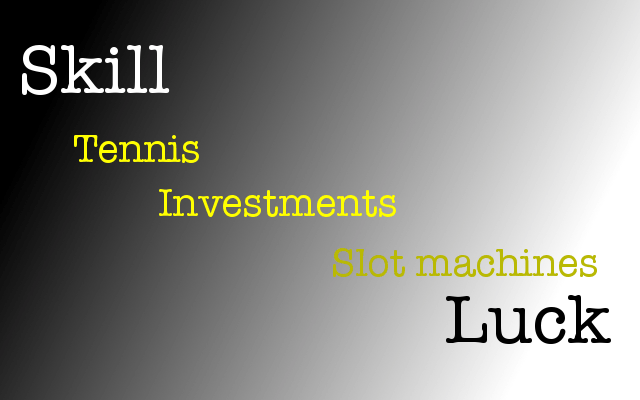
Be careful about silver bullet solutions. We’ve seen this warning before. Most situations have many reasons (we call that ‘part of the reason’ reasoning) and lie somewhere on a spectrum. Greg Ip gave us the problem solving boots of engineers and sandals of ecologists to put on. Charlie Munger warned us about the ‘easy to measure/hard to measure’ spectrum. There’s also the spectrum of skill versus luck
SkillLuck

5/ Silver takes his work, but not himself seriously. “It’s like a rollercoaster,” Silver says about running his website. “I’m passionate about my work, and it’s interesting to me, and hopefully our predictions do well,” but he doesn’t take the perspective of perfect predictions into every part of his life.

James Corden said working with Meryl Streep was perfect, in part, “because she took her work seriously, but not herself.”

6/ Silver knows the wrong side of maybe. “In a perfectly rational world, if you make an 80/20 prediction, people should know, not only will this prediction not be right all the time, but you did something wrong if it’s never wrong. The 20% underdog should come through sometimes.”

But (bridge) players must also continually make peace with good decisions that lead to bad outcomes, both one’s own decisions and those of a partner. This peacemaking skill is required if one is to invest wisely in an unknowable world.” – Richard Zeckhauser.

The “wrong side of maybe mindset,” coined by Phillip Tetlock in Superforecasting, is a valuable skill. Weather predictors get the flack and jokes, but it happens in every career. In Smarter, Better, Faster, Charles Duhigg profiles Annie Duke who explains this framework for poker. I wrote about it in this analysis of Sam Hinkie’s resignation letter.

7/ Silver competes against non-consumption. “We have a keen sense for what is a FiveThirtyEight story and what isn’t…we are a different kind of shop.” Silver notes that this was hard at first (“the site wasn’t all that great in the first three to six months of its existence.”) Eventually they found a good spot, daily stories, rigorously researched, and meticulously presented.

There’s no one else that does what FiveThirtyEight does, so they compete against non-consumption. This fits into the rainforest model that people like James Allworth (@JamesAllworth ) use as an analogy for the economy. Many organizations, creatures, etc, find small niches to occupy and dominate.

8/ Silver understands historical bifurcations. “The demise of Grantland didn’t happen all at once. There were a number of turning points where things could have gone in a way that was helpful or harmful, and most of those forks were harmful.” It might be fun, though wrong, to compare Bill Simmons – captain of the Grantland ship – to Napoleon, so we won’t. But the idea foundation for the demise of Grantland to the rise of Napoleon is the same.

Napoleon only dominated Europe because of a number of turning points where things could have gone in a way that was helpful or harmful. (See #1 here: Napoleon Bonaparte ) Silver guesses that this is also part of the reason for the rise of Donald Trump. If A, B, and C all go one way instead of another, then Trump would be in the lead. Those things all happened. Note, the individual odds may be better than a coin toss, where the overall odds are not. If the odds of each happening were 75%, the odds of all three happening is only 42% (.75^3).

9/ Silver knows the Texas sharpshooter fallacy. I was hoped that he would smash the statistical cherry-picking at ESPN like a birthday piñata, but he did not.

Instead let me point you to David McRaney’s podcast episode about this cognitive bias or the book How Not to be Wrong. Both address this fallacy.

10/ Silver knows when good enough is good enough. If he goes to a New York Rangers game, Silver says he just cheers the team on (see #5, take the work, not yourself seriously). However, he’ll research dinner options.

There’s often a good enough threshold for most of life. My guess is that people successful people have clear ‘good enoughs’ in areas that matter less. Many great writers are also walkers. My guess is that walking is good enough for physical health. B.J. Novak and Casey Neistat both said that their tools are good enough for the work they need to do. Resources are finite, and something that fit a need good enough is something you don’t need to spend more time on.

/ Thanks for reading, I’m @mikedariano on Twitter. If you thought this “shortish” post was long, you should see my book about start-ups that failed.

Napoleon Bonaparte

Napoleon-bonaparte 2763098b

Napoleon Bonaparte was not a nice man. I did not know this. A lot of the people and ideas on this blog exist in the idea of the “adjacent possible.” Introduced by Steven Johnson in Where Good Ideas Come From it’s the idea that before you can see the future,  you have to be next to it. It’s like having a flashlight in the woods. The beam of light gets you down the path, then once you are further down the path, so is the light, and you continue on. Elon Musk calls this idea “the semantic tree.” If you’ve ever read a Wikipedia article, not understood something, and clicked link to read more, you’ve see this idea.

We need a jumping off point.

Napoleon’s era was never an adjacent possible for me, but I wanted him to be. Thankfully, Paul Johnson wrote a packed little book, Napoleon. More books should be like this one. Here are a few things I learned about Napoleon.

1/ Historical bifurcations. We can add Napoleon’s name to the list of the great ‘what-ifs.’ We were close to never having a Napoleon.

  • Had he been born two years earlier, he wouldn’t have been a citizen of France.
  • Had he not read about Corsica Boswell, he wouldn’t have had revolutionary ideas.
  • Had he been accepted into the British Navy, he wouldn’t have joined the French.
  • Had the town ruler not had an (alleged) affair with his mother, he never would have gone to military school.
  • Had the French government made good on their financial promises after his first defeat, he may have toiled on as the King of Elba rather than heading to Waterloo.

Alternative histories are a helpful tool to think about outcomes. I wrote about this in the breakdown of Sam Hinkie’s resignation letter but a more popular treatment comes from Yuval Noah Harari in Sapiens. There, Harari notes that if Charles Darwin hadn’t articulated natural selection, someone else would have.

This isn’t uncommon in science. The adjacent possible in Darwin’s day was a packed room,  the doorway under the sign “Evolution” has people clambering over one another to get through.

Whether Napoleon specifically, or history generally, is like science (this probably would have happened anyway) or more like how the dollar became the world’s premier currency (hear NPR tell that story), I don’t know, but it is worth thinking about.

2/ Conditions matter. Paul Johnson writes, “revolutionary France of the 1790s provided the perfect background for an ambitious, politically conscious, and energetic soldier such as Bonaparte to make his way to the top.”

It was enough of a meritocracy, and Napoleon, thanks in part, to his military school education barely made it. There were also parts of Napoleon’s temperament that helped. “Few successful men,” Johnson writes, “have ever carried a lighter burden of ideology.” Napoleon wasn’t committed to any group. He wasn’t beholden to any ideas. This would prove to be his weakness in sustaining power, but strength in accumulating it.

There were also the physical conditions of war that influenced Bonaparte. In France, Italy, and Germany he chose the choicest spots for the butchers of war. In Spain and Russia, he did not. Johnson writes that the summers in the countries were “eaters of armies” and Napoleon ended up retreating through the Russian winter.

Conditions matter.

In a speech from Charlie Munger to the USC Business School, he explains that after the great depression, Benjamin Graham could “run his Geiger counter over this detritus from the collapse of the 1930s and find things selling below their working capital per share.” A great deal.

Munger notes that this worked for Graham, but not for him and, partner Warren Buffett. “If we’d stayed with classic Graham the way Ben Graham did it, we would never have had the record we have. And that’s because Graham wasn’t trying to do what we did.”

The book, How Music Got Free explains the confluence of conditions too. There had to be new technology (mp3, high speed networks) AND a decline in album quality AND a certain approach from music executives for the digital music revolution to occur.

3/ A Venn Diagram of skills. Napoleon succeeded in specific ways because he was the only one at the time who had such skills. “He became a master map reader, with a gift amounting almost to genius for visualizing terrain… few young officers of his day had this skill or bothered to acquire it.”

Scott Adams notes that he succeeded in this way too. Adams writes:

“I’m a perfect example of the power of leveraging multiple mediocre skills. I’m a rich and famous cartoonist who doesn’t draw well. At social gatherings I’m usually not the funniest person in the room. My writing skills are good, not great. But what I have that most artists and cartoonists do not have is years of corporate business experience plus an MBA from Berkeley’s Haas School of Business.”

Dave McClure started his VC fund because he had the engineering and marketing sides and “there weren’t that may people doing investing that had both disciplines.”

What Napoleon, Adams, and McClure have done is compete against non-consumption. They found a country, medium, and market they could dominate because no one of their skill level was there. It was their new approach to a problem that helped them succeed.

Toward the end of the book, Johnson notes that Napoleon could have gone even further. Had he tried to rule the America’s he would have had a better chance.

4/ Chesterton fences. Napoleon missed a Chesterton fence. Johnson writes, that in destroying the Holy Roman Empire, Napoleon made a mistake. “The Holy Roman Empire filled a role. It was a driver for stressing the cultural unity of Germany while making it difficult to bring about its political and military unity.”

It reminded me of a story that Mardi Jo Link tells in Bootstrapper. Link’s hen house was a mess. The rooster, she thought, was terrorizing the hens. He was always pushing them out the way, taking their spots, waking them up. Enough of that Link thought, and she moved the rooster to another pen. That night a fox got in the hen house and killed a hen. She realized that the rooster served a purpose. His aggression kept the foxes away. She moved him back.

As I noted in episode #01 of mike’s mental models podcast, we should consider the history of something. Ask, why is this this way and not another? After we do that, we can then decide whether to overthrow the Holy Roman Empire, take out the rooster, or tear down the fence.

Thanks for reading, I’m @mikedariano on Twitter. If you liked this post, you’ll love my book about failed start-ups.

Introducing the Mental Models Podcast

toolshed

No notes today, two bits of housekeeping.

1/ A new podcast.

I really enjoyed my first podcast season: Mike’s Notes. That season was a cousin to  the things I wrote here. I explained things like optionality, the XMBA, and how to solve hard things in audio form.

The second season, titled Mike’s Mental Models, will be about the mental models that I’ve studied and used. If season 1 was more inspirational and tactical, season 2 will be more about thinking about thinking.

You can catch up on episode #00 where I explain my approach, and #01 about Gordian knots and Chesterton fences. Show notes and links to the episodes are here: https://medium.com/mikes-mental-models.

2/ Notes about Sam Hinkie’s resignation letter.
After reading Sam Hinkie’s resignation letter a few times I thought “there’s really something here.” So I took notes, thinking I would incorporate it into this site.

Well, the notes got really long so I decided to let it stand on its own. You can buy those notes at https://gumroad.com/l/hinkieletter. They’re written just like this blog, so let that be your guide.

Next week we’ll be back with more of the regular stuff.

Thanks for reading, I’m @mikedariano on Twitter.

Elizabeth Gilbert

Elizabeth Gilbert was on the Longform podcast to talk about writing— and so much more. This interview reminded me of the story that Jill Bolte Taylor tells her book, My Stroke of Insight.

Taylor, a brain scientist, has a stroke and her first thought is panic, “Oh my god I’m have a stroke,” and then excitement “Oh my god, I’m having a stroke!” For Taylor it was scary and sacred.  She could be the patient and doctor.

Gilbert’s interview is like that, only replace ‘stroke’ with ‘best selling author.’ She describes things from both the internal and external. I loved it.  This interview felt spiritual.

Here’s a few things I learned.

1/ Gilbert earned an XMBA. Technically it was her XMFA, but the ends were the same. She saw the opportunity and financial cost of post-graduate education as too high and set out on her own.

“Why learn about the thing by learning about the thing,” Gilbert asks, “when you can learn about the thing by doing the thing.” She kept a notepad with her when she served breakfast and tended a bar. Then she went west and worked as a trail cook.

Gilbert says she was “deliberate” in this. She heard the axiom to “write what you know,” but didn’t know anything. So she solved that problem.

Too often people hope that education solves this problem. It might, but it might not. The high financial and opportunity costs of education can outweigh the benefit. Jack Welch said that only the top-10 B-Schools are worth the time and money.

What do you do? Create your own degree.

Sophia Amoruso used the internet for her XMBA. Tim Ferriss did it by investing. The Wright brothers tinkered and read their way to the airplane.

School is expensive, make sure it’s worth it.

2/ “There’s a huge amount of real estate between the greatest and worst.” – Elizabeth Gilbert

For the first couple years you make stuff, it’s just not that good. It’s trying to be good, it has potential, but it’s not. But your taste, the thing that got you into the game, is still killer. And your taste is why your work disappoints you. A lot of people never get past this phase, they quit. Most people I know who do interesting, creative work went through years of this. – Ira Glass On Storytelling

When I read Eric Weiner’s Geography of Genius I thought, “I’m done. I will never write something that good.”

Gilbert reminded me that I don’t have to. She tells the story of interviewing Tom Waits who used the analogy of the circus. “You don’t have to be the high wire act,” he told Gilbert, “it’s a big tent, go do something else.”

Brian Koppelman recalls watching Amy Schumer on Last Comic Standing, and thinking, “wait, I was in a club with her last year.” He calls in his wife and says, “this girl is a genius and she sucked so hard just last year.”

When you start anything you will be somewhere between the best and the worst, it’s okay. It’s a big tent.

3/ Every job is a j-o-b.

“I have this theory that everything that’s interesting is mostly boring. Life is filled with all these interesting things and we chase the high and the buzz of the excitement of the thing, but 90% of the thing is boring.” – Elizabeth Gilbert

Travel, Gilbert says, is boring. It’s solitary time on a crowded plane. It’s another night alone in a hotel room. Life is not a movie, and we forget this.

“The trouble people get into,” Gilbert says, “is that people go into creative careers because they want an interesting life and then they’re amazed to find out at how much tedium and boring is in there, but if you can stick through the boring part, there is stupendous reward.”

It was Austin Kleon who said, “every job is a job,” and it’s proven once again by Gilbert. The obstacle is to persist through the boredom and tedium.

One way to do that is to love the shit out of that boredom. Chris Hadfield loves the grind of flying. Casey Neistat calls it “the religion of work.” David Chang says “it’s like a scratch you have to itch.”

Find work to hold on to, because temptation is coming, Gilbert says:

“The tricky bit is starting from a place you are very curious because in six months it’s going to feel very boring and tedious because making things is very boring and tedious. Another idea is going to come along very seductively and do the dance of the seven veils in the corner of your studio and say ‘I am a much more interesting, much more exciting idea.”

Life isn’t all rainbows and unicorns. Sometimes you have to do the work. How?

“When those other seductive ideas come along you have to tell them to take a number.” – Elizabeth Gilbert (tweet this)

Thanks for reading, I’m @mikedariano on Twitter.

Brian Grazer

Hollywood Producer, Brian Grazer, Allen & Company, 2015

A few things I learned from Brian Grazer.

But first, do you have an antilibrary?

It doesn’t need to be physical. An antilibrary could be like my stack of unread books or an Amazon wishlist, or notes on your phone. The antilibrary is the product of curiosity.

I found A Curious Mind in my antilibrary. A book I read because I was curious.

The great part of an antilibrary is that it will “menace you” (Taleb). These books will remind you of what you don’t know. They will implore you to be curious. They will whisper, “come, get lost, see what you will find.”

Here are 4 things I learned from Brian Grazer’s A Curious Mind: The Secret to a Bigger Life.

1/ Grazer’s book is about curiosity, and curiosity is a mental model. Mental models are frameworks of thought that help solve problems. To a hammer, every problem looks like a nail – but not every problem is. Mental models are tools to use at different times. Curiosity can be our flashlight.

Grazer uses curiosity to find answers to confusing problems. When faced with giving a speech, he uses curiosity to discover what the listeners want . When faced with telling a story, he uses curiosity to find the good parts. His life has been a curious life, because that’s a helpful tool to solve problems – be curious about them.

We can add curiosity to our tool belt alongside: part of the reason thinking, the outside perspective, filters against folly and others.

2/ “No’s” never stop. Even though he’s successful, people still tell him “no” a lot. “These days,” Grazer writes, “they just smile and put their arm around my shoulder when they do.”

The Tom Hanks movie Splash took seven years to make, and it wasn’t even the Mermaid movie that Hollywood thought would succeed. Grazer heard many “no’s.” The movie succeeded because Grazer was curious. He used each “no” as a chance to be curious. Did someone say “no” because of the director? Was it the script? Did they just not like Grazer? Each “no” forced him to ask more questions – and he got more answers.

There is a lot of rejection if you push forward. Andy Weir and Ben Mezrich heard “no” before becoming best selling authors. Brian Koppelman and David Levien heard “no” when they tried to sell Rounders. Founder of Twisted Sister, Jay Jay French said, “the early days were a struggle, it was constant defeat. Constant rejection.” Curiosity is a way to deflect “no.” It’s a way to keep moving forward, to keep hustling.

3/ ABH, always be hustling. When Grazer started as a messenger in Hollywood, he told gatekeepers he had to hand deliver his messages. He didn’t need to. When a better office opened up, he asked for it. He got it, but didn’t need it. When he moved again to an office that overlooked a walkway he would yell down at people walking by. His boss asked him to stop. He didn’t. (He connected with Ron Howard this way).

Grazer was a hustler.

Each time his hustled, he had to push through a grey area. (Don’t talk to the talent, don’t ask for new offices, don’t yell out the window). He had to be willing to ask for forgiveness rather than permission.

In his snowboarding through Times Square video, Casey Neistat said he didn’t get permission to use Frank Sinatra’s song as theme music, but he did use it.

When Jack Bogle started Vanguard he explained how creating a fund meant that he wasn’t managing a fund. “You’re not allowed to get into investment management,” his bosses told him.

“This fund isn’t managed,” Bogle recalls saying, “And believe it or not, they bought it.”

Paul Graham wrote that to start a company you have to hustle, and worry about the details later:

“There is more to setting up a company than incorporating it, of course: insurance, business license, unemployment compensation, various things with the IRS. I’m not even sure what the list is, because we, ah, skipped all that. When we got real funding near the end of 1996, we hired a great CFO, who fixed everything retroactively. It turns out that no one comes and arrests you if you don’t do everything you’re supposed to when starting a company. And a good thing too, or a lot of startups would never get started.”

Always be hustling, sometimes through grey areas.

4/ Curiosity is a great way to bust your biases. We don’t know what we don’t know, and the easiest person to fool is yourself. If these are the locked and blocked doors, curiosity is the key and crowbar.

My bias was against Grazer, or more broadly, what he represented. What can a Hollywood movie producer who lives in California and has hair that sticks straight up teach me? It turns out a lot. (The story of his hair induced guilt).

That I would not read this book because of who Grazer is, is stupid. That’s how biases work. They sneak in and take root. They hide inside and influence your thoughts. Biases are a (sometimes malevolent) puppeteer. How can we identify a bias and bust it?

Curiosity is Grazer’s preferred tool, but there are are other ways too. Pirates noted that dead men tell no tales – we call it the survivor bias. One way to use Twitter well is to get contrary opinions. Bob Seawright finds a devil’s advocate.

Don’t think you are unbiased, we all lean one way or another, sometimes passively. In her book, It’s Complicated, danah boyd points out that even the software we use is biased.

“Apple’s voice recognition software, Siri, has difficulty with some accents, including Scottish, Southern US, and Indian. 6 Siri was designed to recognize language iteratively. Because the creators tested the system primarily in-house, the system was better at recognizing those American English accents most commonly represented at Apple.”

This isn’t to say that biases are always bad. Sometimes they can help. We should at least be aware them. It’s made a difference for me, without busting my bias, I never would have read A Curious Mind – and you wouldn’t have read this post.

Thanks for reading, I’m @mikedariano on Twitter. If you liked this post, you’ll love my monthly email about books or my own book about why start-up fail.

David Chang

David Chang David Shankbone 2010.jpg
Photo by David Shankbone – Shankbone, CC BY 3.0.

Wow. This podcast with Ezra Klein was good. I didn’t expect it. Sometimes you know of someone in a peripheral way (like Justin Bieber), but then you learn more about them and catalyze an opinion. That’s how this interview felt.

I didn’t expect to learn so much from David Chang, but I did. Here are a few things I learned.

1/ Turn your weakness into a strength. Chang says, “(I had) just amount the right naiveté to know what I could and couldn’t do. I had just the right amount of experience.” He adds, “I was never going to be in the top ten.” He was good, but at the same time not good enough.

In hindsight, the fact that he wasn’t that good, was quite good. “I had no allegiance to anything,” Chang says, “I could pick and choose whatever I liked.” He could use Doritos.

Even though he was classically trained, he never would get his own restaurant. That’s fine. It meant he could start Momofuku.

“You are your own competitive advantage,” said Howard Marks. Chang demonstrated this. This also means that your weaknesses can be turned into your strengths.

Auren Hoffman advised founders to play to their strengths. Gary Vaynerchuk says to punt your weaknesses. From food to tech, the big takeaway is to know yourself.

Understand what you aren’t good enough at (like Chang did when he diverted from the classical food world), to spend your available time on something you can be good at.

Tren Griffin said that Charlie Munger gets this, choosing to invest in companies rather than start them. Naval Ravikant has taken the physical and philosophical health rather than career angles to know himself.

You won’t ever be done. Felicia Day wrote, “knowing yourself is life’s eternal homework.” But it’s so helpful if you figure things out.

2/ Earn your X-MBA. Chang says that he started Momofuku around the same time his friends were going to graduate school. “Okay,” Chang thought. The restaurant will cost 250K all in, “this will be my business school.”

The key part isn’t school, it’s education.

Ezra Klein did this when he chose a writing fellowship instead of an MFA program. Sophia Amoruso did this too, choosing YouTube videos and “Dummies” books rather than business school. Tim Ferriss invested to earn his X-MBA. The Wright Brothers never went to college, they learned on their own.

How do you earn an X-MBA?

  1. Consider the opportunity cost of school. If you go to school, what can’t you do? For Chang this meant he couldn’t start Momofuku, something which required his youth.

  2. Consider the financial cost of school. What are you paying for? What are you hiring the degree to do? Chang figured it was a financial wash.

  3. What connections can you make? Each X-MBA’er met a lot of people while doing their “thing.” Chang found people he’s still friends with.

  4. Are you a good self-directed learner? The Wright Brothers didn’t stay home and play games – they skipped school to read. Chang too had the right makeup for running a restaurant.

  5. How important is signaling? If a degree is a signal in your world, then you probably need the degree.

3/ Love the grind. Chang believed in what Casey Neistat calls “the religion of work.” “It’s like a scratch you have to itch,” says Chang.

To be great, you have to work really hard, harder than Chang. Remember, he couldn’t break through in the classical world of food. That Mount Everest was too much. He had to find a new mountain.

He went off on his own. That too takes a lot of work. It’s why Gary Vaynerchuk makes videos like this:

This hustle never ends. It’s like parenting, notes Klein. You may clear a hurdle but the race continues. Life’s not a linear video game. The same challenge comes up tomorrow. You need to be okay with that.

Even dream jobs are like this. “It’s a misconception to say that if you love what you do,  you love it all the time,” says Chang, “that’s a total lie.”

We’ve heard this before. Austin Kleon, noted that “every job is still job.” Jon Acuff said the same thing.

Marc Maron told James Corden that he went on Conan, and was  surprised that there was no party after. Why, because those people were at their job. “It’s just a bunch of fucking people at work,” Maron said. Even funny boys Seth Rogen and Evan Goldberg said that the job of writing movies still has parts they don’t want to do.

4/ Part of the reason thinking. Here’s what I didn’t expect after this podcast, to be confused about what food to eat. Geez, it’s complex. Chang admits this, “the sustainability of what we do is not an easy question to answer, it weighs on my mind a lot.”

Introduced by Sanjay Bakshi, part of the reason thinking is our mental model to understand that many ingredients enter but one cake comes out.

Chang understands this. He talks about doing right by his employees in the restaurant, the ones in the other restaurant, and the farmers. It’s hard, he tells Klein, to balance all this and then provide food at a price people will pay. One thing he’s doing to answer these question is experimentation.

Before closing his R&D lab, Chang was coming up with new foods for all his restaurants to use. Some of his restaurants are experimenting with a no tips. Each of these tweaks gives him clues as to what parts of the reason are most important.

Systems talk to us. They give us signals about the parts. In the cacophony of life this is hard to hear. Hear it you must.

Look at Monsanto, says Chang. “I think Monsanto is one of the worst fucking organizations on the planet, but how can you debate your cause versus feeding starving people?” Part of the reason thinking is complicated. But it’s worth figuring out. “I view this as a challenge to work around,” Chang says.

** Suggested reading.**

Klein tries to pick Chang’s brain about books to help him be a better manager, and the two agree that there are good books for this, just not management books (“I don’t read any of that stuff,” Chang says. “I’d rather read books. I can learn more from a history book or autobiography about someone that made a ton of mistakes.”)

The good books? The Checklist Manifesto is a “great book. I love that guy.”

The Bhagavad Gita, “it’s about decision making… when I have a tough decision, I ask, ‘what is the actual worst thing that can possibly happen?’ And it can’t be as bad as I think it can be.” Tim Ferriss and Ben Horowitz use this technique too.

Gödel, Escher, Bach: An Eternal Golden Braid“It’s about logic and patterns.”

Thanks for reading, I’m @mikedariano on Twitter.

Wilbur and Orville Wright

First flight2

Before the good stuff, a quick paradox. This blog exists because there were good ideas in podcasts which should be shared in a more permanent, referenced, and connected manner. So I created this site.

But, podcasts are ephemeral and part of a zeitgeist. They are parts promotion and education. Podcasts have an imbalance of signal and noise, and we don’t know what parts are what.

How do we distill the nowness from the knowledge?

Nassim Taleb solves the paradox this way:

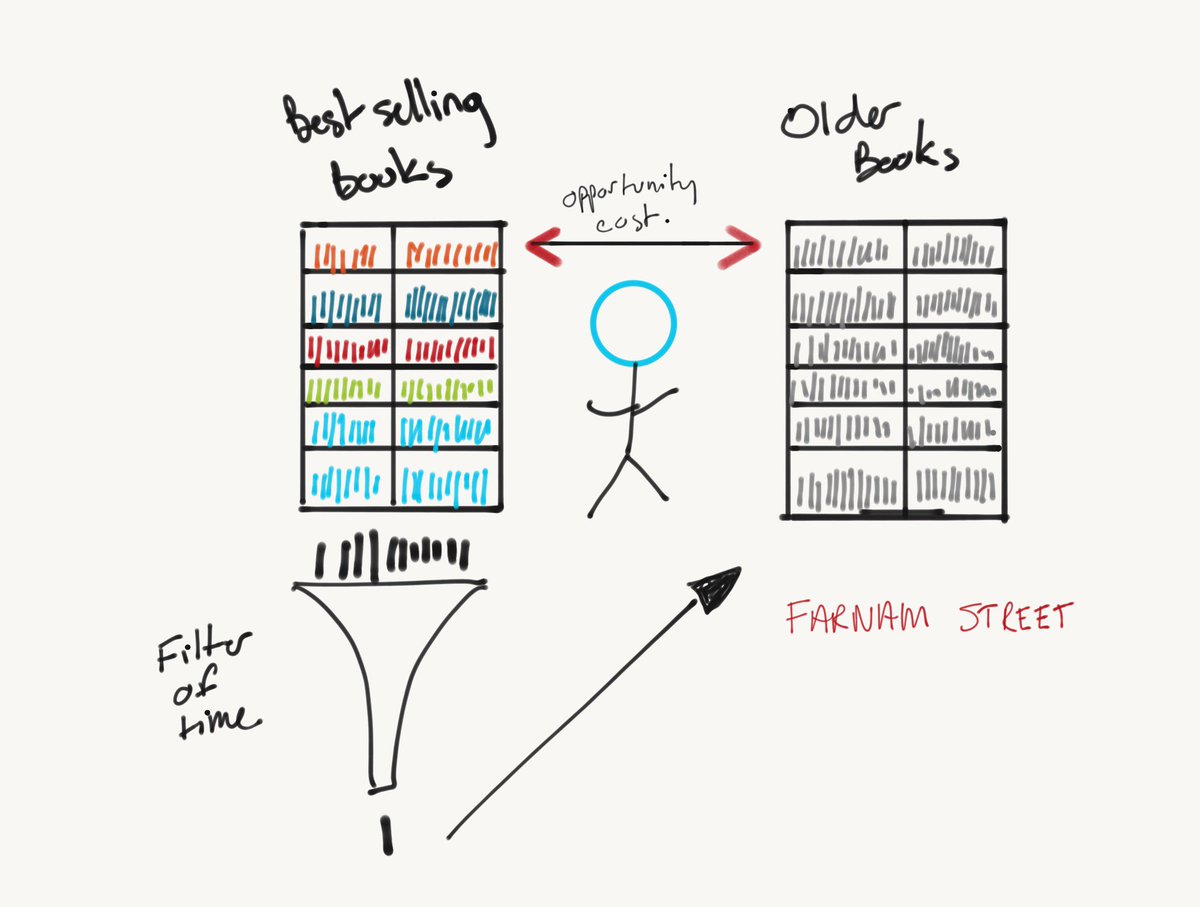
“The best filtering heuristic, therefore, consists in taking into account the age of books and scientific papers. Books that are one year old are usually not worth reading (a very low probability of having the qualities for “surviving”), no matter the hype and how “earth-shattering” they may seem to be.

Farnam Street, one of my favorite blogs, summarized it visually:
Via Farnam Street

My conclusion is this: even though podcasts are of the moment, the connections are not. Each additional person that keeps a low overhead, knows that good things take time, and sees danger in safety adds a pillar to the library we call truth.

History though, remains fertile, and it’s Wilbur and Orville Wright who we can look at now. One hundred years may separate us, but if things work now, as it did then, we should figure out what those things were. Like Grandma’s famous spaghetti and meatball recipe, to survive the test of time, it has to be good.

Each factoid below is from David McCullough’s book, The Wright Brothers.

1/ The Wright brothers valued a low overhead. They had two older brothers and saw the financial challenges each faced. Wilbur and Orville needed to explore the world.

Low overhead is a means of survival. In my book – 28 Lessons from Start-Ups that Failed one of the main causes of death was too high an overhead. This meant hiring too quickly, too much inventory, or expensive marketing. Each commitment a start-up made was an obligation. Each obligation a nail in their coffin.

The Wright brothers avoided this.

Instead, they took the path similar to that of comedians like Jerry Seinfeld, Jay Leno, and Sarah Silverman. Profiled in the book Sick in the Head, each said that they maintained minimalist lifestyles so they could maximize their career. The Wrights did this too.

They didn’t marry. They lived with their sister and father. They expanded slowly. Wilbur and Orville required very little, and only added to their plane what they earned from the bicycle shop.

2/ The Wright brothers undervalued school but elevated education. McCullough writes that their father would let them stay home from school if they were reading something and didn’t want to stop. They were voracious learners.

People can succeed in school or out. The key isn’t school, the key is to learn. Charlie Munger is described as “a book with legs sticking out.” Tim Ferriss created his own business school by investing. Ezra Klein did it for journalism school. The brothers were early enrollees in the XMBA.

The Wright brothers had the chance to go deep in any direction they wanted. Besides two sets of encyclopedias, the brothers had many books, and a father that encouraged reading widely. They never went to college, but you wouldn’t say they weren’t learned men.

3/ The Wright brothers had good timing. Every event is a composite of the events before it. The turn of the century invention of airplanes was no exception. When Wilbur got sick, staying inside for years, Wilbur read to him. All kinds of books, but what struck him most were the books about birds and flight. The invention of dry plated cameras meant there were pictures too.

This primordial soup was one of ideas, specifically about flight. Timing like this matters.

Seth Godin and Mark Cuban both said their timing was good when they got out of the stock market before the dot-com crash. Daymond John (retail, fashion) and Howard Marks (bond investments) both had good timing for their careers. Trip Adler tried to launch on-demand ride sharing too early. Neil Strauss launched his book tour the same weekend as Hurricane Katrina.

The Wrights had good timing. Their invention preceded a world war, and at a time of American growth. They built on the success of others, with information that could be transferred with ease.

Josh Kopelman said there’s no magical dust, good timing is about a little luck and a lot of work. The Wright brothers had both. One observer said of them:

“The Wrights were two of the workingest boys ever seen, and when they worked, they worked. They had their whole heart and soul in what they were doing.”

4/ The Wright brothers didn’t blow up (literally and figuratively). Related to the value of low overhead, you also want to not blow up. You want to survive to fight another day. The Wright brothers did this.

While breathtaking drone footage is common on YouTube, the Wrights had nothing like this. They were careful pioneers. Each brother (they took turns flying, never getting on at the same time in case something happened), tried to minimize the risk of each flight.

Wilbur wrote about this:

“The man who wishes to keep at the problem long enough to really learn anything positively must not take dangerous risks. Carelessness and overconfidence are usually more dangerous than deliberately accepted risks.”

Live to fight another day was a big takeaway from my research on failed startups. Author David McRaney puts it this way: “Success boils down to serially avoiding catastrophic failure while routinely absorbing manageable damage.”

5/ The Wright brothers loved the grind. Besides being, “two of the workingest boys ever seen,” the Wright brothers loved work.

It wasn’t easy to build the world’s first airplane. Clouds of mosquitoes chased them at Kitty Hawk. Busted fliers arrived in France. Broken motors, fanciful press. The only thing missing was that they never trended on Twitter.

When things were bad, they were bad. Riding back to Dayton after a failed fall at Kitty Hawk, it seemed like they could (they would) give up. But, McCullough writes, “the pall of discouragement disappeared in a matter of days, replaced with a surge of characteristic resolve. They would make a fresh start.” Wilbur wrote that despite all these setbacks, “it was the happiest time we’d ever known.”

Another flyer, Chris Hadfield loved the grind too.

“It’s probably not going to happen, but I should do things that keep me moving in the right direction just in case – and I should be sure those things interest me, so that whatever happens I’m happy.”

This is the only way it happens. No one knows something big is happening as it’s happening. James Manos didn’t realize that as he wrote College for The Sopranos, that it would be one of the greatest episodes ever. James Corden didn’t know Gavin and Stacey would be huge. Chamath Palihapitiya didn’t know it about Facebook.

You can aim for big things, but you have to love the work.(a)

6/ The Wright brothers argued. It wasn’t uncommon, McCullough writes, for a day of work to end with an argument. Wilbur and Orville would retire and “sleep on it.” The next day Wilbur would arrive at the workshop and tell Orville that he might be the one who was correct, and Orville would do the same. They argued in pursuit of truths.

One observer said Wilbur, “was always ready to oppose an idea expressed by anybody…ready to jump into an argument with both sleeves rolled up.”

Wright defended this tact, noting, “a good scrap….brought out new ways of looking at things…it helped round the corners.” And Wright, was right.

Part of  how to be a genius is to have good arguments. You must test the mettle of your theories. Bill Simmons argues to make better predictions. Brian Koppelman argues to make a better story. Bob Seawright argues to make better choices.

Thanks for reading, I’m @mikedariano on Twitter.
(a) This is chapter 4 of Charles Duhigg’s new book: Smarter, Faster, Better.