“We have every reason to believe,” said Jane McGonigal, “the future of work will be more like Fortnite than the kinds of office jobs that we have today.”
2020 results
"We have every reason to believe, the future of work will be more like Fortnite than the kinds of office jobs that we have today." @avantgame
What % of jobs are currently more like Fortnite than 2020 office jobs?
I would wager that future response balances will have a COVID-19 influence to them. School for example, seems to be tilting more digital as both administration wants to appear technological, tools become cheaper to implement students, and external forces require it.
“At Twitter we had all the sales people in a different building and so we organized a margarita and taco event in the sales building. Of course all the engineers wanted margaritas and tacos so they had to go and spend time with the sales people and ask them around their roles.”
Kris Cordle
Cordle goes on to tell Shane Parrish that once a sense of community forms it’s easier for the sales people to go to the engineers, “rather than filling out a form that goes to the engineer who goes, ‘what is this person talking about?’.”
Jobs-to-be-done is like an elegant meal—but in the kitchen the cooks are hot and the chef is scratching her head wondering what will make it into tomorrow’s soup.
JTBD-ing is messy because we don’t have the language for it. The axiom to don’t ask the customer what he wants exists not because the customer doesn’t know but because the customer doesn’t know how to express it.
Here’s a question transcription of a sample interview Moesta conducted:
Look at the ground Moesta covers! For a mattress! Look at the language. “You moved?” “Who suggested sand bags?”
JTBD is elegant because of the hard work behind it and the hard work is the translation. Often this comes down to: what does the person need to feel.
Now we can circle back to Cordle and see how, like a game of telephone, the message ‘needs to feel this’ gets garbled going from one person to another. What makes the message clearer is good communication which exists in a good culture.
Margaritas and tacos seems unnecessary to the bottom-line but becomes axiomatic once we trace the process back. Like looking at the flurry of activity in a kitchen can give a sense how such a polished meal emerges.
“I went to a Japanese restaurant in Los Angeles, like the number seven restaurant in Los Angeles, and I couldn’t believe that this was the place. It was in a strip mall somewhere, but it was utterly fantastic. The presentation on the exterior was atrocious, and sometimes I think that is done deliberately. In a sense, there is a category of restaurants where it’s all about food. Like, with a name like Smuckers it has to be good. We couldn’t be this crowded with such terrible frontage.”
That’s Rory Sutherland on episode 201 of Risky Conversations. Tyler Cowen, more here, uses the same idea and beyond, “When I heard that name I thought, this place must be great. When Americans want to eat Ethiopian food, what kind of name are they looking for? The Red Sea? Queen of Sheba? Fine. But when it’s EYO Sports bar you know it’s really for Ethiopians.”
The biggest returns in life come from new information or new analysis. Though it’s helpful to keep in mind that not everyone wants the same returns or if they do, on the same timeline. Dining isn’t only about the food, there are many jobs to be done with a meal out. However, if one of your jobs is different (in scope or time), you can often hire for a great price.
For food, follow the lead of Rory and Tyler, and find good food at places with bad names.
Typical analytic situation have three potentials for improvement (or, competition).
Better data, think motion tracking in football or hockey.
Better models, think the shift from batting average to on-base-percentage.
Better people, think the 1980’s shift when Edward Thorpe began competing with other Ph.D.
However, the largest potential gain in analytics (at least sports, circa 2020) is the implementation. It’s no use coming up with a good idea if you can’t get it into the portfolio.
Richard Sherman and Chris Collinsworth offer a stopgap solution. Talking about the Pittsburgh Steelers decision to punt on fourth and one from the forty-six, “If you’re the Cleveland Browns you’re definitely relieved,” said Sherman, “shoot you only needed a yard, you can fall for a yard on most defenses.”
This idea has been around a long time in sports, Bill Simmons has spoken about it often on his podcast; what does my opponent fear the most? I’ll do that.
Some NFL teams have solved the implementation obstruction with a direct line from the analytics department to the coach. Teams slower to adopt and adapt can take the idea of inversion and just ask one of their coaches. It would be great to see a head coach ask his defensive coordinator if the offense should stay on the field, or indeed if they should punt.
Note, I listened to Thorpe’s A Man for All Markets and while long, it was good particularly because it was read by him!
Could: a verb used for clicks as in, this <insert news> could have these economics effects on your portfolio.
More: a pronoun used to show relative position, though the original may not be stated, as in, Laura got more for her money at Herr’s.
Deal: a noun used to show relative rather than absolute spending. As in, I got a great deal on my new SUV.
Largest increase or fastest growing: an adverb/verb combination demonstrating increase in a small group. As in, pickleball is America’s fastest growing sport. Antonym: Large N, small p.
The theme here is relativity. People are relative thinkers; see corporate greed or cheating college. Words matter because they frame our approach. Listen closely. Consider the focus. Do the words hint at who was at fault? If this were a movie why is this the script? Need to change how people understand something, or apply some extreme ownership?
Part of the reasons pickleball IS so fast growing is my participation. Thanks too to Tim for a conversation long ago that planted this seed.
One way to change an experience, and all experience is subjective, is to change the framing of it. Our food takes longer because we make it fresh. Via a16z:
“There has been some interesting work in the linguistics community asking if we should be using war as a metaphor for the virus. There’s a lot of discussion about ‘front line workers’, which is a war metaphor, but unlike people in the military, they didn’t volunteer for this degree of risk.”
Gretchen McCulloch
McCulloch goes on to consider how things would be different if the pandemic were described as a fire or natural disaster. What if outbreaks were flareups, people sheltered temporarily, and we extinguished the threat?
Some added stress of this pandemic is from our ambiguity aversion: we don’t like the feeling of not knowing.
So we use metaphors. Fights are: Us vs them, victory is this mark, loss is this, collateral damage is undesired but expected.
This post isn’t to say that Fire or Fight is better for the pandemic, but to think about using framing in interesting ways. Here’s one we’ve featured before:
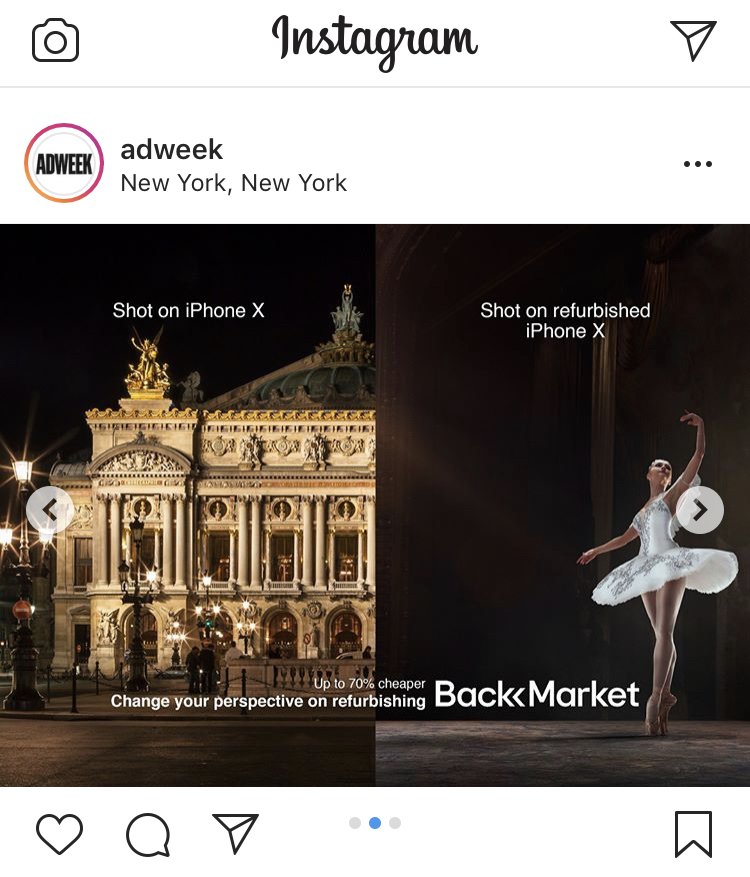
This ad frames opportunity cost. It says, you’ve got 1,200 dollars. Do you want a new iPhone or a nearly-new iPhone and tickets to the ballet?
Framing works not because people can’t do the thinking by themselves, but that they don’t because thinking about all this is hard. We’ve evolved to process information where available equals important. That’s often good enough, so we stop thinking.
This is all good news. It’s why Alchemy is possible. Using the right words changes the focus which changes the understanding which changes the actions.
Would the pandemic be different if we viewed it more as a natural disaster? Maybe. Would our understanding, focus, and concept be different? Certainly.
“Bias” tends to have negative connotations. It’s the “wrong” answer.
The problem here is a translation issue. It’s going from the world of One Answers (mathematics) to the world of Many Answers (life).
Weather is a fascinating demonstration. Nate Silver writes in the 2020 edition of The Signal and the Noise, “The further you get from the government’s original data and the more consumer facing the forecast, the worse this bias becomes.”
Relatedly:
(John Gruber) “I staunchly believe that Fahrenheit is the better scale for weather because it’s based on the human condition. Who gives a crap about what the boiling point of water is, it’s the most ridiculous thing I’ve ever heard in my life.”
(Ben Thompson) “The other thing is that Celsius is not precise enough. In the car it adjusts it by point-five because a single degree of celsius is too much for the car. Fahrenheit is more finely grained in a positive way.”
This is why we have a wet bias. We design weather for people.
Silver again, “It’s deliberate and it has to do with economic incentives. People notice one kind of mistake, the failure to predict rain, more than another kind, false alarms. If it rains when it’s not supposed to they curse the weatherman for ruining their picnic. Whereas an unexpectedly sunny day is taken as a serendipitous bonus.”
One change in my thinking over the yeas has been to reframe ‘bias’ as ‘tendency’ and then consider what’s happening. Humans are only illogical in the game of optimization, which matters in the world of calculations rather than considerations.
Wet bias may be inaccurate but that doesn’t make it wrong.
“My parents are everything to me. They’ve worked their asses off to raise me and my two little siblings, starting with nothing as immigrants. They’re in the restaurant business and the pandemic forced them to burn through a large chunk of their savings, and they stress out over finances every single day. My dad always told me one day he’ll retire once the house is paid off, and that day is finally here.”
The OP dollar cost averaged their way to six Bitcoin for an estimated $240,000. “Thank you bitcoin community for all the memes and bullshit TA threads. I’ve reached my moon.”
We denominate freedom in money (the number) and sometimes get caught in this metric. But personal financial success seems to be mostly choosing from the good options, having good luck, and remembering da moon. Inverted: it’s not getting caught up with the Jones family.
With the 2020/2021 run it’s been a treat to see the Reddit stories about paying down debts, hitting marks, and people cashing out.
There’s certainly luck, but for OP there’s also brains and heart.
“Testing, tracing, vaccination…We will arrive at more of a Swiss cheese approach. Every single thing we’re doing: mask wearing, vaccinations, testing, therapy. Every one is imperfect, like a slice of Swiss cheese. But if we do a dozen of these and lay one over another all the holes are gone. That’s what it’s going to take.”
We’ve addressed this idea before, to always fix your weaknesses, but the pandemic response is another opportunity to think roughly about cost-benefit actions.
Most of the time, s-curves, there’s a great return whereas the same fixed effort later is like squeezing the remnants from a tube of toothpaste. The iPhone is a clear example where for many years it was an amazing improvement but each iteration is more novel.
However, the slew of Apple products is like Brilliant’s block of Swiss cheese. Each iPhone, iPad, AirPods, etc. has ‘holes’ but overall the company has few.
In 2009, Annie Duke finished second behind Joan Rivers on Celebrity Apprentice. This was surprising, said Tyler Cowen, “I would pick you.” On the show Duke was better. She raised more money and won more challenges. In those areas, Duke won. But that’s not really the game of Celebrity Apprentice.
Penn Jillette explained explained that there are two games on one show:
“On reality TV competition shows, there are always at least two competitions going on. There’s the competition that’s the make-believe of the show, and there’s the real completion that happens outside the TV show. Winning the make-believe completion does help with winning the real competition, but they’re not the same.”
Duke too was aware. She told her friends and family there was no way she would win. The rules were simple: Donald Trump chooses a winner. That’s the game of the make-believe show. However, there’s also the second game which Duke won and continues to win as she joins podcast like Cowen Convos.
…
There’s a joke my kids love. It goes like this: You walk into a barbershop and there are two barbers. One is well heeled and has a fantastic haircut. The other is unkempt. Whose chair do you sit at for your follicle fix?
Who do you pick?
There are multiple games at multiple levels. Mostly it’s the game of Show and the game of Go. Some succeed at both games. Warren Buffett comes to mind, and proves it goes deeper because Buffett’s Show game is a certain type.
In games with tight feedback (pool construction), the game of Go is more important. In games with loose feedback, the game of Show rises in esteem.
Most of life is complex and we must play both games. Annie Duke might not have written books, joined podcasts, and shared what she learned without playing the game of Celebrity Apprentice. Jillette noted how the reality-TV game helped with the put-asses-in-seats-at-P&T-theater game. The games feed back on each other. We all play games, how much Show and how much Go?
Tracking Tom Update: Well, he did it. Tom Brady passed for 4,633 yards this year, 377 more than the betting line. We’ll conduct a post-mortem in the future.

 The Waiter's Pad