TIL2017 – Curiosity

Supported by Greenhaven Road Capital, finding value off the beaten path.
This post is part of the TIL2017 Summary Series.

Readers are curious. Entrepreneurs are curious. Juvenile delinquents are curious. Yvon Chouinard pointed out this idea and it appears again and again. Each of these people wants the world to exist in a different form.

When the college dropout codes a technology pillar it’s because they were curious. People without the right avenues, wrote Ken Grossman, are troublemakers. This line is narrower than we realize.

More than a handful of podcast guests say curiosity is fun. It’s like hunting for Easter eggs said Wesley Gray. Curiosity was what Joe Peta did as part of his rehab. Walter Isaacson said a “playful curiosity” was what separates Da Vinci from Dariano (me, you). Tyler Cowen said it’s like being Sherlock Holmes.

These investigators of intrigue often suggest we go. Cowen said books are a great way to learn about things but to really taste a place you have to go there. Jenn Hyman said she got her business idea not while in business classes at Harvard but in her sister’s apartment. Esther Duflo went to Africa and India to solve the questions her curiosity produced.

Before you go, wrote Peter Thiel, believe there are secrets to find. If you go without expecting (hoping) to find something then nothing you will find.

Thomas Russo told Ted Seides to listen to things that surprise you. That’s what happened during Peta’s rehabilitation and deliberation. Why did this baseball team have that record?

To channel Charlie Munger, it will also help to know where not to go. That can be school. Ben Sasse said school is okay, but we need more options. Bloggers like James Altucher and Seth Godin disagree. So might Alice Waters.

Instead of school, go and ask a lot of questions. Scott Norton did this for his ketchup company. He asked experts at making food and experts at eating it. Marcus Lemonis said that he’s like an infant, asking why, why, why.

Brian Grazer wrote a book about curiosity. Brad Gilbert started his own little book about it. Gilbert lost a tennis match to an oaf. How did he beat me? Gilbert wondered. He sat down to watch the guy’s next match and tracked his play, taking notes in a little black book. At their rematch, Gilbert won and he expanded his notes to include more players.

Let curiosity sprout come from novel notions.

Ken Burns said he never picks films because he knows about the subject. He does the opposite. He picks things he doesn’t know about. Jason Calacanis advised pretending you’re a journalist.

The quality of curiosity is quantity. Alton Brown called it the greatest force in the universe. Kevin Delaney said that success comes from ideas.

If I were magical this is the first spell I’d learn. I’d cast curiosity.


TIL2017 – Trust but verify

Supported by Greenhaven Road Capital, finding value off the beaten path.

This post is part of the TIL2017 Summary Series.

“Trust but verify,” – a Russian expression – is helpful and relevant with more accurate and accessible data. Data is a key to the right lock.

Feelings are not facts said Ray Dalio, Ken Burns, and Travis Sawchik. Each of them encourages us to move from the world we expect to the world that exists. Included in the basket of feelings are opinions, biases, inclinations, and ideas. We have to test that stuff.

One favored verification is out of sample tests. This test, said Cliff Asness, is “very calming.” Dalio suggests we find timeless and universal data.

We don’t tend to do that. Instead, we can get tripped up. Extrapolation is a common downfall in sports like the NFL.  Blowout wins in college football, for example, is a poor predictor.

Other times we need to verify how much numbers really matter. Ben Sasse said that a 40:1 student to faculty relationship sounds a lot better than 300:1, but doesn’t matter. So long as there are “five nerds” doing all the talking, the experience for the rest of the students is mostly the same.

Numbers like 99% can be convincing too but upon further inspection may not be. Former football lineman John Urshell expressed doubts about how often brain damage occurs in football.

Other times we can see a complicated system. This is often just marketing said Wesley Gray.

Ideally, we get to control the data from the point of collection. Ben Falk said this is what happens with the Philadelphia 76ers. The team tracks three-point shots made in practice. The players have to prove themselves before they get the green light during a game.

Data control is what sent Esther Duflo into the field. She was concerned that too much foreign aid was assigned by demand and supply wallahs. “Wallah” is Indian for a person involved with a specific thing. Duflo et al. call politicians from both sides to the carpet. Why? They don’t verify their assumptions. Rather than parroting that supply/demand will fix X, run experiments to see what really happens.

When asked about what led him away from market cap weighting, John Montgomery gave Barry Ritholtz this answer, “research.” It’s a funny moment in the interview. Rather than pontificate Montgomery levels. In the same interview, Montgomery explained how he tracks his time. It’s laborious, he said, but it’s something he needs to do if he’s going to verify how he spends his time.

The Nike running team did this with Eliud Kipchoge. Rather than assume that marathon times were a good indicator, they measured oxygen, gait, and diet to verify that the runners were performing at their peak.

Layered on to all this is our biases. The The GMs talk about solving this problem and come up with some good ideas such as writing down your ideas and revisiting and blind voting.

Infinite verification is impossible but basic verification is not. A few calculations or internet searches can give us some idea whether to trust, or verify more.


TIL2017 – Be Different

Supported by Greenhaven Road Capital, finding value off the beaten path.

This post is part of the TIL2017 Summary Series.

We’ve already had a post about Being Different. It was like the song of the year though, so it gets repeated here.

Being Different is valuable because it distinguishes you from others. It’s like when my seven-year-old daughter says ‘Let’s race!’ but speeds off before telling me where the finish line is. If the end is different you can be the first one there.

Danny Meyer did this for restaurants. He wanted to put flavor notes together in a new way. He wanted to emulsify tastes. He wanted new food in New York – and he’s largely succeeded.

We can hold up Meyer and the others in hindsight but the journey to different is lonely. You have to be a loner, a cynic, a skeptic wrote Scott Fearon to be a short seller. Jason Calacanis warned against investing in obvious things. Meb Faber said that “me too” funds will often fail. Marc Andreessen said to look beyond the non-obvious.

Okay. How?

One way to be different is to do something you know. Andy Rachleff suggested this. Create something that you love to use, said Rachleff. In other words, eat your own dog food.

Another way is to learn about something. This is what Scott Norton did when he created a new ketchup brand. If there’s a manual about how to do a thing, it’s not a new thing Norton said.

Marc Andreessen would tell you to look at fringe groups. What are they doing? We see this through history like when the radio went from a novelty to a luxury to a necessity. Cars, phones, dishwashers too.

Sometimes you won’t be different. This is why Gimlet Media doesn’t have a sports show said Alex Blumberg. Until they can do something different than the existing podcasts they’ll sit out.

Sometimes your different thing will be really different. Who, for example, would want to watch eleven hours of civil war pictures? Ken Burns found out that a lot of people would. Burns and Alton Brown both succeeded because they remixed existing ideas to make something new. For Brown that epiphany was when he wondered what a combination of Julia Child, Mr. Wizard, and Monty Python might look like.

Different isn’t a Silver Bullet. The thing still has to be excellent. Jenn Hyman tested the Rent the Runway idea on her sister and friends in college. Scott Galloway tells his NYU Stern students – and anyone else who listens – to build a great product before you worry about marketing. So does Ryan Holiday.

If the different thing succeeds it will be temporary. Others will join this one person race. Edges don’t remain said Ed Thrope. Sports is a petri dish full of examples from Jeff Luhnow to Daryl Morey to The NFL.

Being different will always be hard and sometimes be valuable.

Alice Waters

Supported by Greenhaven Road Capital, finding value off the beaten path.

The tldr version of this post is that Alice Waters started Chez Panisse with obliquity. She knew what to do thanks to a DIY education, lots of (failed) experiments, talking with others (including customers), and keeping her cost low. Her differentiated product focused on a few key things and she hired independent employees.

Also, Alice owned her building, Tren Griffin addresses this in his post on wholesale transfer pricing and restaurants.

Alice Waters is the force behind Chez Panisse and her story is told in Coming to My Senses and Alice Waters and Chez Panisse. I’d have never read these books if not for Rory Sutherland recommending the book Obliquity. This quirky little book by John Kay is about working toward big ideas, it’s about Alice Waters and Chez Panisse. It may be about starting any company.

Kay writes that the biggest brands in the world all started as small companies with big ideas. It was about design or culture or feelings. When I think about Apple, Coca-Cola, Nike, Subaru, WordPress, or NYC I sense an essence. That’s what founders, like Waters,  aim for.

“How the slapdash, make-it-up-as-we-go-along little hangout and its harried mistress became such icons is a story of adventure, misadventure, unintended consequences, steel will, pure chance, and utterly unrealistic visions.”

“Alice decided to cook her way straight through Elizabeth David’s French Provincial Cooking. The book was about more than just good recipes. It portrayed a way of life — honest, elemental, caring — from which a tactile, sense-engaging way of making food emerged as naturally as a plant form the earth.”

“Alice knew, at last, what she wanted. The Montessori way – direct sensory experience, experimentation, optimism, confidence – would be the way of her restaurant. As for the practicalities, she had no specific ideas. She had never heard of a business plan. She had only faith that things would fall into place.”

The restaurant’s goal was “to evoke the sunny good feelings of another world that contained so much that was incomplete or missing in our own.”

Waters had a grand vision for what she wanted her little place in Berkley to be. She got there by bypassing the traditional education system. In high school:

“I cried at my desk…I felt I was just not smart enough.”

“My grades were good generally but I was distractible.”

She graduated high school and enrolled at Santa Barbara. It was too much of a party school. A friend and the culture pulled Alice to Berkley. From there she traveled to Europe. She kept learning, just not in the classroom.

“The dreary classrooms of the Sorbonne versus a joyous immersion in French cuisine in the sparkling, spotless dining rooms of Paris’s restaurants – for Alice it was an easy choice.”

“But I got the whole French aesthetic, from beginning to end. What those thick curtains looked like, what the fruit bowl looked like, how the cheese was presented, how it was put on the shelves, how the baguettes twisted. The shapes, the colored, the styles. Everything in Paris was magical to me.”

Waters traveled with friends and learned about food, culture, restaurants, hosts, and gardens. Back in California, the people came to her; she met filmmakers, foreign students, and academics. The DIY education paired well with Alice’s temperament.

Back in the states she started cooking for friends. Dinner parties and films, dinner parties and themes, dinner parties and experiments. Alice got the idea to start a restaurant. She had seen women running places throughout Europe. She had seen places in California doing things she might like to do. These were here see it to believe it moments.

She found a house in Berkley, but with no money had to beg and borrow from everyone she knew. But she kept a low overhead and spent 1971 looking for supplies in flea markets.

Alice knew – unlike some starups – that she had to talk to her customers.

“Alice had good reason to believe there would be a public for her cooking. Nearly everyone who had come to dine at the little house on Dada Street said that hers was some of the best food they’d ever tasted.”

“I was in the dining room, and I knew what things people were really likening, or how they were reacting to special little things that we’d try for just a few people, and I would feed that back to him.”

She knew what people wanted thanks to a lot of experimentation.

“We were willing to fail, which is absolutely essential to any kind of learning. Truly momentous disasters occurred on a regular basis, both in my artwork, which I destroyed and in her cooking, which she destroyed.”

“Jeremiah would try anything…Fuckups? We had a few. More than a few.”

The testing was what allowed Chez Panisse to be different.

“Much of the food that Alice loved most was la cuisine du marche – market cooking.”

The Chez Panisse hunter-gatherer culture “was was something that no American restaurant had ever done.”

In the first year of the restaurant Waters drew her line in the sand. She found what the most important things were.

“It was simple: ‘No corners cut,’ she told everyone. ‘Ever’.”

“That’s what distinguishes a great salad from a good one — a great one is alive.”

Good ingredients and good cooking of French recipes with small twists was the menu for the early years of Chez Panisse. This wasn’t an easy thing to prioritize. Great ingredients meant new logistics, new inventions, and new processes. Guided by obliquity, Waters didn’t care how long it took or how much it costs. This took a lot of non-glamorous hard work.

About the first year, “It was a train out of control, a wreck about to happen.”

“Nearly always, Chez Panisse managed to present a calm, contented face to the world. Nearly always, there was something going haywire behind the scenes.”

Said a friend, “That’s how I think of Alice…always moving so quickly…She has never wanted to stop. She’s is not a contemplative person.”

Through hard work and word of mouth the restaurant grew it’s top line revenue, bottom line revenue, and bottoms in the seats. With this Waters hired more people. She found that serving great food didn’t necessarily mean food service skills. Instead, Alice looked to hire someone with esprit. Once hired, you operated under the Chez Panisse decentralized command.

About flowers “With Alice’s devil-may-care carte blanche, Carrie’s artistry was also stunningly expensive.”

“If a waiter, or even a buster, wanted to try cooking something, that was fine – though it would never appear in the dining room unless it passed Alice’s unsparing review.”

Alice went through extensive training with new employees so that once they started they could function on their own.

“When somebody would start, I’d take them into every little nook and cranny. They’d have to go into the narrow closet to see how narrow it was. They needed to go outside and see how we took care of the garbage…How hot it was in front of the ovens. How it all felt.”

“After just a couple of weeks, Alice trusted me to do it on my own — that’s one of her characteristics, to trust people. She’s less worried if you don’t’ have the competence if your heart is in the right place and you’re shooting for the right aesthetic. I got in over my head, as did Chez Panisse constantly.”

Waters wasn’t absent. She understood that she didn’t have all the answers and only in brainstorming with the staff would they settle on the right dish.

“The kitchen staff met early every afternoon. The first order of business was to compare what was on the published menu with what was actually in the house. If salmon was scheduled for Friday night and the salmon that had come in that morning was, in Alice’s opinion, anything less than pristine – well, did anyone have a suggestion?”

Early feedback from one patron pointed out that some female servers weren’t wearing underwear. Waters didn’t care. She wanted chic. It was all in service of the spirit of Chez Panisse.

Over time Alice got better at; exploring, cooking, listening, and managing. But this excellence came at a cost. To get 10,000 hours you need support.

“Finally, Alice had to choose between Tom Luddy and Chez Panisse. No one was surprised when she and Tom parted ways — she was married to the restaurant, and both she and Tom recognized that she could never give him the time and attention that he required.”

“She had yet to meet a man with whom she could imagine having a child. Her most recent lover was a cook at Chez Panisse, handsome and sexy and smart and focused — and fifteen years young. She had hardly ever found a boyfriend outside the restaurant, so total was her inhabitants of it.”


Thanks for reading. I’m mikedariano.


Five Financial Autopsies

Supported by Greenhaven Road Capital, finding value off the beaten path.

In his book on market crashes, Scott Nations does an excellent job explaining what happened. While reading I returned to Sanjay Bakshi‘s idea of part of the reason thinking. When cause and effect are hard to untangle, understanding comes from a full picture. Nations does a great job of untangling, separating stories from reasons, politics from populations.

There are patterns to the highlighted crashes. They begin with a catalyst. Nations believes in the Uniquity thesis. In that book, Mark Buchanan looks at how forest fires, earthquakes, and extinctions might relate to economic instances. “In the critical state, the forces of order and chaos battle to an uneasy balance, neither ever fully winning or losing,” Buchanan writes.

fires

Buchanan asks questions like; If a match is dropped on a random square what are the chances of a fire? If one, how severe? The answers depend on the build-up to the critical state, that balance between order and chaos. In Scott Nations’s book, it’s the same thing, down to the catalyst.

“Every modern stock market crash has an external catalyst at its heart. These external catalysts—some are acts of nature, such as 1906’s earthquake; some are geopolitical, as in 1987 and 2010; some are political, as in 2008; and some are criminal, as in 1929—are not sufficient themselves to start a crash, though they are necessary.”

It’s like a bumped domino. Sometimes there’s not enough trees (above) or dominos (here) for things to spiral out of control. Sometimes there are, and that’s usually because, Nations writes, “each collapse has been fueled by a new, poorly understood financial contraption that introduces leverage into a system that is already unstable.”

In the early 1900’s it was the investment trust, in the 1980’s it was the leveraged buy out, in 1929 the Jone’s were jonesing to trade. Leverage made each instance worse.

“In 1907 it was the trust company, a hedge fund dressed as a savings and loan. In 1929 it was the levered investment trust, a massive stock market wager with little room for error. Portfolio insurance was another of these contraptions, though it would take more than a decade to metastasize”

People back then were so dumb. Right? Wrong. Each idea; trusts, LBOs, insurance, hedges, credit default swaps began as a sound idea.

It’s when those sound ideas are taken to extremes that problems arise. Each innovation makes an assumption about the world. On a small scale, those assumptions are fine. On a large scale, they are not. Often those assumptions were about liquidity. Again and again, in the book, a model worked so long as there were buyers and sellers. But when the shit hits the fan the buyers stood on the tables while the sellers hid under them.

A few leveraged participants don’t make a crash. It’s when everybody gets in that things get messy. That happens too. The Liberty Bonds normalized investing and was part of the reason people became interested in the stock market. The LBO corporate raiders were part of the reason stocks ran up, as people hoped they held an acquisition target. Each additional participant was like another breath into a balloon. The system stretches then snaps.

If this were a recipe what would it look like?

  1. The government creates a condition, making things too easy or hard.
  2. Investors seek new returns.
  3. Innovative products which behave one way in the ‘lab’ another way on the ‘street.’
  4. Initial and then mass adoption, often with leverage at each stage.
  5. A catalyst.

There was one idea I kept thinking of while reading this book: Bitcoin.

Nations’s writes, “Despite their differences, Pickens and Icahn seemed to be reading from a book that no one else understood.” This is what I thought listening to Patrick O’Shaughnessy’s Hashpower Documentary. Not only that, but so many of these factors line up with cryptocurrencies. They’re financial products most people don’t understand. They work in one instance but are untested in the wider world. The masses aren’t in but will they be and will there be leverage? What kind of worldwide catalyst could destroy or inflate them?

The book doesn’t have the answers and each new crisis is different from the last. This book isn’t predictive and doesn’t try to be. But it descriptive, and for that, it’s a worthwhile read.


Please stop punting

Supported by Greenhaven Road Capital, finding value off the beaten path.

Sloan Conference week continues! Monday it was how General Managers make decisions, today is all about the NFL.

It’s easy to say “coaches should stop punting!” yet they keep doing it because punting is a conventional failure. “No one got fired for buying IBM,” said Rory Sutherland. Along with career risk/career capital, there’s bias, inertia, and other factors. Here’s what these football guys said about analytics in sports.

Analytics isn’t a panacea. Nothing is. Numbers are merely tools that can lead to black and blue thumbs too. Mike Lombardi (more on him here and here) said that coaches need to figure out the figures and structure practices around them. It’s not about convincing players so much as, in Jocko Willink’s words, showing “commanders intent.”

This is when the buy-in happens. John Urschel played for the Baltimore Ravens and echoed what Lombardi said. If a coach found helpful statistics the players would readily adopt the strategy. However, said Tedy Bruschi, it had to work. He said there were times when Bill Belichick (more on him here) would stop following a model early in the season and never revisit it. Wrong priors were gone priors.

Actions in practice should reinforce the analytic indicators said, Lombardi. Should they punt? isn’t decided on Sunday. That decision is made on Tuesday. Teams will (should?) practice and prepare. The fourth down bot was fun but by then it’s too late.

There is in-game data that the players use. Former players Bruschi and Urshcel both said that it has to be simple. These aren’t statisticians, Urshel said, these are football players. Sometimes he and the other coaches had to help players figure out what this or that meant. Bruschi said that one or two best guesses are what the players need, especially during key moments of the game; third-downs, red zone, high confidence plays, etc.

There’s so much going on the players need to focus on the most important things. We saw this too with Eliud Kipchoge, the fastest marathoner in the world. It’s also something professional investors remind the amateurs; save enough, limit fees, diversify holdings, and be patient. Do the Most Important Things first.

Executives can roll around in the numbers a bit more. Lombardi said that individual player numbers can tell you when someone’s physical skills are declining or when a player needs more rest. Bruschi said that each team approaches numbers differently and that figures are all relative. Yards per game, for example, is a baloney number said, Bruschi.

The panel also discussed how difficult it was looking in from the outside. This is a common theme in sports from Andre Agassi in tennis to Ben Falk in basketball to Neal Huntington in baseball. People on the inside need thick skin for the criticism bombardment from people on the outside who don’t have the same information. It’s so nuanced, said Lombardi, that the same scheme like ‘Tampa Two’ is played differently in Pittsburgh than New England.

This internal/external dynamic also applies to trading players. Like used car sales, there’s an information asymmetry. How, asked moderator Bill Barnwell, do you evaluate Jimmy Garappolo? (This panel occurred before his trade).

Well, said Chase Stuart, look at your prior. What was his score when your team graded him for the draft? Then look at the evidence; completion percentage, time with the Patriots, etc, and update that view. The sample size is small enough that Stuart says to not update your prior. Bruschi said that the sample size is small but the comparables are good. Throwing forty passes in the NFL is a much lot better sample than throwing forty passes in college. But is it better than four years of passes?

There’s also the performance per dollar to consider said, Sandy Weil. Rookie deals are cheap, especially if a player is excellent like Russel Wilson during his rookie contract. Garappolo only has one year left on that type of deal so he’ll be more expensive.

This stuff is complicated – and that’s before the biases the other GM’s talked about. Weil said he was shocked to see that just a few years ago many NFL teams used the fastest forty-yard dash time in their player evaluations. That’s like an executive who picked his best quarter from the past three years.

You get this kind of thinking, said Lombardi, when you begin with the end in mind. If you know you need to solve for X – lineman, linebacker, kicker, etc – you’re more likely to justify why a player does that. Instead, outsource your scouting at the combine. Distance can create impartiality.


Thanks for reading.

Decision making by General Managers

Supported by Greenhaven Road Capital, finding value off the beaten path.

At the 2017 Sloan Conference Billy Beane, Sam Hinkie, Cade Massey, Daryl Morey, and Farhan Zaidi spent an hour discussing decision making.

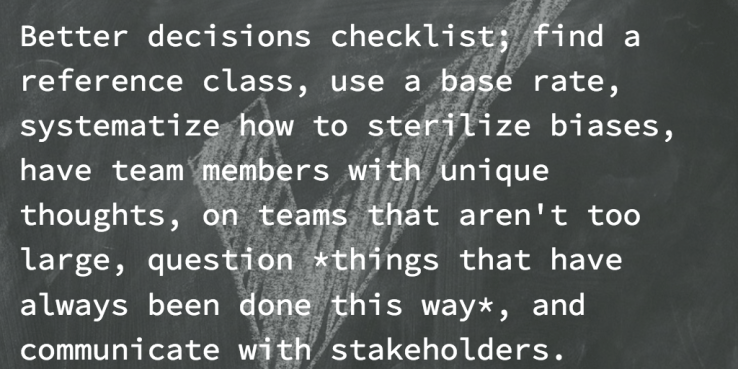
Good decision making is hard. “You realize that you’re in the fishbowl not knowing there’s water,” said Morey, “Half the time with your decisions you don’t know if its cognitive bias, anchoring, or loss aversion. Even if you know its happening it still affects you in a big way.”

These biases can be as puny as presentation. Medical patients tend to prefer surgeries with 90% survival rates to 10% mortality rates. While pernicious, our evolutionary biases can be circumvented.

  • Hinkie suggested to write down your reasoning, let it rest, and then revisit. If a key point fails to hold water, the whole plan is sunk.
  • Morey said to flip the script. Instead of asking if you would trade A for B, consider that instead you had B and were trading for A. “It’s shocking how often you’d go, ‘We’d never think of doing that.'”
  • Zaidi offered a more morbid life hack. Instead of trading a player, imagine you shot him instead. Would you still do the deal?
  • Beane added that most of the decisions we make our independent but we treat them dependently. Just because a player from one school succeeded doesn’t mean the next one will. Related, have no sunk costs.
  • Zaidi conducted blind voting but warned against a false sense of independence. After all, you’re all employees with the same data set.

Good decision making requires humility. Sometimes bad reasons have good outcomes. Fortuna is blind so don’t look to her, but your model needs attention. The best models, said Hinkie, are interesting ones. Free throw shooting is boring. However, those better models are more subject to your views (and biases).

Beane said that he wouldn’t recommend a “scorched earth” policy of only data. Instead, incorporate the non-numerical data. How?

If it’s subjective, rank it.

moreyordinal

Hinkie said he learned from Morey to strip things down. “I’m asking ‘Why?’ a hundred times,” Hinkie explained.

Beaned added, “The idea that anyone can watch a seventeen-year-old for an hour and predict what’s going to happen in ten years is asking too much.” But, he added, you need on the ground intel. Sometimes a scout in Oklahoma can tell you things only a scout in Oklahoma knows.

Remember though, you aren’t doing this on your own. As Eliud Kipchoge said, “one-hundred percent of me is nothing compared to one-percent of my team.” Morey said much the same thing, “That’s why in hiring it’s very important. Passionate, well-informed, well-prepared people will advocate and you will only learn from the strong advocation of someone.” These GMs want people who argue well.

You also need to communicate with the people above and below you. Some ownerships are better said, Beane and Morey. All organizations have stakeholders and in sports, that group includes; players, owners, fans, journalists, and sponsors. Investors know that filtering in aligned limited partners helps them do more. GM of the Astros Jeff Luhnow said:

“I think it’s important in our position we spend the requisite amount of time managing the stakeholders; the fans, the media, the influencers in the organization, the ownership – all of those stakeholders. I spend a large part of my job managing those stakeholders. It all comes down to communication.”

The Sloan Conference GMs are also a group who chose different tacks and tactics. Morey clarified that it’s not so much different as extreme. For example, if you want to score more points, shoot more three-point shots than two-point ones. If you want a great player you need a high draft pick, and the more high draft picks the better.

These leagues are good, said Hinkie, and you need to have an edge that you push. This could be scouting, player development, training, analytics, trades or whatever. The type of edge doesn’t matter so much as having one. Don’t be different for the sake of being different said, Zadia. Be different because you think you’re right.

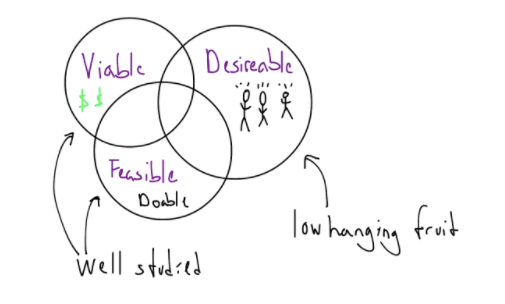
But don’t get comfortable with your difference. In the early days of analytics, said Beane, it was like picking up a dollar off the sidewalk. Then it was like finding fifty cents. Now it’s spotting a quarter. Edges erode. “The game is so much smarter now,” said Beane, “There is no low hanging fruit at the executive level now.”

If you liked this post you may also like posts on Sam Hinkie, Daryl Morey 1, Daryl Morey 2, or Michael Lombardi.

Thanks for reading. Sign up for more here because you read this post.

Peak performance: Marathon running

Supported by Greenhaven Road Capital, finding value off the beaten path.

Holy guacamole this was inspiring, but I’m a runner, fan of documentaries, and lover of musically backed sweeping drone footage. It’s about Nike’s attempt to break the two-hour marathon barrier. If you don’t know, they got damn close, 2:00:25.

Beyond the story, the documentary shows how to get peak performance in the marathon. The 2:00:25 time isn’t an official world record because of the nature of the event. But it was those conditions that led Eliud Kipchoge of Kenya to run faster than anyone in history.

As I watched, I wondered, what does it take for my peak performance?

An interview with Caroline Webb and Khe Hy planted this seed. In that episode, Webb said she asked CEO’s how often they performed their best. Their answers were disappointing. Webb helps people be better. That’s what Nike tried to do too. That’s what anyone can do. Here’s how.

1/ Do the most important things.  To run that far that fast requires you to run far and run fast. Oh, and drink water. When the Nike team showed up at Eliud’s camp they found that he had mostly done this. There was very little the scientists – there were more PhDs than expected – could add to what he was doing.

For Lelisa Desisa of Ethiopia and Zersenay Tadese of Eritrea, it was a different story. The former wasn’t running fast enough, the latter wasn’t running far enough. Zersenay also wasn’t drinking water – ever! Even though he’s an Olympic medalist and holds the world record for the half marathon he’d never taken water during a race.

These big things are often the low hanging fruit. Because Eliud had gotten these things right there was less to do. After Lelisa and Zersenay made changes they had big improvements in their times.

2/ Conditions matter. The Breaking2 attempt was made at a Formula 1 track in Monza Italy. A low elevation, cool temperatures, and minimal incline made this difficult challenge slightly easier.

Environmental conditions and designs can have large effects. Coca-Cola began in Atlanta when it was ground zero for patent medicines. The Black Soxs threw the 1919 World Series when they were poorly compensated. Milton Hershey cut his teeth making caramel and then had the unique opportunity to make milk chocolate in Pennsylvania dairy country and use the reconstruction railroads to ship his sweets. Conditions matter.

As Pete Carroll said about the right environment:

“People will function at a higher level. They’ll come in earlier. They’ll stay later. They’ll be more on it. They’ll inspire those around them. That’s the subtle way of improving an organization.”

Or in how Jason Licht said Bill Belichick evaluates his staff:

“If I said a guy was a first-round draft pick and the Colts picked him, and he turned out to be a bust, they (Belichick and Pioli) wouldn’t have looked down on me. They wouldn’t have said I was a bad grader. Because that player in the Patriots system might have been successful.”

3/ Use data. The Nike scientists measured the runner’s gait, VO2 max, and lactic acid levels. Each measurement gave the team insights into how an athlete could and should perform.

Sports are a natural place for gathering data, but the data changes over time. Baseball has gone from batting average to on-base percentage to pitch framing to visual acuity to camaraderie. And, said Jeff Luhnow those things are always changing. Ben Falk adds that some data is better. Knowing how tall a basketball player is easy to measure but difficult to change. Other data points are difficult to measure but easier to change. Data isn’t a panacea but it does help solve problems.

4/ Remember heart. Part of the reason Eliud performed so well was his heart.

pablo (28).png

There are things we can’t measure that still matter. Spreadsheet cells don’t have the elbow room that life requires. His interviews in the doc are inspiring.


Thanks for reading.

Advice from Ike

Supported by Greenhaven Road Capital, finding value off the beaten path.

The book Ike’s Bluff by Evan Thomas covers the Eisenhower presidency, 1953-1961. Thomas is bullish on the Kansanian, making the case that Eisenhower played the game of president well. That may be the case, but while I’ll never be the “Supreme Allied Commander”, Eisenhower’s decision-making principles work for grunts too.

These are only partial notes. This book was fantastic and along with Minute to Midnight and Dan Carlin’s podcast on the Cuban Missle Crisis, an excellent expedition into recent American history.

  1. You can be a thing or you can do the thing.
  2. Education isn’t about a particular place or person.
  3. Smile and take their best punch.
  4. Prompt good arguments.
  5. Play games you can win.
  6. Consider the opportunity cost.
  7. Question the incentives.
  8. Beware forecasters with partial information.
  9. Don’t just do something, sit there.
  10. What matters that you haven’t (or can’t) measure?

Be or do.

“Eisenhower disliked strutters and desk pounders, especially after working for General MacArthur in the 1930s. He preferred to operate by indirection and behind the scenes.”

Eisenhower was criticized for not cheerleading from his pulpit but that wasn’t his chosen path. He focused more on doing than being. This was true for fellow military man John Boyd who coined our phrase ‘be or do’. You can be a thing, Boyd would tell the people who worked with him, or you can do a thing.

DIY MBA.

“His de facto graduate school was the three years he spent in the early 1920s under the command of General Fox Conner, a genius soldier-scholar, in a remote outpost in the Panama Canal Zone…With Conner, Eisenhower read Plato, Tacitus, and Nietzsche, among other philosophers and thinkers.”

Education isn’t a place or a person. Education is a perspective. Are you going to learn or not? Eisenhower downplayed this to others but he was an eager learner.

Meb Faber is learning by doing by investing in startups. Ben Carlson suggested learning by investing in general. Seth Klarman said he probably learned more during his time at Mutual Shares than at business school. Eisenhower was furiously curious.

“As a boy, he had become so entranced by volumes of Greek and Roman history that his mother, irked that he was neglecting his chores, locked the books in a closet. Eisenhower found the key and read while she was off doing errands (another of his heroes, or in this case an antihero, was Hannibal, a magnificent loser).”

Smile and take their best punch.

“The famous smile, Ike told his grandson, David, came not from some sunny feel-good philosophy but from getting knocked down by a boxing coach at West Point. The coach refused to spar anymore after Ike got up off the mat looking rueful. “If you can’t smile when you get up from a knockdown,” the coach said, “you’re never going to lick an opponent.””

When Andre Agassi started playing tennis his dad said that he needed to learn to take the other guys best punch, to put “a blinster on the other guy’s brain.”

IMG_1396 2.jpg

Argue well. Of all the things in the book, this ability surfaces again and again.

“Eisenhower was cagey, and he could be a provocateur, jumping into discussions to stimulate debate. He wanted to hear all sides, even if that meant arguing with himself.”

“A few days later, in a memo to the Army Chief of Staff, Ike suggested “the use of one or two atomic bombs in the Korea area, if suitable targets can be found.” The suggestion seems offhand, almost cavalier, but it could well have been made in typical Eisenhower fashion, as a prompt to debate.”

“He had an uncanny ability to enter directly and forcibly into a debate without squelching it,” wrote Robert Bowie, the State Department’s policy planning director.”

To argue well is to discuss ideas without ego. It can be uncomfortable noted Dan Egan but it’s a good way to make decisions. Marc Andreessen and his partner Ben Horowitz seem to have followed Ike’s lead. Marc said he takes the other side of Ben’s ideas even if they’re great.

Play games you can win.

“Never get in a pissing match with the skunk,” Ike told his brother Milton, who had pressed him to take on McCarthy by name.

McCarthy was a thorn in Eisenhower’s side. Rather than fiddle with it, it fell out on its own. Basketball teams know you can’t beat a team at their own game. Or, as Charlie Munger said, stay in your circle of competence, “If you play games where other people have the aptitudes and you don’t, you are going to lose.”

In Korea and Vietnam, this idea became a battle.

“Eager to restore their dignity after the shame of Nazi occupation in World War II, France clung to Vietnam, its longtime colony, despite a nationalist revolution led by Ho Chi Minh, who had studied Marxism as a student in Paris. The French wanted to draw the Vietminh, as the Communist rebels were called, into a conventional set-piece battle. The Vietminh were everywhere and nowhere. Talking to a Western reporter in 1952, the Vietminh top general, Vo Nguyen Giap, pointed to a dirt path and said, “Our boulevards.” Smiling, Giap asked, “In our war, where is the front?””

In our post on John Nagl we looked at the lessons of jungle warfare and Eisenhower knew them back then. The jungle, Eisenhower said, would “absorb our troops by divisions!”

Opportunity costs. Eisenhower called it “the great equation.”

“The jet plane that roars over your head costs three quarters of a million dollars. That is more money than a man earning ten thousand dollars every year is going to make in his lifetime…Now, here’s the other choice before us, the other road to take—the road of disarmament. What does that mean? It means for everybody in the world: butter, bread, clothes, hospitals, schools—good and necessary things for a decent living.”

“We pay for a single fighter plane with a half a million bushels of wheat. We pay for a new destroyer with new homes that could have housed more than eight thousand people.”

Knowing these costs is hard. You have cast a wide net, said Rory Sutherland. Opportunity costs exist for books, said Jeff Annello, investments said Marc Andreessen, and work said Ryan Holiday.

Incentives. To go along with opportunity costs, Eisenhower understood the incentives of the people he worked with. Leaders who aren’t owners prefer more to less.

“Eisenhower had a healthy skepticism about the grandiose schemes of the military. He knew how the top brass used worst-case scenarios to frighten their civilian masters into spending more on unnecessary new weapons systems and pet boondoggles.”

““I’m damn tired of the Air Force sales programs,” he said. “In 1946, they argued that if we can have seventy groups, we’ll guarantee security for ever and ever and ever.” Now they had come up with this “trick figure of 141. They sell it. Then you have to abide by it or you’re treasonous.” One member argued that the air force knew better than the politicians how to measure its needs. “Bunk,” Eisenhower scoffed. He knew the Pentagon “as well as any man living,” he said, and he knew how the people who worked there routinely overstated their case.”

Ben Falk saw mangled incentives in the NBA and Eric Maddox saw them in Iraq.

Forecasts for war.

“During the Korean War, President Truman had invoked a document called NSC 68, prepared for the National Security Council, calling for a massive arms buildup to face the Communist threat. NSC 68 warned of a “year of maximum danger,” when the Russians would have a hydrogen bomb and the means to deliver it. Ike regarded “target dates” as “pure rot,” a “damn trick formula of ‘so much by this date.’ ”

“Eisenhower had been more realistic than the jittery Pentagon planners who in the early days of the Cold War had predicted that the Red Army could—and would—roll virtually unimpeded to the English Channel, and even predicted the day: January 1, 1952. According to Army G-2 (intelligence) estimates, the Soviets could overrun Western Europe in two weeks. Writing in the margin of one such estimate in 1948, Ike jotted, “I don’t believe it. My God, we needed two months just to overrun Sicily.””

Part of the reason Eisenhower knew the numbers were wrong was that of the pictures he saw. The U2 spy plane provided the best intelligence he could get on Russia – or any part of the world, including his own farm. Good forecasts take a lot of work. Eisenhower might have been a Superforecaster.

Don’t just do something, sit there.

“Eisenhower was “an expert in finding reasons for not doing things,” recalled Andrew Goodpaster, his staff secretary and the adviser who probably knew him best.”

Sometimes the best action is no action. In the early days of NASA, the default was to do nothing. Gene Kranz wrote, “the first rule of flight control is if you don’t know what to do, don’t do anything.” Busyness, wrote Cal Newport, is not a proxy for productivity. Investor’s trail returns because of doing too much.

What matters that you haven’t measured?

“Ike was a believer in what he called the p-factor—psychology, propaganda, persuasion.”

“He was seeking opportunities to, as he liked to say, “win World War III without having to fight it.””

For this ideas, check out our week of posts on Rory Sutherland.


Thanks for reading. Want more? Sign up here: http://eepurl.com/cYiwTP.

John Montgomery

Supported by Greenhaven Road Capital, finding value off the beaten path.

Barry Ritholtz interviewed John Montgomery of Bridgeway Capital Managment and it was fantastic. Episodes like this are why I love podcasts. I knew nothing of Montgomery but got to spend an hour learning from him.

pablo (27).png

Behavioral finance lightbulbs. Montgomery’s first behavioral finance insight occurred when he was at Harvard Business School

“I was in one particular class where we were studying a quantitative method of investing and at the end of the class the professor stepped back from the blackboard, kind of tugged on his beard and asked, ‘Who thinks that when you get out of school and go to Wall Street you’ll beat this record?’

“This was a pretty fine record. It wasn’t just beating the market, it was doing quite well. Well, eighty percent of the hands in the class went up… I thought, if this is a microcosm of Wall Street five years from now, then using quantitative methods should help get you on the other side of that investment, which should have some advantages.”

“The iron rule of life,” says Charlie Munger, “is that only twenty percent of people can be in the top fifth.” However, some people can stay there. When Ritholtz brings up the idea that most people think they’re above average drivers Montgomery points out the nuance with this idea.

“Well, with respect to driving I’ve never had a chargeable accident. I’ve never had a moving traffic violation. I always go back to the statistics and the logic. Evidence-based investing is what we do.”

Reversion to the mean is real, but Montgomery says, “You want to differentiate when things do and don’t regress to the mean. Is there skill or just luck in driving?” Michael Mauboussin’s book, The Success Equation is about this idea. If clean driving records persist year to year, then driving is more skill than luck. Baseball bull-pens, wrote Joe Peta, tend to mean revert. “Value investing,” said Cliff Asness, “is highly related to mean reversion, they’re almost synonyms.” The Madden Jinx? Probably mean reversion too.

Scratch your itch. Success when starting from scratch takes a lot of stick-to-it-ness. Often that means working on things important to you.

“I love service industries and anytime I experience service that’s subpar I think there’s a market opportunity there; restaurant, hotel, anywhere. If you’re doing a lousy job of providing service you’re inviting competition in.”

“I was an investor in a couple of mutual funds, setting up an IRA and thinking, ‘You should be able to do better than this.'”

“I had a dozen ideas about how to improve that industry.”

Alex Blumberg compared it to a pebble in your shoe. Harry’s founder Andy Katz Mayfield said it was like a nervous breakdown. Soulcycle was a solution to the lack of hiking in NYC.

See it to believe it. Montgomery took a year off to study markets, models, and making money before beginning Bridgeway. This wasn’t his idea.

“I had a model for that. There was a mayor of Houston at the time, Bob Lanier. Each time he switched careers he took a year off to study the heck out of the next thing that he was doing. He was very thoughtful about it and I thought that was a fascinating idea.”

Tyler Cowen explained his moment this way, “I saw him and thought, ‘I want to be some version of this.’” Judd Apatow said that seeing it “puts a lot of gas in your tank.”

Evidence. Montgomery admits, “I’m a quant,” and comes back to evidence-based ideas throughout. Ritholtz needs to get this guy to EBI. For example, derivatives are not a deity.

“The models are built by people and there’s a very strong human component to that. The models are only as good as the modeling process you’ve got.”

And before presenting an idea:

“We have this thing called ‘Confessing your Biases.'”

The base rates of marriage.

“I got married at twenty-one and the statistics on that are not great. The statistics would say wait a while, get more life experience, but it was awesome for me.”

Ritholtz asked, “What led you away from cap weighted?” Montgomery answered:

“Research.”

Every year and a half Montgomery spends a quarter tracking his time to see if his commitments align with his goals.

“I wish there was a Mint.com for my time because it’s a real pain to do.”

Montgomery studied the great depression during his year off.

“If you want the granddaddy of downturns you go back to that period….the specifics of risks have changed but the nature of risk itself has been around a long time and you can learn a lot.”

“I convinced myself from that; be prepared for the inevitable downturn, it’s behavioral, and it’s incredibly difficult to time.”

Stewardship for screening stakeholders. Getting the right people involved helps a lot. It’s the ounce of prevention pound of cure mindset. Bridgeway does this.

“Stewardship is a pretty great screening tool. If you put at one end of the spectrum ‘Greed’ and a lot of the things the finance industry is criticized for and at the other end ‘Generosity’ and making a difference in life. It’s pretty great to say, ‘If you want to make seven figures and are about generating personal wealth you won’t come to Bridgeway.'”

Scott Norton is pursuing “stakeholder capitalism.” Ben Falk was a stakeholder in Sam Hinkie‘s process. But any cause of demand can be a stakeholder; spouses, health, and additions all count too. Early alignment of these is a powerful force.

The behavior gap. Two-thirds!

“This is my biggest sore spot professionally…we have not solved the problem of the behavior gap… the natural tendency of human beings to buy more as thing are going up and fear when things go poorly.”

“Over last fifteen years – on one of our more aggressive funds – the returns to investors is two-thirds of the total return.”

Two-thirds! That’s incredible. How is it that people who are motivated enough to seek out Bridgeway funds aren’t motivated enough to seek out mistakes? Dan Egan had this advice: “If you’re excited about what you’re investing in you should worry. If you’re doing something boring or standard you’re going to stick with it.”

Hire well to argue well.

“We all know that you don’t want to hire a bunch of yes people – but there is tremendous psychological pressure to hire people that look and feel and think just like you.”

“You want to associate with people you trust. Who do you trust? People that look just like you. That’s a formula for disaster.”

“We’re trying to intentionally hire people that don’t agree with us. People who have a different view into things.”

“Some people will say, ‘Do you know that this other team member doesn’t agree with you on XYZ?’ I’m like, ‘Yes, and that’s a good thing.'”

This goes by different names but it’s the same spirit. Larry Kochard calls it “diversity of thought.” Charles Koch calls it “challenge culture.” Hinkie wrote to “tolerate counterarguments.” Ray Dalio calls it “thoughtful disagreement.” Matt Wallaert said: “The thing I love about Oregon is that you can vehemently disagree about something and still come to dinner on Friday night.”

But as noted in Egan’s post and Montgomery’s quotes, this isn’t easy.

Books. Montgomery suggested three books.

The Bible. “Great mapping for life in general but especially finance.”

Daring Greatly. “As a research guy this research is just fascinating.”

The Honest Truth about Dishonesty. “Anybody who is in science or research should read some chapters in this book. We all think because we’re doing numbers and statistics we’re objective but this book would say ‘Not so much and if you think you don’t have that problem it’s going to creep in more not less.'”


Thanks for reading.

Montgomery inspired some digging into marriage rates and I think his base rate for the expected length of marriage shouldn’t be based on his age so much as his education. I guess that’s the point of data. Precision doesn’t always mean accuracy. Life doesn’t fit in spreadsheet cells.