Belichick -Argue well

Supported by Greenhaven Road Capital, finding value off the beaten path.

It’s Super Bowl week and what better way to celebrate that dig into the thinking behind one of the coaches (and general manager) at the game? The posts this week come from this short book

In my readings there were five big ideas that stood out:

  1. Inversion
  2. Pattern recognition
  3. Top-down support
  4. Argue well
  5. Seek counterfactuals

This post addresses the fourth point: argue well

To argue well is to debate but remain friends. It’s to criticize ideas and not people. It’s to stress test ideas and the humility to know that no single person is smart enough to figure out everything on their own.

Parcells and Belichick

Belichick’s relationship with Bill Parcells was testy. Though they had time and success together, it wasn’t a great relationship. David Halberstam writes, “The Bills, they were called, and those on the outside presumed they were good friends, which they were not.” Part of the reason was how Parcells communicated:

“He was volatile and wore his emotions close to the surface. He found that it worked for him, that he could use his emotions as an instrument of coaching. He had a sharp, sardonic wit and a very considerable skill with words; he could taunt a player, sometimes with cruel humor, and in the one-way coach-to-player relationship, the player dared not answer back. Even his very best players and his assistant coaches feared his tongue. He knew the game and had a very good feel for the game and for the mood of his team, but he was never an Xs and Os man, like his junior partner.”

Belichick chose a different path writes Halberstam. “What did fit his personality was the sum of his knowledge, being the best-prepared coach on the field. Players would do what he asked not because he was their pal, but because he could help them win and they came to believe in his abilities.” How do you be the best prepared to win? By being the best informed. That means arguing well in pursuit of the truth.

Writer Michael Holley spent years with Belichick’s Patriots teams and noted, “Belichick has no problem listening to any counter argument – provided that it can be supported with some type of evidence.” In fact, said Scott Pioli, arguing well is a necessity of working with Belichick. “It’s so important that part of the evaluation of you is going to be whether or not you have an opinion.”

Why argue well? Here’s Belichick:

“That way you don’t have those crude masturbation activities. Sometimes somebody can get going and then everyone follows that line of thinking, that process. And then everybody agrees. It’s better when we just analyze independently and all agree or work it out ourselves.”

It’s more valuable to come up with your own ideas and then defend them. That’s what it means to argue well.

Engineers, then and now

Good arguments sharpen the point. They remove the extraneous. Gene Wilder saw this during a meeting with Mel Brooks about Young Frankenstein. Wilder wanted something in the script, Brooks didn’t. They argued back and forth, Wilder recalls he got upset.

“Well, my temperature rose, and after 20 minutes or so of arguing, my color went from red to, I think, blue or purple. I started screaming and then all of a sudden, he said, OK, it’s in. And I said, well, why did you put me through this? And he said, I wasn’t sure if it was right. And I thought if you didn’t argue for it, then it was wrong. And if you did, it was right. So you convinced me.”

That’s what good arguments do. They figure out if someone believes in an idea. They trim the fat. They sculpt the rock. Engineers do this well.

When Andy Grove’s company, Intel, was facing major pressure on its memory chip business. Grove thought they had to pivot to something else. The question was, what? Grove writes that they figured it out by “ferociously arguing with one another while remaining friends.” Intel had to do this as fast as possible.

Grove wrote, “The most important tool in identifying a particular development as a strategic inflection point is a broad and intensive debate.” It’s powerful that Grove, the top person, suggested this. Arguing well requires top-down support. Grove understood that he didn’t know everything. In his book, he acknowledges that his understanding was formed by the past, which by definition, is how things used to be. He knew that things changed and he had to figure out if the idea born in the past could survive in the present.

Another engineer who believed in good arguments was Wilbur Wright.  “(Wilbur) was always ready to oppose an idea expressed by anybody…ready to jump into an argument with both sleeves rolled up,” said family friend George Spratt. He had to be, the Wright brothers, like Belichick, Grove, and Wilder and Brooks were doing something groundbreaking. They were trying to fly.

“A good scrap,” thought Wilbur, “brought out new ways of looking at things…helped round the corners.”

Walt Disney too believed in arguing well, “We voice our opinions and sometimes have good old fashioned scraps, but in the end, things get ironed out and we have something we’re all proud of.”

If you look at what each of these people attempted you see a pattern – each is breaking ground on a new area and needs input from others to figure out how to do it well.

  • Disney was creating the field of animated movies.
  • The Wright brothers were creating the field of aviation.
  • Grove was creating Intel’s microprocessor business.
  • Brooks and Wilder were creating a new kind of movie.
  • Belichick was creating a new kind of football team.

If you are trying to do something that’s never been done, good arguments are part of that.

Tomorrow we’ll end our series on Belichick and look at counterfactuals.

Belichick – Top-down support

Supported by Greenhaven Road Capital, finding value off the beaten path.

It’s Super Bowl week and what better way to celebrate that dig into the thinking behind one of the coaches (and general manager) at the game? The posts this week come from this short book.

In my readings there were five big ideas that stood out:

  1. Inversion
  2. Pattern recognition
  3. Top-down support
  4. Argue well
  5. Seek counterfactuals

This post addresses the third point, top-down support

Even the best strategies fail in the wrong environments. Company politicking, promotions, or precedents can’t get in the way. Only the truth matters. That starts at the top.

Football hierarchy

If your boss fails to listen to you, any discussion is a wasted effort. Belichick listens to Adams. David Halberstam writes;

“He was one of the very few men that Bill Belichick liked to test his own view of the game against, trusting completely Adams’s truly original mind and encyclopedic knowledge of the game; if they differed in a strategy, if they came out on different sides – which happened rarely – then Belichick took Adams’s dissent seriously. He might not ultimately adapt to Adams’s view, but he would always weigh it carefully.”

It wasn’t only Adams that had Belichick’s ear, wide receiver coach Chad O’Shea said, “he wants you to disagree, he respects that, he listens.” Former assistant Scott Pioli said, “this is why Bill is so different than so many people…when he’s asking those questions, you know that every fiber in his body is about winning and doing what is best for the team, with no personal or selfish motives.”

Former assistant Scott Pioli said, “this is why Bill is so different than so many people…when he’s asking those questions, you know that every fiber in his body is about winning and doing what is best for the team, with no personal or selfish motives.”

Even the players saw this, “We’d say, ‘Why don’t we just go to our base stuff and beat them that way?’” said Rosevelt Colvin, “and sometimes he’d say, ‘Okay.’”

This top-down support held when the roles flipped, Belichick’s boss Robert Kraft listened to and supported him. Michael Holley writes in Patriot Reign that Kraft, “knew he could talk to Belichick without any charges of being a meddlesome owner.” This wasn’t always the case for Bill.

Art Modell of the Browns – the first owner Belichick worked for as a head coach –  didn’t know what was going on. He asked the players if Belichick was treating them well (Bill didn’t like this). He also offered $10,000 if anyone could tell him what Ernie Adams did.  

Bob Kraft is different. In 2001 – Belichick’s first draft with the team – he prepared to tell Kraft about why he was choosing certain players. Kraft said, “Bill, I just want you to do what you think is right.” It was a different kind of leadership for the coach and organization. It was support.

Going to space, piling on

When the Apollo 11 lunar mission was about to begin its translunar injection (trip to the moon), head of flight operations Chris Kraft told flight director Gerald Griffin, “Young man, we don’t have to go to the moon today. It’s your call.” This mattered, wrote fellow director Gene Kranz,  “it removed all political pressure from the decision. Griffin knew all he had to do was make the right technical call.”

This spirit at NASA manifested itself again during the Apollo 13 disaster. Kranz wrote, “With a team working in this fashion, not concerned with voicing their opinions freely and without worrying about hurting anyone’s feelings, we saved time.” That is, they got to the facts quickly.

Culture like this can’t be manufactured. Peter Thiel wrote, “no company has a culture, every company is a culture.” You are what you do.

NASA had the kind of top-down support to make the right choices because even though there was a lot of pressure on the flight crews, each boss focused on doing what was right, not what was popular.

Another demonstration of this comes from how Marc Andreessen and Ben Horowitz run the venture capital firm a16z. Regarded as one of the better firms in the business, part of the reason a16z succeeds is top-down support.

In an interview with Tim Ferriss, Andreessen explained that anyone in the company can bring a deal to the table, but nothing gets an automatic green light. “We’ll create a red team, a countervailing force of some set of people,” Andreessen said, “to stress test the thinking.”

That’s good, but not enough. Andreessen knows that because he’s the boss (the “a” in a16z is for Andreessen) people might support him just because of that. It’s the same situation as NASA and the Patriots. Employees can’t value pleasing the boss more than finding the facts. There’s a solution to this says Andreessen. “Ben and I do this to each other. Whenever he brings in a deal, I just beat the shit out of it. I may think it’s the best idea I’ve ever heard and I’ll just trash the crap out of it and try to get everybody else to pile on.”

Belichick supported disagreement from Adams and the coaches and created an environment where people are expected to express ideas that lead to wins. NASA flight directors supported their engineers by creating an environment where the most important thing was safety. The venture capital firm a16z supports an environment where no one feels pressure from the boss because the bosses take opposite sides.

In each case the leader sets the tone for hearing the truth. Once this culture exists it’s time to argue well.

Tomorrow we will argue well.

Belichick – pattern recognition

Supported by Greenhaven Road Capital, finding value off the beaten path.

It’s Super Bowl week and what better way to celebrate that dig into the thinking behind one of the coaches (and general manager) at the game? The posts this week come from this short book.

In my readings there were five big ideas that stood out:

  1. Inversion
  2. Pattern recognition
  3. Top-down support
  4. Argue well
  5. Seek counterfactuals

This post addresses the second point; pattern recognition.

Pattern recognition is a superpower because it saves you resources (time, energy, money). In the same way an outdoorsman knows where to fish, an accountant knows when things smell fishy, or when a chef knows how to fillet a fish, we can have our own superpower, our own pattern recognition. Belichick has Ernie Adams.

Mr. Ernie Adams, Belichick’s Belichick

Ernie Adams is the (nearly) silent partner.  David Halberstam writes:

“Ernie Adams was Belichick’s Belichick, the film master’s master of film. He was supremely knowledgeable about the history of the game – no play was ever forgotten, and his brain was like a little football computer, always clicking away, remembering which defense had stopped which offense, and who the coaches and the players had been.”9

Adams has superb pattern recognition. He’s so valuable to Belichick that in the bank of phones along the sideline there’s a direct line to Adams. Adams is the one who will report whether or not to challenge a play and Belichick will ask during the game “What have we got, Ernie?”

Before Super Bowl 49 against the Seattle Seahawks, the Patriots practiced plays they thought their opponent would run. The person who decided which plays to practice was Ernie Adams. “Ernie would diagram plays that he thought they would run against us or that he had seen from a previous game,” Belichick said. A good thing too.

In the final thirty seconds, with the Seahawks on the Patriots’ one-yard line, quarterback Russell Wilson threw an interception that turned near-defeat into victory for the Patriots. What’s amazing about that play was the practice that preceded it. In the NFL Network film, Do Your Job, the Patriots coaching staff and film narrator talk about how the Patriots practiced the exact play the Seahawks ran.  Here’s the dialogue from the movie.

Coach 1: “What’s funny, if you look at the play is that (Brandon) Browner is telling Malcolm (Butler) what he’s going to do. I’m going to jam this guy and then told Malcolm to just go.”

Coach 2: “If you remember, Malcolm’s matchup was really Kearse, but Browner had seen enough of those pick routes. He anticipated what was coming as well as Malcolm. So he was like, let me get up here and jam the point and you go. Malcolm had seen it in practice.”

Narrator: “Butler had seen it in practice, he just didn’t stop it.”

During this narration there are nearly identical videos of the game and practice footage where you see the before and after. In practice Malcolm gets picked and the receiver catches the ball. In the game Malcolm gets the pick. Here’s what Ernie Adams says in the video:

“You’re going to win or lose games at practice. There’s no such thing as being a game day player. You see situations come up on the practice field, you’ve worked on it, you know what it takes. When it comes up in the game, because you’re trained, you’re seasoned, you’ve seen it – you react and make the play.”

That’s good pattern recognition. At the final moments of the Super Bowl, the win is decided because one team has built pattern recognition into their strategy.

Stocks and submarines

Good in-the-moment decisions come from experience in consistent situations and learning from them. Football is great for this because it’s consistent. It’s the same number of players, the same rules, and the same dimensions. The more nebulous things in life require more work.

Warren Buffett uses pattern recognition to figure out what stocks to buy and when. At the 2016 Berkshire meeting, Buffett said, “pattern recognition gets very important in evaluating humans and businesses. Pattern recognition isn’t 100%, but there are certain things in businesses we’ve seen over and over.”

In an interview with Charlie Rose, Buffett said, “I’ve been reading IBM’s annual report every year for 50 years. This year I saw something that sort of clicked.” Fifty years! That’s how long it took for Buffett to recognize something valuable. It’s what Ernie Adams does too. Adams works 100 hours a week to build up pattern recognition.

Phil Simms played under Belichick and Adams for the Giants and said Adams “is a great source of information for Bill. There’s nothing like somebody that can stand back and get a different view of what’s going on.’’ To put it another way, Adams sees the patterns than Belichick missed.

Belichick learned to invert when he coached offense and defense. Adams is another point of view, another source for triangulation, another pattern recognizer. Pattern recognition can come from any situation with repetition. Even from your youth.

As a US Navy Intelligence Officer James Bradley was trying to figure out a mission for the spy submarine the USS Halibut. Bradley wanted the crew to listen to Russian Navy communications, but do so without being detected. He guessed there was a cable that “ran from the Soviet Union’s missile submarine base at Petropavlovsk, under the Sea of Okhotsk, and then on to join land cables going to Pacific Fleet headquarters near Vladivostok and then to Moscow.”12

He just didn’t know where.

The Sea of Okhotsk is big, 611,000 square miles big. Twice the size of Texas big. The Halibut had an underwater camera, but the crew couldn’t wander back and forth. That would take too long and be too dangerous. Bradley needed to figure out something else.

This is from Blind Man’s Bluff:

“Bradley cleared his mind of charts and maps, freed himself from official assessments, from the meetings, memos, and briefings that swamped the business of intelligence in Washington. He let his eyes close and his thoughts wandered into simpler journeys taken and simpler times, before the Cold War, before World War II, back to the waters of his childhood.

“There he found an answer that was beguiling simple and just strange enough to be true. It was buried in his memories of St. Louis in the 1930’s when he was a boy and his mother packed him up to escape the summer’s heat on river boat rides along the Mississippi River.

“…Young Bradley had taken to passing time with a steamer captains in the pilothouse, and from there he could see a series of black-and-white signs placed discreetly along the shore. Most of the signs marked mileage and location.

“But they were a few, he remembered now, they declared: ‘Cable Crossing. Do not anchor.’ These signs were there to keep some idiot in a boat from snaring and snapping a phone or utility cable in the shallows. Bradley’s eyes snapped open as he realized that what was true of the Mississippi just might be true of Okhotsk. That’s how they would find the cable, he thought. That’s how they would engineer one of the most daring acts of tele-piracy of the Cold War. Halibut would be led directly to her quarry by signs placed somewhere on a lonesome beach in the Soviet Union declaring: ‘Watch Out! Cable Here.’”  

That’s exactly what happened. Commander John McNish would guide the Halibut into Soviet waters and find the cable thanks to a sign on the beach.  Notice the similar language; see something you’ve seen before, practice something, look back in time. Good pattern recognition is about memories and experiences, it’s a tool anyone can carry. You just have to read or do.

Charlie Munger is described as a book with legs. The winningest college soccer coach, Anson Dorrance reads all the time too.  Pete Carroll read Grit by Angela Duckworth and The Obstacle is the Way by Ryan Holiday and invited both to talk to his team. Shane Parrish says that his popular Farnam Street blog is his attempt to “master the best of what other people have already figured out.” Other people’s experiences are your pattern recognition data.

You can also do to build pattern recognition skills. Elizabeth Gilbert thought about going to graduate school, but tuition was too high. Instead, thought Gilbert, why don’t I go out and live and write different things. “You can learn about the thing by learning about the thing,” Gilbert said, “or you can learn about the thing by doing the thing.”  NASA learns by doing; running simulation after simulation. The last simulation before the Apollo 11 landing included an error that the crew muffed during training, but got it right during the lunar landing. That’s good pattern recognition.

Note that pattern recognition has to happen in consistent environments. Randomness conceals accurate results. Sports are remarkably consistent, as the famous scene in Hoosiers shows, the basketball rims anywhere are the same height as those at Hickory.

In areas with more randomness it’s harder to build pattern recognition. Investors see this. As great as Buffett and Munger are, they aren’t perfect. That’s because things are beyond their control. Ditto for NASA. The simulations were good, but not perfect because of randomness and unknown variables.

Tomorrow we’ll look at #3, Top down support.

Peter Lynch

Supported by Greenhaven Road Capital, finding value off the beaten path.

The  Buffetology YouTube channel has some nice content. These are my notes from a Peter Lynch talk in 1994.

Two ideas first:

  1. It’s great that YouTube has the ability to play at a faster than normal speed. Thanks YouTube.
  2. We’ve entered a time when some, (all?) video content is available online. That amazes me. The only thing I’ve never found is an Emmitt Smith commercial where he’s doing bench presses the day after the Super Bowl and says something like, “no time for rest.” As a 49er fan Smith drove me crazy, but I loved that commercial.

Okay, ready?

1/ Understand deeply.  This first quote about investing was worth the time it took to watch.

“If you don’t understand it doesn’t work. This is the single biggest principle. People are very careful with their money. When they buy a refrigerator they get Consumer Reports. When they get a microwave oven they do that. They ask people what’s the best range, what kind of car to buy. They do research on apartments. When they go on a trip to Wyoming they get a mobile travel guide. When they go to Europe they get the Michelin travel guide. People hear a tip on a bus about some stock and they put half their life savings in it before sunset and they wonder why they lose money in the stock market.”

Ramit Sethi has said the same thing about buying a house. It’s the biggest purchase of your life, take some time to become an expert.

Jason Calacanis said “There’s level of deep, deep obsessive knowledge you need to have of all your competitors. Of all the nuances of their products. Of the history.”

We don’t do this. We prefer to “hear a tip on the bus.” That’s because deep understanding is hard. Fortunately, there are ways to get better at it.

  • Be there. Talk to your customers, feel their pain, manage your property. Be like Samuel Zemurray.
  • Make jokes. Comedy requires a deep understanding, just look at Jason Zweig, Lonely Island, and James Corden.
  • Learn. Mohnish Pabrai said,  “(Warren and Charlie) get a little more information because they’re willing to dig deep and read a lot, which most people aren’t willing to do.”

You don’t have to have a deep understanding unless it’s in an area very important to you. Which brings us to point number two.

2/ Do the work or get out. “If you purchase a stock you should do certain things. If you’re not ready to do those things you should keep your money in the bank. Some people aren’t willing to do the homework. Some people don’t have the stomach for it. They should stay out.”

In his How to Start a Startup class at Stanford, Sam Altman said the same thing about entrepreneurship.

On Twitter, when Patrick O’Shaughnessy asked about books for entrepreneurs Wesley Gray replied:

Entrepreneurship and investing are huge challenges but also a lot of fun. What other careers, asks Charley Ellis, allows you to participate until you are one-hundred? “The rewards are really quite substantial.”

Do the work. Otherwise, get a target date retirement (choose one with the lowest expense ratio) and take Jason Zweig‘s advice. When someone asks you about the stock market, tell them, “I don’t know and I don’t care.”

About that stock market….

3/ Macroeconomic liars.  “No one can predict the stock market, it’s a complete waste of time.” “If you spend 14 minutes a year on economics you’ve wasted 12 minutes.”  “Economic predictions are a total waste.” “I spend zero time thinking about what is going on in Washington. I just deal with facts.”

Well, that’s clear.

But, what should I pay attention to?

4/ Microeconomic truths. Lynch might best be known for the “buy what you know approach.” In 2015 he clarified to the WSJ what exactly he meant by that.

He didn’t need to, it’s pretty clear in this video from 1994.

  • If you’re a nurse and you see a new drug that works well, check it out.
  • If you run a smelting plant and you see a new kind of aluminum, check it out.
  • If you run a restaurant (this one is from the WSJ piece) and you see Panera opening on your street, check it out.

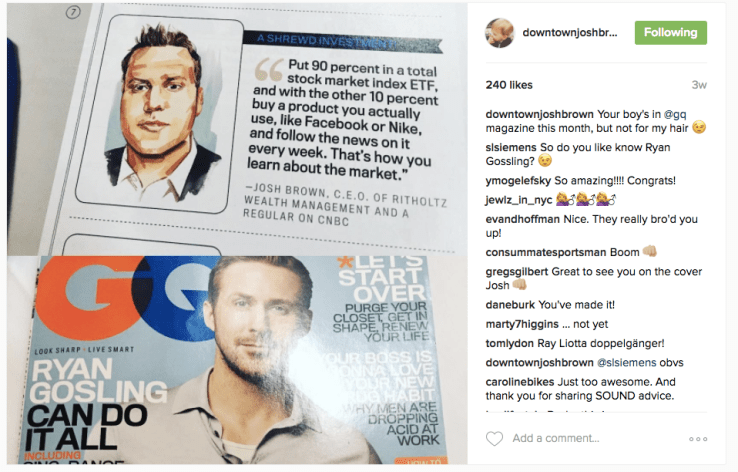
Put 10% in a stock you like, suggests Josh Brown.

Screen Shot 2017-01-17 at 6.46.53 AM.png

“You need an edge to make money,” Lynch says, and having a job in an industry is an edge, “a big edge.”

Edges are only the first step down the path of deep understanding. You also have to be objective. “You can’t treat it like your grandchildren,” says Lynch, “If the fundamentals slip you have to say goodbye to it. Remember, the stock does not know you own it.”

“Investment is most intelligent,” wrote Benjamin Graham, “when it is most businesslike.”

Ah, NBD. Gotcha. How hard is objectivity?  It’s not like I’m prone to the endowment effect, recency bias, survivor bias, optimism/bull market bias, or the anchoring effect. Here’s how Michael Lewis described Daryl Morey’s experience with that last one.

Morey is taking a behavioral economics class at Harvard Business School during the 2011 NBA lockout. The professor asked the students to write down the last two digits of their phone number, then:

“asked the class to write down their best estimate of the number of African countries in the United Nations. Then she collected all the papers and showed them that the peo­ple whose cell phone numbers were higher offered systematically higher estimates of African countries in the United Nations. Then she took another example and said, “I’m going to do it again. I’m about to anchor you. Here. See if you aren’t screwed up.” Everyone had been warned; everyone’s minds remained screwed up. Simply knowing about a bias wasn’t sufficient to overcome it: The thought of that made Daryl Morey uneasy.”

Besides objectivity, there’s something else Lynch suggests. Forget forecasters. The auto section has better information than the financial one.

5/ Be patient.  “Another key element is you have plenty of time. People are in an unbelievable rush to buy a stock.” “You could have waited ten years after WalMart went public and still made thirty times your money.”

In his diary about the great depression, Benjamin Roth writes that an investor needed three things to scoop up cheap stocks.

  1. “Patience to wait for the right moment.”
  2. “Courage to buy or sell when that time arrives.”
  3. “Liquid capital.”

Another way to put this is to wait for the right pitch. Warren Buffett said he learned this from the book by the great hitter Ted Williams. Right now – early 2017 – Berkshire Hathaway has seventy million dollars in cash.

Excellent CEOs – The Outsiders – writes William Thorndike have “crocodile-like patience.”

6/ Margin of safety. According to Seth Klarman:

“A margin of safety is achieved when securities are purchased at prices sufficiently below underlying value to allow for human error, bad luck, or extreme volatility in a complex, unpredictable, and rapidly changing world.”

Joel Greenblatt wrote, “Margin of safety should always top your investment list.”

What does Peter Lynch add to this idea?  “If you can add 8 and 8 and get reasonably close to 16,” says Lynch, “that’s the only math you need to know.”

If it’s not clear there is a MoS, there isn’t one.

7/ Luck. “In chess an outstanding player will beat a good player one thousand times in a row. In poker or bridge there’s more uncertainty. You can play a hand exactly right and lose. The stock market is much closer to poker.”

Ending on the two-jar model seems about right.

Thanks for reading.

Mike

JockoWillink 3

Supported by Greenhaven Road Capital, finding value off the beaten path.

This was originally published on Medium. Moving here for linking convenience. 

In episode 55 Jocko Willink answered “questions from the interwebs” and there were 3 things that stuck out.

  1. Firm goals, flexible means.
  2. Margin of safety in battle and investments.
  3. Feel the real winds (get out of the C-suite).

1/ Firm goals, flexible means.

Jocko calls this “commander’s intent.” The big goal.

If you want to be healthy (the goal), it doesn’t matter that much if you run, lift gym weights, life home weights, lift body weights or do jiu-jitsu (the means). If you want to be wise (the goal), it doesn’t matter if you listen to podcasts, audiobooks, take college courses, enroll in MOOCs, or read physical books (the means).

It’s better if you are actually flexible on the means. As Adam Carolla says, life isn’t like putting together an IKEA nightstand.

Jocko, for example, now has his own line of tea. Not what you expect from a former Navy SEAL. He also runs events, writes books, hosts a podcast, and creates merchandise. Those are all – wide ranging – means that lead to a singular goal.

In Grit, a book about how people successfully achieve things, Angela Duckworth writes;

“Ideally, even if you’re discontinuing one activity and choosing different lower-order goals, you’re still holding fast to your ultimate concern.”

Duckworth’s research suggests firm goals, flexible means. It looks like this:

2/ Margin of safety.

A listener writes in that he was driving home with his wife and kid in the car when a drunkard stepped out in front of him. The imbiber hooted and hollered at the car. After a minute of this, the driver went around the man. He wanted to know if he did the right thing. Was he was teaching his son the wrong lessons in not standing up to the drunk?

Yes, Jocko says, you did the right thing.

Here’s an incomplete list of the things that could have gone wrong if the driver stepped out of his car. The drunk is sick and a two hit fight kills him. The driver is charged with manslaughter, hires a lawyer,  pays for legal fees, borrows money, and ultimately cleared but in debt.

To engage in a street fight you need a margin of safety. Do the good outcomes outweigh the bad?

The same idea applies to investing. A street fight won’t be clean choreography (like in the movies), and an investment won’t just go up and to the right no matter what you hear on TV. Joel Greenblatt wrote that you start with MOS in mind.

“A margin of safety is achieved when securities are purchased at prices sufficiently below underlying value to allow for human error, bad luck, or extreme volatility in a complex, unpredictable, and rapidly changing world.” Seth Klarman

This idea applies at the collective level too. In With The Old Breed, author E.B. Sledge wrote about the battle of Peleliu and — with hindsight — the invasion was a terrible idea. Did McArthur really need this island to secure his flank? Was it worth ten thousand American casualties?

Before you engage in street fights, investments, or battles, ask if 10% goes wrong is this still worth it? What about 50%?

3/ Leaders must feel the winds of the real world.

One of Jocko’s roles during his military career was Admiral’s Aide. It wasn’t his favorite job, but he learned from the Admiral to focus on the people on the ground. In planning meetings, the admiral would ask, “how does this affect the guys in the field?”

The best leaders answer this question.

In Only the Paranoid Survive, Andy Grove repeated this idea;

  • “Our IT manager said, ‘Well, that guy is always the last to know.’ He, like most CEOs, is in the center of a fortified palace, and news from the outside has to percolate through layers of people from the periphery where the action is.”
  • “We need to expose ourselves to our customers…We need to expose ourselves to lower-level employees…We must invite comments even from people whose job is to constantly evaluate and critique us, such as journalists and members of the financial community.”
  • You have to spend more time with people who spend their time ‘outdoors,’ wrote Grove, “where the winds of the real world blow in their faces.”

Jocko points out that it’s because the people in the field that the people are in the meeting. If plumbers don’t plumb, salesmen don’t sell, or soldiers don’t soldier on, nothing else matters.

Being out there also gives information and builds a deep understanding. You can’t enter planning or high-level meetings, says Jocko, and demand change. No. “The way you get ready for it, is to have ammunition.” Jocko says, “You gotta have your ducks in a row.”

That means knowing what it’s like where the winds of the real world blow. You have to know your BATNA. You have to bring options to the table. You have to be able to answer the five whys. Being there helps you do these things.

Joel Greenblatt

Supported by Greenhaven Road Capital, finding value off the beaten path.

I can’t believe I read a book titled You Can be a Stock Market Genius. Normally I’d walk – or scroll – past it. If it even registered I’d think, vanity project or survivor bias. Of course, I’m writing this, so this appears to be a rare and unexpected extreme case (a black swan) where I am wrong.

Joel Greenblatt’s book was good. What I liked most was that Greenblatt talked through big ideas (which we’ll get to below) and walked through situations when he applied those ideas. It was never, ‘I have the golden touch.’ Greenblatt, like Phil Knight in his book Shoe Dog shared humble and honest reflections. Both fund manager and retail founder admitted to a mix of luck and skil (the two-jar model ).

Okay, this isn’t a confessional. Let’s get to it:

How to invest like Joel Greenblatt

Step 1: Be different.

Your edge, Greenblatt writes, comes from taking “knowledge and applying it in places off the beaten path.” You need to be able and willing to look in places other people don’t. Two ways stood out:

  • Difference in deadlines. “Time and interest are your only constraints,” writes Greenblatt.
  • Difference in size. Greenblatt has a friend named “Bob” who lacks your flexibility. Bob’s strategy is “imposed on him by the dollar size of his portfolio, legal issues, and fiduciary considerations.” You can be different when Bob must be the same.

Just be different. Easy peasy.

3te95w

Being different is hard. “Everyone can’t be a contrarian,” Greenblatt writes. You have to, in Howard Marks‘s words, be different and be right.

Only recently I watched The Big Short. While only once have I enjoyed a movie more than a book, The Big Short showed the emotions in a way I didn’t remember.  Michael Burry’s investors wanted out. I thought Mark Baum might kill himself (or someone else). Charlie Geller and Jamie Shipley had everything they owned on the line.

Being different and right is interesting to read (and write) about, but doing it is so much harder.

Look at Harry’s. It’s a good business. Selling razors over the internet is different, but is it right? Maybe. There’s nothing proprietary and Amazon is making more private label goods. “You have to find a niche and differentiate on some dimension. You can’t hope to out Amazon Amazon,” said Harry’s founder Andy Katz-Mayfield. Will he do that? Time will tell.

Sam Adams did much the same thing said founder Jim Koch. His story is great, but do you know how big Sam Adams is? Koch said the big beer makers spill more beer than he makes in a year. Even being different and being right doesn’t mean you’ll be big.

Step 2: Beware of GEEKS bearing gifts.

“Investors must never forget,” writes Seth Klarman, “Wall Street has a strong bullish bias.” Greenblatt has the same idea. You can, and should, listen, read, and pay attention to what is going on but you must “do your own work.” Mohnish Pabrai said this too.

Step 3: Pick your spots.

My college roommate liked to play blackjack. He’d drive an hour to Windsor Canada to play. He tried to convince me to go (presumably to split the cost of gas) by explaining why blackjack was the best game. It was the game, he said, with the best odds for the player and worst for the house.

I never took him up on this offer, but my friend was onto something.

In Bringing Down the House, Ben Mezrich wrote about the MIT card counting team that worked Vegas. Their strategy was to have one person play at a table and “count” the cards. Low cards were minus one, high cards were plus one. If the count trended high, the player at the table would signal to a partner to step up and make a series of large bets.

The card counters were picking their spots.

Greenblatt makes this point by recalling a time he was at Lutece. A great restaurant where no matter what he ordered it would be good. Remember, Greenblatt writes, quoting Benjamin Graham’s idea of Mr. Market, he will knock on your door today, and if you say ‘no’ he’ll be back again tomorrow.

Step 4: Margin of safety.

“Margin of safety should always top your investment list.”  “If you don’t lose most of the other alternatives are good.”  “Look down, not up.”

If it can go wrong, it will go wrong Mr. Murphy once said. Greenblatt once had an investment plunge because of a sinkhole. A sinkhole! “Risk of sinkhole,” Greenblatt writes, “was not one of my checklist items for determining whether or not to invest in a particular merger deal.”

Okay, okay, okay. I get it, but how much do I need?

“A margin of safety is achieved, writes Seth Klarman, “when securities are purchased at prices sufficiently below underlying value to allow for human error, bad luck, or extreme volatility in a complex, unpredictable, and rapidly changing world.”

That doesn’t help much, does it?

The key is not paying too much, no matter how good the idea. Greenblatt writes, “I had no intention of buying my stock at the top end of the industry P/E range, justified or not.”

Margin of safety can be valuable in any investment. It’s having space, writes Greg Ip.  It’s haveing low costs like Sarah Silverman. It’s allowing for the worst case scenario in street fights and island invasions.

That’s is all it takes to succeed as an investor.

  1. Be different.
  2. Listen to, read, and study others, but trust no one and do your own work.
  3. Pick your spots.
  4. Create a margin of safety.

Of course, your mileage may vary.

Oh, and one more thing.

5. KISS

You have to keep it simple. “If it’s too difficult I’d rather skip it,” Greenblatt writes. Let it go if it’s too hard, or for things that move too fast.

This applies to your gear too. The Wall Street Journal, an internet connection, and a library card “can do the trick.” Your local library probably has all three.

My mistakes are actually white swans; common, easy to see, non-fatal, and expected. 

Mohnish Pabrai 2

Mohnish Pabrai was on “The Investor’s Podcast” with Preston Pysh and Stig Brodersen. There were two parts (part1 & part 2 ) and they were fantastic.

My first post about Pabrai were notes from a talk he gave at UC Irvine ( mostly about Coca-Cola). This podcast covered new ground.

Before we jump in. The ~12:00 of part 2 had some ideas related to our thoughts on Moats and Podcasts.

Ready?

1/ Deep understanding. Pabrai said that many of his business classes were interesting but easy for him because he had spent his teenagers years working for his father. He and his brother “were like my father’s board of directors.” Pabrai had already studied the problem, made mistakes, and learned from experience.

“I very accidentally got an introduction to business,” Pabrai said, “during a period of time when my brain was optimized to pick it up.”

This was a theme of the interview, the formative years of brain development. I’ve heard about this as it relates to learning how to play instruments and speak languages but never thought of it in terms of business acumen (domain blindness on my part).

Gary Vaynerchuk may be our proto-contemporary example of this. Vaynerchuk spent his teenage years working in his father’s liquor store. There Vaynerchuk learned to sell, add-on, and study wine.

Pabrai mentions Warren Buffett as someone who did this too. Buffett would buy a six-pack of Coke for a quarter and sell each bottle for a nickel.

You and I are no longer teens (biologically), but we can still appreciate the value in a deep understanding.

2/ Just do it. When should you think and plan and when should you do and act? I don’t know. Pabrai though has two suggestions for when to just do it.

a) If an interesting opportunity arises,“Take the plunge, you can always come back, so take the plunge.” “Life is a very random journey. I’m here talking to you because I picked up a book at Heathrow airport, and it could have been a book on a number of different subjects.” “No one is going to put up a headline that says, ‘take the left fork.'”

b) If someone wise tells you to do something. Pabrai said he “lucked out,” because he was exposed to Buffett’s letters early on. Pabrai was a blank slate, so he imitated Buffett and Munger. It’s worked out.

Yeah, but… NO! No ‘yeah, buts.’

“Some of these I understood when I was starting my own partnership. Other I did not understand the reason but I still just owned it because there was no other model available to me. What I discovered several years later was that every single one of the rules they followed were rules that had been very intensely thought through by these very smart guys. They weren’t random chance.”

“(Munger) told me that it’s very important for an investor to have people to talk to….(and)…When god tells you to do something, you do it.”

Just do it when you come to an interesting fork in the road or when you trust someone completely.

3/ Do your own work. Pabrai doesn’t have an analyst, advice he got from, you guessed it, Buffett and Munger.

“It is a huge advantage not to have an investment team,” Pabrai said, “Investing is not a team sport, it should never be a team sport.”

Why doesn’t it work? In part, because other people’s ideas fall outside your circle of competence. Pabrai explains that an analyst could come up with the best idea in the world, but if you don’t understand it, you won’t act on it. Analysts can also get boxed into an industry. That doesn’t work either says Pabrai. The ideal question is “where should we put our money in the entire universe of possibilities.”

4/ Argue well. You don’t have to argue; quarreling, disagreeing, and squabbling all work too. They key is a pursuit of the truth. “What you do by talking to people not on your payroll,” says Pabrai, “is you get rid of vested interest and conflicts.” Norms, politics, and individual incentives are gone.

Bill Belichick has worked hard to create an environment like this. His assistant coaches are actually graded on coming up with good new ideas. Belichick also listens to his players, assistant coaches, and (what does he do here again?) Ernie Adams.

Good arguments “help round the corners,” said Wilbur Wright. Geniuses argue too.

5/ See it to believe it. Pabrai thought he was dumb. Well, actually, he said he was 67th out of 70 in his third grade and there were probably three carrots in the group. Pabrai needed a catalyst. Lucky for him, one was coming.

Pabrai moved to a new and better school (no carrots there). He took an intelligence test and scored at the top.

This created some cognitive dissonance. How does someone not smart get a smart score? Pabrai went to the test administrators, and was like, ‘umm, you know I’m not smart, right?’ They said to him, ‘no, actually you’re very smart, maybe brilliant.’

This was a big moment. “I felt like after that two-minute conversation in ninth grade I was like Seabiscuit. I just took off.”

Richard Thaler had this see-it-to-believe-it moment when he read Daniel Kahneman’s paper. Ezra Klein had this when he read Matt Yglesias. Judd Apatow had it when he saw Steve Martin.

A recent example – to me – is told in the book The Song of the Dodo where David Quammen writes that Charles Lyell, Charles Darwin, and Alfred Russell Wallace were having this see-it-to-believe-it moment together. They were peeking at evolution by natural selection. A notion that, Quammen writes, “was going to incite a shitstorm of resentment in Victoria’s England.”

We all could use a nudge where we go ‘holy shit, I didn’t know this was possible.’ In fact, it might be necessary.

6/ Does the glove fit? Okay. You’re excited. You’d never heard of Pabrai, but this sounds like someone you’d like to emulate. What’s next?

“The first question investor need to ask themselves is ‘Does the glove fit?’… after you read an annual report you have to ask yourself, ‘you know, I spent two hours reading that, would I have preferred doing that or watching a Star Wars movie?’…you have to ask what type of activities give you the greatest satisfaction.”

If something takes a long time there better be good rewards for it. Steven Johnson talked with James Altucher and said that he has high motivation to play music, but no ambition. That’s what it feels like when the glove fits.

Pabrai has – if I’m reading the tea leaves correctly – a very philosophical approach. If you’re going to spend your life doing something and you have some autonomy over what that thing is, choose something you enjoy.

We’ve seen this before, it goes by different names. Love the grind like Gary Vaynerchuk. Be relentless like Bezos, Belichick, and Buffett. Tinker like Phil Knight and Peter Thiel.

Warning: Tangent ahead.

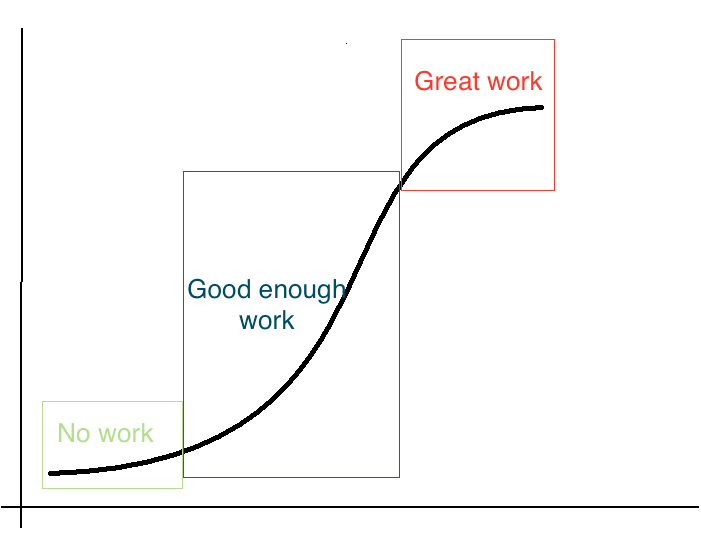
I’ve been thinking about this as; no work, good enough work, and great work.

My theory is that many “good enough” skills are achievable. Take cooking. Buy Mark Bittman’s cookbook and learn the basics. That’s good enough and it’s not that difficult. If you want to move to great work, well then, it’s off to culinary school and years of hard work.

Good enough is attainable. Guitar? Four chords. Fitness? Walk more, sit less. Investing? Index, minimize costs.
s-curvework

Great work is hard. We get off the s-curve ascent and face the slog known as “diminishing returns.” This is roll-up-our-sleeves, put-our-heads-down, and dig in for the long-term territory because that’s the only point where results show up. Delta only shows up over time.  This is why Pabrai wants to know if the glove fits. To get to great work requires a lot of energy, effort, and time. Great work has a high opportunity cost.

It’s why we say here that you can actively invest/be an entrepreneur, but you can’t do either of those things AND have a hobby, be a soccer coach for your kids, and show up to dinner. A lot of things in life are worth a little work for big returns. The great work though, those pursuits are more limited.

[/Tangent end]

7/ Decentralized command. Berkshire Hathaway owns stock in Southwest Airlines. This makes total sense. Here’s the CNBC synopsis of how Buffett feels about airline stocks:

He called the US Airways investment a mistake in almost every annual letter from 1989 to 1996…. ‘if a farsighted capitalist had been present at Kitty Hawk, he would have done his successors a huge favor by shooting Orville down.'”

Wait, this makes no sense. How did this Berkshire end up invested in airlines?

The answer is decentralized command. “I think this is a good example of how Warren only selects the manager and does not interfere with what they do,” says Pabrai. Buffett knows he can’t make every decision, so he creates smaller units that can make better decisions.

Jocko Willink has articulated how the military is organized like this. Amazon calls them “two pizza teams.” Andy Grove wrote about it too. Need more?

“Perot later told Fortune magazine, “I come from an environment where if you see a snake, you kill it. At GM, if you see a snake, the first thing you do is go hire a consultant on snakes. Then you get a committee on snakes, and then you discuss it for a couple of years. The most likely course of action is—nothing. You figure, the snake hasn’t bitten anybody yet, so you just let him crawl around on the factory floor. We need to build an environment where the first guy who sees the snake kills it.” – Jeff Gramm

“Hire the best people you can and leave them alone.” Tom Murphy

“One reason, I think, is that most other companies don’t really understand the concept or its scope and limitations, while many others are loath to grant the freedom and independence from management control that really are necessary ingredients for running a successful Skunk Works enterprise.” – Ben Rich

8/ How to learn from mistakes. “First of all, mistakes are a blessing. Adversity is a blessing.” Pabrai goes on to paraphrase Marcus Aurelius, noting that to have misfortune and prevail is good fortune. “We don’t learn when we do well.”

It’s football season, so in that spirit:

Pabrai points out that this is nice to say, hard to do. “The lessons don’t sink in very well if they are other people’s mistakes. It’s unfortunate. This is one of Munger’s and Buffett’s great strengths, they are really good at learning from others mistakes, so they try to avoid most of them…Learning from other people’s mistakes is so much cheaper.”

Okay, learn from others, got it. What else?

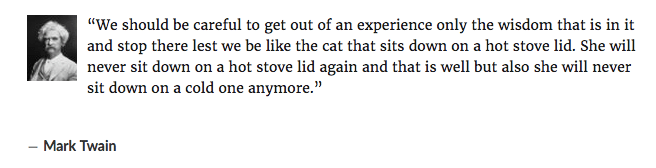
Don’t learn too much from others.
screen-shot-2017-01-19-at-9-49-47-am

9/ Alternatives to school. When asked about books, Pabrai says that Poor Charlie’s Almanac, “(is) a book that I try to re-read every year and every year when I re-read it, I find brand new things that I swear were never in the book before, someone just put them in there…That one book, in my opinion, is better than a college degree.”

Better than a college degree! Why!? Because college has a huge opportunity cost (but also a potentially huge payout).

I could have been more efficient in my time and money budget in college. sigh (and graduate school)

College – and especially graduate school – isn’t always a better option. Failed start-up founders consistently pointed out that they learned a hell of a lot. David Chang eschewed graduate school in favor of opening a restaurant. Elizabeth Gilbert, Tim Ferriss, and Seth Klarman (“I learned an enormous amount there (Mutual Shares), probably more than in my subsequent two years of business school.”) note the value in non-college learning.

What college does well is provide a structure for learning. Patrick O’Shaughnessy said, “Almost everything I learned in college you can go read and do it for ten cents at the library.” Joel Greenblatt said to mix in the WSJ and you’ll be okay. The question is, will you?

Thanks for reading. Despite the length there were some things I left out so if you made it this far you’ll like the podcast.
Charley Ellis

Supported by Greenhaven Road Capital, finding value off the beaten path.

Charley Ellis had a short, but valuable interview with John Authers of the Financial Times.  What I liked most about the interview was how many human elements were involved. How you feel. What you believe. Why do something you know is bad for you. 

One analogy for life is that it’s like sitting at a blackjack table. You have your cards. You have a strategy. You know the odds of when to hit and stay. You also have three college students, free drinks, and that guy next to you that hits at 15.

Ready?

1/ How to beat the market.  It helps if your competition isn’t very good.  “The secret to great success in business is to choose competition that’s not very good. The same thing works in sports, it works in lots of different things.”

An easy way to do this is to find places with no competition. Instagram did this when they became a photo app rather than a check-in app.

Ellis had competition but it was “doctors and lawyers and Indian chiefs with much more important things on their mind. This was a recreational sideline.”

They were competing with Ellis said, “(I would) finish reading a 50,60, 70 page study that told you quite a great deal about what was going on in the past, currently, and what was likely to happen in the future. It was an unfair competitive advantage and we took advantage of it.”

Investors and entrepreneurs have little time for hobbies or coaching youth soccer. If you’re going to spend that much time doing something you better love it. Gary Vaynerchuk loves it.  Joel Greenblatt wrote, “if you’re not going to enjoy the ‘game,’ don’t bother: there are far more productive uses for your time.” The chase should be fun (see #3).

2/ Habits and urges.  “There’s a huge argument for not smoking under any circumstances, but there are still some people doing it.” “We know that gambling is designed to entertain people enough so they won’t  mind losing ten or twenty percent  of their money every wheel turn.” “They’re not actually gambling, they’re gradually losing money.”

Did you eat any cookies over holidays? (Be honest). Diet, much like smoking and gambling is one of those things where our habits and immediate satisfaction trump our goals and long-term rewards. It’s hard, but we can do better.

  • Jocko Willink suggests more discipline in your life. “Discipline equals freedom,” Willink says.

  • Tadas Viskanta and James Osborne proposed planning as a way around pitfalls. If you think something will cause problems; create a substitute or avoid that situation.

  • Jon Stein told Patrick O’Shaugnessy that the Betterment service will display potential tax costs associated with trades. This extra bit of information stops three out of four people.

3/ Do it for the love of the game.When Ellis is asked what would happen to the investing world if you cut everyone’s pay in half he said:

“They wouldn’t leave. They’d still want to play because it’s fascinating, it’s really interesting, it’s very enjoyable and you don’t have to stop at 35…I know a couple of people over 100 who are still involved in active management…The rewards are really quite substantial.”

It’s fun. It’s enjoyable. People like the challenge.

There’s something enjoyable about the process that keeps people around. It’s kept Anson Dorrance in soccer. It’s kept Warren Buffett looking for investments. It’s kept Casey Neistat making videos.

Angela Duckworth wrote in Grit:

“Why were the highly accomplished so dogged in their pursuits?…They were satisfied being unsatisfied…It was the chase as much as the capture that was gratifying.”

4/ Effort != Results.  “We all learned in school that if you studied harder you could get better grades, then we learn in our jobs if we do more work for the employer we get more promotions. Trying harder works in many, many places. It doesn’t work in straight jackets, Chinese finger puzzles…. and it doesn’t work in investment management.”

Seth Klarman gives similar advice in Margin of Safety:

“Investment returns are not a direct function of how long or hard you work or how much you wish to earn.”

Humans (you, me and Bobby McGee) tend to see things linearly. Non-linear instances, like when, unit of work != unit of result, is tougher.


Yvon Chouinard

Supported by Greenhaven Road Capital, finding value off the beaten path.

pablo (8).png

Yvon Chouinard is the founder of Patagonia. He was a guest on the How I Built This podcast and wrote the book Let My People Go Surfing: The Education of a Reluctant Businessman. Before we get into some notes, let me take a moment to point out my stupidity.

Remember Sophia Amoruso? I wrote about what happened to Nasty Gal using the framework from my research on failed statups. I was mistaken.

What if I had contrasted Nasty Gal to Patagonia? They’re both clothing companies built around a brand. Rather than rehash Nasty Gal, let’s start from scratch. Mohnish Pabrai said that when he was starting his investing partnership he just did what Warren Buffett and Charlie Munger did. Pabrai didn’t need to know the why, just the what.

Chouinard has given us that too.

Ready?

1/ Start with you. 

Chouinard started making hardware, not the apparel that Patagonia is known for today. How did he get started? He scratched his own itch.

“Every time we went climbing we came back with ideas to improve the climbing gear…so I became a blacksmith so I could make some of the climbing hardware that I thought would be better than what’s available.”

People who do the thing figure out better ways to do the thing. A better way also means a different way. Chouinard’s pitons were reusable compared to the (cheaper) European ones which were not. It was the same for clothing.

Chouinard’s inspiration was a colored rugby shirt he saw on a trip. Men’s gear was all one color, Chouinard’s wasn’t. His next item was a pair of stand up shorts. Why were they called that? Because the first pair stood up on their own (the fabric was so rigid).

The stuff was good because it had to be. When Chouinard made pitons he used the pitons. It was the ultimate instance skin in the game (SITG). Chouinard writes, “Quality control was always foremost in our minds, because if a tool failed, you could kill someone, and since we were our own best customers, it was a good chance it would be us!”

When Chouinard and his team moved into clothing they were also the ones that used that.

“We knew what we wanted. I heard someone say that if you wait for the customer to tell you what to do you’re too late. We were our own customer. I think that was the secret to coming out with products.”

2/ Make something for the ideal customer.  Chouinard writes:

“All our customers are not equal in our eyes. There are indeed some we favor more than others. These are our core customers, those for whom we actually design our clothes. To understand this more clearly, we can look at our customers as if they existed in a series of concentric circles. In the center, or core circle, are our intended customers. These people are the dirt baggers.”

That’s who you make stuff for, the dirt baggers.

Failed startups never found the “dirt baggers.” Those founders confused “sure” for “hell yeah” and “it looks good” for “OMG, shut up and take my money.”

Chouinard made these mistakes too. He writes that they tried a foul weather line for sailing, but it didn’t sell. There wasn’t enough of a market and he wasn’t a sailor. He didn’t know what to do because they weren’t the ones using it.

3/ You’ll never be ready. “I didn’t know anything about clothing. I learn everything by taking a step forward and see how that feels. If it feels good I take another step, if it feels bad I take a step back.” “I learn by just doing.”

Rather than plan out ideas and see what might or might not work, Patagonia puts their gear in the field. “We test until something fails,” Chouinard writes, “strengthen that part, then see what fails next.”

Gene Kranz noted this about the early space program. The Instagram founders pointed it out too. In his book about Amazon, Brad Stone wrote;

“By the first weeks of 1996, revenues were growing 30 to 40 percent a month, a frenzied rate that undermined attempts at planning and required such a dizzying pace that employees later found gaps in their memory when they tried to recall this formative time. No one had any idea how to deal with that kind of growth, so they all made it up as they went along.”

You’ll never be ready, but don’t mistake that for an excuse to go fast.

4/ Grow slow. At one time Patagonia was growing  50% a year. That was fine until one year they built out too much inventory, a recession hit, and Patagonia had layoffs. “That was really tough,” Chouinard said.

“We couldn’t get any loans from anybody, my accountant introduced me to some mafia guys who wanted to loan me some money at 18% interest.”

Now, “I wait for the customer to tell us how much to make.” It means that Patagonia grows slower, but grows safer.

This conservative approach is a way to apply Margin of Safety (MOS) thinking to business. Looked at one way, too much inventory appears to be a MOS but it is at the expense of cash. Whether it’s street fights, island invasions, or investing a MOS is crucial because there are possible futures you can’t plan for.

It’s easier to keep a MOS with a low overhead.

5/ Keep a low overhead.  “I’d live on fifty cents to a dollar a day.” “Before leaving for the Rockies one summer my friend and I bought a couple of cases of dented cat food cans from a damaged can food outlet in San Francisco we supplemented cat food with oatmeal, potatoes, ground squirrel, blue grouse, and porcupines.”

In tech speak, a low overhead lengthens your runway.

Jay Leno told Judd Apatow he kept a low overhead. “I was also a Mercedes-Benz mechanic at the time. I didn’t have any expenses. I didn’t have any lifestyle to maintain. I liked doing it. I would drive hundreds and hundreds of miles to work for free for four or five minutes. I didn’t know if I would ever really make a living at it.”

Jerry Seinfeld said much the same thing. “I was a minimalist from the beginning, I think that’s why I’ve done well as a comedian…If you always want less, in words as well as things, you’ll do well as a writer.”

6/ Deep understanding. Chouinard was a climber, fisherman, and skier. He’s not a particpant – he’s an instructor. He’s written technical books on all these subjects. He understood – through experience and through study – what the gear and his business needed to do.

As a climber, Chouinard knew what the gear needed to be:

“we used to make a small rock-climbing pack that had a thin foam pad in the back for comfort. The pad was removable so you could take it out and sit on it on cold bivouacs (BIV WACKS). My climbing partner broke his arm in a fall in the Tetons, and I was able to make a perfect splint with the sheet of foam and a few accessory straps.

He understood how the gear should be made:

“You have to choose such relationships carefully. The first thing we look for in a supplier or contractor is the quality of its work. If the standards aren’t high already, we don’t delude ourselves into thinking they’ll be raised for us, no matter how attractive the price.”


He learned how the business should be run:

“Once I decided I was a businessman I decided to really study up on it. I studied every book I could on Japanese management styles and Scandinavian business. I thought there had to be a different way of doing business. I still wanted to only work for part of the year.”

As Napoleon Bonaparte wrote;

“If I appear to be always ready to reply to everything it is because before undertaking anything I have mediated for a long time. I have foreseen what might happen. It is not a spirit which suddenly reveals to me what I have to say or do in a circumstance unexpected by others. It is a reflection, a meditation.”

7/ Decentralized command. “I call in maybe three times in the five months. People know that if the warehouse burns down, don’t call me. What can I do, you know what to do.” “I don’t care when you work as long as the job gets done.”

Pabrai said that Buffett learned early that his most important thing (MIT) was hiring the right manager for the business.


There was more in my notes, but that seems like enough of a nibble to get someone interested. Chouinard inspires me.

Thanks for reading.

Update: An early version of this post misspelled Chouinard as “Chouindard.” I also forgot to note that Chouinard calls in “three times in the five months.”  Thank you to those who noted my mistakes. 

Howard Marks’s “Expert Opinion”

Supported by Greenhaven Road Capital, finding value off the beaten path.

I like reading things Howard Marks writes. There is the book The Most Important Things (which we looked at in this post. There are also Marks’s memos. And like Michael Mauboussin‘s documents from Credit Suisse, they are FREE!

I’ve been thinking about the combination of free and valuable.  This blog is free and (somewhat) valuable. Marks’s and Mauboussin’s writings are free and valuable. The library is free and valuable.

So, we don’t need to pay for things that are valuable. Joel Greenblatt wrote that for many investors, “The Wall Street Journal, a phone to call for company information and news releases, and a library card can do the trick.”

But there are things that are free are NOT valuable. Some free things are anti-valuable. We’ll get to those below.

One final caveat before the notes. Your time may be better spent reading Marks’s memo Expert Opinion (pdf) than this post. I did my best to write something helpful, but, it’s like an appetizer where Expert Opinion is the main course.

For those who will continue, let’s begin.

1/ Entertainment or information?  Serendipitously I read Expert Opinion the day after I watched this:

In that video, Cal Newport suggests three reasons to quit social media.

  • Social media is entertainment. Newport compares it to slot machines and when he said this I immediately thought of emoji. Recategorizing social media as entertainment may help us consume less/more of it. Richard Thaler writes in Misbehaving that people tend to use bucket budgets as a way to keep track of expenses. We can do the same thing with our attention. Imagine Twitter in the same bucket as television. How much of that do you want in your day?
  • Social media is NOT important to your success. Newport’s thesis is that rare and valuable jobs require rare and valuable skills. The Moats and Podcasts post is an examination of this. Things anyone can do (e.g. tweet, podcast) are things that are not valuable. As Tren Griffin wrote, “supply is the killer of value.”
  • Social media is actually hazardous. Newport says that fragmented attention can reduce your ability to do deep work, as well as increase depression (read that abstract and note the parallels to investors/investing) and anxiety.

Marks’s comments about the media suggest it too is more entertainment than informative. If media was more information we would have less hindsight bias like this:

“In particular, now it’s considered to have been a big mistake for Clinton to fail to address the concerns of white men and set out a solution for those who lost jobs and were omitted from economic progress. But during the campaign, no one pointed to this error.”

Information takes work. Consumers need fluency and an understanding of the background conditions. A knowledge of history would help too. If we’re making a list, let’s open up some cognitive space to think about the survivor bias and alternative histories too. It’s work.

“Biological creatures ordinarily prefer effort minimization in routine activities and don’t like removals of long-enjoyed benefits,” said Charlie Munger.

The media knows this. Daniel Kahneman wrote a book about our preference for thinking fast. That means thinking visually and seeking confirmation.

“Following the media experts, while entertaining,” writes Marks, “can be a waste of time intellectually.”

2/ You have to be there.  I’ll bang this drum as long as needed. You have to go to the front lines, the plantations, the place where the winds of the real world blow in people’s faces and get your information there. Alternatives don’t work.

Another story of serendipity.

The day before I read the Expert Opinion, I listened to Lisa Servon on NPR’s Fresh Air. Servon is a professor with a focus on consumer banking. She wanted to know more about unbanking – people without checking and savings accounts. One day she invited a payday lender (scurge!) to her class at Penn. This is her account (emphasis mine):

“This guy to come into class and tell us what was going on. And Joe Coleman showed up – he’s the person I’m referring to – was a very smart, interesting man who spoke very persuasively about why he believed his businesses were really serving the community. And it made a lot of sense. And so I was trying to really square Joe’s story with the data, and it didn’t add up, combined with my knowledge that, you know, my feeling and my experience that low-income people do make smart, economic decisions when they can.

What?

Do you see what happened there? Servon’s not an idiot. She’s not reacting. She’s studied an idea, compared it to her own life, and drew a conclusion (that should sound familiar to you!). Then she found new information and found out she wasn’t quite right. To her credit, Servon wanted to know more.

She worked for four months as a payday lender. She WAS THERE. She learned a lot.

“that experience showed me why I needed to be behind that window because even though I was working there and dealing with people every single day, I still, with my own biases and having grown up using mainstream financial services, didn’t get that.”

It gets better.

When her four months were up Servon walked around the counter and told her customers she was a researcher and wanted to ask them questions. They told her EVEN MORE!

That’s what being there does.

Marks writes, “It’s clear that people who work in the media hadn’t understood many average Americans.” Bingo.

The most (positive) extreme example might be the story told in Mountains Beyond Mountains. Paul Farmer, our protagonist is a rural doctor in Haiti and says, “I would read stuff from scholarly texts and know they were wrong. Living in Haiti, I realized that a minor error in one setting of power and privilege could have an enormous impact on the poor in another.”

Here’s how that went. The predominate medical theory for how someone got AIDS was that they shared an intravenous drug needle or had multiple concurrent sexual partners. Farmer went to Haiti and saw that the people were too poor to buy drugs and had sequential partners (one at a time). What gives? I’ll leave the solution in the book because our big point is this: You have to be there!

I don’t know how right he is, but Chris Arnade seems to have the correct methodology:

https://twitter.com/Chris_arnade/status/816016061225168897

3/ “What do experts know?” Half-way through the memo, Marks lays into the New York Post football experts. Their record was not much better than the flip of a coin. “Virtually none of the eleven experts’ overall picks added value after fees (sound familiar?)” Marks writes, “Even the average of the experts’ “best bets” wouldn’t have produced a positive return after fees.”

Oof.

It’s almost as if those experts were there to entertain rather than inform. It’s too bad there isn’t a system that would help us make better picks. Or put another way, to forecast results in a super way.

Actually, there is just a system that comes in a reusable, convenient, portable, form that purchasers are encouraged to write in and take notes (colloquially known as “book”). Superforecasting by Phillip Tetlock was a great book. We actually used Tetlock’s framework to make better sports predictions when we asked Is Bill Simmons a superforecaster? The answer was yes. Here’s why.

  1. Superforecasters pick their spots. The NY Post experts didn’t do this. They picked every NFL game. Are you saying that the most watched market in the world doesn’t provide pockets of value? Yes.
  2. Superforecasters break intractable problems into tractable subproblems. Marks writes that he had a lunch with Warren Buffett and they both agreed that information should be knowable and important. If an intractable problem cannot be reduced into tractable subproblems it is not knowable.
  3. Superforecasters balance the inside view with the base rate. Are you saying that NY writers have a bias toward NY teams? Yes. Marks agrees, pointing out the mangy week 16 picks from the experts.
  4. Superforecasters don’t overreact or underreact to new information. Are you saying that talking heads on television and in newspapers may overreact? Yes. #boatgate
  5. Superforecasters distinguish some degree of doubt. They avoided, “granularity as bafflegab,” Tetlock writes. Are you saying that all these statistics I hear about winning records in a different time zone against a team with less than 40 games played together might be data mining and irrelevant? Yes.
  6. Superforecasters balance overconfidence. As Daryl Morey reminded us, people don’t like to hear maybe this, and maybe that, but it’s often the best answer.
  7. Superforecasters check for hindsight bias. Lol.

People can be more accurate than a coin. It’s going to take more information (like reading Superforecasting) and less entertainment (social media).

4/ Knowing and caring. Maybe my favorite part from the memo:

“People have been preoccupied with when interest rate increases would take place, and that’s the question I’ve been asked most often. My response has been consistent: How would I know, and why do you care.

Jason Zweig gave similar advice as it related to indexing.

The ultimate beauty of index funds is that they get you utterly out of the business of guessing what will happen next. They enable you to say seven magic words: “I don’t know, and I don’t care.”

Will value stocks do better than growth stocks? I don’t know, and I don’t care — my index fund owns both. Will health care stocks be the best bet for the next 20 years? I don’t know, and I don’t care — my index fund owns them. What’s the next Microsoft? I don’t know, and I don’t care — as soon as it’s big enough to own, my index fund will have it, and I’ll go along for the ride.

5/ Metaphors. “The metaphor is a cover-up.” – Amos Tversky

Marks writes that people often ask him “what inning are we in?” This metaphor assumes that a lifecycle (market, stock, macro, etc.) is like a baseball game. If you know what point of the game it is then you can take advantage of the moment. It’s a simple way to convey a complicated idea. But as Tversky warns, it’s not the whole picture. Marks agrees:

“A standard baseball game consists of nine innings, so “second inning,” “sixth” or “ninth” has a clear meaning. But with the things we’re wondering about here, we never know how long the game will run.”

Metaphors can be good for somethings. Steve Jobs told Walter Isaacson:

“People know how to deal with a desktop intuitively. If you walk in to an office, there are papers on a desk. The one on top is the most important. People know how to switch priorities. Part of the reason we model our computers on metaphors like the desktop is that we can leverage this experiences that people already have. “

We use metaphors a lot. Pay attention and make sure you aren’t communicating too much.

6/ Certainty is a red flag.

Marks writes, “there are no facts about the future, just opinions. Anyone who asserts with conviction what he thinks will happen in the macro future is overstating his foresight, whether out of ignorance, hubris or dishonesty.”

If you are certain about the future, Seth Klarman has advice on what to do:

“Those who can predict the future should participate fully, indeed on margin using borrowed money, when the market is about to rise and get out of the market before it declines. Unfortunately, many more investors claim the ability to foresee the market’s direction than actually possess that ability. (I myself have not met a single one.) Those of us who know that we cannot accurately forecast security prices are well advised to consider value investing, a safe and successful strategy in all investment environments.”

Thanks for reading. Hopefully this has been entertaining and informative!