Harry’s

How to create a direct to consumer company (the Harry’s Razor template)
The TWIST podcast between Jason Calacanis and Andy Katz-Mayfield was a wonderful hour about company creation. Katz-Mayfield told stories about starting Harry’s, and Calacanis asked thoughtful questions about the experience.

As I listened I wondered, what if Katz-Mayfield’s experience isn’t just his own but a model? Is the journey of Harry’s a secret sauce? Can this be replicated?


In The Success Equation, Michael Mauboussin introduces a framework for figuring out the secret sauce.

“Useful statistics have two features. First, they are persistent, which means what happens in the present is similar to what happened in the past. If the job you do is predominantly a matter of skill, you can expect to be able to repeat your performance reliably.”

Good statistics are also predictive of the goals you seek. Let’s say that we keep track of the percentage of shots that a player makes in a basketball game, and the goal of the team is to score points when playing offense. We see that, all things being equal, the higher percentage of shots a player makes, the more points he produces…This is an obvious case, of course, but not all relationships between cause and effect are as clear.

Mauboussin points out that the Moneyball theory of baseball succeeded because some teams figured out that certain statistics were more predictive of wins.

Our question then is this, can we apply this to stories rather than statistics? If Mauboussin read this I’m afraid he would cringe.

What a show.

A frequent mistake is to confuse A preceding B, with A causing B. I’ve written at length about the narrative fallacy, logical errors, and survivor bias. Here we will not address that.

Here we will note what Harry’s has done and compare it with what other companies have done. Sometimes it is the case that A precedes B, because A caused B.

Let’s begin.


Table of contents:

  1. Scratch your own itch.
  2. Focus on you.
  3. Use disruption theory as a template.
  4. Don’t fish in an empty pond.
  5. Build out your moat.
  6. To merge or not to merge, that is the question.

1/ Scratch your own itch.

“The company was born out of an experience I had just going to a drug store and having a nervous breakdown in the aisle because blades were so expensive.” AKM

A good place to start is by solving your own problem, by scratching your own itch.

Paul Graham wrote a decade ago:

Many of the applications we get are imitations of some existing company. That’s one source of ideas, but not the best. If you look at the origins of successful startups, few were started in imitation of some other startup. Where did they get their ideas? Usually from some specific, unsolved problem the founders identified.

Find what people complain about and solve that.

This can’t be the only thing you do though (and Graham notes that too). In my book on startups that failed, too many founders stopped at their itch. It was the idea that if I build it they will come. They won’t, you have to do more than just that.

Scratching your own itch is only the start.

2/ Focus on you.

Harry’s and Dollar Shave Club (DSC) both launched around the same time. Calacanis commented that you often see this. It makes sense that if there’s a problem, more than one person sees it.

Treated incorrectly, competition can drift your focus. Katz-Mayfield didn’t let this happen. He focused on manufacturing, packaging, and selling. He didn’t let the actions of DSC or the in-store brands dictate what Harry’s would do.

Compare the YouTube Home videos for each company:

That DSC video was great and it’s exactly what Harry’s shouldn’t have done.

A helpful warning comes from Gowalla founder Josh Williams. Go read his piece on the “check-in wars”: Play by your own rules.

You are your competitive advantage.

3/ Disruption theory as a template.

Disruption theory from Clayton Christensen goes like this (emphasis mine):

“Disruption” describes a process whereby a smaller company with fewer resources is able to successfully challenge established incumbent businesses. Specifically, as incumbents focus on improving their products and services for their most demanding (and usually most profitable) customers, they exceed the needs of some segments and ignore the needs of others. Entrants that prove disruptive begin by successfully targeting those overlooked segments, gaining a foothold by delivering more-suitable functionality — frequently at a lower price.

Katz-Mayfield said:

“The razors out there today almost feel like children’s toys. There’s like bells and whistles and all sorts of colors. We took the opposite approach. Let’s make the product speak for itself. A streamlined and simple design. We wanted the brand to feel elevated but approachable.”

In the terms of disruption theory, customers “hire” a product to complete a job. What job are men “hiring” their razor for? A clean shave, but done procured quickly and cheaply.
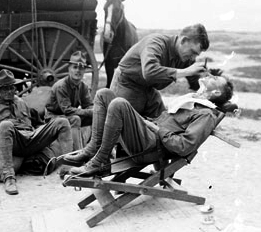
According to disruption theory, the job to “hire” for has three parts; shave, price, procurement. When one part is more than satisfied (clean shave) customers will move on to another (price, procurement).

When Harry’s bought a German blade factory they satisfied the first “need of some segment.” The other razor blade companies did this too but they did it well before they changed the colors or added batteries. The shave was already good enough.

The “more-suitable functionality” is the other parts. People don’t want to wait, have the razor cage unlocked, and then buy the razors. In fact, I don’t want to go to a store at all.

Read what Christensen writes about Netflix and Blockbuster:

“However, as new technologies allowed Netflix to shift to streaming video over the internet, the company did eventually become appealing to Blockbuster’s core customers, offering a wider selection of content with an all-you-can-watch, on-demand, low-price, high-quality, highly convenient approach.”

Overlay that onto Harry’s. The new technology of the internet allowed Harry’s to create disruption in much the same way. Christensen is careful to point out that disruption theory is only a diagnosis. It’s a definition. It’s not an if-this-then-that statement. It’s not predictive and it’s not conclusive, but it is helpful.

Christensen’s book, The Innovator’s Solution, describes how Wal-Mart after their Jet.com purchase or Unilever after their DSC purchase can stop disruption from happening.

Disruption theory can be a template for underdogs.

4/ Don’t fish in an empty pond.

When Harry’s got their first lawsuit:

“It’s like 90% scary and 10% affirmative. It’s like, well at least we had enough of an impact to catch somebody’s attention.”

To get different returns you have to be different. To survive you have to be right. Getting sued (is one way that) validates that.

The challenge is to fish (v.) where the fish (n.) are going to be.

If Harry’s had tried to enter stores they would have been squeezed out, almost literally. Each episode of Shark Tank on ABC or The Profit on CNBC that has a consumer goods company speaks to “shelf space.”

That space is great, but getting a foothold is next to impossible. There are a lot of fish there, but it’s hard to fish there.

Instead, try to find where the fish are going to be.

Success investors like Howard Marks, Bill Miller, and Warren Buffett all have theories about fishing on uncrowded shores where fish may be.

  • Howard Marks wrote. “I think it’s essential to remember that just about everything is cyclical ” This seems to be the angle Katz-Mayfield and co. are taking too. “We looked at a hundred years of shaving history and facial hair trends are cyclical. If you look back in the 60’s and 70’s it was like it is today. Everybody had beards.”
  • Bill Miller says to do different things. Miller’s success in the 1990’s was thanks in part to being one of the few value investors who invested in technology stocks.
  • Warren Buffett says to move in the opposite direction of the crowd; “be fearful when others are greedy and greedy when others are fearful.”

The key is to be different and right. Amazon was different and right. One executive said that Bill Gates was “flabbergasted” at the idea. Sam Adams was different and right. Founder Jim Koch’s darker beer established a foothold because it wasn’t like water. Phil Knight was different and right. Knight wrote that only Nike when “weirdos went out for a three-mile run.”

5/ Build your moat.

“As long as we continue to differentiate on product and brand, we believe there is space for that.”

On Shark Tank Kevin O’Leary asks the pitching entrepreneurs what’s keeping him from entering their industry if he had a lot of money. He’s asking what differentiates them. Often the presenter says they’re the differentiator. That’s the wrong answer.

Charlie Munger explains that there are five kinds of differentiation (moats); supply side economies of scale, demand side economies of scale, brand, regulation, intellectual property. Let’s look at each in turn and see where Harry’s might establish a moat.

Supply side economies of scale. This is an ability to keep prices low because the volume of product and fixed costs spread out over a large volume. Amazon, like an 800 pound gorilla, sits in this moat area (as well as others). Wal-Mart, Ford, and other physical goods companies leverage their advantage of scale.

Demand side economies of scale. Also known as network effects. The more people who use something the better it is. Here we have communication systems; iMessage, Snapchat, Facebook. Microsoft Word and Excel are here. Amazon is here too. AirBnB and Uber both straddle supply and demand side economies of scale.

Brand. A valuable but elusive moat. Tesla’s moat is brand. Nasty Gal’s moat started as a brand.

Regulation. A ruling body like the government decides who can provide a service.

Intellectual property. When Harry’s bought their German factory they got some IP that protected them from lawsuits. How much meat is left on this bone though? Gillette has patented everything from blade coating to “shaving razor demonstration apparatus.


Katz-Mayfield is already thinking about digging a moat. “You have to find a niche and differentiate on some dimension. You can’t hope to out Amazon Amazon,” he told Calacanis.

That means they won’t win on the supply side, Amazon’s volume and margins prevent that. They probably won’t win on the demand side. There’s no regulation and little IP. That leaves brand as the moat.

While Harry’s is limited to a single moat, there are companies that create more than one.


Coca-Cola, the greatest brand ever.

While Amazon is a good brand Coca-Cola is great. They’ve captured more than one moat and it makes their positioning almost unassailable. The biggest problem is that the core cola brands have better moats than the new brands; Minute Maid, Monster, and milk.

Supply side: Coca-Cola owns about 25% of its bottling business. While it may sell this part of the company, they’ve developed systems to create their beverages as cheaply as possible.

Demand side: If you’re a restaurant owner, what do you do when people say, “I’ll have a coke.”

Brand: Coca-Cola gave store owners signs in Coca-Cola red. They created the red Santa. Mohnish Pabrai said, “whenever people are generally happy, Coke wants to be there.”

IP: What’s in the can can be (mostly) replicated, but more importantly, the outside of the can cannot.

Coca-Cola is a great company because they are differentiated. The razor companies were not, and that as Mr. Frost says, made all the difference.


In the same way that disruption is a process not a product, so is moat building. Competitive advantages get worn away from competition or changing environments. The Gillette advantage — The Best a Man can Get — was neutralized when Harry’s bought a German blade factory. Both of these ideas are about quality and one perception cancels the other.

6/ Mergers?

“I love these Tommy Johns, I’m obsessed with them. It’s almost a subscription for me. I look at your brand…why doesn’t somebody roll up five of these…Warby Parker, Casper, someone should just take a whole group of these and say, ‘here’s a collection of them.’ Now we have a database of 10 million credit cards plus emails, that’s super powerful.” — JC

To merge or not to merge. Superficially it sounds good but so does cheesecake.

Successful mergers leave a whole that is greater than the sum of the parts. Disney’s purchase of Pixar is held up as a the gold standard for mergers. Ben Thompson and James Allworth explained why acquisitions make sense:

  • Talent acquisition. John Lasseter turned around Disney animation.
  • Long-term planning. Disney is able to make choices in regards to the future of Pixar characters with more certainty and commitment than Marvel, which they don’t own fully.
  • If revenue or cost savings (ideally both) rise. Heinz buys Kraft foods, enhances supply side economies of scale.
  • Apple buys Netflix and can bundle the app as a default on the phone. Removing small barriers or setting defaults leads to big changes.

In the same podcast the pair share what makes mergers fail to work.

  • When they are empire building.
  • When they become huge distractions.
  • Synergies fail to materialize. Like AOL Time Warner.
  • Redundancy of moats. Tesla and Apple both make great products, but the chief asset of each is brand.
  • Cash for the sake of cash. Shark Tank sharks often say that they could just write a check, but for it to be worth their time they want something they can make a difference in.
  • Pay too much. Thompson guesses Apple would have to pay a 20% premium to buy Netflix. “There’s no such thing as a good or bad idea regardless of price,” write Howard Marks.

Now, back to Harry’s Razor. Calacanis suggests they bundle with Tommy Johns, okay, but what else?

A quick Google search for “direct to consumer brands” led to a listicle of listicles. There are a lot of them. There are plenty of opportunities, so what should Harry’s do?

“I never allow myself to have an opinion on anything that I don’t know the other side’s argument better than they do.”
— Charlie Munger

The case for Harry’s to merge:

Katz-Mayfield should merge with other D2C brands because it will allow them to sell more things to more people. A razor with your underwear, cologne samples with your socks, supplements with your coffee. Merge with the right brands and a marriage, you’ll do more together.

A merger would allow automatic enrollment to begin with less friction. On the Tommy Johns page I click a box that says to add a razor for $2. On the Harry’s page I click a box that says to add underwear.

A private market price could be less than a public premium.

The case for Harry’s not to merge:

Most of what Harry’s can get they can get from a partnership. They can offer the underwear, tie, sock, etc., either way. Partnerships also allow more room for expansion, Harry’s has moved on from razors to include balms and gels.

A merger does not help differentiate the company. Each of these D2C companies is small-ish, their chief asset is their brand. Much like a stadium sponsorship, if you get tied to a loser that’s a waste of your resources too.

Whether Harry’s — or any — of these companies survives and thrives will not be dependent on whether or not they merge. They will either sell something people want or they won’t.


Having a default stance to start from is very powerful. “The path to superior results,” wrote Seymour Schulich, “is to accept only the best ideas.” Schulich expanded on that saying that unless something is twice as good, don’t deviate.

Jon Stein

This was originally posted on Medium. Moving here for linking convenience. 

Jon Stein is the CEO and founder of Betterment. He was interviewed by Patrick O’Shaughnessy on the Invest Like the Best podcast. Here are three things I learned.

1/ Good nudging

Stein explains that Betterment has a Tax Impact Preview for trades.

“We try to help you make good decisions around that (trades). One of the things we’ve done is when you’re about to make a transaction we’ll tell you what are the likely taxes you’ll pay on that transaction.”

This doesn’t stop you from trading on the Betterment platform, but nudges you to not. It works too! Stein said that 75% of people with costly tax implications choose not to go through with the trade, and trading more frequently leads to lower returns.

Nudging is a good tool for this because, as Richard Thaler says, “because we are dealing with humans rather than Econs, they sometimes need help.” People are good at many things, calculating potential tax liability is not one of them.

The case for nudging — any nudging — begins with the idea some option has to be the default. Researcher Brian Wansink has found many ways to change how much and what you eat. Each way could start with a nudge; default to smaller plates, opaque food containers, not clearing dishes. Even the positions of food in a cafeteria line — high or low, front or back — affect what people put on their trays.

Stein has nicked nudges from cafeterias to save people money.


2/ Talk to customers & scratch your own itch

“I was consulting to banks and helping them with product management, risk management, investment portfolio policy and things like this. I found through that experience working with banks that I learned a lot, and I loved it, but I found so often they were building products without talking to their customers.”

When I wrote my book about failed startups one of the most common pitfalls was a failure to understand customers. Founders were intimidated, they talked only to friends and family, or they didn’t ask the right questions. Stein saw this not at a startup, but big bank.

A lot of companies start because a founder wants to scratch their own itch. Sometimes this works.

Naval Ravikant created AngelList. Barbara Corcoran’s Shark Tank investments are itch scratchers. Mark Zuckerberg started Facebook. Etc.

Scratching your own itch is a fine way to start.

But, it’s not enough. You have to get to this moment:

The founders that I wrote about failed to get to this point. They asked friends who were just being nice. They asked people who said, “well it’s not for me but it would be great for my brother-in-law.” In reality, it’s bad for everyone.

Building something without talking to your customers is like a blind pig looking for nuts.


3/ Slow down when things are confusing, complex, or unrelated to the past

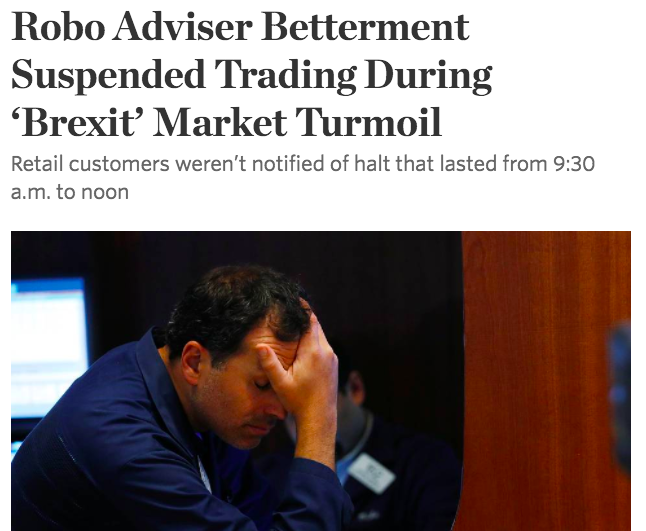
Rather than a quote about Betterment freezing trading during Brexit, here’s the WSJ post:

Here’s what Stein had to say about the matter:

“We always look at volatility and thoughtfully trade for our customers. We always pause trading at the open because markets and ETFs tend be quite volatile. We watch out for things like that, and Brexit was one of those days when all the major banks paused trading because they were worried about volatility.”

I actually like this strategy because it’s aligned with what Daniel Kahneman has said.

“When things get really big and you’re really not sure, slow down.”

There are situations (with limited volatility) where humans can keep up with changes in the system. Sports is one, fire fighting another, piloting a third. We can succeed in those domains with lots of practice, feedback, and consistent condition.

If we don’t develop an adequate skill — fighter pilots call it being “behind the plane” — the system will eat us up.

When Gene Kranz worked at NASA during the Mercury, Gemini, and Apollo missions he wrote that they trained rigorously because, “During a mission countdown or even a flight test, so many things would be happening so fast that you did not have any time for second thoughts or arguments. You wanted the debate behind you.”

Kranz’s rockets went from 5 miles/minute to 5 miles/second. Trading data is 30,000 times faster. It’s too fast. Acknowledge your limits and slow down.


To recap:

  1. Decision options always have some sort of default. Arrange the default in such a way to nudge someone into what’s best for them.
  2. You can start by building something to scratch your own itch but eventually you have to get people to pay you. The sooner you prove/disprove this, the better you’ll be.
  3. In similar situations (“Same as the gym back in Hickory”) practice, checklists, and feedback work. When things move fast, the situation may have changed and you don’t know it. In that case, slow down.

Update 11/14/16: The first version of this post misspelled Jon as John. 

Bill Miller

Let’s not bury the lede. When Bill Miller joined Barry Ritholtz on the Masters in Business podcast, he admitted the secret of his success. Ready?

“Luck.” 

Lifehacker can’t write an article about that.

But, there was another answer too. It wasn’t articulated, but it was there. I had to listen carefully to find it, thankfully I’ve done that before.

In my youth, when time was plenty, the internet allowed people like me to find the answer to the deep questions of life, like, if you play Led Zeppelin backwards could you hear satanic messages? I wanted to know, not for fiendish reasons but engineering ones. Was it possible to make something sound coherent forwards and backwards?

Using this same detective style, I figured out the secret to Miller’s success: He succeeded because he does a lot of small things right everyday.

Is this more helpful than ‘luck’?

In large stretches of episode 47 of his podcast, Jocko Willink talks about this. This idea was the subject of the Grit post.

That’s all it takes to have the success of Bill Miller. Do lots of small things well and get lucky. Well, it takes more than that, here’s some other things I noted:

1/ Why Moneyball no longer works. Miller says he’s a “long-term oriented value investor with a contrarian mindset.” Not like Graham and Dodd, “those things no longer work because they became replicable.”

If you aren’t familiar, Moneyball is the idea brought to light by Michael Lewis’ book Moneyball. It’s the story how one not-so-good baseball team improved by looking at statistical areas other teams undervalued, but that led to wins. Their success like an Apple design, led to a slew of imitators.

As more settlers crowded the fertile ground of ‘valuable things’ the value became harder to find. The smartest teams searched for new ground.

The champion Chicago Cubs, for example, pivoted away from the Moneyball angle and look for soft skills.  The original Moneyball club, the Oakland A’s moved away from Moneyball too. The Pittsburgh Pirates have also broken off in a new direction.

Baseball, like investing, is a Red Queen Effect world. It’s a place where you can improve absolutely but where the results are relative. Your 5K time may improve, but so too does everyone else.

If you want to do more than anyone else, you have to do things differently than everyone else (more at #3).

2/ Measure headwinds and tailwinds. “If the economy is in a recession or a boom, we’ll tend to normalize that. If the economy is growing more rapid than normal, we’ll bring it back to a normal growth rate.”

Here Miller is pointing out that as his team evaluates companies they evaluate the type of environment too.

In November you can plant tomatoes in Florida, but not in Ohio. That’s a big difference if you want to compare the tomatoes each area has in a few months time. Conditions matters and it helps if you can normalize success or failure.

Judith Elsea said that in 2006/2007 venture capital was a different game because, “there was less competition for these deals. The valuations were super low. The aqui-hire machine didn’t start with the dial set at 11.” Auren Hoffman refused to give investment advice because everyone investing at the same time he did, did well. Warren Buffett compares it to a rising tide that lifts all boats (and ducks). Coca-Cola could only have been started in Atlanta.  The ‘Black Soxs’ players did throw the World Series only because they were corrupt, but also because they were poorly paid.

Conditions matter. At the minimum, figure out which way the wind is blowing and factor that into the results.

3/ Be different.  IF there is a ‘secret sauce’ this is it. Much like ‘be persistent’ and ‘get lucky’, ‘be different’ isn’t that instructive. It’d be much tidier if Miller confessed his magic ratio, but we already know silver bullets don’t exist.

Miller has been different and his comments were similar to what Howard Marks wrote:

“I think it is essential to remember that just about everything is cyclical.”

Here’s what Miller said:

  • About Price/Earnings ratios in 1999, “we knew the growth wasn’t going to be linear and some interruption would occur.”
  • About Q1 results in 2000, when 70% of managers beat the benchmark, “that told me that everybody was in tech.”
  • “Because we were contrarian value investors, we were liquidity providers when people wanted out of something.”

Miller’s success partially comes from zigging while other zag. If people are selling, he’s buying (“liquidity providers”). If people are buying, he’s selling (“everybody was in tech”).  “So at the extremes, which are created by ‘most people believe,’ most people are wrong,” writes Marks. Much like our point about Moneyball (#1),  value is inversely related to participants. When more and more people do a thing, the value becomes less and less.

Miller explains that being different isn’t easy. It’s hard to go against the crowd, but easier if it’s at an individual stock level. When I write about this, it’s this difficulty that’s hardest to convey. “Accepting the broad concept of contrarianism is one thing,” writes Marks, “putting it into practice is another.”

Companies like Nike, Sam Adams, and Instagram all did something different, but it was never easy. Listen to and read their stories (Nike, Sam Adams, Instagram) and you’ll start to understand that being different is difficult.

4/ Fighting the last war. “We had a pretty robust strategy,” BUT “this particular crisis was different because it was as asset based crisis and not a liquidity based crisis.”

Oops.

Miller’s admission surprised me. You think someone like BILL MILLER who worked at LEGG MASON with MICHAEL MAUBOUSSIN would be immune to mistakes like recency bias and lack of imagination.

Nope.

Of course it makes sense to account for the last thing. Fool me once, shame on you. Fool me twice, shame on me. In addition to solving the last thing though, let’s extend our understanding using a technique Charlie Munger and Seth Klarman suggest; inversion.

During the Mercury, Gemini, and Apollo missions the astronauts and engineers involved were learning as they went along. No one was an expert. Gene Kranz writes “all of us learned to say ‘I don’t know.'”

One thing they had to figure out was the hatch system for the Apollo capsule. During the Mercury missions, Gus Grisson’s hatch had opened during the water landing, the capsule took on water, and sunk. This mistake was “not easily forgotten,” Kranz writes.

To solve for this the Apollo 1 hatch was “a brute, heavy and awkward.”

“Given the design, a rapid escape from the spacecraft was impossible. But the NASA and North American designers hadn’t been as worried about escape contingencies as they were about the possibility of a hatch popping open into the vacuum of space or another inadvertent opening during a water landing.”

During the Apollo 1 ignition sequence, a fire spread through the capsule and killed all three astronauts. No missions were named Apollo 2 or 3 in honor of the crew and for Apollo 4 the hatch could swing out and be opened in 10 seconds.

Fighting the last war meant the hatch withstood outside forces but not the inverted, opening from the inside.

Fighting the last war meant planning for a liquidity crisis but not the inverted, an asset one.

Fight the last war, but also think about the opposite.

5/ Partnerships“When we’re in the office we’re talking all the time. When we’re not there we’re emailing and talking on the phone.”

Successful teams align on the ends and most, but not all, of the means to get there.

Miller has Samantha McLemore. George Bush had Karl Rove. Bill Belichick has Ernie Adams. Warren Buffett has Charlie Munger. Marc Andreessen has Ben Horowitz.

No one is right all the time. Good partnerships mean better ideas, faster.

Thanks for reading, I’m @mikedariano on Twitter.

Jim Koch

maxresdefaultJim Koch was on the How I Built This podcast to talk about founding Sam Adams. HIBT is one of my favorite podcast series, with interviews around Instagram, Spanx, Clif Bar, Airbnb, and Dermalogica. Podcast fans should subscribe. Here’s what I learned from Koch.

  1. Knowing things deeply.
  2. “Can I bum a quarter?” (low overhead)
  3. A sweet spot for work.
  4. I saw it in a magazine. (see it to believe it)
  5. Dangerous or scary?
  6. The first Sam Adams employee.
  7. “American Beer is like making love in a canoe – fucking close to water.”
  8. Luck.

If you’re short on time skip to #5.

1/ A deep understanding. Though Koch was an MBA/JD and worked at Boston Consulting Group, he also came from a family of brewmasters. “My dad was a brewmaster and it was like being a chef in a kitchen,” Koch explained. He had his great grandfather’s recipe – one that had fell flat in previous decades – and hired someone to “adapt a 19th century recipe into a 20th century brewery.” Koch had a deep understanding of his niche.

A deep understanding is a pillar for a lot of industries. Bill Belichick has it for football, studying film and being around teams from an early age. John Boyd had it for ariel warfare, flying combat missions and then teaching pilots. Yvon Chouinard had it at Patagonia, testing and experimenting with the gear himself.

Each was in an industry; consumables, football, warfare, clothing where things change and each survived the changes because they had a deep understanding.

2/ A low overhead. “I learned that you don’t need that much to live on if you’re really enjoying what you’re doing.” “We rented space, brewed the beer, and they packaged it and I didn’t have to have my own brewery for several years. When I started we didn’t have things you think you need for business. We didn’t have an office. We didn’t have a telephone. I asked myself, ‘am I spending money on things that are going to make the beer better or am I spending money on things just because that’s what you’re supposed to spend it on?’” “We were profitable from the first full month. It was the ultimate lean startup. We had no office. We didn’t even have a telephone. We did all of our business from pay phone and I knew where all the good payphone were in Boston; the ones that were warm in the winter, the ones that had a shelf you could put stuff on. It was very clear to me when I started there were only two things we needed to do really well; make great beer consistently and work our butts off to sell.”

It was refreshing to hear someone talk about a tangible goods business this way. That kind of industry seems ripe for bloat. Not for Koch. Keeping a low overhead isn’t the end itself. Low overhead extends a runway and allows for more chances to get things right.

  • Amazon was built on ‘door desks’ in a garage.
  • CAA started with donated office supplies.
  • Walt Disney used an alleyway to film.
  • Nasty Gal started on eBay and at estate sales.

In The Outsiders, William Thorndike writes, “There’s an apparent inverse correlation between the construction of elaborate new headquarter buildings and investor returns.” The Instagram founders said:

“…so here are two guys with a prototype, a couple of computers, and no office, who raised a half a million dollars who are looking at each other like, we think we can make this last. We were living on peanut butter and jelly sandwiches.”

Paul Graham writes “When and if you get an infusion of real money from investors, what should you do with it? Not spend it, that’s what,” and to “encourage a culture of cheapness.”

Koch also noted the importance of making something great. The a16z podcast had a fantastic episode with David Oyelowo that echoed and elaborated on this point. Oyelowo said part of the reason The Queen of Katwe was made was because everyone involved had a strong resume of work.

3/ A sweet spot. “After six years (at BCG) I had this epiphany. I asked if I wanted to do this for the rest of my life and the answer came back, ‘no.’ The corollary to that was that if I don’t want to do this for the rest of my life, I probably don’t want to do this tomorrow.”

Mohnish Pabrai said much the same thing:

“I have a rule I’ve followed for my entire career: if on Monday morning I’m not fired up for work I do two things. Number one, I don’t go to work. Number two, I hit the reset button.”

In Tim Ferriss’s 2016 podcast with David Heinemeier Hansson the duo talked about the difficulty in defining this. It’s not happiness per se, but something closer to tranquility. It’s a feeling of flow. It’s challenge. It’s a nebulous brew of success and failure. It’s a sweet spot.

4/ See it to believe it. “My dad had given me a copy of Inc magazine and there was an article in there about Anchor Steam, this small brewery in California owned by this great guy named Fritz Maytag and Fritz had a viable small brewery. It was an outlier. When I was a consultant, what always fascinated me were the outliers because that’s where the real learning was.”

There was nothing about American beer culture that suggested a beer like Sam Adams would succeed. So no one pursued it. It wasn’t until Koch saw an example where it was like, yeah, this can work.

For Judd Apatow this moment was when he saw Steve Martin. “Steve Martin was a revelation when I was a kid,” Apatow said. He tells a great story about meeting Martin, negotiating (unsuccessfully) for an autograph, and then sending him an angry letter. The key part though was just seeing Martin. “Unconsciously it put a lot of gas in my tank,” Apatow says, “and it showed me he exists, all these people exist.” It showed him what was possible.

5/ Is it dangerous or is it scary? “There are plenty of things that are scary but aren’t dangerous and there are things that are dangerous but not scary, and those are the things that get you. I’ll give you an example from climbing. Rappelling is a very scary thing to do, but you’re held by a belay rope and that rope will hold a car. Walking off the cliff backwards is scary, but not dangerous. Walking across a thirty-five degree snowfield on a beautiful late May afternoon with a bright blue sky is not scary at all, but it is very dangerous because the snow is melting, and eventually there will be an avalanche. My staying at BCG was dangerous but not scary. The danger there was continuing to do something that didn’t make me happy and looking back when I was 65 and going ‘oh my god, I wasted my life.’”

I loved this idea. Not scary yet dangerous things are the ones that get us. Part of the problem is a misdiagnosis. We aren’t scared enough or we think a danger is too small.  Morgan Housel wrote:

“The most useful lesson from the 2008 financial crisis is that big risks hide under your nose and cause more havoc than you imagined, so having more room for error in your finances than you think you need is a smart idea. Less reliance on forecasts, more time to wait things out, a greater willingness to accept lower returns than you’d prefer.”

Nassim Taleb writes a lot about this. So too does  Greg Ip in Foolproof.

6/ Teamwork. “My dad has told me, if you’re going to have a business Jim it’s lonely, it’s going to have its ups and downs, see if you can find a partner. So I looked around BCG. It was full of the best and brightest from the top business schools, but somehow I couldn’t see them being my partner because they had all the same skills I had. Then I realized there is a person here who is energetic, talented, resourceful, a great people person, has all the skills I don’t really have – and she was my secretary…we were the perfect compliment.”

giphy

Good partnerships, I suggested in the Jeff Bezos post, have people aligned on the ends but not the means.

For Koch that meant someone that had a different set of skills (means/ways). No one person can do it all.

In episode 44 of his podcast, Jocko Willink said about one of his favorite guys in the SEAL teams, “when I started to get a little off the reservation about something…he’d look at me and be like ‘hey Jocko, come back to the light, it’s gonna be okay…When I would start to get negative he would pull me back and the same thing me with him.”

7/ Be Different. “All the Boston beer distributors turned me down because this was the heyday of light beer.”

Being different and being right is great advice but challenging IRL. It’s the idea of finding an idea that’s stupid now but could be brilliant.

In The Everything Store, Brad Stone quotes someone saying that Bill Gates was “flabbergasted” when he heard the plans for Amazon.com. Chew on that.

Phil Knight founded (what would become) Nike when running was different. “To go out for a 3 mile run was something weirdos did, presumably to burn off manic energy.”

Ben Horowitz wrote, “The trouble with innovation is that truly innovative ideas often look like bad ideas at the time.”

8/ Luck. “In all humility, a lot of it was luck. I look back and a lot of things could have gone wrong…a lot of things didn’t go wrong that could have.”

Control what you can, and understand the roll/role of luck.

Thanks for reading, I’m @mikedariano on Twitter. If you liked this post, I sometimes write long posts as short books. Here’s one on Bill Belichick and red teams.

Jeff Bezos

Want to listen instead? This is episode 044 of my podcast, Mike’s Notes.

Well, I  liked The Everything Store by Brad Stone. In my monthly newsletter about books I noted that while this book is about a popular subject (Bezos/Amazon) it’s not perishable. The Amazon juggernaut is here to stay and this book had enough background to get anyone caught up on how we got to now.

I took so many notes on Bezos that he inspired this post about mercenaries, missionaries, and maniacs and I’m digging deeper into the theory of disruption for another written piece. This post will be everything else I learned. All unattributed quotes are from Stone.

  1. Second level thinking with a small change.
  2. You’ll never be ready.
  3. Argue well.
  4. Luck.
  5. Decentralized command.
  6. Always be learning.

1/ Second level thinking (via finer print). 

This is my favorite riddle:

“As I was going to St. Ives, I met a man with seven wives. Every wife had seven sacks, every sack had seven cats, every cat had seven kitts. Kitts, cats, sacks, wives, how many were going to St. Ives?”

Before you open a tab for some calculations (or Google the answer), let me rephrase it:

"As I was going to St. Ives, I met a man with seven wives. Every wife had seven sacks, every sack had seven cats, every cat had seven kitts. Kitts, cats, sacks, wives, how many were going to St. Ives?"

Better?

Theories about information processing suggest that the second presentation will lead to more correct answers. The reasoning goes that because the font is more difficult to read, it nudges us into a mode of closer attention.

In The Success Equation Michael Mauboussin gives us another example (p102):

Jack is looking at Anne, but Anne is looking at George. Jack is married, but George is not. Is a married person looking at an unmarried person?

(A) Yes

(B) No

(C) Cannot be determined.

When I read the book I skipped right over this entire setup, ready for the payout. Why did I do this? Because I knew Mauboussin would tell me the answer. I didn’t need to do any heavy lifting. Then, in the very next paragraph Mauboussin writes:

“The natural tendency when solving problems is to rely on cognitive mechanisms that are fast, low in computational power, and require little concentration…”

Which is exactly what I did in reading rather than thinking.

xt5lmwjsxhrbsusyve

What does this have to do with Bezos? At Amazon employees don’t use PowerPoint, they have to “write six-page narratives laying out their points in prose, because Bezos believes doing so fosters critical thinking.” Jeff Holder, who worked with Bezos at D. E. Shaw told Stone, “PowerPoint is a very imprecise communication mechanism. It is fantastically easy to hide between bullet points.”

Different fonts to think better seems a bit Gladwell-ian. Here’s this funky little finding from psychology, extrapolate as needed, ad infinitum, caveat emptor. 

Of course we should use a bit of trepidation.

The introduction of Stone’s book includes a warning too. When he approached Bezos, Bezos asked about the narrative fallacy (Antifragile  is one of Bezos’s favorite books, “which all Amazon senior executives had to read”).  Thinking more deeply about something can help us make better choices but it’s not a silver bullet. It’s one of many things that solve black box problems.

2/ Never ready. “By the first weeks of 1996, revenues were growing 30 to 40 percent  a month, a frenzied rate that undermined attempts at planning and required such a dizzying pace that employees later found gaps in their memory when they tried to recall this formative time. No one had any idea how to deal with that kind of growth, so they all made it up as they went along.”

This is starting to seem like a late-night-glass-of-wine confession. If you catch people in an honest and reflective state they’ll admit they had no idea what they were doing in the moment. You can prepare, but a lot of it seems to be like treading water.

Michael Lombardi said that football is this way. You never really get a chance to get ahead, to be ready. It’s more like a just-in-time manufacturing system.

Angela Duckworth wrote, “As anyone who has started an organization from scratch can tell you, there are a million tasks, big and small, and no instruction manual for any of them.”

When Gene Kranz showed up to shoot rockets, he was picked up by a test pilot, in his own car. Kranz wrote “without knowing much about anything, I was telling people how to do everything, writing the rules for the control team that would support the Mercury-Redstone launch….Since there were no books written on the actual methodology of space flight, we had to write them as we went along.”

Phil Knight recalls the early days of Nike and sending his chief retail person to run a factory. The guys said that he didn’t think he could do it, that he was in over his head. “Over your head?” Knight recalls saying, “We’re all in over our heads, way over.”

If you can’t be ready what can you do? Take the course that Andy Grove suggests, prepare like firemen prepare for fire.  Bezos uses a different analogy but the same effect. “(Bezos) was looking for versatile managers – he called them ‘athletes’ – who could move fast and get big things done.”

3/ Argue well. Good organizations and the people within the organization argue well. No one person knows everything and ideas need sharpened. “Amazon’s culture is notoriously confrontational, and it begins with Bezos, who believes that truth springs forth when ideas and perspectives are banged against each other, sometimes violently.”

Credit is a power law distribution. Jobs, Wozniak, Cook. Jordan, Pippen, Horry. Buffett, Munger, and, umm, err, – well that proves the point.

Laurie Woolever was on the Salt of the Earth podcast to talk about her career working with people like Mario Batali and Anthony Bourdain. Woolever carefully noted that those high wattage people work hard, but that there are a lot of people behind the scenes. Even the cookbook she wrote with Bourdain took some back and forth before it emerged.

One example at Amazon was Joy Covey, an early CFO, who, “became an intellectual foil to Bezos and a key architect of Amazon’s early expansion.”

I didn’t get the idea that Bezos was combative for the sake of being combative, but for the sake of the truth. As Amazon grew larger Bezos added the position of Technical Advisor and his first appointee was Andy Jassy, who:

“would define the shadow role as a quasi chief of staff, and today the position of Bezos’s shadow, now formally know as technical adviser, is highly coveted and has broad visibility within the company. For Bezos, having an accomplished assistant on hand to discuss important matters with and ensure that people follow up on certain tasks is another way to extend his reach.”

Bezos wanted someone who could think like him, but not completely. This is true of a lot of partnerships. The Warren Buffett and Charlie Munger duo is like this. Ditto for Marc Andreessen and Ben Horowitz. Bill Belichick and Ernie Adams have this too.

You have to argue well to find the truth. Stephen King writes that the truth of a fiction story is like a fossil. The story is there, it just needs exhumed. It means flyting like geniuses,  and constructive confrontation.

4/ Luck. Amazon fits the two-jar model. There were high skill draws; Bezos is smart and relentless. There were also high luck draws. For example, Amazon wrapped up funding in 2000. “While other dot-coms merged or perished, Amazon survived through a combination of conviction, improvisation, and luck.”

Their luck wasn’t done there. Amazon Web Services was a bit of luck too. Bezos said, “Developers are alchemists and our job is to do everything we can to get them to do their alchemy.” He could have used another analogy; builders, creators, dreamers, but he chose alchemy. Something great could come out, but he didn’t know what.

Even the chief Amazon product – the Kindle – benefitted from a bit of luck. “In a sense, Amazon got lucky. A technology (e-ink) perfectly suit for long-form reading on a device (and terrible for everything else) just happened to be maturing after a decade of development.”

As an individual Bezos was lucky.

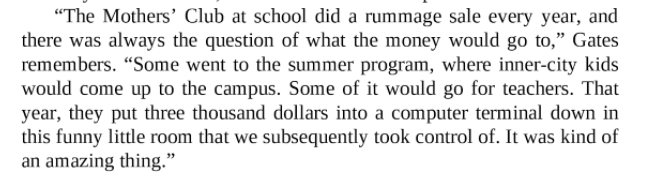
“At age eight, Bezos scored highly on a standardized test, and his parents enrolled him in the Vanguard program at River Oaks Elementary School, a half-hour drive from their home…(where) A local company donated the excess capacity on its mainframe computer to the school, and the young Bezos led a group of friends in connecting to the mainframe via a Teletype machine that sat in the school hallway.”

Bezos’s story could be the brother to the one Malcolm Gladwell tells in Outliers about Bill Gates:

y6_pisu7gq

And Bezos’s mother?

“Jackie Bezos prevailed on the local school officials to let her son into the middle school’s gifted program despite the fact that the program had a strict one-year waiting period….’You want to account for Jeff’s success, look at Jackie,’ says Bezos’s childhood friend Joshua Weinstein. ‘She’s the toughest lady you’ll ever meet and also the sweetest and most loyal.'”

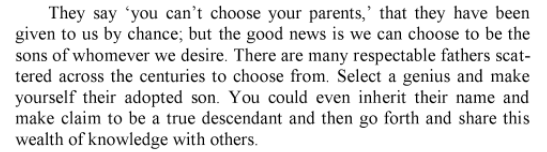
Parenting isn’t all luck though. Seneca has this advice:

dshow0zdyj

Control the things you can as best you can. We don’t get to choose parents that accidentally or on purpose, get us hands-on experience in an industry that changes the world. But we do get to choose who we learn from.

5/ Decentralized command. Bezos said:

“A hierarchy isn’t responsive enough to change, I’m still trying to get people to do occasionally what I ask. And if I was successful, maybe we wouldn’t have the right kind of company.”

Stone clarifies:

“Bezos’s counterintuitive point was that coordination among employees wasted time, and that the people closest to the problems were usually in the best position to solve them.”

The solution to this was Amazon’s “two-pizza teams.” The idea that if a group is working late on a problem, there shouldn’t be more people than what two pizzas can feed.

Neil Roseman put it this way, “Autonomous working units are good. Things to manage working units are bad.”

Decentralized command works really well in complex adaptive systems where things are always changing. CEO’s like Tom Murphy said to “Hire the best people you can and leave them alone.” Warren Buffett suggested to “hire well, manage little.”

There’s only so much arguing well (#3) that Bezos can do. Eventually he needed to let other people make the right decisions. Andy Grove said that it’s hard to weigh how much to trust people, but they know things out there with the “winds in their face.”

6/ Always be learning. What surprised me in the book was how many other people were mentioned. Newton attributed his work by standing on the shoulders of giants. Bezos, it seems, fully internalized this.

Anything successful Bezos tried. He met with Jim Sinegal, the founder of Costco who told him, “you can fill Safeco Field with the people that don’t want to sell to us.” The lesson was that some people won’t like what you’re doing. That’s a good thing. As John Boyd told his accomplices, “So you got your reward; you got kicked in the teeth. That means you were doing good work. Getting kicked in the teeth is the reward for good work.”

Sinegal also told Bezos that customer loyalty was key. Amazon has emphasized that too.

Bezos wanted AWS to be like building blocks, an idea he got from a book, a book he read during a Think Week (an idea he may have picked up from Bill Gates).

Books are a great source for this, and are often recommended. Read a lot like Bezos, Gates, Munger. Also, do. Munger said, “If we hadn’t bought See’s (candy), we wouldn’t have bought Coke.” They had to do that to learn. Bezos, of course, would learn by doing too.

“I didn’t know Jeff Bezos,” said Stephen Graves, a consultant hired to help get fulfillment operations optimized, “but I just remember being blown away by the fact that he was there with his sleeves rolled up, climbing around the conveyors with all of us. We were thinking critically and throwing around some crazy ideas of how we can do this better.”

Thanks for reading, I’m @mikedariano on Twitter.

Anecdotal data point: A watch I bought on Amazon stopped keeping time after six weeks. Every few days it would reset to 1/1/12. I emailed them about it. They told me it was beyond the 30 day return period but because I was a valued customer they would refund my money, AND I didn’t have to go through the process of shipping the watch back.  It was this last part that made me feel “valued.”

What do you get when you cross a mercenary & missionary?

In tech-leaning podcast I hear the terms mercenary and missionary used to compare two types of workers.

  • Mercenaries are hired guns who show up, do the work, collect a check and move on.
  • Missionaries are people who believe in the cause, go the extra mile, and want to be part of something bigger.

Related to this is an idea that company founders are good investments. There’s Peter Thiel‘s Founders Fund and Ashton Kutcher told Kara Swisher that he prefers to invest in founders. The assumption here is that founders are missionaries.

That’s true, but what if we created a false spectrum? Why can’t founders be missionaries and mercenaries? We will call them maniacs.


The person who crystalized this for me was Jeff Bezos, or at least the Jeff Bezos in Brad Stone’s book The Everything StoreThat Bezos is a maniac (and he probably had to be).

Before starting Amazon:

Bezos was in his midtwenties at the time, five foot eight inches tall, already balding and with the pasty, rumpled appearance of a committed workaholic. He had spent five years on Wall Street and impressed seemingly everyone he encountered with his keen intellect and boundless determination.

Bezos seemed to love the idea of the nonstop workday; he kept a rolled-up sleeping bag in hs office and some egg-crate foam on his windowsill in case he needed to bunk down for the night.

As Amazon grew, Bezos infected others with his relentlessness. In 1996 Amazon needed a new warehouse facility. They found a building in a seedy part of Seattle.

Parking was scarce and expensive. Nicholas Lovejoy suggested to Bezos that the company subsidize bus passes for employees, but Bezos scoffed at the idea. “He didn’t want employees to leave work to catch the bus,” Lovejoy says. “He wanted them to have their cars there so there was never any pressure to go home.”

One employee said about Bezos, “If you’re not good, Jeff will chew you up and spit you out. And if you’re good, he will jump on your back and ride you into the ground.”

Bezos wanted Amazon to stock everything and at the lowest prices (missionary), but also do so faster and better than anyone else, no matter the cost (mercenary).

Through Stone’s book you get the impression that Bezos did not have executive meetings that began with rounds of kumbaya. Rather, Amazon sounds more like the military. Maybe Amazon had to be that way.

Cal Newport writes that rare and valuable jobs require rare and valuable skills. Charlie Munger writes that successful capital allocation is “not supposed to be easy. Anyone who finds it easy is stupid.” Howard Marks writes that “investors are always looking for it…but the silver bullet doesn’t exist.”  Ben Horowitz writes that solving problems is more of a lead bullet approach.

Do you have to be a maniac – a mercenary and missionary – to do the work it takes?

One of the early employees who did a lot was Joy Covey. After  four years she left to spend more time with her family, but as Stone was working on his book she emailed him and wrote:

As I read the (Isaacson) Jobs book I really had to wonder if that (sometimes-harsh) intensity isn’t an essential element when so much of what you want to do requires boldness, immediacy, ruthless prioritization, and risk.

I even had an insight and question about myself, that maybe I haven’t begun to really find my own limits, since I have not, aside from those times of highest stakes and intensity at Amazon, really run free following my own insights and directions without being too accommodating of others.

Do you hear what she’s saying? She’s pointing out that things don’t change on their own. If you want to dent the universe you’ll need to swing a big enough hammer.


Many of the stories about Bezos reminded me of this column by Malcolm Gladwell:

Whenever I take the freeway west from Toronto to my parents’ house, I pass a park where I ran a cross-country race many years ago. It was the county championships. I had just turned thirteen, and had been a “serious” runner for no more than six weeks, which meant that I knew almost nothing at all about running, except that you were supposed to run as hard as you could for as long as you could. My coach told me to stay close to the front, and I took the instruction literally, the way that dutiful thirteen-year-olds do. So I attached myself to the best runner in the field—a fifteen-year-old named Lloyd Schmidt—and did not let go.

The race began by winding along a series of trails and roads on the fringes of the park. It was a warm autumn afternoon. I remember the illicit thrill of running with the leaders, where I knew I did not belong. My lungs and my legs gradually slipped out of synch. I fell first half a breath short, then a full breath short. The world around me grew hazy. We came to a steep hill. My coach was standing there. “Now,” he said. I willed myself to pass Schmidt, accelerating off the top of the hill. That’s the part of the course that I see from the highway every time I drive by, and it never fails to send my stomach sideways. The next thing I remember was Lloyd Schmidt holding me up at the finish. I remember lying on the ground, slowly bringing my knees up to my chest. I remember the panic of not being able to get enough air into my lungs. I had done what everyone always says you are supposed to do as a human being. I had given it my all. And I realized that what everyone says you should always do was so painful that I never wanted to do it again.

I think that’s what it’s like to work with Bezos.

You can accomplish something incredible but it’s going to take incredible work.


Any part of success is skill and luck and maniacs try to increase their skill as much as possible. Time is one way to quantify this.

Bezos slept at the office and worked long hours. Bill Belichick and Ernie Adams work 100+ hour weeks. Munger’s children said they never spent much time with him except for vacations at their lake house. John Boyd’s worked long hours and late at night.  Gene Kranz, a NASA flight director for Apollo 11, 13, and other missions wrote, that flight engineers packed their bags for long days, not knowing when they might be home.

Mercenaries and missionaries go home from work, maniacs go home with work.

Thanks for reading, I’m @mikedariano on Twitter.


John Boyd

Imagine that Steve Jobs, with his wisdom, determination, RDF, grit, hunger, and vision didn’t want to change computing, but something bigger. What if Jobs focused on cancer research? Automobile safety? Inner city education? What if a dent maker chooses not something that you can hold in your hand that displays filtered photos of lunch, but that keeps people alive?

Let me introduce to you John Boyd.

Boyd was the Steve Jobs of the military. He was the guy who saw around the corner, who walked the walk and talked the talk, the idealist who let nothin’ get in his way. Navy SEALS like Rorke Denver and Jocko Willink have great lessons to teach, but John Boyd is a hero.
Which is why I haven’t done notes on him.

Boyd seemed like too much. It’s like summarizing Springsteen or Dylan. They meant so much. Can a summary be enough? Summarizing is almost disrespectful. But, I can’t neglect Boyd. His contributions are too grand.

Before we get into the notes, know that these are incomplete. In the same way Robert Coram’s book, Boyd, is only a small glimpse of a life, these notes are only a blink.

Okay, ready?

1/ The pace of life. Everyone runs life at their own pace. Some people have a faster cadence. Teddy Roosevelt for example, would burst into his home and be halfway up the stairs before the door closed behind him. He also completed his coursework fast, wanting to get outside again. Teddy kept a high cadence.

Boyd too had a faster pace of life. For example, he was always learning.

“He always carried books, not just class books, but book on history and war and philosophy,” Coram writes about Boyd at the University of Iowa. Not that he was a bookworm, “He was tall and handsome and dark-haired…he was an athlete and very popular.” Later in life he would come home with piles of things to read. He would go back to school to get a degree from Georgia Tech. Even when his daughter Mary Ellen was born, “Boyd was at the hospital, but he was in the hall, bent over his books.”

Had Boyd been only a constant learner, his contributions would have been large. But Boyd, was a doer too. During the Korean War (1953) Coram writes:

“Even Boyd’s fellow F-86 pilots, all of whom were avid and passionate about flying jets, were struck by his enthusiasm and energy. More than one said they had never seen a man before or since who was so single-minded about aviation. He did not see the F-86 as an engine and fuselage and an inanimate collection of esoteric parts; he saw it as a sleek and beautiful and lethal weapon of war, almost a living thing, each aircraft having its own personality, each to be ridden into the heavens in the name of the United States of America.”

In college Boyd read. In Korea he flew.  At the Pentagon he kept “a grueling pace that his cohorts find difficult if not impossible to keep up with,” noted a supervisor.

While this pace would yield some great ideas, it was also has costs. In any system there’s a reaction for each action. Boyd worked in a military system and things were done a certain way.

That way was to support generals rather than the truth. Boyd emphasized the latter and saw the reactions. In fact, if it hadn’t been for a few allies that buffered Boyd like fenders on a car, his career would have ended much earlier.

Boyd paid personal costs too. Coram writes, “It is almost as if Boyd believed his family obligations were over once he had finished his job of fathering five children. Mary’s job was to raise the children while he went about his life’s work,” and:

“John Richard Boyd – as is often the case with men of great accomplishment – gave his work far greater priority than he did his family. The part of his legacy that concerns his family is embarrassing and shameful.”

The people who are on podcasts and have books written about them are ‘achievers.’ We look at them because they did something. Charlie Munger is often cited for his brilliance in finance, mental models, and investing. Munger is a father too, and here his accomplishments are fewer. As I read Damn Right I got the sense that Munger was an often-gone father. Charles Munger Jr. says they saw the elder Munger at the lake house but, “the rest of the year we didn’t see him much.”

Steve Jobs wasn’t the best father. NASA Flight Director Gene Kranz wrote, “Behind every great man is a woman – and behind her is the plumber, the electrician, the Maytag repairman, and one or more sick kids. And the car needs to go into the shop.”

On the other hand, Milton Hershey and the Wright brothers never had children. The pace without children is different from the pace with them.

It’s hard to create the iPod, land people on the moon, create a national chocolate brand, or change the military culture. HUGE change requires HUGE commitment. Boyd achieved so much because of his pace for life, but only in the domain of ‘warfare’. Had he put the same effort into the domain of ‘promotion’ or ‘family’ he would have had more success there.

2/ Figure out the most important thing (MIT). The MIT for fighter pilots is this:

“Have student assume in trail position on the instructor and learn how to stay in that position throughout any maneuver.” – John Boyd

The trail position is the MIT for fighter pilots, and it’s how Boyd got his nickname, 40 second Boyd. The story goes that Boyd would meet any fighter at 30,000 feet over the “Green Spot” in the Nevada desert. The challenger would take up the trail position and Boyd would reverse the situation within 40 seconds or pay 40 dollars. Boyd never lost.

Once Boyd figured this out – ideas that became the energy maneuverability theory – he started to teach it to anyone who would listen. Coram writes:

“In his article in Fighter Weapons Newsletter, Boyd preached that one of the first teaching tools is to have a student get on the six-o’clock position of the instructor and stay there as the instructor goes through every evasive maneuver known to aviators. And this is how he began his air-to-air training with new students.”

Boyd wrote about the MIT. He taught in the air, “Boyd gave them their chance and one by one he hosed them, and then he nursed them along, teaching, demonstrating how to control the Hun (F-100).” One the ground he taught them more, “They headed back to ops for the debrief, the most important part of the mission. How well a fighter pilot conducted the debrief was one of the most important criteria in evaluating that student as a possible instructor.”

On the ground, in the air, back on the ground, Boyd taught the MIT.

Flying airplanes is a high skill (rather than luck) activity. It’s why checklists work. It’s why deliberate practice with feedback works. It’s why you can learn from experience.

So at Nellis the idea was to push the aircraft beyond the envelope, to make the training as much like combat as possible. The saying of the time was “The more you bleed in peacetime, the less you bleed in war.” This is another way of saying that normal rules of safety and common sense were often ignored. The thinking among pilots was “If you survived Nellis, Korea will be easy.”

Like Boyd’s understanding of the trail position, MITs don’t have to be complicated. Chris Sacca said about Facebook, “at the end of the day they accelerate the things that have the most likes on them.” Coca-Cola aimed to not lose countries or any part of their brand name. Bill Belichick saysthe MIT for wide receivers is to get open and catch the ball.

Coaches like Anson Dorrance and Pete Carroll say the MIT is to un-cap the human potential. Howard Marks writes about (a few) MITs, mostly avoiding big mistakes. Kara Swisher suggested that Yahoo failed, in part, because they didn’t have the right MITs.

If you can’t figure out a MIT invert the question. What mistake will destroy you? That’s your MIT.

3/  Friends, enemies, & stakeholders. For as smart and hardworking as Boyd was, he was socially an imbecile. This was surprising. How could someone who figured out so much not realize the social drag he fought?

He purposefully – or unknowingly – neglected people in pursuit of the mission. If you worked with him he could be like a father. Anything else and you were a nobody. There were three groups of people in Boyd’s life; friends, enemies, and stakeholders.

 Friends. Boyd did have some friends. Coram calls them the acolytes. They were the linchpins to Boyd’s theories. Without them running cover, making amends, greasing skids, backrooming ideas, sneaking computing time, or bouncing around ideas (with late night phone calls) Boyd the man wouldn’t be Boyd the hero. Each got a version of the be or do speech:

“Tiger,” he would say, “one day you will come to a fork in the road”

“And you’re going to have to make a decision about which direction you want to go.” He raised his hand and pointed. “If you go that way you can be somebody. You will have to make compromises and you will have to turn your back on your friends. But you will be a member of the club and you will get promoted and you will get good assignments.”

Then Boyd raised his other hand and pointed another direction.

“Or you can go that way and you can do something — something for your country and for your Air Force and for yourself. If you decide you want to do something, you may not get promoted and you may not get the good assignments and you certainly will not be a favorite of your superiors. But you won’t have to compromise yourself. You will be true to your friends and to yourself. And your work might make a difference. To be somebody or to do something. In life there is often a roll call. That’s when you will have to make a decision. To be or to do? Which way will you go?”

Boyd found people who were smart, tough, and committed. He saved careers, turned “water walkers,” and aligned with people going his way. Boyd teamed up with just enough of the right people to help him get things done.

Enemies. There’s the truth and there’s how you get to it. People did not like Boyd’s means.  If the Pentagon was a technology startup, Boyd would have been great. He moved fast and broke things decades before it was a rallying cry or sticker on a laptop.

One time an edict came down that there were to be no more mistakes. Boyd said “zero defects was stupid.” This tactlessness was typical.

“Boyd had established a pattern: no matter what his contributions to the Air Force or to national defense might be — and there were significant contributions yet to come – – his outspoken nature, his lack of reluctance to criticize his superiors, and his love of conflict with others would hinder his promotion throughout his career.”

“He was a thirty-nine-year-old major who had demonstrated at Eglin that he did not care about military politics, human nature, and the ways of the world.”

Boyd pursued the truth as he saw fit. In Vietnam and Korea Boyd observed combat. In Fighter Weapons School he taught techniques. At Georgia Tech he learned physics. There was no better prepared person to institute change at no worse a place.

Much of Boyd’s clashes reminded me of Bill Belichick’s time as the Cleveland Browns coach. Belichick ruffled feathers of reporters, Boyd of Pentagon staffers. Belichick cut quarterback Bernie Kosar because he wasn’t physically fit. Boyd said the fighter planes  pieces of shit. Belichick’s boss, Art Model, was clueless about Belichick’s style of football. Boyd’s bosses were blue suitors who were clueless about Boyd’s philosophy of warfare.

Both were brilliant in their domains, but both made enemies.

When Modell announced the Browns move, manikins of Belichick and Modell were hung outside the stadium. Staffers didn’t go out for lunch anymore. Boyd would have fit in, saying,  “So you got your reward; you got kicked in the teeth. That means you were doing good work. Getting kicked in the teeth is the reward for good work.”

Parades

Stakeholders. We touched on Boyd’s pace above, and we won’t rehash it only to say that dent makers don’t have infinite time. As the saying goes, somethings gotta give.

Boyd recognized this on the professional side of his life. As he progressed through his career, saw promotions come and go,  made more enemies than friends, and realized the need to be independent.

“Boyd knew he had to be independent and he saw only two ways for a man to do this: he can either achieve great wealth or reduce his needs to zero. Boyd said if a man can reduce his needs to zero, he is truly free: there is nothing that can be taken from him and nothing anyone can do to hurt him.”

Boyd wanted FU money which allows stakeholder neglect. Your boss is a stakeholder in your life. So is the cable company, the cell phone company, and student loan company. Each one of those companies owns time in your day. You can follow Boyd and reduce your needs or become wealthy enough those stakeholders bother you as much as ants at a picnic.

It’s not just money though. It’s any demand that pulls away from THE THING YOU WANT. Coram writes that when Boyd fully gave up the idea of the promotion track, “he came to find that freedom from the concerns that governed the lives of most officers was remarkably liberating.”


John Boyd accomplished a lot in his life. Robert Coram writes about the successes and shortcomings wonderfully. It’s a great book.

  1. Boyd lived at a supersonic pace.
  2. Boyd focused on the most important thing.
  3. Boyd had enough friends, not too many enemies, and minimized the stakeholders in his life.

Thanks for reading, I’m @mikedariano on Twitter.

Dinesh Kandanchatha

Dinesh Kandanchatha joined Aaron Watson to talk about books, conditions, and jobs. Start to finish this podcast episode had no dull spots. My notes cover these areas:

  1. A reading habit that involves rereading.
  2. Conditions for success.
  3. Kandanchatha’s strategy for employees.
  4. Deep understanding.
  5. Career freedom.

As always, unattributed quotes are from the subject, Kandanchatha.

A (new) reading habit. “Then what I’ll do every year is select one book, which is to me a book that I need to keep reading and I will reread that book over and over again.” “It’s not about the quantity of the knowledge you acquire but the depth at which you are practicing it.”

What I liked so much was Kandanchatha’s idea about understanding something deeply by revisiting it. When Tren Griffin launced 25iqbooks.com I was kind of disappointed becuase there weren’t surprises. Patrick O’Shaughnessy gets this too, on recent podcast episodes he asks people like Christian Rudder about books that are under the radar.

What if I’m looking at this all wrong? What if I should only re-read the really good books.  Griffin tweeted this to me:

I’ll be thinking more about this. All I know for sure is that reading is good.

The person and the situation. “I’m a firm believer that there are mostly no bad people and it’s just a bad situation or a bad fit and I try to reflect that in the conversation with the individual.”

It’s hard to fire people but Kandanchatha explains his system.“It has to be based on good reasons…most people don’t sit down and write them out and I did. I sat down and wrote down the list. The other thing I said was ‘what happens if I don’t do this?’ and write down that list.”

What I liked about this was his acknowledgement of the conditions. It’s the person and the situation, not only one or the other.

When we miss this duality we often fall for the fundamental attribution error. Sports are an easy place to see this. Michael Mauboussin says that wide receivers are dependent on the situation, kickers less so.

Strategy. Kandanchatha has a two part system for onboarding employees.

  1. Do they execute?
  2. Are they competent?

Execution is measured as a percentage. “Everyone does a direct report and it’s a five minute catch up. The priorities are listed for the week and what’s done or not done is captured….At the end of the week you tally them up.”

“It’s really important to me that you have a 90% plus execution rate.” At first I thought his number was kind of low. I mean, who doesn’t get most of their work done a regular basis? Of course I said this without measuring it.

“I have been struck by how important measurement is to improving the human condition. You can achieve incredible progress if you set a clear goal and find a measure that will drive progress toward that goal… this may seem basic, but it is amazing how often it is not done and how hard it is to get right.” Bill Gates

Competency is whether or not you can get things done. Competency in what Jocko Willink calls “extreme ownership.” Kandanchatha says,  “I don’t care how you get it done, just that you achieved the outcome in a way that’s consistent with the principles of the culture of the organization.”

If you need help, you ask for it. If you need to break things down and take smaller steps you do that. What matters is moving forward.

Deep understanding.  “The best way to invest is to actually run a business in the area that you’re investing in. I invest in technology companies because I understand what it takes to make a technology company successful. I invest in what I know…You want to invest in things that you know inside and out and are able to maximize your very slim odds.”

Speaking of rereading books, one of my favorites is The Five Elements of Effective Thinking, where deep understanding is like rock (the element, get it?) where knowledge is built on.

One tool for deep understanding is to tell good jokes.

Jason Zweig‘s book The Devil’s Financial Dictionary is funny because Zweig understands finance deeply. [The Lonely Island] (https://thewaiterspad.com/2016/06/15/lonely-island/) trio understand deeply. So do advertisers.

Deep understanding can be used for more than humor. Elon Musk and Jeff Bezos are notable because they ask for reports to learn from. Milton Hershey had a deep understanding of candy, cutting his teeth (figuratively) on caramel before chocolate. Tony Hawk said:

“The best advice I have is, you want to learn every aspect of what you’re getting into. I learned it by accident. I didn’t ever want to learn what point of purchase was, or net, but I embraced it because I wanted to be prepared for what was to come.”

The taxi driver and bank manager.  “Jobs are a form of short term security but you give up freedom. When you are an entrepreneur you have all the freedom in the world but you have no security.”

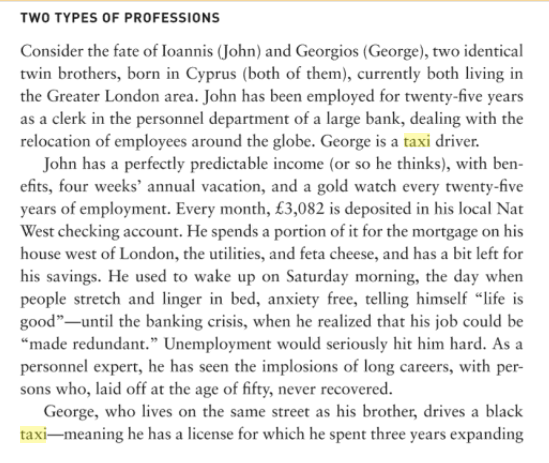
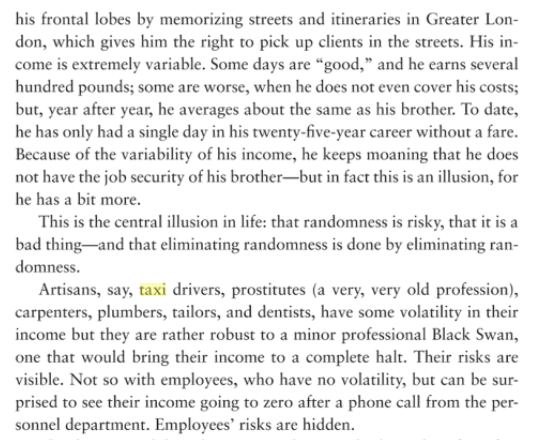
This is something Nassim Taleb writes about in Antifragile as he describes brothers, one of whom drives a cab (the entrepreneur) and the other who works in a bank (the jobber, pun intentional). Taleb writes about these two types of professions:

screen-shot-2016-10-25-at-7-17-58-pm

Screen Shot 2016-10-25 at 7.18.42 PM.png

Kandanchatha appears to support this model. Note that he says “short term security.” The kind of security John has – or soon will have had – at the bank.

Thanks for reading, I’m @mikedariano on Twitter.

The Most Important Thing

This post appeared on Medium. Moving here for linking convenience.

When Ryan Holiday was asked about his favorite gadget he said “physical books, it’s the perfect technology.” He’s right. Where else can you study years of someone’s life for $20 and a few hours of time. Isn’t that amazing?


On example of this is Howard Marks’ book The Most Important Thing. While the title is deceptive — there are multiple important things — it’s full of wisdom.

I enjoyed the book, it’s one of the better per page books that I read this year. After reading it I boiled down the many lessons ever further, like good maple syrup. The big ideas are:

  1. Outsized returns are not easy
  2. Cyclical vs linear
  3. Margin for error is important
  4. Live to fight another day

1/ Outsized returns are not easy

Marks begins his book by explaining that the goal for an investor returns beyond the market average. Marks, along with other wise investors like Warren Buffett, suggest that people who don’t want to put in the time, effort, and risk to earn greater than the market return will be happy in index funds. In his commentary in The Intelligent Investor, Jason Zweig writes that investors could be much happier if they got comfortable saying “I don’t know and I don’t care.” While outsized returns sound great, they require a lot of work.

It takes a lot of effort to beat the market. You could have a hobby instead.

If you want to earn beyond the market return then you have to think beyond the market. Marks calls this second level thinking. This is not easy, it’s “deep, complex, and convoluted,” and “there’s no easy answer.”

Take any stock du jour. Microsoft in the 1990’s, Google in the 2000’s, or Facebook in the 2010’s. Each was only a good investments for a sliver of time. Their value was largest when their popularity smallest.  If you hear about something at a cocktail party, suggests Marks, know it’s too late.

Second level thinking isn’t all you need. That’s one of many obstacles.

Another is moral hazard. “The risk-is-gone myth,” writes Marks, “is one of the most dangerous sources of risk.” It’s the thinking that because the Titanic had innovative bulkheads it was unsinkable. It’s thinking you have things Foolproof.

Another obstacle to outsized returns is that it’s hard to be different. To summarize Marks in one sentence, you have to be different and you have to be right, but difference is uncomfortable. When Katherine Graham took over the Washington Post she was the only women in an industry dominated by men. Not only that, but she took a different strategy. Her decisions led to many successes, but they weren’t easy to make.

A final challenge for the investor is that it takes regular work, everyday, to show up, roll up your sleeves, and do the work. Consistency of work trumps intensity six days a week and twice on Sundays. Angela Duckworth wrote “Greatness is many, many individual feats and each of them is doable.”

If it were easy everyone would be doing it. (This was a dorm room poster I had in college).

2/ Cycles

Thinking in cycles rather than lines has been a major shift for me. At the same time I read The Most Important Thing, I watched this video from Simon Wardley:

Before I thought only in lines, now I think in cycles and maps. Marks writes, “it’s essential to recognize the conditions of the marketplace.” Survival schools teach a similar concept, warning people not to “bend the map,” to see things as you wish not as they are.

Even though Marks came up through the Booth School of Business in Chicago, he doesn’t believe entirely in the Efficient Market Hypothesis. “I do not believe the consensus view is necessarily correct.” (Ditto for fellow Alum Richard Thaler)

Instead, Marks sees the market like a cycle/pendulum, “At the extremes, which are created by ‘most people’ believe, most people are wrong.”

Adoption of this model isn’t the only thing. You must have the right model and know where you are in it.  “Being too far ahead of your time is indistinguishable from being wrong,” writes Marks. That means at certain points you need to, as Barry Ritholtz says, “don’t just do something, sit there.” Marks writes, “Sometimes we maximize our contributions by being discerning and relatively inactive.”

Warren Buffett says to be greedy when others are fearful and fearful when others are greedy. Bill Belichick rolls out different formations in the second half, so teams can’t adjust at halftime. There are optimum times to act and other times to wait. Bill Simmons recalled this exchange in his 2010 trade value column.

Before we hit the last two groups of players, I have a quick All-Star Weekend story for you …

So it’s 2:45 in the morning on Friday night. All the Dallas bars and parties have either closed down or stopped letting people in. I’m standing on Main Street with a bunch of people, including Worldwide Wes, the renowned NBA power broker who’s really a cross between Confucius, a benevolent uncle and The Wolf in “Pulp Fiction” to assorted NBA superstars and up-and-coming stars. Known as “Uncle Wes” to the players, he carries more weight within the league than basically anybody. Because he keeps such a low profile, I could never figure out why. Which is why I went out of my way to spend some time with him on Friday night.

Back to Main Street: We’re standing with a young player who wants the night to keep going. The young player pushes to find another bar even though the odds are against it. Uncle Wes makes a face. He’s squashing this right now.

“Nothing good can happen at this point,” Wes explains simply. “You can’t chase the night. When the night is over, the night is over. That’s just the way it is. You just gotta wake up tomorrow and hope for a better day.”

Uncle Wes had spoken. I am not exaggerating by saying it’s a strangely profound moment. Within 15 seconds, our group splinters in three directions to look for cabs. I find one with my friend Connor. We climb in. We look at each other.

You can’t chase the night.

Marks writes that before they do anything, “We’d better have a good idea where we are.” Before action requires location. John Boyd’s OODA loops emphasize this; observe, orient, decide, act (rinse, repeat, and rock).

Know where you are on the line, map, or cycle, and only then act. 

3/ Margin for error

Because it’s hard to do well (#1) and accurate cycle timing is difficult  (#2), Marks builds in a cushion for mistakes. Margin of error equals value minus price.

Margin for error = Value -price

Marks writes that value, “is the indispensable starting point.” But price is important too, “There’s no such thing as a good or bad idea regardless of price.”

If there’s enough of a difference — enough margin for error — it’s worth buying. Rarely is this a clear choice. If it’s an obvious investment, say, one you overheard at a cocktail party, then something is off in the value & price calculations.

The Bill Gurley story about missing out on Google because it was too expensive was one of the most shared anecdotes I wrote up. Gurley said his mistake was in not thinking how things could go right and too much about price. If we think about the equation above, Gurley ranked price as too high and value as too low.

I got the impression that venture capitalists need to be optimists when it comes to values. Chris Sacca said much the same thing about passing on AirBnb. He thought about what could wrong not what could go right.

That’s not to say that Sacca, Gurley, and Marks should have similar investments. Marks looks for a hearty margins that is computable with second level thinking. He tries to be a six foot person crossing a five foot river.*

That margin for error is important because no matter how focused the value calculations, reality can diverge from that, and often does. Life is full of possible, yet unrealized outcomes.

Marks joins Nassim Taleb’s choir about possible futures and writes, “risk may have been present even though loss didn’t occur” and “much of risk is subjective, hidden, unquantifiable.”

Each decision we approach is like a tree. We start on the trunk, and move down branches. Each fork in the road our decision is influenced by the Two-Jar model of skill and luck.  “The truth is,” writes Marks, “much of investing is ruled by luck.”

This feels squishy but Marks gives us some guidance for figuring things out.

  1. For things that are too difficult we should adopt Charlie Munger’s mindset and move on.
  2. For things you can know, know them as much as possible.
  3. Don’t suffer attribution substitution and confuse good profits with good process. Some people were ducks on a rising pond or had a tailwind.

So much is hard to figure out, acknowledge your weaknesses and build in redundancies. 

4/ Live to fight another day

“If we avoid the losers the winners will take care of themselves.” — Howard Marks

To win the game you have to stay in the game. Sports provides a nice analogy for this. No matter how well you’re playing at the moment, no matter the competition, or your teammates — if you get a red card you’re done.

In finance this is called permanent loss of capital. In other areas it’s reputation loss. For the riskiest ones it’s your life.

“If this decision is wrong, will it be painful or fatal?” – Matt Barrett, former chairman Bank of Montreal

NFL analyst Michael Lombardi says teams that aren’t complete let opponents hang around too long. They don’t finish them. Lombardi’s former employer, Bill Belichick and the New England Patriots emphasize this. “We talk a lot that before you win you have to learn not to lose,” said assistant coach Matt Patricia.

“The man who wishes to keep at the problem long enough to really learn anything positively must not take dangerous risks. Carelessness and overconfidence are usually more dangerous than deliberately accepted risks.” — Wilbur Wright

Stay in the game, some take a long time to win/enjoy. Live to fight another day. 

Thank you for reading.

*As the comments below note, I didn’t explain fully about the margin for error in the river analogy. Marks writes that outcomes are based on skill and luck. You should try to do anything you can to improve your skill. That includes the acknowledgement that rivers 5 feet deep on average can be much deeper in spots. Thanks Patrick for pointing this out. 10/27/16

Jocko Willink 2

I have so many notes from Willink. It’s probably the total minutes listened winner of my podcast list. His weekly episodes are often two hours long. These notes are from episode #44. All quotes unless otherwise attributed are from Willink. Times in parenthesis are from the YouTube video.

1/ Lifelong learning (3:10) “The thing that’s cool about answering questions from the interwebs is that it does make me think about that specific situation that someone’s in… when I get forced to answer questions, I am learning. Just like when reading a book you’re learning…when you teach a move in jiu jitsu you get better at it.”

Nearly everyone written about here is in a state of growth. Mostly that’s through reading books – which Willink does a lot of too – but any form of learning counts. Let’s look at the ways to continue learning.

  • Read/listen. The easiest to do, but the lightest for results. I read a lot, but not all of it sinks in. In fact, without this blog, most of what I hear would literally be in one ear and, well, not literally but almost, out the other. Everyone here suggests you read more, so read more.
  • Teach/Speak/Write. This is the next level. Answering questions forces Willink to do this. Writing this blog does this. Michael Mauboussin told Shane Parrish that he learns by teaching.
  • Do. When Elizabeth Gilbert thought about MFA programs she thought, why don’t I just go do cool stuff and write about that.

Combine these ideas as a replacement for school and you have what we call the XMBA, but everyone can and should be a lifelong learner.

2/ Zone of Proximal Development (Goldilocks zone). (6:45) “One of the most critical ways to be careful in jiu jitsu is to pick the right training partner because there are some knuckle head training partners in every gym.”

Growth (in skill, knowledge, relationship) happens in the Goldilocks zone, things should be just right. When I was an adjunct professor we called in the Zone of Proximal Development. I did this because I wanted to impress on undergraduates that I was wise. In using big words I proved I was not.

Dan Coyle‘s research suggests a success rate between 50 and 80 percent. Steven Kotler has thoughts on this too.

Goldilocks fits in the little bear’s bed, but only because she too is little. Goldilocks grows and so will our Goldilocks zone. Willink suggests that strong young men can roll with anyone. Forty-three years olds might want to exercise more caution. Black belts on the other hand, are probably the safest group because they understand things the most. They have the skill to slide the challenge to the appropriate level.

3/ Decentralized command requires trust. (24:15) “What you’re really building with decentralized command is trust.” “The best way to build trust is to give trust.”

I’m glad Willink said this, because even though I think I’ve seen decentralized command in places like NASA, with Outsider CEOs, and at Intel with Andy Grove, I still don’t completely get it. When Willink added the part about trust, DC started to make more sense.

Good decentralized command requires the “do your job” ethos of the New England Patriots football team. Josh McDaniel said about his early time with the team:

“It was simple. If I was given something to do, I was expected to do it absolutely perfect, as best as I could, every time I did it. And if I did those things right, I’d get something else to do.”

Sometimes we need to a word (like ‘trust’) that acts as a key. Adam Savage recalled looking for a specific type of bottle and only after he learned that bottles are named by their lips he found it. Willink clarified DC in the same way with the word trust.

Charlie Munger said, “We’ve decentralized power in our operating business to a point just short of total abdication.” Munger and Buffett trust their employees.

Pete Carroll does it in football by asking his players what they need to succeed. He trusts his players.

The University of Utah let people like Ed Catmull run around and do what they were most interested in because they trusted them.

4/ But it’s always been done this way. (28:45) “Sometimes you need to send a little shock value. Hey, new Sheriff in town.”

This part was great. Willink adds:

“Notice the things I just said there were fairly irrelevant (no parking in the back lot). Those are fairly inconsequential things and those are okay. Occasionally you see someone come in and try to execute a fundamental change and you go ‘wait a second, you’ve been here for a day and a half and you want to execute a fundamental change in what we’re doing here, we have a problem with that.’”

Don’t just go in, “show some tactical patience.”

It sounds like Willink wants you to consider Gordian knots and Chesterton fences.

  • Gordian knot, it makes no sense to figure this out. Let’s blow it up and start from scratch.
  • Chesterton fence, there’s probably a reason things are done this way. Let’s figure it out before we act.

Willink’s suggestion is to treat small, “inconsequential things” as Gordian knots. Drastic change is okay. For the larger things, “show some tactical patience.”

One NBA tradition that proved to be a Gordian knot was the pregame shootaround. Popularized in the 1970’s by Bill Sharman as a way to burn off nervous energy it had been an NBA staple. But not for the Spurs.

“We quit doing that two decades ago,” Spurs coach Greg Popovich said, “they are a waste of time.”

The shootaround began because a coach did them and he was successful, but that might not have been part of his success. The New York Times obituary on Sharman, notes that the shootaround popularity grew after his Lakers won the 1972 championship. That team  included Jerry West and Wilt Chamberlain. Maybe they won because of great players, not the shoot around.

A short tangent. Writing and reading these ideas is one thing. Application is another. Astronaut Chris Hadfield gives us a strategy for how to move beyond consumption and into application.

“Over the years, I’ve realized that in any new situation, whether it involves an elevator or a rocket ship, you will almost certainly be viewed in one of three ways. As a minus one: actively harmful, someone who creates problems. Or as a zero: your impact is neutral and doesn’t tip the balance one way or the other. Or you’ll be seen as a plus one: someone who actively adds value. Everyone wants to be a plus one, of course. But proclaiming your plus-oneness at the outset almost guarantees you’ll be perceived as a minus one, regardless of the skills you bring to the table or how you actually perform.

Astronauts are the best of the best. But, when test pilots become astronauts, it’s like a caterpillar becoming a butterfly. Some think they’ve arrived, but they’ve only just begun to fly. Don’t be a know it all, writes Hadfield.

Becoming a plus one takes time. You have to figure out the Gordian knots and Chesterton fences. When Hadfield first went to space he the low man on the totem pole. This was well before his YouTube videos. He wasn’t the mission leader. Instead he decided to be a zero. He would do his job as best as he could and follow whatever orders came down. He was a team player.

5/ Train your weaknesses and race your strengths. (35:30) “Becoming comfortable in the water is very important. Water makes you better. Water makes you a better person.” “Water is a pain in the ass. It stops things from working.” “The reason I said this is a universal question (‘How do I become more comfortable in the water?’) is because it’s the same thing for just about everything else that you’re going to do…Want to get better at pull-ups? Do more pull-ups. Want to get better at public speaking? Get up and do more public speaking.”

Like we saw above, (#2) the Goldilocks zone is great for training. Getting in the water, and doing anything makes things a bit harder. Willink adds that you can push your zone by swimming with clothes, outside, and so on. During training for my triathlon I realized my training mistake. I’d done all my swims in the (near tranquil) YMCA pool. Not only did I never share a lane, I rarely shared the pool. The triathlon water was a bit choppier.

You want to train your weaknesses, do so with help, build redundancy into your life. “Water will kill you so when you swim you gotta have to have a lifeguard,” Willink says. “Don’t train alone and don’t train with someone that’s doing the same thing as you. You can’t endure the same thing together. It’s a real simple rule, it’s one up, one down. If it’s your turn to train, I stay up.”

Redundancy is survival. In other episodes Willink has repeated the military mantra that two is one and one is none. Redundancy can look like many things:

  • It can be people. The lead gambler in the 1919 Chicago Black Sox’s scandal had layers of people between him and the baseball players.
  • It can be space. In Foolproof, Greg Ip writes about the value of space between homes and floodplains, between one airplane and another.
  • It can be money. Know anyone that carries a folded fifty?
  • It can be body parts. Nassim Taleb writes, “Look at the human body. We have two eyes, two lungs, two kidneys, even two brains- and each has more capacity than needed in ordinary circumstances.”

Part of the reason the Titanic sank was a lack of redundancy. It was engineered for any two compartments to flood. The builders thought it might be poked but not sheared. Then there weren’t enough lifeboats, other ships lacked radio men, and so on and so on. People died because of a lack of redundancy.

Willink compares it to an event horizon, “you go over than line and you’re done.” Build redundancy in your life and train your weaknesses to push the event horizon further away.

6/ Finish line fallacy  (51:00). “You can see a lot of times in these 24 hour fitness situations where guys will be lifting weights and then one guy is like ‘hey, he’s kind of lifting a lot’ and then you’ll see someone – all of a sudden – doing that same exercise trying to lift more.” – Echo Charlies

I saw this when I was training for a marathon. I’d get on the treadmill for a two-hour run, see some young kid next to me, and up my speed.  He’d be done after twenty minutes and I was still on it. I never claimed to be smart.

If you end up running someone else’s race, you’ll be committed to their finish line and that may not be where you want to end. Instagram and Gowalla found this out when the “Check-in wars” began. Instagram succeeded and Gowalla failed.

This works at the individual level too. Don’t compare yourself to Jeff Bezos, or Warren Buffett, or anyone. Focus, like Echo Charles says, on your own workout.

7/ Those people. (1:06:15) “It’s important to realize those people (negative people) exist everywhere, and everybody has to deal with them. If you run into one of these people don’t be at all surprised, as if they’re a lone ranger out there being negative.”

We’ll let Marcus Aurelius – who Jocko says will be a subject of the podcast, eventually – comment on this one:

Quotefancy-104734-3840x2160.jpg

8/ Partnerships (1:10:00) “He was one of my favorite guys in the SEAL teams…when one of us started to get a little off the reservation about something…he’d look at me and be like ‘hey Jocko, come back to the light, it’s gonna be okay.” “When I would start to get negative he would pull me back and I did the same thing for him.”

One unexpected understanding from the book and podcast notes here is how often partnerships come up. Working with the right people has a multiplying effect. Bill Belichick has Ernie Adams. Anson Dorrance has Bill Palladino. Michael Ovitz had Ron Meyer.

A peer that pushes back is good red teaming.

9/ Simple but not easy advice. “If you’re too demanding here’s what you do, real simple, get less demanding. ”

A lot of advice is simple but not easy. Want to do something more, then do it. Want to do something less, don’t do it. That’s really all there is to it, but it’s not easy to implement.

One of Willink’s favorite lines is that “discipline equals freedom.” Discipline works well because it make simple advice easier to follow. Be disciplined about working out or reading books. Be disciplined about checking Twitter or watching television. Discipline works because motivation ebbs and flow, opportunities come and go. Discipline stays. Discipline, Willink says, “is the root quality that will improve every aspect of your life.”

Elizabeth Gilbert said that writing books are first about excitement and then about discipline.

My current reminder of this is a Tom Seaver quote.

Thanks for reading, I’m @mikedariano on Twitter.

When I say the triathlon water was choppy what I really mean is that I was totally and completely unprepared for the situation, and consequential butt kicking I endured. Of course, Jocko would probably tell me that this was Good.