Stephen McKeon joined Ted Seides for a podcast about drones, (block)chains, and wine. Most of the second half is about McKeon’s articles about tokens, compliance, and liquidity. We’ll focus on the wider ideas. Ready?
…
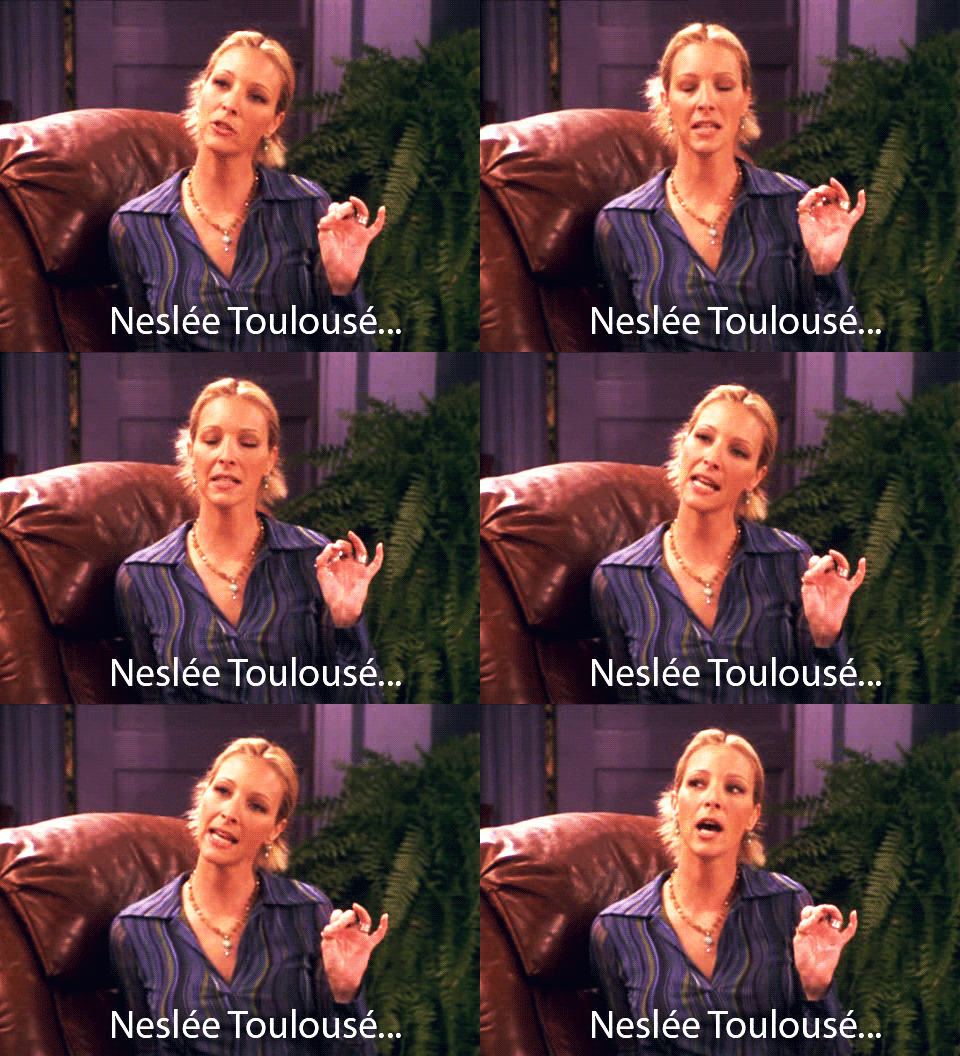
At the peak of the dot-com bubble, spring of 2000, McKeon took a job at a tech startup. “I had nothing to lose. I had no dependents. Making rent was my biggest concern.” This is a great time to act because of the limited stakeholders. Though the startup failed, “It felt educational in some ways.” Like Jenna Fischer, McKeon turned a failed outcome into a helpful experience.
His next job was at a winery in Napa Valley. Shortly after joining, the winery relocated nearer to McKeon and he found himself doing more because he lived closer. McKeon worked his way up to CFO as people more qualified than him steadily exited. He got the job, “largely just because I was there.”
McKeon’s early career is the success equation. He advocates for active serendipity at the end of the podcast and emphasized that yes, luck plays a role in every outcome but there still preparation we can do. Like Annie Duke’s podcast with Seides, this humble point of view is crucial.
Ed Catmull writes that without considering luck, we trick ourselves into believing false causality. “We must acknowledge the random events that went our way, because without acknowledging our good fortune – and not telling ourselves that everything we did was some stroke of genius – leads us to make more realistic assessments and decisions.”
Not wanting to harvest grapes forever, McKeon headed to Purdue for a Ph.D. It was a “non-traditional path (but) I took those experiences from the winery and they served as the basis of most of my early research.” The boots on the ground experience often guides us to better information for decisions.
Andy Grove advocated we feel the breeze of the real world. Jan Chipchase wrote, “The best way to understand how a culture adopts (or doesn’t adopt) an innovation is to go there and see it for yourself.”
After his graduate program, McKeon got a job and met a pair of students who would start a drone company. Like his other startup, McKeon spent this time “being close to emerging technologies.” In addition to drone regulation, McKeon started thinking about blockchains.
As he talked with Ted, the second half revolved around Josh Wolfe’s question and solution; Ask what’s a huge pain in the ass and solve for that. McKeon explained how blockchain might change 24/7 trading, settlement time, fractional ownership and liquidity issues.
In the same way eBay allowed people to sell baseball cards, blockchain may allow people to sell anything or even parts of anything. “Blockchain offers us protocols that are specifically built to move value,” McKeon noted.
But why does it have to be blockchain? The interview is pleasantly devoid of buzzwords and McKeon thinks it’s a Gordian Knot. Microsoft and Google are incentivized to not agree to a common protocol, which is the dirt solutions grow in. It’s why Master of None was ten episodes on Netflix. “There’s no reason for twenty-two episodes of anything,” Aziz Ansari said. New tech lets people start fresh.
There’s still work to be done. “Wallets are still kind of intimidating to people,” McKeon said, but “Coinbase is like logging onto Fidelity.” ‘Design matters’ is an echo we hear from the IDEO team, Rory Sutherland, David Ogilvy and Dan Ariely.
This was an inspiring episode. Whether any of McKeon’s ideas will transpire no one knows but learning the thinking behind them has already been helpful.
Austen Allred joined David Perell to talk about Lambda School. Come to school for free and then pay us back a part of your salary for a set period of time. The repayment dollars and days are limited.
Lambda School is a great idea, a great option, and a great risk. But it doesn’t need to dominate, it just needs to work. Education should be like sports, do what suits you.
On this blog, the Lambda model is like the XMBA (eXperiential Masters in Business), though it applies to much more than business.
Mike Lombardi wrote that he got his Ph.D. in football from professors like Walsh, Parcells, and Belichick. Jerry Seinfeld studied at the school of comedy stores, even writing a forty page paper about his experience. Stewart Butterfield said his XMBA was at Yahoo. There are so many options for learning.
But we don’t usually see them.
Or can’t do them. In the podcast, Perell professes his lack of preparation for anything like this. At nineteen, he says, I was not ready. At nineteen he probably wasn’t even aware.
Ben Thompson’s points out that every strength forms a weakness and every weakness forms a strength. This applies to our point of view too. Apple and Amazon, Thompson writes, are different companies because of their point of view. College is great for one way of learning, terrible for another.
For Elizabeth Willard Thames, a focus on careerism meant ignoring financial independence. Thames’s point of view/ mental model/ approach to living was the rubric model. Check these boxes and collect two-hundred dollars as you pass go and climb the career ladder. She wrote:
“I’d assumed that was all I needed to do in order to ensure lifelong success. The formula for life as I understood it was: you go to college, you get good grades, you graduate, you get a good job and you live happily ever after; right?!”
Elizabeth and her husband, neé boyfriend, had a philosophical awakening and then tactical restructuring. They answered two questions: What do I want out of life? What are frugal analogs that lead there?
Their imagination increased. It took a mental shift. Live like this, not like that. Everyone’s normal is different.
Nick Bilton wrote about Silk Road, “Even though all these people were dealing in illicit activities, they each had a moral sense that their particular outlawed product was more just than another.” Drug dealers rationalized that their fix was safer. Gun sellers rationalized that their weapon was less dangerous. Semi-affluent, semi-intelligent, semi-ambitious young people rationalize that college is the best education.
In the podcast, Perell says, “We have this idea that you go and learn for four years and then you go into the workforce.” And considering a new path is an “abrupt shift” and “difficult”.
Allred said the first question they get at Lambda School is, “will this be on the test?” Students land at Lambda like Mrs. Frugalwoods, with a rubric mentality. It’s this mindset that Seth Godin warned against. When asked what school should teach, Godin said that schools should teach students how to lead and how to solve interesting problems.
This is what entrepreneurs do. Jim DeCicco wondered, can coffee be better? Tariq Farid wondered, can I sell fruit arrangements? Katrina Lake wondered, will someone rent the runway?
Another way to look at this is to think like a world builder. In Ezra Klein’s interview with N.K. Jemisin the duo talk about path dependence, creative choices, and alternative histories.
Marc Cohodes warned, “don’t let school get in the way of your education.” Traditional school is one way to do things. Lambda school is another. Education is like world-building, only instead of a book, it’s a life.
First, we find new paths, then down them, we stride.
…
We can start with this question, What job am I hiring for? Education does a lot of things. Allred said:
“One of the difficult things to define about a university style education is what is it. There’s the social aspect, the networking aspect, the skill training, the signaling (even getting in). We said, ‘We’re going to take the one element that we feel is most important, the skills training.’ If you’re a software engineer you don’t have to have a degree. Nobody cares what your educational background is like if you can write code.”
Allred and Perell don’t address it but here’s a clarifying question; do looks matter? Sweet selfies and sharp suits mean that signaling is important.
Campaigning Congressmen and Instagram Influencers need to look good on camera. Vanessa Selbst wears jeans at Bridgewater (and has a Yale law degree) but I’d wager her office conversations matter more than her professional presentation.
From suits and selfies, we proceed down the spectrum to professors, comedians, coders, plumbers, and robots. Sometimes signaling through diplomas or souls is important.
It’s as Harvard (🚨signaling 🚨) professor Clayton Christesen wrote, and said, “Jobs arise in our lives. When we realized that we have a job to do we have to go out and find something to get the job done. Understanding the job is what we need to understand, not the customer.”
…
Coders, plumbers, and robots all have jobs where verdicts trump transcripts.
When signaling matters less there’s our always adapting XMBA curriculum. A new addition is to think about it not as education, but as an adventure.
Story, Robert McKee writes, “is a metaphor for life.” Joseph Campbell’s hero’s journey.
Campbell’s book or Netflix interviews are worth watching. And calling the XMBA a quest matters. The IDEO brothers wrote, “Language is the crystallization of thought. But the words we choose do more than just reflect our thought patterns—they shape them. What we say—and how we say it—can deeply affect a company’s culture.”
The hero’s journey is part of our DNA like two eyes or hairlines. And if we’re going to make a quest we may as well equip ourselves well. Allred said he spends a lot of time thinking about this:
“How can I eliminate all the other distractions for people? The first way is making tuition free upfront…how can we take all the distractions away to help someone get from point A to point B? Because we know you can, but lives are complicated and messy.”
Think of friction like a dial. Turn it up for things we want to avoid, turn it down for things we want to do.
Annie Duke prescribes Odyssian precommitment. Ted Sarandos said, “What it takes to get you out of your house if you’re on episode four of Stranger Things is pretty high.” Sam Hinkie said about communicating with one coach, “We’d feed him the information in a way that he liked and could consume.” That meant tactile, not digital. Evenings, not mornings. Big font, not small.
The hero’s journey is our own adventure and unlike YouTube summaries or Campbell’s book, it won’t be linear. It won’t be short either. This said Allred, is one challenge of one form of education:
“You have to have a long-term view for that (training or apprenticeship) to really make sense. If you have to hit your quarterly numbers you’re not building out an apprenticeship.”
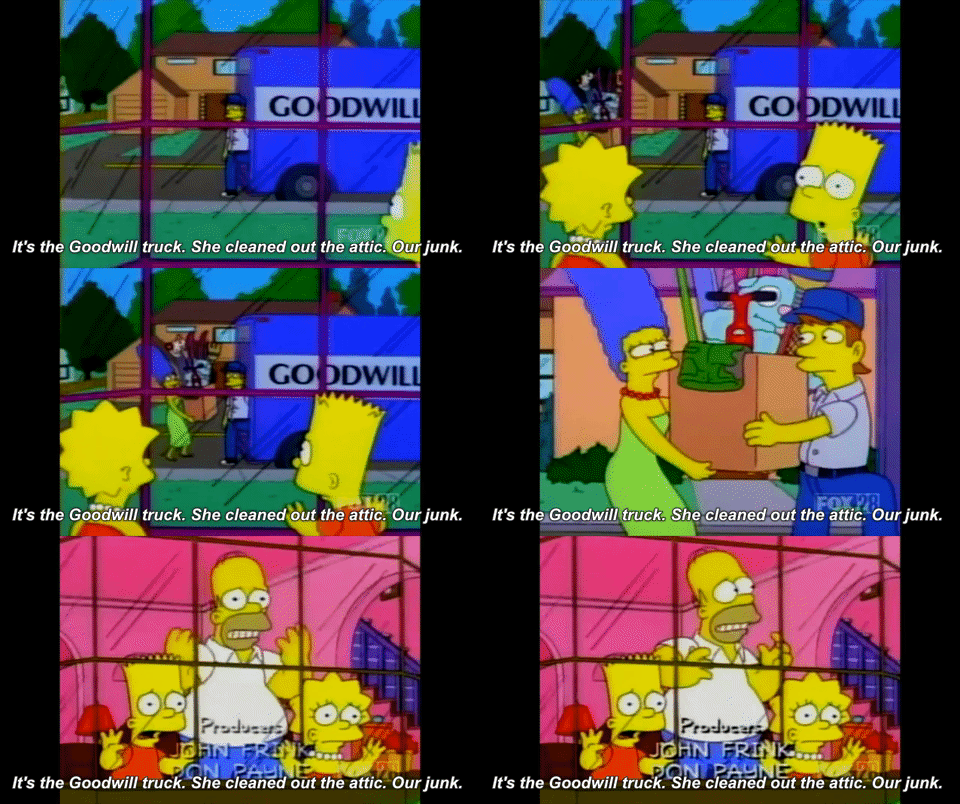
The hero’s journey will lead us to places we aren’t ready. That’s good. Mike Reiss was the showrunner for the third season of the Simpsons and wrote he was trained in none of the jobs he had to do. John Elkann was invited to the Fiat board at twenty-one. Jerry Kaplan started a startup without ever having “managed squat.” In the early days of Amazon they “made it up as they went along.”
Sometimes we’ll get lucky, but we only notice that in hindsight. Jenna Fischer‘s first job out of college was as a secretary. That training, helped her get a roll (many years later) as another secretary, this time in The Office.
…
If you want a bit more, check out Cal Newport. As always, thanks for reading.
We’ve written about Mike Lombardi three times. First in 2015, about his podcast with Shane Parrish. Again in 2017, summarizing some ideas from the GM Street podcast. Lastly, when he sat on an MIT Sloan Panel that implored NFL coaches to PLEASE STOP PUNTING. Today we’ll highlight his book, Gridiron Genius.
This book inundates the individual reader with immediately implementable ideas. It will mostly interest sports fans, but anyone who reads it can get one good idea that makes the time and financial investment worth it. My big takeaway was this, good leaders create lush cultures that encourage hard work, debate, and active curiosity.
If you don’t want to read the book, listen to Lombardi’s podcast. He’s good on the mic and the slow drip of lessons through an NFL season is like a semester at school.
…
Lombardi’s had the good fortune to work with three NFL legends; Al Davis, Bill Belichick, and Bill Walsh. These three men “contributed to my Ph.D. in advanced football. It’s a degree that was 35 years in the making”.
Belichick is the most successful coach Lombardi worked with and there are many stories about how he leads by example. Belichick is not only the last to leave, sometimes he doesn’t, spending the night in his office. Belichick is driven by a lust to look good.
Ha! He doesn’t care about looking good, he cares about winning. Lombardi wrote, “He (Belichick) is not worried about where an idea comes from; he cares only about whether it makes the team better.”
When Marc Andreessen was asked about arguing with Ben Horowitz, he said much the same thing. Andreessen wants to be right at the group, not the individual level.
For both the Patriots and a16z, this culture starts at the top. “In New England, Robert Kraft approved of, even demanded, a culture change and gave Belichick nearly total control of football operations to achieve it. In Cleveland, Modell was both a meddler and a steadfast proponent of the status quo.”
Lombardi and Belichick’s former colleague, Nick Saban, had the Cleveland, not New England NFL experience. “Saban knew the potential of the former Charger (Drew Brees), but he was not allowed to sign Brees and his surgically reconstructed throwing shoulder…Saban met with internal resistance as he tried to embed his own culture. There was zero buy-in to the new system, with players and executives alike balking at what they perceived to be a radical transformation.”
Culture is a multiplication coeffecient. Good cultures are greater than one, bad cultures are less. Bill Simmons said this about the NBA:
Mike adds that “I never had to hold back,” when he debated Belichick. This is the culture Ben Sasse tries to create. A debate then unity. Independence then unification.
But healthy yet helpful debate it isn’t easy to habituate. Dan Egan pointed out that good arguments are hard. Charlan Nemeth said that the devil’s advocate is empty calories.
Maybe good arguments come from places where leaders promote growth? Lombardi wrote about Bill Walsh, “He was naturally curious, always searching for ways to fix his team or just better accomplish the simplest tasks, and he demanded the same thing of his staff.” Maybe good debates grow in the right conditions. Just like players.
“I couldn’t help but wonder (in 2002 when Rich Gannon, after a decade of mediocrity was the MVP) just how many potentially great quarterbacks have wasted away in the wrong system.”
“What Walsh knew better than anyone in the game was that the key to success in the passing era of the NFL was to marry the right quarterback to the right scheme.”
In his book about the Patriots, Michael Holley quoted a scout who said that the coaches weren’t admonished if a highly graded player didn’t pan out on another team. The thought was, with the Patriots that player may have made it.
Coca-Cola is the story of the right company, at the right time, in the right place. The right (left?) situation is also the story of Alice Waters, who went from slacker to protester when she transferred from UC Santa Barbara to UC Berkeley. Ben Horowitz knows conditions matter and suggests how to talk to a prophet of rage.
These discussions about conditions and culture aim to avoid what Annie Duke coined ‘resulting’. Duke wrote, “Learning from your outcomes is a really poor strategy. It’s great if you’re playing chess; but it’s terrible if you’re playing poker, it’s terrible if you’re investing, it’s terrible if you’re driving.”
Lombardi wrote, “Their moods (Belichick and Saban) are never a reflection of the score – it’s about the execution.” Michael Mauboussin told Ten Seides, good decisions “boil down to probabilities and outcomes and trying to be on the right side of expected values.” It’s, as Phillip Tetlock suggested, being okay with the wrong side of maybe.
Belichick sounds like a great boss, “You will constantly hear Belichick proclaim to his staff and players, ‘I screwed that up,’ or ‘That’s on me.’” — for a certain type of person. Reflecting on their time in the 1990’s, in Cleveland, Lombardi wrote about working for Belichick, “It was just another reminder of what a professional, well-run workplace Belichick had created in Cleveland and just how rare that kind of an atmosphere is in the NFL.”
Later in the book, he writes about Tom Brady, “It’s no exaggeration to say that Brady’s body truly is his temple. In the old days, players treated their bodies more like carnival tents.”
What we see in the 288 pages that cover Lombardi’s 35-year Ph.D. program is the professionalization of football. Players can only get so big or so fast. Coaches can only stay so late. But culture, a good culture is limitless.
Today’s audio post is about two questions. What kind of a life do you want to live, and what can you change to live like that?
Our story is from the Frugalwoods who achieved financial independence and retired early to rural Vermont – but they are just characters in a universal story.
It’s about how to live.
We live this way and not that way because of our point of view. Stand over here and see one solution, stand over there and see another. Politics is an easy but vapid example. Instead, listen to the podcast and chew on these:
“At some point, we lose the ability to have clarity about what we know.” – Charlan Nemeth
“The most important thing Alan taught me was that it wasn’t about me – it was about the client.” Roz Hewsenian
At Harvard, Teddy Roosevelt wrote that he was, “comfortable, not rich.” In his final two years, he spent $2400 on clothes and club dues. A family of four could live on that much for six years.
Lastly, our point of view can be literal. “I’m 5’2” and there’s a whole world of apparel that’s not relevant to me.” Katrina Lake.
Jim DeCicco of KITU super coffee joined Aaron Watson in New York City to talk about building a coffee brand.
First, a sidetrack.
Why is coffee more fragmented than soda? Why is sugar-water different than coffee-water? Coca-Cola is a huge brand while Starbucks is smaller. Maybe Coca-Cola is the anomaly? My guess is that Coca-Cola’s ‘growing season’ was akin to Google or Apple’s. A Coke and an iPhone are sister products, separated by 100 years. They are products of their time.
Onto the notes.
…
From appearing on Shark Tank to podcasting with Aaron Watson, Jim DeCicco has worked hard to create a successful coffee brand. While there are plenty of startup missteps, DeCicco and his brothers have done at least a few things well.
The very first thing is to make something people want. At the Going Deep Summit, Aaron Watson like the Mocha flavor of coffee. Others do too. But product doesn’t need to be perfect, only good enough.
In Cass Sunstein’s book, The World According to Star Wars he writes about the Music Lab experiments. When different groups of people were randomly sorted and asked to rank the same songs they came up with different rankings. And it wasn’t based on what was ‘best’. If a song is good enough its final ranking depended on the social cues.
As Ryan Holiday put it, great marketing can’t save a bad book. J.K. Rowling/ Robert Galbraith is one example.
DeCicco and his brothers made something – originally in a dorm room – that was good enough. Now they’re marketing it. The next question is; will people buy it?
“Before we had a business plan and a logo and a marketing strategy and all those things, we said, let’s sell this and see if people want to buy it.”
With great luck and good fortune, a founder will get it right the first time. For everyone else, they need to press the flesh.
“For the first six months, we would make our own product, make the deliveries, pour out samples. Once we had traction we were eventually able to get into a co-packer.”
DeCicco added, “I’ll be pouring samples till the day that I die.” That’s a great business strategy. Ron Shaich started out much like the DeCicco brothers. He started with a generic cookie recipe, so generic it was on the chip bag. It may have been French.
As Schaich passed out samples on the sidewalk he solicited feedback. Cookies led to croissants, croissants led to slicing, slicing led to the aha moment. We should sell sandwiches. And with much hard work Panera was born.
This approach is the same one that IDEO uses, only they have a much more modern-SF-design vibe. From west to east, if you don’t talk to your customers your business won’t survive.
Some of the situations and suggestions will seem simple. Too much, too little, etc. Some things are more complicated. Successful entrepreneurs don’t have the answer but they believe they can find them. The answer may be in the next internet search or cold email.
“Jordan reached out to Seth Goldman (of Honest Tea) who said, ‘Guys this is awesome, read my book (Mission in a Bottle) and if you have questions let me know.’ It was there we were first introduced to the idea of co-packers.”
Breadcrumbs are in every Google search. That’s what Trish and James Higgins did. “We just went on to Google and we were like ‘How do I buy a small business?'”
With a search, the DeCicco brothers have also found the VC model. “It’s a weird business model. We’re building our dreams with other people’s money. We’re growing super fast. We’re not at a point where we can sacrifice growth for profitability, which is why we need to raise capital.”
VC money is a tradeoff. It’s (hopefully) a smaller piece of a bigger pie. But as we talked about with Stakeholders, if you pocket VC money, you don the VC model. That means growth. If you aren’t willing to grow – or pivot to grow like Stewart Butterfield – don’t take the money.
Ben Thompson spoke with Shane Parrish on The Knowledge Project podcast. Their conversation covered Ben’s start, tech today, and one of my favorite topics – strengths as weaknesses and weaknesses as strengths.
This is not our first post with Thompson’s takes. In Exponent 108 we looked at technology and jobs, inverting problems and questions, and winners and whiners.
Onto Thompson’s podcast with Parrish.
1/ See it to believe it. “For me, the most obvious outcome was I would go work in academia. That was something that was visible to me and accessible, but even then, my world was very small.”
Thompson had a stable youth. But he never thought of moving to Taiwan (where he lives now) or applying to Ivy League schools. Thompson’s curiosity combined with a good education was enough of a glimpse to see what exists beyond the horizon. And sometimes a glimpse is all you need.
Lee Child was fired from television at the worst time, late in his career. The network said he was too expensive. He didn’t know what to do next. His wife joked that he could be a supermarket ‘reacher’, helping old ladies and small children get things from the top shelves. Luckily for us, that’s not what he did. Child become a writer because he saw it could be done.
“(John MacDonald) made me think it was possible. I could see how it could be done. I love to see how things work on a granular level.”
There’s a difference, said Paul Rudd, about recognizing something in the abstract and as possible:
2/ POVs “I think to the extent my viewpoint is unique, the starting point is different. I start from business models.”
New views show new news.
Thompson likes basketball so much he has a Twitter handle just for ‘no tech’, @notechben. In the same way that Thompson is insightful because his new point-of-view, one of the NBA’s most outlandish basketball players succeeded because of his literal point of view.
This player was so good, he often played against kids who were bigger and stronger. So our future NBA star played guard. In a book about his career the author wrote, “…and this was crucial to the breadth, depth and originality of his eventual style; he became the quick little man who brought the ball up.”
This experience was formative because, “Most big men in basketball have always been big, which means they have always played as big men and seen the court as big men.” They developed one point of view. But our player, “by contrast, developed a guard’s view of the entire court, and he could, as few centers could, see an entire series of moves even before they developed.” Our player? Bill Walton. Our author? David Halberstam.
These advantageous POVs are disadvantages too. Strengths have a weakness and weaknesses have a strength. Thompson, for example, reflected that he’s not so good with the granular.
“I’m a strong believer that anyone, their strengths are their weaknesses and one is the same. If you’re super strong, one day you’re inevitably going to be weak in a corresponding area. I think my talent, such that it is, is this ability to view things systematically and to see very clearly and quickly how a business model flows through to product decisions.”
Andy Rachleff agrees, “One’s greatest strength is always one’s greatest weakness.” Bill James (of Baseball Abstract) too, “Every form of strength covers one weakness and creates another, and therefore every form of strength is also a form of weakness and every weakness a strength.” Jocko Willink advances flanking exercises, which exist as a weakness because of a strong front.
Here’s Thompson on Microsoft:
“They didn’t miss it (the smartphone). They just were fundamentally unequipped to compete in it, and that’s what happens. That’s how disruption happens, and the stories of companies moving seamlessly from one paradigm to another are basically nonexistent because all the things that make you strong and competitive in one paradigm make you fundamentally ill-equipped to be in the next one.”
3/ Where to work from? “…on a day-to-day basis to not be in San Francisco, to not be immersed in tech in an environmental basis, but to be living abroad, living in a different country, talking to people who mostly aren’t really interested, or don’t really care, that much I think is tremendous.”
Yes, there are downsides, Thompson said, but, “being on the outside looking in brings, I think, a lot of clarity and skepticism, probably more than anything.” This is another strength as weakness and weakness as strength.
Ken Burns said that he loves living, as Thompson does, away from it all. ” I live in a tiny village in New Hampshire, which permits us to do the deep dives, to do the necessary research and keep the sanity in the course of a 10-plus-year project.” Michael Mauboussin guessed that a smidgen of Warren Buffett’s success is due to being away from New York City. William Thorndike guessed this too, “This distance helped insulate them from the din of Wall Street’s conventional wisdom.”
Josh Koppelman said, “There’s a real benefit to not being in the valley echo chamber….to see how the rest of the world views technology is really compelling.”
Other times you gotta be where the action is. Jenna Fischer‘s advice is to get to NYC, Chicago, or LA if you want to be an actor. There are some things you have to do in person. There are some things you only discover in person. Poor Economics is a book about discovery. Esther Duflo wrote, “References to a certain old-fashioned sociological determinism, whether based on caste, class, or ethnicity are rife in conversations involving the poor.” She’s advocating for factfullness. It’s finding, what Jan Chipchase wrote, is Hidden in Plain Sight: “Every new technology put out on the market is introduced with assertions and assumptions about how it will be used, but it’s only through actual experience that “use” is defined.”
Thompson covers technology strategy. He’s not in Tawain to avoid San Francisco’s fog, he’s in Tawain to avoid San Francisco’s hot air.
4/ Rapid fire. A few more ideas and links.
Malcolm Gladwell’s Ketchup Conundrum. Thompson said, “Well, I think you just said it. I think the internet has a barbell effect where there are returns to the biggest and returns to the smallest, and if you’re stuck in the middle, it’s just a very dangerous place to be.” Heinz, he said, should listen to Warren Buffett and dominate the B2B areas. The barbell is a helpful mental model; whether it’s reading habits like Marc Andreessen or investing angles like Roz Hewsenian.
No one will dominate Google. But the next Google, “will come from someone being in a garage who latches onto the next paradigm shift that makes it impossible for the powers that be to compete.” It’s about being different and being right.
Why does Stratechery’s subscriptions work the way they do? “I wanted the feeling of paying to be a positive feeling, where you’re going, ‘This is such great stuff. I want more. Can I pay to get more?'” Our Rory Week was all about feelings mattering too.
What about writer’s block? “Well, I think the most common misconception people have about what I do, especially given the amount of things I write about, is it’s not like every day you’re starting from nothing and scratching together an opinion on stuff that goes on.” Robert McKee suggested a trip to the library to cure writer’s gap. Anne Lamont would agree, “The word block suggests that you are constipated or stuck, when the truth is that you’re empty.”
Roz Hewsenian joined Ted Seides for a summary of her career – and summary of many of the themes we write about here. If decision hygiene were a thing, Hewsenian would be like Steph Curry. And like Curry, Hewsenian had to put in a lot of work to get there.
…
“If you know you’re going to try to convince somebody who has a different point of view of a point you want to make, you’ve got to start out with, what is this person’s point of view, why do they believe what they believe, what are their priors and bona fides. You gotta start there.”
Normally we see empathy touted by marketers like David Ogilvy or designers at IDEO but it’s part of any sale.
In her ILTB podcast, Bethany McLean explains how she brings empathy to her interviews. You have to “turn over every stone” and “even if you see that they’re skewed in their point of view, ask, why is it skewed?”
…
“I went into the MBA with the idea that I would continue my ‘helping orientation’ and I would go into human resources. That’s what I thought until I walked into my first finance class.”
Sometimes it’s only exposure that brings awareness. This is what’s possible. Those kinds of multidisciplinary experiences lead to new paths, at the end of which, are new solutions.
Lee Child seeded the Jack Reacher series with four pounds (£) of writing supplies and one idea. Child said, “He (John D. MacDonald) made me think it was possible. I could see how it could be done.”
…
An early boss at Kraft taught Roz a lesson that’s lasted her entire career.
“The first thing he taught me about management is that when I did something wrong, the first question he asked me was, ‘What didn’t I do for you to be ready?’”
She learned about extreme ownership. Besides EO, Jocko Willink also advocates for a decentralized command. Hewsenian said, “I allow the staff to follow their natural curiosity.”
How so? At a Monday meeting, she said they were going to focus on China. “I never said to them, ‘long-only hedge funds,’ instead I said, ‘think about this.’ I allowed them to go out and find the best managers they could.”
Mike Reiss was an early Simpsons writer and showrunner. Reflecting back on the series’s success he wrote, “The true secret to The Simpsons’ success is the valuable input of network executives. We don’t have any.”
…
Roz moved from Kraft to Pepsi to Dimensional Funds. There she focused more on investments and emphasized optionality.
“I never adopted this all or nothing attitude. Life isn’t that black or white or cut or dried. If you keep your eye on the bigger picture, you can figure out how to get there with virtually any investment.”
Hewsenian had options because she had career capital. Judd Apatow said you’ll write something for anyone who writes you a check. Michael Caine agrees, telling actors to first choose the roles that fulfill your dreams, if those aren’t available, take the ones that fill your belly. When asked about Jaws 4, Caine says he never saw the movie but saw a lot of the house he bought with its check.
Hewsenian’s elastic optionality comes from decades of hard work.
…
Besides a culture that values options, runs decentralized (to a point, always to a point), and insists on extreme ownership, Hewsenian also argues well. “We staff every manager who’s undergoing a deep dive for due diligence with a sponsor, a skeptic, and a director.”
Ben Horowitz suggested some tension, “…but not so much tension that you hate each other.” Horowitz’s sparring partner, Marc Andreessen said, “The way I think about is this; it’s more important to have a successful partnership than being right on any particular issue.”
…
An early lesson for Hewsenian was to never say ‘No’ to a client. “You figure out how to give them some of what they want so that you show them you heard them, which is ninety-percent what the issue is.”
Charlan Nemeth’s conversation with Russ Roberts has, like a sledgehammer, both broken and reinforced an idea we cling to and trust; good arguments.
Andy Grove wrote, “we developed a style of ferociously arguing with one another while remaining friends (we call this “constructive confrontation”).”
Michael Holley wrote about Bill Belichick, “You actually got credit when you logically disagreed with him.”
Chris Cole said that he asks his staff why he’s wrong, “This is an existential question if you’re a long volatility manager.”
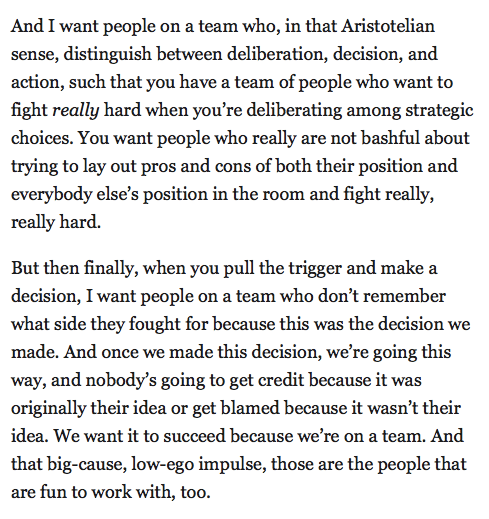
Good arguments are fair fights. They are verbal fisticuffs and mental wrestling matches but with good sportsmanship. Ben Sasse told Tyler Cowen:
…
In her podcast with Roberts, Nemeth notes we’ve got some of this stuff wrong. For starters, disagreements in groups is good but difficult. The power of the majority and going along to get along is “Probably the most powerful phenomenon in social psychology.”
What it comes down to, Nemeth explains, is the assumption that truth lies in numbers. Sometimes it is, and sometimes it ain’t. Crowds are wise when judgments are independent and participants are knowledgeable. Anyone can guess an Ox’s weight:
“Majorities can be correct but aren’t necessarily correct,” Nemeth says, “The real concern is that when they’re wrong we still follow them.”
That’s the basis for good arguments. However, good isn’t easy.
Culture is like a greenhouse. In some places, some things, like dissent, thrive. One Patriot’s scout said that if he graded a player highly, but that player failed on another team, Belichick and (former GM) Scott Pioli wouldn’t hold it against him. Maybe he would have succeeded with the Patriots. Belichick and Pioli avoided Annie Duke‘s resulting trap.
Many cultures have anti-disruption norms. In college, I learned to pause in the middle of class – and not the end – to ask students if they had any questions. At the end of class, they hoped to escape early. Good culture is created from the top down, even if you’re just an adjunct instructor. Brent Beshore said good bosses shoulder the shit umbrella.
Nemeth notes that it is perfectly rational to not speak up, especially if you have less experience. Roberts said, “I think the lesson here for managers, families, and friends is to react graciously to negative comments or constructive criticism.”
An early mentor to Jim Chanos was Bob Holmes. Chanos had shorted a stock that doubled, “The New York partner was screaming for my head on a plate. I was all of twenty-five years old. But he stood behind me. He’d seen the work. He’d seen the documents. He’d said, ‘Kid, you’re right.'”
“There are costs to being a contrarian,” Nemeth said. She sometimes plants a confederate in her classroom. That person will take the other side of the issue. Once they do, “Everything zeroes in on them.” Once perfectly behaved college students will, “at first by innuendo and then more directly, suggest that the person is either stupid or immoral.”
When people repeatedly challenge us we get irritated. Nemeth uses 12 Angry Men in her classes.
In the podcast, Nemeth warns against superficial solutions. Having a red team or devil’s advocate is often just a name for a role. Bob Seawright agrees that a skepticism is “not the same thing as real disagreement.”
It’s better than nothing, but barely. “It’s an intellectual game…They’ve been teaching this (devil’s advocate) in business school and I never believed it.”
So what works?
“To have an impact as a dissenter you have to be consistent over time. It isn’t a one-shot thing.”
The incentives are complicated too. “You can stand up and take the risk but you won’t benefit from it in the sense that people will think better of you.” Again, culture matters. Movies, like in 12 Angry Men, can suggest situations. Nemeth said, “That’s a dramatic vehicle but it parallels many studies.”
Two people that seem to have figured things out are Josh Wolfe and Marc Andreessen.
Wolfe said that in each fund, each person gets one wild hair investment. If someone pounds the table when no one else does, that’s good. Nemeth said that good dissent “has to do with authenticity and conviction.”
Andreessen said that he values being right as a group more than being right as an individual. His haggling with Horowitz is, as Nemeth said, built on an attitude of respect. “If you’re rude it’s much easier to dismiss you because it’s much easier to attribute it to your personality and ignore the position in which you have conviction. You can show conviction without yelling.”
…
Having the experience, culture, and teams like Wolfe and Andreessen take time and feedback. Here are three things to be more like those two.
1/ Change our point-of-view. “At some point, we lose the ability to have clarity about what we know.”
Whether it’s Munger’s quote about learning (or unlearning) or Has Rosling‘s attitude of factfullness, the world changes and so should we.
Or, the world is different than we saw it. “My final two years in the Marines flew by and were largely uneventful,” wrote J.D. Vance, “though two incidents stand out, each of which speaks to the way the Marine Corps changed my perspective.” Everyone lives in a bubble, the question is, how distorted is your view?
2/ Rebrand Dissent.
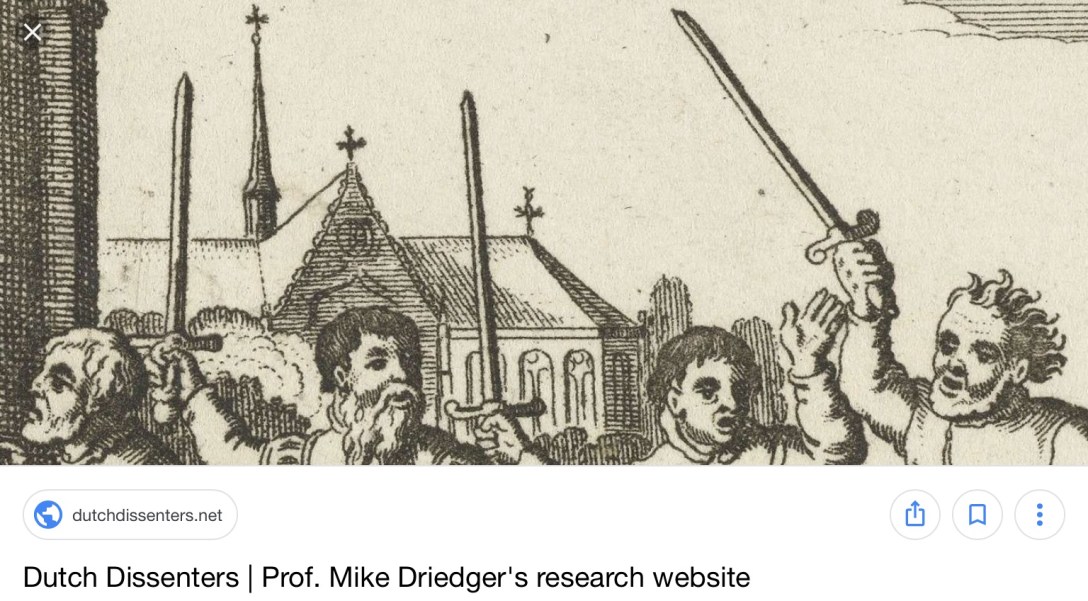
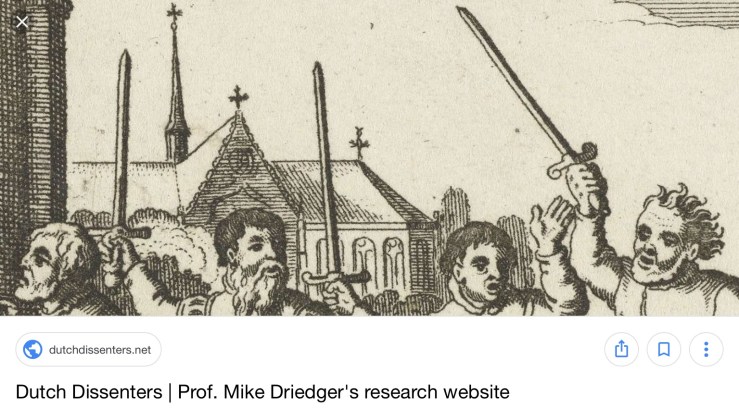
This is from a google search for “dissenters.” Words conjure images, Nemeth said, and with this kind of marketing, no one is buying.
Scott Adams wrote, “One of the easiest forms of persuasion involves associating one image or idea with another in a way that makes some of the goodness (or badness) of one rub off on the other.”
Dissent needs a rebranding.
3/ Ask, Are you sure? Roberts said, “With those three words; ‘Are you sure?’ It’s remarkable how fast people climb down from their overconfidence.”
Nemeth likes this idea, “Opening the lid just a little bit does make a difference…It’s not being disrespectful but it’s being clear.” Much like Five Whys, a few more questions can lead to better answers.
…
Good dissent and debate and discussion are worth working toward. Lite dissent is like cooking a grilled cheese sandwich. Sure, there are ingredients, heat, and a procedure, but it’s not really cooking.
Derek Thompson spoke (March 2017) with Barry Ritholtz about a stew of ideas from his book Hit Makers. I enjoyed the book and it will make further appearances here, but we’ll just focus on Thompson’s talk with Ritholtz.
Barry quotes the book, “Content may be king but distribution is the kingdom,” and asks Thompson to explain.
Content is king is, “so obviously not true. Some of the biggest hits in music and movie history depended overwhelmingly on distribution mechanisms to get out to the public.”
In the book, he cites the greatest show of all-time and brings up their run-up bump up.
We get dated graphics and a timeless lesson. It is both the sizzle and the steak that matter. For better and worse.
Jonah Goldberg lamented to Russ Roberts, “Part of the problem is the corruption of mass media where these politicians know they can keep their jobs with a good media campaign rather than writing legislation.”
Legislators do a better job selling us about their job than legislating for new jobs. This is part of all jobs, only the degree changes. Lee Child said that after a new Jack Reacher book comes out he’ll have dozens of fans come up to him and say I’m your biggest fan, when is the next book out? To which Child responds, Last week. “Eighty percent of marketing,” he told Andy Martin, “is just reminding people that the book is out.”
Josh Wolfe emphasized that selling and building are crucial elements for entrepreneurs. Bethany McLean noted, “This idea of storytelling in business is amazing because of the power that you can create something from nothing with a great story.”
In 2018 it’s the story of Elon Musk. How much of Tesla is sizzle? How much is steak? Jim Chanos isn’t biting:
“I think the Tesla stock might not be worth anything. To us, it is one of the bellwethers of this market. It is a hopes and dreams stock. Investors have pinned their hopes and dreams on this stock and on this CEO, who has done a very good job promoting that vision. The problem is that it is an automobile company.”
In his book, Thompson used novel stories and new studies. There were few socio-anthro-psycho-logical retreads on the tires that move his book.
In one study, Stanford professors looked at Reddit successes. They found images which were shared about seven times each, but who only ‘took off’ once or twice. What happened if you kept the pictures the same but changed the title?
Their finding is one of Thompson’s key points. Things need to be different but not too different. Or, things need to be the same, but not too similar. There is a goldilocks zone for what people want. For example:
Bad titles for this Civil War caricature were, “I’m not sure I quite understand this picture,” and “So I was looking for a picture of a bear…” Those titles are cold. They are bad fits for the community. The hit? Naturally, “‘Murica.”
Though that’s not the end of the story for laser-eyed-Abe. This picture’s score rocketed a second time with the title, “God bless whoever makes these..,” Good titles are like good jokes; not too short and not too long and landing with the audience.
How does something land? Ritholtz asked, “What do you do to make things people want to talk about?”
“When I write an article, for that article to go big, it can’t just be appealing to my first audience, my first level of readers. They can’t simply say, ‘Ok. Cool.’ Click out, and never talk about it again.’ I need a handful of them to want to pass it along because they think that passing along that article will make them – my readers – look smart, morally in touch, surprisingly counter-intuitive about what is true about economics.”
“To create something that your consumers feel will make them look good if they pass it along.”
Thompson wants his readers to signal something. Whether it’s explanations from Geoffrey Miller, Rory Sutherland or Robin Hanson, we all signal. Kayak founder Paul English wanted to create a purple Swatch that cost ten thousand dollars. The money would go to charity, but people could still signal.
Maybe hits are more important than ever. Thompson’s examples mostly come from what Brian Arthur called the two economies.
The innovation economy which is defined by increasing returns, positive feedback, heavy on know-how and light on resources.
The optimization economy which is defined by bulk processing, genteelism, and heavy on resources and light on know-how.
Arthur wants managers to be aware of their economy. Innovative economies require commando units who can move fast and break things. Optimization economies require hierarchy and baby steps. Thompson points out that Reed Hastings of Netflix is really a venture capitalist.
Maybe that’s why Marc Andreessen enjoyed their conversation so much. Can you tell who said what?
“There’s this counterfactual universe where Netflix got disrupted by some other company that created streaming and made DVD rentals irrelevant.”
“We don’t need to be associated with just one type of content/investment.”
“As we grew we tried to have less rules, not more rules.”
What Marc and Reed are trying to do is be different. Everybody is a contrarian is one of Ritholtz’s favorite quotes. Life of Brian, one of his favorite moments.
Tweet and repeat, we are all individuals. Life of Brian uses comedy to define the absurdity. Being funny shows a deep understanding. Jason Zweig said about writing The Devil’s Financial Dictionary, “The ability to define a term in such a way to be cynical or funny is a measure of your own skepticism.” That is, you understand both sides. B.J. Novak said, “You really learn something when you parody it.”
Rory Sutherland takes it from entertainment to sales.
“Behavioral economics is to some extent, the study of differences between, how we think we choose and how we really choose. Comedy seems a close relative. Not all, but some is partly about context, it’s about the extraordinary effect of context on how we behave. In one context twenty dollars can feel like fun and in another a monstrous extravagance.”
“The comedian is a bit like the anthropologist, they have to be this kind of alien outsider who’s capable of observing things at a distance, with a degree of detachment.”
A final quote that struck Ritholtz from the book. “A reader both performs the book and attends the performance. She is conductor, orchestra, and audience.” Thompson replied that “…books are ours. They belong to us in a way that movies don’t.”
Blog posts are like that too. Thanks for reading. The three quotes went; Andreessen, Hastings, Hastings.
Today we’ll highlight Mike Reiss; writer, showrunner, and jack-of-all-trades for The Simpsons. In Springfield Confidential Reiss admits that he wasn’t the funniest staffer (but definitely in the top ten) and tells many great stories.
The Simpsons were expected to fail. In a writer’s room survey every writer said they thought the show would last six weeks, except for one. He guessed thirteen. “I took the job but didn’t tell anyone what I was doing,” Reiss wrote.
With this attitude, they made something new. “Maybe that’s the secret of the show’s success: since we thought no one would be watching we didn’t make the kind of show we saw on TV; we made the kind of show we wanted to see on TV.”
Much like Alice Waters, this was something that no American enterprise had ever done. Investor’s know Mark’s maxim to be different and be right, but how does someone go about this? Reiss’s career is a clue.
“Although we bounced from job to job (Airplane 2, Alf, Johnny Carson, Sledge Hammer, It’s Garry Shandling’s Show) and took whatever came our way, all these sitcoms taught us valuable lessons that we were about to use on The Simpsons.” Reiss and writing partner Al Jean also wrote for the Harvard Lampoon.
One kind of art is graffiti and former NYPC officer Steve Osborne wrote, “To normal people, graffiti looks like some nonsense written by a two-year-old child with a crayon, but to the trained eye it contains a wealth of knowledge.”
An investor or writer can figure out if something is good if they develop “a cold eye to the work.” Koppelman said of this objectivity, “If you want to be a screenwriter read a thousand screenplays and watch a thousand movies and then you will have a frame of reference for the work if you’re honest enough with yourself.”
Reiss built a reservoir of experience. At The Tonight Show, he wrote sixty jokes a day. He learned, “night after night, one out of every three jokes would bomb.” Reiss also learned to find secrets.
“He wondered why there were even hotels. He researched hotels and finds out that hotels have only been around a hundred years. Before hotels, there were inns and beds and breakfasts. You’d roll into town and there was some old lady who would rent you out a room.”
“The reason why that starts to lose out to Hyatt, Hilton and those guys was that you didn’t know what you were going to get at the inn.”
“So Brian said, with the internet, I could rate every room, every air mattress, and every house to a finer degree than the Hilton can. I can get the best of beds and breakfasts and hotels in one product.”
“That was the secret he learned along the way.”
Reiss’s learned secret was the punchline.
“I’m not a spiritual man. I don’t believe in ghosts or astrology or reincarnation. And if the Dalai Lama is so godlike, why does he need glasses?… I have only one supernatural belief: No matter what the setup, there’s always a perfect joke for it. It may not be a great joke, but it’s always the right joke for the moment: it’s there in the universe waiting to be discovered.”
With Reiss’s attitude and experience, The Simpsons succeed. They also had a good culture. Reiss reprimands the reader, “if you want dirt, dig a hole.” Except for a hire or two, the show had very few assholes. Even better, they had fewer executives.
The problem with television executives is that they step outside their circle of competency and violate a decentralized command structure. Reiss wrote:
“When Homeboys in Outer Space premiered, the Los Angeles Times called it ‘the best new comedy of the season.’ And then the executives got involved: they shot down every story pitched to them and assigned us a supervisor who told us, ‘I come from soap operas. I don’t get comedy.'”
“The true secret to The Simpsons’ success is the valuable input of network executives. We don’t have any.”
Beyond the stories in the book, Reiss repeatedly address the question Why/How did The Simpsons work? Reiss repeatedly gives the same answer; a variety of reasons. Their great writers. There were no actors (“Actors in live-action shows get bored doing the same role week after week.”). There was a meritocracy, (“The writers’ room is a democracy where you vote with laughter – like a kibbutz, only more Jewish.”)





 The Waiter's Pad