Ed Catmull

Ed Catmull joined Jason Calacanis on the TWIST podcast for a two-part interview. Here are some notes from part one.

Screen Shot 2016-08-16 at 2.03.10 PM.png

1/ Decentralized command. “It (The University of Utah) was completely free and open. There were great professors, and they weren’t micromanaging. It was like, ‘okay, we’re at the front of the easter egg hunt, cut the line and let’s go’.”

I loved this idea of less talk more action that Catmull describes as the front of an easter egg hunt. It reminds me of the way that Andy Grove described the approach of a Strategic Inflection Point. Grove explained that when you face a 10X size change in your job, you need to let “chaos reign” as part of the problem solving process. That is, you don’t know what to do so you should get going trying things.

The best way to try things is to let people do what they think is best. Rather than top down instructions, you try bottom up experiments.

Being bottom up is a key “pillar” for Seth Klarman. It’s also suggested by Clayton Christensen when Disruption is afoot.

2/ Nobody knows what the hell they’re doing at the start. “I modeled my hand and then wrote a little programming language to move the fingers. I made it out of plaster and forgot to put the vaseline on my hand and had to use a knife to get the mold off.”

It’s easy to look at today’s Pixar and think I could never do that, whatever that is. Well, that’s true at every start. Nike started with a ruined waffle iron. Patagonia started with shorts so rigid they stood up on their own. UNC Women’s soccer had donated uniforms at the beginning, and only had matching sweatshirt after an alumni thought they looked too disheveled. Coke was one of thousands of generic “patent medicines.” Stephen King through Carrie in the trash because he thought it was bad.

If you’re at the start, just keep doing it. It’s nothing now, but might be something someday.

3/ Be there – or not. “He (George Lucas) wanted to be in the Bay area. He did not want to be close to that system (Hollywood) because it was ingrown and closed and so forth. Up here he could be free to do what he wanted to do.”

Lucas followed the path of Buffett, who works in Omaha so he’s not around the cacophony of sellers and buyers on Wall Street. Tadas Viskanta works out of Indiana. Josh Kopelman is a venture capitalist based in Philadelphia. Sometimes it’s better to not be there. Often because there is too noisy.

In the Andy Grove post and podcast we looked at the value of being there. It’s usually more helpful to be there than not. Grove is smart enough to point out that just because you’re there, talking to customers or inspecting facilities doesn’t mean those people are correct.

For Lucas and Catmull, it’s good that Pixar wasn’t in Hollywood. I’m not sure the same Pixar would have survived in Hollywood.

4/ Get the right stakeholders. “Lucas got divorced and his first wife got the money and he got the company. It meant that for the time being he was no longer in the same cash position. He had to pare back to his core, the filmmaking. And he sold us.” “When he (Steve Jobs) actually acquired us from Lucas Film he put his arms around us and said, ‘whatever happens, we have to be loyal to each other.”

Lucas had the wrong stakeholder in his personal life, an ex-wife.

Jobs had the wrong stakeholders in his professional life, Apple.

The former sold Pixar to learn that lesson. The latter bought Pixar with that lesson learned.

Wesley Gray and Seth Klarman both try to get the right investors, the right stakeholders, for what they’re trying to do. “How do you make an investment decision for a 3-5 year hold when you don’t know if you’ll have that capital for 6 months,” asked Klarman. Brian Koppelman did too when he married the right person. Anson Dorrance gets the right soccer players. Yahoo did not get the right type of quantity of employees.

The people you answer to (husbands, cable providers, bosses, kids, family, clubs) matters. The more people and type of demands, the less flexibility in your choices. Lucas had to sell Pixar to get flexibility back. Jobs kept options by being in tune to the Pixar requests.

And options are…

5/ And options are good.  “When he (Michael Eisner) renegotiates, I want to come in as an equal partner which means we need to put up half the money which means we need to have the money in the bank, therefore we have to go public.”

Catmull recalls Steve Jobs saying this as Pixar prepared to release Toy Story and go public around the same time.

It reminded me of what Chamath Palihapitiya said about the Facebook phone and Facebook going public. In the case of Jobs and Catmull, they had just enough money to finish their project (Toy Story) but they would need more money to do the next thing. Palihapitiya also had just enough money to finish his project (the phone) but needed more money for the next thing.

facebook-phone-concept-image-002

Palihapitiya couldn’t convince Mark Zuckerberg to go public sooner, and the funding dried up.

Cash means chances. Comedians like Sarah Silverman live frugally so they can do more of the right kind of comedy. Failed start-ups mess this up. Sophia Amoruso sold office furniture that was too fancy to get back cash (and chances).

“There was no way that I was going to have interns rolling around on these things! It sent the wrong message to the company to preach frugality while balling out on twelve grand worth of chairs.”

Thanks for reading, I’m @mikedariano on Twitter.
ps. One final quote, “Afterwards both (Jeff) Katzenberg and Steve (Jobs) thought ‘that’s the worst deal I ever did.’” We’ll get into this idea in an upcoming podcast episode about the book Getting to Yes.

Andy “Paranoid” Grove

Andy Grove’s book Only the Paranoid Survive is great. It’s a book that explains one thing from a person who did it.

Grove’s thesis is that strategic inflection points (SIPs) are “full scale-changes in the way business is conducted, so that simply adopting new technology or fighting the competition as you used to may be insufficient.”

These points rarely “come in with a bang,” but instead “approach on little cat feet.” “You may have a hard time even putting a finger on what has changed, yet you know that something has.”

These moments affect businesses and in turn affect people. When Wal-Mart entered a town it affected the business, and in turn the people who worked there. When larger container ships required larger ports, it affected the businesses, and in turn the people who worked there. When high speed internet allowed people like Casey Neistat to make videos it affected the content companies and the people who worked there.

Grove’s book is full of ideas and explanations about SIPs and he points out time and again the fractal nature of them. SIPs happen at all levels, it just depends on your point-of-view. “Your career is literally your business,” Grove wrote, “You own it as a sole proprietor. You have one employee: yourself.”

We’ll touch on four things that apply to the businesses of people and to the people of businesses.

  1.  Be there to know what’s going on.
  2. Have a Devil’s advocate.
  3. Decentralized command is a powerful tool.
  4. People are involved and people have emotions.

Before we start, a podcast version of this episode is/will be available here: https://soundcloud.com/mikesnotes, https://overcast.fm/itunes1055386383/mikes-notes, https://itunes.apple.com/us/podcast/mikes-notes/id1055386383 

Ready?

1/ Be there. Being there is all about having the right information, not filtered information. Grove wrote, “Our IT manager said, ‘Well, that guy is always the last to know.’ He, like most CEOs, is in the center of a fortified palace, and news from the outside has to percolate through layers of people from the periphery where the action is.”

Each layer between the c-suite and the customer is a layer where filters naturally happen. As Tren Griffin wrote, “as a manger you can’t review everything.” The fact that you have middle managers is precisely because they have a certain skill at filtering. Unless they filter the wrong stuff. How do you get around that?

“We need to expose ourselves to our customers…We need to expose ourselves to lower-level employees..We must invite comments even from pole whose job is to constantly evaluate and critique us, such as journalists and members of the financial community.”

You have to spend more time with people who spend their time ‘outdoors,’ wrote Grove, “where the winds of the real world blow in their faces.”

We saw this with Neville Isdell. He wrote about route riding in all black townships in South Africa “observing what was happening in the marketplace while he (a salesman) went about his normal sales job.”

Wherever Isdell went for Coca-Cola he visited bottlers. He visited plants in East Germany and traveled through Checkpoint Charlie. He drove around the Philippines. He visited all kinds of places in Australia.

We saw this with Samuel Zemurray, who worked in the banana fields.

lr27mevnlk-thumb

Wesley Gray saw this when he was in Iraq. The things he had learned (from the c-suite) were not what he saw on the ground.

Startups failed because they weren’t there.

But, the doesn’t mean they’re right. “I feel much safer back here in California than he does in ‘enemy territory,’” Grove observed, “But is my perspective the right one? Or is his?”

The goal is to see which way the wind is blowing, it’s to hear if people say, “people don’t just…” and ask them follow up questions. It’s getting your hands dirty, and when you wash them to question the work being done.

2/ Appoint a devil’s advocate. “We developed a style of ferociously arguing with one another while remaining friends (we call this “constructive confrontation”).

Intel mastered the art of argument. You have to. SIPs sneak up on you. Hence the subtitle of the book, “Only the Paranoid Survive.”

Not every middle manager or plant manager is going to be right. They can’t be. Instead you need people who will argue a position to its finest point. “The most important tool in identifying a particular development as a strategic inflection point is a broad and intensive debate,” wrote Grove.

Other successful organizations suggest a Devil’s advocate. Ben Horowitz, a disciple of Grove, instilled it at his venture capital firm a16z. He did such a good job this is how his cofounder,  Marc Andreessen put it:

“It’s the responsibility of everybody else in the room to stress test the thinking. If necessary we’ll create a red team. We’ll formally create the countervailing force and designated some set of people to counter argue the other side.”

“Whenever he (Ben Horowitz) brings in a deal, I’ll trash the shit out of it,” Andreessen bragged like a brother.

Andreessen takes the other side because you need people of authority and power on both sides. UNC soccer coach Anson Dorrance has Bill Palladino. “No one else is going to say ‘no’ to Anson.” Palladino said. Bob Seawright said that the other side needs to be “empowered” or you won’t really get good pushback.

Why do you need one? Because you’re old, man. Grove wrote that his experiences (and success) happened in the past twenty years. If things are about to change, then he’s probably not prepared for it at all. A devil’s advocate helps you see that.

3/ Decentralized command. Something in this book that’s not in a lot of other is an admittance of non-brilliance. Phil Knight did this well in his book Shoe Dog and Grove does it too.

When he writes about profiting from a SIP, Grove notes that it’s the front line people that made a lot of decisions about what to do.

“It (production numbers) got there by the autonomous actions of the finance and production planning people, who sat around painstakingly allocating wafer production capacity month by month.” When these middle managers looked at what was profitable, they made the choices that helped lead the company out of a SIP. “The process of adapting to change starts with employees who, through their daily work, adjust to the new outside forces.”

You have to trust your people for this to work. Skunk Works did. Nike did, “I let them be” wrote Knight. Navy Seals did, it’s a favorite topic of Jocko Willink. Louis C.K. did, and Horace and Pete was better because of it.

How do you use decentralized command?

  • Give people some space (like children).
  • Hire for strengths.

Kids love to explore the world but don’t (always) know not to get in stranger’s cars, stick things in outlets, or click on certain internet links. Parents eventually let them spread their wings, but create a net of sorts for them to fall into. Good managers do this too.

Anson Dorrance tries to create artificial chaos so his team is prepared. That means running late to get to games, long road trips, and intense drills at practice. Then, when stressful situations arise, the players are somewhat prepared. Ditto for their play on the field. Dorrance prepares them and then lets them play. Grove suggests this too:

“Resolution of strategic dissonance (that is, not knowing what direction to go as a company) does not come in the form of a figurative light bulb going on. It comes through experimentation. Loosen up the level of control that your organization normally is accustomed to. Let people try different techniques…Management has to become more tolerant of the new and the different.”


To get the right people you hire for strengths. Dorrance hires soccer players that hustle, which is harder to teach than footwork. Ben Horowitz said you hire for strength rather than lack of weakness. Gary Vaynerchuk said to doublt down on your strengths and punt your weaknesses.

Individual strengths are an advantage, especially as companies move from being vertically structured, (the whole hog) to horizontally structured (selling bacon or chops).  Mark Zuckerberg coded the first Facebook, but as the company has grown he’s done less. Mark Cuban started off installing routers, now he has a specialist take care of the technology. Walt Disney did almost everything on the first Mickey Mouse, but delegated to others later on.

4/ It’s emotional. I was surprised by the amount of emotion in Grove’s book. SIPs are hard and take a toll on everyone involved. “It’s very personal…I learned how small and helpless you feel…Confusion engulfs you…I felt the frustration that comes when the things that worked for you in the past no longer do any good.”

That’s just from one page.

Sophia Amoruso said, “sometimes you just kind of explode and hopefully no one else is around.” In my research on failed startups, the emotional weight was harder than anyone realized.

Grove wrote, “businesspeople have emotions, and a lot of their emotions are tied up in the identity and well-being of their business…In many instances, your personal identity is inseparable from your lifework.”

Early Warren Buffett understood this. In his letters to shareholders he tried to head off their emotional trains. “It is most important to me that you fully understand my reasoning in this regard and agree with me not only in your cerebral regions, but also down in the pit of your stomach.” Buffett needed them to know that when things got rocky, when they felt a swell of emotions, that they understood his system.

Teddy Roosevelt said he saw men crying when they weren’t selected to go with him to fight in Cuba. The Chicago ‘Black’ Soxs players were upset when they couldn’t play baseball. “The center of their lives was talent on spiked shoes. Without the demonstration of this, they were nothing.”

We are more than our jobs, but that realization carries more emotional freight than most people expect.

Thanks for reading, I’m @mikedariano on Twitter.


Steve Callahan

This is a repost from Medium. Putting it up here for linking convenience. 

In 1982, Steven Callahan was lost at sea for 76 days after his boat, the Napoleon Solo sunk. Here are three things I learned from Callahan’s book,Adrift.

1/ Stoicism can save your life.  I believe in stoicism, and have seen the benefits for parents. With any philosophy though, it feels good when others validate it. Callahan does.

“The sea has no wrath to vent,” he wrote, “time will pass.”

His situation wasn’t personal. The sea has not selected him — though he regularly toys with this idea — for this challenge. It is merely a circumstance.

Seneca wrote about this:

“What can happen to one can happen too all. If you let this idea sink into your vitals, and regard the ills of other people as having a clear path to you too, you will be armed long before you are attacked.”

Being lost at sea could happen to anyone, and Callahan comes to grips with it.

Seneca again:

“No one could endure lasting adversity if it continued to have the same force as when it first hit us.”

Callahan knows that this too shall pass. 

2/ Lots of little things have to go right. As time passed, Callahan’s gear started to fail. His solar stills stopped distilling. His raft sprung a leak. About it, Callahan wrote, “if any one thing goes wrong I will not survive.”

Later in the book he questions the calculations derived from his homemade sextant and guesses of speed that if his estimations are off (even 5 miles a day), he could remain lost for another three weeks.

Success if often a lot of little things going right.

David McRaney spoke about this, saying, “success boils down to serially avoiding catastrophic failure while routinely absorbing manageable damage.”

Daymond John said, “all entrepreneurs that are successful take affordable next steps, they don’t mortgage the entire farm on the first bet they have.”

Nick Murray said the easiest way for investors to blow up is to chase big gains.

The Wright brothers had to have good weather, their materials shipped in one piece, their calculations precise.

My book on failed start-ups is full of stories where one little thing goes wrong; a hire, a credit crunch, a bad launch and the whole thing crumbles.

Survival in any area is about a lot of little successes lining up.

3/ Simple does not mean easy.  About survival Callahan writes, “the script sounds simple enough.” Eat. Drink. Keep afloat. Each of these is constantly challenged. Whenever he was able to get slightly ahead in one area, he fell behind in another. He needed fish to eat, but fishing wore him out. He wanted to reach land sooner, but those pushing winds and storms nearly capsized him.

Simple, but not easy exists all around us.

  • Cal Newport wrote that Deep Work is simple, but not easy. (“Craftsman like (Ric) Furrer tackle professional challenges that are simple to define but difficult to execute — a useful imbalance when seeking purpose.”)
  • Carl Richards wrote that personal finance is simple, but not easy. (“Repeating that process over and over may not be sexy, but it gets the job done.”)
  • Cliff Asness wrote that investing is simple, but not easy. (“We basically know how to invest. A good analogy is to dieting and diet books. We all know how to lose weight and get in better shape: Eat less and exercise more.”)
  • Marc Andreessen said that starting another Silicon Valley is simple but not easy.
  • Tony Robbins said that living a joyous life is simple but not easy.
  • Anson Dorrance said succeeding in sports is simple but not easy.

Thanks for reading, I’m @mikedariano on Twitter.

One final quote I liked about survival bias:

“I think of the pilot chart figures, which are averages taken from ships’ data. There might be some truth to the idea that charted estimates of gale strength tend to be low. After all, if a captain hears of bad weather, he doesn’t usually head his rust bucket for the center of it in order to get some fresh air.”

Tony Robbins

Tony Robbins was on the Tim Ferriss podcast and it was good.

Sometimes I think Robbins is more ‘Tony full of baloney’ and sometimes I hear him speak and find myself nodding along, clenching my fists, and getting ready to take over the world.

The truth is somewhere in between.

Today we’ll just touch on just three ideas.

  1. Doing simple but not easy things.
  2. Inversion as  way to solve problems.
  3. Learning from others.

Ready?

1/ Daily habits. “It’s a daily practice…as you do it more and more it’s like a muscle.”

Here Robbins was talking about practice of living a joyous life, but this idea can be applied to anything.

Head coach of the University of North Carolina women’s soccer Anson Dorrance frames it the same way. The task is easy, but you need to do it daily. Dorrance compares it to flipping a light switch. “That’s all it takes, but you have to make that decision every day.”

A lot of what we want in life is simple but not easy.

Marc Andreessen said setting up another Silicon Valley is simple; “you want rule of law, you want ease of migration, you want ease of trade, you want deep investments in scientific research.” That’s very formulaic. It’s like a recipe, but it’s not easy. When Andreessen tells people they often “get a stricken look on their face and they’re like, ‘what if we want Silicon Valley but we can’t do any of those things?”

Simple, but not easy.

Or, a grander example. Steve Callahan was lost at sea for 76 days. An experienced sailor he had lifeboat and some basic supplies. He wrote that the survival process is simple but not easy.

“I must work harder and longer each day to weave a world in which I can life. Survival is the play and I want the leading role. The script sounds simple enough: hang on, ration food and water, fish and tend the still. But each little nuance of my role takes on profound significance. If I keep watch too closely, I will tire and be no good for fishing, tending the still, or other essential tasks. Yet every moment that I don’t have my eyes on the horizon is a moment when a ship may pass me.”

Survival is simple; eat, drink, and watch for ships but it’s not easy.

Or with money. Cliff Asness wrote:

“We basically know how to invest. A good analogy is to dieting and diet books. We all know how to lose weight and get in better shape: Eat less and exercise more. But as Warren Buffett would say, that is simple—but not easy. Investing is no different. ”

This is what Robbins was channeling. Choosing a joyous life is simple, but not easy. You have to do a little thing each day and that’s the challenge.

2/ Inversion. “I don’t know what would cause someone to kill men, women, and children…but I can tell you who didn’t do it, a happy person.”

Robbins’s quote is from when someone asked him what would make a person commit a mass shooting and Robinson says he doesn’t know. But he uses inversion to figure out who did not do it and if we know who didn’t, that helps give an answer too.

Neville Isdell used inversion when he worked at Coca-Cola and asked, what could Pepsi do that would take market share?

Bill Simmons used inversion when he asked, what can the opponent do that scares me the most?

Terry Gross used inversion when she said, “you find out who you are by finding out who you’re not.” Morgan Housel lived this when he worked at an investment bank, left, and ruled that out as a career choice.

In Flash Boys, Michael Lewis wrote that one aha moment was when the RBC team slowed down their trade requests rather than speeding them up.

“It was counterintuitive,” says (Rob) Park. “Because everyone was telling us it was all about faster. We had to go faster. And we were slowing it down.”

Inversion reframes a problem. Rather than trying to solve what to do, you can solve what not to do.

  • What would hurt Coca-Cola? Letting anyone else use the term “cola” and they litigated aggressively.
  • What thing could a sports team do? Play a lineup that scares you.
  • What do you want to be when you grow up? Well, I’ll tell you what I don’t want to be.

This works at many levels too. Tren Griffin said, want to have a good spouse? Then be a good spouse. 

3/ Time travel. “My father had talked about this guy that had been such a loser before and now he was so successful so I asked the guy ‘What did you do?’ and he told me he had gone to this seminar by a guy named Jim Rohn I asked ‘What’s a seminar?’ and he said ‘This man gets up and shares the best of what he’s learned over thirty years of his life in an evening, and it saves you all those years.”

Learning from other people is the best way to save time, and you always need more time. Casey Neistat vlogged that what he really wants is more time.  neistattime.gif

Time is all there is. Startups need time. Yahoo needed more time. And the best way to find time is to skip mistakes. You do that by learning from others.

Reading books is the most prescribed solution. (If you want my suggestions sign up for a monthly email).

Robbins got it by going to a seminar, and now he gives them. David Chang and Ezra Klein read biographies. We’ll give the last word(s) to Charlie Munger:

“You’d be amazed at how much Warren reads – at how much I read. My children laugh at me. They think I’m a book with a couple of legs sticking out.”

Thanks for reading. Hopefully this saved you some time too. I’m @mikedariano on Twitter if you want to talk more about books.

Seth Klarman

Serendipity led me to this video of Seth Klarman from 2009. Here’s what I loved about it; it’s timeless.

Or, in modern terms, this content is evergreen.

No matter when you watch it, it’ll be valuable. We say it over and over again here, if something is true over time and domains it’s valuable. Hopefully this blog demonstrates that. It’s why we range in topics from Skunk Works to Walt Disney to Marc Andreessen and Ben Horowitz.

Ready?

1/ XMBA.  “I learned an enormous amount there (Mutual Shares), probably more than in my subsequent two years of business school.”

Klarman joins the ranks who say that some non-school experience was formative. Sometimes that means skipping school entirely. Elizabeth Gilbert considered an MFA degree but decided against it. Why? “Why learn about the thing by learning about the thing, when you can learn about the thing by doing the thing,” Gilbert said.

David Chang framed it the same way. Graduate school or restaurant? Chang figured he’d learn the same at either, so he chose to start a restaurant.

Shane Parrish created Farnam Street as a sort of XMBA. Tim Ferriss did it via investing. The Wright brothers often skipped school to focus on learning whatever interested them at the moment.

Want to get your eXperiential Master’s degree? Be like Klarman and just keep learning.

2/ Imitation is a fine place to start.  “We always follow value principles but try to improve on them through in-depth fundamental analysis and detailed research.”

Klarman studied the Benjamin Graham, Warren Buffett, and Charlie Munger style of value investing. It was a good start. Later on in the video, Klarman emphasized having a niche.

“A lot of people mock fandom and fan fiction,” wrote Felicia Day, “like it’s lazy to base your own creativity and passion on someone else’s work. But some of us need a stepping-stone to start.”

Stephen King encouraged new writers this way, “stylistic imitation is one thing, a perfectly honorable way to get started as a writer and impossible to avoid really.”

Jason Calacanis told Tim O’Reilly, “I copied everything you did coming up. You’re my inspiration for a lot of what I do.”

Anson Dorrance pilfered bits and pieces from other college coaches for his program at the University of North Carolina.

Start by imitating, but move to being different. Walt Disney imitated cartoon animals before he settled on a mouse. Warren Buffett imitated Benjamin Graham before forming his own style. Klarman imitated Buffett before moving on.

3/ Who are your stakeholders? “The more flexibility you have, the better your ability to maneuver in complicated, volatile, and fairly competitive markets.”

Klarman, and Wesley Gray, both try to get the right kind of stakeholders to invest with them. It matters who you answer to.

Klarman explained that if he had a narrow mandate like investment grade debt he would be handcuffed. It’s better to have “more weapons at your disposal.”

Look at real estate for example. Klarman explained that someone could invest in actual real estate, REITs, bonds that back real estate and so on. Had his stakeholders limited his choice, he would have had fewer options, and options are good.

Jack Schwager and Barry Ritholtz talked about Plan B as a form of having options. Napoleon Bonaparte had no religion and rode the political trends like a teenager follows music. Judd Apatow said he only has options now because he did good work years ago.

Success usually comes one of two ways.

  1. Like Klarman and Gray, you get the right stakeholders to answer to. Brian Koppelman did a version of this when he “married the perfect person.”
  2. You can also minimize the stakeholders, limiting how many people you answer to.

The second goes hand in hand with Low Overhead. Apatow remembers visiting Jerry Seinfeld’s apartment early in his career. There wasn’t much. It was minimal. Apatow asked why Seinfeld wasn’t jumping into the type of sitcoms that were popular at the time and Jerry said he was waiting for the right opportunity. He could afford to wait because kept a low overhead, because he limited his stakeholders.

4/ Exploring niches.  “We don’t think we’re the best analysts of business, but we are good at complicated situations. The messier the better. We like situations with a catalyst.”

Klarman started by imitating (#2) and continued learning early in his career (#1). He explored niches and found his own areas of focus. Klarman landed on messy situations with a catalyst.

Klarman explained that a catalyst is some event that triggers investors without the same flexibility (#3) to sell. If a stock is taken out of the S&P 500, that’s a catalyst. Spin offs are catalysts. Downgraded debt is a catalyst.

Note here that each of these conditions are external observations, that may or may not be true. “A rose by any other name would smell as sweet,” and AA debt by any other name  still has underlying assets. Klarman has gotten great because he found a niche and dominated it. He found something different.

Which leads to #5…

5/ Be different. “Often the greatest opportunities are around the edge of things. If everyone is looking at something a certain way, looking at it a little differently can be incredibly refreshing. If everyone is looking for stocks in the S&P 500, you’d want to look at S&P 501.”

think-differentYou have to think different. You have to ask yourself a version of Peter Thiel‘s question; what do I think is true that others do not. 

For Phil Knight it was the idea that people would go running.

For Sophia Amoruso it was that a vintage clothing store could be called Nasty Gal.

For Ken Fisher it was to ask what can I fathom that other people cannot?

For Morgan Housel it was to ask what can I do that others can’t or won’t.

For Phil Rosenthal it was to make Everybody Loves Raymond and not another copy of Seinfeld.

6/ How many baskets for your eggs? “We think one of the mistakes most investors make is overly diversifying. Owning 100 one percent positions and not willing to identify their very best ideas, trying to limit their losses by at most losing ten or twenty basis points. The problem with that is that it presupposes that all your losses will be one-off events from a company having a particular problem rather than the whole market going down.”

If you put your eggs in one basket you should follow the adage of Mark Twain and watch that basket.

Peter Thiel writes that “life is not a portfolio,” and the “entrepreneur cannot diversify herself.”

At some level, everything is a concentrated bet. Even a diversified SP500 index fund is a concentrated bet on the capitalism and success of those companies.

Klarman also says, “if you can tell a good idea from a bad idea, how can you not tell a great idea from a good idea?”

7/ Finish line fallacy. “We had a client come in one time and say ‘we want to come in and tell you how we’re benchmarking you.’ I said, ‘I won’t meet with you. I’ll meet with you on anything else, but not that because it will change what I do.'”

Klarman’s client wanted to come in and explain how he would compare his results to a benchmark. He was going to create a false finish line.

Sometimes this works. Warren Buffett created one for his early investors so they would know if he was doing a good job or not. Buffett wanted to know that an asset (his investment) wasn’t a great situation (the market on the whole).

Sometimes it doesn’t. Part of Yahoo’s demise was because Marissa Mayer was buoyed while at Google. What people thought was a great asset (Mayer) was a great situation (Google).

Klarman opted for a take-it-or-leave-it approach. He knew that if someone else compared him to a benchmark, that if someone else created a finish line for a race he wasn’t running, that he would change his strategies – and for the worse. Instead, he kept doing what he was doing.

Thanks for reading, I’m @mikedariano on Twitter.
Blind Man’s Bluff (book notes)

Blind Man’s Bluff by Sherry Sontag is the story of the United States submarine efforts from the 1950’s, through the cold war with the Soviet Union, and into the mild  1990’s. The book was good, but only partially because of the submarines.

mwwsxapg8g7gu

The real payoff was that some ideas like, deep understanding, red teaming, the butterfly effect and others were important 30 years ago on a submarine just like they are today.

If something works over time in over domains, it really works. Let’s see what some of those things are, but first, my favorite quote from the book.

“Intelligence officers invited other Navy men to train alongside them, noting in one invitation that they were engaging in the world’s ‘second-oldest profession,’ one with ‘even fewer morals than the first.'”

Okay, ready?

1/ The Butterfly Effect. “The Soviets had always used their subs, most of them small and antiquated, for coastal defense. But in dividing up Nazi war booty, the United States, Great Britain, and the Soviet Union had each come into a few experimental German U-boats.”

Small initial causes can have large effects.

German U-Boats were the best in the water. Those hunter-killer packs tortured US ships. In Shadow Divers Robert Kurson wrote that the submarines could get close enough to the United States coast, that they tuned into the radio stations and peered at the cars that went to park on the dock.

What we can remember is that small changes can have big effects. Wesley Gray compared model creep to the children’s game of telephone. “The little girl says ‘the princess kissed the frog’ and by the end of the circle it’s ‘Spider Man beat up He-Man.’ It’s a totally different stories because you have small little changes.”

Another example is when an alumnus gave the University of Oregon Track program a $1M donation to resurface the track. There was extra polyurethane after the job was done, so the coach took it home.

This coach was a tinkerer, and he thought maybe the same surface that the track was made of could be the sole of a shoe. He tried to mold the polyurethane using his wife’s waffle iron. It didn’t work. It locked the appliance up.

He took the idea to a manufacturing facility and thanks to some industrial releasing agents the mold worked and Bill Bowerman created the first best-selling shoe for a company called Nike.

The Butterfly Effect is a non-predictive model. That’s helpful too, said, Tren Griffin. Knowing what we don’t know can create limits on what we try to explain.

2/ Navy first movers and surfersJohn Craven was the chief scientist of the Navy Special Projects Office. When he was appointed to that position his first priority was to explore the depths of the ocean. For the Navy it was tenth. Out of ten.

Eventually Craven got his hands on an old sub the Navy didn’t have any other use for, the USS Halibut. The boat was retrofitted for deep water exploration and got “space-age equipment.” All the updates meant that the crew had to work around regular malfunctions. That was okay, because there was no one around them.

Charlie Munger compared this to surfing. “There are huge advantages for the early birds,” he said. But, he and Warren Buffett don’t “invest in these people who are ‘surfing’ on complicated technology.”

If you are first and unnoticed, you get to make mistakes and learn along the way. That’s what happened to Milton Hershey with chocolate and Tony Hawk with skateboards. It’s also what happened to the Halibut. It was the only submarine doing deep water exploration.

You can’t just be first. You have to also be good. As Mungers says, “you get mired in the shallows.”

Steve Blank warns about first movers. Blank wrote that too many companies worry about being first over worrying about being right. “What startups lose sight of is there are very few cases where a second, third, or even tenth entrant cannot become a profitable or even dominant player.”

The important thing is to stay on the wave, not to be the first at the beach.

3/ It’s about more than money. “They (the spooks) could have ridden Navy spy planes and been home every night in time for dinner, sleeping with their wives instead of dozing cheek to toe with a half-dozen men and a torpedo or two.”

People work for more than money. The sailors and spooks on these Navy spy subs worked for the thrill. They loved it.

Money is usually only part of what someone wants. Artists like Nicholas Megalis and Walt Disney wanted money for their next project.

Phil Knight compared it to blood in the body. Robert Kurson found that treasure hunters wanted to find treasure to fund their next treasure hunt which would fund the next one and so on.

Money is a means, for something else. Josh Kopelman said that when the Mint.com team came to him, it wasn’t money they needed.  It was a solution. Mint had won the TechCrunch40 award and got hammered with traffic. They didn’t know what to do. Kopelman helped them. They needed his experience and connections more than his money.

No one needs money. We need and want the things money can buy.  We want kayaks or safe homes or vacations or respect. There often other ways to get that. For the submariner, they chose to be on a submarine for three-month stretches because it offered them that something else.

4/ Deep understanding at charm school. To command a submarine you had to attend Navy Admiral Hyman Rickover’s “charm school.”

Besides courses in leadership, “the men were grilled on the workings of nuclear reactors.” It wasn’t easy.

“The reactor courses were exercises in depression and frustration, one where candidates were hammered mercilessly. Rickover himself took delight in warning the PCOs that at least a third would fail. He and his men relentlessly interrogated candidates about the details of circuit breaker theory, physics, anything in the thick stack of reactor manuals, testing to see which third it would be.”

Submarine commanders had a deep understanding.

At Skunk Works they brought in pilots to help them built airplanes because that deepened the understanding.

Charlie Munger says to understand the other side of a trade better than yours.

Patagonia founder Yvon Chouinard wrote “the more you know the less you need.”

Jason Calacanis said he doesn’t consider an investment unless someone knows their product front to back, the competitor inside out, and the market from top to bottom.

Ben Horowitz said:

“It’s a real common characteristic in great founders that they want to know absolutely everything about the company and how it works. They want to know every knob and every button. They have a strong desire to do every job in the company themselves.”

Tony Hawk said his “best advice” is to “learn every aspect of what you’re getting into.”

Louis C.K. thinks of learning new things as merit badges.

The more you know about what you’re involved in, the better.

5/ Red teaming. It’s 1969 and commander Whitey Mack is trailing a Yankee class sub. This is the latest Soviet model. This is a sub that’s never been tracked before. This is big.

Why? Submarines were tracked by their sound signatures. Imagine Shazam. Sonar men would listen for tells when a sub was turning left or right. If they could detect a din, they may figure out a pattern. Yankee class ships were so new no recorded patterns existed. Mack wanted to get them.

There was just one problem. He had lost the sub. To find it again the crew red teamed it.

“Mack was going to try to guess where the Yankee was headed next, and he wanted to try to beat her to her destination. Now Mack, His XO Charles H. Brickell Jr., the engineer officer Ralph L. Tindal and others bent over charts and began an intense game of ‘what if,’ putting themselves in the place of the Yankee’s commander.

They tried to think like their enemy, and it worked. They found the submarine as it was headed to deeper water and where they could follow it more easily. Mack and his crew were able to build a sound profile that hundreds of other missions would use.

Neville Isdell red teamed as Pepsi when he was running Coke. Marc Andreessen red teamed his partner Ben Horowitz. Bethany McLean red teamed stock salesman by talking to shorters.

Red teaming is a way to get out of your head, past your deep understanding (#4), and think like the enemy.

Thanks for reading, I’m @mikedariano on Twitter.
If you liked this post get my podcast for your commute, dog walk, run, chores, or errands.

What happened to Yahoo?

If you’re too young to remember, on the early internet, fifteen years ago, Yahoo was everything. Yahoo mail was great. Clubs and teams were organized on Yahoo groups. Fantasy sports were run through Yahoo sites. They were one of the better search engines too.

Now their core business was sold to Verizon for just under 5B$. What happened? We’ll look at what Kara Swisher and Eric Jackson have to say about Yahoo’s journey.

Caveat emptor, this is one data point of many. An island in the sea. I’ll try to make the case that some of Yahoo’s missteps are ones that currently successful businesses have avoided.

Finally, this post is available in podcast form; https://soundcloud.com/mikesnotes, https://itunes.apple.com/us/podcast/mikes-notes/id1055386383, https://overcast.fm/itunes1055386383/mikes-notes if you’d prefer listening. Plus, awesome sound effects.

Ready?

1/ Beware majestic ducks on ponds. “They thought they would bring in this Googler and just because they worked at Google they could immediately make things right. Well, Google was an abnormally interesting place of talent all together at once. It doesn’t mean that if you pull individual parts out that they could succeed.” KS

In another Recode episode Swisher told Eric Jackson:

“I had seen a different side of her, and all the Google executives. I think they get buoyed by being at Google and everybody gets this sort of extra special polish because they’re at Google. It doesn’t mean that once they remove themselves from that paradise they do well.”

In Warren Buffett’s early letters (pre-Berkshire Hathaway) he explained the framework in terms of a duck on a pond. Buffett wrote, “the rise and fall of the lake is hardly something for him to quack about.” Uncle Warren had to create his own yardstick, to see how much was the tide and how much was him. He used the Dow Jones Industrial average. If his holdings didn’t outperform that group of stocks over three year periods he told his investors, “if our performance declines to a level you can achieve by floating on your back, we will turn in our suits.”

Buffett exceeded those returns and more. His ducks on a pond analogy continued through the success, “I like to think we’ve flapped our wings a few times.”

Swisher thinks that Mayer was a duck on a rising pond, rather than duck flapping their wings a few times.

“If you’ve done well in a bull market all you can assume is you’ve been long during a bull market,” Jack Schwager told Barry Ritholtz.

Conditions matter. Milton Hershey benefited from good conditions (a rising tide) and succeeded in building a company that still bears his name (flapped his wings). Hershey’s tide was a build up of railroad infrastructure, a population boom thanks to immigration and workers in southern Pennsylvania, and national advertising that supported brands like Hershey, Coca-Cola, and Wrigley.

Mayer had a similar tide.

  • Where Hershey’s infrastructure was railroads, hers was broadband.
  • Where Hershey’s population boom was immigrants, hers was people with smartphones.
  • Where Hershey’s brand building was national advertising, hers was mobile ads, ads sense, and the shift from newspapers.

Mayer rode a rising tide at Google, but the same conditions didn’t exist at Yahoo.

2/ It’s only about the MOST IMPORTANT THINGS (MIT). “Here’s how you succeed, build great products. If you build a great product or buy a great product…when you have that many that many years of no great products – redoing the weather app to make it prettier is not a great product – it’s what I call table stakes. It’s like when she added free iPhones and food. Okay, that’s table stakes.” KS

No word if Yahoo served table steaks.

Swisher thinks that Mayer missed the MIT. Build a great product.  Yahoo used to have great products. Their sports site was better than ESPN. Their mail app was at one time the best. Other services like fantasy sports, finance, and Flickr were all great too. Early internet users went to Yahoo everyday.

What happened?

Not enough good people. Good people lead to good products which lead to good people and so on. Don’t confuse this for a chicken and egg problem, you can buy or build the egg to start. Swisher points out that Facebook’s acquisitions like Instagram, WhatsApp, and Oculus has kept them from becoming “Grandma’s Facebook.”

Good products are the MIT for a technology company, but any company needs a MIT.

  • For young Warren Buffett the MIT was companies with a book value greater than or equal to their market capitalization.
  • Former NBA coach Pat Riley said, “the major part of my job isn’t to tell the players what to do. The most important thing I do is to create a great setting for them to work in.”
  • Stephen King says “the truth is the most important thing.” What does that mean for an author of fiction?

In his book On Writing (part memoir part masterclass), King writes (p186, emphasis mine):

“My mother, God rest her, didn’t approve of profanity or any such talk; she called it “the language of the ignorant.” This did not, however, keep her from yelling “Oh shit!” if she burned the roast or nailed her thumb a good one while hammering a picture-hook in the wall. Nor does it preclude most people, Christian as well as heathen, from saying some-thing similar (or even stronger) when the dog barfs on the shag carpet or the car slips off the jack. It’s important to tell the truth; so much depends upon it, as William Carlos Williams almost said when he was writing about that red wheelbarrow. The Legion of Decency might not like the word shit, and you might not like it much, either, but some-times you’re just stuck with it—no kid ever ran to his mother and said that his little sister just defecated in the tub

Honesty is paramount, King writes, “If you substitute ‘Oh Sugar!’ for ‘Oh Shit!’ because you’re thinking about the Legion of Decency, you are breaking the unspoken contract that exists between writer and reader.” Honesty is King’s MIT.

MITs will change, but your focus on them does not. Satisfy one MIT and then move on.

The recruitment problem at Yahoo reminded me of the Elon Musk technique for recruitment. Dolly Singh, head of talent acquisition at SpaceX said, “the Space X recruiting pitch was ‘if you want as hard as it gets, then great. If not then you shouldn’t come here.”

Work for Musk, change the world. Work for Yahoo, and, what? That’s what Swisher pointed out. Tesla gets missionaries. Yahoo did not.

3/ Pattern recognition. “Do they realize what they’re doing? They’re facilitating your success. It had happened before. I had seen it happen with AOL, Netscape and others, where they facilitated the success of other peoples business’s and didn’t realize the real business.” KS

Here Swisher is recalling a meeting with Larry Page when he pointed out that Google was getting more search traffic than Yahoo (who was using Google for their search). Swisher had seen this before. Swisher has good pattern recognition. Yahoo did not.

Pattern recognition is a superpower. It’s saves time, money, or opportunity. In podcast episode 027, I guessed that Louis CK has good pattern recognition skills. Like an experienced baseball player, he could wait for a fat pitch. I also guessed that Mark Zuckerberg is still building his.

Patrick O’Shaughnessy said, that he sees young people buying “expensive, exciting stuff ($TSLA, $AAPL).” But, “If history rhymes, which it often does, an older, more boring, stodgier, portfolio is probably going to do better.” This is pattern recognition.

Alex Blumberg started Gimlet Media because he saw patterns:

“This American Life worked. Planet Money worked. After Planet Money worked it felt like you can take this kind of storytelling, this kind of long form journalism and you can apply it to a bunch of different places and now we know that this is fertile ground for this kind of storytelling….then Serial comes along and demolishes everything in its path and then it was very clear that it was the right instinct.”

4/ Know thyself. “Looking back now, what I wish I had been more vocable about was that she was first time CEO. She wasn’t a good manager. There were a number of mistakes she made in how she managed people. How she set strategy….She had a lot of direct reports (n=26), that’s impossible. It sort of speaks to an overconfidence in yourself.” – EJ

Here Jackson proposes that Mayer didn’t “know thyself.” Unlike, say Teddy Roosevelt. In his book, The Rough Riders, Roosevelt was asked to lead a regiment into Cuba. Teddy wrote, “while I believed I could learn to command the regiment in a month, that it was just this very month which I could not afford to spare, and that there-fore I would be quite content to go as Lt. Colonel if he would make (Leonard) Wood Colonel.”

Roosevelt knew he didn’t have the right skills, right now, so he deferred to someone else.

It’s more than technical know-how too. When Andy Weissman spoke about evaluating founders he asks whether the company and the person can scale. Elizabeth Gilbert said she needed to write, but not in graduate school. She said that being in a room with 12 other people wasn’t the best situation for her. Gary Vaynerchuk said he needs to work, he needs to grind. Ezra Klein said he doesn’t do conference calls well. When Nasty Gal was moving from explosive growth to sustainable growth Sophia Amoruso stepped out of the CEO role because, she said, the things a CEO needs to do aren’t the things she is good at dong.

Each of these things, from the big to the small, is part of knowing yourself. Of knowing what you do well and where you need help. Swisher and Jackson think Mayer lacked some of this.

5/ Stakeholders, runway, and career capital. “This wasn’t my idea (Marc Andreessen said this to Sarah Lacy days after Marissa was hired). She should fire something like, ten thousand people…had she done that she basically would have seemed a lot more profitable for a lot longer than she did. It would have bought her more time. It would have given her an opportunity to do more things. She was in such honeymoon period at the time no one would have questioned her.” EJ

There are three things to unpack here.

  • Stakeholders.
  • Time + opportunity = runway.
  • Career capital.

Yahoo had too many employee stakeholders. Stakeholders are anything you are accountable to. The more stakeholders, the less flexibility.

Wesley Gray said he recruits a certain type of investor for his fund. He wants stakeholders that aren’t skittish.

Louis C.K. said he didn’t want advertisers on his show Horace and Pete because they were stakeholders that would influence what he was doing.

Walking the dog is a stakeholder that demands one hour a day. In a 2014 interview with Lifehacker Ira Glass was asked his best time-saving shortcut/life hack. He said nothing. That’s clearly not so. Any person that runs one of the biggest podcasts in the world, has a family, and does speaking gigs all over the country has to have some time saving trick. After thinking about it for a moment this is what Glass said:

I guess my biggest life hack—and this is the very first time I’ve attempted to use the phrase “life hack” in a sentence—is that my wife and I decided to live just a few blocks from where I work. We did this because of our dog. Since I spend at least an hour every night walking the dog, I didn’t want to spend another 60 or 90 minutes a day commuting. I don’t have the time. Like lots of people, I work long hours.

Ira Glass recognized his dog was a stakeholder on his time, so he lives near his office. Your internet bill is a stakeholder too. It demands some number of hours of work. Relationships are stakeholders. Hobbies are stakeholders. Everything you are committed to limits what else you can be committed to. Andreessen, Swisher, and Jackson think Yahoo was committed to too many employees.

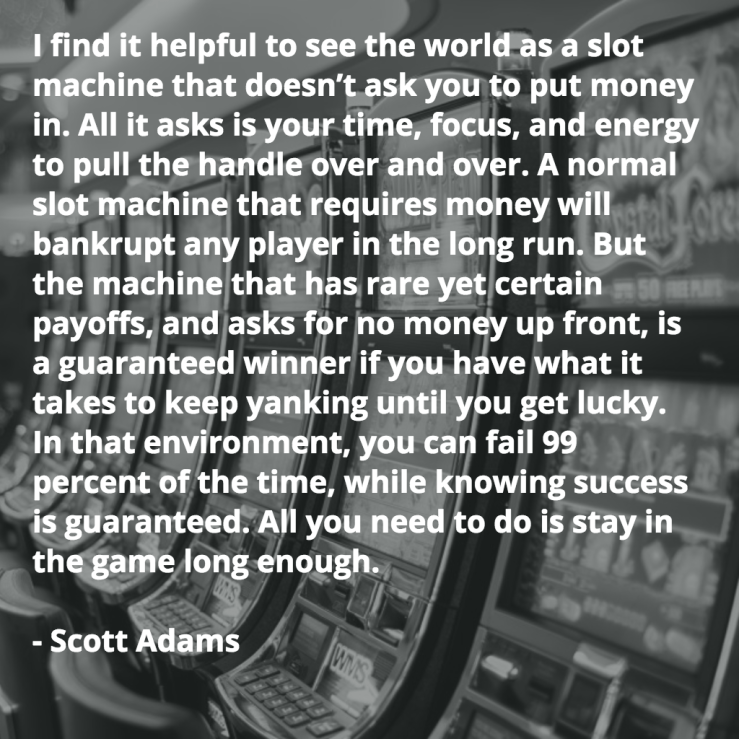
Dropping stakeholders would give Yahoo more time and opportunity. You need both to increase your chance of success. Dilbert cartoonist Scott Adams puts it this way:

“I find it helpful to see the world as a slot machine that doesn’t ask you to put money in. All it asks is your time, focus, and energy to pull the handle over and over. A normal slot machine that requires money will bankrupt any player in the long run. But the machine that has rare yet certain payoffs, and asks for no money up front, is a guaranteed winner if you have what it takes to keep yanking until you get lucky. In that environment, you can fail 99 percent of the time, while knowing success is guaranteed. All you need to do is stay in the game long enough.”

It didn’t have to be this way. Mayer had the career capital to lay off a lot of people. Career capital is an idea Cal Newport has written about. His theory is that to have a great job, you have to have great skills. Mayer had a great job because she had great skills. She could have leveraged the perception of those skills – this person knows what they’re doing – and made drastic changes.

When someone asked Judd Apatow how gets to work with people like Adam McKay and Will Ferrell, he explained it’s because he has career capital. Terry Gross has career capital because she cut her teeth coming up through public broadcasting. Chamath Palihapitiya said he did whatever Kevin O’Connor asked of him and built his career capital this way.

Mayer had a reservoir of capital that she could have used.

There’s not one thing that killed Yahoo. No one person. As Ben Horowitz wrote:

“The problem with these (business) books is that they attempt to provide a recipe for challenges that have no recipes.”

This post, I hope, was more of a guided tour. These ideas were suggestions. Things that might have worked had then been different. As I’ve written before, it can be just as helpful knowing what not to do. To recap.

  1. Beware of things that succeed because of rising tides and tailwinds.
  2. Don’t forget about the MIT.
  3. Built up experiences (or read books for a shortcut) to help you recognize patterns.
  4. Know your strengths and your weaknesses. Punt what you don’t do well.
  5. Reduce stakeholders to get more options. You need a long runway to experiment. the more career capital you have, easier cutting down will be.

Thanks for reading, I’m @mikedariano on Twitter.

Jack Schwager

Jack Schwager was on the Masters in Business podcast with Barry Ritholtz to talk about traders, trading, and the big ideas. The interview covered a lot of ground but we’ll only look at 3 quotes from the episode.

The podcast version of this post is much better. It has interview clips from Daniel Kahneman and Warren Buffett along with sound effects from The Fast and the Furious and Wile E Coyote.

Ready?

1/ Plan B in movies and books. “Before you take a village, a house, a hill, you know have to about getting in, getting out and what’s our exit…If our exit is blocked what’s our plan B and what’s our plan C. If you want to get out alive, you have to know what your exit strategy is and what the alternatives are if something mucks up the plan.” Barry Ritholtz

When Ritholtz began as a trader, the head of his desk, a marine combat instructor gave him that advice. Plan B is a good option when you can’t predict what’s going to happen. In finance you can buy options, the right to buy something at one price when it might change later.  At Disney it’s the ‘park hopper’ tickets that gives you the option to pay to visit more than one park in a day.

Plan Bs fits nicely with the military maxim that two is one and one is none.

But Plans B can be a dangerous temptress. It can be a port in storm, but a place you don’t want to be. Marc Maron said, “If you have a plan-b, you’re just a hobbyist.” Fellow comedian Jordan Peele said, he moved to Chicago and “There’s not going to be a fallback.”

What is it? Are backup plans good options OR are they excuses?

Here we can refer to the thinkings of Daniel Kahneman as to when or if we need a backup plan. Kahneman said that “when things get really big and you’re really not sure, slow down.”

Kahneman’s research suggests that we operate in two systems, like gears on a car. System 1 is our automatic and reactive system. It’s fast and lets us catch falling things, cook a familiar dinner, or drive. System 2 is our more effortful style of thinking.

System 1 is kids playing Pokemon go. System 2 is adults playing it.

Kahneman’s research is so powerful because he noted that we tend to run in system 1 in many cases when we should  run in system 2. Having a Plan B is a way to use system 2 before you have to make the choice. If you can have a backup plan before you need one, then you’ll be more likely to use it.

When things move fast and are unfamiliar we should slow down in our decision-making. If things move slow and are familiar we can make faster choices. That same framework can help us device when to make a plan B.

If we are in a fast-moving, unfamiliar situation, with large possible losses, get a Plan B.

planbcd

That idea, from FF6, isn’t the best. By now, fancy chase scenes are system 1 to those characters.  After about four movies you probably can with your gut. Plus, backup plans are terrible for movies, but good for real life.

Much of life is complex. You don’t know all the variables. The footing shifts. The conditions change. Unless you live and breathe something, for example Kahneman found that firefighters have very intuitive system 1 type reactions for being in dangerous buildings, you’re probably better off creating backup plans. What the marine instructor told Ritholtz. It also works for investing. You need a plan to get out, and many people don’t have one for you, especially those that talk on TV.

It’s why Tadas Viskanta said his blog is “forecast free.” If you’re going to get someone in, you also need to get them out.

Plan Bs lets you pre-program system 2 decisions into complex situations.

2/ Bull Markets and Buffett’s Ducks. “If you’ve done well in a bull market all you can assume is you’ve been long during a bull market.”

Schwager added that bull markets can go on for years.

It’s hard to separate luck from skill, especially in a changing landscape. Michael Mauboussin suggested to use inversion to figure it out.

The amount you can fail on purpose, Mauboussin said, corresponds to the amount of skill involved in a game.

As a parent I can see the role of skill in every game, race, or contest with kids. When you let a kid win that game has skill. When you try to lose on purpose but can’t, that’s luck.

My favorite example was when a 12-year-old won the 2015 NCAA basketball pool at ESPN. He was lucky. With thirty grand in prizes we can assume that there were “skilled” contestants, but here we can apply Mauboussin’s question — can I lose on purpose?

Kind of. If you always pick the higher seed you will lose. But there is a decent chunk of luck too.  I’ve been in a few March Madness pools won by people who choose their winners based on colors or geographic locations. NCAA basketball pools are a more even mix of skill and luck.

Skill and luck operate like actors on a stage where the scenery is the conditions. It’s a rising tide. A bull market. The 90’s in Silicon Valley. No matter your skill level during these conditions, everyone was a winner.

It’s like having a tailwind. You don’t know how much is your skillful navigation and how much the conditions are helping you.

When asked to give investing advice, Auren Hoffman said, “none of your listeners should take advice from me on investing…I’ve been a very active investor in the last eight years, and if you were a very active investor, in the valley, 100% of them did really well.”

Warren Buffett compared this to a duck on a pond. He wrote to early investors that their duck (Buffett) should rise faster than the pond, which was the market. If they couldn’t – in Buffett’s words – flap their wings some, then the investors should take their money elsewhere.

The rising tide shouldn’t be avoided. It can be a great catalyst for something. Daymond John said that as he was staring FUBU he noticed that there was something else bubbling up. It was hip hop culture. That rising tide could lift him up as he figured things out. John’s appearance on the TV show Shark Tank suggest that he, in Buffett’s words, flapped his wings along with the rising tide.

How do we figure out the roll of skill and luck on a rising, or falling tide? Time helps as a filter. Schwager said, “there’s always luck involved, but the longer you go the less luck will win out.” Nassim Taleb said we can compare it to other moments in history. If theory A works now, would it have worked five years ago?

A current example might be truck sales. The top three selling cars in America are all trucks. If you are a successful truck salesman, is it skill, luck, or a rising tide?

My guess is a rising tide. Low gas prices and cheap financing mean that people don’t need to be sold when they enter the lot.  If I were a truck salesman this would be something to keep in mind. It’s not my personal skill selling trucks, rather the rising tide of cheap gas and stable financing.

This idea of rising tides leads us to our final point. If we can seize a rising tide, like Daymond John, our truck salesman, or Auren Hoffman we can hit a home-run.

3/ Wait for a fat pitch. “One trait important for good trading is patience…patience to wait for a fat pitch.”

Schwager isn’t the only one to use that baseball analogy. Warren Buffett does too.

“Ted Williams described in his book, The Science of Hitting, that the most important thing for a hitter is to wait for the right pitch. That’s exactly the philosophy I have for investing.”

The right pitch is what Louis C.K.  did when he made the show Horace and Pete. A show that’s an investment that Buffett would probably love.

69084-1xgfiflzxeddykfes8pe56a

Louis had the idea for Horace and Pete for a while. He had kicked around the format in his head after seeing the stage play set for television. Louis wrapped up a season of his FX show Louie and started to write. He wrote two episodes and then reached out to Steve Buscemi. Here’s what he told Charlie Rose.

“If I come up this idea a year before it wouldn’t have existed. But he had just come off this big show and I said, what are you doing. And he said “nothing, I’m looking for stuff to do.” And I said do you want to do a series with me. And he said “yes, sure.” And I said we’ll play brothers. And he goes “yeah, okay.”

That moment in Louis’s career was a right pitch moment.

Louis couldn’t have done the show if he were committed to a movie and had to do it. As it turned out, Louis was but was able to get out of it because he had enough career capital to shuffle the deck because a better idea – the idea for Horace and Pete – had come along.

It’s going to work out for Louis. The show was nominated for 2 Emmy awards and Louis has plans to sell it to a streaming service or network down the line. Louis did the 3 things Schwager. suggested

  • Louis had a plan B. If things didn’t work out for the show, he could make back his money by going on tour.
  • Louis focused on his skills; writing, acting, directing, and editing a show — rather than ride a zeitgeist and hope for luck. Plus like Daymond John, it’s a rising tide for streaming entertainment creators.
  • Louis also got the timing right. He had a point in his career with a lot of career capital, the right skills, and eagerness from people like Netflix. An example of missing the boat for timing was the Facebook phone.

With the Amazon subsided Blu R1 HD smart phone getting great reviews – and who can argue with a $50 smartphone that you pop a new sim card into. This works for Amazon because they can advertiser on it. The home screen that used to hold kid pictures now holds Kibbles ones. Amazon is a good advertiser with lots of data, but Facebook, oh man, Facebook.

Facebook exists for advertisers. This isn’t awful. Better ads should be a win-win and if Facebook knows I like books by Daniel Kahneman and Michael Lewis (which I do) then seeing an ad for the Michael Lewis book about Daniel Kahneman is a win-win. I find something I love. Facebook sells a good advertisement.

Imagine that sort of win-win on a phone. Imagine Facebook, the place you post about movies, relationships, politics, and so on now has all your metadata.

Where you are and when is Fort Knox and advertisers are still trying to get in like Wile E Coyote.

tumblr_nhvfs2vvpy1s2wio8o1_500

Facebook tried a phone,but it didn’t work. Chamath Palihapitiya told Kara Swisher that the phone didn’t work because he made it difficult for Mark Zuckerberg to say yes. “It still would have cost Facebook a billion dollars to do,” Palihapitiya explained.

Well that seems like a lot of money. But Louis made a similar sized bet. He took out a loan for millions of dollars, and he was just one person.  The problem for Facebook was the timing. They hadn’t gone public yet.

Facebook didn’t wait for a fat pitch. They could have waited to launch the phone a year later. At a time when people were more open to sharing their data.

Each day people mind being tracked less and less. My EZ pass knows where and when I drive on a toll road. My Fitbit tracks my steps and sleep patterns. Cookies on my computer know what websites I’ve been to and Google serves up relevant ads. We check-in on Facebook and send geofilters on Snapchat.

Why didn’t Zuckerberg see this trend? Or, what made the difference between Mark Zuckerberg at Facebook and Louis CK with Horace and Pete?

Age.

My guess is that Louis has better pattern recognition skills than Zuckerberg, and can better wait for a fat pitch. Louis’s succeeded and failed as a stand up. He’s had successful shows and cancelled ones. He’s been married and not married. Louis understands when to act and when to wait.

Zuckerberg didn’t have the same pattern recognition. He saw the value in mobile, but jumped in too early. He knows this, it’s why reading is such a priority for him. In 2015 he shared his book club with people on Facebook and wrote, “I’ve found reading books very intellectually fulfilling. Books allow you to fully explore a topic and immerse yourself in a deeper way than most media today.”

Books are also a shortcut to pattern recognition. Learning helps you figure out when to wait and when to act.

Schwager pointed this out too, “I’m only profitable as a trader because I’ve just spoken to so many people that have so much experience.”

Tren Griffin wrote about pattern recognition:

“As a manager you can’t review everything. In my experience the best managers know when they smell something rotten and drill down when they sense it. And when they sense something great they drill down so they can optimally fertilize it.”

Pattern recognition works because it optimizes time, money, and opportunity cost. If you know that restaurants with dirty windows probably have dirty kitchens you won’t eat that them. If you know human beings can be irrational, you won’t built models that make them rational. If you know you feel better after a long walk, you’ll take more long walks to feel better.

Our time to build patterns is limited and so reading is a good shortcut. Otto von Bismarck wrote “Only a fool learns from his own mistakes. The wise man learns from the mistakes of others.”

Thanks for reading, I’m @mikedariano on Twitter.

If you made it this far and think I do good work, get it touch (559-464-5393). I’m looking for work when my kids head back to school.

How to Build the World’s Greatest Airplane

Skunk Works by Ben Rich and Leo Janos is the story of the first skunk works operations that ran out of the Lockheed shop in California. Headed by Kelly Johnson and then Ben Rich, they were the ones responsible for the stealth fighter, U-2 spy plane, and Blackbird. Beyond lessons in government bureaucracy and ground breaking engineering, the book gives a blueprint for how to make anything.

Like this:

SR-71 Blackbird


1/ Decentralized command. The Skunk Works shop was run by Kelly Johnson, who had two ways of doing things, his way or the highway.

One part of his style was to let people do their own work and do it well. The first rule Johnson explained to new recruits (and you had to be recruited) was:

“The Skunk Works program manager must be delegated practically complete control of his program in all aspects. He should have the authority to make quick decisions regarding technical, financial, or operational matters.”

Hire good people and get out of their way.

This was easier said than done when building aircraft for the Air Force, but Johnson and his successor Rich both did it.

Decentralized command is a consistent piece of leadership advice from  Jocko Willink too. You need to empower people to lead and accomplish goals on their own. Phil Knight wrote about his early team at Nike, “I let them be, let them do.”

Most people miss this.

“One reason, I think, is that most other companies don’t really understand the concept or its scope and limitations, while many others are loath to grant the freedom and independence from management control that really are necessary ingredients for running a successful Skunk Works enterprise.”

When Louis C.K. made Horace and Pete he didn’t do a lot of rehearsing. They did table reads Monday, rehearsals Tuesday, and shot Wednesday and Thursday. It was different. It was fast. One friend who helped said that the actors even felt odd because they often went home early. This worked because decentralized command.

“Pressure is good for really good actors,” Louis said. He gave good people the right conditions. Even for Alan Alda, who Louis didn’t want. Then he decided, why not? “I love every single thing he’s done and he wants this, so I said, let’s just do it.”

It was Louis’s show. It was his idea. It was his money, and “you always want to help a little,” he said. But Louis never kibitzed.  “He (Alda) invented that fucking character, it’s not what I had in my head, it’s something a billion times better.” Brian Koppelman said the same thing about his show Billions. Though he and David Levien wrote the show, it’s the director each episode that makes it something more. It’s decentralized command.


2/ Hit your MITs, and stop at good enough. Satisfy your most important things (MITs) – and stop. The Blackbird MITs were a speed of Mach 3 and altitude of 80,000 feet. It put the plane out of reach of Soviet missiles and Migs. MITs will evolve over time, and that makes getting them right a challenge.

Skunk Works managed this. The stealth bomber “was put together with avionics right off the aviation version of the Kmart shelf.” Ditto for the Blackbird, “to save cost and avoid delays, whenever possible we would use engines, avionics, and flight controls from other aircraft and cleverly modify them to fit ours.”

The MITs for a prototype were: cheap, reliable, repeatable.

They used proven equipment that was lying around. As the plane evolved, the designers, engineers, and machinists adjusted their focus to performance and quality. The titanium skin, for example, forced a retooling of the shop.

Don’t worship a MIT. Just get there and move on to the next one. Someone suggested they extend the 3,000 mile range of the plane another 80 miles. Johnson did the calculations and noted that those extra miles would cost $20M and the plan was scrapped. Rich wrote:

“If we were off in our calculations by a pound or a degree, it didn’t particularly concern us. We aimed to achieve a Chevrolet’s functional reliability rather than a Mercedes’s supposed perfection. Eighty percent efficiency would get the job done, so why strain resources and bust deadlines to achieve that extra 20 percent, which could cost as much as 50 percent more in overtime and delays and have little real impact on the overall performance of the aircraft itself.”

Rich pointed out that some things were paramount, but going past them wasn’t.

In episode 026 of my podcat we looked at the early strategies of Warren Buffett, who shifted from one MIT to another. Initially Buffett wanted cigar butt companies. His MIT was intrinsic value which was greater than the market cap. Later the MIT was the quality of the business and management. He realized that certain gains in these MITs were good enough. He wrote in an early letter:

“It does also not seem sensible to me to trade known pleasant personal relationships with high grade people at a decent rate of return, for possible irrigation, aggravation, or worse at potentially higher returns.”

For the Blackbird the MIT was mach 3 and 80,000 feet. Once they got there they stopped.

For Buffett the MIT was “a decent rate of return.” Once he got there he stopped.


3/ People. When you are dealing with people (which is always) remember that people are human and will do dumb/silly/crazy/unexpected things.

For as great as the Blackbird was, it still had a problem, the pilot. They would return from missions and debrief that they “ran out of ass before they ran out of gas,” and “my mind went numb ten minutes ahead of my ass.”

The plane had incredible technology, but people were involved and people make mistakes.

When Jack Schwager was asked why his book Market Wizards holds up he said that even though the market changes, the people don’t. Charlie Munger wrote, “what determines the behavior are incentives for the decision maker,” and “getting the incentives right is a very, very important lesson.”

“Begin each day by telling yourself: Today I shall be meeting with interference, ingratitude, insolence, disloyalty, ill-will, and selfishness – all of them due to the offenders’ ignorance of what is good or evil.” – Marcus Aurelius

People can be amazing too. The Blackbird made a sonic boom as it flew, and was kept away from populated areas. Except one, Susanville California. It just couldn’t easily be avoided. One day the townspeople (sans-pitchforks) had enough. They complained about plaster cracking and windows shattering from the bursts.

Rather than preach their authority, the Skunk Works team “had the townspeople in, showed them the airplane, appealed to their patriotism, and told them the boom was ‘the sound of freedom.’ They lapped it up.”


4/ Prioritize and execute.

How do you eat an elephant? One bite at a time.

How do you build a spy plane? One piece at a time.

A frequent implementation of P&E is the beat the shit out of it and fix what breaks system. This is what Yvon Chouinard did at Patagonia. “We test until something fails, strengthen that part, then see what fails next.” It’s also what they did at Skunk Works.

In 1961 they were testing how much pressure Blackbird’s fuel tanks could hold. They did this by pumping air into the titanium tanks. Like dad at a birthday party, they wanted to see how much air could fit into their titanium balloon.

Of course they had to do this at night “when very few people were around.” They started to pump and the crew hid behind a thick steel wall. At ten inches of mercury pressure “Kaboom! The drag chute compartment in the rear blew out.” They fixed the fail point and started again.

At ten and a half inches “the drag chute forward bulkhead ruptured with a loud bang.” Eventually they got the design they needed. Breaking is a good prioritize and execute technique.

Labeling things as too hard is another. “If something is too hard,” explained Charlie Munger,” we move on to something else. What could be simpler than that?”

A third way to P&E is to dissect big problems.  Stephen Dubner explained why smaller problems are easier to solve.

  1. They may be virgin territory.
  2. They are less tangled.
  3. They are easier to change.
  4. They are more accurately observed.

We saw this with Nike and Phil Knight.

  1. Running shoes were virgin territory, “to go out for a three-mile run was something weirdos did.”
  2. Knight and his co-founder Bill Bowerman were only making one kind of shoe.
  3. To launch a shoe company was easier than a shoe + apparel or shoe + apparel + technology.
  4. The market shortcomings for running shoes was clear to Knight and Bowerman, there weren’t many shoes and those that were out there weren’t good.


Thanks for reading, I’m @mikedariano on Twitter. If you don’t like reading posts, you could listen to my notes intead; https://soundcloud.com/mikesnotes, https://itunes.apple.com/us/podcast/mikes-notes/id1055386383, https://overcast.fm/itunes1055386383/mikes-notes.

 

Marc Andreessen & Ben Horowitz

Oh boy. Ben Horowitz and Marc Andreessen joined Sonal Chokshi on their home turf, the a16z podcast to talk about the future of the world. It was good.

After this podcast I wanted to work for Andreessen and Horowitz. It feels like they want to change the world for the better. Listen to this episode and read Kevin Kelly’s The Inevitable if you need convincing.

If reading isn’t your thing, I have a podcast, https://soundcloud.com/mikesnotes.

Okay, onto the notes.

1/ Founders must understand deeply. “It’s a real common characteristic in great founders that they want to know absolutely everything about the company and how it works. They want to know every knob and every button. They have a strong desire to do every job in the company themselves.” – Horowitz

But they can’t.  Founders have to be able to do all the jobs but can’t actually do them.

Milton Hershey epitomized this. He started at a confectionery in Philadelphia. Then in Denver, and New York City. He returned to Pennsylvania and started his own caramel company based on his own recipes.

That company grew and he successfully exited. Hershey created a chocolate company with the proceeds from the sale. He began the same recipe and process discovery with chocolate as he had with caramel.

Hershey never stopped tinkering with chocolate recipes (he worked in his lab even after he retired) but he gave control and management to the people. Hershey could do all the jobs, but turned them over to others.

Phil Knight had a similar experience with Nike. Knight began by importing shoes from Japan at night and on weekends while auditing companies during the day. This was combined with Knight’s experience running cross country and track in college. He built up a deep understanding:

  • Of business; from auditing companies and seeing their mistakes.
  • Of shoe design; from Bill Bowerman who was always messing around with the shoes.
  • Of the Japanese business culture; from importing Tiger shoes.

As his first company – Blue Ribbon Sports – grew, Knight was able to give up control to other people. Knight could do all the jobs, but turned them over to others.

Andy Weissman said when he looks to make an investment, he considers how well the business and the person will scale. Founders have to understand things deeply, so deeply that they understand they can’t and shouldn’t do everything.

2/ Double down on strengths and punt your weaknesses.  “We had this great advantage when we started the firm that we ourselves were founders. We probably got more risk tolerant with our view of founders over time. We’re much more interested in the magnitude of the strength than the number of the weaknesses.” – Horowitz

Before Teddy Roosevelt went off to Cuba he was asked to lead a group of men. That’s probably not the best idea Roosevelt wrote:

“Fortunately, I was wise enough to tell the Secretary (Alger) that while I believed I could learn to command the regiment in a month, that it was just this very month which I could not afford to spare, and that there-fore I would be quite content to go as Lt. Colonel if he would make (Leonard) Wood Colonel.”

Roosevelt understood that he could learn to lead the soldier, just not quickly enough, and that his strength was to be second in command.

Horowitz wrote about how companies should approach hiring:

“You hired for lack of weakness rather than for strengths. This is especially common when you run a consensus-based hiring process. The group will often find the candidate’s weaknesses, but they won’t place a high enough value on the areas where you need the executive to be a world-class performer. As a result, you hire an executive with no sharp weaknesses, but who is mediocre where you need her to be great. If you don’t have world-class strengths where you need them, you won’t be a world-class company.”

If you don’t know what your strengths are then you need to invert the problem. “One easier way to figure out what your strengths are is to figure out what they aren’t,” suggested Auren Hoffman. Terry Gross gave similar advice, “you find out who you are by finding out who you’re not.”

3/ Silicon Valley is simple, but not easy to create.  “Economic delegations come in and ask ‘what can we do to have our own Silicon Valley?’ Then we go; you want rule of law, ease of migration, ease of trade, deep investments in scientific research, no non-competes, fluid labor laws, the ability to start companies quickly. At some point the visitors get this stricken look on their face and they’re like, but what if we want Silicon Valley but can’t do any of those things?” – Andreessen

It’s simple but not easy to create Silicon Valley.

Good leadership, said Jocko Willink, is simple but not easy.

Gary Vaynerchuk wrote, “one of the hardest things about making your dream, or your small business, or your blog, or whatever is just doing it.”

Charlie Munger said “plain vanilla stock picking is hard enough.”

4/ Be there for network effects. “There are real network effects, geographical network effects and Silicon Valley has the biggest one in technology and you always have to keep in mind – and this is something that gets lost – that there are no local technology companies.” – Horowitz

Why do you have to be in Silicon Valley? To work with the best people.

Why do you need to work with the best people? Because technology is a winner take all.

“There’s nobody who sells internet search to Wyoming,” Horowitz explained. The product of internet search is available to everyone, everywhere, and so you need to create the best version of that. For technology it’s in Silicon Valley. For movies it’s Hollywood. For finance it’s New York (as far as the United States goes).

Often people say you have to be there to get a deep understanding. Percy Fawcett for exploration, Wesley Gray for military interventions, Samuel Zemurray for running an import business.

Other times you have to be there to connect with the people. That’s that Horowitz proposes. Austin Kleon and Nicholas Megalis said the same thing, only about connecting on the internet.

If you can get the right people running something, you get a lollapalooza effect. Taylor Pearson wrote about the value of product-market-founder effect. Replace founder with team and you’ll have something much greater than the sum of its parts.

5/ Too much inertia and you’ll pay the strategy tax. “In a way they (Amazon) have an interesting advantage in that they’re not tied to the last generation of user interfaces so that they don’t have to pay the strategy task for shoehorning in their A.I. into say the iPhone.” – Horowitz

Amazon doesn’t have a device to built an interface on, but that’s good because they can think of new interfaces (and devices) to build.

“In the beginner’s mind there are many possibilities, but in the expert’s mind there are few.” Shunryu Suzuki

“Strategy tax” articulates the weakness (tax) that accompanies the strength (strategy).

The Chicago Black Soxs were unorganized in their fix of the 1919 World Series and because of that failed to get paid by the gamblers who profited. But that disorganizing turned out to be helpful because they didn’t get convicted in the court of law.

Tony Hawk couldn’t skate the same way as other kids, so he had to make up a style that fit him. Later on that style would become popular and Hawk was the best at those tricks.

Imagine if the Apple Watch switched to only voice commands, or the television tracked your eye movement to make selections. Whatever you call it; inertia, fences, tax, it’s a force that acts on your business to provide an advantage but also creates a disadvantage.

Thanks for reading, I’m @mikedariano on Twitter.