What happened to Yahoo?

If you’re too young to remember, on the early internet, fifteen years ago, Yahoo was everything. Yahoo mail was great. Clubs and teams were organized on Yahoo groups. Fantasy sports were run through Yahoo sites. They were one of the better search engines too.

Now their core business was sold to Verizon for just under 5B$. What happened? We’ll look at what Kara Swisher and Eric Jackson have to say about Yahoo’s journey.

Caveat emptor, this is one data point of many. An island in the sea. I’ll try to make the case that some of Yahoo’s missteps are ones that currently successful businesses have avoided.

Finally, this post is available in podcast form; https://soundcloud.com/mikesnotes, https://itunes.apple.com/us/podcast/mikes-notes/id1055386383, https://overcast.fm/itunes1055386383/mikes-notes if you’d prefer listening. Plus, awesome sound effects.

Ready?

1/ Beware majestic ducks on ponds. “They thought they would bring in this Googler and just because they worked at Google they could immediately make things right. Well, Google was an abnormally interesting place of talent all together at once. It doesn’t mean that if you pull individual parts out that they could succeed.” KS

In another Recode episode Swisher told Eric Jackson:

“I had seen a different side of her, and all the Google executives. I think they get buoyed by being at Google and everybody gets this sort of extra special polish because they’re at Google. It doesn’t mean that once they remove themselves from that paradise they do well.”

In Warren Buffett’s early letters (pre-Berkshire Hathaway) he explained the framework in terms of a duck on a pond. Buffett wrote, “the rise and fall of the lake is hardly something for him to quack about.” Uncle Warren had to create his own yardstick, to see how much was the tide and how much was him. He used the Dow Jones Industrial average. If his holdings didn’t outperform that group of stocks over three year periods he told his investors, “if our performance declines to a level you can achieve by floating on your back, we will turn in our suits.”

Buffett exceeded those returns and more. His ducks on a pond analogy continued through the success, “I like to think we’ve flapped our wings a few times.”

Swisher thinks that Mayer was a duck on a rising pond, rather than duck flapping their wings a few times.

“If you’ve done well in a bull market all you can assume is you’ve been long during a bull market,” Jack Schwager told Barry Ritholtz.

Conditions matter. Milton Hershey benefited from good conditions (a rising tide) and succeeded in building a company that still bears his name (flapped his wings). Hershey’s tide was a build up of railroad infrastructure, a population boom thanks to immigration and workers in southern Pennsylvania, and national advertising that supported brands like Hershey, Coca-Cola, and Wrigley.

Mayer had a similar tide.

  • Where Hershey’s infrastructure was railroads, hers was broadband.
  • Where Hershey’s population boom was immigrants, hers was people with smartphones.
  • Where Hershey’s brand building was national advertising, hers was mobile ads, ads sense, and the shift from newspapers.

Mayer rode a rising tide at Google, but the same conditions didn’t exist at Yahoo.

2/ It’s only about the MOST IMPORTANT THINGS (MIT). “Here’s how you succeed, build great products. If you build a great product or buy a great product…when you have that many that many years of no great products – redoing the weather app to make it prettier is not a great product – it’s what I call table stakes. It’s like when she added free iPhones and food. Okay, that’s table stakes.” KS

No word if Yahoo served table steaks.

Swisher thinks that Mayer missed the MIT. Build a great product.  Yahoo used to have great products. Their sports site was better than ESPN. Their mail app was at one time the best. Other services like fantasy sports, finance, and Flickr were all great too. Early internet users went to Yahoo everyday.

What happened?

Not enough good people. Good people lead to good products which lead to good people and so on. Don’t confuse this for a chicken and egg problem, you can buy or build the egg to start. Swisher points out that Facebook’s acquisitions like Instagram, WhatsApp, and Oculus has kept them from becoming “Grandma’s Facebook.”

Good products are the MIT for a technology company, but any company needs a MIT.

  • For young Warren Buffett the MIT was companies with a book value greater than or equal to their market capitalization.
  • Former NBA coach Pat Riley said, “the major part of my job isn’t to tell the players what to do. The most important thing I do is to create a great setting for them to work in.”
  • Stephen King says “the truth is the most important thing.” What does that mean for an author of fiction?

In his book On Writing (part memoir part masterclass), King writes (p186, emphasis mine):

“My mother, God rest her, didn’t approve of profanity or any such talk; she called it “the language of the ignorant.” This did not, however, keep her from yelling “Oh shit!” if she burned the roast or nailed her thumb a good one while hammering a picture-hook in the wall. Nor does it preclude most people, Christian as well as heathen, from saying some-thing similar (or even stronger) when the dog barfs on the shag carpet or the car slips off the jack. It’s important to tell the truth; so much depends upon it, as William Carlos Williams almost said when he was writing about that red wheelbarrow. The Legion of Decency might not like the word shit, and you might not like it much, either, but some-times you’re just stuck with it—no kid ever ran to his mother and said that his little sister just defecated in the tub

Honesty is paramount, King writes, “If you substitute ‘Oh Sugar!’ for ‘Oh Shit!’ because you’re thinking about the Legion of Decency, you are breaking the unspoken contract that exists between writer and reader.” Honesty is King’s MIT.

MITs will change, but your focus on them does not. Satisfy one MIT and then move on.

The recruitment problem at Yahoo reminded me of the Elon Musk technique for recruitment. Dolly Singh, head of talent acquisition at SpaceX said, “the Space X recruiting pitch was ‘if you want as hard as it gets, then great. If not then you shouldn’t come here.”

Work for Musk, change the world. Work for Yahoo, and, what? That’s what Swisher pointed out. Tesla gets missionaries. Yahoo did not.

3/ Pattern recognition. “Do they realize what they’re doing? They’re facilitating your success. It had happened before. I had seen it happen with AOL, Netscape and others, where they facilitated the success of other peoples business’s and didn’t realize the real business.” KS

Here Swisher is recalling a meeting with Larry Page when he pointed out that Google was getting more search traffic than Yahoo (who was using Google for their search). Swisher had seen this before. Swisher has good pattern recognition. Yahoo did not.

Pattern recognition is a superpower. It’s saves time, money, or opportunity. In podcast episode 027, I guessed that Louis CK has good pattern recognition skills. Like an experienced baseball player, he could wait for a fat pitch. I also guessed that Mark Zuckerberg is still building his.

Patrick O’Shaughnessy said, that he sees young people buying “expensive, exciting stuff ($TSLA, $AAPL).” But, “If history rhymes, which it often does, an older, more boring, stodgier, portfolio is probably going to do better.” This is pattern recognition.

Alex Blumberg started Gimlet Media because he saw patterns:

“This American Life worked. Planet Money worked. After Planet Money worked it felt like you can take this kind of storytelling, this kind of long form journalism and you can apply it to a bunch of different places and now we know that this is fertile ground for this kind of storytelling….then Serial comes along and demolishes everything in its path and then it was very clear that it was the right instinct.”

4/ Know thyself. “Looking back now, what I wish I had been more vocable about was that she was first time CEO. She wasn’t a good manager. There were a number of mistakes she made in how she managed people. How she set strategy….She had a lot of direct reports (n=26), that’s impossible. It sort of speaks to an overconfidence in yourself.” – EJ

Here Jackson proposes that Mayer didn’t “know thyself.” Unlike, say Teddy Roosevelt. In his book, The Rough Riders, Roosevelt was asked to lead a regiment into Cuba. Teddy wrote, “while I believed I could learn to command the regiment in a month, that it was just this very month which I could not afford to spare, and that there-fore I would be quite content to go as Lt. Colonel if he would make (Leonard) Wood Colonel.”

Roosevelt knew he didn’t have the right skills, right now, so he deferred to someone else.

It’s more than technical know-how too. When Andy Weissman spoke about evaluating founders he asks whether the company and the person can scale. Elizabeth Gilbert said she needed to write, but not in graduate school. She said that being in a room with 12 other people wasn’t the best situation for her. Gary Vaynerchuk said he needs to work, he needs to grind. Ezra Klein said he doesn’t do conference calls well. When Nasty Gal was moving from explosive growth to sustainable growth Sophia Amoruso stepped out of the CEO role because, she said, the things a CEO needs to do aren’t the things she is good at dong.

Each of these things, from the big to the small, is part of knowing yourself. Of knowing what you do well and where you need help. Swisher and Jackson think Mayer lacked some of this.

5/ Stakeholders, runway, and career capital. “This wasn’t my idea (Marc Andreessen said this to Sarah Lacy days after Marissa was hired). She should fire something like, ten thousand people…had she done that she basically would have seemed a lot more profitable for a lot longer than she did. It would have bought her more time. It would have given her an opportunity to do more things. She was in such honeymoon period at the time no one would have questioned her.” EJ

There are three things to unpack here.

  • Stakeholders.
  • Time + opportunity = runway.
  • Career capital.

Yahoo had too many employee stakeholders. Stakeholders are anything you are accountable to. The more stakeholders, the less flexibility.

Wesley Gray said he recruits a certain type of investor for his fund. He wants stakeholders that aren’t skittish.

Louis C.K. said he didn’t want advertisers on his show Horace and Pete because they were stakeholders that would influence what he was doing.

Walking the dog is a stakeholder that demands one hour a day. In a 2014 interview with Lifehacker Ira Glass was asked his best time-saving shortcut/life hack. He said nothing. That’s clearly not so. Any person that runs one of the biggest podcasts in the world, has a family, and does speaking gigs all over the country has to have some time saving trick. After thinking about it for a moment this is what Glass said:

I guess my biggest life hack—and this is the very first time I’ve attempted to use the phrase “life hack” in a sentence—is that my wife and I decided to live just a few blocks from where I work. We did this because of our dog. Since I spend at least an hour every night walking the dog, I didn’t want to spend another 60 or 90 minutes a day commuting. I don’t have the time. Like lots of people, I work long hours.

Ira Glass recognized his dog was a stakeholder on his time, so he lives near his office. Your internet bill is a stakeholder too. It demands some number of hours of work. Relationships are stakeholders. Hobbies are stakeholders. Everything you are committed to limits what else you can be committed to. Andreessen, Swisher, and Jackson think Yahoo was committed to too many employees.

Dropping stakeholders would give Yahoo more time and opportunity. You need both to increase your chance of success. Dilbert cartoonist Scott Adams puts it this way:

“I find it helpful to see the world as a slot machine that doesn’t ask you to put money in. All it asks is your time, focus, and energy to pull the handle over and over. A normal slot machine that requires money will bankrupt any player in the long run. But the machine that has rare yet certain payoffs, and asks for no money up front, is a guaranteed winner if you have what it takes to keep yanking until you get lucky. In that environment, you can fail 99 percent of the time, while knowing success is guaranteed. All you need to do is stay in the game long enough.”

It didn’t have to be this way. Mayer had the career capital to lay off a lot of people. Career capital is an idea Cal Newport has written about. His theory is that to have a great job, you have to have great skills. Mayer had a great job because she had great skills. She could have leveraged the perception of those skills – this person knows what they’re doing – and made drastic changes.

When someone asked Judd Apatow how gets to work with people like Adam McKay and Will Ferrell, he explained it’s because he has career capital. Terry Gross has career capital because she cut her teeth coming up through public broadcasting. Chamath Palihapitiya said he did whatever Kevin O’Connor asked of him and built his career capital this way.

Mayer had a reservoir of capital that she could have used.

There’s not one thing that killed Yahoo. No one person. As Ben Horowitz wrote:

“The problem with these (business) books is that they attempt to provide a recipe for challenges that have no recipes.”

This post, I hope, was more of a guided tour. These ideas were suggestions. Things that might have worked had then been different. As I’ve written before, it can be just as helpful knowing what not to do. To recap.

  1. Beware of things that succeed because of rising tides and tailwinds.
  2. Don’t forget about the MIT.
  3. Built up experiences (or read books for a shortcut) to help you recognize patterns.
  4. Know your strengths and your weaknesses. Punt what you don’t do well.
  5. Reduce stakeholders to get more options. You need a long runway to experiment. the more career capital you have, easier cutting down will be.

Thanks for reading, I’m @mikedariano on Twitter.
Jack Schwager

Jack Schwager was on the Masters in Business podcast with Barry Ritholtz to talk about traders, trading, and the big ideas. The interview covered a lot of ground but we’ll only look at 3 quotes from the episode.

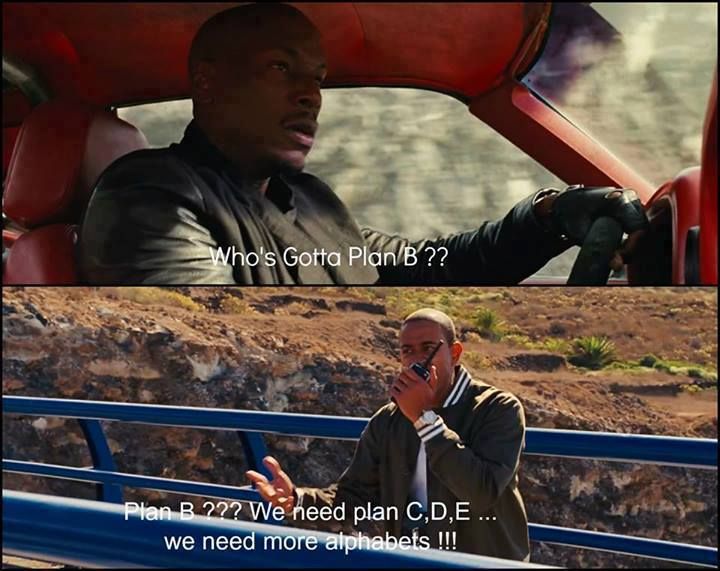
The podcast version of this post is much better. It has interview clips from Daniel Kahneman and Warren Buffett along with sound effects from The Fast and the Furious and Wile E Coyote.

Ready?

1/ Plan B in movies and books. “Before you take a village, a house, a hill, you know have to about getting in, getting out and what’s our exit…If our exit is blocked what’s our plan B and what’s our plan C. If you want to get out alive, you have to know what your exit strategy is and what the alternatives are if something mucks up the plan.” Barry Ritholtz

When Ritholtz began as a trader, the head of his desk, a marine combat instructor gave him that advice. Plan B is a good option when you can’t predict what’s going to happen. In finance you can buy options, the right to buy something at one price when it might change later.  At Disney it’s the ‘park hopper’ tickets that gives you the option to pay to visit more than one park in a day.

Plan Bs fits nicely with the military maxim that two is one and one is none.

But Plans B can be a dangerous temptress. It can be a port in storm, but a place you don’t want to be. Marc Maron said, “If you have a plan-b, you’re just a hobbyist.” Fellow comedian Jordan Peele said, he moved to Chicago and “There’s not going to be a fallback.”

What is it? Are backup plans good options OR are they excuses?

Here we can refer to the thinkings of Daniel Kahneman as to when or if we need a backup plan. Kahneman said that “when things get really big and you’re really not sure, slow down.”

Kahneman’s research suggests that we operate in two systems, like gears on a car. System 1 is our automatic and reactive system. It’s fast and lets us catch falling things, cook a familiar dinner, or drive. System 2 is our more effortful style of thinking.

System 1 is kids playing Pokemon go. System 2 is adults playing it.

Kahneman’s research is so powerful because he noted that we tend to run in system 1 in many cases when we should  run in system 2. Having a Plan B is a way to use system 2 before you have to make the choice. If you can have a backup plan before you need one, then you’ll be more likely to use it.

When things move fast and are unfamiliar we should slow down in our decision-making. If things move slow and are familiar we can make faster choices. That same framework can help us device when to make a plan B.

If we are in a fast-moving, unfamiliar situation, with large possible losses, get a Plan B.

planbcd

That idea, from FF6, isn’t the best. By now, fancy chase scenes are system 1 to those characters.  After about four movies you probably can with your gut. Plus, backup plans are terrible for movies, but good for real life.

Much of life is complex. You don’t know all the variables. The footing shifts. The conditions change. Unless you live and breathe something, for example Kahneman found that firefighters have very intuitive system 1 type reactions for being in dangerous buildings, you’re probably better off creating backup plans. What the marine instructor told Ritholtz. It also works for investing. You need a plan to get out, and many people don’t have one for you, especially those that talk on TV.

It’s why Tadas Viskanta said his blog is “forecast free.” If you’re going to get someone in, you also need to get them out.

Plan Bs lets you pre-program system 2 decisions into complex situations.

2/ Bull Markets and Buffett’s Ducks. “If you’ve done well in a bull market all you can assume is you’ve been long during a bull market.”

Schwager added that bull markets can go on for years.

It’s hard to separate luck from skill, especially in a changing landscape. Michael Mauboussin suggested to use inversion to figure it out.

The amount you can fail on purpose, Mauboussin said, corresponds to the amount of skill involved in a game.

As a parent I can see the role of skill in every game, race, or contest with kids. When you let a kid win that game has skill. When you try to lose on purpose but can’t, that’s luck.

My favorite example was when a 12-year-old won the 2015 NCAA basketball pool at ESPN. He was lucky. With thirty grand in prizes we can assume that there were “skilled” contestants, but here we can apply Mauboussin’s question — can I lose on purpose?

Kind of. If you always pick the higher seed you will lose. But there is a decent chunk of luck too.  I’ve been in a few March Madness pools won by people who choose their winners based on colors or geographic locations. NCAA basketball pools are a more even mix of skill and luck.

Skill and luck operate like actors on a stage where the scenery is the conditions. It’s a rising tide. A bull market. The 90’s in Silicon Valley. No matter your skill level during these conditions, everyone was a winner.

It’s like having a tailwind. You don’t know how much is your skillful navigation and how much the conditions are helping you.

When asked to give investing advice, Auren Hoffman said, “none of your listeners should take advice from me on investing…I’ve been a very active investor in the last eight years, and if you were a very active investor, in the valley, 100% of them did really well.”

Warren Buffett compared this to a duck on a pond. He wrote to early investors that their duck (Buffett) should rise faster than the pond, which was the market. If they couldn’t – in Buffett’s words – flap their wings some, then the investors should take their money elsewhere.

The rising tide shouldn’t be avoided. It can be a great catalyst for something. Daymond John said that as he was staring FUBU he noticed that there was something else bubbling up. It was hip hop culture. That rising tide could lift him up as he figured things out. John’s appearance on the TV show Shark Tank suggest that he, in Buffett’s words, flapped his wings along with the rising tide.

How do we figure out the roll of skill and luck on a rising, or falling tide? Time helps as a filter. Schwager said, “there’s always luck involved, but the longer you go the less luck will win out.” Nassim Taleb said we can compare it to other moments in history. If theory A works now, would it have worked five years ago?

A current example might be truck sales. The top three selling cars in America are all trucks. If you are a successful truck salesman, is it skill, luck, or a rising tide?

My guess is a rising tide. Low gas prices and cheap financing mean that people don’t need to be sold when they enter the lot.  If I were a truck salesman this would be something to keep in mind. It’s not my personal skill selling trucks, rather the rising tide of cheap gas and stable financing.

This idea of rising tides leads us to our final point. If we can seize a rising tide, like Daymond John, our truck salesman, or Auren Hoffman we can hit a home-run.

3/ Wait for a fat pitch. “One trait important for good trading is patience…patience to wait for a fat pitch.”

Schwager isn’t the only one to use that baseball analogy. Warren Buffett does too.

“Ted Williams described in his book, The Science of Hitting, that the most important thing for a hitter is to wait for the right pitch. That’s exactly the philosophy I have for investing.”

The right pitch is what Louis C.K.  did when he made the show Horace and Pete. A show that’s an investment that Buffett would probably love.

69084-1xgfiflzxeddykfes8pe56a

Louis had the idea for Horace and Pete for a while. He had kicked around the format in his head after seeing the stage play set for television. Louis wrapped up a season of his FX show Louie and started to write. He wrote two episodes and then reached out to Steve Buscemi. Here’s what he told Charlie Rose.

“If I come up this idea a year before it wouldn’t have existed. But he had just come off this big show and I said, what are you doing. And he said “nothing, I’m looking for stuff to do.” And I said do you want to do a series with me. And he said “yes, sure.” And I said we’ll play brothers. And he goes “yeah, okay.”

That moment in Louis’s career was a right pitch moment.

Louis couldn’t have done the show if he were committed to a movie and had to do it. As it turned out, Louis was but was able to get out of it because he had enough career capital to shuffle the deck because a better idea – the idea for Horace and Pete – had come along.

It’s going to work out for Louis. The show was nominated for 2 Emmy awards and Louis has plans to sell it to a streaming service or network down the line. Louis did the 3 things Schwager. suggested

  • Louis had a plan B. If things didn’t work out for the show, he could make back his money by going on tour.
  • Louis focused on his skills; writing, acting, directing, and editing a show — rather than ride a zeitgeist and hope for luck. Plus like Daymond John, it’s a rising tide for streaming entertainment creators.
  • Louis also got the timing right. He had a point in his career with a lot of career capital, the right skills, and eagerness from people like Netflix. An example of missing the boat for timing was the Facebook phone.

With the Amazon subsided Blu R1 HD smart phone getting great reviews – and who can argue with a $50 smartphone that you pop a new sim card into. This works for Amazon because they can advertiser on it. The home screen that used to hold kid pictures now holds Kibbles ones. Amazon is a good advertiser with lots of data, but Facebook, oh man, Facebook.

Facebook exists for advertisers. This isn’t awful. Better ads should be a win-win and if Facebook knows I like books by Daniel Kahneman and Michael Lewis (which I do) then seeing an ad for the Michael Lewis book about Daniel Kahneman is a win-win. I find something I love. Facebook sells a good advertisement.

Imagine that sort of win-win on a phone. Imagine Facebook, the place you post about movies, relationships, politics, and so on now has all your metadata.

Where you are and when is Fort Knox and advertisers are still trying to get in like Wile E Coyote.

tumblr_nhvfs2vvpy1s2wio8o1_500

Facebook tried a phone,but it didn’t work. Chamath Palihapitiya told Kara Swisher that the phone didn’t work because he made it difficult for Mark Zuckerberg to say yes. “It still would have cost Facebook a billion dollars to do,” Palihapitiya explained.

Well that seems like a lot of money. But Louis made a similar sized bet. He took out a loan for millions of dollars, and he was just one person.  The problem for Facebook was the timing. They hadn’t gone public yet.

Facebook didn’t wait for a fat pitch. They could have waited to launch the phone a year later. At a time when people were more open to sharing their data.

Each day people mind being tracked less and less. My EZ pass knows where and when I drive on a toll road. My Fitbit tracks my steps and sleep patterns. Cookies on my computer know what websites I’ve been to and Google serves up relevant ads. We check-in on Facebook and send geofilters on Snapchat.

Why didn’t Zuckerberg see this trend? Or, what made the difference between Mark Zuckerberg at Facebook and Louis CK with Horace and Pete?

Age.

My guess is that Louis has better pattern recognition skills than Zuckerberg, and can better wait for a fat pitch. Louis’s succeeded and failed as a stand up. He’s had successful shows and cancelled ones. He’s been married and not married. Louis understands when to act and when to wait.

Zuckerberg didn’t have the same pattern recognition. He saw the value in mobile, but jumped in too early. He knows this, it’s why reading is such a priority for him. In 2015 he shared his book club with people on Facebook and wrote, “I’ve found reading books very intellectually fulfilling. Books allow you to fully explore a topic and immerse yourself in a deeper way than most media today.”

Books are also a shortcut to pattern recognition. Learning helps you figure out when to wait and when to act.

Schwager pointed this out too, “I’m only profitable as a trader because I’ve just spoken to so many people that have so much experience.”

Tren Griffin wrote about pattern recognition:

“As a manager you can’t review everything. In my experience the best managers know when they smell something rotten and drill down when they sense it. And when they sense something great they drill down so they can optimally fertilize it.”

Pattern recognition works because it optimizes time, money, and opportunity cost. If you know that restaurants with dirty windows probably have dirty kitchens you won’t eat that them. If you know human beings can be irrational, you won’t built models that make them rational. If you know you feel better after a long walk, you’ll take more long walks to feel better.

Our time to build patterns is limited and so reading is a good shortcut. Otto von Bismarck wrote “Only a fool learns from his own mistakes. The wise man learns from the mistakes of others.”

Thanks for reading, I’m @mikedariano on Twitter.

If you made it this far and think I do good work, get it touch (559-464-5393). I’m looking for work when my kids head back to school.

How to Build the World’s Greatest Airplane

Skunk Works by Ben Rich and Leo Janos is the story of the first skunk works operations that ran out of the Lockheed shop in California. Headed by Kelly Johnson and then Ben Rich, they were the ones responsible for the stealth fighter, U-2 spy plane, and Blackbird. Beyond lessons in government bureaucracy and ground breaking engineering, the book gives a blueprint for how to make anything.

Like this:

SR-71 Blackbird


1/ Decentralized command. The Skunk Works shop was run by Kelly Johnson, who had two ways of doing things, his way or the highway.

One part of his style was to let people do their own work and do it well. The first rule Johnson explained to new recruits (and you had to be recruited) was:

“The Skunk Works program manager must be delegated practically complete control of his program in all aspects. He should have the authority to make quick decisions regarding technical, financial, or operational matters.”

Hire good people and get out of their way.

This was easier said than done when building aircraft for the Air Force, but Johnson and his successor Rich both did it.

Decentralized command is a consistent piece of leadership advice from  Jocko Willink too. You need to empower people to lead and accomplish goals on their own. Phil Knight wrote about his early team at Nike, “I let them be, let them do.”

Most people miss this.

“One reason, I think, is that most other companies don’t really understand the concept or its scope and limitations, while many others are loath to grant the freedom and independence from management control that really are necessary ingredients for running a successful Skunk Works enterprise.”

When Louis C.K. made Horace and Pete he didn’t do a lot of rehearsing. They did table reads Monday, rehearsals Tuesday, and shot Wednesday and Thursday. It was different. It was fast. One friend who helped said that the actors even felt odd because they often went home early. This worked because decentralized command.

“Pressure is good for really good actors,” Louis said. He gave good people the right conditions. Even for Alan Alda, who Louis didn’t want. Then he decided, why not? “I love every single thing he’s done and he wants this, so I said, let’s just do it.”

It was Louis’s show. It was his idea. It was his money, and “you always want to help a little,” he said. But Louis never kibitzed.  “He (Alda) invented that fucking character, it’s not what I had in my head, it’s something a billion times better.” Brian Koppelman said the same thing about his show Billions. Though he and David Levien wrote the show, it’s the director each episode that makes it something more. It’s decentralized command.


2/ Hit your MITs, and stop at good enough. Satisfy your most important things (MITs) – and stop. The Blackbird MITs were a speed of Mach 3 and altitude of 80,000 feet. It put the plane out of reach of Soviet missiles and Migs. MITs will evolve over time, and that makes getting them right a challenge.

Skunk Works managed this. The stealth bomber “was put together with avionics right off the aviation version of the Kmart shelf.” Ditto for the Blackbird, “to save cost and avoid delays, whenever possible we would use engines, avionics, and flight controls from other aircraft and cleverly modify them to fit ours.”

The MITs for a prototype were: cheap, reliable, repeatable.

They used proven equipment that was lying around. As the plane evolved, the designers, engineers, and machinists adjusted their focus to performance and quality. The titanium skin, for example, forced a retooling of the shop.

Don’t worship a MIT. Just get there and move on to the next one. Someone suggested they extend the 3,000 mile range of the plane another 80 miles. Johnson did the calculations and noted that those extra miles would cost $20M and the plan was scrapped. Rich wrote:

“If we were off in our calculations by a pound or a degree, it didn’t particularly concern us. We aimed to achieve a Chevrolet’s functional reliability rather than a Mercedes’s supposed perfection. Eighty percent efficiency would get the job done, so why strain resources and bust deadlines to achieve that extra 20 percent, which could cost as much as 50 percent more in overtime and delays and have little real impact on the overall performance of the aircraft itself.”

Rich pointed out that some things were paramount, but going past them wasn’t.

In episode 026 of my podcat we looked at the early strategies of Warren Buffett, who shifted from one MIT to another. Initially Buffett wanted cigar butt companies. His MIT was intrinsic value which was greater than the market cap. Later the MIT was the quality of the business and management. He realized that certain gains in these MITs were good enough. He wrote in an early letter:

“It does also not seem sensible to me to trade known pleasant personal relationships with high grade people at a decent rate of return, for possible irrigation, aggravation, or worse at potentially higher returns.”

For the Blackbird the MIT was mach 3 and 80,000 feet. Once they got there they stopped.

For Buffett the MIT was “a decent rate of return.” Once he got there he stopped.


3/ People. When you are dealing with people (which is always) remember that people are human and will do dumb/silly/crazy/unexpected things.

For as great as the Blackbird was, it still had a problem, the pilot. They would return from missions and debrief that they “ran out of ass before they ran out of gas,” and “my mind went numb ten minutes ahead of my ass.”

The plane had incredible technology, but people were involved and people make mistakes.

When Jack Schwager was asked why his book Market Wizards holds up he said that even though the market changes, the people don’t. Charlie Munger wrote, “what determines the behavior are incentives for the decision maker,” and “getting the incentives right is a very, very important lesson.”

“Begin each day by telling yourself: Today I shall be meeting with interference, ingratitude, insolence, disloyalty, ill-will, and selfishness – all of them due to the offenders’ ignorance of what is good or evil.” – Marcus Aurelius

People can be amazing too. The Blackbird made a sonic boom as it flew, and was kept away from populated areas. Except one, Susanville California. It just couldn’t easily be avoided. One day the townspeople (sans-pitchforks) had enough. They complained about plaster cracking and windows shattering from the bursts.

Rather than preach their authority, the Skunk Works team “had the townspeople in, showed them the airplane, appealed to their patriotism, and told them the boom was ‘the sound of freedom.’ They lapped it up.”


4/ Prioritize and execute.

How do you eat an elephant? One bite at a time.

How do you build a spy plane? One piece at a time.

A frequent implementation of P&E is the beat the shit out of it and fix what breaks system. This is what Yvon Chouinard did at Patagonia. “We test until something fails, strengthen that part, then see what fails next.” It’s also what they did at Skunk Works.

In 1961 they were testing how much pressure Blackbird’s fuel tanks could hold. They did this by pumping air into the titanium tanks. Like dad at a birthday party, they wanted to see how much air could fit into their titanium balloon.

Of course they had to do this at night “when very few people were around.” They started to pump and the crew hid behind a thick steel wall. At ten inches of mercury pressure “Kaboom! The drag chute compartment in the rear blew out.” They fixed the fail point and started again.

At ten and a half inches “the drag chute forward bulkhead ruptured with a loud bang.” Eventually they got the design they needed. Breaking is a good prioritize and execute technique.

Labeling things as too hard is another. “If something is too hard,” explained Charlie Munger,” we move on to something else. What could be simpler than that?”

A third way to P&E is to dissect big problems.  Stephen Dubner explained why smaller problems are easier to solve.

  1. They may be virgin territory.
  2. They are less tangled.
  3. They are easier to change.
  4. They are more accurately observed.

We saw this with Nike and Phil Knight.

  1. Running shoes were virgin territory, “to go out for a three-mile run was something weirdos did.”
  2. Knight and his co-founder Bill Bowerman were only making one kind of shoe.
  3. To launch a shoe company was easier than a shoe + apparel or shoe + apparel + technology.
  4. The market shortcomings for running shoes was clear to Knight and Bowerman, there weren’t many shoes and those that were out there weren’t good.


Thanks for reading, I’m @mikedariano on Twitter. If you don’t like reading posts, you could listen to my notes intead; https://soundcloud.com/mikesnotes, https://itunes.apple.com/us/podcast/mikes-notes/id1055386383, https://overcast.fm/itunes1055386383/mikes-notes.

 

Marc Andreessen & Ben Horowitz

Oh boy. Ben Horowitz and Marc Andreessen joined Sonal Chokshi on their home turf, the a16z podcast to talk about the future of the world. It was good.

After this podcast I wanted to work for Andreessen and Horowitz. It feels like they want to change the world for the better. Listen to this episode and read Kevin Kelly’s The Inevitable if you need convincing.

If reading isn’t your thing, I have a podcast, https://soundcloud.com/mikesnotes.

Okay, onto the notes.

1/ Founders must understand deeply. “It’s a real common characteristic in great founders that they want to know absolutely everything about the company and how it works. They want to know every knob and every button. They have a strong desire to do every job in the company themselves.” – Horowitz

But they can’t.  Founders have to be able to do all the jobs but can’t actually do them.

Milton Hershey epitomized this. He started at a confectionery in Philadelphia. Then in Denver, and New York City. He returned to Pennsylvania and started his own caramel company based on his own recipes.

That company grew and he successfully exited. Hershey created a chocolate company with the proceeds from the sale. He began the same recipe and process discovery with chocolate as he had with caramel.

Hershey never stopped tinkering with chocolate recipes (he worked in his lab even after he retired) but he gave control and management to the people. Hershey could do all the jobs, but turned them over to others.

Phil Knight had a similar experience with Nike. Knight began by importing shoes from Japan at night and on weekends while auditing companies during the day. This was combined with Knight’s experience running cross country and track in college. He built up a deep understanding:

  • Of business; from auditing companies and seeing their mistakes.
  • Of shoe design; from Bill Bowerman who was always messing around with the shoes.
  • Of the Japanese business culture; from importing Tiger shoes.

As his first company – Blue Ribbon Sports – grew, Knight was able to give up control to other people. Knight could do all the jobs, but turned them over to others.

Andy Weissman said when he looks to make an investment, he considers how well the business and the person will scale. Founders have to understand things deeply, so deeply that they understand they can’t and shouldn’t do everything.

2/ Double down on strengths and punt your weaknesses.  “We had this great advantage when we started the firm that we ourselves were founders. We probably got more risk tolerant with our view of founders over time. We’re much more interested in the magnitude of the strength than the number of the weaknesses.” – Horowitz

Before Teddy Roosevelt went off to Cuba he was asked to lead a group of men. That’s probably not the best idea Roosevelt wrote:

“Fortunately, I was wise enough to tell the Secretary (Alger) that while I believed I could learn to command the regiment in a month, that it was just this very month which I could not afford to spare, and that there-fore I would be quite content to go as Lt. Colonel if he would make (Leonard) Wood Colonel.”

Roosevelt understood that he could learn to lead the soldier, just not quickly enough, and that his strength was to be second in command.

Horowitz wrote about how companies should approach hiring:

“You hired for lack of weakness rather than for strengths. This is especially common when you run a consensus-based hiring process. The group will often find the candidate’s weaknesses, but they won’t place a high enough value on the areas where you need the executive to be a world-class performer. As a result, you hire an executive with no sharp weaknesses, but who is mediocre where you need her to be great. If you don’t have world-class strengths where you need them, you won’t be a world-class company.”

If you don’t know what your strengths are then you need to invert the problem. “One easier way to figure out what your strengths are is to figure out what they aren’t,” suggested Auren Hoffman. Terry Gross gave similar advice, “you find out who you are by finding out who you’re not.”

3/ Silicon Valley is simple, but not easy to create.  “Economic delegations come in and ask ‘what can we do to have our own Silicon Valley?’ Then we go; you want rule of law, ease of migration, ease of trade, deep investments in scientific research, no non-competes, fluid labor laws, the ability to start companies quickly. At some point the visitors get this stricken look on their face and they’re like, but what if we want Silicon Valley but can’t do any of those things?” – Andreessen

It’s simple but not easy to create Silicon Valley.

Good leadership, said Jocko Willink, is simple but not easy.

Gary Vaynerchuk wrote, “one of the hardest things about making your dream, or your small business, or your blog, or whatever is just doing it.”

Charlie Munger said “plain vanilla stock picking is hard enough.”

4/ Be there for network effects. “There are real network effects, geographical network effects and Silicon Valley has the biggest one in technology and you always have to keep in mind – and this is something that gets lost – that there are no local technology companies.” – Horowitz

Why do you have to be in Silicon Valley? To work with the best people.

Why do you need to work with the best people? Because technology is a winner take all.

“There’s nobody who sells internet search to Wyoming,” Horowitz explained. The product of internet search is available to everyone, everywhere, and so you need to create the best version of that. For technology it’s in Silicon Valley. For movies it’s Hollywood. For finance it’s New York (as far as the United States goes).

Often people say you have to be there to get a deep understanding. Percy Fawcett for exploration, Wesley Gray for military interventions, Samuel Zemurray for running an import business.

Other times you have to be there to connect with the people. That’s that Horowitz proposes. Austin Kleon and Nicholas Megalis said the same thing, only about connecting on the internet.

If you can get the right people running something, you get a lollapalooza effect. Taylor Pearson wrote about the value of product-market-founder effect. Replace founder with team and you’ll have something much greater than the sum of its parts.

5/ Too much inertia and you’ll pay the strategy tax. “In a way they (Amazon) have an interesting advantage in that they’re not tied to the last generation of user interfaces so that they don’t have to pay the strategy task for shoehorning in their A.I. into say the iPhone.” – Horowitz

Amazon doesn’t have a device to built an interface on, but that’s good because they can think of new interfaces (and devices) to build.

“In the beginner’s mind there are many possibilities, but in the expert’s mind there are few.” Shunryu Suzuki

“Strategy tax” articulates the weakness (tax) that accompanies the strength (strategy).

The Chicago Black Soxs were unorganized in their fix of the 1919 World Series and because of that failed to get paid by the gamblers who profited. But that disorganizing turned out to be helpful because they didn’t get convicted in the court of law.

Tony Hawk couldn’t skate the same way as other kids, so he had to make up a style that fit him. Later on that style would become popular and Hawk was the best at those tricks.

Imagine if the Apple Watch switched to only voice commands, or the television tracked your eye movement to make selections. Whatever you call it; inertia, fences, tax, it’s a force that acts on your business to provide an advantage but also creates a disadvantage.

Thanks for reading, I’m @mikedariano on Twitter.

Warren Buffett

Want to listen to this post instead? It’s episode #24 of my podcast:

This interview from 2012 with Warren Buffett is only eleven minutes long, but it’s Buffett at his best. I watched it for research on another project, but the notes were worthy a post of their own.

1/ Keep a low overhead. “I have every possession I want. I have friends with a lot more possessions but in some cases I think the possessions possess them rather than the other way around.”

My brother is looking for a house to buy and I told him “the more expensive the house, the more expensive the stuff.” More square feet means more roofing shingles, a larger HVAC system, and more paint for the walls. A smaller house means less overhead and more flexibility.

Start-ups fail when they don’t keep a low overhead. Sophia Amoruso succeeded becasue she did. So did the comedians Judd Apatow talked to. Jay Leno told him that his day job (mechanic) paid for his necessities so that he was free to experiment as a comedian.

Burton Malkiel told this story about when Jack Bogle met Buffett.

“When Jack Bogle first met Warren Buffett they were at a hotel together and Jack recognized Warren, went up and introduced himself, and he said to Warren, ‘you know the thing I really like about you is you have rumpled suits just the same as I do’ and Jack and Warren have become very good friends.”

And it’s not just money. Marc Andreessen pointed out that the biggest cost isn’t money, it’s time and the missed opportunity to do something else. Buffett – apparently – avoids that.

2/ When something works, just do it. “With Notre Dame’s record, who am I to argue with that.”

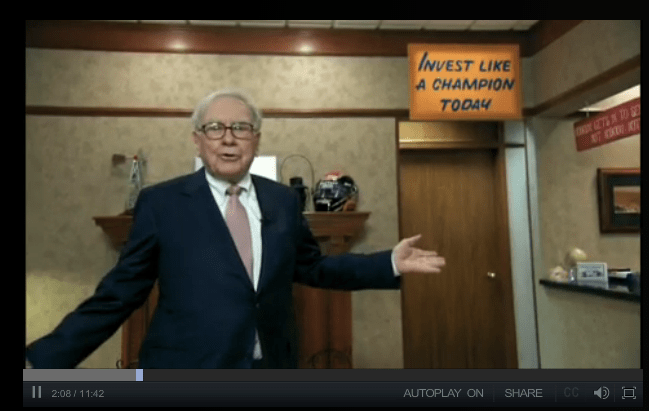
Screen Shot 2016-07-05 at 8.54.16 AM.png

Buffett said that he liked the Notre Dame Play Like a Champion sign so he had a similar one made for his office. Sometimes things just work and we can use them without knowing why. This idea is a second cousin to Nassim Taleb’s idea of lecturing birds how to fly.

3/ Wait for the right pitch. “Ted Williams described in his book, The Science of Hitting, that the most important thing for a hitter is to wait for the right pitch. That’s exactly the philosophy I have for investing.”

You have to know what the right pitch is (see #5) but also be able to wait. Bob Iger, the CEO of Disney said, “doing nothing can be a very powerful action unto itself.” Barry Ritholtz and Nick Murray  suggested the don’t just do something, sit there strategy.

This is hard to do, wrote Nassim Taleb, because “it is much easier to sell ‘look what I did for you’ than ‘look what I avoided for you.’”

Good timing though is a key variable in many successes. Milton Hershey, Tony Hawk, and Dire Straits all had great timing.

4/ Use the right tools.  “It (the phone) and a pile of reading material are the primary instruments. It’s just a question of gathering facts, which come in mostly via print and thinking about them. If I can make one good decision a year, we’ll do okay.”

When asked about a computer Buffett said “not in my office.”

When Twitter was released Seth Godin wondered, “will Twitter make me better at the things I want to be good at?” His answer?  “No.”

Nate Silver pointed out the difference between using the right tool and being right about the tool. “It’s not like the stat-heads won a unilateral victory…it’s more like people are saying ‘we have to be smarter about making decisions and use these different tools at our disposal.’”

To evaluate baseball players you need to use the best tool. To teach people you need to use the best tool. To invest you need to use the best tool. Silver, Godin, and Buffett all found  the best tools for them.

5/ Pattern recognition. “I’ve been reading IBM’s annual report every year for 50 years. This year I saw something that sort of clicked.”

Pattern recognition saves time and money. The best way to see patterns is through experience. The best way to gain experience is to read.

Reading is the fucking warp whistle from Super Mario 3. It gets you to the next level that much faster..

“Only a fool learns from his own mistakes. The wise man learns from the mistakes of others.” – Otto Von Bismark

Start-ups come to Andy Weissman because of his pattern recognition. Investors come to Jim Chanos because of his pattern recognition. Alex Blumberg started a company because of his pattern recognition.

Buffett too has great pattern recognition. At the 2016 Berkshire meeting he said:

“pattern recognition gets very important in evaluating humans and businesses and pattern recognition isn’t 100%, but there are certain things in businesses we’ve seen over and over.”

Thanks for reading, I’m @mikedariano on Twitter.
David Heinemeier Hansson

This is a post migration from Medium so I can link to it more easily. 
Photo by David Merrett.

DHH joined Dan Andrews on the Tropical MBA podcast and it was good.

Why? DHH is a contrarian. Not for the sake of being one (though you do get the vibe), but because he has something to say. He’s the anti-VC voice.

Part of the reason venture capital is so prominent, Hanson says, is because they trumpet their successes. Chris Dixon told Shane Parrish much the same, “it (VC) gets a lot of attention in the press but it’s a very small industry.”

Hanson is a bit bolder, comparing VC to a casino, lottery, and cabal.

Here’s the beautiful part, both Dixon and Hanson can be right. VC is good, and VC is bad. What matters is whether it’s good for you. Hanson says that if you want to swing for the fences, be a unicorn, then VC might be the way to go. But it might not too.

Here are a few other things I learned.

1/ Invisible scripts. “Hey, why didn’t anyone tell me about these alternatives,” Hanson says about his desire to speak out. He wants people to know that bootstrapping “a nice $5M” business is an option. He wants to unveil this hidden option.

We’ve had invisible scripts pointed out before:

We also know how to bust invisible scripts: reframe them.


2/ You can’t measure friendship. “I’ve found a group of people that I do like spending a lot of time with and that’s more special than people give it credit for.”

This Hanson quote brought to mind something Charlie Munger wrote:

“Practically everybody (1) overweighs the stuff that can be numbered, because it yields to the statistical techniques they’re taught in academia, and (2) doesn’t mix in the hard-to-measure stuff that may be more important. That is a mistake I’ve tried all my life to avoid, and I have no regrets for having done that.”

Whether it’s business or life we can be careful about overweighing the numbered stuff that yields to statistical techniques.

If happiness = Lamborghini + Lots of Money + startup + marriage; Hanson would be set. Hanson found this wasn’t the case, writing:

It was like I had pulled back the curtain on that millionaire’s dream and found, to my surprise, that most of the things on the other side were things I already had.

3/ Humility. “I retain the humility of knowing that just because I have hit a homerun with Basecamp does not mean that I have some magic voodoo touch that’s going to turn everything else into gold.”

A lack of humility (hubris) can destroy hedge funds and inflate economic bubbles.

Humility helps. It can help one “survive the vicissitudes of life”, launch a startup, or dominate a sport. And you can be humble with an admission of luck.

Thanks for reading, I’m [@mikedariano](http://twitter.com/mikedariano) on Twitter.

Patrick O’Shaughnessy

Patrick O’Shaughnessy was on the – just launched – Meb Faber podcast. The interview was good. Faber should have a good podcast, though if he gets too far into the weeds I’ll need to learn a few more things to follow along. O’Shaughnessy kept things easy and here’s what I noted.

1/ Where you start from matters. “We like to say that stocks are guilty until proven innocent. You shouldn’t start with market weights and move away, you should say ‘I want to built a reasonably diversified but highly active strategy based on factors like this.’”

Every position has a default. Have you thought about what it is?

For example, “No” is a great default for making choices. Mellody Hobson said that one of her analysts had a default of no. “Her process is one of elimination, she assumes she doesn’t want to own anything.” Michael Lombardi said something similar, “scouting is not about finding players, scouting is about eliminating players.”

Others use it for better productivity. Tim Ferriss, Chris Sacca, and Cal Newport all say they look at new projects and think “No.” Only if it’s really good, will it change their mind.


2/ The Finish Line Fallacy. “If you’ve been a concentrated deep value investors over the long term you do really really well. If you checked your account every twenty years you’ve been doing great. But people don’t do that.”

You can’t try to wins someone else’s race, with someone else’s finish line. I do this when on the treadmill, always looking around at the speeds next to me. It doesn’t matter in the gym, and it doesn’t matter in your portfolio. 

Charlie Munger said, “I don’t think it’s a tragedy that one competitor had a little better ratio one period…I don’t think we should worry about the fact that somebody else had a good quarter.” Tadas Viskanta said, “if you get someone in the market, you need to also get them out.” Josh Williams wrote that when he played someone else’s game it was the beginning of the end for his company.

Jason Fried took a wider, wiser, angle. When asked what success was to him, Fried said, “something you would like to do for many days in a row.” You fail to achieve this, he explained, if you try to finish someone else’s race. If you try to be Jeff Bezos.

“His success (Bezos) is one that’s very very hard to achieve…most likely you won’t get there…the odds are stacked against you…and if you think that’s the only way you’re going to be miserable.”


3/ Invert, always invert. “There’s tremendous value in studying short sellers. Most of the time the focus is on long investors who focus on the best companies to buy. I think  it’s more interesting to look at guys like Jim Chanos and their methodology for identifying companies to short. That way we know what stocks we can avoid.”

Typically, it’s Charlie Munger who explains it best:

“For example, if you were hired by the World Bank to help India, it would be very helpful to determine the three best ways to increase the man-years of misery in India—and, then, turn around and avoid those ways. So think it through backward as well as forward. It is a trick that works in algebra and a trick that works in life.”

O’Shaughnessy will look at what Jim Chanos condsiders important, and avoid companies that exhibit similar symptons.

Terry Gross said this works for careers too, “you find out who you are by finding out who you’re not.”

Mohnish Pabrai explained that Coca-Cola succeeded thanks to inversion as thinking. “The first thing you don’t do is losing half the brand name.” Coca-Cola had a great brand and what would have happened if they let other people use the Cola part of it?

Inversion was the jumping off point of my book; 28 Lessons from Start-ups That Failed. I found out how technology start-ups made money, personal, and strategy mistakes. Things like expensive marketing, fast hiring/slow firing, and not knowing customers were consistent start-up maladies.

4/ History rhymes. “It’s really expensive exciting stuff ($TSLA, $AAPL) for young people, really boring cheap stuff for older people, and if history rhymes, which it often does, that older, more boring and stodgier portfolio is probably going to do better.”

We’ll call this idea pattern recognition. It’s why Marc Andreessen and David Chang suggest people read biographies. They want to see patterns in successful decision making. Andy Weissman said pattern recognition is his best skill:

“If we were good at starting companies, we would start companies. We’re not good at starting companies, so we don’t. We don’t want to be involved in the running of the business, we can provide a good level of service because we have seen lots of different types of business at lots of different types of stages and we have good pattern recognition that provide frameworks for how to support the decisions entrepreneurs need to make.”

Tren Griffin pointed out the advantage of pattern recognition, stories, and history.  “Business school should be taught from more of a historical case format,” Charlie Munger believes, Griffin pointed out,  “that you learn from pattern recognition and in order to learn from pattern recognition you have to see a lot of examples.”

The value of pattern recognition is that it saves time and money (two things that kills companies).

5/ Smart humans do dumb things. “The company pre-announces earnings for no known reasons and the stock goes directly back to the strike price and I end up eating bologna and mustard sandwiches for a year.” – Faber

If humans are playing the game, they will do dumb stuff. When Richard Thaler began research that would form behavior economics he actually kept a list of theories title, “dumb stuff people do.” Charlie Munger talked about this too:

6/ Incentives matter. “There’s a law in economics that says when a measure becomes a target, it ceases to be a good measure. For example, there was a rat infestation problem in colonial French Vietnam. Their solution was that they would offer a small bounty for each rat tail turned in. People started collecting bounties, but then officials went out in town and noticed rats running around without tails. People were cutting off the tails and letting the rats return to the sewers.”

Shane Parrish was disappointed in the higher education incentives of you scratch my back, I’ll scratch yours. John Nagl studied different incentives for miltary surrender to see that sometimes you needed a carrot, and sometimes a stick. Napoleon Bonaparte’s troops sent their spoils home and created the incentive to keep fighting.

When you know the existing incentives you can also avoid them (inversion!).  Louis C.K. wanted to avoid traditional economic incentives when he made Horrace and Pete:

“I want to do this show for years I thought, but every time I took a big dramatic or tragic turn on the show, I thought, the only thing that keeps you from doing that in a sitcom or any series is that you need to stay within the margins so the show stays the same and so it can stay on the air. The decision to make big moves on a television show is economic.”


7/ Be there and eat your own cooking. “My advice is to be as hands on as possible, invest in this stuff yourself, eat your own cooking, live it yourself, talk to investors as much as you can – because investor psychology is everything.”

Wesley Gray said, “after being imbedded with the (Iraqi) people I started realize that culture matters.” You have to be there to best understand a situation. John Nagl found that the best military commanders were “smart enough to go out into the jungle.” Chris Dixon said places like NYC and LA are great because “with people in the arts and media and all kinds of different industries, and that creates a different creative dynamic.” Being there helps. 

But, we can invert this idea too. Josh Koppelman said “there’s a real benefit to not being in the valley echo chamber….to see how the rest of the world views technology is really compelling.”  He needs to see non-SF types use technology. Warren Buffett left NYC, said Jason Zweig, because too many people were whispering in his ear.

Tadas Viskanta put it best when he said, “you have to be much more of a conscious consumer.”

Thanks for reading, I’m @mikedariano on Twitter.

Wesley Gray

Wesley Gray joined Barry Ritholtz on the Masters in Business podcast. It was a pleasant surprise like the Andy Weissman interview. I didn’t know of Gray but enjoyed the interview. That’s the beauty of podcast subscriptions. Ready for the notes?

1/ When the pool of participants expands. When asked by Ritholtz what advice he would give young people, Gray said to  “build mental toughness,” because, “you’re competing not with Americans, you’re competing with the globe now. We have a lot of Chinese guys and they grind. They work harder, faster, stronger, so you gotta rise to the occasion.”

When the pool of potential participants expands, the competition is more intense. To put it another way; exploitable opportunities gradually disappear. Howard Marks said, “part of the luck is to get there early, and I did.”

In Full House, Stephen Jay Gould explains this in terms of a “right wall” in the distribution of results. As we get closer to the wall of limits (human bone density, speed of light, etc) then the competitors will start to bunch up. This is signalled in four ways:

  1. Flattening of improvement. Record breaking results come at a slower rate. We see fewer Warrn Buffetts. 
  2. Promise of even greater rewards. Financial, social, or other gains become available. It’s cool to be a startup, and you might even make some money.
  3. Become accessible to all. When women were able to run the Boston Marathon, their times improved at a faster rate than the men.
  4. Optimized methods of training. Bill Simmons said Lebron James is better than Larry Bird – esentailly because – he stayed healthy longer.

Burton Malkiel said:

“As the market gets more and more professional, when people are better trained, when people have better sources of information…it’s then harder and harder to actually beat the market.”

Milton Hershey saw this in the caramel business. He sold his Lancaster Caramel Company for a million dollars and started in a less crowded area – milk chocolate.

Marc Andreessen explained the idea this way:

“We don’t foreclose the possibility that there will be another mobile killer or social killer app but it’s getting harder and harder and harder because more and more people have figured out that you can do these things and the winners have gotten very established. One of the ways to think about it; first you had Facebook and then Twitter and then Instagram and now Snapchat, and those all became big winners. What would it take to make the fifth one? You only have so many icons on the home screen of your phone. It has to knock one of the other ones off.”

The more people who play, the harder it is to win.

2/ Butterfly effects in the game of telephone. “Model creep is like the old game with the kids. The little girl says ‘the princess kissed the frog’ and by the end of the circle it’s ‘spider man beat up he man.’ It’s a totally different stories because you have small little changes.”

I’d never thought of the game telephone as a metaphor for the butterfly effect, but it fits nicely. Small changes in the system can make big differences.

Waffle trainer  Phil Knight‘s waffle trainer (one of Nike’s first hits) opperated in this area.

A University of Oregon Alumni donated a million dollars for a new track. After the job was done, there were a few extra barrels of polyurethane around, and head coach Bill Bowerman took them home.

Bowerman was a tinkerer, and after seeing his wife make waffles one Sunday morning, he tried to pure the polyurethane in the waffle iron. It locked up the appliance. Bowerman didn’t stop. His next stop was an industrial processing plant that added a binding agent. A few more tweaks and a shoe that helped launch the Nike company was born.

If it hadn’t been for the donation, the extra materials, the waffles, or any other number of ingredients Nike’s shoe wouldn’t have been the same.

3/  Red flags. “We leverage a lot of technologies. People have built up statistical constructs to predict who will be red flagged as being a fraudster and at the outset, if you’re extreme red flagging on any of these things we remove them.”

As you get better with pattern recognition you can spot red flags more accurately. Gray employes the best pattern recognizers, computer algorithms. People can build this skill too. Jim Chanos credited his pattern detection skills. Chamath Palihapitiya said Dan Loeb leaving Yahoo was a red flag. Chris Sacca said it’s a red flag if “in the pitch the founder is trying to convince themself.” Naval Ravikant said a lack of energy, integrity or intelligence is a red flag.

Red flags can be anything, banks use trick questions, Van Halen used m&m candy.

Red flags are good heuristics, but only work when you know what to red flag.

4/ Facts > predictions. “If you have 50% margin year in and year out that’s probably a good business.”

Gray’s thesis is to invest in undervalued things that are still valuable. Easier said than done. Gray looks for cheap businesses that still have some good numbers. Not companies that are predicted to have good numbers, but actual-rock-hard-in-writing good numbers. 

Facts > predictions. 

“Extrapolation is a dangerous, generally invalid, and often foolish game,” wrote Stephen Gould.

Mellody Hobson said about the New York Knicks, “there may be a perspective of ‘they’re winning or not winning’ but we can look at the data like season ticket holders buying every year.”

Tren Griffin wrote that “what (Charlie) Munger looks for is a business that has a significant track record.”

B.J. Novak said, “you never know how something is going to play out until you test it…there’s no one smarter than the audience.”

5/ Busting biases (as best you can) “Even if you understand the biases. Even if you’ve memorized Kahneman’s book. Even if you know it, and how the biases influence you, you realize you still can’t control against the biases.”

If only reading this book could correct your biases. Sadly, it cannot. Even Kahneman(!!), who wrote the book on the planning fallacy still fell for the planning fallacy, said Jason Zweig.

6/ Humble pie is the best medicine for ego. “Thank god I had the opportunity to eat a lot of humble pie along the way.”

Gray said that early in his investing career he ate a lot of humble pie. Recent guest Ryan Holiday wrote a book that supports this kind of diet.

Chamath Palihapitiya cautioned, “ego is a terrible way to make decisions, it’s really good things to have, to make ourselves feel valuable and be confident, but that shouldn’t drive our decision-making.”

Jocko Willink said humility helps for leadership because “you gotta be humble and you gotta be coachable.”

David Heinemeier Hanson said, “I retain the humility of knowing that just because I have hit a homer with Basecamp does not mean that I have some magic voodoo touch that’s going to turn everything else into gold.”

Know were a little lucky. Know you could lose it all tomorrow. Try new things to remember being a pleb.


Thanks for reading, I’m @mikedariano on Twitter. Episode 023 of the Mike’s Notes podcast has two more ideas; stakeholders and culture.

Podcast update #2

Podcasting is still fun. I’ve found a balance between text and audio ones without too much overlap. My goal with the podcasts was like the blog, but different stories. 

Since update #1, here’s what I published.

  • Episode 022: 100-year-old business lessons (from Milton Hershey)
  • Episode 021: Three lessons from business of parody. (Terry O’Reilly)
  • Episode 020: Sunk cost missteps, including advice from [Mohnish Pabrai](https://thewaiterspad.com/2016/06/20/mohnish-pabrai/)
  • Episode 019: Business strategies used by Phil Knight and Peter Thiel

Updates here will be monthly, subscribe to get the episodes; https://itunes.apple.com/us/podcast/mikes-notes/id1055386383, https://soundcloud.com/mikesnotes, or https://overcast.fm/itunes1055386383/mikes-notes.

Early reviews are positive. My wife for example, said, “I’m glad you found someone else to listen to you talk.”

Walt Disney

Walt Disney 1946.JPG
I picked up the book, Walt Disney by Neil Gabler, after Marc Andreessen recommended it. The book is good, but it’s thick.

I’m only partially through the book, but entirely through Disney’s early career. Disney, like other noted people, has a lot of lessons from early in his career. Let’s see what they are.

1/ Disney was a grinder. “(The paper route) developed an appreciation of what spare time I did have and used it to great advantage in my hobbies.” – Walt “When he’d come home and long after everybody else was (in) bed, Walt was out there still puttering away, working away, experimenting.” – Roy Disney

Most biographers credit Disney’s work ethic to his demanding father, who worked on farms and factories. Disney was a relentless worker when it came to drawing cartoons, performing on stage, or filming movies. He did what Gary Vaynerchuk suggested:

“The people that win with my content are the ones who suck out everything I say for a year or two, then put their head down for 18 hours a day and then pop back up 3 years later and start reading more content from me because they’ve taken the first step and now they’re looking how to get from 1K to 1M.”

That’s what Walt did.

A girlfriend of an early animator who worked for Disney said, “he had the drive and ambition of ten million men.” Later on, when he married, Disney and his wife would go to the studio. She would take a nap while he worked, but as she slept he would turn the clock back an hour. Then, when she woke, he would point out that the time was still early and they could stay longer.

But you can’t be busy for the sake of business. You have to build up a valuable toolbox.

2/ Disney built up a skill toolbox.  “I found out that the inside and outside of an ambulance is as good a place to draw as any.”

Disney’s military service was sort, but valuable (see #3). He never gave up drawing when he was there. After he returned he started a cartooning business, and then film and animation. With each medium he built up valuable skills. He took art classes, checked out library books, and talked to the people who did the best work. 

The modern day example of this process might be Louis C.K.. He compared stocking his toolbox to the Matrix:

Louis C.K.: You know, like what’s the movie, “Matrix.”

Charlie Rose: “Matrix,” yes.

Louis C.K.: When there is a helicopter and he says to her, you know how to play helicopter. And she goes wait a minute and she loads the program. Now I do. Well, anyone can do that. It just takes longer. You can just load a program. So, now I know how to create a multi camera drama and mount it the same week that I shot it. And how to direct many great actors which I had never done before.

Malcolm Gladwell said you can built up a writer’s toolbox working for a newspaper. “It used to take me ages to write,” said Gladwell, “then I worked at a newspaper for ten years and I was cured of that.”

3/ Travel is a net positive. “(France was) a lifetime of experience in one package.”

Disney loved his time aboard. Jamie Foxx and Tim Ferriss both said travel affected them on a spiritual level (Africa and Japan).

Travel lets you see the world. Elizabeth Gilbert started to travel because she heard to write what you know but admitted she didn’t know anything.

Travel is much better than reading a book about a place said Tyler Cowen.

4/ **Barter as a starter.” “I got to be a little celebrity in the thing.”

Disney said that after he sold an early animation to a distributor for what it cost him to make, leaving no profit. The publicity he earned though was probably worth more. Another instance was when he traded work for office space, drawing cartoons for a newspaper. 

5/ Constraints help creativity. “The first Mickey Mouse was made by twelve people, after hours, in a garage.”

Disney created other successful characters, but lost them through legal poaching. One to a distributor, another to an early partner. Mickey Mouse was his third creation, and he only came up with it because he had to. It had to be something they could animate quickly. It would be an animal. It couldn’t be a cat.

Each constraint chipped away at the range of choices until Disney could only do so much, and out came Mickey Mouse.

Donald Campbell said, “the greatest thing about being Scottish is that you’ve got something to push against.” Jason Fried said “fewer official working hours helps squeeze the fat out of the typical workweek.” Terry Gross said she’s glad her show isn’t longer because it forces her to squeeze in a good conversation.

Constraints help us be more creative.

6/ Flyting. “We voice our opinions and sometimes have good old fashioned scraps, but in the end things get ironed out and we have something we’re all proud of.”

Though Walt may have had the last word, there was a lot of back and forth before he ruled.

Wilbur Wright said friend of the family George Spratt “was always ready to oppose an idea expressed by anybody…ready to jump into an argument with both sleeves rolled up.”

True, said Wilbur, but “a good scrap….brought out new ways of looking at things…helped round the corners.”

Flyting is a marker of places of genius. Ancient Greece had the symposia, Florence had workshops, Edinburgh had flyting (15th century rap battles), and Calcutta had the adda.

7/ You are never ready. “Everything’s fine. When I get back we’re going to make a big start…but he really didn’t have anything. And then on the train he sketched out some plans.” Roy Disney

Walt and Roy Disney learned their lessons the hard way. They oscillated between success and bankruptcy. They got scammed and taken. They hustled and were hustled. They were never ready for the business until they were ready.

The modern equivalent is the story of Nike that Phil Knight tells in Shoe Dog. Knight, like Disney, is never ready for the next thing.


8/ Want more than money.  “If you want to know the real secret of Walt’s success, it’s that he never tried to make money. He was always trying to make something that he could have fun with or be proud of.” Ward Kimball, Animator

Money is nothing more than fuel. Nicholas Megalis comared it to gasoline. Phil Knight compared it to blood in the body. Robert Kurson found that treasure hunters wanted to find treasure to fund their next treasure hunt.

Money, said Tim Ferriss is “wampum.” It’s the thing that leads to the THING.

9/ Home field advantage.

Part of the reason the Disney’s lost their intellectual property (#5) was they didn’t know the rules of the game. Walt especially was too trusting of early partners and Roy’s role grew as he had to keep Walt from making too many errors.

Walt’s domain of expertise was in creating art, not negotiating distribution. He was a skilled basketball player who sometimes mistakenly dabbled, on a baseball field.

Actual baseball players, the Chicago Black Soxs made the same mistake. They had no gambling experience (or plan) when they threw the 1919 World Series. They failed to win, and failed to get well paid.

Napoleon Bonaparte often created home field advantage. When he didn’t, he faced the worst loses; Waterloo, Spain, Russia.

Warren Buffett said, “we don’t look at something like that (Amazon.com) and try to beat them at their own game. They’re better than we are at that, and we aren’t going to try to out Bezos Bezos.”


Thanks for reading. Thanks for reading, I’m @mikedariano on Twitter. The podcast version of this blog (with different stories) is available wherever podcasts are posted; https://itunes.apple.com/us/podcast/mikes-notes/id1055386383, https://soundcloud.com/mikesnotes, https://overcast.fm/itunes1055386383/mikes-notes.