Rorke Denver

It’s one thing to see connections is similar things, Grit in athletes for example. If you find something that works in one sport, people like Pete Carroll will try to get it to work in another.

It’s a different kind of treat if you find connections in different things. That’s part of the appeal of what Rorke Denver writes about in Damn Few. There are things in the Navy SEAL training that can apply to a range of situations. I noticed at least four.

  • Why to roll play and run simulations.
  • Conditioning for luck.
  • The support great work needs.
  • Wait. Wait. Wait. Go!

Ready?

1/ Role play. “At the range, we have special malfunction drills for each make and model of weapon. We load a dummy round inside the magazines that will cause the gun to stop firing. You never know when that bad round is coming through. Now, how quickly can you clean the jam and get back into the fight?”

Tim Kennedy showed the same thing on Instagram.

A video posted by Tim Kennedy (@timkennedymma) on May 4, 2016 at 12:16pm PDT

This role play is valuable because it turns abnormal situations into normal ones. Denver wrote that when it came to shoot someone, he was so conditioned to the act of shooting at bodies (or at least the silhouette shape) that it didn’t affect him.

Good simulations don’t have to involve guns. We can create them anytime there is an unknown outcome that we want to prepare for.

Gene Kranz, a flight director from the Mercury through Apollo programs wrote about the simulations they did to get into space, take people through space, and land on the moon.

  • Once Kranz arrived at his office and was told he had ‘been in a car accident’ on the way and had to sit out the training runs that day. Everyone else stepped into a new role.
  • In another simulation a communication director based in Hawaii ‘had a heart attack’ and only after the simulation was over did Kranz learn it wasn’t true.
  • On the final day of simulations before the Apollo 11, a day that typically ended on a high note to encourage self belief, simulation threw Kranz’s crew  error code “1202.” Kranz ordered an abort. It was the wrong call, but a good simulation. That code, which no one had seen before, came up during the actual lunar descent.

Phil Knight saw the value of roll play  (after a few missteps).

Before Nike, Knight started a company called Blue Ribbon Sports and they imported shoes. Knight needed help. He talked Bill Bowerman – his college coach – into joining the venture. “Sure,” Bowerman told him, “come over and we’ll draw up the papers.” Knight arrived at Bowerman’s house to find Bowerman, his wife, and his lawyer all there. Knight recalls Bowerman’s wife tilting her head and “gave a pitying look. Boy they’re going to skin you alive,” she said.

Luckily for Knight, they didn’t. This meeting and a few in Japan with the shoe manufacturers taught him he should roll play his meetings. He did, writing that “Like two actors running lines, we went through every possible argument.” Sometimes he needed it. Sometimes he didn’t.

It’s not easy, and it requires going deep. “Simulation is no substitute for investing, since most mistake in investing are psychological.” wrote Tren Griffin.

The military has dummy rounds. NASA has a Simulation Supervisor. Phil Knight had someone to verbally joust with. The better the dress rehearsal, the better the performance.

2/ Conditioning for luck. “Fairness is an irrelevant concept in war. Screwing with the trainees’ expectations—forcing them to deal with failure, irrationality, and unpredictability—is a vital part of training SEALs. Things won’t be fair on the real-life battlefield, where the stakes are infinitely higher.”

If #1 Role Play, was about training for things you can control. Then #2 is about training for things you can’t control. It’s about exposure to luck. During training Denver calls it “random acts of instructor violence.”

The violence isn’t a literal physical assault. That has no place in SEAL training. But those extra PT evolutions sure can feel like abuse. “What did we do wrong?” the trainees want to know after some especially grueling evolution. “Nothing,” the instructor shrugs. “Just do it again.” And again. And again. It’s brutal. But it does send a message:

Luck is a hard thing to pin down, to point at and say there it is!

Part of it is a problem with the detection. It’s bad equipment (You and me!).

Jack Schwager said “I’ll have good luck too. The bad ones you really notice. The good ones you’re smart on the bad ones are bad luck.” It’s the ability to attribute success to your smarts and failure to external faults.

Luck, Michael Mauboussin consistently points out, can be good or bad, can be large or small. Sometimes we just get lucky. The stats for this blog are a good example. Part of the reason many or few people read it is what else is published. If it’s a slow week, more readers come here. If something bigger happens, less.

What the heck do we do about luck?

Acknowledge it, know that it affects your results, but focus on the process.

Half of soccer is luck. Economists and Coaches agree. What do the latter – like Pete Carroll –  do? They focus on the process.

Knight put it this way, “Luck plays a big role…Hard work is critical, a good team is essential, brains and determination are invaluable, but luck may decide the outcome.”

3/ Support to be great. “Standing on the beach in a tight, quiet circle with Ro, Big D, Cams, Lope, and the others, I talked about balance instead. “Before we step on that bird tomorrow and begin this campaign,” I said, “we need to be sure everything at home is taken care of. Your finances are in order. Your families have what they need.”

If you want to do extraordinary things, like write best-selling books, be in professional sports, or be a Navy SEAL you must have support to do it.

In episode 033, Failure is Not an Option we talked about this idea, around the 21:00 mark.

To recap here.  When Malcolm Gladwell wrote Outliers, he wanted the 10K hours idea not to be an instruction but a warning. If you need 10K to be great, then there are all kinds of things you can’t do.

“To me the point of 10,000 hours is: if it takes that long to be good, you can’t do it by yourself. If you have to play chess for 10 years in order to be a great chess player, then that means that you can’t have a job, or maybe if you have a job it can’t be a job that takes up most of your time,” Gladwell told Stephen Dubner.

Gene Kranz, our NASA flight director agreed. “Behind every great man is a woman – and behind her is the plumber, the electrician, the Maytag repairman, and one or more sick kids. And the car needs to go into the shop.”

The Wright brothers never married. They lived at home where their sister (and then hired help) helped out. Robert Kurson‘s pirate hunters had marriages that ended because someone wanted to be an 10K hour expert. Jay Leno told  Judd Apatow that he kept his requirements to a minimum so he could do comedy. Leno tried to minimize the stakeholders becuase he couldn’t answer to them and become a commedian.

In Denver’s podcast with Brett McKay he said

“When you first start the training program demands are full-time with very little time off. When you show up with your first team you’re going into multiple rounds of advanced training. Then you’re going to deploy and chase the nation’s enemies. It’s very very taxing on families. You have to have an extremely strong gal that’s going to make it through that experience.”

You need support to be great.

4/ Wait. Wait. Wait. Go! “Take time to deliberate, but when the time for action comes, stop thinking and go in.” Napoleon Bonaparte

Denver didn’t want to have any part of Act of Valor. He told them “no.” Twice. Then he started to think about it and talk about it. He changed his mind. Denver writes that he wanted to inform people about what being a Navy SEAL is about.

Part of any success in life is getting the timing right. Warren Buffett says it’s waiting for the right pitch.  It’s having the patience to wait, wait, wait and then go.

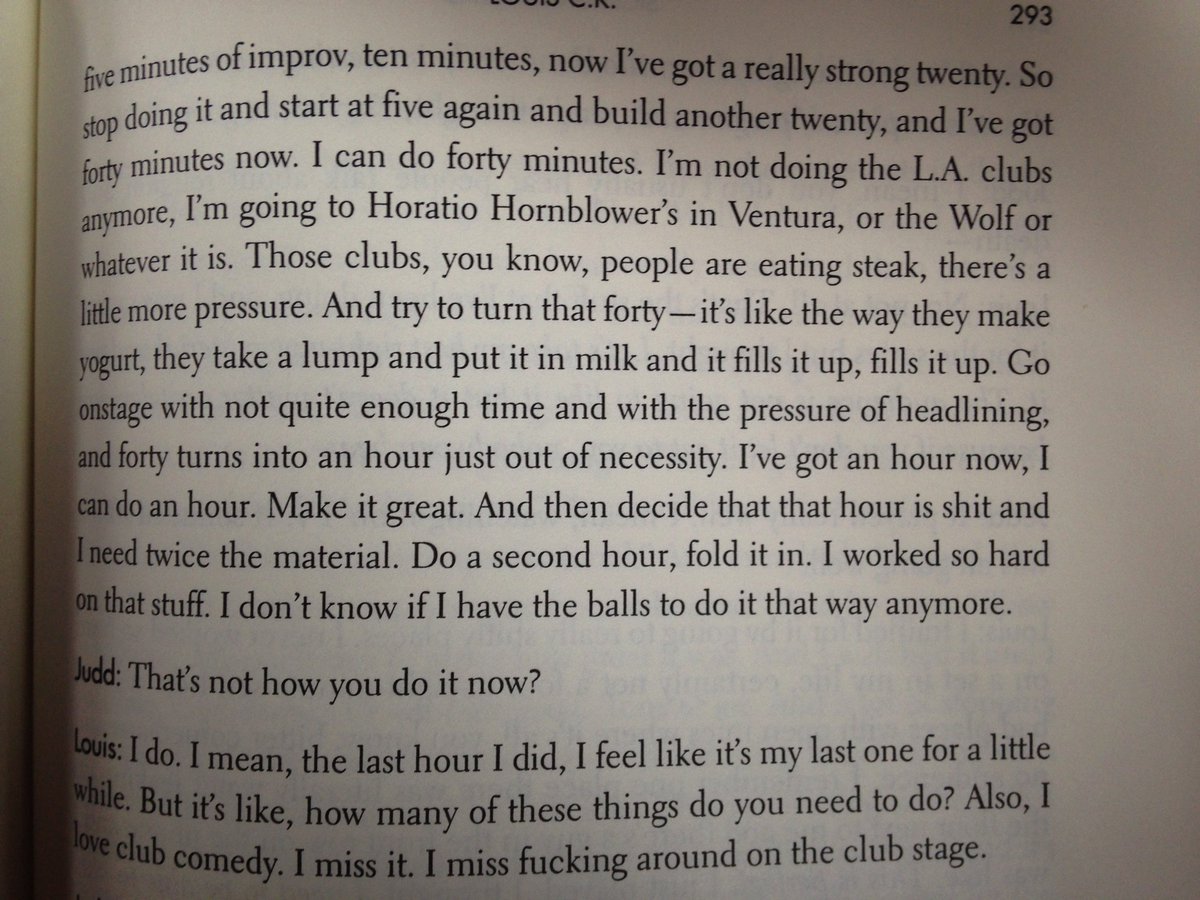
Louis C.K.  was patient enough to make Horace and Pete.

Gary Vaynerchuk warns people that it’s going to be a slog. Too many people, Vaynerchuk says, are  “very impatient  in the first twenty-four hours out of the box. They’re looking for fast and cheap dollars.” It doesn’t work like that. You need to be patient, persist, and have grit.

We’ll give the final word to Steven Pressfield:

“The professional arms himself with patience, not only to give the stars time to align in his career, but to keep himself from flaming out in each individual work. He knows that any job, whether it’s a move or a kitchen remodel, takes twice as long as he thinks and costs twice as much. He accepts that. He recognizes it as reality.”

Thanks for reading. If you liked this post, you might like my podcast: https://soundcloud.com/mikesnotes or book.


Pete Carroll

The serendipity of life is marvelous.

On a family visit to the library I saw Grit (which I recently wrote about). In Grit there’s a story about the Seattle Seahawks, who Ryan Holiday had just visited. Head Coach Pete Carroll started Win Forever with Michael Gervais, who hosts the podcast, Finding Mastery, which has some great episodes, among them one with Pete Carroll. Here are my notes.

1/ Leaders need to support their troops. Carroll said that a fork-in-the-road moment (circa 1973) was when he started to ask his players what they thought they should practice.

“I’d just had a night meeting with the defensive backs and I had decided to ask the guys what they needed to work on. We had a great discussion. I was filling up the board with stuff that we could figure out in their individual periods. It was the best meeting I’d ever had. I was so fired up. I ran into Chester Caddus (the head coach, “as old school as you could get”). He said, ‘you don’t ever ask your players what they want to work on. You tell them, you’re the coach. I don’t want you to ever do that again.’ I was just crushed, but later I thought, maybe he doesn’t get it.”

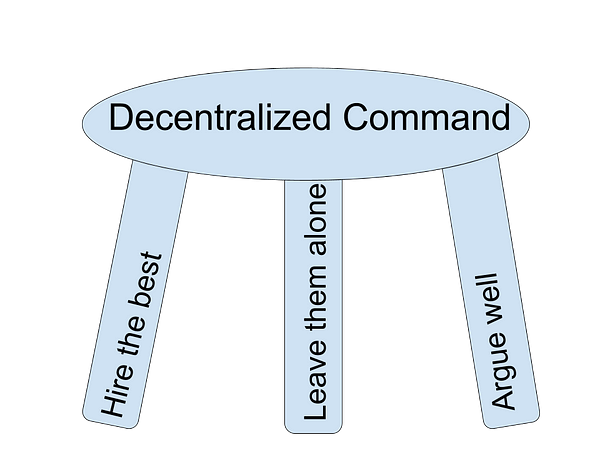
Carroll had found the idea of decentralized command – when a leader trusts individuals to make the right choice. Note, this only works when there is top down support from those leaders. Caddus didn’t provide this, Carroll does.

During the Apollo 11 moon landing there was a lot of pressure. The Mission Control Flight Director Chris Kraft told Gerry Griffin “Young man, we don’t have to go to the moon today. It’s your call.”  That was important, wrote Gene Kranz, “The impact of Kraft immediately removed all political pressure from the decision. Griffin knew all he had to do was make the right technical call.”

Carroll does this too:

“When I help guys in our organization I’ll give them guidelines. ‘When we’re in a situation, it’s okay to do this, if it doesn’t work out I’m fine with that.’…If I’m not making the call, they’re making the call for me and I’m going to try to bolster their confidence to go for it…If you called it on my team, I’m the one that ultimately takes responsibility for it. So go for it.”

Having leaders that create this environment isn’t easy, but it’s often fruitful. Phil Knight created it at Nike. It’s how to build the world’s greatest airplane. It’s how you find Russian submarines. It’s how Jocko Willink teaches leadership.

Decentralized command is paramount when times are tough. In his book, Only the Paranoid Survive,  Andy Grove explains the value of engineers, salespeople, and factory managers having a say.

“They (middle management) usually know more about upcoming changes than the senior management because they spend so much time ‘outdoors’ where the winds of the real world blow in their faces.”

Ed Catmull echoed the value of decentralized command. He said about the University of Utah, “It was completely free and open. Great professors, and they weren’t micromanaging. It was like, okay, we’re at the front of the easter egg hunt, cut the line and let’s go.”

If you don’t know exactly which way to go, trust your people.

2/ Be there. “If I’m not living it, how can I expect anyone else to. It’s trying to be as involved and available as possible. You can’t sit on your butt and do that.”

Carroll has an open door policy. A lot of great leaders do, though it may not matter. A lot of great leaders aren’t ever in their office. They’re out there.

Coca-Cola people do this a lot. Neville Isdell went all over the world and into some harry situations to see what people were buying, how, when and where. In For God, Country, and Coca-Cola, Mark Pendergrast writes, “Doug Ivester liked to prowl the back alleys of the world to see where Coke was or was not. He spent a third of his time on the road.”

You have to go see it, smell it, eat it, and talk to customers between bites. (Not talking to customers means death).

Percy Fawcett had to be there to discover things (unlike what he called “armchair archeologists”.) John Nagl wrote about how being there is great military strategy. Samuel Zemurray was there to create a banana empire.

After John Chatterton found a U-Boat off the New Jersey shore, he walked through a similar one at a museum to get a feel for the ship.  Stanley McChrystal did the same thing, only substituting Afghan vineyards for the submarine.

3/ Process is greater than product. “The winning/losing thing. The judgment at the end of it. You can’t focus on that. If you focus on that you’re missing all the things that happen in the meantime. What really gets you there are the good plays, one after another. One step at a time. One thought at a time. If you believe and trust in that, the outcome will turn out the way you want it to.”

Process is more important than product because product is a liar.

Well, maybe it doesn’t lie, but it clouds the truth. Product is a touch random.

In this Michael Mauboussin post we looked at the role randomness plays. Randomness (alias: good/bad luck) is to some degree in everything. When that’s the case, we can’t know absolutely how our effort leads to an outcome.

fork-in-the-road-585348_640.jpgIt’s easier to figure out how you messed up chicken cacciatore than how you lost a football game. Carroll’s career has a fair bit of randomness and he needs to be especially careful. Attributing an outcome to skill when it was luck is like misreading a hiking sign and going down the wrong path.

Carroll avoids this by shifting his attention to process.

4/ Be relentless.  “When you’re a competitor you don’t rest. You’re either competing or you’re not. We’re in a relentless pursuit of finding the competitive edge in everything we’re doing, and that’s a mentality. You’re either competing or you’re not. You’re either working at doing better or you’re going in the wrong direction. You’ve got to be on. You can’t be too comfortable, you have to keep pushing.”

People who succeed are relentless.

Gary Vaynerchuk observed:

“The people that win with my content are the ones who suck out everything I say for a year or two, then put their head down for 18 hours a day and then pop back up 3 years later and start reading more content from me because they’ve taken the first step and now they’re looking how to get from one thousand to one million.”

Walt Disney was relentless. The girlfriend of an early animator said Disney “had the drive and ambition of ten million men.” Later on, when he married, Disney and his wife would go for a drive through the country that always ended at his studio. She would take a nap while he worked, but as she slept he would turn the clock back an hour. Then, when she woke, he would point out that it was still early and they could stay longer.

Anson Dorrance “despises nothing more than holidays,” and has for a long time. A schoolmate remarked, “the rest of us just wanted to make good enough grades to stay in school, play sports, drink beer, and pick up women, but Anson’s goals were greater. He was not just another guy in the dorm. He was very busy doing Anson things.”

Stephen King jokes that he only takes off three days a year (Christmas, July 4th, his birthday) because it makes for good copy. He really doesn’t. “The truth is that when I’m writing, I write every day.” Peter Thiel wrote that there are many secrets to find, “but they will only yield to relentless searchers.”

Why do you have to be relentless?

In absolute terms you need to get better at the thing you’re doing. Disney had to get better at animating. Dorrance better at communicating. King better at writing.

In relative terms you need to get better than anyone else. Catmull’s work on computers had to be better than everyone else’s. Grove’s microprocessors had to be better too. Carroll’s team is very vulnerable to relative changes.

One more thing, have you ever been to Relentless.com?

5/ Culture. Given the right environment people “will function at a higher level. They’ll come in earlier. They’ll stay later. They’ll be more on it. They’ll inspire those around them. That’s the subtle way of improving an organization.”

Culture is a multiplier. Good culture is a 2.25X boost. Bad culture is a 0.8X drag.

Carroll talks a lot about good culture (like #1, how leaders support their troops; and #3 a focuses on process).

Thiel wrote, “no company has a culture, every company is a culture.” Early Nike, for example, was a group of “butt heads.” Culture is not offering Yoga or ping-pong. Culture, says Auren Hoffman is what makes you different. Culture can create things like Grit.

If you try to transplant culture like an organ it’s going to be rejected. I liked how Shane Parrish put it:

“You can’t just add 20% innovation time to your organization and expect you’re going to be Google. No, you have to understand what Google was doing. How it fit in their culture. Why it was part of their culture. Why it worked as part of their culture. And now why it’s stopped. And you further have to map it to the base rate.”

Thanks for reading, I’m @mikedariano on Twitter.
Grit

Grit by Angela Duckworth was everything I wanted. Easy to read, but backed by research. Memorable stories, but not retreads. New material, but not beyond grasp.

Duckworth’s book is about the foundational blocks of grit, some of which we’ve seen here. Here are 5 things gritty people do.

1/ Love the grind. Early in the book (page 8) Duckworth asks, “why were the highly accomplished so dogged in their pursuits?” What she found was that “They were satisfied being unsatisfied…It was the chase as much as the capture that was gratifying.”

It was the journey, not the destination – and not easy journeys. Not downhill with the wind at our backs journeys. Every journey. This is familiar. Jocko Willink talks about it all-the-time.

“It’s kind of like when people talk about going through SEAL training. They think you can make it through if you don’t want to make it through. But if you truly don’t want to make it through, you’re probably not going to make it through. It’s the same thing with jujitsu. It’s hard to do it just for the black belt.”

If you’re doing it just for the ends, the black belt, or the title, you (probably) won’t have enough fuel for the journey.

Soccer coach Anson Dorrance says it’s about the trying not the winning.  

“We judge our performance against the ideal game. We want perfect passing, perfect finishing, perfect organization overall. So we’re not really playing against our opponents, we’re playing against the game. It’s impossible to beat the game, but we want to keep trying.”

Dorrance is thinking about the journey (the work) not the destination (the outcome).

Ideas like overnight success and I want it now blur the spirit of the process.

You have to learn to love the grind. To love the process. To embrace the journey, even when the winds at your face, the hill is steep, and it’s just started to rain.

There are ways to make the grind more enjoyable. Like a parka when it’s snowing or a shovel to dig a hole, a few key tools can keep the work a challenge and not an impossibility.

Duckworth writes that you focus on the nuances after the novel is gone. You can also build out your skills, reframe your obstacle into a game, or find something where you act like a missionary (rather than a mercenary).

2/ Simple but not easy. “Greatness is many, many individual feats and each of them is doable.”

Duckworth calls it the mundanity of excellence, and notes “mundanity is a hard sell.” The advice she’s giving about how to to be great is simple but not easy.

Gina Martin Adams and Barry Ritholtz talked about how investing is simple but not easy. That post included many simple but not easy links, here they are again, and we’ll note to add Duckworth’s ideas about greatness.

Surviving at sea is simple, but not easy.  Starting a soccer team is simple, but not easy.  Creating another Silicon Valley is simple, but not easy.  War is simple, but not easy.   Eating right is simple, but not easy.  Leadership is simple, but not easy.  Deep work is simple, but not easy.

3/ Persistence. “Grit is about working on something you care about so much that you’re willing to stay loyal to it.” “In interviews about what it takes to succeed, high achievers often talk about commitment of a different kind. Rather than intensity, what comes up again and again in their remarks is the idea of consistency over time.”

As the saying goes, half of everything is just showing up (but you have to show up everyday).

The other day I didn’t want to run, but wanted to have run. I ended up running. About a mile in, I thought, “I can’t believe I didn’t want to do this today, this feels great.” The hard part was showing up.

To persist means running everyday, or writing, or whatever verb leads you to your goals. It’s loving the grind (#1) because each night when you fall asleep the board gets reset. Each morning you wake up at zero. Yesterday’s score of 1, or 25, or 1,000,000 doesn’t matter. Persistence means working today no matter what you did yesterday.

A family friend of the Wright brothers  noted that they were “two of the workingest boys around.” When times were good, and not. After the 1901 trip to Kitty Hawk, Wilbur was so flummoxed and frustrated  that he considered quitting the whole thing. However, writes David McCullough, “The pall of discouragement disappeared in a matter of days, replaced with a surge of characteristic resolve. They would make a fresh start.”

The brothers persisted.

Michael Ovitz is another example of this kind of persistence.

  • Ovitz’s elementary teachers asked his parents to tell Michael to ask fewer questions in class. He didn’t, he persisted.
  • When Ovitz got his first ‘inside’ job (rather than outside giving studio tours)  he finished his required work as fast as possible so he could do other things he wanted.
  • When Ovitz started his own agency, co-founder Michael Rosenfeld said, “We just worked seven days a week, around the clock….just to watch Ovitz was enough, if anybody had any doubts about our succeeding. This was not a man who was thinking about failure.”

At each stage of his life Ovitz consistently worked toward his goal. This persistence was so intense(“I drove people crazy, I drove people out of their minds, but they liked it. I was this brash, inquisitive lunatic.”) that it overcame his interpersonal shortcomings. Paul Newman said Ovitz was a cross between Mother Teresa and a barracuda.

Grit is about getting up each time you’ve been knocked down. It’s about doing the work each day.

4/  Culture. “If you’re a Seahawk, you’re not just a football player. If you’re a KIPPster, you’re not just a student. Seahawks and KIPPsters do things in a certain way, and they do so for certain reasons. For instance, growing up, my dad liked to refer to himself as a Duponter.”

Culture can build grit. Culture can build anything. Artificial culture, much like artificial plants, doesn’t provide the stuff you really need.  Duckworth writes that culture means you make a “categorical allegiance to that in-group.” You identify as a something.

When Ben Horowitz wrote that “yoga is not culture,” this is what he meant.  Auren Hoffman said that culture is the thing you do that’s different.

Wesley Gray saw this on the battlefield. When he was in Iraq, Gray saw that 5 months of military presence (no matter how big the guns) was not going to untangle ages of culture.

  • Artificial culture is installing office plants, saying Yoga is culture, buying ping-pong tables, or giving kids iPads and calling it techno-literacy.

Andy Grove saw the importance of culture. When Intel was fighting for its survival, Grove needed everyone to be pulling in the same direction. Culture facilitates that.

“An environment like this is easy to describe but hard to create and maintain. Dramatic or symbolic moves do nothing. It requires living this culture, promoting constant collaborative exchanges between the holders of knowledge power and the holders of organizational power to create the best solutions in the interest of both.”

Culture builds attitudes. Some of those – like grit – can take organizations incredible places.

5/ Too hard pile. If it’s too hard, give up. (Really)

Duckworth suggests this kind of goal organization.

FullSizeRender 5.jpg
From my notes.

Everything leads to the master goal at the top. Sometimes one of the bottom circles will prove too hard, require a skill we don’t have, or be obstructed because of financial, geographic, or timing obstacles. It’s important, writes Duckworth, to switch to an adjacent goal that will still lead to the top.

“Ideally, even if you’re discontinuing one activity and choosing different lower-order goals, you’re still holding fast to your ultimate concern.”

It’s the goal setting equivalent of Charlie Munger‘s investing theory. Munger says that if it’s too hard to figure out if an investment is good or not, move on.

In podcast 034 we looked at how Bill Simmons uses this too hard idea for potential football wagers.

Simmons says, “I wouldn’t bet on anything in this division. Stay away from the AFC South.” Simmons, like Duckworth and Munger rules one path as too hard and moves to an adjacent one.

Jack Canfield told the story of a family friend who wanted to play in the NBA. The young man was good, but not good enough to fulfill his dream of playing professional basketball. Okay,  Canfield recalled, if that’s too hard, what’s a parallel path? The young man figured out a front office job was more achievable. He did it. He made it to the NBA, as an executive.

I like Duckworth’s book a lot. If you want to see more of what I’m reading, sign up to get a monthly email.

– @mikedariano


Gina Martin Adams

Gina Martin Adams joined Barry Ritholtz on the MIB podcast. I’d never heard of Adams, but this was a good interview. Let’s get into the notes.

1/ Passion. “If you have a passion for this business you will find a home, but you have to have a passion.”

I hate passion as advice. It’s only half of the story. The other half? Hard work.

Tren Griffin wrote, “One trick related to passion is that you are not likely to be passionate about something you do not understand…the more you know about some topics, the more passionate you will get.”

That’s the key. You need an understanding, a skill, a level of competence to ignite the flywheel that passion spins.

Mohnish Pabrai said, “I have a rule I’ve followed for my entire career: if on Monday morning I’m not fired up for work I do two things. Number one, I don’t go to work. Number two, I hit the reset button.” On the surface that sounds like follow your passion, but it’s really more like, do something that rewards you.

PassionSkill (1)Things that reward you are hard, but not too hard. Dan Coyle found the sweet spot in athletics. So too did Steven Kotler. Austin Kleon pointed out that his dream job has a lot of things that aren’t dreamy.

Jocko Willink said “If you are super passionate about it there’s a very good chance you’re going to be one of the top performers.” It’s not just the passion that gets you there. It’s the work.

I think Adams meant this. That, it’s going to take a lot of hard work for a great job and that you’ll need some passion to help you through it.

2/ Fighting the last war. “Today anything is a massive problem for the banks. I think a lot of what’s holding financials back is this psychological impediment ‘when’s the next crisis coming?’…you can name a gazillion things that are going to ‘bring the banks under’ which are so unlikely but the psychology is set up to expect that kind of thing.” – Adams

“It’s classic recency effect. Every general is fighting the last war. Every investor is thinking ‘here comes the next credit crisis.’ It’s never what just happened, it’s always something different.” -Ritholtz

Recency effects happen to us all the time. I just finished Faiulure is Not an Option and did a podcast episode about it (#033). One of the stories in there was about the recency effect.

About the Apollo 1 disaster, where an eruption in the module killed all three astronauts, Gene Kranz wrote about why they couldn’t escape:

“The exterior opened outward while the interior pressure hatch opened inward. It was a brute, heavy and awkward. Given the design, a rapid escape from the spacecraft was impossible. But the NASA and North American designers hadn’t been as worried about escape contingencies as they were about the possibility of a hatch popping open into the vacuum of space or another inadvertent opening during a water landing. The premature opening of Gus Grissom’s Mercury hatch and the loss of his capsule was a lesson not easily forgotten.”

This makes sense. Solve a problem after you face it. You don’t want the door to open in space. You don’t want the door to open during splashdown. We solve these problems well, but we often stop there.

The problem is that we don’t think through enough counterfactuals. We don’t ask, what else could happen? Michael Mauboussin had a great explanation about counterfactuals, and we can expand it here.

NASA solved for BIG BAD OUTCOME #1 (space coming in) and #2 (ocean coming in) but missed #3, (astronauts can’t get out). They fixed it, but what about #4, #5, and so on?

In the book Kranz notes the tradeoffs you have to make. Designers can’t solve every problem. Coming up with as many counterfactuals as possible gives you a chance to decide how many problems you want to solve. You commit to solving a, b, c, and d, but choose not to solve, e, f, g. NASA learned this the hard way.

I’m diving into Red Teams and part of what makes them so helpful is that they see a wide array of problems. Red teams succeed because they bust cognitive biases, they find new facts, they understand history. When Marc Andreessen says he trashes the shit out of Ben Horowitz‘s arguments he does so to test them. He’s trying to avoid effects like fighting the last war.

We can’t “fight the last war.” We have to fight it and figure out what’s next. Red teams help do that.

3/ I don’t care that, it’s just too hard. “Have people just thrown up their hands and said, ‘you know what, I’m just going to index and not even think twice about it.’?” – Ritholtz

“I think that’s part of it. I think more importantly it’s that investors have just shunned the equity market altogether.”- Adams

I loved this exchange because it lets me tie together two great quotes.

The ultimate beauty of index funds is that they get you utterly out of the business of guessing what will happen next. They enable you to say seven magic words: “I don’t know, and I don’t care.” – Jason Zweig

&

If something is too hard we move on to something else. What could be simpler than that? – Charlie Munger

I’ve written more about Jason Zweig and Charlie Munger other places, so we won’t rehash all their ideas here. But this one is beautiful. It’s all about the Sigmoid curve.

z03hs

At some point your effort leads to diminishing returns. You have to make a tradeoff.

Do I continue to conduct investment research, write books, or learn to play the guitar OR DO I read my kids more books, exercise more, or spent an extra hour at work?

Investing, unlike say, guitar practice or reading books to kids, is really hard to do well. As Michael Mauboussin, Jack Schwager, and Gladwell and Simmons pointed out (via soccer), as the competition increases, success is harder and more prone to luck.

Why not just do something else with your time?

4/ Finding secrets. “Our clients are the institutional investors. What are the products that their clients are asking them for. It’s passive products in a lot of ways. So my client may want something very different than they wanted in the past.”

This part surprised me. Adams’s client’s clients are relaying the message to them about what they want. That doesn’t often happen.

Have you ever told the local Ford dealer what you want to see manufactured? No, you just buy a Toyota the next time.

Adams’s and her clients need to find secrets. Peter Thiel crystallized the idea of finding secrets, and I’ve come to visualize them like coal seams. They’re all around us, but they’re hidden. Some are big, some small. It takes a bit of digging and work, but you could find one.

  • When Phil Knight founded Nike, he found a secret.
  • When Apple released a touchscreen smartphone, they found a secret.
  • When J.K. Rowling wrote Harry Potter, she found a secret.

When Steve Jobs said “A lot of times, people don’t know what they want until you show it to them,” this is (probably) what he was getting at. He found a secret that people wanted, but couldn’t articulate. Here are some others:

  • I couldn’t articulate that I wanted a Disney vacation, but we’ve been there as a family and it was great.
  • I couldn’t articulate that I wanted a watch so tough you could wear it while handling a chainsaw, but I bought a Casio G-Shock.
  • I couldn’t articulate why a book about Coca-Cola would be good, but it was.

Secrets are everywhere. If you run a business you need to constantly be looking for them.

5/ Simple, but not easy. “Everybody who started on a trading desk is always told ‘cut your losers short and let your winner run.’ Understanding that and actually doing it are two completely different things.” – Ritholtz

Life itself, is simple, but not easy.

Surviving at sea is simple, but not easy. Starting a soccer team is simple, but not easy. Creating another Silicon Valley is simple, but not easy. War is simple, but not easy. Eating right is simple, but not easy.

Solving what do I do and how do I do it are both important questions.

6/ Pattern recognition. “I distinctly recall sitting in my office during that summer and thinking ‘why is the market so  ridiculously stable, what does the market know that I don’t know?’ then you think back to that period and you have a lot of people saying Bear (Stearns) was the big moment and that was going to be it. Then suddenly you have this wave of trouble in the fall.”

In his interview with Ritholz, Michael Mauboussin joked about hindsight bias. It seems like there’s a little here with Adams too.

If there isn’t, then Adams should have acted on her pattern recognition. When something doesn’t smell right begin further examination.

Coke used to send their executives to Europe to build their pattern recognition skills. Disney did the same thing, only at a resort in Denver. Ground Control for space missions did it with simulations.

Pattern recognition is a super power. Athletes have it. Investors like Jason Calacanis, Jim Chanos, and Warren Buffett have it. Fighter Pilots like John Boyd have it.

The faster you can Observe, Orient, Decide, and Act – the better you will be. Pattern recognition gets you through these OODA loops faster.

7/ Strengths in weaknesses and weaknesses in strengths. “Being a woman on Wall Street is both a blessing and a curse. There are a lot of blessings that come along with being a woman on Wall Street. You are immediately recognizable. It’s a curse because you 100% don’t fit in – still. ”

In your strengths are weaknesses and in your weaknesses are strengths.

  • Wigan, a soccer team, takes long shots that have a low probability of going in (weakness) but which allow them to recover on defence (strength).
  • Tim Ferriss saw this in wrestling and started to look everywhere for them.
  • When you are surrounded by an enemy (weakness), it also means you have unlimited fields of fire (strength). And vice versa.
  • The 1919 Chicago ‘Black’ Soxs were so disorganized they didn’t get paid by the gamblers who promised (weakness) but when they went to trial the state couldn’t prove they conspired together (strength).
  • Tony Hawk had to form his own style (weakness) which became the de facto way later (strength).

If you have a weakness, turn it into a strength.

Thanks for reading, I’m @mikedariano on Twitter. If you liked this post, you might like my book – http://amzn.to/1nztynB. If you didn’t like this post, well, why are you still reading?
Podcast Update #3

avatars-000203369713-p89s0v-t500x500You can subscribe to my podcast at the usual sources (033 was my favorite). Here are the links if needed:

Here are the episodes I’ve done so far.

023 Wesley Gray on stakeholders and culture. The type of person you have to answer to matters a lot and so does the culture (which you have to be there to figure out).

024 Warren Buffett. Five ideas from a short interview Buffett gave with CBS. It goes along with this post: https://thewaiterspad.com/2016/07/13/warren-buffett/

025 Neville Isdell, former Coca Cola CEO. Lessons from a Coke lifer.

026 Early Warren Buffett. Another Buffett podcast, this time focusing on his early letters.

027 Jack Schwager. Backup plans, tailwinds, and waiting for the right pitch.

028 What happened to Yahoo? The blog post for this episode got a lot of hits. It also serves as an inverted example to what Schwager talked about in 027.

029 The beginning of UNC soccer. Part of the reason UNC soccer has been dominate is the way they started. This episode looked at four features anyone can apply.

030 The coach of UNC soccer, Anson Dorrance. Dorrance preaches effort and in this episode we looked at how that relates to Sisyphean tasks.

031 Andy Grove. This one was fun. Grove was a brilliant leader and his book Only the Paranoid Survive served as the backbone for this episode and the post.

032 Michael Mauboussin. Also fun. Mauboussin talked with Barry Ritholtz about a slew of good thinking ideas. This was the podcast that accompanied the post I wrote.

033 Lessons from Mission Control. MY FAVORITE ONE. What can we learn from the person who was the flight director for the Apollo space missions?

Soccer guesses by Simmons and Gladwell

Malcolm Gladwell and Bill Simmons talked about the 2016 Olympics and one part at the end caught my attention.

Simmons says,”it’s incredible to me that the US women’s soccer didn’t make the final four in the Olympics,” and  “there’s a whole strategy conversation that’s probably super nerdy for this.”

I’ve got some super nerdy theories that fit within the things we’ve looked at on this blog.

  1. Talent gardens have to be seeded (players) and weeded (coaches).
  2. Certain things happen when the best people play.
  3. Soccer outcomes are a lot about luck.

Ready?

1/ Talent gardens. It’s fun to think of natural talent in the same fairy tale terms as overnight success. Neither exists. Talent, like flowers, requires a garden to grow. Dan Coyle pointed out that you need to have the right setting (even if it’s just a “penniless Russian tennis club”) and you need role models who “fill the windshield.”

Gladwell put it this way a few years ago:

“So why are the Jamaicans so good? There are many reasons, but the simplest is that the effect of peers on high performance are REALLY strong. In Jamaica, EVERYONE sprints. There are 20 heats in the 100-meter regional championships. And because everyone sprints, and the average quality of sprinting is so high, everyone’s expectations are raised accordingly. The psychological ceiling on elite performance if you are a high school sprinter in Kingston is, like, a foot higher than if you are a high school sprinter in America.”

In the podcast he told Simmons, “they (Jamaicans) are finding 100% of their sprinting talent.” In our garden metaphor; they have good seeds (psychological ceiling), good dirt (lots of focus on it), and good weeding (coaches who’ve seen and done a lot).

This isn’t easy. Gladwell’s recent Revisionist History podcast (episode #4)shined a light on how poorly the education system does this. If you are a really smart, but also really poor kid, the chances of someone finding your for an academic scholarship are low. Especially compared to a similar percentile kid that plays football.


You are what you measure. You are what you grow.

For all the focus on the athletes, we may be focusing not enough on the coaches. Gladwell says:

“There’s two separate things we’re talking about here. One necessary revolution has to be in the numbers of people who are playing a sport. And the second necessary revolution has to be in the sophistication of the coaching and preparation…I wonder if we underestimate the coaching preparation contribution and overestimate the pool.”

We have great seeds, but don’t weed the garden. That’s not to say we don’t cull it correctly, but maximize the growth.

Part of having great seeds is having a lot to choose from. It’s like a choice of restaurants in New York versus Yorktown. This is not the problem US Women’s Soccer has. “For men the best athletes are playing basketball,” Simmons says, “from a female standpoint it would seem like soccer is where the best athletes are.”

Soccer  gets the best American female athletes. That’s good, but certain things happen when the best participants get a chance to play.

2/ What happens when the best play? Simmons – a soccer dad – guesses that part of the problem for the US Olympic team was that they don’t play the right style. He sees youth soccer as chip and chase soccer. Teams are so focused on winning at all levels they prioritize it above everything else.  “At some point that catches up to you because everybody is fast, everybody is good,” Simmons says.

When the number of people drawn to something explained Stephen Jay Gould, the results begin to push against “a wall.”

bellcurvewithtails

Walls mean we go from Fat Tails to a (more) Normal Distribution.

When baseball allowed more players, the batting average distribution became more narrow, though the mean didn’t really change.

It wasn’t because of some mythical mathematical principle that rules the world, but because of “a right wall.” There is a physical limit to how fast a human can swing a baseball bat, react to a pitch, and build strength. Those limits form a wall and force the distribution to condense.

If women’s soccer participation has increased we should expect to see similar trends as in baseball. The more players, the more good players, the closer we get to the “right wall” of human performance.

morris-datalab-wsoccer-1
Image from Five Thirty Eight Data Lab

Soccer participation has gone up, and so we can expect the pattern to continue. Not only in the US, but globally.

When you get more people playing a ZERO SUM GAME it gets more difficult to win. (1)

Nate Silver played online poker, until it converged at right wall.

Burton Malkiel said “The problem is, as the market as the market gets more and more professional, when people are better trained, when people have better sources of information…it’s then harder and harder to actually beat the market.”

Michael Mauboussin coined the term “paradox of skill” which applies here. When skill goes up, to have success, you need luck to go up too.

Imagine the World Series of Poker. Eight thousand people qualify, the top one thousand get something back.  In the 2010 tournament, researchers found that the better the player, the bigger the payout.

Players classified as high skill are 12 percent more likely to make the money than the average player, and 19 percent more likely to make the final table.

At the final table you need some luck. Annie Duke told Charles Duhigg, “all we can do is learn how to make the best decisions that are in front of us, and trust, over time, the odds will be in our favor.”

To rephrase it, all we can do is make the best decisions and know we’ll have some bad luck. When lots of people participate the skill needed to win improves. At that stage – whether it’s the World Series of Poker or Olympics – you need to get lucky.

3/ Luck.  Soccer, like most things in life, comes down to some degree of luck. Chris Anderson wrote, “Soccer is basically a 50/50 game. Half of it is luck and half of it is skill.” Bad bounces, late reactions, and one half second too late all have a sort of butterfly effect on the game. You need some luck to succeed.

5ezoihnzv0mfk

After the US Women lost, goalkeeper Hope Solo said,  “The better team did not win.” There’s a decent chance she was right. If the ‘better’ team gets less ‘lucky’ in a game that’s 50% skill and 50% luck to begin with, then the better team will not win quite often.

Her comments seemed so out of line because EVERYTHING IN LIFE IS LIKE THIS.  Like Al Pacino says in the clip, “in life and football…one half a step too late or too early and you don’t quite make it.”

The same week Neil Strauss released a book and began his big media circuit Hurricane Katrina struck. How’s that for luck.

Phil Knight wrote, “Luck plays a big role…Hard work is critical, a good team is essential, brains and determination are invaluable, but luck may decide the outcome.” For someone who wore the Nike jersey, Solo missed this.

We tend to forget the good luck says Jack Schwager “I’ll have good luck too. The bad ones you really notice. The good ones you’re smart on the bad ones are bad luck.” We have hindsight bias.

Good luck and bad luck is in every bit of our lives.

Thanks for reading, I’m @mikedariano on Twitter. If you liked this post about podcasts, you can check out my podcast https://soundcloud.com/mikesnotes

(1) One area this has not been true is basketball. Zach Lowe and Marc Stein talked about it (~31:00)

Stein mentions that he’s confused about why Argentina hasn’t gotten better and he says “I know they’re a soccer nation” but then cites the Golden Generation (Ginobili, Scola, Nocioni). Why hasn’t Argentina basketball approached the right wall domestically, and reached a certain level at worldwide play? They were there, but now they are not.

Because Argentina is a soccer nation that got lucky Manu Ginobili played basketball. He just happened to have the right set of genes and be born into the right family along with a few other good players.

Argentina is 31st in population so the odds were good that someone could succeed.  Take any of those pretty good players off the Argentine teams and you likely don’t have the period of success. Argentina capitalized on good luck rather than a right wall. It makes sense they would revert to the mean.

To summarize:

  • Countries reward things differently. In America, basketball is more rewarded than soccer which is more rewarded than intelligence.
  • Rewards attract more people.
  • More people means more competition and shifts the standard deviation of outcomes until they approach some kind of limit.
  • Once at that limit competition within or between groups leans more heavily on luck.

Jim Miller

Jim Miller is on the podcast book tour to promote Powerhouse: The Untold Story of Hollywood’s Creative Artists Agency and he spoke with Bill Simmons about it.

Miller’s given some good interviews (like this one with Aaron Watson) but what I’m most excited for about the book is Ovitz. I read the 1997 ‘Ovitz’ book and it has little bits of (“I drove people crazy, I drove people out of their minds, but they liked it. I was this brash, inquisitive lunatic.”) How you can read that and not want to learn more ?  It sounds like Miller’s book has it.

Ready for the notes from Miller?

1/ Find secrets. “There were through lines between all three (CAA, SNL, ESPN). Lorne Michaels at SNL, disruption. ESPN and the birth of cable sports, total disruption. CAA 1975 and beyond, disruption. Just blowing up the existing ecosystem that had been there.”

Each alphabet soup companies found a secret. They found things that people wanted but where the needs hadn’t been answered.

I recently finished, For God, Country, and Coca-Cola about the ENTIRE HISTORY OF COCA-COLA. Mark Pendergrast actually does a great job of taking the behemoth apart one piece at a time. One theme of the book was that Coke found secrets (accidentally and on purpose). One was bottle size:

In 1990, when Doug Ivester took over the North American sector, Morgan pitched him with the idea of a 20-ounce contour bottle for Coca-Cola Classic. Ivester enthusiastically approve the project. In March 1994, when the bottles hit Chicago test markets, they outperformed anyone’s wildest expectations, boosting sales by 224 percent in a matter of weeks.

A 224% increase means you’ve found a secret!

But one the cola company never even thought to look for. For a time the six and a half bottle was the only way you could bottle Coca-Cola. As the company explored and tested they discovered secrets.

“Every great business,” wrote Peter Thiel “is built around a secret that’s hiding from the outside.”

Phil Knight did this when he started Nike. There was no such thing as athletic shoes, much less athletic brands. Companies didn’t sponsor athletes. There was little indication that the sports apparel market was a real thing. The only person looking there was Knight. In one hand was a graduate school project, in the other some startup cash from his dad.

Tony Hawk found a secret in the skate world.Milton Hershey found a secret in chocolate. Ed Catmull found a secret in computers that could make movies.

Secrets are like untapped geysers in a world where everyone is thirsty.

2/ Congenial intensity. “All of sudden they (Michael Douglas and Joel Silver) look over and Ron Meyer is jumping over the craps table to beat the crap out of two guys, including one guy who was really big.” “Which is it, is he (Meyer) the nice Jewish guy who talked to his mom every day while she was alive and that everybody loves or is he the guy who was in the marines and his body is covered in tattoos and is probably the last guy you want to piss off because he plays for keeps. That’s a duality you don’t see everyday.”

I loved this story, but when I started to think about what it meant I started to see it everywhere. How is it that Jocko Willink is a former Navy Seal but also Dear Abbey of sorts via his podcast? How is it that Steve Jobs was mercurial but Ed Catmull said that wasn’t quite right? How does Anson Dorrance push his players to the edge but keep a father figure type role?

My guess is that this duality is – one of many – a valuable skill, especially for leaders. You have to be intense in pursuit of the right things, but not in others. As Meryl Streep told James Cordentake the work seriously but not yourself.

3/ It’s never cut and dryIt’s never single effects. “You tell a couple of stories where here’s all this bad stuff this guy (Ovitz) would do, he’d threaten people…all this stuff.” Simmons “At the same he was doing an incredible jobs for his clients. It’s not just one-dimensional. It’s not just one narrative.” Miller

Ovitz, intensity without congeniality. If he worked for you, all the better. If he was against you, batten the hatches. He’ll (probably) come off as a villain in this book at worst, a jerk at best. Miller and Simmons note though that he did some good things too. We should consider both sides of this ledger.

“He’s a cross between a barracuda and Mother Teresa.” Paul Newman

Net-net thinking takes time and effort when we don’t always have both. In the Michael Mauboussin post we noted how we mentally loaf rather than finding base rates and comparing our situation. Net-net thinking requires those resources too.

Charlie Munger thinks we should think net-net about Coca-Cola. Sure, the health effects are neutral at best, but what about your productivity, energy, or mood? Does Coke make you get more done? Does it make you happier? No one would say a Disney vacation ‘wasn’t worth it’ just because it cost thousands of dollars. They’d ask if you had a good time. Why, Munger wonders, is Coke not considered the same way. Is it like a vacation for your mouth.

411-620x836

Another Coke example (geez, this is a lot of Coke in this post, but c’mon, I just read ~500p on the company) is New Coke. Largely deemed a failure because the $4M project was poorly received by the public.

Here’s some of what people wrote in: “Would it be right to rewrite the Constitution? The Bible? To me, changing the Coke formulas is of such a serious nature.”

People were not happy.

That was one side of the ledger. Let’s take a moment of time and bit of effort and ask What else happened?

It turns out that Coke got more than $4M of publicity by the time pivoted and restocked Coke Classic. “Unintentionally,” Pendergrast writes, “Goizueta and Keough had converted the gigantic marketing blunder into a commercial coup.” Further, “despite – or because of – the New Coke fiasco, the Company’s soft drink market share in the United States had swelled to 39% versus 28% for Pepsi.”

Was New Coke a mistake or not? If you look at things from a net-net perspective it’s harder to judge.

4/ Playing the long game. “I couldn’t believe that CAA doesn’t get recurring commission on the four billion and counting that Seinfeld has made.” Simmons

Wait a moment said Miller. “Ron Meyer was the one who basically took CAA out of it because Howard West and George Shapiro wouldn’t have been able to be part of the show, and they asked him as a favor…and remember it was called the Seinfeld chronicles, it was just a pilot. Even given the success of Seinfeld he did a solid for his buddies George and Howard.”

Seth Klarman pointed out that you want to leave a little meat on the bone for someone else. Klarman says that he tries to sell a position before it hits what he guesses is the highest value so that there are people to sell to. In this same way Meyer was able to line up other projects for CAA.

Long term success and short-term success often have different actions. Nick Murray said, “I don’t know how anybody who’s a counselor to advisors who are trying to get their clients to think and act long-term would sully himself with a forecast of any kind.”

Ovitz too saw the difference in long-term versus short-term actions. “You don’t get respect unless you first command respect,” Ovitz said, “you can’t ask someone to do something you won’t do yourself. You have to be first out of the foxhole if you want to lead in battle.”

“When a task had to be done, Ovitz said to himself, ‘I’m going to do it,’ and the other four all said ‘great.’ And before anyone realized it, Ovitz knew more about the business than any of the others.”

5/ Timing Matters. “Ovitz and Meyer were lucky they were in the movie business back then because they had much more influence and many more clients working. It’s a tougher business now.”

Part of finding secrets is the timing in finding them. You can have a great idea (Mark Cuban suggested streaming music) but if the time isn’t right you’ve got nothing.

Ovitz and Meyer had good timing for a new type of agency.

Failed Start-ups had poor timing for their ventures.

Barbara Corcoran had good timing for NYC real estate.

Chamath Palihapitiya had poor timing for the Facebook phone.

6/ Counterfactual construction. “That’s a fun ‘what if’ if (Tony) Kornheiser’s wife had okayed the L.A. move…what if Mike Ovitz had taken the Universal job?” Simmons “What if Tipper Gore had allowed Al Gore to let Bill Clinton give a couple of speeches for him in 2000?” Miller

In the Michael Mauboussin  post I wrote about how hard counterfactuals were to come with. Compared with the outside view, especially so. To get the outside view we start at the base rate and then move up or down, left or right. Counterfactuals are harder because you don’t start  anywhere. In fact, if you start from what actually happened you might be biased by that  very result.

Simmons and Miller have a solution. Ask ‘what it?’

I remember ‘What if’ questions being banned in 7th grade English class, but they’re actually quite valuable. Along with ‘Why 5X’ we can get to other ideas more easily this way.

  • What if Sam Hinkie hadn’t been fired?
  • What if LTCM has pulled out of the nosedive?
  • What if the Soviets had sunk an American submarine in the cold war?

commonpocketsThese ‘What If’ questions unlock a mental door I didn’t know I had much less one that I had locked. Mauboussin used a roulette wheel in his analogy of counterfactuals and that’s a good one because we can see what the other choices were. Black 15, Red 19, Black 4, etc.

‘What if’ questions begin to populate a roulette wheel of our own counterfactual outcomes.

Thanks for reading, I’m @mikedariano on Twitter.


Michael Mauboussin 3

Michael Mauboussin joined Barry Ritholtz on the Masters in Business podcast and I loved every minute of it. Mauboussin is great, and I’ve taken notes on some of his other conversations; Michael Mauboussin with Shane Parrish and another with Michael Mauboussin and Ritholtz.

I saw a lot of tweets about this interview and someone said that what makes Mauboussin a good interviewee is that he understands things deeply and can speak clearly. I couldn’t agree more. If you want to skip ahead there were 7 parts to my notes.

  1. Know the pot and the payout.
  2. Incentives matter.
  3. The inside and outside views.
  4. Wonderful story telling machines.
  5. How should you invest?
  6. Hold my beer and watch this.
  7. Rising ducks on rising tides.

This post is a longer one. If you want to buy it for ease of reading on a Kindle or via the Kindle app, purchase it on Amazon. If you want to listen, get the podcast version. If you’re reading it here, let’s get started. 

1/ Know the pot and the payout. (“Any damn fool can see.”)  “If you’re a handicapper and you want to make money there are two things that are important. One is how fast the horse is going to run (the fundamentals). Second is the odds on the tote board. The way you make money isn’t picking a winner. The way you make money is picking mispriced odds. That idea really carries over to investing. I think as investors many of us blur those two things.”

Jeff deGraff puts it in poker terms “if the opportunity to stay in the pot is low enough and the reward is high enough, absolutely stay in. Even though there might be a very slim chance of pulling a straight, the chance to stay in makes an awful lot of sense.”

Charlie Munger is – of course – the most colorful conveyor of this idea:

“Any damn fool can see that a horse carrying a light weight with a wonderful win rate and a good post position etc., etc. is way more likely to win than a horse with a terrible record and extra weight and so on and so on. But if you look at the odds, the bad horse pays 100 to 1, whereas the good horse pays 3 to 2. Then it’s not clear which is statistically the best bet using the mathematics of Fermat and Pascal.”

Short seller Jim Chanos said he’s seen “seen far more stocks go to zero than infinity.” If you short a stock, you could theoretically, have uncapped losses. The sky’s the limit, but Chanos says this rarely happens.

Cliff Asness explained this to Tyler Cowen:

“I want to ask one of my two older kids (age 12)… ‘Does this (merger arbitrage) sound like a good idea to you?’…There’s about a 98 percent chance they say, ‘No. That sounds like a terrible idea to me, you can lose a lot, you can make a little. Who wants to do that?’ I’d be the proudest pop on Earth if either one of them kind of paused and said, ‘how often do both of those two things happen, Dad?’ Because, that’s the proper question.”

The point we want to get to is the “pause.” It’s not to “blur” the two things. We want to think through the idea. We want to ask why it’s a good bet to make.

Sometimes longshot bets are worth placing if the cost is low, and  sometimes almost certain bets are worth placing even if the cost is high. Most things are somewhere in the middle. 

Know the pot. How much you can win?

Know the odds. What’s the chance for each outcome?

Do the math.

Note that this gets harder the more people doing it. Mauboussin calls this the paradox of skill, “if the people who are less capable are walking away from the poker table, who’s left?” As my dad says, if you look around and can’t tell who the fool is, it’s you.

The paradox is that, “when activities have both skill and luck, as most things do in life, as skill increases luck becomes more important,” explained Mauboussin. Luck becomes more important because there are fewer fools at the poker table and the range of skills has narrowed.

Burton Malkiel used this to explain why it’s hard to be an active investor, “the problem is, as the market gets more and more professional, when people are better trained, when people have better sources of information…it’s then harder and harder to actually beat the market.”  

Nate Silver said he stopped playing online poker because of exactly this. Stephen Jay Gould called it the “right wall” and explained how it works with distributions.  Former Philadelphia 76ers General Manager Sam Hinkie put it this way in his farewell letter:

“Opportunities in a constrained environment winnow away with each person that agrees with you, though. It reminds me of when we first moved to Palo Alto. Within about a week of living there a voice kept telling me, “This is great. Great weather, 30 minutes to the ocean, 3 hours to ski, a vibrant city 30 miles away, and one of the world’s best research universities within walking distance. People should really move here.” Then I looked at real estate prices. I was right, yes, but this view was decidedly not a non-consensus view. My viewpoint as a Silicon Valley real estate dilettante, which took a whole week to form, had been priced in. Shocker.”

There are two parts to any investment; the horse/company/house/investment and what people think the horse/company/house/investment are worth. Ideally something is accidentally mispriced (Seth Klarman talked about this), but it doesn’t happen often.

Situations get even harder to figure out when the novices leave the table and the remaining skill level is high.

2/ Incentives matter. Mauboussin was once asked to suggest a better research process. He proposed the research team be split. One group works on one area, one on another. Then they come together at the end of the process and compare notes. “They kind of said ‘that’s a cool idea, see you later,’ it didn’t go very far.”

Mauboussin’s idea was probably good, but the people listening weren’t incentivized to try it.

Incentives are a powerful force. Charlie Munger says “what wins in human affairs are incentives.” He tells this story:

From all business, my favorite case on incentives is Federal Express. The heart and soul of their system—which creates the integrity of the product—is having all their airplanes come to one place in the middle of the night and shift all the packages from plane to plane. If there are delays, the whole operation can’t deliver a process full of integrity to Federal Express customers.

And it was always screwed up. They could never get it done on time. They tried everything: moral suasion, threats, you name it. And nothing worked.

Finally, somebody got the idea to pay all these people not so much an hour, but so much a shift—and when it is all done they can all go home.. Well, their problems cleared up overnight.

So getting the incentives right is a very, very important lesson. It was not obvious to Federal Express what the solution was. But maybe now, it will hereafter more often be obvious to you.

Mauboussin suggested the company split their research according to point #1.

  • What’s the fundamentals of the business, the skill of the team, the cards in your hand, the quality and location of the house?
  • What’s the stock price, the odds of the team, the chances with your cards, the housing market? 

Answer these questions separately and then at the last moment bring them together to get an accurate picture of what’s happening. My guess is that the idea didn’t go very far because the managers had the wrong incentives. Their incentive was career preservation. One way we do this is erring to fail in normal ways rather than succeed in abnormal ones.

A profession that’s had this examined a lot is football, here’s coach Kevin Kelley.

Kelley doesn’t punt on fourth down. He’s been very successful, but recognizes the traditional incentive system.

I liked was this quote most ( 1:12).

9sgen6yga1o3e

That’s the impression. That’s the incentive. Don’t be a crazy nutjob. Especially when things are going well. What’s the incentive if you’re doing well? Don’t rock the boat.

Toward the end of the interview Mauboussin comes back to this point about sports. “This remains remarkably pervasive… they’re still doing things that don’t make a lot of sense…A lot of it is that people grew up with the sport. They can’t expand their view.”

I’d argue that the things they are doing do make sense in the system of incentives that exist in sports.

Sports aren’t completely about winning and losing. Sports are about reputations, attitudes, attendances, feelings and ego. If sports were all about winning and losing then things like prima donna soccer owners wouldn’t be a thing and Sam Hinkie would still have his job as GM of the 76ers.

In episodes #3 of Malcolm Gladwell’s Revisionist History podcast he looks at this very thing. Wilt Chamberlain refused to shoot his free throws underhand – EVEN THOUGH IT MADE HIM A BETTER SHOOTER!!! – because he didn’t like the way it looked. Sports isn’t always about winning.

When the Philadelphia 76ers fired Sam Hinkie, it was about more than basketball. Hinkie wasn’t trying to win in the traditional way. He could be bad, but not that bad. His system I guessed was good, but the incentives weren’t to win that way. 

Hinkie’s situation reminded me of when Bill Belichick was the Cleveland Browns head coach. Neither guy was great with the media (think about their incentives when a coach doesn’t appear buddy-buddy). Belichick’s demise began when he cut quarterback Bernie Kosar. This is from The Education of a Coach.

“On Monday, November 8, they cut him, and they did it with a certain brutality, as Belichick spoke of Kosar’s diminished skills. For Cleveland the unthinkable had happened. He had cut their favorite son.”

The people of Cleveland doubted him. Doubted the football coach who is a defensive mastermind. The coach whose father was a long tenured assistant. The coach who won two Super Bowls with the Giants with Bill Parcells. The coach who no one outworked. Here’s what an early peer said.

“I think a lot of it came from the fact that he had not played big time football and because of that he felt he had to work twice as hard as anyone else to prove himself, to prove his bona fides…he was someone who was simply not going to be denied.”

That’s the guy who was fired a week after the team owner moved the franchise to Baltimore. That’s the guy who the fans changed “must go” for each home game after Kosar was canned.

The incentives in sports go beyond only winning.

Incentives matter and figuring out which incentives matter to which people is a powerful tool.

3/ The inside and outside view. Mauboussin uses the example of a kitchen remodel to explain the inside and outside view.

The inside view is what you know about the kitchen, the contractor, the job, and the situation. “Left to our own devices,” Mauboussin says, “that’s how we solve problems.”

Then we see our neighbor one day and he asks about the van in the driveway. We tell him about the remodel (already delayed, countertops) and he smirks. He knows that remodels take longer and cost more. He’s the outside view.

“Psychologists have found,” Mauboussin says, “that introducing the outside view almost invariably improves the quality of decisions.” The problem is that we loaf. It takes a mental effort to come up with the outside view  and then compare it to what we were thinking. You need to figure out the range of outcomes for the kitchen remodel then where yours might fall in that range.

There’s a way to make this easier. Rules, numbers, and formulas.  

“The virtue of basic rules for buying and selling are precisely because you take the emotion out,” Mauboussin says, “and you’re making fundamentals and expectations two separate things.” Emotions are the inside, rules and numbers are the outside. Remember, when dealing with people (you included), you will be dealing with emotions. Those can cloud the inside view even further.

Business is emotional. Andy Grove wrote, “People who have no emotional stake in a decision can see what needs to be done sooner.” That is, people who see more of the rules and numbers side. But you can’t just present the facts. You have to untangle them. “Confusion engulfs you,” Grove wrote. “In many instances, your personal identity is inseparable from your lifework.”

That’s the kind of emotional investment involved. That’s why, Mauboussin says you need rules. “I felt the frustration that comes when the things that worked for you in the past no longer do any good,” wrote Grove. Look at that not from the Intel executive angle but from the investor angle. You had a system that worked, it made you one of the best in the world, then it stopped. Is it permanent? Maybe a dip? A blip? It’s certainly how you define yourself.

It’s easy to write about the inside/outside view or to listen to Mauboussin talk about it. Application is much harder. The inside/outside view is a simple but not easy system. To do it well we need practice. Fortunately this starts the same way, it’s all about the base.

In situations without a big swing (Intel), we can look at the base rate. We can ask “What normally happens?” Remember coach Kelley? Want to guess the base rate for fourth down conversions of three yards or less?  It’s one hundred ten out of two hundred twenty. That’s the NFL number. Start there. That’s the base rate, the outside view.

What if your team practices this skill and gets better than the base rate? What if the other team knows this and practices against it? Start with the base rate and move around from there.

Screen Shot 2016-08-20 at 7.13.50 AM.png
Or just Google it. These are expected points from fourth down attempts based on field position.

Another reason to get the base rate/ the outside view/ the numbers and rules point of view because the people involved in a project tend to be more optimistic about its completion and success than people not involved (like the kitchen remodel). This happened to Daniel Kahneman. He was part of a team of people tasked with writing a new textbook. They began the work and in the beginning it was easy. He writes that the team had made good progress over the first year.

Soon they began to write about the planning fallacy (Chapter 23 of Thinking Fast and Slow ).

Well, thought Kahneman, let’s see what this looks like up close. He asked each team member to write down how much longer they thought the book would take to finish. The collective average was 2  years. Not bad, but Kahneman didn’t stop there. He writes:

“I turned to Seymour, our curriculum expert, and asked whether he could think of other teams similar to ours that had developed a curriculum from scratch… and Seymour said he could think of quite a few.”

Okay, so far so good.

“I asked him to think of these teams when they had made as much progress as we had. How long, from that point, did it take them to finish their textbook projects? He fell silent.”

Uh oh.

“I never realized this before, (Seymour said), but in fact not all the teams at a stage comparable to ours ever did complete their task.”

Oh no.

In groups with comparable situations 40% failed to finish. Of those who finished, none did it in less than 7 years. But, wait! This group has Daniel freaking Kahneman, a man who would go on to win a Nobel Prize. Surely a brilliant star can lift a team. Kahneman asks about this:

“I grasped at a straw: ‘When you compare our skills and resources to those of the other groups, how good are we? How would you rank us in comparison with these teams?’ Seymour did not hesitate long this time. ‘We’re below average,’ he said, ‘but not by much.’”

Gulp.

No matter how great you are, the base rate is a good place to start. Especially because of an omnipresent villain, storytelling machines.

4/  Wonderful storytelling machines.  “Once an event occurs, all of us effortlessly and naturally create a narrative to explain that outcome. Two things kick in, the first in hindsight bias. We start to believe we knew what was going to happen with a greater probability than we actually did…And the second thing that happens is creeping determinism, where you start to believe that what happened is the only thing that could have happened.”

What we need are counterfactual stories and the honesty to admit we were wrong. First we’ll look at the stories we tell, then about being wrong.

As football season is almost here, let’s continued that theme. Here’s a nice counterfactual from the NYT:

Here’s a thought exercise for you. Imagine that for decades no one ever thought of the punt. Teams knew nothing else than to run or pass on 4th down. And then one day it’s invented. Some guy comes up to a coach and says, “Kick the ball on every 4th down and the other team gets possession 37 yards further down the field.” The coach would think he was crazy: “Wait, you want me to give up one quarter of my opportunities for a first down on every series…just for 35 yards of field position? Do you realize how much that’s going to kill our chances of scoring?”

And that coach would be absolutely right. It’s funny how boxed in our thinking can be. Except for the most desperate of circumstances or with inches to go just outside of field-goal range, today’s N.F.L. coaches will choose to punt.

“Boxed in thinking” is another way to say that we stink when it comes to coming up with counterfactuals. That quote is from 2009, but the point is the counterfactual. We have a tendency, as Mauboussin puts it, “to believe that what happened is the only thing that could have happened.”

“Coincidence is logical,” said a great football/soccer player and coach Johan Cruyff.

In the book Why Everything You Know About Soccer is Wrong Chris Anderson and David Sally write “we remember, and place undue significance on, things that do happen while ignoring those that do that.” In soccer this is easy to see, goals.

A goal is salient. A defensive play is not. So what? “People discount causes that are absent (things that didn’t happen) and augment the importance of causes that are present (things that did happen),” the duo wrote. 

Counterfactuals are a tricky creature. We tend to like them if they confirm our self-image but reject them if they tell us we may be wrong. Philip Tetlock found this in his research on predictions and concluded, “Experts were open to “I was almost right” scenarios but rejected “I was almost wrong” alternatives.”

That is, when presented a counterfactual, something else that could have happened after a small tweak, people wanted to believe it if it made them right but rejected it if it made them wrong.

A quick summary: We tend to overemphasize the things we see happen and deemphasize the entire range of other possible outcomes. 

A lovely example of this has been the Chuck Klosterman podcast tour for his latest book; But What if We’re Wrong. I’m a huge Klosterman fan and liked his interview with Russ Roberts the most.

I haven’t read Klosterman’s book (yet), but the premise from the interviews he’s done is that we can’t predict what will be remembered from any certain time period. Popular music, for example, will be viewed differently in 100 years in the same way that we view music from 100 years ago. Klosterman explains:

“But for the most part, everything, whether it’s music, film, books, whatever the subject may be, culture seems to operate like this over time. You start with a huge field of potential candidates. There are many people who could be seen as really central to the existence of that art form. And then time plods along. And as time plods along, certain candidates drop by the wayside. They get lost or they disappear, or their relevance changes. And eventually you get down to only one artist remaining. And then, the significance of that artist is kind of amplified and exaggerated. And that person ends up becoming interchangeable with the art form. John Philip Sousa being this example–there were many people creating marches.”

It’s hard to think of what else could have happened. In the late 1800’s Sousa was one of many marching music composers, but we tend to remember only him. Why? If you asked someone 100 years ago, would they come up with this outcome? 

I tried to consider counterfactuals in my book, 28 Lessons from Start-ups That Failed. The question was, what contributes to a start-up failure?  

Remember the movie The Social Network. Watch that and you could think there is a recipe for a successful start-up. Good idea (social networks), test case (Harvard campus), roll out, smart people, tweak the product, hoodies. But what if other companies do those same things? Will they succeed?  How do you tease out who succeeds and who doesn’t? Coming up with counterfactuals helps you see the world in truer terms. 

Now, about being wrong.

On some level we all know we are wrong. Mauboussin references Kathryn Schulz and she has a great TED talk about being wrong. After a funny story to start, she says;

“We get it in the abstract…but when it comes down to me, right now…suddenly all this abstract appreciation of fallibility goes out the window and I can’t think of anything I’m wrong about.”

How great is that? Of course I’m wrong about some things, but what? Just like the counterfactuals, it’s hard to come up with things that aren’t there. To create a story from scratch. This blog is probably wrong about a lot of things, but I can’t tell you what any are.

Schulz thinks we’ve messed up culturally about the feeling of wrongness. We wrongly emphasis wrongness in school. “So by the time you are nine years old, you’ve already learned that people who get stuff wrong are lazy irresponsible dimwits. Second of all, the way to succeed in life is never to make any mistakes.”

We equate wrong with bad. Being wrong means lower grades in school. It means isolation from one group. It means being that kind of kid. These expectations creep into the teacher’s lounge and they creep into our lives. “We learn these really bad lessons really well,” Schulz says.

But being wrong is rational.  “What’s it mean to be rational?” asks Mauboussin, “That your beliefs map accurately to the world. That’s a real challenge because the world is constantly changing and requires you to change your own views.”

If the facts change, you need to change your mind. You were wrong, now you’re right.

How do we do this? Two ideas come to mind; be comfortable in the wrongness but don’t stay there.

Part of the reason that Anson Dorrance succeeded as a soccer coach is that he trains his teams to be comfortable in uncomfortable situations. Running late? Not a problem, his teams are late all the time. Tired? Not a problem, his team conditions ruthlessly. Fifty fifty ball in the box? Not a problem, that’s his favorite drill and they run it all the time.

If you can weave comfort with wrongness into your decision-making process you’ll panic less and have fewer knee jerk reactions. Seth Klarman spoke about how culture matters here. If someone makes a mistake, don’t yell at them, Klarman said. That’ll incentivize them to just not tell you the next time. In Schulz’s terms, don’t equate wrong with bad. 

The second thing you need to do is not stay there. As Ritholtz likes to say, “you can be wrong but you can’t stay wrong.” Know the feeling of being wrong, that’s it’s not the end of the world, and move on. To put it differently, succeed by adapting.

We saw how Steve Callahan did this when he was lost at sea. Callahan didn’t have enough food, so he focused his efforts on catching more food. When he needed water, he switched his focus to that. He succeeded by adapting.

The history of Coca-Cola is one of adaptation too. Coke began as a patent medicine, all sizzle no steak. Then it was a pick me up beverage, both steak and sizzle. When people thought there might be too much pick me up (was it the caffeine, the sugar, or the cocaine derivative?) it was a refreshing beverage. Then it was an American beverage and so on. Coke has evolved, in name and formula because the times they are a changin. Coke succeeded by adapting.

ywho6uyzx2zkq


Charlie Munger said about the Berkshire Hathaway success, “It is remarkable how much long-term advantage [we] have gotten by trying to be consistently not stupid, instead of trying to be very intelligent.” Berkshire succeeded by adapting. They’ve been wrong but haven’t stayed wrong.

But it won’t be easy.

“In life consistency is valued as a good thing.” Mauboussin says, “If you’re changing your view you’re called a flip flopper. In investing, if you’re doing the right thing, that’s what you need to do.”  

Andy Grove explained this beautifully in his book Only the Paranoid Survive. His thesis was that at strategic inflection points (SIPs), a business has to be open to change. This is what Intel did. They had to shift from memory chips to microprocessors.

Grove/Intel faced a SIP just when they were most profitable in memory chips. There was so much money it was hard to tell they were wrong. They were. This is also part of Clayton Christensen’s disruption theory. Grove explains it best with just the title of his book ONLY THE PARANOID SURVIVE. If you carve out a niche, people will come for you.

Sometimes numbers will tell you that it’s time to change. That you’ve been telling the wrong story. Intell saw the price of Japanese chips and knew the story was about to change. Coca-Cola saw Pepsi’s market share and knew the story was about to change. Google saw Yahoo’s search numbers and knew the story was about to change. Sometimes numbers will tell you, sometimes it has to be people.

That person is a Devil’s Advocate. Anson Dorrance, Marc Andreessen and Ben Horowitz, and Bob Seawright all suggest you have someone push back on your ideas. Stanley McChrystal talked about it in war games. It’s part of being a genius.

We are wonderful storytelling machines. The problem is that we tend to create narratives that only look at the most visible actions and miss things that mattered but are harder to see.

5/ So how should you invest? Index funds.

Mauboussin says this is the way to go for most people, and I agree. Why should you? Let’s apply our four big idea so far.

  1. The stock price (odds) is easy to find out but the quality of the business (fundamentals) is much harder. You may use an iPhone Mr. Lynch but is Apple a good business? 
  2. Incentives are often misaligned and not always financial. How does your broker make money? What’s the incentive for the person giving you advice? 
  3. The inside and outside views are hard to balance, especially for people emotionally involved. It’s one thing to say you’re ready for a drop, another thing to ride one out.
  4. How good are you at coming up with counterfactuals? How good are you at storytelling? Most people excel at the latter but require the former to pick the right stocks. 

James Osborne had a nice post in August 2016 about “Spicing things ups.” Osborne is good about taking the planned, rational, organized, act-don’t-knee-jerk-react path. But even he is sometimes tempted.

“Some days this is just so excruciatingly boring I can barely stand it. I never get to do anything new. I never find some exciting stock or fund to buy. I never get to tell a great story over beers about the great trade I made in my account that week. I don’t have a new painstakingly crafted white paper to defend some exotic currency trade I just put on.”

Listen to Jason Zweig’s advice and get comfortable telling people “I don’t know and I don’t care,” when they try to talk about the stock market.

6/ Hold my beer, and watch this. Mauboussin recalls Dan Gilbert’s book Stumbling on Happiness and says, “mentally healthy people are mildly cognitively delusional.”

We sometimes smirk at these people, but we need these people.  To paraphrase Nassim Taleb, the failures of the individual make success for the group.  

  1. At the individual level we don’t want to overestimate our own abilities.
  2. At the collective level we want people who overestimate their own abilities.

Zoom in and we in we see it this way.  Burton Malkiel explained:

“You ask a group of 200 students, are you a better driver or a worse driver than all the other students in the room, and 90% of them say they are better than average. It’s like Lake Wobegon, we’re all better than average.”

“The iron rule of life is that only 20% of the people can be in the top fifth,” said Charlie Munger. Individually we need to see this. But as a whole, we don’t want everyone to see this.

Look at Phil Knight. Knight had to believe he was better than average to create Nike. We need many “Knights” to believe they are better than average because some unpredictable amount will get lucky and we all will be better for it. We benefit from the risks people like Dan Coyle take in writing books, David Chang take in opening restaurants, and Alex Blumberg take in starting podcasts.

7/ M R Ducks. “People massively underestimate the role of their organization in their own success. They think they’re the one carrying the weight when in fact it’s everything that’s going on around them.” Mauboussin recommended Chasing Stars as a book that looks at this. We call this ducks on rising tides and we’ve seen it a few places.

We guessed Marissa Mayer benefitted from the tide known as Google. Jack Schwager said to watch out for bull market tides. B.J. Novak and The Office floated up with the tide of iTunes.

We hijacked the idea of ducks on a rising tide from the early Warren Buffett letters. Buffett wrote to shareholders that they should know if the returns were due to a rising tide or him “flapping his wings.” 


That’s probably enough for now. Thanks for reading, I’m @mikedariano on Twitter.

Notes: I used the funky fraction 110/220 so you couldn’t peek ahead and immediately see the answer.

How I write these posts v3.0

A different tack today, so skip it now if you aren’t interested in the process behind these posts. I always enjoy the this is how I write posts or videos (Ryan Holiday just did one), and this is one for  how the Andy Grove post happened.

1/ Find the source. Tren Griffin writes the wonderful 25iq.com blog had a post about Grove. Some of the quotes sounded interesting so I ordered the book on Amazon.com (we have Prime).

For podcast notes this just means listening to episodes as they come up. I subscribe to 80 feeds. If I’ve started an episode, I’ll continue it. I’ll skip quickly, and start from the top.

2/  Read the book (or listen to the podcast). For Grove’s book, Only the Paranoid Survive it meant reading it. I try to follow Stephen King’s advice as closely as possible and take a book everywhere.

I take a book with me everywhere I go, and find there are all sorts of opportunities to dip in. The trick is to teach yourself to read in small sips as well as in long swallows. Waiting rooms were made for books – of course! But so are theater lobbies before the show, long and boring checkout lines, and everyone’s favorite, the john.”

At first taking a book everywhere was odd, but now it feels normal along with the phone, wallet and keys. The hard part is reading the book, a simple but not easy exercise for sure.

As I read/listen I let my confirmation bias work for me. If there’s an idea, like, keeping a low overhead I’ll make a note of it. To get new ideas I try to look for areas of a book or podcast episode where I didn’t take any notes. Why is the person writing this? Why did they include this? How else could this have happened?

More often than not I can’t answer, but sometimes something good comes from these questions.

3/ Put ALL THE NOTES in Evernote. Overcast, my podcast app of choice, allows you to export at a certain time to a variety of services, one of which is Evernote. Mostly I listen to podcasts on runs, and export timestamps to Evernote to look at later.

For book notes it means paging through the book and copying what I underlined. The books notes for Only the Paranoid Survive were 1400 words in total, but only 500 made it into the Grove post. How? I chose the most common themes.

While I transcribe my notes and Grove’s quotes from the book, I organize it by theme. Here’s a snippet of that.

Screen Shot 2016-08-14 at 8.05.02 AM.png

Two similar ideas thirty pages apart. I include terms “devil’s advocate, flyting, argue well, etc” to search for this later. In my head these are adjacent ideas, and I want (hope) that future searches for this concept would show this quote.

Flyting by the way, is the wonderful term I got from Geography of Genius, another book that promotes constructive confrontation. Wilbur Wright was a flyter too, “(Wilbur) was always ready to oppose an idea expressed by anybody…ready to jump into an argument with both sleeves rolled up,” said family fried George Spratt. “A good scrap….brought out new ways of looking at things…helped round the corners,” Wilbur said.

4/ Outline, write, proof, publish, (fix mistakes I find later). I’ll outline a post with the major ideas, fill in the direct quotes, and add the links. One helpful tool for this is aText. It’s a software program that lets you have key sequences that fill in programmed text. So, if I want to link to a post like this: Peter Thiel, I’ll only type “;;pt1.” That five character segment expands to Markdown code, which WordPress turns into hyperlinks.

I’ll try to write the first draft fast, making lots of errors, including too many words, and with more examples that are necessary. Then it sits for a day or two. Then I edit it. Then I publish it. Then I find another spelling error and update the post.

The actual writing of each post might take an hour. The note organization thirty minutes. The book reading, three hours. A podcast, one hour.

Ed Catmull

Ed Catmull joined Jason Calacanis on the TWIST podcast for a two-part interview. Here are some notes from part one.

Screen Shot 2016-08-16 at 2.03.10 PM.png

1/ Decentralized command. “It (The University of Utah) was completely free and open. There were great professors, and they weren’t micromanaging. It was like, ‘okay, we’re at the front of the easter egg hunt, cut the line and let’s go’.”

I loved this idea of less talk more action that Catmull describes as the front of an easter egg hunt. It reminds me of the way that Andy Grove described the approach of a Strategic Inflection Point. Grove explained that when you face a 10X size change in your job, you need to let “chaos reign” as part of the problem solving process. That is, you don’t know what to do so you should get going trying things.

The best way to try things is to let people do what they think is best. Rather than top down instructions, you try bottom up experiments.

Being bottom up is a key “pillar” for Seth Klarman. It’s also suggested by Clayton Christensen when Disruption is afoot.

2/ Nobody knows what the hell they’re doing at the start. “I modeled my hand and then wrote a little programming language to move the fingers. I made it out of plaster and forgot to put the vaseline on my hand and had to use a knife to get the mold off.”

It’s easy to look at today’s Pixar and think I could never do that, whatever that is. Well, that’s true at every start. Nike started with a ruined waffle iron. Patagonia started with shorts so rigid they stood up on their own. UNC Women’s soccer had donated uniforms at the beginning, and only had matching sweatshirt after an alumni thought they looked too disheveled. Coke was one of thousands of generic “patent medicines.” Stephen King through Carrie in the trash because he thought it was bad.

If you’re at the start, just keep doing it. It’s nothing now, but might be something someday.

3/ Be there – or not. “He (George Lucas) wanted to be in the Bay area. He did not want to be close to that system (Hollywood) because it was ingrown and closed and so forth. Up here he could be free to do what he wanted to do.”

Lucas followed the path of Buffett, who works in Omaha so he’s not around the cacophony of sellers and buyers on Wall Street. Tadas Viskanta works out of Indiana. Josh Kopelman is a venture capitalist based in Philadelphia. Sometimes it’s better to not be there. Often because there is too noisy.

In the Andy Grove post and podcast we looked at the value of being there. It’s usually more helpful to be there than not. Grove is smart enough to point out that just because you’re there, talking to customers or inspecting facilities doesn’t mean those people are correct.

For Lucas and Catmull, it’s good that Pixar wasn’t in Hollywood. I’m not sure the same Pixar would have survived in Hollywood.

4/ Get the right stakeholders. “Lucas got divorced and his first wife got the money and he got the company. It meant that for the time being he was no longer in the same cash position. He had to pare back to his core, the filmmaking. And he sold us.” “When he (Steve Jobs) actually acquired us from Lucas Film he put his arms around us and said, ‘whatever happens, we have to be loyal to each other.”

Lucas had the wrong stakeholder in his personal life, an ex-wife.

Jobs had the wrong stakeholders in his professional life, Apple.

The former sold Pixar to learn that lesson. The latter bought Pixar with that lesson learned.

Wesley Gray and Seth Klarman both try to get the right investors, the right stakeholders, for what they’re trying to do. “How do you make an investment decision for a 3-5 year hold when you don’t know if you’ll have that capital for 6 months,” asked Klarman. Brian Koppelman did too when he married the right person. Anson Dorrance gets the right soccer players. Yahoo did not get the right type of quantity of employees.

The people you answer to (husbands, cable providers, bosses, kids, family, clubs) matters. The more people and type of demands, the less flexibility in your choices. Lucas had to sell Pixar to get flexibility back. Jobs kept options by being in tune to the Pixar requests.

And options are…

5/ And options are good.  “When he (Michael Eisner) renegotiates, I want to come in as an equal partner which means we need to put up half the money which means we need to have the money in the bank, therefore we have to go public.”

Catmull recalls Steve Jobs saying this as Pixar prepared to release Toy Story and go public around the same time.

It reminded me of what Chamath Palihapitiya said about the Facebook phone and Facebook going public. In the case of Jobs and Catmull, they had just enough money to finish their project (Toy Story) but they would need more money to do the next thing. Palihapitiya also had just enough money to finish his project (the phone) but needed more money for the next thing.

facebook-phone-concept-image-002

Palihapitiya couldn’t convince Mark Zuckerberg to go public sooner, and the funding dried up.

Cash means chances. Comedians like Sarah Silverman live frugally so they can do more of the right kind of comedy. Failed start-ups mess this up. Sophia Amoruso sold office furniture that was too fancy to get back cash (and chances).

“There was no way that I was going to have interns rolling around on these things! It sent the wrong message to the company to preach frugality while balling out on twelve grand worth of chairs.”

Thanks for reading, I’m @mikedariano on Twitter.
ps. One final quote, “Afterwards both (Jeff) Katzenberg and Steve (Jobs) thought ‘that’s the worst deal I ever did.’” We’ll get into this idea in an upcoming podcast episode about the book Getting to Yes.