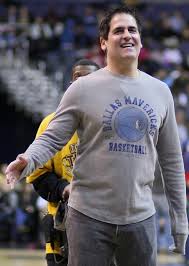
 Mark Cuban (@MCuban) joined James Altucher to talk about following your passion, leaving a trail, and finding success in life. Before we jump in, know that a lot of the conversation in this interview revolves around Cuban’s apps, Cyber Dust and Xpire. It’s an interesting conversation about big ideas, but not a lot of ideas you and I can apply to our own lives. But there are some good ones, like:
Why following your passion is bad advice. James begins the interview with a nice twist, turning things around on Cuban. James lists all of Cuban’s companies and experiences and asks him if isn’t going from building computer networks, to creating an audio company to stream basketball games, to buying an NBA basketball team a procession of passion? No, it’s not Cuban says.
“It wasn’t because I wasn’t passionate about systems integrations. It wasn’t because I was passionate about computers, even though I liked them…The more I worked with computers, the better I got at it. The better I got at it, the more passionate I became about it. The more passionate I became at it, the better I got at it.”
On his blog, he’s a bit more blunt, writing, “What a bunch of BS. “Follow Your Passion” is easily the worst advice you could ever give or get.”
 Ramit Sethi (episode #36) told James something similar, “When you get good at something, you get passionate.” Mark Ford (episode #102) took a stand against following your passion as well, noting that if you start a business with your passion, you’ll start to see its warts. If you find yourself stuck in this passion rut see the note at the end of this post.
Cuban tells James that his thinking was formed during college when he and some friends owned a bar. The bar was going to be shut down due to some violations but it imprinted on Cuban the idea of survival. He tells James, “I went through a period where I just wanted to survive month to month” and when he moved to Texas and started his own company, his short term goal was just to be profitable and survive another day. Jay Jay French (episode #75) told James the same thing happens with a band. If you can just keep playing, making enough money, and see another day – you’re doing okay.
When Cuban’s (profitable) company – MicroSolutions – sold, Cuban walked away with $3M in his bank account, which was more than enough. He tells James, “my goals was to retire, but my parameters were that I could live like a student.” Cuban was hoping for one million and live off ten percent of that. Tim Ferriss (episode #22) noted a similar mindset in his interview. Ferriss said that money was just “wampum” – a medium you used and that you don’t always need money for that. Cuban for example, bought a lifetime pass on American Airlines, which cost a lot of money up front, but for the rest of his life he gets to fly first class. Kevin Kelly (episode #96) echoed this too, once you figure out how little money you really need, you can focus on many other things.
Fast forward through the 2000’s where Cuban has more financial success trading stocks. Now he’s created Cyber Dust, and James says the name sounds kind of antiquated. Yeah, Cuban says, but “there’s no such thing as a good URL that’s going to work no matter what.” Cuban lists all the domains he owns, and some of them seem good, but he doesn’t have businesses that will work in them. Jay Jay French told James the same thing about writing music, “nobody knows why anything is a hit.”
At this point in the interview the pair talks about Cyber Dust and Xpire. If you’re not interested in any of this you can skip to the 34:00 mark, but there was one other point to add here. Cuban notes that with all the data that exists about us, people can figure out quite a bit. Some people know this as the curly fry effect. Researchers at Cambridge looked at 60K Facebook users and found that, “their ‘likes’ alone, predicted a wide range of personal traits. The researchers could predict attributes like a person’s gender, religion, sexual orientation, and substance use (drugs, alcohol, smoking).”Another study was able to predict where people would be in twenty four hours. If you have an iPhone, it can do this.
James and Cuban move their conversation to what Cuban looks for on Shark Tank and Cuban says there are four things he aims for a company to have:
- Growth. Peter Thiel (episode #43) told James that every successful business has to find a secret. Secrets are areas where few people are and have more room for growth. An example Thiel often gives is to think in terms of atoms rather than bits. In bits (Facebook, Twitter, Uber) we’ve seen major changes but in atoms (biology, transportation) we haven’t. Thiel reasons that you’ll have a better chance of growing in atoms than in bits.
- Entrepreneurs that can run it. Jason Calacanis (episode #77) told James that he looks for entrepreneurs that “know this stuff cold.” They need to understand both their business, but their competitors too, and the industry at large. They need to understand the nuances as well as a comedian – like Carol Leifer (episode #66) knows about how to shut down a rowdy audience member.
- Differentiation. Dave McClure (episode #98) told James that differentiation was how he started 500 Startups. He saw that in the domain of angel investing, very few people understood both marketing and engineering as well as he did. He was different in a good way.
- That Cuban can add value.
About selling his own companies, Cuban notes “luck and timing have a lot to do with it.” Scott Adams (episode #47) compared success to pulling a slot machine handle and eventually getting lucky. Kevin Kelly said he “lucked out to be at this moment.” Jim Luceno (episode #60) told James that “sometimes hard work isn’t enough.” Noticing luck is important – says Stephen Dubner (episode #20) – because it helps us better evaluate our effort and skills. If you tried something and it didn’t work, it’s good to note why. If it was back luck, you know your effort and skill were good and you should try it again. If not, then something else needs to change.
James asks for a few predictions about what the next big things are going to be and Cuban says that he thinks passive sensors, like a heart rate monitor or cameras that can quantify data will be a growing area. He also thinks that personalized medicine will become larger and that our grandkids will ask, “is it true that everyone bought the same kinds of medicine.”
–
Thanks for reading. – @mikedariano
One more note, about So Good They Can’t Ignore You. I created a reading supplement to the book, offering updates on the examples in the book, providing case studies (from some guests here), and creating an email drip that can spur you along in your reading and get you asking (and answering the right questions). You can find more details here or on the Products page of this site.
 The Waiter's Pad
[…] #24 Mark Cuban […]
LikeLike
[…] #24 Mark Cuban […]
LikeLike
[…] #24 Mark Cuban […]
LikeLike
[…] #24 Mark Cuban […]
LikeLike
[…] #24 Mark Cuban […]
LikeLike
[…] #24 Mark Cuban […]
LikeLike
[…] #24 Mark Cuban […]
LikeLike
[…] #24 Mark Cuban […]
LikeLike
[…] #24 Mark Cuban […]
LikeLike
[…] Jillette, Kevin Kelly, and Mark Cuban all said they would live simply to be able to do what they wanted. […]
LikeLike
[…] Mark Cuban and Seth Godin both cashed out before the dot com crash and admit they got lucky. Trip Adler says that at Y-Combinator he was told his idea for a ride sharing app wouldn’t work. It was 3 years before Uber. […]
LikeLike
[…] Now he looks for “slam dunk” opportunities. The big investors featured here all mention this; Mark Cuban, Chris Sacca, and Gary Vaynerchuk all say they focus on businesses where they personally can make […]
LikeLike
[…] 4: Persist. Timing is impossible to nail. The only thing you can do is keeping doing it. Mark Cuban offered streaming music years too early. Trip Adler had the idea for ride sharing years too early. […]
LikeLike
[…] 4: Persist. Timing is impossible to nail. The only thing you can do is keeping doing it. Mark Cuban offered streaming music years too early. Trip Adler had the idea for ride sharing years too early. […]
LikeLike
[…] Mark Cuban and Seth Godin both cashed out before the dot com crash and admit they got lucky. Trip Adler says that at Y-Combinator he was told his idea for a ride sharing app wouldn’t work. It was 3 years before Uber. […]
LikeLike
[…] Mark Cuban said the same thing. He lived cheaply, and was willing to retire cheaply. “I was willing to live like a college student,” Cuban says about his mindset at the time. All Cuban wanted was an American Airlines lifetime pass and the time to use it. […]
LikeLike
[…] Mark Cuban was willing to live like a college student to “make it.” Penn Jillette lived out of his car to “make it.” Kevin Kelly noted that we need little to “make it.” Jay Leno did stand-up at retirement homes and worked as a Mercedes Benz mechanic to “make it.” […]
LikeLike
[…] Dixon says, someone can learn on the job, but not the other way around. Both Jimmy Wales and Mark Cuban are examples of […]
LikeLike
[…] Mark Cuban was willing to live like a college student to “make it.” Penn Jillette lived out of his car to “make it.” Kevin Kelly noted that we need little to “make it.” Jay Leno did stand-up at retirement homes and worked as a Mercedes Benz mechanic to “make it.” […]
LikeLike
[…] path as Andy Weir, but you could model the persistence. You can’t become a tech mogul like Mark Cuban, but you can be inspired by his attitude. You can’t make movies like Judd Apatow but you can […]
LikeLike
[…] Blumberg was deep in radio before his startup Mark Cuban memorized user manuals before he sold anything. Gary Vaynerchuk knows the ins and outs of every […]
LikeLike
[…] says, look at someone like Mark Cuban or Marcus Lemonis. Those guys are rich and take over businesses, but we don’t see them as […]
LikeLike
[…] matters a lot. Seth Godin and Mark Cuban both admit their luck timing stock sales. Amy Schumer said she was about to quit before she met a […]
LikeLike
[…] Lady luck strikes again. We’ve seen lady luck bless (and curse) many people. Seth Godin and Mark Cuban both said they were lucky timing the stock […]
LikeLike
[…] Chris Sacca (“I only get invovled in deals I can personally make an impact”) and Mark Cuban mentioned this first person to call mindset and share it on the Shark Tank television […]
LikeLike
[…] what it takes. It’s a long list of people who attribute some success to luck: Seth Godin, Mark Cuban, Jason Zweig, Morgan Housel, and Michael Mauboussin among many others. Each of them worked really […]
LikeLike
[…] Godin and Mark Cuban both said their timing was good when they got out of the stock market before the dot-com crash. […]
LikeLike
[…] Mark Zuckerberg coded the first Facebook, but as the company has grown he’s done less. Mark Cuban started off installing routers, now he has a specialist take care of the technology. Walt Disney […]
LikeLike
Maybe the right advice should be “Follow your talent(s)”. When we become good (ie, above average) at something, it is very likely that we yoke skill building to talents.
I suggest you read these two short posts by Brett Steenbarger:
http://traderfeed.blogspot.fr/2016/08/awakening-your-trading-talent.html
http://traderfeed.blogspot.fr/2016/08/how-to-find-your-trading-talent.html
Thanks for your work Mike, I really appreciate it.
LikeLike
Thanks for the links. Steenbarger gave a great interview I noted but I failed to follow up for more of his stuff. Will dig into these.
LikeLike
[…] of finding secrets is the timing in finding them. You can have a great idea (Mark Cuban suggested streaming music) but if the time isn’t right you’ve got […]
LikeLike
[…] smarter people… or find a different room.” Daymond John likes to do Shark Tank deals with Mark Cuban to work with someone smart. Bethany McLean wrote about the “smartest guys in the room” […]
LikeLike
[…] Mark Cuban tried to start a streaming media company, but the ISP speeds weren’t fast enough.Casey Neistat was (probably) too late with his tech company, Beme. Percy Fawcett had bad timing because a world war broke out. Trip Adler was too early for a ride sharing service. Chamath Palihapitiya was too early pitching the Facebook phone. […]
LikeLike
[…] in the board like in the public market, I want to know, is this a company that we can help.” Mark Cuban says this about his Shark Tank TV deals […]
LikeLike