Christian Rudder

Christian Rudder joined Patrick O’Shaughnessy on the Invest Like the Best podcast to talk about data, luck, and what people really want on dating sites.

A chunk of the interview is about Rudder’s book  Dataclysm which I had forgotten all about. A shame because I remember enjoying it, understandable because that was two years ago. Here’s one of my many highlights:

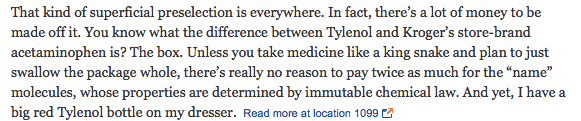
screen-shot-2016-10-14-at-9-28-16-am

If you like the humor of “taking medicine like a king snake” mixed with branding, you’ll like the book.

Okay, that suggestion out-of-the-way, let’s get to the podcast notes.

1/ Luck. “I think there is a lot of luck involved. We talk about it all the time, we’re smart guys, we worked hard. Things could have gone sideways very easily. I wish more entrepreneurs recognize the amount of luck that has gone into their success because there is a tremendous amount.”

The best understanding for the role of luck comes from Michael Mauboussin‘s Two-Jar model. Everything we do is an outcome luck mixed with skill.

Sometimes you’ll build up a good skill “draw.” Rudder is smart. He works with smart people. The niches of online dating was well-timed. Ditto for his previous work at The Spark. These sorts of things we can control, and increase our skill draw value.

Sometimes you’ll “draw” good luck, sometimes not.  How much online dating grew was luck. How fast college campuses installed high-speed internet in the late 90’s was luck. Rudder seems to understand this balance.

It seems like an admission of luck is part of sustainable success. Instagram‘s success was half luck. Soccer (Anson Dorrance) is half luck. Football (Bill Belichick, Pete Carroll) is half luck.

We see sustained success from people who admit to the roll of luck because that allows them to make better decisions in that environment. It’s like saying, it looks like rain, I should take an umbrella compared to it looks like rain, but I won’t get wet. Activities with more luck, writes Mauboussin in The Success Equation requires a different approach.

2/ MITs. “It occurred to us very early on that those are crappy metrics (ex: pageviews) for a dating site. What does it say about a dating site if someone is coming day after day after day for two years. That looks great for Twitter, but that’s horrible for us.”

When Donald Keough was with Coca-Cola (but not yet president) he recalls a meeting between Robert Woodruff and a group of lawyers. The conversation was around some legal advice Woodruff needed to know. At one point in the meeting Woodruff turned to a lawyer that hadn’t spoken and asked, “what do you do?” The lawyer, without missing a beat, said “Mr. Woodruff, I sell Coca-Cola.”

If you work for Coke, you sell Coke. That’s the most important thing. If you run a dating site you look at metrics like messages sent and connections. That’s the most important thing.

Rudder points out that it’s easy to get caught up in the MIT of other people. That’s the finish line fallacy. The Outsiders all keep their own MITs. Startups that failed look at the wrong MITs. Jason Fried suggests you keep your MITs rather than Jeff Bezos’s:

“His success (Bezos) is one that’s very very hard to achieve…most likely you won’t get there…the odds are stacked against you…and if you think that’s the only way you’re going to be miserable.”

If OkCupid chased the MIT of page views that would have been fine for their advertising network, but horrible for users.

3/ Learning from the real world. “The skills that have been most important to me in what I’ve done has been a kind of world real experience, a sense of how people work. I haven’t spent my entire life in an academic department. I’ve done a lot of different things. I think that is extremely helpful in analyzing data. Any data analysis in a social setting your goal is to understand human behavior.”

A jack of all trades is a master of none, but oftentimes better than a master of one.

Rudder adds to the idea that a multidisciplinary approach works well. In Investing, The Last Liberal Art, Robert Hagstrom writes:

This broad-based approach is the heart of the New Investing. It is no longer enough just to acquire and master the basics in accounting, economics, and finance. To generate above-average returns, I believe, requires much more. The New Investing theorized by Charlie Munger and practiced by Bill Miller starts with the basics and then extends outward in all directions, toward any and all disciplines.

Rudder adds that we shouldn’t make things too complicated.  “A lot of the statistics and data analysis is not rocket sciences. In fact, the more rocket science-y it gets, that implies the worse your data actually is.” Instead, “You have to be able to make intelligent guesses about what people want.”

My guess is that Rudder (and co-founders) figured out OkCupid by trial and error. The better trials, the better errors. A descent scope of knowledge (the fox knows many things) helps figure this out.

Life is improvisation. A figure things out as you go approach. If you can understand a few key theories (“A few really big ideas carry most of the freight,” says Charlie Munger ) you’ll run shorter and more accurate trials.

A quick story of my own. When I supervised college seniors during their year of student teaching there were two ways students under achieved; lack of preparation and excessive paperwork preparation. The former group liked to “wing it” and “figure things out as they went.” These students always had below average scores because they weren’t prepared enough. They were foxes but in the wrong environment.

The second group focused on the paperwork component (and there was an obnoxious amount of paperwork) to the neglect of classroom flexibility. Their plans were too rigid and once the train was derailed there was no getting it back on.

  • The first group lacked local expertise but had adaptability.
  • The second group lacked adaptability but had local expertise.

The best students were in the middle of these poles. Jocko Willink says “discipline equals freedom” and that applied in these classrooms. The best students understood their key ideas deeply enough (lessons plans, preparation paperwork) but didn’t obsess over them. These sweet spots were  – I think –  Rudder’s experience too.

4/ Twitter. “In online dating the people have to talk to each other, unlike Facebook or Twitter where you can just talk to your friends who are like you. The people are all strangers and there is no pre-existing network laid over this whole thing.”

There are ways to use Twitter well; bust your biases, find information, collaboration, and connection. Rudder’s comments echo what Tom Brokaw said about television. Brokaw recalled the White House environment at Nixon’s resignation as lighthearted.  When he talked to his producer and saw the video the mood was quite different. “It always was for me an instructive lesson about the difference between television reality and real reality,” Brokaw said.

Ditto for Twitter.

5/ Niches. “The people who exhibit the highest variance in their appeal do better. Say you’re 5 out of 10. It’s better for half the people to think you’re a 9 and half the people think you’re a 1 than have everyone think you’re a five.”

It pays to be different, especially when it comes to The Selfish Gene/sex.

Right now I’m reading The Beak of the Finch a wonderful book about Darwin’s finches and evolution. One (of many) parts of the book that struck me was the difference in natural selection and reproductive selection.

  • Natural selection favors animals that blend in with their environment.
  • Reproductive selection favors animals that stand out from their environment.

Evolution swings like a pendulum between the two.

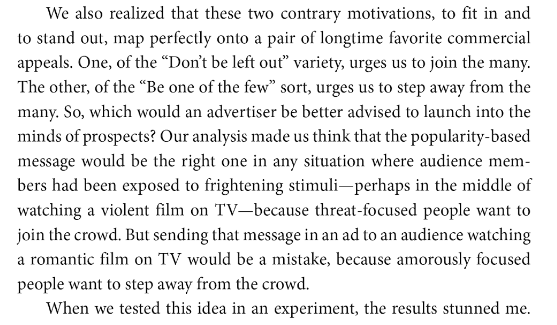
In Pre-Suasion Robert Cialdini writes about this application to the world of advertising (p74).

Screen Shot 2016-10-15 at 9.34.36 AM.png

On the Galapagos Islands, Darwin’s finches want to be attractive enough to stand out (beak depth, size) but not so much so that owls eat them. Our own dating preferences seem to mimic this, only we don’t need to worry about the predators and can spread our plumage.

6/ Life would be so easy if it weren’t for people. “You have to grapple with the human psyche so the site will function. Obviously these twenty year old women don’t want to hear from these forty-five year old guys and we have to make everyone happy running OkCupid.”

Rudder calls this “Wooderson’s Law” (1:08)

In any of our endeavors it helps to remember we’re dealing with people. Don’t get sucked into strategy as a service (do hit refresh a few times). People do, want, and need things that numbers can’t predict. Rudder knew that 20-year-old women don’t want messages from 45-year-old guys, no matter how highly rated and motivated.

Numbers prove a computable measuring tool, but stories (psychology) matters too. Richard Thaler built his work around the shift from numbers to stories. Our brains evolved for stories.

7/ Business plans. “It was kind of a genius plan. The Spark had tons of time wasting stuff; things to read, dumb tests to take, and web toys that would appeal to high school and college kids. So they would pass these things around, waste their time, not study while they’re playing around on The Spark. And then, lo and behold, hey student who hasn’t studied! Check out our new product Sparknotes.”

I thought this was great and can only imagine the conversation that inspired it.

Person 1: How about we sell abbreviated notes for famous works of literature?

Person 2: You mean like Cliff notes?

Person 1: Hmmm.

-time passes-

Person 1: Remember that idea I had? What if we provide both the time-wasting element and the notes in the same place?

Person 2: Brilliant. 

This is like your doctor’s office selling doughnuts.

Thanks for reading, I’m @mikedariano on Twitter.

The Two-Jar Model

This post is available in podcast form. Search “Mike’s Notes” in your favorite player. The audio version includes Metallica, and audio of the block quotes below. It’s on Soundcloud too.

Stop now if you don’t want to read another post centered around Michael Mauboussin. I’ve written about his podcast interviews three times(!!); Michael Mauboussin, Michael Mauboussin 2, & Michael Mauboussin 3. I think my 1990’s Van Halen collection had fewer editions.

After Tren Griffin‘s post about The Success Equation I knew it was time to finally read Mauboussin’s work rather than hear him talking about it.

The book was great. It explained concepts just as clearly as he does in these interviews. The part of the book that had the biggest effect on me was the Two Jar Model.

Antique Mason jars.jpg
By FiveRings at English Wikipedia, CC BY 3.0, Link

That idea is that any outcome is a combination of “valuable” skill and  “boost/drag” of luck. In the book Mauboussin uses ample examples, so I will too.

On Sunday afternoons our YMCA has tennis lessons. I get the kids in the car, pull out the driveway, pull back in because we don’t have our rackets, leave again, drive to tennis, get out of the car, and get the kids in their groups. As I sit there waiting and reading, none other than Serena Williams shows up (she’s visiting family) looking for a volley partner. I volunteer, of course.

We warm up. Williams, impressed by my forehand, suggests we play a friendly game. I agree, of course. My serve.

My first toss is just right (skill +10, luck +2) and with a pedestrian pace the ball glides across the net, into the service box. Williams steps into a backhand (skill +70, luck +5) and smashes a winner down the line. As I retrieve the ball I wonder if Elon Musk has talked to Williams about certain aspects of escape velocity.

Love, fifteen. Of course.

My next service toss is a little low and a wind gust pushes the ball a hair (skill +6, luck -2). This serve, a cumulative “4” does no better than the first. After hitting her winner Williams walks to the net and says something to the effect of “shoulder rehab” and “left handed.” The match continues.

In this parable, no cumulative score of my skill and luck is enough to win a point against Williams. Tennis is a game of skill.  Now imagine instead of playing Tennis I’m managing a soccer team. Soccer is more toward the luck end of the spectrum and if I were to go against the greatest manager in the world, the chance of me coaching to a victory is much better, though still not good.

Mauboussin writes that we draw from each jar and the sum of the scores is the outcome. Sometimes we’ll be lucky and good, sometimes we’ll be bad and unlucky. Often we’ll be in the middle.

Before dive deeper, let’s dismiss platitudes available on motivational posters. Mauboussin writes, “There is no way to improve your luck because anything you can do to improve a result can reasonably be considered a skill.” That is, you don’t make your luck.

When Bill Gurley became an analyst he was lucky because soon after he arrived, the people above him left, there’s nothing he could do to improve that result. Gurley got a vacated position because he was skilled enough to prepare for and apply for it.

Often it’s hard to identify where on the spectrum we are.  “Most of the successes and failures we see are a combination of skill and luck that can prove maddeningly difficult to tease part,” Mauboussin writes.

So what?  Depending on the location, processes differ.  For activities with more skill like surgery, games of checkers, tennis.

  • “You can rely on specific evidence.”
  • “History is a useful teacher.”
  • Small samples are okay.
  • Deliberate practice and checklists work.

For activities with more luck, like roulette or the stock market.

  • Beware of small sample sizes.
  • Fast mean reversion.
  • Base rates are a better guidance.

Mix all these ingredients and you get a pair of suggestions for how to act in certain situations.

  1. Toward the skill end of the spectrum,  use deliberate practice.
  2. Toward the luck end of the spectrum,  focus on the process and not outcomes.

Example 1: Bill Belichick

Process. Football, Mauboussin writes, has a luck factor somewhere between hockey and baseball. It’s about 48% luck. I’m unaware about how much Belichick knows this but he seems to understand it. His process towards luck is to focus on what his players are doing, not the score. Belichick looks at how his team is playing, even when they’re losing.  (4:30)

“I really felt good about the team, even though we’d gotten smashed. I felt something about the team that night in the second half that I really thought we could build on. Anyone that wanted to cash it in could have cashed it in. We weren’t going to win. We were behind, we were on the road, their crowd was in a frenzy. The Chiefs were playing very well but I could see the fight.”

Practice. In this clip, Belichick and his staff are explaining how they prepared for the play that would end the Seahawks season in Super Bowl 49. (35:00)

For the Patriots successful season there was both luck and skill. Belichick focused on the process parts where luck ruled the outcomes and was focused on the skill parts with specific practice.

Example 2: Stephen King

Process. No one knows what will be a bestseller, not even Stephen King. He told Rolling stone his best book was, “Lisey’s Story. That one felt like an important book to me because it was about marriage, and I’d never written about that. I wanted to talk about two things: One is the secret world that people build inside a marriage, and the other was that even in that intimate world, there’s still things that we don’t know about each other.”

Writing a bestseller has a fair bit of luck so King trusts the process. He focuses on the things he can do. King jokes that he only takes off three days a year (Christmas, July 4th, his birthday) because it makes for good copy. He really doesn’t. “The truth is that when I’m writing, I write every day.” Stephen King doesn’t know if a book will be a bestseller, but he knows the kind of work that he needs to do.

Practice. When King was interviewed about learning the rules of grammar he said.

“When we name the parts, we take away the mystery and turn writing into a problem that can be solved. I used to tell them that if you could put together a model car or assemble a piece of furniture from directions, you could write a sentence. Reading is the key, though. A kid who grows up hearing “It don’t matter to me” can only learn doesn’t if he/she reads it over and over again.” That’s part of the skill of writing. Understanding the building blocks of language.”

There are things a writer can control. In all the interviews of Mauboussin I’ve never heard him mention his writing process (beyond a preference for physical over digital books) but he has something like King identifies. I have a hex wrench and Ikea bookshelf. Mauboussin is on This Old House.

Example 3: Louis CK

I’ve written (long) notes about how Louis C.K. made Horace and Pete  and there were parts of that story that fit this process and practice view that the two jar model suggests.

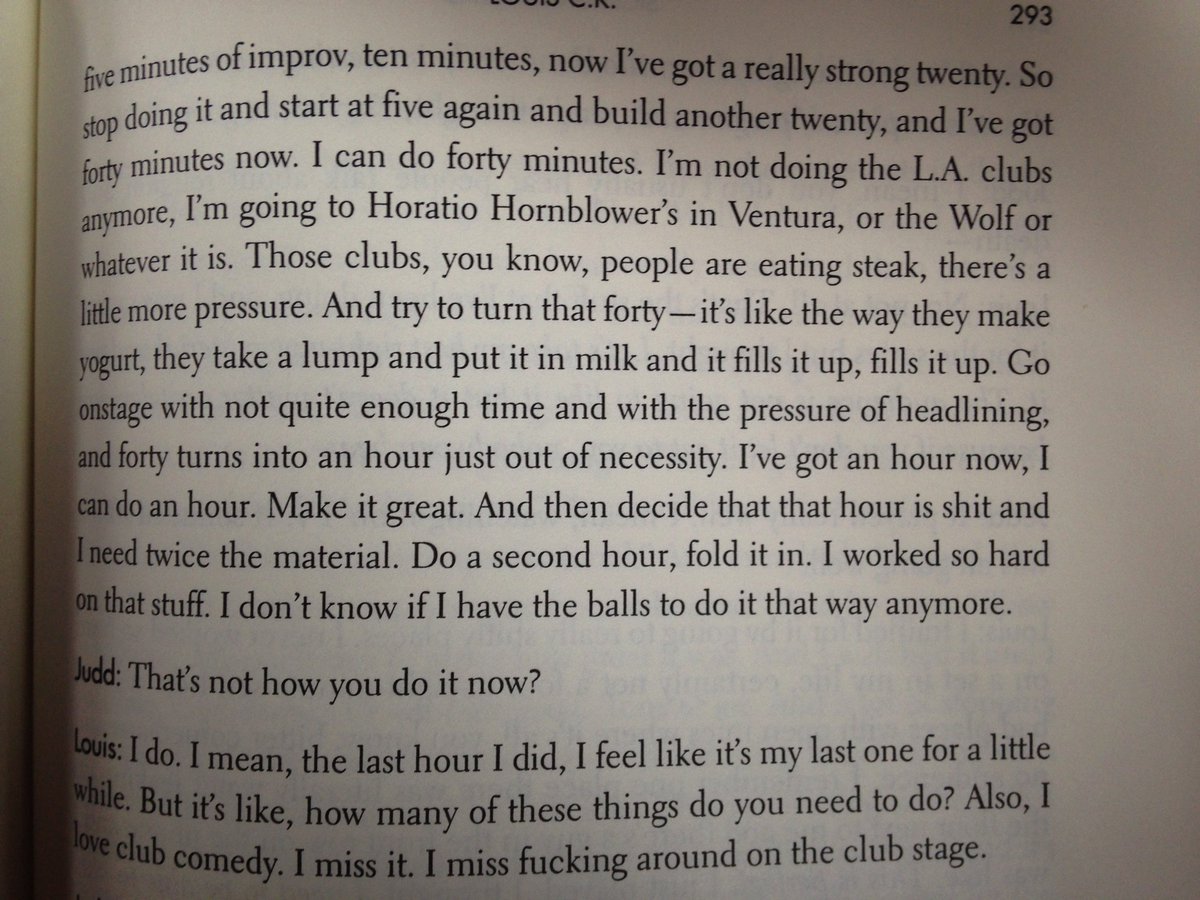
Process. If Stephen King doesn’t know what makes a bestseller, that means nobody does, Louis included. King writes daily, uncovering the story like a fossil, and stays true to the characters (“no kid ever ran to his mother and said that his sister just defecated in the tub”) . Louis told Judd Apatow that he too has a process for making comedy.

LCK process

Start with five minutes, make it ten, stretch it to twenty, rinse, repeat. The outcome for “what’s funny” draws from the luck jar just as “football win” and “best selling book” draw from two jars as well. Each person though emphasizes the work that could lead to good results.

Practice. Here is part of an interview Louis gave with Charlie Rose when he was promoting Horace and Pete (lightly edited):

Charlie Rose: Here is what I hear. I mean, you know, write standup the best. Acting and getting — not only good reviews but also more and more roles. You’re now a director….You are now a producer…You manage this whole thing….I mean, do you come to some sense, I can pretty much do whatever I want?

Louis C.K.: Well, there are a million things I can’t do yet, but thank God, you know. You want to be able — you want to keep trying — you want to get — it’s like if you are in the army, a friend of mine was in the army back in the ’80s.

Louis C.K.: Late ’80s. And so, he’d just go to like, he took his little platoon, he’s sergeant, he’d go like, let’s go to jump school.Let’s all just go to jump school. And they go for, he was a, what do you call it, reserve.

Louis C.K.: So, on his weekends, instead of sitting around playing ping pong, let’s go to jump school. And then they have a patch for jumping. And then they go hey, let’s go to medic school. So, they all got rated as medics. And they got this big bunch of patches all these things skills that he’s packing his head with. Unfortunately, then a war broke out and he was sent right to the front. Look at all these skills you have.

Charlie Rose: And we need you.

Louis C.K.: I like being patches, it’s like being a boy scout. And then all of a sudden you can do that. You know, like what’s the movie, “Matrix.”

Charlie Rose: “Matrix,” yes.

Louis C.K.: When there is a helicopter and he says to her, you know how to play helicopter. And she goes wait a minute and she loads the program. Now I do. Well, anyone can do that. It just takes longer. You can just load a program. So, now I know how to create a multicamera drama and mount it the same week that I shot it. And how to direct many great actors which I had never done before.

Everything we do has some mix of skill and luck. Any little thing you can do is skill, and you should use deep work to get better at that. Any thing you can’t control is luck, and you’ll be well served to focus on good process rather than outcomes. Any outsized returns are a combination.

After the 2015 NBA finals Zach Lowe wrote:

“Yep, the Warriors got lucky. They suffered no major injuries, beat teams that did, and got through the West without facing the Clippers or Spurs.

Guess who else got lucky: every team to ever win the championship. Pick any playoff season — literally, any season — and you’ll find multiple injuries that tilted the championship odds. Sometimes those injuries were minor — temporary dings to a few key role players. Sometimes they were career-threatening injuries to stars.”

Thanks for reading,

Mike

ps. If you want more, I wrote a book about Bill Belichick’s Red Teaming. It’s a mix of process and practice.

Red Teaming like Bill Belichick

In the first post on Bill Belichick I noted that it was part of a larger work in progress. That work is done.

It’s an e-book available on Amazon.com – free from October 12 through October 15.

It’s shortish, about 7,000 words, and looks at five red team tools that Bill Belichick uses.

  1. Inversion. Turn the question around, ask the opposite, figure out how to fail.
  2. Pattern recognition. Avoiding mistakes because you’ve learned your lesson is a powerful force.
  3. Culture. What the boss says and does.  
  4. Counterfactuals. What else could have happened and why didn’t it?
  5. Argue well. Focus on the truth and put egos and agendas aside.

The e-book covers a lot of the same ground that this blog does, some of the stories and ideas are the same. If you like this blog, you’ll like this.

If you’re curious, read the Belichick post. That post largely resembles point number one of the book.

Mike


The Outsiders

This was originally published on Medium. Posting here for linking convenience.
The Outsiders was good. What I liked most about William Thorndike’s book was the efficiency of it. Much like the CEOs he describes, the pace of the book is quick, and focused on the most important things.

The book is an attempt to bust the availability bias towards the contemporary CEO. The people on magazines. The “action-oriented leader who works in a gleaming office building and is surrounded by an army of hardworking fellow MBAs.” That leadership style may work for some, but it’s not the only — as the subtitle says — blueprint for success.

As I read six big themes came up:

  1. Be different and find truths.
  2. Keep an (inner) scorecard.
  3. Decentralize.
  4. Forecasting well is hard; a high investments (in time) and low return activity.
  5. Keep a low overhead.
  6. Think like a croc.

Being different & finding truths

I do not believe the consensus view is necessarily correct — Howard Marks

Each of the 8 outsiders Thorndike profiles earns their reputation because they outperformed both their industries/colleagues and the general market. This book looks at — in Warren Buffett’s words — ducks who flapped their wings and didn’t only sit on a rising tide.

To rise faster than the market, the outsiders had to be different. They have to answer the question Peter Thiel asks, what do you believe that is true that nobody else believes?

How did the outsiders do this?

For starters, most outsiders had “fresh eyes” and could “take a broom to the cobwebs,” writes Thorndike. They were well educated, yet poorly experienced as executives. This was a plus. They never succumbed to the things have always been this way momentum.

Another thing they did was relentlessly pursue the truth.“As a group they were, at their core, rational and pragmatic, agnostic, and clear eyed,” writes Thorndike.

“You are not right because others agree with you, but because your facts and reasoning are sound.” — Benjamin Graham

Finally, they were emotionally tough. It’s not easy to be different. Katherine Graham, for example, was on a “lonely path…a particularly difficult position for the only female executive in a high-profile, clubby, male-dominated industry.” Thorndike’s own experience mirror this. He writes, “in many ways the business world is like a high school cafeteria clouded with peer pressure.”

I saw this too in my research on startups that failed. Being different carries an emotional weight most underestimate.

One means of coping was to keep an inner scorecard.

Inner scorecard

If you are playing a different game, don’t keep the same score. Tom Murphy said, “The goal isn’t to have the longest trip, but to arrive at the station first using the least fuel.”

The outsiders did this mostly by focusing on cash and/or shareholder value. An emphasis on this metric meant matching means to those ends.

Thorndike writes that this was easier because many of these outsiders didn’t reside in New York City. “This distance helped insulate them from the din of Wall Street’s conventional wisdom.” They didn’t have someone yelling and telling that they were playing the wrong game.

Ed Catmull said that George Lucas moved to San Francisco to get away from the cacophony of Hollywood.

Seth Klarman recalls a client asking to come in and explain how they benchmarked his results. Klarman said, “I won’t meet with you. I’ll meet with you on anything else, but not that because it will change what I do.” Klarman didn’t want to know their score, how they kept it, or if it differed from his. He kept his own scorecard.

Decentralization

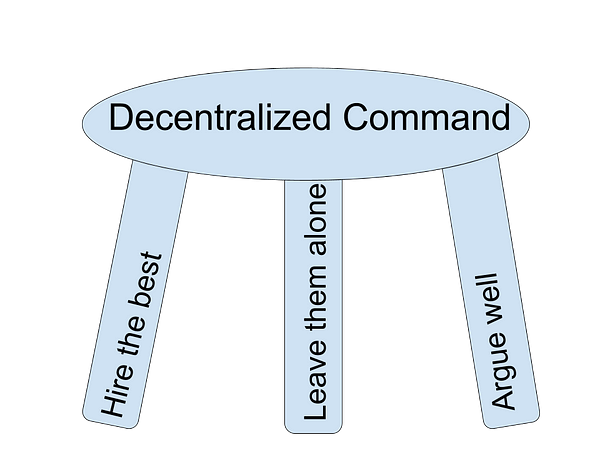
That so many great companies were run by so few people shouldn’t have surprised me, but it did. “Decentralization is the cornerstone of our philosophy,” read a CapCities annual report.

Tom Murphy said to “Hire the best people you can and leave them alone.” Warren Buffett suggested to “hire well, manage little.”

Decentralized command believes the people closest to the problem arrive at the best solutions. Andy Grove wrote:

“They (middle management) usually know more about upcoming change than the senior management because they spend so much time ‘outdoors’ where the winds of the real world blow in their faces.”

“I feel much safer back here in California than he does in ‘enemy territory.’ But is my perspective the right one? Or is his?”

Grove’s company — Intel — was saved because of decentralized command. “The process of adapting to change starts with employees who, through their daily work, adjust to the new outside forces.” It means letting people make their own good choices.

We’ve decentralized power in our operating business to a point just short of total abdication. — Charlie Munger

That said, communication still needs to happen. A third leg of the stool for decentralized command is arguing well.

Caesar Sweitzer said his Office of the Chairman meetings were “wrestling matches conducted in a constructive, collegial way.”

Grove too encouraged good arguments, “we developed a style of ferociously arguing with one another while remaining friends.” Scott Pioli said part of the coaching evaluation with the New England Patriots was whether or not you had an opinion.

Forecasting

Me and yo’ daughter, got’s this thing going on
(We got a special kind of thing going on)
You say it’s puppy love
We say it’s full grown
Hope that we feel this, feel this way forever
You can plan a pretty picnic
But you can’t predict the weather, Ms. Jackson

– Outkast

The outsiders were great time managers. None fretted about appearances, and all committed to work with high returns. That meant reading, getting their hands dirty, and talking to people smarter than them. It meant few meetings, public relations, or forecasting.

“My only plan is to keep coming to work each day,” said Henry Singleton, “I like to steer the boat each day rather than plan ahead way into the future.”

The outsiders spend more time in the moment than in the future. Though Thorndike doesn’t address it in the book, I have two guesses why:

  1. The future is hard to predict.
  2. Plans have an anchoring effect.

Not only is the future hard to predict, but we tend to overestimate our own abilities. We watch sports because the players are great, but also think I could have done better than that(!) at each drop or missed putt. Maybe, but probably not.

Plans also anchor your thinking. Once you have a plan you have this thingand you start to compare options to the thing. It’s easy to get anchored to the thing.

Daniel Kahneman compares anchoring to ballparks. The anchor is the epicenter and once we drop it, it’s hard to move. If you peg returns or cost or anything to your thing, it becomes the comparison until it’s dislodged. Dislodging, of course, comes with a price of energy, time, and even money. The outsiders avoid this fuss.

Instead, Outsiders thought like crocodiles (more on that in a moment).

Low overhead

Here’s an easy business tip, keep a low overhead. “There’s an apparent inverse correlation between the construction of elaborate new headquarter buildings and investor returns,” writes Thorndike. Specifically debt interest, the evil twin of compound interest. Each outsider used debt like a chainsaw, with care and attention.

Without numerical fluency, in the part of life most of us inhibit, you are like a one-legged man in an ass-kicking contest. — Charlie Munger

Munger’s suggestion for numerical fluency applies here. Understand debt payments and positive cash flow, and the acolytes for positive cash flow are many.

  • Sophia Amoruso slowly stair stepped into larger spaces as she grew Nasty Gal.
  • Ben Horowitz’s lower overhead helped him get cash flow positive and keep control of his company.
  • Yvon Chouinard ate cat food before he founded Patagonia.
  • The Instagram founders lived on peanut butter sandwiches, two computers, and a rented server when they founded their company.
  • Michael Ovitz — and his fellow founders — used borrowed office furniture, gifted office supplies, and had wives answer the phones of the early CAA.

A lower overhead gives you time, it avoids the hedonic treadmills, and steers clear of dealing with loss aversion.

Like a crocodile

There’s a joke in NBA commentary that people don’t like to trade with the San Antonio Spurs because that team has made so many good trades people assume they’re on the wrong end of one with them. The Spurs, like the outsiders, are crocodilian. They wait, wait, wait, and then GO!

Time after time a non-outsider CEO paid too much for an asset, failed to seize the opportunity, and needed to sell it in a worse climate than when they bought it. They were like a thirsty animal, needing any source of water. The outsiders were the crocodile.

  • John Malone —scooped up Metropolitan Cable Companies
  • Katherine Graham — scooped up overleveraged newspaper publishers
  • Warren Buffett — scooped up a portion of Goldman Sachs

Not from the book, but applicable.

  • Bill Belichick — scooped up Randy Moss from the Oakland Raiders.

The best managers never paid too much. Each outsider in the book had some level they would not cross, even by a hair. John Malone’s hurdle, for example, was 5X cash flow.

The crocodile does not pursue prey, it waits for it, and so did the outsiders. Warren Buffett describes his investing activity as “inactivity bordering on sloth.”

Richard Feynman espoused this mindset too. “The only way to solve such a thing (safe-cracking) is patience.”

Tom Brokaw

Tom Brokaw joined David Axelrod to talk about his life, so far. Growing up our family watched a lot of Brokaw and this interview was a nice summary of his life, many parts of which I didn’t know. Here are my notes.

1/ Be there at the right time. Brokaw said, “I got there (California) at the peak of the change.” Later the same thing happened when Brokaw  went to Washington D.C.

Howard Marks wrote that the right ideas at the wrong time still means you’re wrong. Timing matters.

Brokaw was at the right place at the right time. He was in California to cover Reagan, he was in D.C. to cover Watergate, and he was the only American reporter in Berlin with satellite coverage when the Berlin Wall fell.

Bill Gurley had good timing when he was hired and quickly promoted because the people ahead of him left. Instagram was a block in the pyramid that could only be built on camera technology, 3G data speeds, and social networks. Karl Rove too was in the right place (Texas) at the right time (1980’s).

What’s of note is that none of these people controlled the where and when but each took action on the what. Gurley applied for the jobs, Instagram pivoted from check-ins to filtered photos, and Rove started a consulting business. Brokaw too took advantage, hustling his way up.

2/ Marriage (stakeholders). “She was breaking off our friendship because of my behavior and said, ‘No one can understand what you’re doing. You’re parents are terribly disappointed in you, for good reason. I’m just not interested in having a relationship with you anymore.”

Brokaw would marry that person and said, “it’s been 54 years of marriage at this point.”

The person you marry in life is one of the most important stakeholders in your life, and it’s important to get stakeholders who align with you (and you with them).

Brokaw says Mary’s words were “a breakthrough.” Her stern lecture came as he was bumming around. Great stakeholders help us when we need it.

Spouses are special kinds of stakeholders. (VCs always compare marriage with investments, I’m not sure if this says more about investments or marriages). There are only a few people who dent the universe and a correspondingly few who will be married to them. Bill Belichick, Louis C.K., and the original universe denter – Steve Job, all separated from their spouses.

It’s hard to find the right person in life, especially for those with extreme drive.

That said, career success and marital success are not mutually exclusive. Brian Koppelman, Seth Godin, and Neville Isdell have all had great careers and marriages.

Whether it’s spouses, investors, or people you owe money to, anyone in your life can influence your life.

3/ Right conditions. “It was a town with a very high degree of intellectual accomplishment. In the three years that I was in that high school we had two people go to Harvard on full ride scholarships, one to West Point, two to the Air Force Academy – and these were just the guys. If the women had been in the pool we would have blown the lights out because they were the brightest people in town. There was a sense you could take on big challenges and accomplish them.”

Dan Coyle‘s work is the best I know on this idea of being around good people who can challenge you.

The key for an organization – town, school, business, club – is to create the right atmosphere and get the right people. Sometimes that means dealing with prophets of rage, writes Ben Horowitz:

If you’ve worked in a company for any length of time, you’ve probably seen one of these prophets. People refer to them as glass breakers, cowboys, toe stompers, or just plain assholes. Yet it’s difficult to get rid of them, because they produce massive amounts of high-quality work. Beyond that, they have indomitable will. No obstacle is too great, no task too large, no problem is too hard and they do not care who they offend, upset, undermine, or piss off to get the job done.

What you need to do with these people, writes Horowitz, is coach them well, give the right kind of feedback, and accept them. That is, create the right conditions for their and everyone else’s success.

Another way to build good condition is having books around. From Elizabeth Gilbert to the Wright brothers, people praise the availability of books.

Pete Carroll also praises the value of getting the right conditions, noting that people, “will function at a higher level. They’ll come in earlier. They’ll stay later. They’ll be more on it. They’ll inspire those around them. That’s the subtle way of improving an organization.”

4/ Deep understanding. “The radio station said, ‘we’d like to do this teenage disc jockey show, why don’t you come up here and try out?’ So, with my then girlfriend we ran that show and that led to a succession of jobs at that station in the summertime.”

Despite Brokaw’s wanting college career – he dropped out, twice – he built up a deep understanding of his work. He told Axelrod that from an early age he and his mom talked about politics. Then he was in the radio business, then news in Iowa, and onto Atlanta, Los Angeles, and New York/D.C. Brokaw’s experience built up a deep understanding.

People gain a deep understanding a few ways:

  1. Start young like Brokaw, or Bill Belichick.
  2. Read a lot like Charlie Munger, or Elon Musk.
  3. Immerse yourself in it (disregard all else) like John Boyd.
  4. Write things down as you go like Morgan Housel or Gene Kranz.

Cal Newport suggests that rare and valuable jobs require rare and valuable skills. Action, not passivity, builds those skills. As Dusty Springfield advised;

Wishin’ and hopin’ and thinkin’ and prayin’
Plannin’ and dreamin’ each night of his charms
That won’t get you into his arms

5/ Models with headwinds/tailwinds. “I grew up in a household in white bread America in which the three biggest heroes were Jesse Owens, Jackie Robinson, and Joe Louis. Not because my dad was a sports fan, but because he knew what they had to do to get to where they were.”

Tim Ferriss likes to say he interviews people who succeeded despite their attributes. It’s those people that had to work extra hard to achieve something that can teach us best.

Ben Horowitz wrote that for certain jobs, people who succeeded with less ideal circumstances will be better employees.

… anybody with a pulse can sell a massively winning product like Google Ads or VMware hypervisors, but people who consistently sold Lanier copiers against Xerox were elite. In fact, it might be a good sign that a sales rep was successful at a bad company. To succeed at selling a losing product, you must develop seriously superior sales techniques. In addition, you have to be massively competitive and incredibly hungry to survive in that environment.

Investors with a modicum of humility point this out. Warren Buffett set out a yardstick to measure his success, and told his investors that if he didn’t produce greater returns to take their money elsewhere. Auren Hoffman said he had good investing returns thanks to timing as much as his choices.  Jack Schwager said “If you’ve done well in a bull market all you can assume is you’ve been long during a bull market.”

The athletes that Brokaw grew up with weren’t successful because they had tailwinds, rising tides, or a bull market. They succeeded without those things, and their success was special.

6/ The internet window, demonstrated by television.  Upon Nixon’s resignation Brokaw said:

“There was this surreal atmosphere in the White House…at the back of the room there was a lot of staffers (one was teasing another about his haircut) and people were kind of hanging around. It was as if this was an enormous relief. Nixon comes out and makes his speech, goes out to the helicopter and raises his hands in defiance, with the victory sign, and lifts off. One of his counselors turned to me and said, ‘I’m going fishing.’

I go back to the office and David Brinkley says to me, ‘Did you think he was going to pull out a Derringer and shoot himself when he was up there?’ I said, ‘What are you talking about?’ I was in the room seeing everything. He said come down to the control room and take a look at the television picture.

On television isolation you penetrated Nixon’s psyche at that point. You didn’t see the staff wandering around, talking about what they were going to do. It always was for me an instructive lesson about the difference between television reality and real reality.”

I immediately thought of Twitter. There are ways to use Twitter well and one of those is to bust your biases and get a more accurate view of the world.

Everything we see is through a frame. Sometimes a change in our internal framing helps us solve problems.

Mellody Hobson reframed her company as private to think through decisions. Andy Grove did this too:

I looked out the window at the Ferris Wheel of the Great America amusement park revolving in the distance, then I turned back to Gordon and I asked, “If we got kicked out and the board brought in a new CEO, what do you think he would do?” Gordon answered without hesitation, “He would get us out of memories.” I stared at him, numb, then said, “Why shouldn’t you and I walk out the door, come back in, and do it ourselves?”

Maria Konnikova said “Mental framing is a very powerful thing…there’s always something you can do, you can always change the way you are thinking about something.”

Framing is so powerful, writes Robert Cialdini, because it can set the tone for how people will make decisions. The kind of music in the wine aisle influences what wines people buy. Reading words like “Florida, retiree, worried” primes people – we think – to walk slower.

One of my favorite recently discovered quotes is another form Horowitz.

Predict or build?

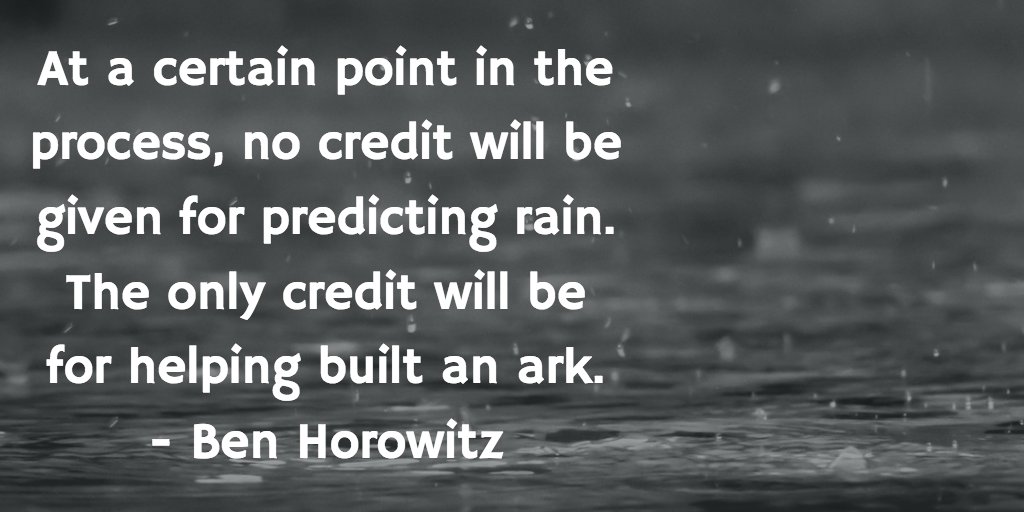
At a certain point in the process, no credit will be given for predicting rain. The only credit will be for helping to build an ark.

That means to build an environment where you acknowledge the framing, the priming, and the effects it has on you. Use Twitter well, understand television reality is different from real reality, and always [be curious](https://thewaiterspad.com/2016/04/06/brian-grazer/).

Thanks for reading, I’m [@mikedariano](http://twitter.com/mikedariano) on Twitter.


Chris Sacca 2

Chris Sacca and Matt Mazzeo joined Jason Calacanis on This Week in Startups to talk tech, Twitter, and teenagers (okay, not really teenager, but at least how Sacca is old, man).

There were actually two parts to this interview, but my notes are only from the first.

Ready?

1/ Fresh eyes on the problem. “You’ve got teams within those companies (potential Twitter buyer) that can take a fresh look and make them simpler. One of the things that Twitter suffers from right now is that everybody who works there is a power user of Twitter. Rarely do they get any fresh eyes on the product.”

If you want to have a good team, you need to have good team members. Peter Thiel wrote, “a lot of these companies aren’t solo efforts of a god-like person that does everything.” That means you have to work with other people, and if you want to be great they should be great people too.

Part of that is having people with multiple points of view. Sacca believes Twitter needs fresh eyes, and the best organizations bake those in. Bill Belichick gets pushback from coaches and Ernie Adams. Anson Dorrance gets pushback from assistant coach Bill Paladino. Ben Horowitz gets pushback from Marc Andreessen. The Wright brothers got pushback from each other.

Good organizations argue well. Andy Grove called it constructive confrontation. It’s arguing, but remaining friends. It’s taking a different point of view and suggesting why it makes sense. That’s what Twitter needs.

2/ The most important thing (MIT). “All they (Facebook) do at the end of the day is they accelerate the things that have the most likes on them.”

This was great to hear. If more people like a thing, then make the thing show up more.

Charlie Munger likes to say that a few mental models carry most of the intellectual freight. To put that in Facebook/Sacca terms, a few mathematical models provide most of the content people want. Get the right ones and you’ll zip along.

When John Boyd taught at fighter pilot school he focused on the MIT, “Have the student assume in trail position on the instructor and learn how to stay in that position throughout any maneuver.” That was the MIT. If you were being chased, how fast could you shake your tail? If you were chasing, how fast could you take down the plane?

Anson Dorrance is bad at paperwork and email because his MIT is coaching and recruiting.  Aziz Ansari deleted his email account. Christopher Nolan doesn’t have email or a cell phone. Neal Stephenson explains why he’s a bad email correspondent:

The productivity equation is a non-linear one, in other words. This accounts for why I am a bad correspondent and why I very rarely accept speaking engagements. If I organize my life in such a way that I get lots of long, consecutive, uninterrupted time-chunks, I can write novels. But as those chunks get separated and fragmented, my productivity as a novelist drops spectacularly.

For Ansari, Nolan, and Stephenson, social and communication are not MITs.

For technology companies product is the most important thing and Kara Swisher said Yahoo!? didn’t have it.

MITs don’t have to be complicated, but they do have to be prioritized.  KISS your MIT.

3/ Circle of competence (and control). “We invest in things where we feel we can personally move the needle. Instead of just throwing darts in the board like in the public market, I want to know, is this a company that we can help.”

The right choice of capital allocation brings the best returns. That’s capital in every sense, time, money, resources, and so on. Sacca wants to be in areas where not just his money, but his patter recognition skills (see #4) are helpful.

Charlie Munger  said, “I think the record shows the advantage of a peculiar mind-set not seeking action for its own sake, but instead combining extreme patience with extreme decisiveness.” Munger wants the same way as Sacca, control. Airlines, for example, don’t have this.  Berkshire’s investment in USAir fluctuated with the market. “It worked out fine for Berkshire, but we’re not looking for another experience like it.”

Warren Buffett said at the 2016 Berkshire meeting, “we’re not going to try to out Bezos Bezos.” Buffett and Berkshire have the money to enter e-commerce, but not the skill.

Walt Disney lost much of his early intellectual property becuase his circle of competency was in animation, not legal. Only as Roy Disney’s – Walt’s brother – role grew did Disney become a business.

4/ Pattern recognition. “We (Sacca and Mazzeo) have very complementary skills. Where my value comes in, there are very universal principles in building all these principles. While I may not be a great arbiter of that original idea, I am certainly valuable in determining whether your story is working. I’m certainly good at sussing out ‘are these the guys and gals with the hustle?’”

“That said, I’m not a kid. If I see an app in the app store at $4.99, I’m like, yeah $4.99, whatever. Yet we know that is a huge tipping point where a lot of people, millions and millions of people abandon that option.”

This was the part I enjoyed most. Sacca admits that his skills are different from Mazzeo’s. The former is older, with more experience and kids. The latter is younger, dating rather than married, and believes in e-sports. This kind of pairing tends to succeed.

Sacca’s pattern recognition dovetails with #3, skating within your circle of competency. He also points out the “complimentary skills” which is a combination many successful pairs share, and part of #1, fresh eyes.

Sacca got his pattern recognition through lots of experience, especially with high profile investments in Twitter and Uber. You and I can get some of that experience via books. The biggest help will be time, and how you use it.

Pattern recognition is a superpower, like moving faster than everyone else or moving through time (because you make fewer mistakes). I did a podcast episode about it.

Thanks for reading,

Mike

KISS your MIT, keep it (your most important thing) simple, stupid.

Charlie Munger 2

I finished  Janet Lowe’s book, Damn Right about Charlie Munger with a fat stack of notecards on the book. That makes sense, I assumed, Munger has a lot to teach. Then I reread my first post on Charlie Munger and saw that there was little overlap. Few ideas from the first book I read about Munger was notable in the second book about Munger. How great is that!

The first, Tren Griffin’s Charlie Munger focuses more on the investing side and Lowe’s is more of a biography.

I can only hope that the lack of overlap means I’m smarter. That in the first book I learned first book kind of things and in the second I was a touch wiser.

Munger is like a modern-day Benjamin Franklin and we all have a lot to learn from him, but shouldn’t imitate him. I liked what Griffin wrote in this first chapter of his book.

“The point is not to treat anyone like a hero, but rather to consider whether Munger, like his idol Benjamin Franklin, may have qualities, attributes, systems, or approaches to life that we might want to emulate, even in part.”

Here are some of those approaches.

1/ Finish line fallacy. “Charlie judges himself by an inner scorecard – and he’s a tough grade.” – Warren Buffett

The goal isn’t to win someone else’s race but to run your own. Lowe writes that “envy strikes him as the silliest of the seven deadly sins since is produces nothing pleasant at all. To the contrary it simply makes the practitioner feel miserable.”

At the 2016 Berkshire Hathaway meeting Munger addressed this as it related to Geico, “I don’t think it’s a tragedy that one competitor had a little better ratio one period…I don’t think we should worry about the fact that somebody else had a good quarter.”

Jason Calacanis said his finish line is to be the #1 angel investor, not some series of returns. Ryan Holiday warned Shane Parrish about writers angling toward the wrong finish line. Jason Fried pointed out that you can’t be Jeff Bezos, “His success is one that’s very very hard to achieve…most likely you won’t get there…the odds are stacked against you…and if you think that’s the only way you’re going to be miserable.”

Run your own race.

2/ FU money. “I had considerable passion to get rich. Not because I wanted Ferraris – I wanted the independence.” – Munger

One of my favorite internet niches is financial independence. People like Mr. Money Mustache and the Mad Fientist not only have super cool-dorky names, but they also tell another story. One where you bike to work, invest huge portions of your income, and live moderately. Their story is important, to paraphrase Auren Hoffman, because it shows that the default doesn’t have to be the only option.

The backbone to financial independence is the freedom when you don’t have to work. Many FIers keep working because they like it. They have the freedom to someday not go. That’s the idea I got from Munger.

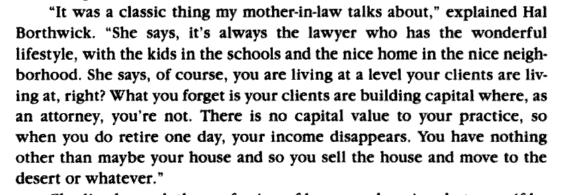
In Damn Right, Munger’s son Hal explains how you get FU money:
screen-shot-2016-09-24-at-7-32-39-am

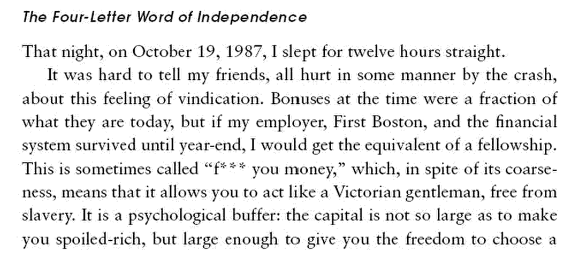
Nassim Taleb writes in The Black Swan that this means independence:
Screen Shot 2016-09-27 at 9.00.59 AM.png

When/If you don’t need to listen to other people your worldview changes. There are two sides to this balance, one the financial independent bloggers report, income and expenses. Taleb’s big payout meant his income was large enough to cover his current expenses. Munger learned this too. Ben Horowitz found this in his business under the name “positive cash flow.”

3/ Other’s opinions. “Everybody engaged in complicated work needs colleagues. Just the discipline of having to put your thoughts in order with somebody else is a very useful thing…we (Buffett and Munger) both think the other one is worth listening to.” Munger

One valuable cog in the machine of organization is having smart people around and listening to them. Karl Rove said the Bush White House had this. Bill Belichick encourages this on his football teams.

Assistant coaches say that Belichick is approachable, so long as you have your facts right. Former vice president of player personnel Scott Pioli said that part of the annual evaluation system of coaches was “whether or not you have an opinion,” and “Bill never discouraged me. Because even when we disagreed and got into it, he never discouraged me from having a different opinion.” Belichick wants his coaches to talk to him and push back.

Good organizations do this. Andy Grove said that part of the reason Intel succeeded was because they had “broad and intensive debates.” “We developed a style of ferociously arguing with one another while remaining friends,” wrote Grove.

Smart arguments are in places of genius too.

For this to work the boss has to listen. Belichick listened, Grove listened, and Buffett listens to Munger.

Anson Dorrance is the winningest college soccer coach but he needs his assistant Bill Palladino, because as Palladino says, “no one else is going to say no to Anson.”

Former CEO of Coca-Cola, Donald Keough writes that these sorts of relationships are requisites of success, and in The Ten Commandments for Business Failure he points out Munger explicitly:

“When teams of leaders complement and balance one another (as in the case of Warren Buffett and Charlie Munger at Berkshire Hathaway, Tom Murphy and Dan Burke at CapCities, or Frank Wells and Michael Eisner at Disney), then one person’s shortcomings can often be offset by another’s strengths.

Failure to do this, writes Keough leads to isolation, which, “carried to its most extreme form, tends to breed a sense of almost divine right.”

4/ Youth soccer coaches don’t get 10,000 hours. “Up here we went fishing. We were always making fires. The rest of the year we didn’t see him much.” Charles Munger Jr.

“I think my mother gave him an incredible amount of latitude to concentrate on his affairs and career. She did everything in the home.” Emilie Munger

It’s hard, maybe impossible, to be world class at something and do much else in life. Malcolm Gladwell popularized the idea of 10,000 hours, but he clarified that his point wasn’t to set a bar, but to note how high it was. There’s an opportunity cost to expertise.

John Boyd was the greatest American fighter pilot and made huge contributions to the philosophy of war, but he was never nominated for “Dad of the Year.” In his book on Boyd, Robert Coram writes in the epilogue, ” John Richard Boyd – as is often the case with men of great accomplishment – gave his work far greater priority than he did his family. The part of his legacy that concerns his family is embarrassing and shameful.”

Steve Jobs was not a stellar father.

NASA Flight Director Gene Kranz wrote, “Behind every great man is a woman – and behind her is the plumber, the electrician, the Maytag repairman, and one or more sick kids. And the car needs to go into the shop.” Rorke Denver said he couldn’t be a Navy SEAL if not for his wife doing the family stuff.

One of my favorite books on productivity is Laura Vanderkam’s 168 Hours. Vanderkam looks at time use surveys and concludes that the problem isn’t a lack of time, but a misuse of time.  Subtract a fifty hour work week and eight hours of sleep each night and you still have almost 9 hours a day for other things. This idea isn’t new. Two thousand years ago Seneca wrote,

It is not that we have a short time to live, but that we waste a lot of it. Life is long enough, and a sufficiently generous amount has been given to us for the highest achievements if it were all well invested.

But these people who make a dent in the world seem to be at another level. Their professional commitments are all-consuming. Their work takes a huge bite out of a finite pie. These people don’t/can’t be the youth soccer coach – heck, they probably won’t even attend any games.

5/ XMBA (night and evening curriculum). “(Munger) began investing in securities and joining friends and clients in business endeavors, some of which prove to be graduate-level courses in the school of hard knocks.” – Janet Lowe

When I articulated the idea of the XMBA, it only existed as an option different from college. You could, like David Chang, Tim Ferriss, Sophia Amoruso, or Elizabeth Gilbert consciously replace “school learning” with “life learning.” That does work, but Munger’s actions point to a better model.

That model is that you are always learning. Seth Klarman said, “I learned an enormous amount there (Mutual Shares), probably more than in my subsequent two years of business school.”

When I taught at college the students always told me that the things they learned in the field were 10X as valuable as the things we taught on campus.

That’s what happened to Munger. He learned from life. That’s really important.

I didn’t internalize this until I found Shane Parrish‘s Farnam Street blog. Whoa, I thought, you can read, think, and talk about ideas? I assumed after college that I was mostly done. I was wrong.

Getting things right later in life is about learning from the things earlier in life. Warren Buffett said, “If we hadn’t bought See’s (candy), we wouldn’t have bought Coke.” Notice how easy it is to change the nouns and verbs and have your own lessons for life.

  • If I hadn’t dated Kim, I wouldn’t have married Jan.
  • If I hadn’t failed Economics, I wouldn’t have the motivation to finish my degree.
  • If I hadn’t taken that early meeting with Ben, I wouldn’t have the opportunity to start my business.

The key isn’t the particulars, but the sequence, which comes because you paid attention and learned something.

I still believe the XMBA is a good idea, a real alternative to college thanks to technology. But it stands on the foundation that is lifelong learning. You don’t need an MBA if you are a lifelong learner.

6/ Be different and be right. “Graham often told his students that there were two requirements for success on Wall Street; the first is to think correctly  and the second is to think independently.” Janet Lowe

You have to be different and you have to be right.

In the recent post on Instagram, we looked at how they pivoted from being a gamified-check-in app to a photo-sharing-social-network. We guessed that they followed the different and right idea.

First, they were right because they imitated what had been working. Check-in apps were the right direction. There was something to this smartphone in your pocket. The Instagram founders said that they knew people wanted to use the phones in their pockets to share their view of the world with others. They thought that view was as check-ins.

Imitation is a good way to figure out what’s right. Look at what others are doing and just do that. It’s wrong to stop there, you have to be different too.
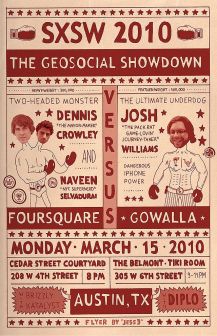
bf3ec2536170fef2004419711ee669a4Second, Instagram became different. Foursquare and Gowalla were slugging it out and Burbn (the precursor to Instagram) had to move on to something else. They did when one of the founders went on vacation and had a simple conversation with his girlfriend about how filters make photos look better.

Howard Marks coined the idea of being different and right, and its value has been demonstrated in other domains too. Bill Belichick was different when he focused on studying film and physical preparation for each season. Bill Gurley pointed out that startups in VR aren’t interesting to him because they aren’t different enough. The big players like Samsung, Facebook, and Google will likely crush those startups. Instead he said, “Most big startup breakouts are where people aren’t paying attention.” What’s more different from that? Milton Hershey was different in that he made milk chocolate.

7/ Some things are worth more. “Ben Graham had blind spots. He had too low an appreciation of the fact that some businesses were worth paying big premiums for.” – Munger

Bill Gurley saw this with Google. When asked about why he didn’t invest, Gurley said:

“I think it came down to the price at the time was remarkably high and the team was remarkably self-confident in a way that would cause you to question whether they could pull it off but they did. I go back and the learning is that if you have remarkably asymmetric returns you have to ask yourself, ‘how high could up be and what could go right?’ because it’s not a 50/50 thing. If you thought there was a 20% chance you should still do it because the upside is so high.”

If we can figure out what’s valuable and what’s worthless we can buy the former, when it’s expensive or cheap.

Athletes are a proxy for investments and this thinking applies. Lebron James is one of the best players in the NBA (valuable) and landed on his first team via a high draft pick (expensive).

Tom Brady is one of the best football players in the NFL (valuable) and landed on his first team via a low draft pick (cheap).

The hardest part of this is picking out the valuable from the worthless. Long Term Capital Management was an expensive, but valuable investment until it suddenly wasn’t. Darko Milicic was an expensive but worthless NBA player. Once you get good enough at finding valuable assets, you can hone this philosophy. It’s what Munger says they did:

“See’s Candy was acquired at a premium over book (value) and it worked. Hochschild, Kohn, the department store chain, was bought at a discount from book and liquidating value. It didn’t work. Those two things together helped shift our thinking to the idea of paying higher prices for better businesses.”

Warren Buffett added, “I became very interested in buying a wonderful business at a moderate price.”

8/ Patience to wait. “I think the record shows the advantage of a peculiar mind-set not seeking action for its own sake, but instead combining extreme patience with extreme decisiveness.” – Munger

Jack Schwager said that his success in investing is thanks to patience. Buffett’s addressed this too. Gary Vaynerchuk warned about impatience out of the box. Louis C.K. had patience to make his show Horace and Pete.

Munger sees Berkshire Hathaway’s patient capital as a supreme asset.

Patience isn’t the only part of Munger’s quote, you need decisiveness too. That means knowing what the right situation looks like. It means pattern recognition and reading books and having good decision makers around you. It means winning hinge plays.

The podcast and post about Instagram had a point about hinge plays, what they mean and why they are important. The Instagram founders said that a key decision to their success was choosing an open graph over a closed one. That’s a hinge play, a fork in the road, a bifurcation. One way leads to one collection of outcomes, one way leads to another.

Patience and knowledge allow you to wait until you get to the really big ones, and the understanding to know which way to go. Bill Belichick looks at third downs as hinge plays. Warren Buffett has said certain investment decisions are hinge plays.

“You’d get very rich if you thought of yourself as having a card with only twenty punches in a lifetime, and every financial decision used up one punch. You’d resist the temptation to dabble. You’d make more good decisions and you’d make more big decisions.”

To put it one other way; Wait, wait, wait, GO!

9/ Read books by dead people. “I think you when you’re trying to teach the great concepts that work, it helps to tie them into the lives and personalities of the people who developed them. I think that you learn economics better if you make Adam Smith your friend.” “I frequently like the eminent dead better than live teachers.” – Munger

Do you realize how amazing this is? That you can be friends with Munger, Smith, or anyone else? Seneca wrote that the dead are never too busy to see you and will happily share what they’ve learned. Munger’s work too is available to anyone with an internet connection.

Not only that, BUT IT’s FREE! All it costs is your time.

10/ Low overhead. “I don’t know of anybody our size who has lower overhead than we do, and we like it that way. Once a company starts getting fancy, it’s difficult to stop.” Munger

What I didn’t know about Munger before this book was that he’s been successful his entire life. He went to the University of Michigan, Caltech, and Harvard Law. He was a successful lawyer with successful investments before he teamed up with Buffett. He’s never been poor.

Or dumb.

Warren Buffett makes compound interest a lead role in many of his stories and a high overhead might be the foil. Excessive overhead is credit card debt, compounding the wrong way.

When Sophia Amoruso started her company she kept a low overhead, always stair-stepping (never rushing) to larger sizes, websites, and employees. Eventually her company moved into a large space and she took a vacation. Upon her return she saw Herman Miller chairs. Amoruso writes:

There was no way that I was going to have interns rolling around on these things! It sent the wrong message to the company to preach frugality while balling out on twelve grand worth of chairs. You can’t act like you’ve arrived when you’re only just receiving the invitation.

“Once a company starts getting fancy, it’s difficult to stop.” In part because we hate losing things.

We feel loses more intensely than we feel gains. Mix into that inertia and status quo and you have a soup of entitlement, expectations, and emotions.  If you supervise a business, division, or family, keep a low overhead.

11/ Decentralized command. “We’ve decentralized power in our operating businesses to a point just short of total abdication.” -Munger

The right people making the right decisions is a powerful tool. In episode 035 of my podcast we looked at different areas where this works.

  • Pete Carroll does it in football by asking his players what they need to succeed.
  • NASA flight director Chris Kraft helped his engineers by relieving political pressure from them saying yes.
  • The Skunk Works team used decentralized command to build the world’s best aircraft.
  • The University of Utah let people like Ed Catmull run around and do what they were most interested in.
  • Andy Grove used it to get Intel out of one area of expertise and into another.

Decentralized command is the feature that lets organizations move faster with less oversight and wasted time and money.

12/ Luck and skill. “(US Air) worked out fine for Berkshire. But we’re not  looking for another experience like it…(airlines are) a very leveraged business. So when the industry turned, it turned beautifully – for US Air included.” Munger.

One tenet of Buffett and Munger’s work is the idea that capital should be distributed where it can do the most work. Their investment in GEICO and the accompanying insurance “float” is often cited as the gasoline that makes this engine run.

The float is invested in the best opportunities that Buffett and Munger can find, and those returns more than outpace what GEICO needs to return in claims.

Buffett and Munger’s focus is in areas where they can have the most success, and that dictates areas where they have some ability to control the outcome.

Airline returns have too many things that can’t be controlled. Even if Munger follows the right process, he can still be wrong. We’ve seen how sports like soccer and football have this too.

Chriss Sacca told Jason Calacanis in his September 2016 podcast, “We invest in things where we feel we can personally move the needle. Instead of just throwing darts in the board like in the public market, I want to know, is this a company that we can help.” Mark Cuban says this about his Shark Tank TV deals too.

These investors all look for things where they can make a specific difference. They look for places with causation between effort and outcome.

Thanks for reading,

Mike
Podcast Update #4

avatars-000203369713-p89s0v-t500x5001

Wowza, the fourth update for the podcast. This is great. To keep things fresh, and produce something of decent quality, I’ve settled on the schedule of 2 or 3 blog posts a week and 1 podcast episode. You can subscribe to it:

On iTunes, https://itunes.apple.com/us/podcast/mikes-notes/id1055386383

Or on Soundcloud, https://soundcloud.com/mikesnotes

034 NFL bets/ making good forecasts. I listened to Bill Simmons talk about NFL bets on a run and so much of what Simmons says about gambling relates to what Phillip Tetlock writes about in Superforecasting. This episode looks at those overlaps.

035 The Education of Bill Belichick. The audio version of this post.

036 Pattern Recognition. Stories about this “superpower” from investors, submarine commanders, football coaches, and pilots. It also includes the three ways I guessed you can build this skill.

037 Six things Instagram did right. The audio version of the Instagram post.


Default “no”

This was originally posted on Medium. Moving here for linking convenience.

This got me thinking…

Examples:

When Bill Gurley spoke with Kara Swisher she asked about inflated valuations. Gurley said “you have to play the game on the field.” It sounded like he didn’t want his next dollar to necessarily follow his first, but was already committed.

Marc Andreessen said that the biggest cost of an investment isn’t money or time, but opportunity. He told Tim Ferriss, “The investors in Friendster were more likely than not, unable and unwilling to invest in Facebook when it came along because they were conflicted.”

When the Apollo 13 capsule limped back to earth, engineers wanted to use more power for a faster trip (and to warm up the astronauts). Lead Flight Director Gene Kranz said ‘No.’ “Generating options was our business, and options remained as long as there was power, water, oxygen, and propellant.”

Seth Klarman said that because his fund’s stakeholders don’t have a mandate for him to hold certain assets; S&P500, REITs, AAA graded paper, etc., he has the option to say “no” to more things and wait for the right things.

“The path to superior results is to accept only the best ideas,” Seymour Schulich wrote in Get Smarter. That means saying “no” to most things.

“I am incredibly cautious about my use of the most dangerous word in one’s productivity vocabulary: ‘yes,’” Cal Newport wrote in Deep Work. Newport looks at the unit of time the way Schulich looks at the unit of money.

The default option — opt in or opt out — for organ donation influences donation rates. Ditto for automatic (the default) enrollment in retirement plans. Nudges are powerful. Richard Thaler knows this.

Patrick O’Shaughnessy said, “We like to say that stocks are guilty until proven innocent.” That sounds like a ‘no’ that could be a ‘yes.’

Generalizations:

  1. Waiting appears less valuable than doing. This pressures some people to say “yes”/action.
  2. It’s easier to avoid commitments than get out of commitments. Saying “no” keeps you toward the easier end of this spectrum.
  3. Some things are hard to figure out. Saying “no” keeps you from being embroiled in things Charlie Munger says are too hard.
  4. Some things are dangerous, it’s better to live to fight another day.
  5. You can’t start ex nihilo.
  6. Our automatic reactions to things are impossible to stop. A (safe) default gives us time to “think things over.”

Counterfactuals:

  1. Taken too far, saying “no” means you rule out everything.
  2. Sometimes a “no” will turn to “yes” with second level thinking ( “First-level thinking says, ‘I think the company’s earnings will fall; sell.’ Second-level thinking says, ‘I think the company’s earnings will fall less than people expect, and the pleasant surprise will lift the stock; buy.’” — Howard Marks)
  3. Our “no” can be built on an outdated/wrong system; needing a center for an NBA team, Blackberry thought only business people needed smartphones, in blind taste tests people want a sweeter cola and we got New Coke.
  4. A default “no” will work better for abstainers, less well for moderators.

Instagram

Instagram logo 2016

Note, this one runs a touch long. If you want to listen, there’s a podcast version called “Mike’s Notes.” If you want to buy the e-book of this post for ease of reading, or to support the blog, it’s available on Amazon.

NPR has a new podcast call How I Built This hosted by Guy Raz. Episode 2 was an interview with Instagram founders Kevin Systrom and Mike Krieger. It was good. One note before the notes, I wasn’t sure who was talking during the episode so some of these quotes go unattributed.

Our table of contents:

  1. Imitation is a fine place to start, but not stay.
  2. Keep a low overhead.
  3. Get lucky (like, really lucky)
  4. Hinge plays
  5. Timing matters
  6. You’ll never be ready for a trial by fire.

1/ Imitation is a fine place to start, but not stay. “At that time there were so many check-in apps. There was Foursquare and Gowalla and a bunch of others trying to make it. Of course, following the trend, I thought there was something here about the devices in everyone’s pockets being available to share new types of information.”

Instagram was born as a check-in app too, alias, Burbn. Good name, but a bad strategy, and one they soon moved away from. It’s okay to imitate so long as you soon relocate.

When Casey Neistat was asked how to create a great YouTube channel, he inverted the question and pointed out the best way NOT to succeed – imitate. Starting as an imitator is okay, continuing to success as one is not.

Stephen King writes that everyone imitates to start. Whether conscious or not, you don’t start from scratch.

“You may find yourself adopting a style you find particularly exciting, and there’s nothing wrong with that. When I read Ray Bradbury as a kid, I wrote like Ray Bradbury – everything green ad wondrous and seen through a lens smeared with the grease of nostalgia.”

King goes on to explain that the styles of his youthful imitation blended into “a kind of hilarious stew…a necessary part of developing ones own style.”

Seth Klarman said he imitated Warren Buffett, but moved on. “We always follow value principles but try to improve on them through in-depth fundamental analysis and detailed research.”

Jason Calacanis told Tim O’Reilly that he imitated everything he did early on.

In the domain of sports Anson Dorrance learned about coaching soccer practices from watching Dean Smith coach basketball practices. “Every elite coach is part innovator, part imitator,” Dorrance said. Football coaches like Bill Belichick and Pete Carroll both take then tweak too.

The Instagram guys note that Gowalla was an imitator, and founder Josh Williams wrote a great postmortem (parts of which were in my book on failed start-ups). Williams wanted to create an app “for people to see the world through the eyes of their friends.” Instead he got stuck in the “Check-in Wars” and that accidentally became the key metric people used to compare Gowalla and Foursquare.

Here’s Williams’s warning about imitation:

It turns out there was another app that shared a similar vision called Burbn. They were building yet another check-in type service loaded with every feature but the kitchen sink. But early user feedback, coupled with a desire to avoid the check-in battle shitshow already in progress, led them to drop everything to focus on one simple feature: photos.

They made the act of taking and sharing photos (many of which just happened to be location-tagged) fast, simple, and fun.

They made their own rules. They called it Instagram.

Gowalla got stuck in a battle they didn’t want to fight. Burbn/Instagram escaped the fray and found newly available beachfront property.

Imitate and relocate is a another way to express Howard Marks‘s idea of being different and being right. Imitation is a way to be right, following what has so far worked. Relocation is that you have to be different.

Janet Lowe wrote, “(Benjamin) Graham often told his students that there were two requirements for success on Wall Street: the first is to think correctly and the second is to think independently.” People from Charlie Munger and the Instagram founders have done just that.

2/ Keep a low overhead.  “That’s more money (the first $50K invested) than I had ever heard of in my entire life of a business getting… so here are two guys with a prototype, a couple of computers, and no office, who raised a half a million dollars who are looking at each other like, we think we can make this last. We were living on peanut butter and jelly sandwiches.”

Instagram needed time to figure out that they were a photo-sharing-social-network and not a check-in-game-social-network. That difference is the whole story. They had the time to figure this out because they kept a low overhead.

If a start-up doesn’t die, it was a good day. One way to die is to spend too much money. In my book there were four money mistakes:

  1. Hiring too fast.
  2. Expensive, low return marketing.
  3. Too much hardware or inventory.
  4. Sunk cost bias.

Instagram did none of these things. It was two guys, with some laptops and one server, flitting from one idea to another, and pitching over coffee meetings. In the book I compared these pitfalls to quicksand. Krieger and Systrom moved through the jungle like Tarzan.

In his free e-book, Some More Things, Ben Horowitz writes about another way to avoid the money pit; positive cash flow (which is just enough revenue to cover the overhead):

“This wasn’t about strategy or tactics; this was about freedom. The freedom to build the company the way we thought was best. Over the next five years, investors wanted us to do lots of things. Some things they wanted were smart and some very stupid. We listened to what they had to say, but we always did what we thought was right and we never worried about the consequences. Investors did not control our destiny. Over those five years the company’s value grew 40-fold as a result of controlling our own destiny and being able to make our own decisions.”

Horowitz would have lost control of his company if he kept a higher overhead and needed investor’s money.

Before Yvon Chouinard started Patagonia, he had a small hardware climbing gear company. To keep the company running (and him fishing, skiing, climbing, and so on) Chouinard lived cheaply.  “I’d live on fifty cents to a dollar a day,” he wrote. “Before leaving for the Rockies one summer my friend and I bought a couple of cases of dented cat food cans from a damaged can food outlet in San Francisco we supplemented cat food with oatmeal, potatoes, ground squirrel, blue grouse, and porcupines.”

Chouinard needed time to figure out Patagonia.

Jay Leno told Judd Apatow that he kept a low overhead. “Well, I was also a Mercedes-Benz mechanic at the time. I didn’t have any expenses. I didn’t have any lifestyle to maintain. I liked doing it. I would drive hundreds and hundreds of miles to work for free for four or five minutes. I didn’t know if I would ever really make a living at it.”

Apatow remembered entering Jerry Seinfeld’s apartment early in his career and thinking, there’s not much here. “I was a minimalist from the beginning,” Seinfeld said, “I think that’s why I’ve done well as a comedian…If you always want less, in words as well as things, you’ll do well as a writer.”

Accidentally or not, both Leno and Seinfeld figured out that they needed to practice their act to get good at it. That meant sometimes working for free. You can’t do that kind of thing if you have bills to pay.

Ezra Klein found this out as he developed his career. Before Klein started Vox or wrote for the Washington Post he was a bored college student – until he found something called ‘blogging.’ Klein decided to give it a try.

He wasn’t great, but he didn’t need to be. Klein said publications saw ‘blogging’ and needed writers.  He got a fellowship at the American Prospect. It paid, “very little, but it taught you how to do magazine journalism.” If Klein hadn’t had a low overhead he couldn’t have taken this opportunity. “I was a college student, so I could reorient my career. It was not an opportunity that would have worked for someone with three kids.”

Sophia Amoruso saw interns rolling around on Herman Miller chairs. That’s not okay. Her assistant sold them on Craigslist. “We don’t have an isolated group [managers] surrounded by servants. Berkshire’s headquarters is a tiny little suite,” said Charlie Munger. Michael Ovitz built the most powerful agency in Hollywood with borrowed furniture, a gift of office supplies from his father, and his wife answering the phones.

The more time you have to figure something out, the better your chances of getting it right. Expenses truncates that time.

3/ Get lucky (like, really lucky). I think we’re going to focus on photos.”

The scene where Instagram pivoted to photos could have come from a movie. Systrom tells it:

“She (his girlfriend) said, ‘well I don’t think I’m going to post very much, my photos aren’t that good. They’re not as good as your friend Greg’s.’

Well Greg uses a bunch of filter apps to make them look nice.

She said, ‘well you should probably add filters.’

It doesn’t matter if you back-in accidentally or charge forward full throttle when you find yourself with a good idea. The luck of Instagram didn’t stop there.

“Before you knew it we had overloaded our system…to be clear, there is no reason we should have succeeded. The server was down every other hour and people just kind of forgave us. They came back and they would share their photos. At the time mobile networks weren’t that great either, so people would blame their connection and not us – which was great.”

The good fortune continues! In some ways I wonder if Netflix has this same advantage. When the streaming slows I rarely think negatively about Netflix, my ISP on the other hand….

The founders know they’ve been lucky. When Raz asks how much of it has been luck they say:

“50%. I have this thesis that the world runs on luck and the question is what you do with it. Everyone gets lucky for some part of their life, the question is; are you alert enough you know you are being lucky? Are you talented enough to take that advantage and run with it? Do you have enough grit to stay with it when it gets hard?’”

Bill Gurley had a similar experience. He had been hired to write about the technology sector when a row of people above him left the company. Gurley says he took advantage:

“I got very lucky that CS First Boston gave me an opportunity. Then two weeks after I joined, Charlie Wolfe was there and covering PCs and he announced that he wanted to resign and back off and so I went into my tiny little apartment and wrote a 20 page assessment of the PC industry. I went in and begged for Charlie’s job…It couldn’t have been more fortunate because I moved through the ranks very quickly.”

The job opened up (a lucky break), but Gurley had to hustle to take advantage of it. uiqg24ih

Before Gene Kranz was played by Ed Harris in Apollo 13 he was like many other high schoolers before him – bagging groceries. Kranz was a bright kid, earning scholarships to Notre Dame and the Naval Academy. He was going to do big things.

Then he had a physical examination. His blood sugar level  was too high (one of the perks of the grocery store was the candy). His scholarships were revoked.

Kranz’s bad luck was offset by a kind teacher (Sister Mary) who helped him earn a $500 scholarship to Parks Air College in St. Louis.

We see Kranz at a fork in the road just like the Instagram founders. He’s just had a bit of good luck and it’s up to him to take advantage of it. Kranz does, and goes on to lead the Apollo 11 lunar landing.

“There’s always luck involved,” Jack Schwager said about investing. Soccer is a 50/50 game. Football has a high amount of luck too. Coach Pete Carroll tries to get his players to focus on the parts that aren’t prone to luck:

“The winning/losing thing. The judgment at the end of it. You can’t focus on that. If you focus on that you’re missing all the things that happen in the meantime. What really gets you there are the good plays, one after another. One step at a time. One thought at a time. If you believe and trust in that, the outcome will turn out the way you want it to.”

World Series of Poker champion Annie Duke told Charles Duhigg, “all we can do is learn how to make the best decisions that are in front of us, and trust, over time, the odds will be in our favor.”

Life will have good luck and it will have bad luck.  If you can recognize when an obscurely good opportunity presents itself, that can really help your company, career, or team.

4/ Hinge plays. “We sat down very early on in the product design process and asked ourselves, do we want to be a place where you send a friend a request and you have to accept it in order to see those photos or do we want to be open and anyone can follow anyone. I’m so glad we ended up choosing the open model.”

Bill Belichick calls these moments of a football game “hinge plays.” During one Super Bowl he told assistant coach Romeo Crennel, “we can’t give up this play. We can’t give up a first down on third-and-25. I mean that will kill us.” I didn’t start to think about hinge plays until I started thinking about alternative histories/possible outcomes.

Tic-tac-toe-game-tree.svg

By Traced by User:Stannered, original by en:User:Gdr – Traced from en:Image:Tic-tac-toe-game-tree.png, CC BY-SA 3.0, https://commons.wikimedia.org/w/index.php?curid=1877696

Tic tac toe has 255,168  histories/outcomes. The image’s bottom row shows 12 possible starts. Football has a tree like this too. Even a ‘game’ like tossing a coin demonstrates this.

tree-diagram11

Belichick believes that there are certain plays in the game, hinge plays, that swing from one outcome to another. In coin tossing it might be that you win only when you get two of the same (heads & heads or tails & tails). Toss one tail and you’ll need another to come up. Tossing a coin is a game of  randomness, football and technology companies less so, but the hinge plays exist in both.

The hinge for Belichick’s football teams are 3rd down plays. Part of the reason Belichick admired linebacker Lawrence Taylor was because “he was a monster on third down.”

If we can identify these hinge plays, we can improve our odds for success. Peter Thiel wrote that a hinge play for him was whether or not to take a Supreme Court clerkship. “With the benefit of hindsight, we know that winning that ultimate competition would have changed my life for the worse.”

Once we start to think of possible histories we can identify hinge plays that lead us to the desired goals. This is easier said than done.  Economists Chris Anderson and David Sally looked at soccer and found that defense really does win championships. Not allowing a goal leads to a better outcome than scoring a goal. This is hard to see. If you watch a soccer game and see a great crossing pass into the box, header, or corner kick it’s clear those kinds of offensive plays affected the course of the game. It’s much harder to identify when a defender makes a sharp pass, steals the ball, or is in the right spot at the right time.

Naval Ravikant put it this way:

Think about all the outcomes. Think about the desired ones. Focus on hinge plays that get you closer.

5/ Timing matters. “We started the company right at the moment where the quality of those (smart phone) cameras just kind of met up with point and shoots, and because of that everyone started taking pictures with their phone, but they had no place to put them, or it was hard.”

Good timing allows good ideas to become great.

Jim Miller said, “Ovitz and Meyer were lucky they were in the movie business back then because they had much more influence and many more clients working. It’s a tougher business now.” Tony Hawk got great at skateboarding right before it started to get big. Barbara Corcoran said, “my asset was terrible years for New York…I had the luckiest timing of any kid in the world because I happened to land in New York at its darkest hour.” Milton Hershey built out his distribution on Civil War reconstruction efforts and creeping railroads.

However, timing cuts both ways.

Mark Cuban tried to start a streaming media company, but the ISP speeds weren’t fast enough.Casey Neistat was (probably) too late with his tech company, Beme. Percy Fawcett had bad timing because a world war broke out. Trip Adler was too early for a ride sharing service. Chamath Palihapitiya was too early pitching the Facebook phone.

What helps for the right timing is a certain amount of patience. It’s an ability to pass on okay ideas and then seize great ones.

Louis C.K.  did this when he created Horace and Pete. Louis was scheduled to make a movie during the same time but there was something about his idea for Horace and Pete that tugged at him.

Louis started writing episodes and thinking about how he could make it and who would be in it. Steve Buscemi came to mind. He’s be great, Louis thought, and he was available because his show – Boardwalk Empire – had just ended. Louis called around to other actors he liked and almost all of his first choices said yes.

Louis had good timing but he also took advantage of the skills he had built up in the same way that Bill Gurley saw a chance and took it and that the Instagram guys suggest you have the talent to seize the moment. Louis told Charlie Rose it’s like that scene in the Matrix:

When there is a helicopter and he says to her, you know how to play helicopter. And she goes wait a minute and she loads the program. Now I do. Well, anyone can do that. It just takes longer. You can just load a program. So, now I know how to create a multicamera drama and mount it the same week that I shot it. And how to direct many great actors which I had never done before.

Certain conditions lead to better outcomes than others, and central this is timing. In the same way a backyard gardener plants tomatoes at one time in the year and not another, creating any kind of company is influenced by the timing too.

Business though has no “final frost.” There are no signs to go, and none to wait. As we pointed out in #3, you sometimes need to be lucky – and build up some skills along the way.

6/ You’ll never be ready for a trial by fire. “Those initial weeks it was trial by fire. We had to learn everything on the job and we had so many chances to fail, but we just kept at it. We kept working. We pulled a bunch of all nighters. The amount we learned in that first year was just crazy. It was like five years of college all in one.”

Though the Instagram story is told in a shiny, tiny podcast episode, there is so much more. One thing to emphasize here is that Systrom and Krieger weren’t prepared. They couldn’t be, no one is.

When Gene Kranz showed up at NASA control for the first Mercury mission an astronaut gave him a ride from the airport. This figure-it-out-as-you-go ethos wasn’t only in the early days. Throughout his book, Failure to Launch, Kranz notes that they figured out stuff as they went:

“Without knowing much about anything, I was telling people how to do everything, writing the rules for the control team that would support the Mercury-Redstone launch.”

“Since there were no books written on the actual methodology of space flight, we had to write them as we went along.”

“Such was flight control in the final year before the lunar landing. Assignments and opportunities came like a lightning flash. There were no precedents, no guidelines. All of a sudden you were given a job and you did it – whatever it took.”

When I was an adjunct instructor, I taught in the education department and prepared student teachers to lead a classroom. Their most frequent complaint was that they weren’t ready. I told them that they would never be ready. There’s no “Very Official: Complete Training Manual” sitting on a shelf somewhere. You just get out there and figure things out.

Angela Duckworth (author of Grit) started  Breakthrough Greater Boston, and wrote, “As anyone who has started an organization from scratch can tell you, there are a million tasks, big and small, and no instruction manual for any of them.”

In Nike’s early days, Phil Knight needed someone to go figure out why one of their factories wasn’t running as efficiently as it could have been. Knight chose one of his first hires, Jeff  Johnson. Johnson was a retail guy. He told Knight he didn’t think he knew what to do, and felt over his head.

“Over your head!” Knight wrote, “We’re all in over our heads! Way over!”

Thanks for reading, I’m @mikedariano on Twitter.